How do you hire a chief innovation officer? #

Hire a chief innovation officer (CINO) in five moves: decide the positioning, mandate and budget before the search; choose whether to promote from within or appoint from the market; assess candidates against the ten competencies of an exceptional innovation leader; run a structured interview built on your own challenges; and give the new leader a team and resources from day one. The central test is whether the candidate knows how to enable a whole organization to innovate, which is a different job from being a strong innovator.

  • The role in one paragraph: the CINO is the enabler and orchestrator of the company's innovation function, connecting innovation efforts with the organizational purpose and strategy and bringing the C-suite and the wider company on board. The role itself, and the leadership models to choose from, are covered in the chief innovation officer guide
  • A note on the title: the abbreviation CINO avoids confusion with the chief information officer (CIO). Some companies hire a VP or head of innovation instead, and the same competencies apply at either level
  • 1. Decide first: settle the positioning, the mandate, the budget and the first team before writing the job description, because each choice changes who the right candidate is
  • 2. Choose the source: promoting a successful internal leader is convenient, but a transformation mandate usually calls for someone with deep experience in innovation methodology
  • 3. Define the profile: assess candidates on the ten competencies, from mastery of the innovation process to risk appetite, and on a track record of leading change
  • 4. Interview on real problems: test strategic vision, innovation method, problem solving on a challenge your company actually faces, leadership style and the approach to measuring innovation
  • 5. Resource the hire: a CINO appointed without a team, a budget and visible executive sponsorship is set up to fail, however strong the candidate
Key Takeaway

Hire for the ability to make others innovate. Every other part of the process, from the scorecard to the interview questions, should test that.
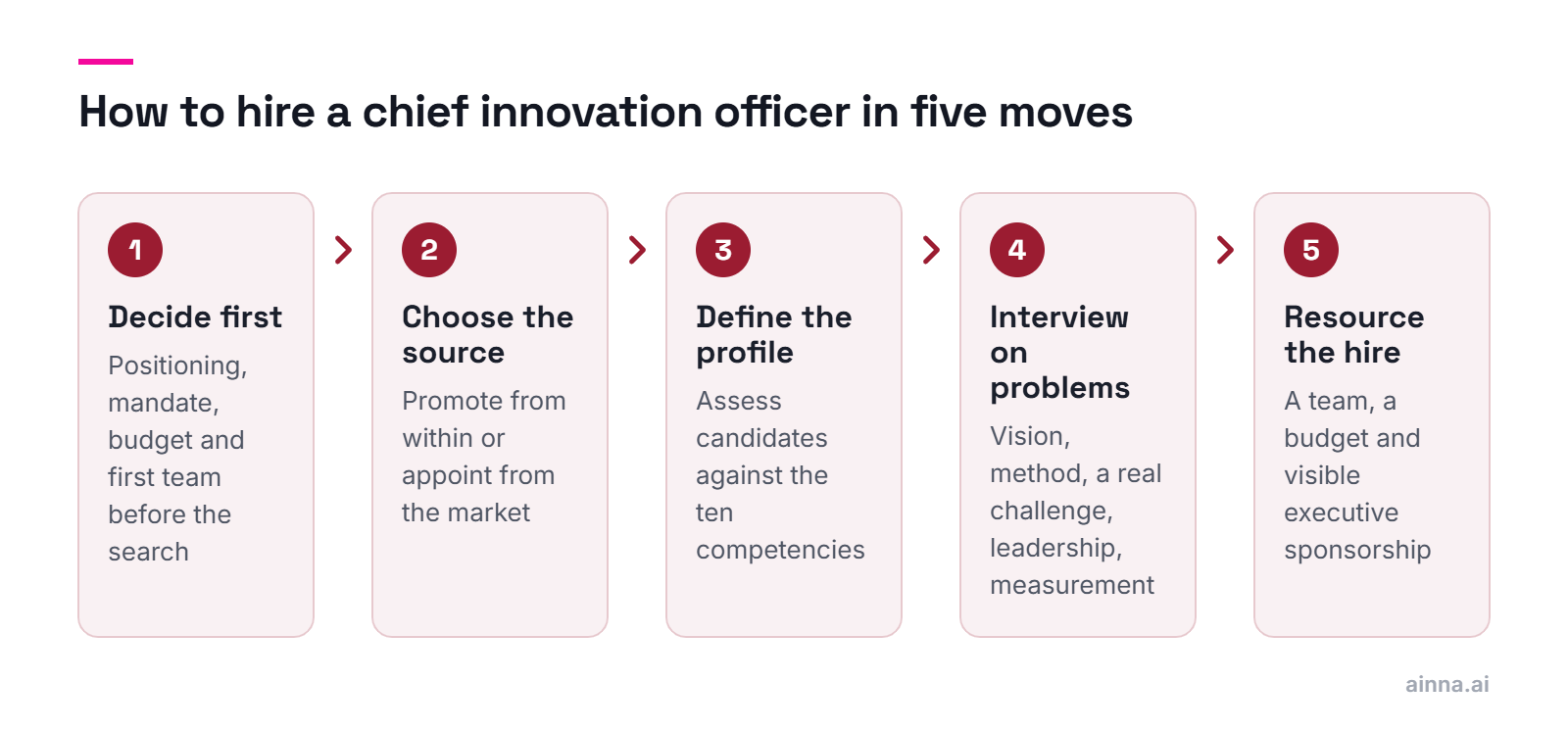
Five steps to hire a chief innovation officer: decide positioning, mandate and budget; choose internal or external; assess the ten competencies; interview on real problems; resource the hire.
A chief innovation officer appointed without a team, a budget and visible executive sponsorship is set up to fail, however strong the hire.
Inside Ainna Know which opportunities deserve the budget. The Judge, Ainna's AI evaluator, scores each opportunity across ten dimensions and shows its reasoning. Explore Ainna Enterprise

When is a company ready to hire a chief innovation officer? #

A company is ready when it has decided to make the whole organization more innovative, not just to run a few projects, and is prepared to give the role authority, resources and time. The CINO role is typically found in large enterprises facing industry disruption, or where innovation is acknowledged as critical and backed by significant investment. According to an Egon Zehnder study reported in Harvard Business Review, 29% of Fortune 500 companies had a senior innovation executive by 2017. The first test is internal: whether anyone at leadership level already has the skills to architect an innovation program.

  • The ambition is organization-wide: the purpose is a transformation program that empowers the organization to innovate at scale and pace, rather than a single lab or project
  • The skills are missing at the top: preparing an innovation program starts by checking whether leadership has a deep understanding of the innovation process and experience architecting innovation programs. If an experienced innovation leader already exists, the decision is straightforward; if not, you hire
  • The context demands it: industry disruption, or a strategy that depends on new products, services and business models, makes dedicated innovation leadership a priority rather than a side responsibility of another executive
  • Leadership will fund it: the program needs a budget approved by leadership and a mechanism for requesting additional funding as it grows. Without that commitment, a hire mostly signals intent
  • Leadership will be patient: innovation programs deliver results over long timeframes and are designed to embrace certain kinds of failure, and expectations of rapid transformation undermine them
  • The model fits the company: the right leadership design depends on industry, size, innovation objectives, strategy and innovation maturity, and a C-level CINO is one of several options
Key Takeaway

Hire a CINO when you are ready to change how the organization innovates and to resource that change. Hiring one to signal ambition, without the mandate or the budget, sets the role up to fail.

What should you decide before hiring a chief innovation officer? #

Decide where the role sits, what its mandate and scope are, how it is funded, whom the leader can hire and how success will be judged. These decisions shape the profile you need. A C-level innovation leader emphasizes strategic alignment and cultural transformation, while a VP or head of innovation focuses more on process optimization and portfolio management. As Harvard Business Review observes, the job's responsibilities vary a lot by company, business challenge and background, so a job description written before these choices describes nobody in particular.

  • Positioning: a CINO reporting to the CEO, or a VP or head of innovation reporting to another executive such as the CTO or chief strategy officer. The trade-offs of each model are compared in the chief innovation officer guide
  • Mandate: write it as enablement. In Innovation Mode 2.0 the mandate is to empower the organization to innovate at scale and pace, and the mission is 'to empower the company to thrive through the discovery and pursuit of new business opportunities'
  • Scope: agree whether the role goes beyond the core responsibilities, for example into organizational design for innovation, shaping and funding research and development programs and teams, or specific investments
  • Budget: secure funding in the budget cycle, set clear criteria for allocating it, and create a mechanism for flexible, just-in-time financing of promising initiatives
  • Team: decide the first hires the leader can make. A new program needs at least an innovation architect and a program manager working closely with the leader from the start
  • Expectations: agree with the C-suite how success will be judged and over what timeframe, before any candidate is asked to promise results
  • Sponsorship: a title given without a team, a budget and visible executive backing leaves even a strong leader with a platform and no means to act
Key Takeaway

Every one of these choices changes who the right candidate is. Make them first, and the scorecard and the job description follow from them.

Should you promote an internal leader or hire a chief innovation officer from outside? #

If the goal is to transform how the organization innovates, appoint from the market someone with strong experience in innovation methodologies, processes and frameworks. Promoting a successful leader from the core business is convenient and brings product, customer and market knowledge, internal networks and credibility. But innovating yourself and empowering others to innovate are fundamentally different missions: the first needs domain expertise, the second needs innovation methodology and leadership skills. In my experience, domain experts in senior innovation roles rarely have the holistic view needed to transform an organization.

  • Why promotion is tempting: the internal leader knows the company's products, customers and markets, has strong networks and credibility, and understands the organization's capabilities and constraints, which feels comfortable for everyone
  • Where it breaks: domain experts create value by generating ideas, inventing or leading implementations, but rarely know how to enable others to innovate faster and at scale
  • The narrow frame: without formal training in innovation methods, domain experts tend to frame innovation within their own sphere of knowledge and favor incremental improvements with an execution mindset over a diverse portfolio that includes more disruptive possibilities
  • What an external appointment adds: a leader who can bring the best innovation technologies, tools and knowledge together into one program, and fresh thinking from outside the industry or from cross-industry experience
  • How to cover the domain gap: put the right domain experts on the team under the innovation executive, so methodology leads and expertise supports
  • When promotion works: if an internal leader already has proven experience in innovation methodology and program architecture, promotion combines that with organizational knowledge. The test is the skill set, not where the candidate sits today
Key Takeaway

Choose the source by the mission. To produce innovation, promote expertise; to make the whole organization innovative, appoint mastery of innovation methodology and staff the domain knowledge around it.

What competencies should a chief innovation officer have? #

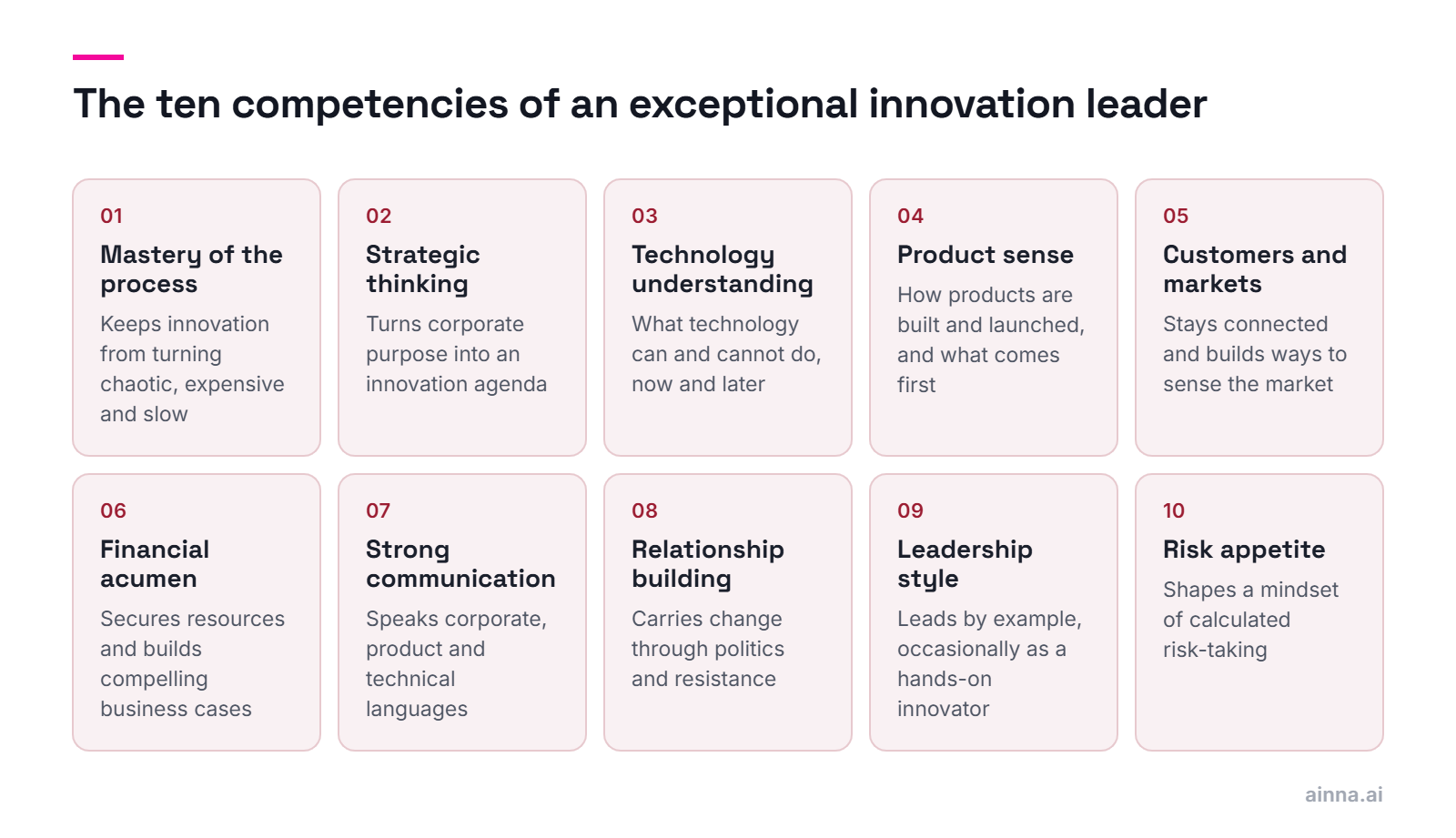
In Innovation Mode 2.0 I describe ten competencies that exceptional innovation leaders share, whether the role sits in the C-suite or at VP level: mastery of the innovation process, strategic thinking, a deep understanding of technology, superior product sense and prioritization, strong communication, relationship building and influencing, customer and market understanding, financial acumen, a special leadership style, and risk appetite. They must also be adaptive, ready to improve the innovation function itself. The points below cover the six business and method competencies; the people competencies follow in the next answer.

  • Mastery of the innovation process: corporate innovation can become chaotic, expensive and slow. The leader must know which processes, tech stack, templates and resources make sense for the organization, make the right interventions at the right time, and architect a powerful innovation function
  • Strategic thinking: the ability to translate the corporate purpose and objectives into focus areas or an innovation agenda, and to shape the initiatives, programs, roadmaps and projects that best support the strategy
  • Deep understanding of technology: knowing what current technologies can and cannot do, what is feasible now and what will become feasible within the company's innovation horizon. The leader need not be a hands-on technologist, but must be fluent enough to be pragmatic about limits
  • Superior product sense and prioritization: knowing how a product is conceived, designed, validated, built, launched and operated, and prioritizing through a balanced opportunity portfolio. Experience in actual product development, with a strong focus on product innovation, is a major success factor; see what product sense means
  • Customer and market understanding: staying connected with customers and users, and establishing mechanisms that sense the market, identify emerging needs and pain points, and turn market intelligence into innovation opportunities
  • Financial acumen: securing and allocating resources, understanding innovation economics, building compelling business cases, calculating potential ROI when it makes sense, and balancing short-term results with long-term innovation potential
Key Takeaway

These six describe someone who can architect an innovation function and tie it to the business. A candidate brilliant at one of them and weak on the rest will struggle to build the whole function.

A grid of ten innovation leader competencies: process mastery, strategic thinking, technology, product sense, customers and markets, financial acumen, communication, relationships, leadership style, risk appetite.
Six concern business and method, four concern people; add adaptiveness, the readiness to refine the innovation process as the company changes.

What leadership qualities make an innovation leader exceptional? #

Four of the ten competencies concern how the leader works with people: communication across corporate, product and technical audiences; relationship building and influencing that carries change through politics and resistance; a special leadership style of leading by example, occasionally as a hands-on innovator; and the risk appetite to shape a mindset of calculated risk-taking. Add adaptiveness, the readiness to refine the innovation process with data and experiments as the company changes, and probe two related strengths: change management and cross-functional reach. These qualities decide whether a sound plan survives contact with the organization.

  • Strong communication: the leader must speak 'corporate', 'product' and 'technical' languages, because they work with product, technology and commercial leaders, engineers, designers and the C-suite
  • Relationship building and influencing: innovation rarely happens in isolation, so the leader needs experience building relationships across the organization that help navigate politics, overcome resistance to change and form coalitions for innovation
  • Change management: look for candidates who have led organizational change in previous roles, overcoming resistance from stakeholders while aligning with the company culture and building consensus
  • Cross-functional reach: the leader is a connector across product development, research and development, marketing, IT and operations, bringing teams and divisions together under one innovation initiative
  • A special leadership style: leading by example, being hands-on and occasionally acting as an innovator. Seeing the leader take part in the process is one of the most inspiring experiences for teams and the community of innovators
  • Risk appetite: the ability to shape a different mindset about taking calculated risks and handling potential failures in the innovation context
  • Adaptiveness: the cultural, financial and operational state of a company changes over time, so the leader must be ready to innovate the innovation function itself, following a data-driven, experimentation approach
Key Takeaway

Methodology tells you what the program should be. These qualities decide whether the organization follows the person running it.

What experience should a chief innovation officer candidate have? #

Look for a track record of innovation that led to measurable business outcomes, experience designing and running innovation programs, hands-on product development, work across functions and geographies, and an entrepreneurial mindset from a startup or from intrapreneurship inside a larger company. Seniority and a creative reputation are not substitutes. The candidate should be able to show how their work connected to strategy and delivered value, whether as outcomes for users, revenue growth, market share or operational efficiency.

  • A track record of innovation: launching new products, implementing breakthrough processes or driving digital transformation initiatives that led to measurable business outcomes
  • Innovation program experience: strong experience with innovation methodologies, processes and frameworks, ideally having designed and led an innovation program rather than only contributing ideas to one
  • Product development: real experience conceiving, building and launching products, with a strong focus on product innovation
  • Cross-functional and global experience: leaders who have worked across functions and geographies bring different perspectives and are better equipped to scale innovation across teams and business units
  • An entrepreneurial mindset: experience in a startup, or as an intrapreneur inside a larger company, often brings the agility and creative problem solving that disruptive innovation needs
  • Leading change: evidence of managing organizational resistance and delivering change initiatives, since innovation often requires significant change inside the organization
  • Industry experience: useful, and in some sectors important, but not critical, as the next answer explains
Key Takeaway

Ask for evidence, not adjectives. Every claimed success should come with the strategy it served, the resistance it met and the outcome it delivered.

Does a chief innovation officer need industry experience? #

Not necessarily. Industry experience can matter, especially in highly regulated sectors such as healthcare, financial services or energy, where the leader must understand compliance and regulation while driving innovation. But the belief that an innovation leader must be a domain expert is a common misconception. A deep understanding of the domain is essential; extensive expertise in it is far less important than profound skills in innovation program architecture and leadership. A skilled leader from another industry can bring a fresh view and cross-industry insight, and domain gaps can be covered by experts on the team.

  • When it matters most: in highly regulated industries, a leader who already understands the complexities of compliance and regulation can drive innovation within them
  • Understanding versus expertise: the leader must understand the business deeply, including its products, customers and constraints, but does not need to have spent a career in it
  • Why an outsider can be an advantage: provided the other competencies are in place, a leader without industry expertise brings a different way of thinking and cross-industry insight into the innovation process, strategy and roadmap
  • The risk of hiring for domain alone: domain experts without training in innovation methods tend to frame innovation narrowly and favor incremental improvements
  • How to cover the gap: bring domain experts into the innovation team under the leader, and expect the leader to partner closely with the business leaders who own those markets
  • What to test in the interview: ask how the candidate would build an understanding of your business. A strong answer includes a structured assessment, with surveys and interviews across the hierarchy, not only briefings from the executive team
Key Takeaway

Treat industry experience as a requirement only where regulation makes it one. Domain knowledge can be added through the team after the hire; innovation methodology and leadership cannot.

Did you know? Every conversation in Ainna follows the Innovation Mode methodology, first published by Springer in 2020, updated in Innovation Mode 2.0 (2026), and applied in the innovation centers its author designed or optimized. See the methodology in action

How should you structure a chief innovation officer interview? #

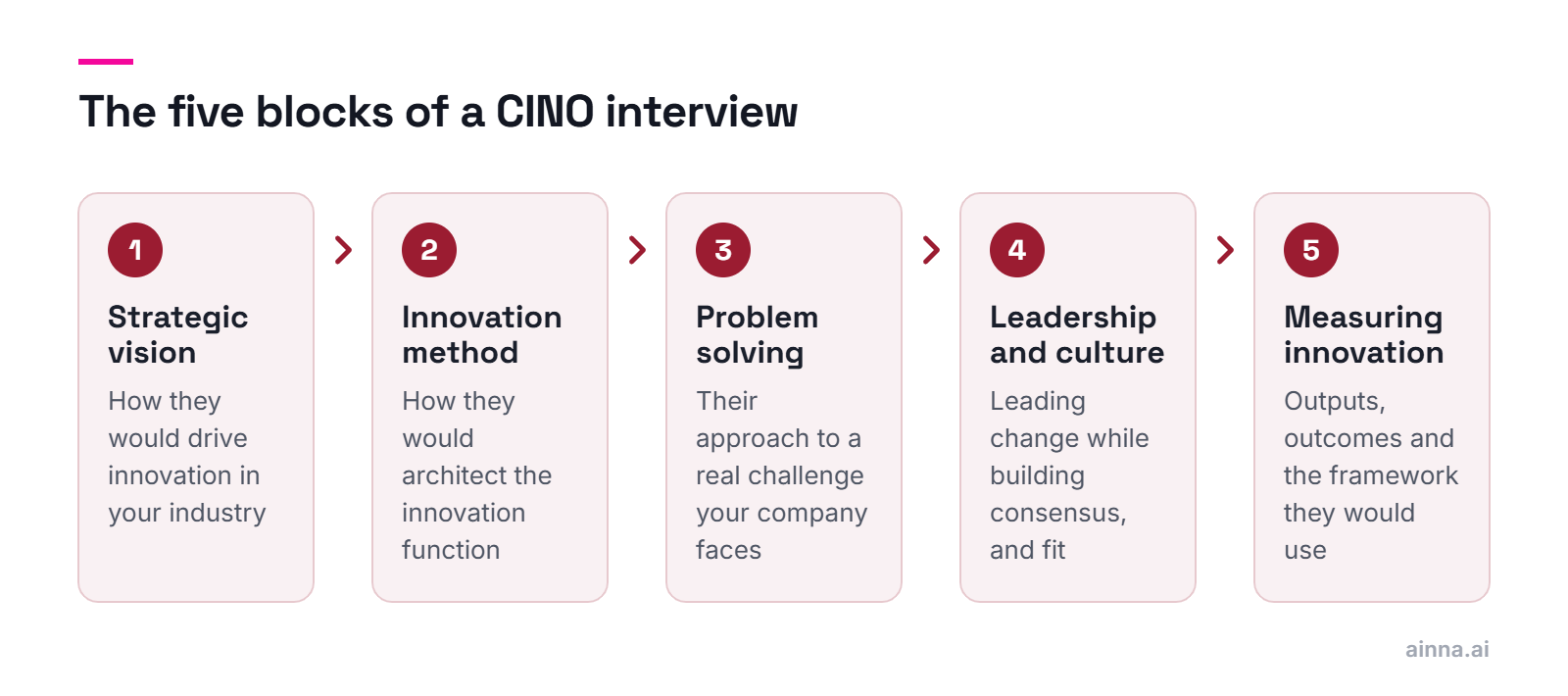
Structure the interview around five blocks, each tied to the scorecard: strategic vision, innovation method, problem solving on a real challenge, leadership style and culture fit, and measuring innovation. Ask candidates how they would drive innovation in your industry, then give them a real problem your company faces and watch how they approach it. Close with how they define and measure innovation success. The interview should reveal whether the candidate can enable the organization to innovate, not only whether they have good ideas.

  • Strategic vision: ask how they would drive innovation in your industry, including strategy, methods and tools, and how they aligned past initiatives with corporate strategy. Strong answers show an understanding of your business environment and of the role innovation plays in long-term success
  • Innovation method: ask how they would architect the innovation function, from spotting and framing opportunities to validating them and bringing them to market. This tests the competency a transformation mandate depends on
  • Problem solving: present a real-world challenge where innovation could help, and ask how they would approach it and which techniques and frameworks they would apply. Judge critical thinking, how they navigate complexity, and whether they end with a practical, actionable plan
  • Leadership style and culture fit: probe whether they can lead change while building consensus, and how their style fits your culture and the organization's dynamics
  • Measuring innovation: ask how they define innovation outputs and outcomes, which framework they would use to measure performance, and where quantifying innovation gets hard
  • Who takes part: a CINO must work closely with the rest of the C-suite and with many departments, so those leaders should see the candidate in these blocks, not only the CEO and HR
  • Final selection: choose the candidate who balances strategic vision, technical understanding and strong leadership, and who aligns with your culture and long-term strategic goals
Key Takeaway

Use your own strategy and problems as the interview material. Generic questions get rehearsed answers; your real challenges show how the candidate actually works.

Five interview blocks for a chief innovation officer: strategic vision, innovation method, problem solving on a real challenge, leadership style and culture fit, and measuring innovation.
Tie each block to the scorecard, and involve the C-suite and department leaders the new CINO will work with.

What interview questions test a chief innovation officer's strategy and method? #

Ask questions that make candidates apply their method to your company, and listen for specifics. Cover how they would drive innovation in your industry, how they have aligned innovation with strategy, how they would architect the innovation function, how they would approach one of your real challenges, which technologies matter within your innovation horizon, how they prioritize competing opportunities, and how they stay connected to customers. Each question below comes with what a strong answer contains, drawn from the competencies and responsibilities of the role.

  • 'How would you drive innovation in our industry?' A strong answer names a strategy, methods and tools, shows an understanding of your business environment, and explains where innovation fits in your long-term success
  • 'Tell us about a time you aligned innovation with corporate strategy. What got in the way?' A strong answer shows the translation from corporate purpose and objectives into focus areas and problems worth solving, and describes real obstacles and how they were handled
  • 'How would you architect our innovation function?' A strong answer starts by assessing the current setup, then covers how the organization will spot, frame and validate opportunities, how validated opportunities reach the market, and how adoption will be driven
  • 'Here is a challenge we face. How would you approach it?' A strong answer sets out a problem-solving process, applies suitable innovation techniques and frameworks, and ends with a practical, actionable plan rather than a list of ideas
  • 'Which technologies matter for us within our innovation horizon, and what are their limits?' A strong answer separates what is feasible now from what will become feasible later, and is explicit about limitations
  • 'Several opportunities compete for the same budget. How do you decide?' A strong answer uses a balanced opportunity portfolio tied to purpose and strategy, builds business cases, calculates ROI where it makes sense, and balances short-term results with long-term potential
  • 'How do you stay connected to customers and the market?' A strong answer describes mechanisms that sense the market and surface emerging needs and pain points, and shows how that intelligence became innovation opportunities
Key Takeaway

Weak answers stay general: frameworks named but never applied, ideas without a plan, technology without limits. Strong answers sound like someone already working on your problems.

What interview questions reveal a chief innovation officer's leadership style? #

Ask about change they led, how they communicate across audiences, how they take part in innovation themselves, how they handled failure, how they would open innovation to the whole organization, how they have improved an innovation process and which partners they would bring in. These questions test the people competencies and whether the candidate can lead change while building consensus. Listen for named situations, stakeholders and consequences. A candidate who describes innovation as something they did alone, rather than something they enabled others to do, is describing a different job.

  • 'Tell us about a change you led that met strong resistance.' A strong answer names the stakeholders, explains how resistance was overcome, and shows the coalitions built and the consensus reached while the change still happened
  • 'Explain one opportunity to our CFO, then to our engineers, then to our designers.' A strong answer switches convincingly between corporate, product and technical language
  • 'When did you last take part in an innovation activity as a participant?' A strong answer gives hands-on examples of leading by example, not only of sponsoring events
  • 'Describe an innovation bet that failed. What happened next?' A strong answer shows a calculated risk, a clear decision to stop or change course, and how the learning was used, which is the mindset the leader must spread
  • 'How would you make sure innovation is not seen as your team's job alone?' A strong answer is about enabling others: a shared innovation language, common frameworks and tools, and innovation champions inside functional teams
  • 'Tell us about an innovation process you changed because it was not working.' A strong answer uses data and experiments to refine the process, showing a leader who will innovate the innovation function itself
  • 'Which external partners would you bring in, and why?' A strong answer connects startups, academic institutions, industry organizations or innovation hubs to specific strategic needs, through open innovation and co-creation
Key Takeaway

Leadership questions are where rehearsed answers show. Ask for the next level of detail every time: who objected, what changed and what the leader did personally.

How do you assess a candidate's approach to measuring innovation? #

Ask the candidate to define innovation outputs and outcomes, describe the measurement framework they would introduce, and explain where quantifying innovation gets difficult. A strong candidate treats measurement as a system for steering and improving the innovation function, not a single return figure. They cover the ability to discover, validate and realize opportunities, cultural change and the adoption of innovation capabilities, and business impact such as revenue growth, operational efficiency or market impact. They also explain how they would set realistic expectations with the C-suite.

  • Outputs versus outcomes: the candidate distinguishes what the innovation function produces from the business results it contributes to, and has a history of delivering results against clear metrics
  • Coverage of the whole function: a strong framework includes KPIs for the ability to discover, validate and realize opportunities, plus goals and milestones such as a shift in the culture of innovation. For ventures specifically, see measuring corporate venture building
  • Leading indicators: they track progress, engagement and the adoption of innovation capabilities, because wide adoption is a leading indicator that the program is working
  • Honesty about limits: they can name the challenges of quantifying innovation, such as long timeframes and the need to embrace certain kinds of failure, and they calculate ROI where it makes sense rather than everywhere
  • Managing expectations: they plan to use measurement to communicate the 'State of innovation', educate the C-suite on the right success metrics and set meaningful expectations
  • Measurement as steering: they use data from each iteration to improve the program, which keeps the innovation function healthy as the company changes
  • Warning signs: measuring only revenue, which judges long-horizon work too early, or only activity, which rewards busy programs with little result; see why corporate innovation fails
Key Takeaway

A CINO judged on inadequate or incomplete metrics is pushed toward the wrong work. Hire the candidate who can explain the right metrics to your board.

What should a chief innovation officer hiring scorecard include? #

Build the scorecard from the ten competencies and the interview blocks, grouped into seven criteria: innovation method and program architecture; strategy and focus; technology and product; customers, markets and finance; influence and change; leadership style, culture fit and risk appetite; and measurement and adaptiveness. For each criterion, write down the evidence that counts before interviews begin. Weight the criteria to the mandate: a C-level role emphasizes strategic alignment and cultural transformation, while a VP-level role emphasizes process optimization and portfolio management.

  • Innovation method and program architecture: evidence of having designed and run an innovation function or program, and of knowing which processes, tools and interventions fit which situation
  • Strategy and focus: evidence of translating corporate purpose and objectives into an innovation agenda of focus areas and problems worth solving, and of keeping initiatives connected to business reality
  • Technology and product: a realistic view of what technologies can and cannot do within the innovation horizon, hands-on product development experience, and a record of prioritizing a balanced opportunity portfolio
  • Customers, markets and finance: mechanisms they have built to sense customer needs, business cases they have made, and budgets they have secured and allocated
  • Influence and change: fluency in corporate, product and technical language, coalitions built across organizational politics, and change delivered against resistance
  • Leadership style, culture fit and risk appetite: personal, hands-on participation in innovation, calculated risks taken, failures handled as learning, and alignment with your culture and long-term strategic goals
  • Measurement and adaptiveness: a measurement framework that covers discovery, validation, realization and culture, and examples of improving an innovation process using data
Key Takeaway

Agree the evidence for each criterion before the first interview. A scorecard written after meeting a favorite candidate describes the candidate, not the role.

What should a chief innovation officer job description include? #

A chief innovation officer job description should state the mission, the reporting line and scope, the accountabilities and the requirements. Take the accountabilities from the core responsibilities of the role: enabling innovation, setting its focus, building opportunity discovery and implementation capabilities, fostering the culture, measuring performance, connecting internally and externally, and providing talent and resources. Take the requirements from the ten competencies. Avoid describing the role as the company's chief source of ideas; the job is to empower the organization to innovate.

  • Mission: for example, to empower the company to thrive through the discovery and pursuit of new business opportunities, with a mandate to help the organization innovate at scale and pace
  • Reporting line and scope: whom the role reports to, and any responsibilities beyond the core, such as organizational design for innovation, shaping and funding research and development programs, or specific investments
  • Build and focus the function: architect the innovation function and its technologies, platforms, processes, programs and workshops, and translate strategic directives into an innovation agenda of focus areas and problems worth solving
  • Discover and deliver opportunities: establish an end-to-end process to identify and validate opportunities, manage a balanced opportunity portfolio, and set up the teams, systems and processes that bring opportunities to market and drive adoption
  • Culture, talent and resources: foster a culture of innovation and address cultural blockers; identify, develop and hire innovation talent and champions; secure funding and set clear criteria for allocating it
  • Connect and measure: unite teams under shared innovation frameworks, methods and tools, build partnerships with startups, academic institutions, industry organizations and innovation hubs, and run a measurement system that reports the state of innovation
  • Requirements: the ten competencies, a track record of innovation with measurable outcomes, experience leading organizational change, and experience with innovation methodologies and program design
Key Takeaway

Write the job description after the decisions on mandate and positioning, not before. Strong candidates read it as a signal of whether the company understands the role.

Many organizations evaluate long-term innovation using short-term KPIs, while others rely on vanity metrics of innovation activity, such as the number of ideas generated, patents filed, and workshops conducted.

What are the red flags when hiring a chief innovation officer? #

The main red flags are creativity without strategy, weak change management and an overemphasis on technology. Watch also for candidates who see themselves as the company's chief inventor rather than the enabler of everyone else, who frame innovation narrowly within their own domain, who cannot explain how to measure innovation or where measurement gets hard, and who promise rapid transformation. Each signals a leader likely to produce activity, friction or disappointment rather than a lasting innovation capability.

  • Lack of strategic focus: creativity with no clear connection to business strategy or the organizational purpose, which leads to projects that fail to deliver long-term value, or any value
  • Weak change management: no track record of handling organizational resistance or leading successful change, so the candidate's ideas stall once they meet the organization
  • Overemphasis on technology: a focus on technology without considering people, culture, processes and market dynamics, which keeps innovation from being integrated into the company's broader strategy
  • The chief inventor: a candidate who wants to produce the innovation personally rather than empower the organization to do it, a frequent misconception about the role
  • A narrow frame: every example comes from one domain and every proposal is an incremental improvement, with no sign of a diverse opportunity portfolio
  • No view on measurement: no framework for innovation outputs and outcomes, or no awareness of how hard innovation performance is to quantify
  • Promises of quick transformation: innovation programs deliver over long timeframes, and a candidate who promises rapid results is setting the unrealistic expectations that undermine them
Key Takeaway

Most red flags describe a strong individual contributor applying for a systems job. Admire the ideas, then hire for the ability to build the system.

What mistakes do companies make when hiring an innovation leader? #

Many hiring mistakes come from misunderstanding the role. Companies hire an idea generator, a technical inventor or a symbolic motivator when they need someone to build a capability. They promote the most successful domain expert into a transformation mandate. They hire before deciding positioning, mandate and budget. And they appoint a leader without a team, resources or realistic expectations, then judge them with metrics that miss much of what the innovation function does. Each mistake can be avoided before the offer is signed.

  • Hiring for a misconception: treating the role as idea generation, technical invention or motivation, or valuing creativity over methodical execution and the ability to drive innovations to market
  • Promoting expertise into a transformation job: domain experts can innovate, but empowering an organization to innovate calls for innovation methodology and leadership skills
  • Hiring before deciding: the responsibilities play out differently depending on innovation maturity, industry and position in the hierarchy, so an undefined role attracts candidates for the wrong version of it
  • A title without a team: the leader needs a core team, a budget and visible executive sponsorship to act. A C-level title with none of these gives the organization an announcement, not a capability
  • Unrealistic expectations: expecting rapid transformation from programs that by design deliver results over long timeframes and embrace certain kinds of failure
  • The wrong metrics: judging the new leader on inadequate or incomplete metrics that fail to capture the whole innovation function and the opportunity discovery process
  • Ignoring fit: selecting on skills alone, without checking alignment with the company culture and long-term strategic goals. The wider reasons innovation leaders struggle once in the role are covered in the chief innovation officer guide
Key Takeaway

An excellent hire can still fail in a role the company has not prepared. Fix the role, the resources and the expectations before blaming the person.

Inside Ainna One method for every opportunity your company pursues. Ainna Enterprise frames, assesses and documents every opportunity the same way, so leaders compare like with like. See Ainna for enterprise

What should a new chief innovation officer do first? #

A new innovation leader's first job is to frame the innovation program, not to launch initiatives. In Innovation Mode 2.0 the essential early steps are to set up a small, motivated, cross-disciplinary core innovation team; run a preliminary assessment of the current innovation setup against an ideal innovation architecture; articulate the innovation vision with corporate executives; and draft a roadmap while identifying the additional skills the team needs. The findings come together in an Innovation Masterplan that aligns leadership on direction.

  • Set up the core team: perhaps the most important early job. Start with an innovation architect and a program manager working closely with the leader, and expect the team to grow fast as the program takes shape
  • Run a preliminary assessment: surveys and interviews with key people across the hierarchy reveal how innovation is perceived, what needs to change and what people expect, producing a gap analysis of capabilities, resources, skills and talent
  • Surface the hidden problems: the assessment typically uncovers cultural blockers, capability gaps and areas for improvement the company may not know it has, and ends in a report that states its innovation maturity level
  • Articulate the vision: work with corporate executives to frame an innovation vision aligned with the organizational purpose and strategy, define innovation in the company's context and agree what success looks like
  • Draft the roadmap and expand the team: use the assessment to draft a high-level plan and roadmap, and identify the additional key skills the team needs
  • Compile the Innovation Masterplan: the living document that frames the whole program and drives alignment among leaders, described in the next answer
  • What the CEO should provide: access to key people across the hierarchy for the assessment, and leadership time to articulate the innovation ambition and interpret the first findings
Key Takeaway

Judge the new leader's early work by the quality of the diagnosis and the plan, not by the number of events launched.

What is an Innovation Masterplan, and what should it contain? #

The Innovation Masterplan is the foundational, living document of an innovation transformation program. The innovation program director, usually the new innovation leader, compiles it from the preliminary assessment and uses it to align leaders on the program's direction. It frames objectives, scope of work, leadership model, projects, workshops and communication plans, along with activities, timelines, milestones and ways to track progress and measure success. At any point it reflects the strategy, goals and current state of innovation. For the executive who made the hire, it is also the first concrete evidence of how the new leader thinks.

  • Vision and goals: the program's objectives, how they align with the organizational purpose and strategy, and the timing, aspirations and strategic importance of the program
  • Innovation agenda: the organization's mid- and long-term innovation focus, expressed as strategic problems worth solving as prioritized by leadership
  • Current state of innovation: where the company stands on the Innovation Maturity Index, the evidence behind that rating, previous innovation attempts, known issues, blockers and areas for improvement
  • Innovation team structure: the initial team with clearly defined roles, responsibilities, target headcounts and hiring plans
  • Budget: initial estimates for hiring, capabilities such as innovation management software, educational programs and events, approved by leadership with a mechanism for requesting additional funding
  • Success criteria: high-level goals and milestones, such as a shift in the culture of innovation, plus measurable KPIs that reflect the ability to discover, validate and realize opportunities
  • Stakeholder map: a 'relationship navigator' of the people and groups who influence or benefit from the program, such as executive sponsors, product leaders, innovation champions and domain experts
Key Takeaway

Ask to see the Masterplan early and review it with the leadership team. Agreement on this document is what turns a new appointment into a sponsored program.

How should a new chief innovation officer build the innovation team? #

Select the core innovation team carefully, for talent and for the willingness to lead a complex cultural and technological transformation, because its composition shapes the program's velocity, credibility and cultural influence. Balance internal candidates, who bring organizational knowledge and relationships, with external hires, who bring fresh perspectives from other industries and geographies. Use carefully selected consultants for specific roles early on or to fill expertise gaps, but build the core from permanent professionals whose compensation is aligned with organizational outcomes, so innovation becomes a core capability rather than a temporary initiative.

  • Select for commitment as well as talent: the core team is the inner force of the whole program, so members must be willing to lead a demanding transformation, not only be skilled
  • Decide the engagement model deliberately: permanent hires, consultants or a hybrid affect team dynamics, short-term results and long-term innovation performance, so weigh timing and organizational readiness
  • Balance internal and external hiring: internal people bring organizational knowledge and established relationships; external talent brings perspectives from diverse industries and geographies that challenge conventional thinking
  • Build the core from permanent staff: long-term employment with generous compensation aligned with organizational outcomes creates continuity, accumulates knowledge and brings a level of commitment that is difficult to replicate through consulting
  • Use consultants strategically: well-chosen consultants and advisors with the right expertise and cultural fit can support some roles early in the program, cover expertise gaps and add capacity during intensive transformation
  • Start small, grow fast: an innovation architect and a program manager are the starting point. The full core and extended team, and how it is structured, are described in the chief innovation officer guide
  • Look beyond the team: the leader also helps functional leaders identify and develop innovation champions in their own teams, and can reach global talent through contractors or vendors
Key Takeaway

The CINO is only the first hire. The team around them decides whether innovation becomes a capability the company keeps.

How does AI change what to look for in a chief innovation officer? #

AI raises the bar on the technology competency without changing the core of the role. The leader still enables the organization to innovate, and now also needs a pragmatic grasp of what AI can and cannot do, what is feasible now and what will be feasible within the innovation horizon. The job includes selecting AI-powered capabilities for ideation, opportunity identification and market intelligence, and driving their adoption. The red flag of overemphasizing technology matters even more, because people, culture and process still decide whether innovation happens.

  • Fluency with limits: AI and machine learning belong in the candidate's technical fluency, including the ability to judge potential realistically and name the limitations
  • Provisioning, not building: the innovation team selects capabilities such as AI-powered systems that support ideation and opportunity identification, and market intelligence tools, then drives their adoption; see the innovation tech stack guide
  • One method across the team: unified frameworks, methods and tools make it easier for teams to exchange information and compare opportunities, and platforms such as Ainna apply one method to frame and assess every opportunity
  • Judgment on where AI earns investment: ask how the candidate would decide which AI initiatives to fund. A strong answer starts from strategic problems worth solving rather than from the technology
  • People still decide: a candidate who talks only about AI tools, without people, culture, processes and market dynamics, shows the overemphasis on technology that keeps innovation apart from strategy
  • Adaptiveness matters more: as tools change, the leader must keep refining the innovation process with data and experiments, innovating the innovation function itself
  • Roles are shifting: how AI changes innovation roles, and how leaders should respond, is covered in how innovation leaders should adapt to AI
Key Takeaway

Hire an innovation leader who is fluent in AI and unimpressed by hype. The job is still to build a capability people use, now with more powerful tools.

Inside Ainna

One method for every opportunity in your portfolio

Ainna Enterprise applies the Innovation Mode methodology across your innovation team: every idea framed the same way, scored against the same criteria and documented as an investment case, so decisions compare like with like.

Ideas in โ†’
Opportunities out.