What is startup idea validation?

Startup idea validation is the systematic process of testing whether a business idea is worth building before committing significant resources to development. It answers three questions in sequence: Is the problem real and painful enough? Does your proposed solution effectively address it? Is there sufficient demand to sustain a business? In the Innovation Mode methodology, idea validation is formalized as two interconnected capabilities: Opportunity Discovery (identifying high-potential concepts through structured assessment) and Opportunity Validation (testing the riskiest assumptions with real-world evidence through business experimentation).

  • The cost of skipping validation is catastrophic: research consistently shows that 'building something nobody wants' is the number one cause of startup failure - ahead of running out of money, team problems, or competitive pressure. Validation exists to prevent this
  • In the Innovation Mode framework, validation maps to the first two layers of the Three-Layer PMF Journey: Problem-Market Fit (does a real, painful problem exist for a large enough audience?) and Solution-Market Fit (does your proposed approach effectively address that problem?). Only after both are confirmed should you commit to building a full MVP
  • Validation is not a single event - it's a process that progressively reduces uncertainty. You start with the cheapest, fastest tests (conversations, desk research) and escalate to more expensive ones (prototypes, experiments) only when earlier signals are positive
  • What validation is not: it's not asking friends if your idea sounds good (confirmation bias), running a survey with leading questions (demand bias), or building a landing page and counting signups without understanding intent (vanity metrics)
  • The Innovation Mode approach emphasizes that validation should be ongoing - even after the product launches. Ideas may originate from many sources - corporate hackathons, customer feedback, market shifts, or individual inspiration. Regardless of origin, every idea deserves the same rigorous validation before resources are committed
  • Effective validation saves not just money but time - the most irreplaceable resource for a startup. Spending two weeks validating can prevent six months of building the wrong thing
Key Takeaway

Every hour spent on validation before building is an hour that compounds. You either confirm you're on the right path (and build with confidence) or discover you're not (and redirect before wasting resources). The founders who validate rigorously don't move slower - they move faster because they spend less time building things nobody wants. Ainna for Founders can help you start the validation process in 60 seconds.

What is the difference between idea validation, market research, and customer discovery?

These are related but distinct activities, and confusing them leads to false confidence. Market research tells you about the landscape. Customer discovery tells you about the people. Idea validation tells you whether your specific idea is worth building. In the Innovation Mode methodology, all three feed into the Opportunity Discovery process, but validation is the decisive step that produces a go/no-go recommendation backed by evidence.

  • Market research: understanding the landscape - market size (TAM/SAM/SOM), trends, competitive dynamics, regulatory environment. It tells you whether an attractive market exists, but not whether your specific idea will work within it
  • Customer discovery: understanding the people - their problems, workflows, pain points, willingness to pay, and existing workarounds. Use The Problem Framing Template to structure this systematically. It tells you whether a real problem exists, but not whether your solution is the right one
  • Idea validation: testing whether your specific concept solves the identified problem well enough that people will adopt, pay for, and retain it. This is where the Innovation Mode Nine-Dimension Idea Assessment Model and Business Experiment Framing Template apply
  • The sequence matters: market research first (is the market attractive?), then customer discovery (is the problem real?), then idea validation (is our solution viable?). Skipping steps creates blind spots. Doing them out of order wastes effort
  • A common failure pattern: founders do extensive market research, confirm a large TAM, and proceed to build - without ever validating that their specific solution resonates with target users. Market opportunity does not equal product opportunity
  • In the Innovation Mode framework, all three activities are orchestrated through the Opportunity Discovery capability, which maintains a continuous pipeline of ideas flowing through assessment, feedback, and discovery
Key Takeaway

Think of it as three concentric circles: market research asks 'Is there a market?', customer discovery asks 'Is there a problem worth solving?', and idea validation asks 'Is our idea the right solution?' You need all three, in that order. See our Product Discovery guide for a deeper framework on the discovery process.

When in the startup journey should I validate my idea?

Before you write a line of code, before you hire a team, and before you spend money on anything other than learning. The Innovation Mode methodology positions validation as a prerequisite to building - not a parallel activity. The Three Essential Innovation Capabilities run in sequence: Opportunity Discovery identifies and assesses the idea, Opportunity Validation tests it with real-world evidence, and only then does Opportunity Realization (the Venture Studio) begin building the MVP.

  • The cost of validation increases at every stage: a conversation costs an hour, a survey costs a day, a prototype costs a week, an MVP costs months. Validate the cheapest assumptions first, and only escalate when earlier signals are positive
  • Validate in layers: first validate the problem (do people actually have this pain?), then validate the solution concept (does our approach resonate?), then validate demand (will people pay/adopt?). This maps directly to the Three-Layer PMF Journey
  • Many founders make the mistake of 'validating while building' - writing code and talking to users simultaneously. This creates confirmation bias: you hear what you want to hear because you've already committed to a direction. Validate first, then build
  • There is a point where validation becomes procrastination. If you've confirmed the problem is real, the solution resonates, and demand signals are positive, it's time to build. As Innovation Mode 2.0 states, 'the real risk is releasing a non-viable first instance too late'
  • For AI startup ideas, validation has an additional layer: can the technology actually deliver the promised quality? This must be tested before building the full product - see our AI PRD guide on eval-driven validation
  • Re-validate when conditions change: a pivot, a new competitor entering the market, a technology shift, or a change in your target user segment all warrant returning to validation
Key Takeaway

The right time to validate is always 'before you build.' The wrong time is 'after you've spent six months and your savings building something based on assumptions.' Validation is not a phase you complete - it's a discipline you practice throughout the startup innovation journey.

How do I validate that the problem I'm solving is real?

Most startup ideas begin with a solution. Successful validation begins with the problem. If the problem isn't real, frequent, and painful enough that people actively seek solutions, no amount of brilliant engineering will save your product. In the Innovation Mode methodology, problem validation uses The Problem Framing Template to structure the investigation: who is affected, what the current state is, what the ideal state looks like, and how frequently the problem occurs.

  • The Problem Framing Template from The Innovation Mode asks four essential questions: (1) Who experiences this problem? (2) What is their current state - how do they cope today? (3) What would the ideal state look like? (4) How frequently and intensely do they experience this pain? The gap between current state and ideal state is your opportunity
  • Talk to potential users - but structure the conversations to avoid bias. Ask about their current workflow, their frustrations, and how they solve the problem today. Do not describe your solution and ask if they'd use it - that's concept testing, not problem validation
  • Look for existing workarounds: if people have cobbled together spreadsheets, manual processes, or hacks to address the problem, that's strong evidence the pain is real. If nobody is doing anything about the problem, either the pain isn't severe enough or you haven't found the right audience
  • Quantify the problem using market sizing: how many people or organizations experience this problem? How much are they spending on current solutions or workarounds? What's the cost of the problem remaining unsolved?
  • Beware of 'nice to solve' vs 'must solve' problems. People will tell you a problem exists and agree your idea sounds interesting. That's politeness, not validation. The test is whether they're actively spending time, money, or effort trying to solve it today
  • In the Innovation Mode Nine-Dimension Idea Assessment Model, the first two dimensions address this directly: 'Importance of the problem' (how significant is it universally?) and 'Strategic alignment' (how relevant is it to your market focus?). Both must score high before proceeding
Key Takeaway

Problem validation is the cheapest, fastest validation you can do - and the most consequential. Spend a week here before spending months on anything else. If the problem isn't validated, everything downstream is built on sand.

Why is validating the problem more important than validating the solution?

Because you can always change the solution, but you can't change the problem. If you've validated that a real, painful, widespread problem exists, you have multiple chances to find the right solution through iteration. If you've validated a solution to a problem that doesn't exist, no amount of iteration will help. In the Innovation Mode Three-Layer PMF Journey, Problem-Market Fit (Layer 1) must be established before Solution-Market Fit (Layer 2) becomes meaningful.

  • Many of the most successful companies pivoted their solution multiple times while staying focused on the same validated problem. Slack started as a gaming company but kept solving the team communication problem. Instagram started as a location check-in app but kept solving the photo-sharing problem
  • Solution validation without problem validation creates a dangerous trap: you build something elegant that nobody needs. The technical team falls in love with the architecture, the designer falls in love with the UX, and nobody asks whether the underlying problem is worth solving
  • In the Innovation Mode Idea Assessment Model, effectiveness (how well does the solution address the problem?) cannot be meaningfully scored unless the problem itself has been validated. A solution that perfectly addresses an unimportant problem scores high on effectiveness but low on importance - and the overall Opportunity Score reflects this imbalance
  • Problem validation is also faster and cheaper: you can validate a problem through 10-15 structured interviews in a week. Solution validation requires at minimum a concept description, often a prototype, and frequently a design sprint
  • The Innovation Mode approach keeps problems and solutions decoupled. As Innovation Mode 2.0 emphasizes, 'a properly framed idea uses simple, non-technical language and is technology agnostic' - separating the problem from implementation details preserves adaptability
  • The practical test: can you describe the problem without mentioning your solution? If you can, and the problem statement alone makes listeners nod in recognition, you likely have Problem-Market Fit
Key Takeaway

Fall in love with the problem, not the solution. The problem is your anchor; the solution is your hypothesis. Validated problems are permanent assets. Unvalidated solutions are expensive experiments.

What is the Nine-Dimension Idea Assessment Model?

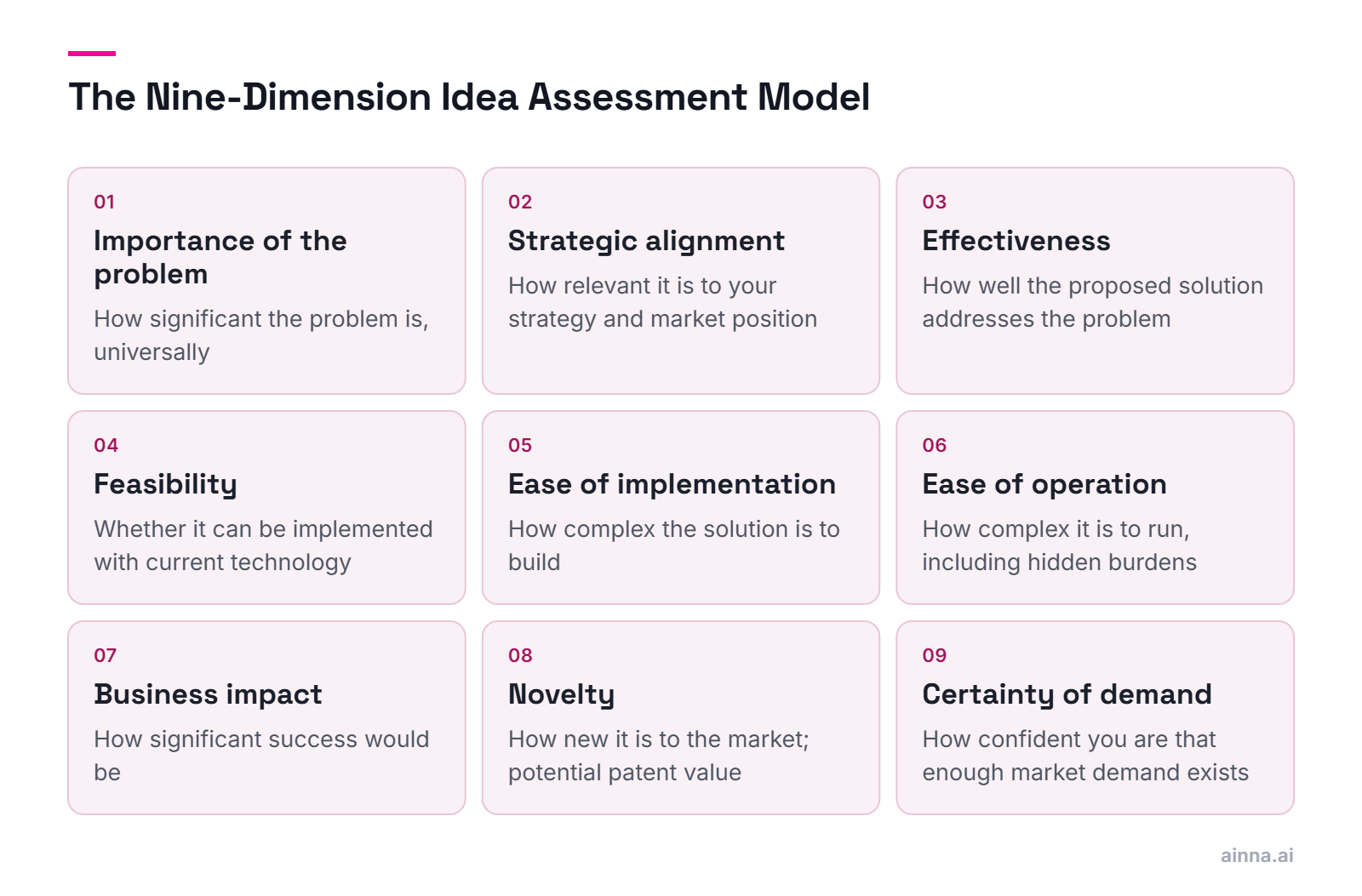
The Nine-Dimension Idea Assessment Model is the Innovation Mode framework for evaluating the potential of a business idea systematically. Described in Innovation Mode 2.0 (Chapter 6.2), it scores an idea across nine weighted dimensions to produce a single Opportunity Score that reflects its business potential. The nine dimensions are: importance of the problem, strategic alignment, effectiveness of the solution, feasibility, ease of implementation, ease of operation, business impact, novelty, and certainty of demand.

  • Dimension 1 - Importance of the problem: How significant is the problem being solved, universally? This captures the size and severity of the pain, independent of whether it aligns with your company's current focus. Estimating the number of affected users or organizations gives this dimension grounding
  • Dimension 2 - Strategic alignment: How relevant is the problem to your organization's strategy and market position? Combined with Dimension 1, this reveals opportunities that are both universally important and strategically relevant - or universally important but currently outside your radar (which may signal a pivot opportunity)
  • Dimension 3 - Effectiveness: How well does the proposed solution address the problem? This requires deep understanding of the concept and how it works in practice. Evaluators reference how others have solved similar problems and what made attempts succeed or fail
  • Dimension 4 - Feasibility: Can the solution be implemented with current technologies in a reasonable timeframe? This includes technical feasibility, economic viability, and legal or regulatory constraints. As Innovation Mode 2.0 cautions, 'overemphasizing the feasibility of an idea, especially at an early stage, may introduce constraints and limit its potential'
  • Dimensions 5-6 - Ease of implementation and ease of operation: How complex is it to build and how complex is it to run? These are quick, informed estimates - not detailed cost analyses. They surface hidden operational burdens that could undermine an otherwise promising concept
  • Dimensions 7-9 - Business impact (how significant would success be?), Novelty (how new is this to the market? potential patent value?), and Certainty of demand (how confident are we that sufficient market demand exists?). These three dimensions together determine whether the idea is a marginal improvement or a potential game-changer
Key Takeaway

The model's power is in making idea assessment structured, repeatable, and transparent rather than leaving it to gut feeling. Each dimension is scored 0-10 by expert evaluators, with weighted aggregation producing the final Opportunity Score. Different 'lenses' (product view, IP view, growth view) can re-weight the same scores for different strategic contexts.

What is the difference between risks, uncertainties, and silent assumptions in idea validation?

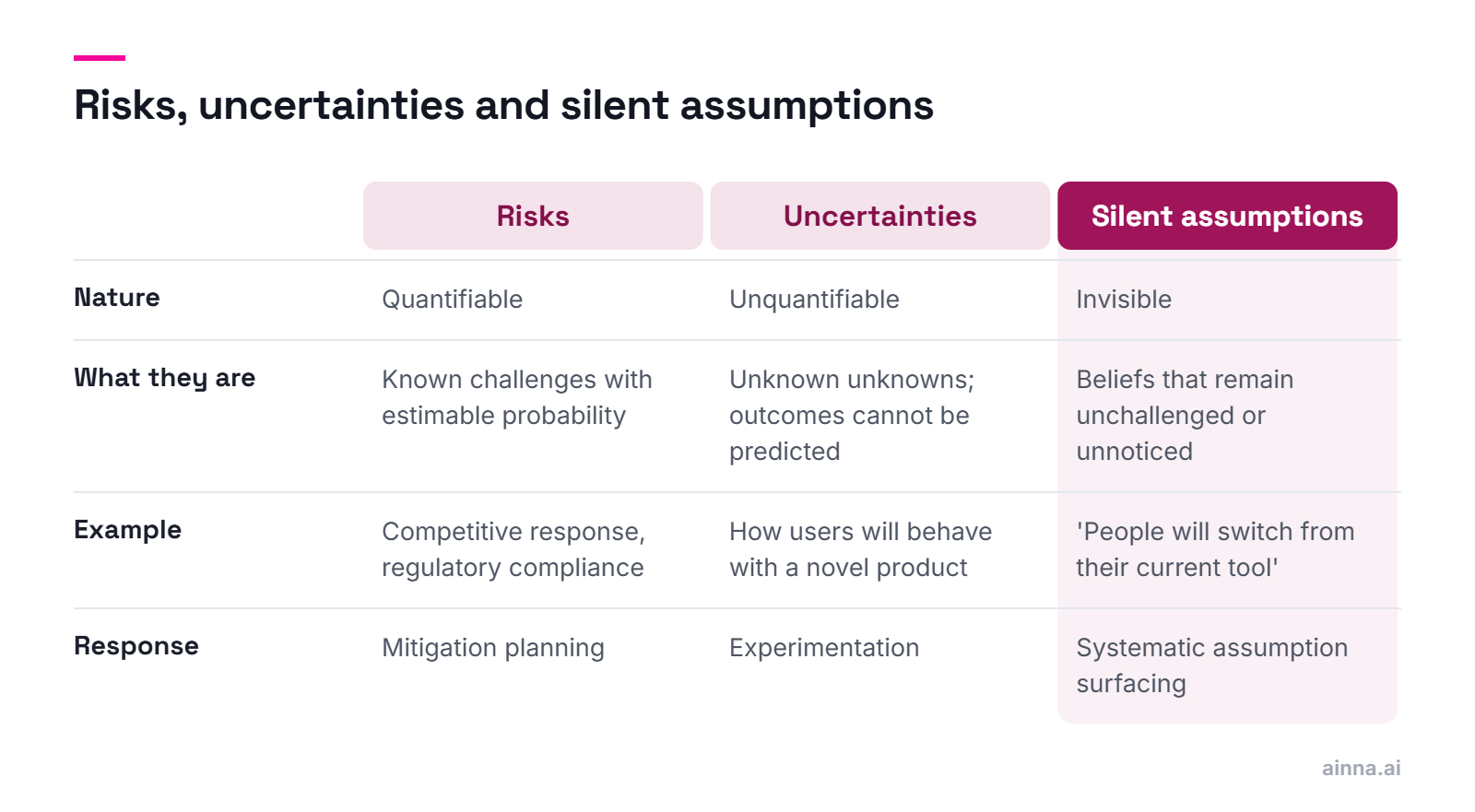
This distinction is one of the most important concepts in the Innovation Mode validation methodology, and getting it wrong leads to applying the wrong response to each type of unknown. Risks are known challenges with estimable probability and impact. Uncertainties are unknown unknowns where outcomes cannot be predicted. Silent assumptions are beliefs that remain unchallenged or unnoticed - the most dangerous of the three because entire business plans may rely on them without anyone realizing it.

  • Risks are quantifiable: you know what could go wrong, and you can estimate the likelihood and impact. Examples: competitive response risk, technical reliability risk, scalability risk, regulatory compliance risk. Response: mitigation planning - you reduce the probability or limit the impact through proactive measures
  • Uncertainties are unquantifiable: you don't know what will happen, and you can't assign meaningful probabilities. Examples: how users will actually behave with a novel product, how emerging technologies will reshape the market, how cultural shifts will change demand patterns. Response: experimentation - you design tests that reveal real behavior under real conditions
  • Silent assumptions are invisible: they are beliefs embedded in your thinking that you haven't even identified as assumptions. Examples: 'our users have reliable internet,' 'people will switch from their current tool,' 'the data we need is available and clean.' Response: systematic assumption surfacing - actively challenge every belief underlying your concept
  • As Innovation Mode 2.0 states: 'When beliefs about customer behavior, market dynamics, or technological capabilities remain unchallenged or even unnoticed, entire business plans and important decisions may rely on an unstable basis. Unlike identified risks or uncertainties, silent assumptions are blind spots'
  • The Innovation Mode Opportunity Validation team 'distinguishes between quantifiable risks, explorable uncertainties, and hidden assumptions - applying probabilistic assessment, experimentation, or discovery techniques as appropriate'
  • Practical exercise: list every statement in your pitch deck that starts with 'users will...', 'the market is...', or 'we can...' - these are assumptions. For each one, classify it as a risk (you can estimate the probability), uncertainty (you need to test it), or silent assumption (you hadn't even noticed you were assuming it)
Key Takeaway

The most dangerous unknowns are the ones you don't know you have. Risks you can plan for. Uncertainties you can test. Silent assumptions can sink your startup before you realize they exist. The first step in validation is making all three visible.

How should I frame my startup idea for effective assessment?

A poorly framed idea cannot be properly assessed - no matter how strong the underlying concept. In the Innovation Mode methodology, idea framing uses two complementary tools: The Problem Framing Template (articulating the problem clearly) and The Universal Idea Model (articulating the solution in a single, testable statement).

  • The Universal Idea Model structures your idea as: 'An [object] for [users] that [does X] in order to [achieve Y].' This forces clarity - if you can't fill in all four elements, your concept isn't well enough defined to validate. Example: 'A platform for product managers that generates complete documentation packages in order to accelerate product discovery by 10x'
  • Frame the problem separately from the solution. As Innovation Mode 2.0 emphasizes, 'a properly framed idea uses simple, non-technical language and is technology agnostic.' This separation preserves adaptability - if the solution fails validation, you can explore alternatives without abandoning the problem
  • Use The Product Concept Template to expand beyond the one-liner into a structured concept description: target users, core value proposition, key differentiators, initial feature set, and business model hypothesis
  • Avoid premature technical commitment. Specifying 'we'll use GPT-4' or 'built on blockchain' in your idea framing limits exploration and invites technology risk. Frame the capability, not the implementation. The technical architecture is determined during PRD development, not during idea validation
  • Name the unknowns explicitly: what do you believe that you haven't proven? What assumptions are embedded in the concept? What risks and uncertainties exist? The earlier you make these visible, the more targeted your validation can be
  • A well-framed idea enables faster, more accurate assessment because evaluators can focus on substance rather than interpretation. The Innovation Mode Idea Assessment Model works best when the idea is framed clearly enough that different evaluators assess the same concept - not their own interpretation of it
Key Takeaway

Idea framing is not documentation busywork - it's the first act of validation. The process of articulating your idea clearly enough to fill in the templates will reveal gaps, contradictions, and assumptions you hadn't noticed. If your idea can't survive being written down precisely, it can't survive the market. For a deeper guide on how product discovery documentation drives better outcomes, see this guide from The Innovation Mode.

What are the most effective methods for validating a startup idea?

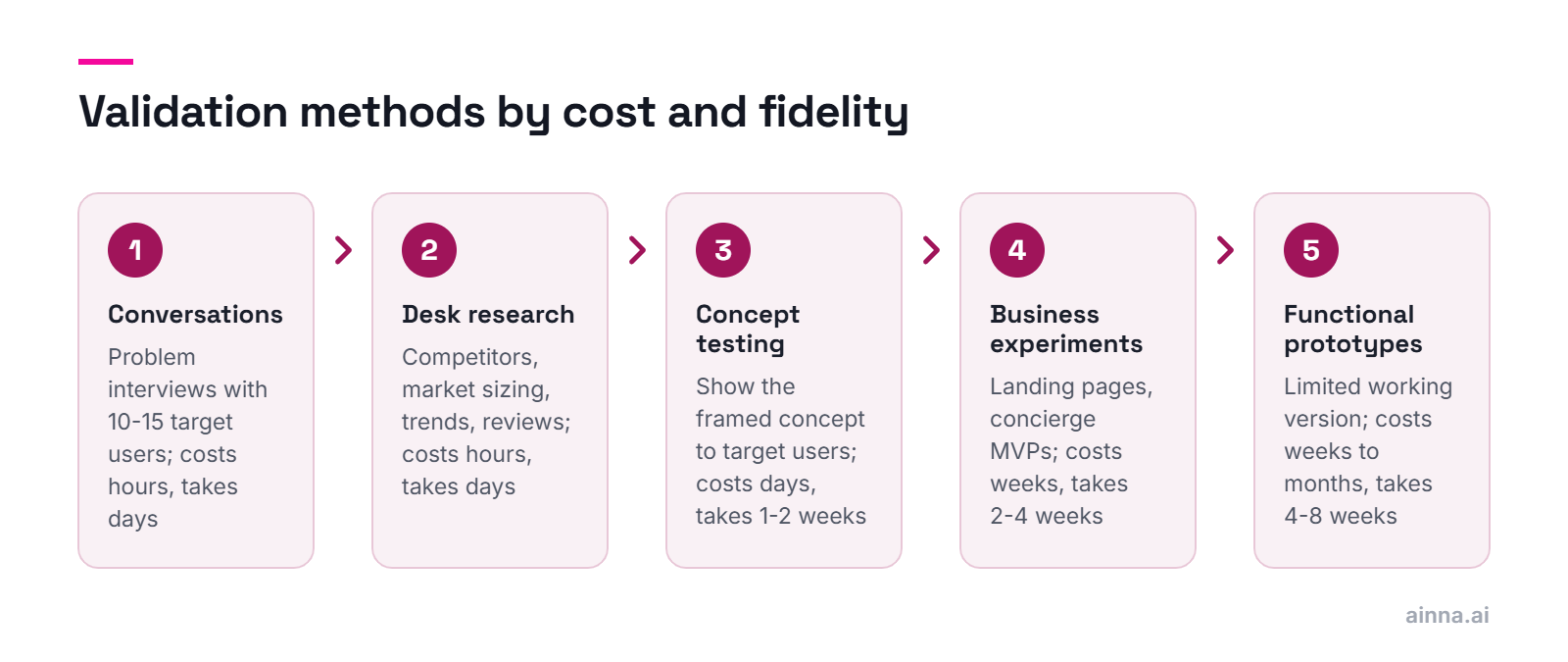
Effective validation methods are ordered by cost and fidelity - start cheap and fast, escalate only when earlier signals are positive. In the Innovation Mode methodology, validation methods span a spectrum from desk research and user interviews (Layer 1: Problem-Market Fit) through concept testing and design sprints (Layer 2: Solution-Market Fit) to business experiments and functional prototypes (pre-Layer 3: demand and feasibility validation).

  • Tier 1 - Conversations (cost: hours, timeline: days): Problem discovery interviews with 10-15 target users. Don't pitch your idea - ask about their problems, workflows, and current solutions. Listen for emotional language ('I hate,' 'I waste hours on,' 'I wish') - that's where real pain lives
  • Tier 2 - Desk research (cost: hours, timeline: days): Competitive analysis, market sizing, trend analysis, patent searches, and analysis of existing solutions and their reviews. This reveals whether the problem is already solved, how large the opportunity is, and where competitive gaps exist
  • Tier 3 - Concept testing (cost: days, timeline: 1-2 weeks): Present your framed concept (using the Universal Idea Model and Product Concept Template) to target users and measure their response. Use design sprints for rapid concept development and testing
  • Tier 4 - Business experiments (cost: weeks, timeline: 2-4 weeks): Use the Business Experiment Framing Template to design formal hypothesis tests. Landing page tests, concierge MVPs (manually delivering the service), Wizard of Oz experiments (human-powered backend behind an automated interface). As Innovation Mode 2.0 describes, experiments involve 'actual customers interacting with realistic prototypes in real market conditions'
  • Tier 5 - Functional prototypes (cost: weeks-months, timeline: 4-8 weeks): Build a limited but working version that tests the core hypothesis. This is not yet an MVP - it's a focused implementation designed to validate specific assumptions. The Innovation Mode Opportunity Validation team manages this process
  • The key principle: each tier should produce a clear go/no-go signal before investing in the next. If Tier 1 interviews reveal that nobody has the problem you're solving, you've saved yourself the cost of Tiers 2-5
Key Takeaway

The best validation approach is not the most rigorous one - it's the one that gives you enough confidence to make the next decision at the lowest possible cost. Over-validating is almost as wasteful as under-validating: at some point, you need to build.

How do I design a business experiment that produces trustworthy results?

A business experiment that produces trustworthy results has five components defined before it runs: a specific hypothesis, a measurable success criterion, a defined audience, a controlled execution method, and a pre-committed interpretation framework. In the Innovation Mode methodology, the Business Experiment Framing Template structures all five, preventing the common trap of running experiments that generate data but not decisions.

  • Hypothesis: state what you believe in testable terms. Not 'users will like our product' but 'at least 15% of landing page visitors who match our target persona will click the signup button.' The hypothesis should be falsifiable - if the result doesn't meet the criterion, the hypothesis is rejected
  • Success criterion: define what 'success' and 'failure' look like before the experiment runs. This prevents post-hoc rationalization ('well, the numbers were low but the feedback was positive'). Set the bar in advance
  • Audience: who are the test subjects? They must represent your actual target users, not just convenient participants. As Innovation Mode 2.0 describes, 'the provisioning of the prototype to real users happens in a controlled manner through a defined process, targeting a carefully designed audience'
  • Execution: how will the experiment run? In-product experiments (A/B tests, feature experiments) test within a live product. Out-of-product experiments (landing pages, concierge MVPs, standalone prototypes) test independently. Choose based on what you're validating
  • Interpretation framework: decide in advance what you'll do with each possible outcome. If the hypothesis is confirmed, what's the next step? If it's rejected, do you iterate, pivot, or abandon? If results are ambiguous, what additional experiment would resolve the ambiguity?
  • As Innovation Mode 2.0 defines it: 'Business experimentation is the practice of testing hypotheses by obtaining insights and signals under real-world conditions. It acknowledges that innovation inherently involves uncertainty and provides a systematic way to address it through targeted learning activities'
Key Takeaway

The most common experiment mistake is not designing a bad experiment - it's running an experiment without deciding what you'll do with the results. If you haven't committed to a response for each outcome before the experiment runs, you'll rationalize whatever result you get.

How is validating an AI startup idea different from validating a traditional startup idea?

AI startup ideas carry all the standard validation requirements plus an additional layer: you must validate the technology hypothesis alongside the product hypothesis. Can the AI actually deliver sufficient quality for the core use case? In the Innovation Mode methodology, this adds a validation step between Solution-Market Fit and the MVP build: testing whether the model can perform at the quality level users need, before committing to product development.

  • The dual hypothesis problem: traditional startups validate 'will users want this product?' AI startups must also validate 'can the AI do this well enough?' These are independent questions - strong demand for a capability doesn't mean current AI can deliver it reliably
  • Quality floor validation: define the minimum acceptable quality for your AI output and test whether current models can meet it. Use the eval framework approach from our AI PRD guide - structured evaluations across defined quality dimensions. If the quality floor isn't achievable, the idea isn't viable regardless of demand
  • Prompt-level prototyping: for LLM-powered products, you can often validate the core AI capability with a well-designed prompt chain before writing any product code. Build a prompt-based prototype and test it with target users to gauge whether the output quality is sufficient
  • Model dependency risk: your core intelligence is likely rented through APIs. Validate that your product creates value beyond the model layer - through proprietary data, domain expertise, workflow integration, or user experience. If removing the model API would leave you with nothing defensible, your idea has a fragility problem
  • The expectation gap: users may compare your AI product's output to state-of-the-art consumer AI products (ChatGPT, Claude) even if your product serves a completely different use case. Validate user expectations specifically - not just whether the AI works, but whether users perceive it as good enough given their reference points
  • Validate the economics: every AI query has an inference cost. Validate that your pricing model can absorb inference costs at scale while maintaining healthy margins. An AI product that works brilliantly but loses money on every query doesn't have product-market fit
Key Takeaway

AI startup validation is more complex than traditional validation because you're testing two hypotheses simultaneously: product-market fit and technology-market fit. Both must hold for the idea to be viable. The good news is that AI prototyping is fast and cheap - you can test the technology hypothesis in days, not months.

How can I use existing market signals to validate demand without running my own experiments?

Some of the strongest validation evidence is already out there - you just need to know where to look. Before designing your own experiments, mine the signals the market is already producing. In the Innovation Mode methodology, this is part of the Opportunity Discovery process: scanning the environment for evidence that validates (or invalidates) the problem, the demand, and the competitive landscape before investing in primary research.

  • Competitor reviews are a goldmine. Read every 1-star and 3-star review of competing products on app stores, G2, Capterra, and Trustpilot. The 1-star reviews tell you what's broken. The 3-star reviews tell you what's almost-good-enough - that's your opportunity gap. If hundreds of people are complaining about the same limitation, you've found a validated pain point
  • Search volume and intent: what are people actually searching for? Tools like Google Trends, keyword research platforms, and even Google's 'People Also Ask' boxes reveal what questions people have and how urgently they need answers. Rising search volume for a problem query is a strong demand signal
  • Community conversations: Reddit threads, Stack Overflow questions, LinkedIn discussions, Hacker News comments, Quora answers, and niche forums. When people post 'Is there a tool that does X?' or 'I've been doing Y manually for years,' that's unprompted demand validation. The language people use to describe their pain is also your future marketing copy
  • Crowdfunding and waitlists: Kickstarter/Indiegogo campaigns in adjacent spaces show what people are willing to pay for before it exists. Product Hunt launches and their engagement patterns show what the early adopter community responds to. Existing waitlists for vaporware products demonstrate demand without supply
  • Job postings as demand signals: if companies are hiring people to solve the problem you're automating, there's validated demand. If you're building a tool for competitive analysis and companies are posting 'Competitive Intelligence Analyst' roles, the market is paying real salaries to address this pain manually
  • The Innovation Mode approach to competitive analysis extends beyond direct competitors to 'alternative solutions' - spreadsheets, manual processes, consultants, internal tools - that people use today. Each workaround is evidence that the problem is real and painful enough that someone has invested effort in addressing it
Key Takeaway

The best validation doesn't always require building anything or talking to anyone. The market is constantly producing signals about what people want, what they're frustrated by, and what they're willing to pay for. Your job is to read those signals before investing in your own experiments - and then use your experiments to test what the market signals can't tell you: whether your specific solution is the right one.

How long does startup idea validation take?

A rigorous validation cycle can be completed in 2-6 weeks for most digital product ideas. That's not a shortcut - it's the result of working in layers, starting with the cheapest tests, and escalating only when signals are positive. In the Innovation Mode methodology, the Opportunity Validation team is designed to move fast: they receive validated opportunities from the Discovery team and apply targeted testing techniques - experimentation, prototyping, and proof of concept - to produce evidence-based recommendations.

  • Week 1: Problem validation - 10-15 user interviews, desk research, competitive landscape review, market sizing. Output: validated problem statement, initial market assessment, identified competitors and gaps
  • Week 2: Idea framing and assessment - articulate the concept using the Universal Idea Model and Product Concept Template, score against the Nine-Dimension Idea Assessment Model, identify key risks, uncertainties, and silent assumptions
  • Weeks 3-4: Concept testing and experimentation - run a design sprint, build a landing page test, create a concierge MVP, or develop a prompt-level prototype (for AI ideas). Use the Business Experiment Framing Template for each test
  • Weeks 5-6 (if needed): Deeper validation - functional prototype testing, extended user testing, pricing experiments, or partner conversations. Only pursue this if earlier signals are positive but ambiguous
  • Some ideas can be invalidated in hours: if Tier 1 conversations reveal nobody has the problem, or desk research reveals the market is saturated, you've gotten a clear answer fast and cheaply. Don't spend weeks validating what a day of research could have resolved
  • For AI startups, add 1-2 weeks for technology hypothesis validation - eval-driven quality testing and prompt-level prototyping to confirm the AI can deliver at the required quality level
Key Takeaway

Two to six weeks of validation versus six to twelve months of building the wrong thing. The math is straightforward. Even if validation adds a month to your timeline, it saves you from the far more expensive outcome of building a product nobody wants.

How much does startup idea validation cost?

Proper validation can cost anywhere from effectively zero (conversations and desk research using free tools) to a few thousand dollars (prototype development and paid user testing). In the Innovation Mode approach, the emphasis is on maximizing learning per dollar spent - which means starting with the cheapest methods and only investing in more expensive validation when earlier signals justify it.

  • Tier 1 (free-low cost): user interviews (your time), desk research (Google, public databases, competitor websites), community engagement (Reddit, LinkedIn, industry forums). Tools like Ainna for Founders can generate problem statements, competitive analysis, and product concept documentation in 60 seconds
  • Tier 2 (hundreds of dollars): landing page tests (domain + hosting + ad spend for traffic), survey tools, simple prototype tools (Figma, no-code builders). A basic landing page experiment can run for under $500 in ad spend
  • Tier 3 (low thousands): functional prototype development, professional user testing services, design sprint facilitation, paid market research. A focused design sprint with a small team costs 1-2 weeks of team time
  • The most expensive component is always team time, not tools. Two founders spending two weeks on validation costs two weeks of runway - which is dramatically cheaper than six months of building the wrong product
  • AI tools have compressed validation costs significantly. Market research that took a consultant weeks can now be completed in hours. Competitive analysis that required expensive databases is now accessible through AI-powered platforms. The barrier to validation has never been lower
  • Compare the cost to the alternative: the median startup burns through hundreds of thousands of dollars before discovering the concept isn't viable. Even the most expensive validation process ($5,000-10,000) is a rounding error compared to the cost of building unvalidated
Key Takeaway

If cost is your reason for skipping validation, you're making the most expensive decision possible. Validation is the cheapest insurance a startup can buy - it protects your most scarce resources (time and money) from being wasted on unvalidated assumptions.

What are the most common startup idea validation mistakes?

After 25+ years of product innovation and advising dozens of startups, the most common validation mistakes cluster into three categories: asking the wrong questions (confirmation bias), testing the wrong things (validating the solution before the problem), and drawing the wrong conclusions (interpreting politeness as validation). The Innovation Mode methodology addresses each through structured frameworks that force objectivity.

  • Confirmation bias: asking 'Would you use this?' instead of 'How do you solve this problem today?' The first question invites polite agreement; the second reveals genuine behavior. Use The Problem Framing Template to structure discovery conversations around the problem, not the solution
  • Skipping problem validation: jumping to solution testing because you're excited about what you're building. The Innovation Mode Three-Layer PMF Journey explicitly requires Problem-Market Fit before Solution-Market Fit for this reason
  • Asking friends and family: they want to support you, not tell you hard truths. Validate with strangers who match your target persona - people with no social obligation to be kind about your idea
  • Over-indexing on stated intent: 'I would definitely pay for this' means nothing until money changes hands. Words are cheap; behavior is expensive. Prioritize behavioral signals (signups, pre-orders, time invested) over stated preferences
  • Ignoring negative signals: cherry-picking the three enthusiastic interview responses while dismissing the seven lukewarm ones. In the Innovation Mode Idea Assessment Model, multiple evaluators assess independently to prevent individual bias from dominating the Opportunity Score
  • Validating in a vacuum: testing your idea without understanding the competitive landscape. Someone may already solve this problem well enough. Always include competitive analysis in your validation process
Key Takeaway

The meta-mistake underlying all these is treating validation as a formality rather than a genuine search for truth. If you're not genuinely open to the possibility that your idea is wrong, you're not validating - you're seeking permission to build.

When is enough validation enough?

This is the question validation guides rarely address - and it's just as important as 'how to validate.' Endless validation is a form of procrastination disguised as rigor. In the Innovation Mode methodology, the test is straightforward: you have enough validation when you can articulate the problem clearly, your solution concept resonates with target users, initial demand signals are positive, and the remaining unknowns can only be resolved by putting a real product in front of real users.

  • You're ready to build when: (1) you can describe the problem without mentioning your solution and people recognize it, (2) target users respond positively to your framed concept (Universal Idea Model), (3) your market sizing shows the opportunity is large enough, (4) you've identified the key risks and uncertainties and have mitigation or testing plans for each, and (5) the remaining questions can only be answered by market behavior, not by more interviews or desk research
  • The diminishing returns signal: when your last 5 conversations or experiments confirm what you already know rather than revealing new information, you've likely reached the point of diminishing returns. Additional validation at this stage is stalling, not learning
  • The remaining-unknowns test: list everything you still don't know. For each unknown, ask: 'Can this be resolved by more pre-build validation, or does it require a live product in front of real users?' If most items require a live product, it's time to build the MVP
  • Watch for validation theater: running increasingly elaborate experiments not because you need more evidence but because building feels risky. If you've validated Problem-Market Fit and Solution-Market Fit, the next layer (Product-Market Fit) requires a launched product. No amount of pre-build validation substitutes for real usage data
  • The Innovation Mode framework builds a natural stopping point into the process: the Opportunity Validation team produces a recommendation - proceed, pivot, or stop. When the recommendation is 'proceed,' the handoff to the Opportunity Realization team is decisive. As Innovation Mode 2.0 states, 'the real risk is releasing a non-viable first instance too late'
  • A practical heuristic: if you've completed the first three validation tiers (conversations, desk research, concept testing) and signals are consistently positive, you likely have enough. Tiers 4-5 (business experiments, functional prototypes) are for ideas with specific high-risk uncertainties that justify the additional investment
Key Takeaway

Validation isn't about eliminating all uncertainty - that's impossible. It's about reducing uncertainty enough to make the next investment decision with confidence. When the remaining unknowns can only be resolved by building, that's your signal to stop validating and start building.

How do I transition from a validated idea to building an MVP?

The transition from validated idea to MVP is where most startups either over-invest (building too much) or under-prepare (building without a clear definition). In the Innovation Mode methodology, this transition follows a defined path: the validated opportunity package from the Opportunity Validation team is handed to the Opportunity Realization team (the Venture Studio), who applies the Seven-Step MVP Definition Process to produce a complete Product Definition Document - then builds.

  • What you should have before transitioning: a validated problem statement, a framed product concept (Universal Idea Model), positive signals from validation experiments, identified risks and uncertainties with mitigation plans, and initial market sizing
  • The transition artifact: write a PRD that captures everything learned during validation - the problem, the validated solution concept, target users, success metrics, MVP scope, and the assumptions that remain untested. Decompose features into user stories that map directly to validated user needs. This document bridges discovery and development
  • Apply the Six-Step MVP Synthesis Method to identify the smallest feature set that delivers enough value to test your remaining hypotheses. The MVP is not a small product - it's a focused product designed to validate the path to product-market fit
  • Create your pitch deck and one-pager if you need funding. Ainna for Founders generates these from your validated concept in 60 seconds. The validation evidence you've gathered is your strongest pitch material - it demonstrates that you're building on evidence, not assumptions
  • Define success metrics for the MVP before building. What signals will tell you the MVP is working? What will trigger a pivot? Use the PMF Signal Convergence Model to structure your measurement framework from day one
  • Don't re-validate what's already validated. The transition to building should be decisive. If you've confirmed Problem-Market Fit and Solution-Market Fit, commit to the MVP and let the market provide the next layer of evidence. Begin shaping your go-to-market strategy in parallel with MVP development - not after
Key Takeaway

The transition from validation to building is not a leap of faith - it's a structured handoff. Every insight from validation becomes an input to the MVP definition. Every remaining uncertainty becomes a hypothesis the MVP is designed to test. You're not guessing anymore; you're testing with a launched product. If you're assembling a team for the build phase, see our product development team guide.

What tools and resources help with startup idea validation?

The best validation tools accelerate your learning, not just your output. In the Innovation Mode approach, validation tools span three categories: framing tools (structuring the problem and concept), testing tools (running experiments and gathering evidence), and documentation tools (capturing and communicating what you've learned).

  • Framing tools: Ainna for Founders applies The Innovation Mode methodology to help you frame your product opportunity - generating problem statements, product concepts, competitive analysis, and complete documentation packages in 60 seconds. The Innovation Toolkit provides templates for problem framing, idea assessment, and business experiment design
  • Testing and experimentation: landing page builders for demand testing, survey tools for concept validation, no-code prototype builders for functional testing, analytics platforms for behavioral measurement. The Business Experiment Framing Template structures each experiment
  • Market intelligence: use market sizing frameworks and competitive analysis methods to understand the landscape. AI-powered research tools can compress weeks of analysis into hours
  • Documentation and communication: your validation findings need to be captured in artifacts that drive decisions - PRDs, pitch decks, one-pagers. These documents turn validation evidence into strategic assets
  • For AI startup validation specifically: prompt engineering tools for testing AI capability hypotheses, eval frameworks for measuring output quality, and the AI PRD framework for documenting AI-specific requirements
  • Use code AINNA.AI to explore Ainna for Founders - frame your idea, assess the opportunity, generate documentation, and stress-test your concept before building
Key Takeaway

Tools should make validation faster and more rigorous, not replace the intellectual work of understanding your market and users. The best tool is one that compresses the time between 'I have an idea' and 'I have evidence that it's worth building.'

Meet Ainna

Ready to Validate Your Startup Idea?

Ainna applies The Innovation Mode methodology to help you discover and frame product opportunities - generating problem statements, product concepts, competitive analysis, pitch decks, and PRDs so you can validate before you build.

Ideas in.
Opportunities out.