What is a product roadmap and why does every product team need one?

A product roadmap is a strategic communication tool that connects your product vision to the work your team does every day. It answers the question: how will this product evolve over time to deliver on its promise? Without one, teams default to building whatever feels urgent rather than what actually matters.

  • A roadmap articulates the direction and priorities of a product over time - it is a plan, not a promise
  • It aligns engineering, design, marketing, sales, and leadership around shared goals and sequencing
  • Great roadmaps focus on outcomes (what will change for users and the business) rather than outputs (what features will ship)
  • The roadmap is the bridge between product discovery and product delivery - it captures what you have learned and where you are headed
  • Without a roadmap, teams lose the 'big picture' and get trapped in reactive, backlog-driven execution
Key Takeaway

A roadmap is not bureaucracy - it is how strategy becomes tangible. Every product team needs one, whether it fits on a whiteboard or lives in a sophisticated tool.

What is the difference between a product roadmap and a product backlog?

The roadmap is strategic; the backlog is operational. A roadmap communicates where you are going and why. A backlog defines what to build next and how. Confusing the two is one of the most common mistakes in product management - it collapses strategy into task management.

  • A roadmap focuses on themes, outcomes, and strategic bets over quarters - it is for alignment and communication
  • A backlog focuses on user stories, tasks, and acceptance criteria within sprints - it is for execution
  • The roadmap should be understandable by anyone from the CEO to a new team member; the backlog is for the delivery team
  • Roadmap items are intentionally high-level: 'Improve onboarding retention by 20%' rather than 'Add tooltip to step 3'
  • The backlog is derived from the roadmap - not the other way around. Strategy drives tasks, not tasks drive strategy
Key Takeaway

If your 'roadmap' looks like a Gantt chart of Jira tickets, you have a backlog with a fancy name. True roadmaps operate at the strategy layer.

How does a product roadmap differ from a release plan or project plan?

A roadmap answers why and what at a strategic level. A release plan answers when and how at an operational level. A project plan tracks the execution of a specific initiative. They are complementary documents that serve different audiences and different decision-making needs.

  • Roadmap: strategic direction, themes, outcomes, rough time horizons (Now/Next/Later or quarterly)
  • Release plan: specific features, dates, dependencies, and deployment logistics for a given release cycle
  • Project plan: detailed tasks, milestones, resource allocation, and timelines for a single initiative
  • A product leader owns the roadmap; delivery teams own release and project plans
  • Confusing these documents creates either over-specified roadmaps (too rigid) or under-specified release plans (no clear rationale)
Key Takeaway

Each document serves a purpose. The roadmap sets direction, the release plan coordinates delivery, and the project plan manages execution. Problems arise when teams try to collapse all three into one artifact.

What are the main types of product roadmaps?

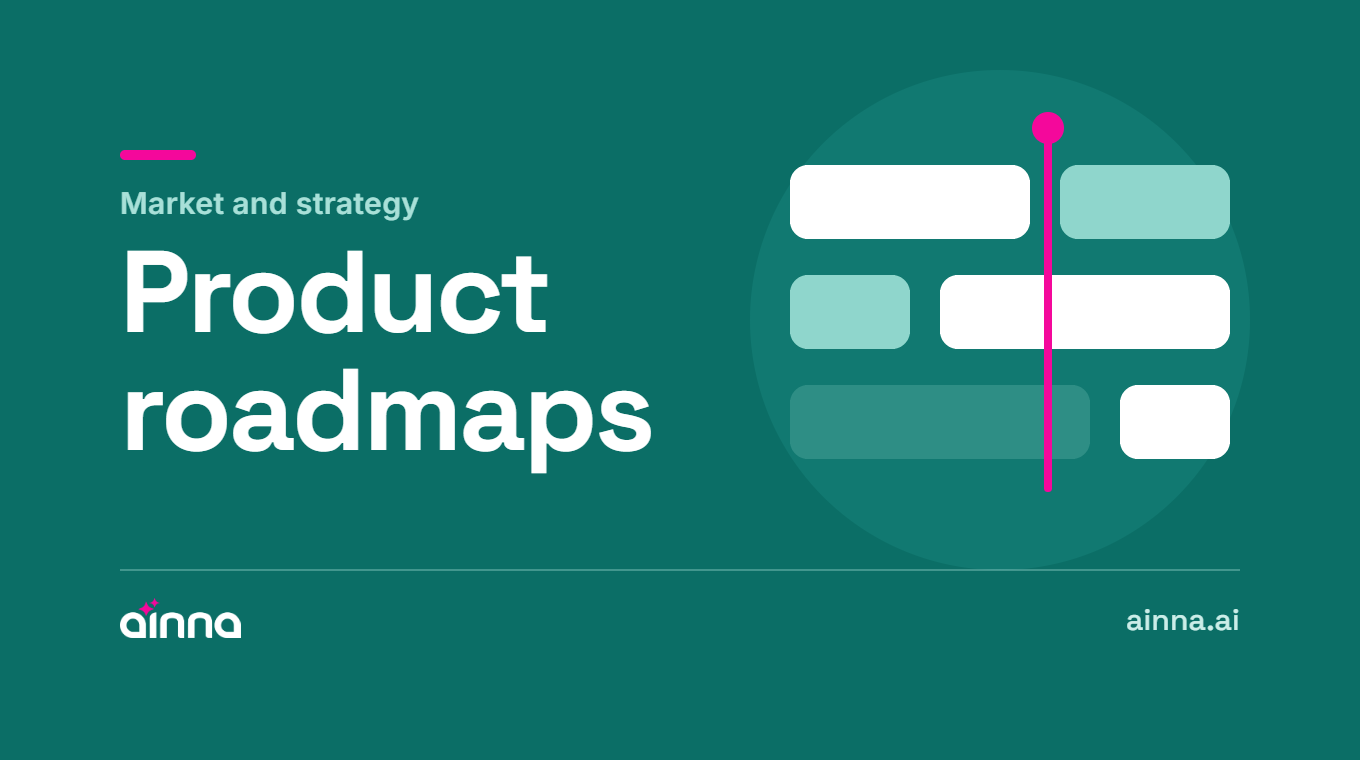
Roadmaps come in several formats depending on audience and purpose: outcome-based, theme-based, Now-Next-Later, timeline-based, and portfolio roadmaps. The best teams often maintain multiple views of the same underlying strategy rather than forcing one format to serve all needs.

  • Outcome-based roadmaps organize around measurable results ('reduce churn by 15%') rather than features - ideal for executive and investor audiences
  • Theme-based roadmaps group work under strategic themes ('onboarding excellence', 'platform scalability') - great for cross-functional alignment
  • Now-Next-Later roadmaps replace rigid timelines with confidence zones: committed, planned, and exploratory - popular in agile environments
  • Timeline roadmaps show work against calendar quarters - useful for coordination with marketing, sales, and partnerships, but risky if treated as commitments
  • Portfolio roadmaps show multiple products or product lines together - essential for CPOs and VPs managing a product portfolio
Key Takeaway

There is no single 'right' format. The best roadmap is the one that creates alignment for your specific audience. Many mature product teams maintain two or three views of the same strategy.

What are the most common product roadmap mistakes?

The most damaging roadmap mistakes are treating it as a feature list, making it too rigid, skipping the discovery work that should inform it, and failing to communicate it effectively. These mistakes turn a strategic tool into a political liability.

  • Feature-list roadmaps: listing features without connecting them to user problems or business outcomes makes the roadmap meaningless as a strategic tool
  • Date-driven roadmaps: committing to specific dates too far out creates false precision and forces teams to ship scope rather than quality
  • Skipping discovery: roadmapping without problem framing or user evidence produces roadmaps built on assumptions, not insights
  • Roadmap hoarding: keeping the roadmap private or sharing it only upward defeats its purpose as an alignment tool
  • Never updating: a roadmap that does not evolve based on what you learn from MVPs, experiments, and customer feedback becomes fiction
  • One-size-fits-all: presenting the same roadmap to investors, engineers, and customers confuses everyone
Key Takeaway

Most roadmap problems are strategy problems in disguise. If you do not have a clear product vision and discovery practice, no roadmap format will save you.

What does a good product roadmap actually look like?

A good roadmap looks different depending on its audience and format, but the best ones share common traits: they lead with outcomes, organize around strategic themes, use time horizons instead of rigid dates, and tell a story that any stakeholder can follow. Here are concrete patterns that work.

  • Example 1 - Now/Next/Later for a startup: NOW: 'Reduce onboarding drop-off from 60% to 35% (validated via MVP testing).' NEXT: 'Expand to team accounts (discovery underway, 12 interviews completed).' LATER: 'Explore enterprise self-serve (hypothesis stage, market signal strong)'
  • Example 2 - Theme-based quarterly for a scaling product: Q2 themes are 'Activation improvements' (3 initiatives), 'Platform reliability' (2 initiatives), 'Growth experimentation' (2 initiatives) - each with an outcome metric and owner
  • Example 3 - Portfolio view for a CPO: three product lines shown side by side, each with 2 to 3 quarterly themes color-coded by strategic pillar (growth, retention, platform) - enabling cross-product resource allocation decisions
  • What all good examples share: outcomes over features, confidence levels that decrease with time horizon, clear connection to product vision, and evidence backing for prioritization
  • What bad roadmaps look like: a flat list of features with delivery dates, no strategic rationale, no success metrics, and no mechanism for adaptation
  • The pitch deck version of your roadmap tells the same story but optimized for an investor audience - vision, traction, and the strategic bets that will drive the next phase of growth
Key Takeaway

The best way to learn what good looks like is to study roadmaps from teams that ship great products. Start with the format that matches your audience, then iterate based on what creates the most productive conversations.

How do I create a product roadmap from scratch?

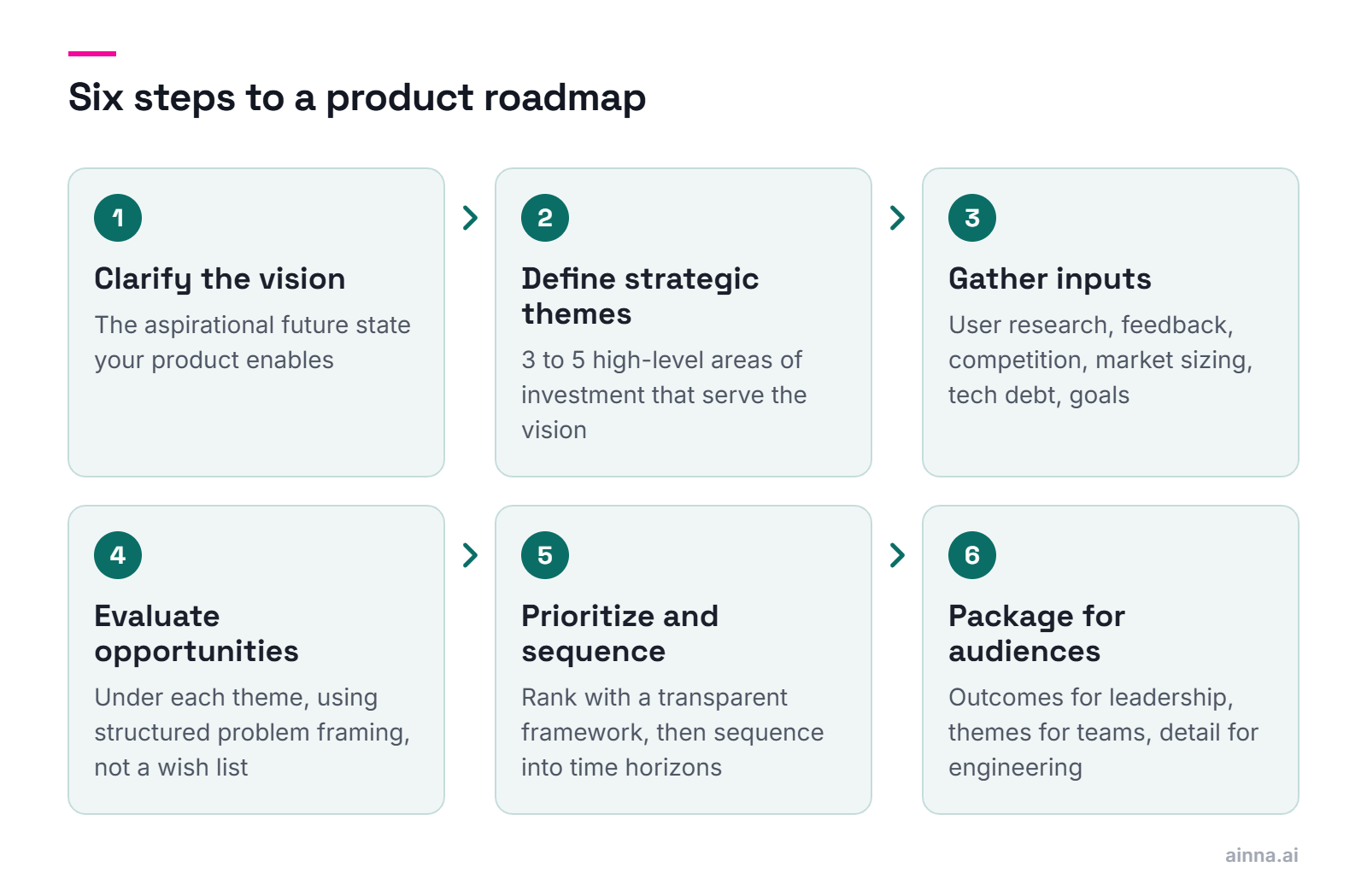
Start with your product vision and strategy - not with a list of feature requests. A good roadmap is the output of structured thinking about where your product needs to go, informed by discovery, market context, and business objectives. The process is: vision, strategy, themes, prioritized bets, then roadmap.

  • Step 1: Clarify your product vision - the aspirational future state your product enables. Use the Product Concept Template to articulate this clearly
  • Step 2: Define strategic themes - 3 to 5 high-level areas of investment that serve the vision (e.g., 'expand to enterprise', 'reduce time-to-value')
  • Step 3: Gather inputs from multiple sources - user research, customer feedback, competitive analysis, market sizing, technical debt assessments, and business goals
  • Step 4: Generate and evaluate opportunities under each theme - using structured problem framing rather than a wish list of features
  • Step 5: Prioritize using a transparent framework (RICE, impact vs effort, or strategic fit scoring) and sequence into time horizons
  • Step 6: Package for your audience - outcome-focused for leadership, theme-focused for cross-functional teams, detail-focused for engineering
Key Takeaway

The roadmap is the artifact; the thinking behind it is the real product. Invest more time in steps 1 through 4 than in the formatting of the document itself.

What inputs should inform my product roadmap?

Great roadmaps synthesize signals from multiple sources: user research, business strategy, market dynamics, technical realities, and competitive landscape. Relying on any single input - especially stakeholder requests alone - produces a roadmap that optimizes for politics rather than product value.

  • User and customer signals: support tickets, NPS feedback, interview insights, usage analytics, churn reasons - the voice of the people who use your product
  • Business objectives: revenue targets, expansion goals, partnership commitments, market opportunity sizing
  • Discovery outputs: validated opportunities from continuous discovery, design sprints, and experimentation
  • Technical inputs: infrastructure needs, scalability constraints, security requirements, tech debt that blocks future velocity
  • Competitive intelligence: what competitors are shipping, market gaps, differentiation opportunities
  • Innovation pipeline: ideas from hackathons, ideation programs, and team brainstorming that have been assessed and validated
Key Takeaway

The strongest roadmaps emerge from the intersection of these signals - not from any single source. Product leaders must synthesize, weigh, and make judgment calls about which signals matter most right now.

How do I prioritize what goes on the roadmap?

Prioritization is the hardest and most important part of roadmapping. Use a structured framework to make tradeoffs transparent - not to eliminate judgment, but to ground it. The goal is not a perfect ranking; it is a defensible, well-reasoned set of strategic bets that your team can rally behind.

  • RICE scoring (Reach, Impact, Confidence, Effort) works well for comparing discrete opportunities with a common unit of measurement
  • MoSCoW (Must/Should/Could/Won't) is useful for scoping a release or defining MVP boundaries - pairs well with roadmap theme planning
  • Kano model helps distinguish between baseline expectations, performance features, and delighters - critical for competitive positioning
  • Impact vs Effort matrices provide a quick visual filter, though they can oversimplify complex tradeoffs
  • Strategic fit scoring evaluates each initiative against your top 3 to 5 strategic themes - high alignment means high priority
  • Whatever framework you use, make the reasoning visible - stakeholders who understand the tradeoffs become allies, not adversaries
Key Takeaway

No framework produces perfect priorities. The value is in the structured conversation - forcing explicit discussion about what matters most and what you are choosing not to do.

How far out should my product roadmap look?

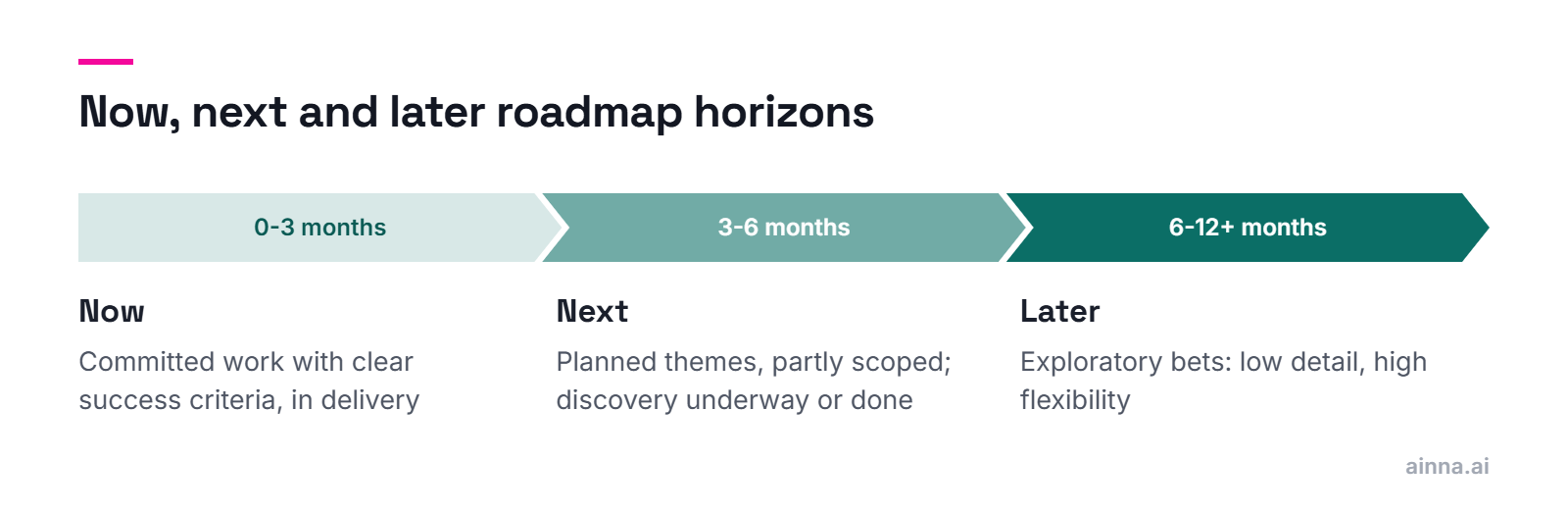
The right time horizon depends on your product stage, market velocity, and organizational needs. The Now-Next-Later approach works for most teams: high confidence and detail for the near term, directional themes for the mid-term, and exploratory bets for the long term.

  • Now (0 to 3 months): committed work with clear success criteria, actively in delivery. This should align closely with your sprint backlog and user stories
  • Next (3 to 6 months): planned themes with defined opportunities, partially scoped. Discovery work is underway or completed
  • Later (6 to 12+ months): strategic directions and exploratory bets. Low detail, high flexibility. Informed by vision and market trends
  • Early-stage startups may plan only 1 to 3 months ahead - and that is perfectly appropriate given the rate of learning
  • Enterprise products with long sales cycles, compliance needs, or hardware dependencies may need 12 to 18 month visibility
  • The key principle: confidence and specificity should decrease as you look further out. Detailed 18-month roadmaps are fiction disguised as planning
Key Takeaway

Plan with appropriate precision for each time horizon. Over-specifying the future creates false commitments; under-specifying the present creates chaos.

How does product discovery feed into the roadmap?

Product discovery is the engine that fuels your roadmap with validated opportunities rather than untested assumptions. A continuous discovery practice means your roadmap evolves based on evidence - user needs confirmed through research, prototyping, and experimentation.

  • Discovery identifies the problems worth solving; the roadmap sequences when and how you will solve them
  • Use the Problem Framing Template to structure each opportunity before it enters the roadmap
  • Opportunities validated through prototyping or MVP experiments earn higher priority - they carry lower risk
  • Design sprints can rapidly validate roadmap candidates: one week to confirm whether an opportunity is worth a quarter of investment
  • Roadmap items in the 'Later' zone should correspond to active discovery threads - you are learning now what you will build then
  • The Universal Idea Model provides a compact format for capturing each opportunity before it gets roadmap space
Key Takeaway

The best roadmaps are the output of continuous discovery, not annual planning exercises. Discovery makes your roadmap smarter over time.

Should I use a product roadmap template, and what should it include?

A template is a useful starting point, not a finished product. The best roadmap templates enforce strategic structure (vision, themes, outcomes, time horizons) while remaining flexible enough to adapt to your product's unique context. Use a template to save setup time, then customize it relentlessly.

  • A strong roadmap template includes: product vision statement, 3 to 5 strategic themes, time horizon structure (Now/Next/Later or quarterly), outcome metrics per initiative, confidence indicators, and an owner for each theme
  • Templates prevent common mistakes by forcing structure: you cannot skip the 'why' when the template has a mandatory outcome field
  • The Innovation Toolkit provides structured templates for problem framing and product concepts that feed naturally into roadmap planning
  • Avoid overly rigid templates that dictate format over substance - a template with 47 required fields will be abandoned by sprint 2
  • Create audience-specific templates: a one-page executive summary template, a detailed team template, and an investor deck template - all driven by the same underlying data
  • The fastest path from roadmap decisions to professional documentation is to combine your roadmap template with Ainna, which generates complete PRDs and decks from structured product inputs in 60 seconds
Key Takeaway

A template gives you structure; your strategy gives it meaning. Start with a proven template, make it yours, and iterate as your roadmapping practice matures.

What is an outcome-based roadmap and why should I use one?

An outcome-based roadmap organizes work around measurable results rather than feature deliverables. Instead of 'Build recommendation engine,' it says 'Increase content discovery by 30%.' This shift forces teams to focus on impact and gives them freedom to find the best solution - which may not be what you originally assumed.

  • Outcomes describe the change you want to see: user behavior shifts, business metric improvements, problem elimination
  • Features are hypotheses about how to achieve outcomes - not the outcomes themselves
  • Outcome framing empowers teams: instead of 'build feature X,' they explore the best way to achieve result Y
  • It makes success measurable - you know whether the roadmap item worked, not just whether it shipped
  • Outcome-based roadmaps are easier to communicate to executives and investors because they speak the language of business impact
  • They naturally connect to the problem framing discipline - every outcome maps to a problem worth solving
Key Takeaway

Shipping features is easy. Achieving outcomes is hard. Outcome-based roadmaps keep your team focused on what actually matters.

How do I connect my roadmap to the product vision and company strategy?

Your roadmap is the bridge between an aspirational product vision and the concrete work teams do every sprint. The connection flows: company mission informs product vision, product vision informs strategy, strategy defines themes, and themes organize your roadmap. If you cannot trace a roadmap item back to vision, question whether it belongs.

  • Start every roadmap cycle by revisiting the product vision - the aspirational future state described in your Product Concept
  • Define 3 to 5 strategic themes that serve the vision and align with company-level objectives for the current period
  • Every roadmap item should map to at least one strategic theme - orphan items are a red flag
  • Use a simple traceability test: for each item, ask 'if we achieve this, does it move us toward the vision?' If the answer is unclear, deprioritize
  • Communicate the vision-to-roadmap connection explicitly - teams that understand why work harder and make better micro-decisions
  • As a product leader, your role is to be the keeper of this connection - ensuring the roadmap serves the vision, not just the loudest stakeholder
Key Takeaway

Vision without a roadmap is a dream. A roadmap without a vision is a to-do list. The magic is in the connection between the two.

How do I connect OKRs to my product roadmap?

OKRs (Objectives and Key Results) define what success looks like for a given period. The roadmap defines how you plan to achieve it. When connected properly, OKRs become the accountability layer of your roadmap - every theme and initiative maps to a measurable result that the organization has committed to pursuing.

  • Company-level OKRs inform product-level OKRs, and product-level OKRs inform roadmap themes. The roadmap is where OKRs become actionable
  • Each roadmap theme should connect to at least one Key Result. Example: theme 'Activation improvements' serves KR 'Increase 7-day retention from 25% to 40%'
  • Key Results provide the success metrics for roadmap items - replacing vague 'ship by date' milestones with outcome-based measurement
  • Avoid the trap of setting OKRs and roadmaps independently. If your roadmap cannot achieve your OKRs, either the roadmap or the OKRs need revision
  • Use OKR check-ins (typically monthly) as natural moments to review roadmap progress and adapt - they create built-in course-correction opportunities
  • For startups, OKRs may be simpler: 1 to 2 objectives with 3 to 4 key results. The roadmap then becomes the set of experiments and MVPs designed to move those results
Key Takeaway

OKRs without a roadmap are aspirations. A roadmap without OKRs has no accountability. Together, they create a system where strategic intent meets measurable execution.

How do I build a roadmap when the market or product is highly uncertain?

Uncertainty is not the enemy of roadmapping - it is the context in which most real roadmapping happens. The key is to match your roadmap's specificity to your confidence level, build in explicit learning milestones, and design the roadmap to adapt based on what you discover.

  • Use the Now-Next-Later format: commit only to what you have validated, plan what you are actively exploring, and keep long-term items as directional bets
  • Frame uncertain roadmap items as hypotheses: 'We believe [initiative] will achieve [outcome] because [evidence]'
  • Build learning milestones into the roadmap: 'By end of Q2, we will know whether enterprise expansion is viable based on 10 pilot outcomes'
  • For early-stage products, the roadmap is largely a sequence of experiments - each one informing the next bet
  • Use prototypes and design sprints to de-risk roadmap items before committing full engineering resources
  • Communicate uncertainty honestly: stakeholders respect 'here is what we know and here is what we are testing' more than false precision
Key Takeaway

The best roadmaps under uncertainty are designed to reduce uncertainty. Every item should either deliver value or generate learning - ideally both.

How do I balance innovation, tech debt, and customer requests on the roadmap?

This is the central tension of every product roadmap. The answer is not a fixed ratio but a deliberate, transparent allocation that shifts based on product maturity, business context, and strategic priorities. The worst approach is to leave it implicit - tech debt and innovation quietly disappear when only customer requests are visible.

  • Make the allocation explicit: 'This quarter, 60% delivery, 20% tech debt, 20% innovation' - visible on the roadmap itself
  • Tech debt is not optional maintenance - it is velocity insurance. Ignoring it creates compounding cost that eventually paralyzes delivery
  • Customer requests should be filtered through problem framing: the request is rarely the right solution, but the underlying problem is often valid
  • Innovation investment (exploration, hackathons, experimentation) feeds the 'Later' zone of your roadmap with validated opportunities
  • Early-stage products skew toward innovation and discovery; mature products need more maintenance and optimization
  • The ratio should be reviewed quarterly - changing market conditions or technical reality may demand a rebalance
Key Takeaway

Great roadmaps make the invisible visible. When tech debt and innovation time have named slots on the roadmap, they get protected. When they are implicit, they get squeezed.

How do I tailor the roadmap for different audiences?

Different audiences need different views of the same underlying strategy. Executives want outcomes and business impact. Engineering wants scope and dependencies. Customers want value and timing. Investors want market opportunity and momentum. One roadmap document cannot serve all four audiences well.

  • Executive view: outcome-based, quarterly, connected to business metrics and company OKRs. Answer: 'What impact will this have?'
  • Engineering view: theme-based with enough technical context to plan sprints, identify dependencies, and flag risks. Answer: 'What are we building and what do we need?'
  • Customer/sales view: value-focused with approximate timing. Answer: 'What problems will be solved and roughly when?'
  • Investor view: market-driven with milestones that demonstrate traction and vision. Pairs naturally with your pitch deck
  • Internal team view: the most detailed, showing the connection between vision, themes, and specific initiatives with their success criteria
  • Create these as views of a single source of truth - not as separate documents that drift apart
Key Takeaway

A roadmap that tries to speak to everyone speaks to no one. Tailor the message, maintain the strategy.

How do I get stakeholder buy-in for my roadmap?

Buy-in is not a one-time event at a roadmap review meeting - it is the result of a continuous process of involvement, transparency, and trust. Stakeholders who are surprised by your roadmap were not involved early enough. Stakeholders who challenge your roadmap constructively are assets, not obstacles.

  • Involve stakeholders in discovery, not just in review - people support what they helped shape
  • Share the inputs and reasoning, not just the outputs. 'We prioritized X over Y because of [data/evidence]' is more persuasive than 'trust us'
  • Use a transparent prioritization framework so tradeoffs are visible and defensible
  • Address 'what we are NOT doing and why' explicitly - this preempts the most common pushback
  • Create a dedicated one-pager for each major roadmap theme to give stakeholders something concrete to react to
  • Build credibility through consistent delivery - teams that ship what they promised earn trust for future bets
Key Takeaway

The goal is not unanimous agreement - it is informed alignment. Stakeholders who understand the tradeoffs will support decisions they might not have made themselves.

How do I handle feature requests that do not fit the roadmap?

Every feature request is a signal, but not every signal deserves a roadmap slot. The key is to have a clear, respectful process for receiving requests, evaluating them against your strategy, and communicating decisions - without saying 'no' in a way that damages relationships.

  • Never dismiss requests outright - acknowledge the underlying problem. 'That feature may not be the right solution, but the problem you are describing is real'
  • Route requests through your prioritization framework so the decision is systematic, not personal
  • Categorize requests: does this fit a current theme? Does it reveal a new opportunity worth discovering? Or is it a one-off that serves a narrow use case?
  • Keep a 'parking lot' of evaluated-but-deferred ideas - capture them as structured ideas using the Universal Idea Model so they are not lost
  • Share decisions with context: 'We evaluated this against our current themes and it does not align with [theme]. Here is what we are prioritizing instead and why'
  • Re-evaluate parked requests regularly - market conditions change, and yesterday's 'not now' may become today's top priority
Key Takeaway

Saying no to features is saying yes to strategy. A product leader who cannot say no produces a roadmap that tries to please everyone and delights no one.

How do I present the roadmap effectively in a review meeting?

A roadmap presentation is a strategic narrative, not a feature walkthrough. Start with the 'why' - the vision and the key insights that shaped your thinking. Then walk through the strategic themes and the biggest bets. End with what you need from the audience: alignment, resources, or decisions.

  • Open with context: key customer insights, market shifts, or business results that informed the roadmap. Ground the audience in reality before showing the plan
  • Present themes before items - 'Our three strategic bets this quarter are...' before diving into specifics
  • For each major initiative, connect problem-to-solution-to-outcome: what user pain are we addressing, what is our approach, and how will we measure success
  • Highlight what changed since the last roadmap and why - this demonstrates responsiveness and learning
  • Be transparent about uncertainty: 'We are confident about Now, directional about Next, and exploratory about Later'
  • End with a clear ask - do not leave the room with ambiguous alignment. 'Are we aligned on these priorities for Q2?'
Key Takeaway

The best roadmap presentations feel like a strategic conversation, not a status report. You are building shared understanding, not seeking approval.

What makes a roadmap a 'living document' and how do I maintain it?

A living roadmap is one that evolves continuously based on new evidence - user feedback, experiment results, market shifts, and delivery learnings. It is not rewritten quarterly and forgotten in between. The roadmap should reflect your current best understanding of what matters, updated as that understanding deepens.

  • Review and update the roadmap at least monthly - not just at quarterly planning ceremonies
  • Integrate signals from continuous discovery: user interviews, experiment results, and analytics insights should flow into roadmap adjustments
  • Track outcomes, not just delivery. When a shipped feature does not move its target metric, that is roadmap-relevant information
  • Maintain a changelog: document what changed, when, and why. This builds trust and institutional memory
  • Use the roadmap in weekly team standups and monthly stakeholder updates - it should be a living reference, not a dusty artifact
  • Treat MVP results as formal roadmap inputs: 'Based on MVP learnings, we are escalating / deprioritizing / pivoting this initiative'
Key Takeaway

A roadmap that only updates quarterly is a planning artifact. A roadmap that updates continuously based on evidence is a strategic tool.

When should I change the roadmap and when should I stay the course?

Change the roadmap when evidence demands it - not when opinions shift. The discipline is having pre-defined success criteria for roadmap bets so you can distinguish between 'this needs more time' and 'this is not working.' Great product leaders pivot on tactics while holding steady on strategy.

  • Define success criteria for each roadmap initiative before committing - so you have an objective basis for evaluating progress
  • Distinguish between strategy pivots and tactic adjustments: changing how you achieve an outcome is normal; changing which outcomes matter is a bigger decision
  • Watch for consistent negative signals across multiple channels: poor user engagement, negative feedback patterns, team velocity problems - these warrant roadmap changes
  • Resist changing the roadmap based on a single anecdote, one loud customer, or competitor panic. Seek patterns, not noise
  • Market disruptions (new regulations, competitor launches, technology shifts) are legitimate triggers for roadmap re-evaluation
  • Be transparent when changing course: 'We learned X, which changes our assessment of Y. Here is the adjusted plan and rationale'
Key Takeaway

Changing the roadmap based on evidence is not failure - it is learning. Changing it based on politics or panic is drift. Know the difference.

How do I measure whether my roadmap is working?

A successful roadmap delivers the outcomes it promised, not just the outputs it listed. Measure roadmap effectiveness at three levels: did we ship what we planned, did shipping achieve the intended outcomes, and did the roadmap process itself create alignment and enable good decisions?

  • Outcome achievement: for each delivered roadmap item, did the target metric move? 'We shipped the onboarding redesign and reduced drop-off by 18%' - that is success
  • Delivery reliability: what percentage of committed (Now) items shipped on time? Consistently missing commitments signals scoping or capacity problems
  • Pivot quality: when you changed course, was it based on evidence? Good pivots are a sign of healthy roadmapping, not failure
  • Stakeholder alignment: do cross-functional teams understand the priorities and feel informed? Survey or measure this qualitatively
  • Discovery-to-roadmap velocity: how quickly do validated opportunities move from discovery to the roadmap? Slow pipelines mean missed market windows
  • Team health: is the team energized by the roadmap or burned out? A roadmap that destroys morale cannot deliver great products
Key Takeaway

The ultimate measure of a roadmap is whether the product is better because of it - more valuable to users, more viable as a business, more aligned as a team.

How do roadmap items translate into PRDs and development work?

Each roadmap initiative, once committed and sufficiently scoped, needs a Product Requirements Document (PRD) that translates strategic intent into actionable specifications. The roadmap says what and why; the PRD says what exactly, for whom, and how we will know it works.

  • When a roadmap item moves from 'Next' to 'Now,' that is the trigger to create (or finalize) its PRD
  • The PRD inherits the roadmap item's outcome goals, success metrics, and strategic rationale - it does not reinvent them
  • Use the Product Concept Template as the bridge between the roadmap theme and the PRD's detailed specification
  • Break the PRD into user stories that flow into sprint backlogs - this is where the roadmap finally becomes executable work
  • Tools like Ainna eliminate the documentation bottleneck entirely: you have just spent hours aligning stakeholders on Q2 priorities and the engineering kickoff is Monday - Ainna generates a complete PRD from your structured inputs in 60 seconds, so you can move from decision to action without the usual 3-day writing sprint
  • Each PRD should reference its parent roadmap item explicitly, so the team always understands the strategic context of what they are building
Key Takeaway

The flow is: vision informs roadmap, roadmap informs PRD, PRD informs backlog. Each step adds specificity while preserving strategic intent.

What regular cadences and ceremonies support effective roadmapping?

Great roadmapping is not a quarterly event - it is a continuous practice supported by regular cadences. The right ceremonies keep the roadmap alive, aligned, and responsive without drowning the team in process overhead.

  • Weekly: brief roadmap check-in with the product team. Are we on track? Any new signals that affect current priorities?
  • Bi-weekly or monthly: broader stakeholder update. Share progress, highlight learnings, flag any changes, and collect feedback
  • Quarterly: full roadmap review and planning. Assess outcomes from the past quarter, review discovery pipeline, set themes and priorities for the next
  • Annual or semi-annual: strategic review. Revisit product vision, evaluate market position, reassess strategic themes
  • Ad-hoc: triggered by major events - significant customer feedback, competitive moves, experiment results, or organizational changes
  • Keep all ceremonies lightweight: a 30-minute weekly check-in is better than a 3-hour monthly deep-dive that everyone dreads
Key Takeaway

Cadence creates rhythm, and rhythm creates momentum. The right ceremonies turn roadmapping from an event into a capability.

How is AI changing the way product teams approach roadmapping?

AI is compressing the entire roadmap cycle - from discovery inputs to documented decisions to stakeholder communication. Tasks that took days (market research, competitive analysis, PRD writing, deck creation) now take minutes, freeing product leaders to spend more time on the strategic thinking and judgment that no tool can replace.

  • Faster signal processing: AI tools can synthesize customer feedback, support tickets, and usage data to surface patterns that inform roadmap priorities
  • Accelerated documentation: tools like Ainna generate complete PRDs, pitch decks, and one-pagers from roadmap decisions in seconds - collapsing the documentation bottleneck
  • Better discovery: AI-powered tools enable faster user research analysis, automated competitive scanning, and rapid market sizing
  • Scenario modeling: AI can simulate the impact of different roadmap priorities, helping teams evaluate tradeoffs before committing
  • AI as a roadmap input: the rapid emergence of AI capabilities creates new product opportunities that must be evaluated and roadmapped alongside existing priorities
  • What AI does not change: the need for strategic vision, user empathy, stakeholder judgment, and the courage to make hard tradeoffs
Key Takeaway

AI makes the mechanics of roadmapping dramatically faster. But the strategic judgment - which problems to solve, which bets to make, which tradeoffs to accept - remains deeply human.

How do I go from a roadmap decision to stakeholder-ready documentation quickly?

You have just spent three hours in a roadmap review, your leadership team is aligned, and now someone asks: 'Can you send me the PRD and a deck I can share with the board by Friday?' That used to mean 3 to 5 days of writing. With structured inputs from your discovery work and roadmap planning, AI tools now collapse that into minutes.

  • Step 1: Capture the roadmap decision in structured format - problem statement, target outcome, success metrics, and strategic rationale
  • Step 2: Use the Product Concept Template to frame the initiative's scope, target users, and value proposition
  • Step 3: Feed these structured inputs into Ainna to generate your documentation package - PRD, pitch deck, and one-pager - in 60 seconds
  • Step 4: Review and customize the generated documentation with domain-specific context your team provides
  • Step 5: Distribute the right document to the right audience - deck for leadership, PRD for engineering, one-pager for cross-functional teams
  • This workflow collapses what traditionally took 3 to 5 days of writing into a half-day process including review
Key Takeaway

The bottleneck was never the thinking - it was the packaging. AI eliminates the documentation overhead so your roadmap decisions become actionable faster.

What tools do product teams use for roadmapping?

The right tool depends on your team's size, process maturity, and integration needs. But the tool is not the roadmap - it is just a container. A clear strategy in a spreadsheet beats a confused strategy in a sophisticated platform every time.

  • Dedicated roadmap tools (Productboard, Aha!, Airfocus) offer structured views, scoring frameworks, and stakeholder portals - good for mature product organizations
  • Project management platforms (Jira, Linear, Asana) can serve as roadmap tools with the right configuration - convenient if your team already lives there
  • Lightweight options (Notion, spreadsheets, Miro boards) work well for smaller teams and startups - low overhead, high flexibility
  • Documentation tools: Ainna bridges the gap between roadmap planning and stakeholder-ready documentation - generating PRDs and decks from roadmap decisions
  • Presentation tools: roadmaps for executives and investors need visual packaging - pitch decks that tell the strategic story
  • The most important 'tool' is the process: how you gather inputs, make decisions, communicate priorities, and track outcomes
Key Takeaway

Choose tools that reduce friction in your process, not tools that add complexity. The best roadmap tool is the one your team actually uses.

How do roadmaps differ for startups versus enterprise products?

Startup roadmaps are hypothesis-driven experiments with short horizons and fast pivots. Enterprise roadmaps are coordination instruments with longer horizons, more stakeholders, and stronger commitments. Both need strategic clarity - they just express it differently.

  • Startups: roadmap horizon is 1 to 3 months, organized around MVP experiments and learning milestones. The primary audience is the founding team and investors
  • Enterprise: roadmap horizon is 4 to 6 quarters, organized around themes and OKRs. Multiple teams, products, and stakeholder groups must coordinate
  • Startups pivot frequently - the roadmap is a living experiment log. Enterprise products change direction slowly but with larger blast radius
  • Startups need roadmaps that double as investor communication tools - showing traction, velocity, and strategic vision
  • Enterprise teams need roadmaps that integrate with release management, compliance, and cross-product dependencies
  • Both benefit from the same core discipline: discovery-driven prioritization, outcome focus, and transparent communication
Key Takeaway

The principles are the same; the cadence and formality differ. Whether you are three people in a garage or three thousand in a corporation, the roadmap serves the same purpose: connecting what you believe to what you build.

Meet Ainna

Ready to Turn Roadmap Decisions into Action?

Ainna applies The Innovation Mode methodology to generate complete pitch decks, PRDs, and one-pagers from your product thinking - so your roadmap decisions become stakeholder-ready documentation in seconds, not days.

Ideas in.
Opportunities out.