Core Innovation Concepts

Fundamental definitions and types of innovation that form the foundation of modern product thinking.

Innovation is "value through novelty"—the successful implementation of new ideas that create tangible value for users and markets. The critical distinction: invention is creating something new, innovation is making it matter.

  • Implementation required—the idea must be built and deployed, not just conceived
  • Accessibility matters—real users must be able to experience it
  • Value creation is essential—it must solve real problems or create new opportunities
  • A brilliant idea in a notebook is an invention; that idea built into a product customers use is an innovation
  • Innovation requires both novelty AND market adoption

According to the OECD Oslo Manual, innovation is measured by implementation and impact—not by cleverness of the idea alone.

Disruptive innovation is a process where a product or service starts at the bottom of a market—typically simpler, cheaper, and more accessible—then relentlessly moves upmarket until it displaces established competitors.

  • Starts simple—targets overlooked or underserved market segments
  • Initially inferior—established players ignore it as "not a threat"
  • Improves rapidly—eventually meets mainstream customer needs
  • Displaces incumbents—by the time they react, it's too late to respond effectively
  • Classic examples: Netflix vs Blockbuster, smartphones vs cameras/GPS, cloud vs on-premise servers

Not every successful innovation is disruptive. The term has a specific meaning—it's about the trajectory of market entry, not just being innovative or successful.

Sources:The Innovator's DilemmaClayton Christensen, 1997Christensen Institute

Incremental innovation improves existing products through continuous, smaller-scale enhancements (evolution). Radical innovation introduces breakthrough ideas or technologies that fundamentally change markets (revolution).

  • Incremental: lower risk, continuous timeline, moderate investment (e.g., iPhone 14 → 15)
  • Radical: higher risk, breakthrough moments, significant investment (e.g., original iPhone launch)
  • Incremental sustains current business; radical creates future growth
  • Most successful companies need both types running in parallel
  • Incremental is easier to execute; radical is harder to copy

Portfolio balance matters. Over-indexing on incremental leaves you vulnerable to disruption; over-indexing on radical starves current revenue.

Product innovation is the creation of a good or service that is new or significantly improved in its technical specifications, components, materials, software, user experience, or other functional characteristics.

  • New products—entirely new offerings to the market
  • Significant improvements—major enhancements to existing products
  • Technical advances—new materials, components, or software capabilities
  • UX improvements—significantly better user friendliness or accessibility
  • Examples: adding AI recommendations to e-commerce, launching new product lines, redesigning with better materials

Product innovation focuses on what you deliver to customers, as opposed to process innovation which focuses on how you deliver it.

Sources:OECD Oslo ManualProduct innovation definition

Process innovation is a new or significantly improved production or delivery method, including changes in techniques, equipment, and/or software. While product innovation focuses on what you deliver, process innovation focuses on how you deliver it.

  • Production methods—new manufacturing or development techniques
  • Delivery mechanisms—improved logistics, distribution, or fulfillment
  • Supporting activities—better maintenance, purchasing, or computing infrastructure
  • Operational efficiency—reduced costs, improved quality, faster turnaround
  • Examples: Amazon's fulfillment automation, Toyota's lean manufacturing, Spotify's continuous deployment

Process innovation often enables product innovation by making previously impossible things economically viable. They work together.

Social innovation prioritizes impact and value at the societal level—focusing on improvements in working models, education, healthcare access, and community development. Unlike commercial innovation driven by profit, social innovation is driven by measurable improvements to communities.

  • Social impact—measurable improvements to communities and society
  • Accessibility—reaching underserved or marginalized populations
  • Sustainability—long-term systemic change, not just short-term fixes
  • Collaboration—often involving multiple stakeholders across sectors
  • Drivers: non-profits, social enterprises, activists, governments, B-corps, purpose-driven companies

Examples include microfinance models, open-source educational platforms, community health worker programs, and fair trade certification systems.

MVP & Product Development

Essential product development terminology from MVP to Product-Market Fit.

MVP (Minimum Viable Product) is the version of a new product that allows a team to collect the maximum amount of validated learning about customers with the least effort. It's minimum in scope but must be viable—actually solving the core problem.

  • Minimum—just enough features to be usable for the core use case
  • Viable—actually solves the problem well enough to generate real feedback
  • Product—something real users can experience, not just a concept
  • Common misconception: MVP doesn't mean broken or low quality—it means focused
  • Purpose: learn fast, validate assumptions, reduce risk, iterate based on real behavior

The term was coined by Frank Robinson and popularized by Steve Blank and Eric Ries. For a complete guide, see our MVP FAQ.

Product-Market Fit (PMF) is the degree to which a product satisfies a strong market demand. It's the moment when your product and your market are in harmony—users actively seek you out, word-of-mouth drives growth, and retention curves flatten.

  • Signs you HAVE PMF: users actively seek your product, word-of-mouth drives growth, users would be "very disappointed" if it disappeared
  • Signs you HAVE PMF: retention curves flatten, you can't build features fast enough to meet demand
  • Signs you DON'T have PMF: users try once and don't return, sales cycles are long and difficult
  • Signs you DON'T have PMF: constantly pivoting features, customers say "nice" but don't pay or recommend
  • Marc Andreessen: "You can always feel when product/market fit isn't happening... And you can always feel it when it's happening."

PMF is the prerequisite for scaling. Scaling before PMF is the most common cause of startup failure—you're just accelerating toward a wall.

A prototype is an intentionally incomplete instance of a product built to validate underlying concepts and test assumptions with the most uncertainty. It's a learning tool, not a final product—designed to answer questions and reduce risk.

  • NOT the final product, NOT built for scale, NOT feature-complete
  • IS a learning tool, conversation starter, risk reducer, assumption validator
  • Types: paper prototypes (sketches), clickable mockups (interactive but non-functional), Wizard of Oz (appears automated, humans behind scenes), functional prototypes (working but limited)
  • The best prototype is the fastest one that answers your most critical question
  • Prototypes are meant to be thrown away—don't get attached

Match prototype fidelity to the question you're answering. Testing a concept? Paper sketch. Testing usability? Clickable mockup. Testing feasibility? Functional prototype.

Rapid prototyping is the process of building inexpensive instances of a product or system extremely fast, in a streamlined fashion. Speed over polish—hours or days, not weeks—with outputs ranging from static sketches to functional but limited artifacts.

  • Speed over polish—prototypes built in hours or days, not weeks
  • Low fidelity acceptable—just enough to test the concept
  • Iterative—build, test, learn, repeat in rapid cycles
  • Disposable—prototypes are meant to be thrown away after learning
  • Tools: Figma, InVision for UI; 3D printing for hardware; no-code tools for functional prototypes

The cost of being wrong decreases dramatically when you fail with a 2-day prototype instead of a 6-month build. Rapid prototyping embodies the "fail fast" philosophy.

Agile engineering refers to software development practices that embrace change, engage customers early, and deliver incremental value frequently—typically in 1-4 week sprints with continuous feedback loops and adaptation.

  • Fast iterations—typically 1-4 week sprints with working software at the end
  • User feedback loops—continuous input from real users shapes priorities
  • Responding to change—over following a rigid plan
  • Working software—prioritized over comprehensive documentation
  • Key practices: daily standups, sprint planning/reviews, CI/CD, test-driven development, pair programming

Agile vs. Waterfall: traditional "waterfall" plans everything upfront. Agile accepts that requirements will change and builds systems to accommodate that reality.

Experimentation & Innovation Culture

Building organizations that innovate through experimentation, learning, and cultural transformation.

Innovation culture is the system of values, behaviors, symbols, and mental models that embrace novelty and change as drivers of business improvement and success. It's not what organizations declare—it's what they demonstrate through rewards, tolerance, and punishment.

  • Psychological safety—people can propose ideas without fear of ridicule or punishment
  • Experimentation mindset—failure is treated as learning, not career damage
  • Cross-functional collaboration—silos are actively broken down
  • Customer obsession—user needs drive decisions over internal politics
  • Resource allocation—dedicated time and budget for exploration, not just execution

Warning signs of weak innovation culture: "That's not how we do things here," ideas only flow top-down, risk-taking is punished, short-term metrics dominate all decisions.

Business experimentation is an organizational attitude that promotes hypothesis testing and learning through structured experiments and feedback loops. A business experiment is a well-defined, repeatable initiative designed to capture insights that assist decision-making or validate specific hypotheses.

  • Requires: technology (tools to run/measure), culture (acceptance of "failure"), mindset (failure = learning), process (structured design and analysis)
  • Experiment structure: Hypothesis ("We believe X will cause Y"), Metric (what you'll measure), Threshold (what success looks like), Timeline (how long you'll run)
  • Examples: A/B testing, landing page tests, pricing experiments, feature flags, beta programs
  • Key principle: experiments should be designed to be conclusive—clear success/failure criteria defined upfront
  • Scale matters: start with small, reversible experiments before big bets

Organizations that experiment systematically make better decisions because they replace opinion-based arguments with evidence-based learning.

"Fail fast, fail safe" is a product development philosophy that encourages discovering failures early—before significant resources are committed—and structuring experiments so failures don't create dependencies, expectations, or lasting damage.

  • Fail Fast: discover if something won't work as early as possible—a week 2 failure costs far less than a month 6 failure
  • Fail Safe: structure experiments so failures happen before significant resource allocation, before customer expectations are set, before technical debt accumulates
  • How to practice: test riskiest assumptions first, build prototypes before products, set kill criteria upfront, celebrate learning not just success
  • The goal isn't to fail—it's to learn fast; failure is just one type of learning signal
  • Requires cultural support: if failure is punished, people won't take the risks needed to learn

The opposite of fail fast is "fail expensively"—discovering problems after months of development and significant investment.

A hackathon is a design sprint-like event where developers, designers, product managers, and subject-matter experts collaborate intensively on projects—typically over 24-48 hours. It's an intensive, software-centric ideation, prototyping, and presentation challenge.

  • Typical structure: kickoff (problems/themes introduced), team formation (cross-functional self-organization), building (intensive 24-48 hour sprint), presentations (teams demo solutions), judging (winners selected)
  • Business value: surface unexpected solutions, identify hidden talent, build cross-team relationships, create prototypes for further development
  • Cultural value: energize innovation culture, break down silos, demonstrate that rapid progress is possible
  • Success factors: clear problem statements, diverse teams, executive visibility, path for winning ideas to continue
  • Risk: hackathons without follow-through become demoralizing—winning ideas that go nowhere kill future participation

The best hackathons have a clear pipeline for promising prototypes to receive continued investment after the event ends.

Ideation is the process of generating, capturing, and post-processing ideas as potential solutions to problems or opportunities for business value. It takes problem statements, user insights, and market context as inputs and produces candidate solutions for evaluation.

  • Inputs: problem statements, business context/constraints, user research, market trends, technical possibilities
  • Techniques: brainstorming (quantity over quality), SCAMPER (Substitute, Combine, Adapt, Modify, Put to other use, Eliminate, Reverse), How Might We (reframe problems as opportunities), Crazy 8s (8 ideas in 8 minutes), brainwriting (silent generation then sharing)
  • Critical success factor: separate idea generation from idea evaluation—judging too early kills creativity
  • Generate widely, then filter ruthlessly—most ideas won't survive, and that's expected
  • Diversity matters: cross-functional teams generate more varied and innovative ideas

The goal of ideation isn't to find the perfect idea—it's to generate enough options that you can identify promising directions to prototype and test.

Business Strategy & Models

Strategic frameworks and business model concepts for innovation leaders.

Business model innovation is introducing new "logic" to how a company creates, delivers, and captures value—beyond just improving products. It's about changing the fundamental economics or mechanics of your business, not just what you sell.

  • Components that can be innovated: value proposition (what you offer), revenue model (how you make money), cost structure (how you manage expenses), delivery mechanism (how you reach customers), customer relationships (how you interact)
  • Examples: Netflix (DVD rental → subscription streaming), Gillette (sell razors cheap, blades expensive), Spotify (ownership → access), Airbnb (asset-light platform vs owning hotels)
  • Product innovation can be copied; business model innovation is harder to replicate
  • Often more defensible than product features alone
  • Requires rethinking assumptions about how value flows in your industry

The most disruptive companies often combine product innovation with business model innovation—changing both what they offer and how they monetize it.

TAM (Total Addressable Market) is the total revenue opportunity at 100% market share. SAM (Serviceable Addressable Market) is the portion you can realistically serve given your business model. SOM (Serviceable Obtainable Market) is what you can realistically capture in the near term.

  • TAM: total market demand if you had 100% share—the theoretical ceiling
  • SAM: the segment you can actually serve given geography, business model, and capabilities
  • SOM: what you can realistically capture in Year 1-3 given competition and resources
  • Calculation approaches: top-down (industry reports, narrow by segments), bottom-up (unit economics × addressable customers), value theory (value delivered × willing customers)
  • Example: TAM = $10B global project management software; SAM = $2B enterprise English-speaking markets; SOM = $50M Year 1-3 target

Investors want large TAM (big opportunity) but realistic SOM (you understand your path). Inflated TAM without credible SOM signals naivety.

Open innovation is a model enabling companies to utilize both internal and external knowledge as part of their innovation process. Core principle: not all smart people work for you—valuable ideas can come from outside your organization.

  • Inbound: bringing external ideas in via acquisitions, licensing, partnerships, crowdsourcing
  • Outbound: sharing internal innovation out via spin-offs, licensing IP, open-source contributions
  • Coupled: joint ventures and co-development with partners
  • Examples: P&G's Connect + Develop, LEGO Ideas platform, pharmaceutical patent pools, open-source foundations
  • Benefits: access more ideas, reduce R&D costs, speed to market, de-risk investments

Challenges include IP protection, integration complexity, and NIH ("Not Invented Here") syndrome where internal teams resist external ideas.

Sources:Open InnovationHenry Chesbrough, 2003

Centralized innovation means the innovation agenda and outputs are controlled by a single entity (R&D department, innovation lab). Decentralized innovation means innovation can originate from any team, with knowledge diffused across the company.

  • Centralized: single team owns agenda, slower but more deliberate, easier to align, limited idea sources, best for breakthrough R&D
  • Decentralized: distributed ownership, faster parallel efforts, risk of duplication, broader input, best for incremental innovation
  • Centralized advantage: focus and resource concentration on big bets
  • Decentralized advantage: more ideas surface, closer to customer problems
  • Most successful organizations use hybrid: centralized for major bets, decentralized for continuous improvement

The right model depends on your innovation goals. Breakthrough innovation often needs centralized focus; continuous improvement thrives with decentralized ownership.

Organizational Innovation

How organizations structure and operationalize innovation capabilities.

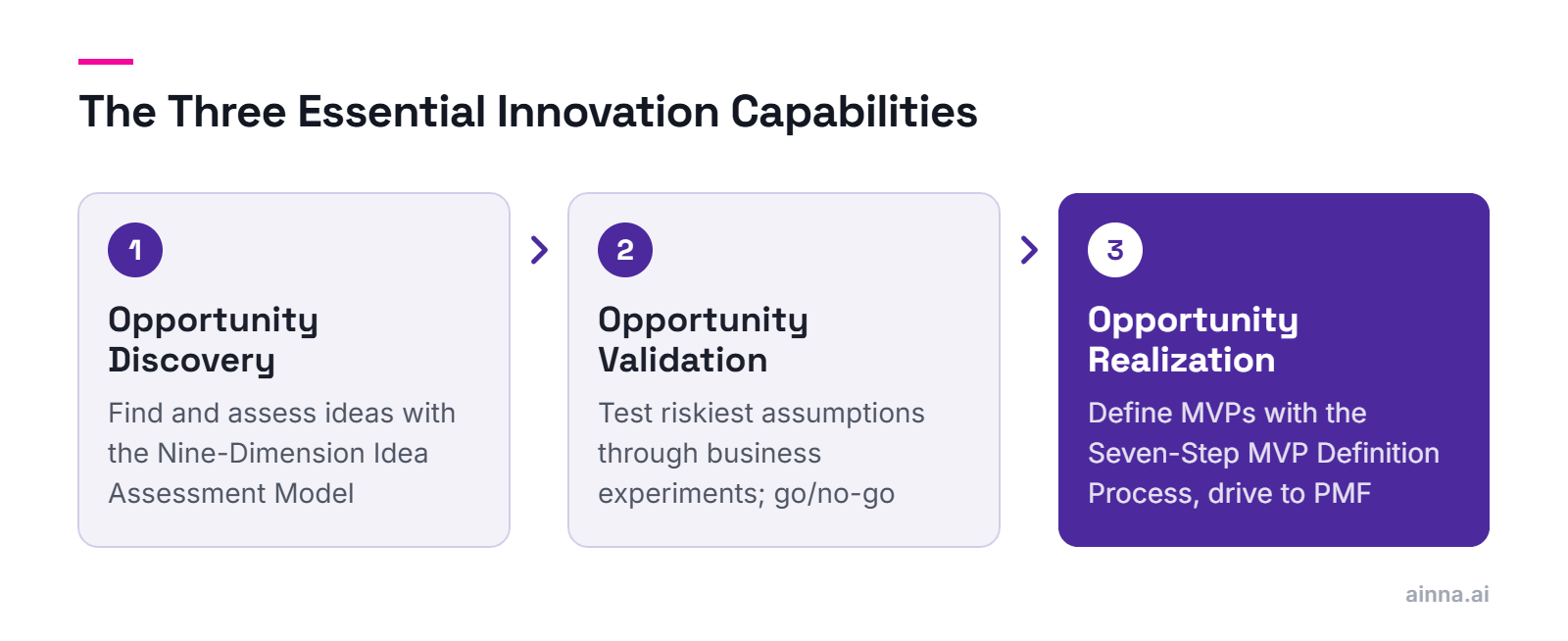
The Innovation Function is an always-on system of procedural, cultural, and technical activities, innovation enablers, and resources—all aimed at maximizing the likelihood of producing successful Innovation Opportunities. It's innovation as a continuous capability, not an occasional project.

  • Processes—stage gates, funding mechanisms, portfolio management
  • Culture—values, behaviors, and incentives that support innovation
  • Technology—tools for ideation, prototyping, experimentation, and measurement
  • Enablers—training, partnerships, innovation labs, external networks
  • Resources—dedicated budget, time allocation, and specialized talent

Innovation shouldn't be an occasional project or isolated department—it should be a continuous organizational capability, like finance or operations. Maturity progresses: Ad-hoc → Repeatable → Defined → Managed → Optimized.

An Innovation Opportunity is a feasible, well-structured solution to a defined problem, with novel aspects that are validated as highly probable value drivers for a critical mass of users. It's an idea that has passed initial validation gates.

  • Feasible—can actually be built with available resources and capabilities
  • Well-structured—problem and solution are clearly defined, not vague
  • Novel—contains new elements, not just incremental improvements
  • Validated—evidence supports the value hypothesis through research or experiments
  • Scalable—addresses a "critical mass" of users, not just edge cases

An idea becomes an Innovation Opportunity when: the problem is validated, solution approach is defined, feasibility is assessed, value potential is estimated, and initial validation is complete. Most ideas never become Innovation Opportunities—that's expected.

Innovation Mode is a special mode of operation where an organization drives business impact through novelty and continuous improvement—naturally and systematically. There's no distinction between "innovation culture" and "corporate culture"; innovation is simply how work gets done.

  • Innovation happens naturally—embedded in daily operations, not special initiatives
  • No distinction between "innovation culture" and "corporate culture"—they're the same
  • Processes, methods, and tools are fully integrated into how work happens
  • People are motivated and aligned with company purpose
  • Learning and adaptation are continuous, not occasional

Signs an organization is in Innovation Mode: ideas flow freely across hierarchy, experimentation is routine, failure is analyzed not punished, customer insights drive decisions. Learn more at The Innovation Mode.