What is an AI product - and what isn't one?

An AI product is one where a learned, probabilistic system - rather than hand-coded deterministic logic - is responsible for generating, predicting, classifying, or deciding something that directly shapes the user experience or business outcome. The defining characteristic is not that the product 'uses AI somewhere' but that the product's core value depends on a model making judgments that cannot be fully specified in advance. A search engine that ranks results using a machine learning model is an AI product. A calculator app that uses an AI API to parse voice input into numbers is not - the AI there is a utility, not the value.

  • The litmus test: if you replaced the AI component with a hand-coded rules engine, would the product still deliver its core value? If yes, it's a product using AI. If no, it's an AI product
  • AI products have probabilistic outputs: the same input can produce different outputs, and 'correct' is a spectrum rather than a binary state
  • AI products exhibit emergent behavior: the system may do things - good and bad - that were never explicitly programmed or anticipated by the product team
  • AI products have a training-inference lifecycle: their behavior changes not just through code deployments but through model updates, data changes, and fine-tuning
  • AI products introduce novel failure modes: hallucinations, bias amplification, adversarial vulnerabilities, and model drift - none of which exist in traditional software
  • Traditional software breaks visibly (error messages, crashes). AI products can fail silently - producing confident-sounding but wrong outputs that users trust
Key Takeaway

Understanding whether you're building an AI product versus a product that uses AI is the single most important framing question for your PRD. It determines which sections you need, how you define quality, how you specify acceptance criteria, and how you plan for the product's evolution. Get this wrong, and you'll write a PRD that fundamentally mismatches your product's nature.

What are the different types of AI products and how do their PRD needs differ?

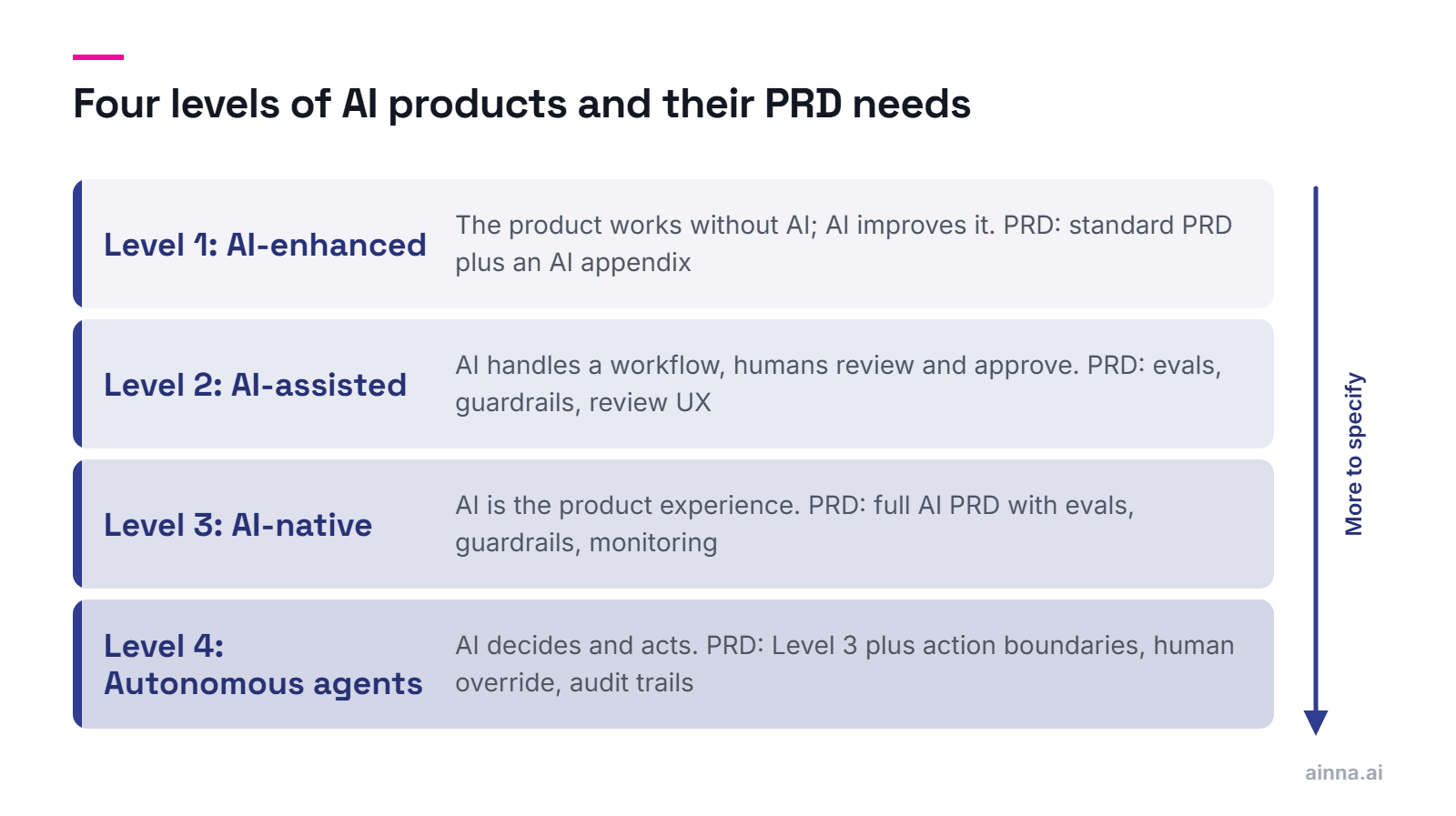
AI products exist on a spectrum from 'AI-enhanced' to 'fully autonomous.' Where your product sits on this spectrum determines how much of the AI PRD framework you need. A product using AI for smart autocomplete has very different specification needs than an autonomous AI agent that makes decisions and takes actions on a user's behalf. Understanding this spectrum prevents both over-engineering simple AI features and under-specifying complex ones.

  • Level 1 - AI-Enhanced Features: Traditional product with AI sprinkled in. Examples: autocomplete, spell-check, image auto-tagging. The product works without AI; AI improves it. PRD needs: add an AI implementation appendix to your standard PRD covering model constraints and basic quality thresholds
  • Level 2 - AI-Assisted Products: AI handles a significant workflow but humans review and approve outputs. Examples: AI-drafted emails, code suggestions, document summarization. PRD needs: eval framework for output quality, guardrails for content safety, clear UX for human review and correction
  • Level 3 - AI-Native Products: AI is the product experience. Examples: conversational chatbots, generative design tools, AI tutors, recommendation engines. PRD needs: full AI PRD treatment - comprehensive evals, guardrails, model strategy, monitoring, responsible AI considerations
  • Level 4 - Autonomous AI Agents: AI makes decisions and executes actions with minimal human oversight. Examples: agentic commerce systems, autonomous trading agents, self-driving software. PRD needs: everything from Level 3 plus action boundary specifications, human override mechanisms, audit trails, and regulatory compliance
  • Most products are Level 2 or 3. The mistake teams make is treating a Level 3 product as Level 1 - writing a standard PRD with a paragraph about 'the AI part'
  • Your product may span multiple levels: a platform might have Level 1 autocomplete, Level 2 document generation, and Level 3 conversational support - each component needs specification appropriate to its level
Key Takeaway

Before writing a single line of your PRD, place your product on this spectrum. If you're at Level 1, a standard PRD with AI annotations may suffice. If you're at Level 3 or 4, you need the full framework this guide describes. Most teams underestimate where they sit - when in doubt, specify one level higher than you think you need.

Can you give concrete examples of AI products at each level?

Understanding the spectrum in the abstract is useful; seeing real products at each level makes it actionable. Here's how real-world AI products map to the spectrum - and what each level means for the PRD you'd write.

  • Level 1 (AI-Enhanced): Email spam filters, photo auto-enhancement, smart reply suggestions. The product functions without AI; AI adds convenience. PRD focus: accuracy thresholds, false-positive tolerance, user opt-out
  • Level 2 (AI-Assisted): GitHub Copilot (suggests code, human decides), AI writing assistants (drafts content, human edits), medical image analysis (flags anomalies, doctor diagnoses). PRD focus: suggestion quality evals, human-in-the-loop UX, confidence display, liability boundaries
  • Level 3 (AI-Native): ChatGPT, Claude, and conversational AI platforms; AI-powered customer support; personalized learning tutors; generative design tools like AI prototyping systems. PRD focus: comprehensive eval framework, conversation design, guardrails, trust/transparency, monitoring, model strategy
  • Level 4 (Autonomous Agents): AI agents that book travel and negotiate prices, agentic commerce systems that buy and sell autonomously, AI agents that manage infrastructure. PRD focus: action boundaries, approval workflows, audit trails, kill switches, regulatory compliance, financial exposure limits
  • A single product can evolve across levels: a customer support tool might start as Level 2 (AI drafts, human sends) and evolve to Level 3 (AI handles tier-1 independently). Your PRD should specify which level you're targeting for each release
  • The AI product landscape is evolving rapidly - capabilities that required Level 3 complexity a year ago may become Level 1 commodities as models improve. See 2026 innovation trends for how this trajectory is unfolding
Key Takeaway

Classify your product honestly. Teams that build Level 3 products but write Level 1 PRDs discover the gap during launch - usually through user complaints about quality, safety incidents, or stakeholder misalignment. The classification isn't about complexity for complexity's sake; it's about matching your specification rigor to your product's actual risk profile.

What's the difference between an AI PRD and an AI agent specification (AGENTS.md)?

These are fundamentally different documents serving different audiences and purposes. An AI PRD is a strategic alignment artifact for humans - it tells your team, leadership, and stakeholders what you're building, why, and how you'll measure success. An agent specification (like AGENTS.md or system prompts) is a technical instruction set for AI systems - it tells the model how to behave, what tools to use, and what boundaries to respect. One aligns people; the other constrains machines. You need both, and neither replaces the other.

  • The AI PRD answers what and why: what problem are we solving, who are the users, what does success look like, what quality thresholds must we hit, what guardrails are needed, what's the model strategy
  • The agent specification answers how: system prompt instructions, permitted actions, response formats, tool access, memory rules, escalation logic - the operational behavior definition
  • The PRD is read by product managers, designers, engineers, leadership, legal. The agent spec is consumed by the AI system itself (and the engineers configuring it)
  • The PRD defines that 'the AI must never provide medical diagnoses.' The agent spec implements that as specific system prompt instructions, content filters, and topic guardrails
  • The PRD specifies eval quality thresholds (93% accuracy on golden test set). The agent spec doesn't - evals are external quality measurement, not internal behavior instructions
  • As AI agent orchestration becomes more common, some teams confuse agent configuration with product specification. The PRD should define the agent's boundaries and objectives; the agent spec should implement them
Key Takeaway

Think of it as the same relationship as a traditional PRD and the codebase: the PRD specifies what the product should do and the code implements it. With AI products, the PRD specifies the product requirements and the agent specification (plus prompts, evals, and guardrails) implements them. Writing a detailed AGENTS.md without a PRD is like coding without requirements - you might build something impressive, but you can't verify it's the right thing.

Why does a traditional PRD fail for AI-powered products?

Traditional PRDs are built for deterministic systems - you specify an input, define the expected output, and verify the result is exact. AI products are fundamentally probabilistic: the same input can produce different outputs every time. A specification that says 'the model should be helpful and concise' is too vague to be actionable, too ambiguous to verify, and too static to keep up with a system that changes behavior with every model update.

  • Traditional PRDs assume deterministic behavior: input A always produces output B. AI products break this assumption completely
  • Acceptance criteria like 'the feature works correctly' are meaningless when outputs vary on every run
  • AI systems introduce failure modes that don't exist in traditional software - hallucinations, bias, prompt injection, model drift
  • The underlying technology shifts rapidly: a model upgrade can change your product's behavior overnight without any code change
  • User experience depends on probabilistic quality rather than binary correctness - requiring new specification approaches
  • Traditional PRDs are written once and updated occasionally; AI PRDs must be living documents that evolve with the model
Key Takeaway

The core issue is not that PRDs are obsolete for AI - it's that the format of traditional PRDs cannot capture the unique requirements of probabilistic systems. You need a PRD that specifies ranges of acceptable behavior rather than exact expected outputs.

What are the key differences between an AI PRD and a traditional PRD?

An AI PRD retains the strategic core of a traditional PRD - problem statement, target users, success metrics, scope - but adds entirely new sections and transforms how existing sections work. The biggest shifts: acceptance criteria become eval frameworks, technical constraints include model selection and data requirements, user stories must account for variable outputs, and the document itself requires a faster update cadence.

  • Traditional PRD defines what the system does; AI PRD also defines how well the system performs and what it must not do
  • New sections required: eval framework, guardrails specification, model strategy, data requirements, responsible AI considerations
  • User stories shift from 'As a user, I can...' to 'As a user, I receive outputs that are [accurate/relevant/safe] within [defined thresholds]'
  • Success metrics must include AI-specific measures: accuracy, hallucination rate, response quality, latency, and eval pass rates
  • Technical constraints expand to cover model selection rationale, inference costs, context window limits, and fine-tuning strategy
  • Risk sections must address AI-specific threats: adversarial inputs, bias amplification, data poisoning, and model degradation
Key Takeaway

Think of it this way: a traditional PRD is a blueprint. An AI PRD is a blueprint combined with a quality contract, a safety specification, and an adaptation plan - all in one document.

When do I need an AI-specific PRD versus a standard one?

You need an AI-specific PRD whenever your product's core value proposition depends on a probabilistic system - typically a machine learning model, LLM, or generative AI component. If the feature would work identically without AI (for example, using AI merely to auto-fill a form field with deterministic data), a standard PRD with an AI implementation note may suffice. But if the product's quality, safety, or user experience hinges on model performance, you need the full AI PRD treatment.

  • Products where AI generates user-facing content (chatbots, writing assistants, code generators) - always need an AI PRD
  • Products using AI for classification or prediction (fraud detection, recommendation engines) - need AI-specific sections on accuracy, bias, and monitoring
  • Products with AI as a back-end optimization (search ranking, resource allocation) - may need a hybrid approach with AI-specific appendices
  • Products merely using API calls to well-defined AI services (OCR, speech-to-text) - often a standard PRD with model constraints is sufficient
  • The key test: does the product's quality depend on a model's judgment rather than its computation?
Key Takeaway

When in doubt, err toward the AI PRD format. The additional sections around evals, guardrails, and responsible AI considerations will improve your product even if the AI component seems straightforward at first.

What sections must an AI PRD include that a traditional PRD doesn't?

Beyond the standard sections every good PRD needs (problem statement, users, goals, scope, user stories), an AI PRD requires at least six additional sections: an eval framework, guardrails specification, model strategy, data requirements, responsible AI considerations, and a monitoring and adaptation plan.

  • Eval Framework: the structured, repeatable tests that define 'what good looks like' - effectively replacing traditional acceptance criteria
  • Guardrails Specification: explicit rules for what the AI must not do - content safety, topic boundaries, action permissions, and escalation triggers
  • Model Strategy: which model(s) to use, why, cost implications, fallback options, and upgrade path
  • Data Requirements: training data needs, retrieval-augmented generation (RAG) sources, data quality standards, and privacy constraints
  • Responsible AI Considerations: bias audits, fairness criteria, transparency requirements, and regulatory compliance (e.g., EU AI Act)
  • Monitoring and Adaptation Plan: how model performance is tracked in production, drift detection strategy, retraining triggers, and the human review loop
Key Takeaway

These sections aren't optional extras - they're as fundamental to an AI product as the feature list is to a traditional product. Skipping them is like building a car without specifying the braking system.

How do I define 'good enough' for a system that gives different answers every time?

You shift from specifying exact outputs to specifying measurable quality dimensions with acceptable thresholds. Instead of 'the system returns the correct answer,' you define: 'the system returns a factually accurate, well-structured response that addresses the user's question at least 92% of the time, as measured by our eval suite.' This requires breaking 'good' into concrete, testable signals.

  • Identify the quality dimensions that matter for your product: accuracy, relevance, tone, safety, completeness, format compliance
  • Set measurable thresholds for each dimension - these become your pass/fail criteria instead of binary test cases
  • Distinguish between hard constraints (must never reveal PII, must never generate harmful content) and soft targets (preferred tone, response length)
  • Use a portfolio of evaluation methods: deterministic checks for format/structure, AI-as-judge for subjective quality, human review for edge cases
  • Accept that 100% quality is impossible - define the acceptable error rate and the cost of each error type
  • Establish baseline performance with a golden test set before launch, then improve iteratively
Key Takeaway

The paradigm shift is from 'does it work?' to 'how well does it work, and is that good enough for our users?' This is uncomfortable for teams used to deterministic systems, but it's the only honest way to specify AI product quality.

What are evals, and why are they the new acceptance criteria for AI products?

Evals (evaluations) are structured, repeatable tests that measure how well your AI system performs against defined quality dimensions. In AI product development, the eval framework becomes your acceptance criteria - it defines the target, measures pass or fail, tracks improvement, and prevents regression. Unlike traditional test cases, evals run continuously and adapt as your system evolves.

  • An eval breaks 'be helpful and accurate' into testable signals: Is the format correct? Are required facts included? Is the tone appropriate?
  • Three types of eval judges: algorithmic (format validation, string matching - fast and cheap), AI-as-judge (subjective quality assessment - scalable but needs calibration), and human-aligned (complex quality dimensions - expensive but ground truth)
  • Your PRD should specify which quality dimensions need evals, what measurement approach each uses, and what the pass thresholds are
  • Evals replace the traditional QA sign-off: instead of 'PM tests feature and approves,' the eval suite runs on every commit and reports a quality score
  • The eval dataset should include golden examples (ideal outputs), edge cases, adversarial inputs, and real production samples
  • Start with 3-5 measurable signals per feature - you can expand as you learn what matters
Key Takeaway

Think of evals as the bridge between your PRD's quality aspirations and engineering's implementation reality. They make subjective quality requirements concrete and measurable - which is exactly what AI products need.

How do I write user stories for AI features that produce variable outputs?

Traditional user stories follow the pattern: 'As a [user], I want to [action] so that [outcome].' For AI products, you need to extend this pattern to include quality expectations and failure modes: 'As a [user], I want to [action] so that [outcome], where the AI output meets [quality threshold] and gracefully handles [known edge cases].'

  • Add quality clauses: 'As a sales rep, I want AI-generated email drafts so that I can respond faster, where drafts are contextually relevant at least 90% of the time and never include fabricated customer data'
  • Include failure-mode stories: 'As a user, when the AI cannot generate a confident response, I see a clear indication and alternative actions rather than a hallucinated answer'
  • Specify guardrail stories: 'As a user, the AI never provides medical diagnoses, financial advice, or content that violates our content policy - even if I explicitly ask for it'
  • Write feedback loop stories: 'As a user, I can rate AI outputs and provide corrections so the system improves over time'
  • Consider trust-building stories: 'As a new user, I can see examples of AI output quality before committing to using the feature for real work'
  • Reference our user stories and agile guide for the foundational patterns, then layer AI-specific clauses on top
Key Takeaway

The key difference is that traditional user stories assume the system either works or doesn't. AI user stories must express a spectrum of acceptable behaviors and define what happens at each quality level.

What success metrics should an AI PRD define?

AI products require dual success metrics: traditional product metrics (engagement, retention, conversion, NPS) plus AI-specific metrics (accuracy, hallucination rate, eval pass rates, response quality, latency, and guardrail trigger rates). You need both to understand whether your product is truly succeeding - a chatbot with high engagement but high hallucination rates is a ticking time bomb, not a success.

  • Product quality metrics: eval pass rate across quality dimensions, accuracy on golden test sets, hallucination rate, format compliance rate
  • User experience metrics: task completion rate, user satisfaction (CSAT) with AI outputs, re-prompt frequency (how often users rephrase because the first response was poor), escalation-to-human rate
  • Safety metrics: guardrail trigger rate, content policy violation rate, adversarial input detection rate, false positive rate on safety filters
  • Operational metrics: inference latency (p50, p95, p99), cost per query, model uptime, context window utilization
  • Business metrics: time saved vs. manual process, adoption rate among target users, feature retention at 7/30/90 days
  • Define leading indicators (eval scores, latency) and lagging indicators (user retention, NPS) - optimize the leading ones
Key Takeaway

The biggest mistake in AI PRDs is defining only traditional product metrics and ignoring AI quality metrics - or vice versa. You need the full picture because a fast, cheap model that hallucinates will destroy trust, and a perfect model that takes 30 seconds to respond will destroy engagement.

How do I specify AI guardrails in a PRD?

Guardrails define the boundaries of acceptable AI behavior - what the system must not do, regardless of user input. Your PRD should specify guardrails across four layers: input filtering (what prompts to reject), output validation (what responses to block), action boundaries (what the AI can and cannot execute), and escalation triggers (when to hand off to a human).

  • Input guardrails: topic relevance filters, prompt injection detection, PII detection in user inputs, blocklists for known attack patterns
  • Output guardrails: toxicity filters, hallucination detection, format validation, brand voice compliance, regulatory content restrictions
  • Action guardrails: permission boundaries for AI agents (e.g., 'can read emails but cannot send them'), approval workflows for high-stakes actions, confidence thresholds for autonomous decisions. As described in Innovation Mode 2.0, operating an AI Sandbox with carefully controlled data feeds, strict access control via well-defined Model Context Protocol (MCP) servers, and intelligent monitoring provides a robust foundation for constraining agent behavior
  • Escalation guardrails: when to route to human review (low confidence, sensitive topics, repeated failures), how to communicate limitations to users transparently. Include kill switches for immediate termination of AI threads if anomalies or unexpected behaviors are detected
  • Specify guardrails as hard constraints in the PRD, not as 'nice to haves' - these are non-negotiable product requirements
  • Include test scenarios for each guardrail: adversarial inputs that should be caught, edge cases at the boundary, and false-positive tolerance levels
Key Takeaway

In traditional products, you specify what the system does. In AI products, specifying what the system must never do is equally important - and often harder. Guardrails are not a post-launch safety patch; they belong in the PRD from day one.

How do I document responsible AI requirements in the PRD?

Responsible AI requirements cover bias, fairness, transparency, privacy, and compliance. These aren't aspirational statements - they're testable requirements that belong in your eval framework. Your PRD should specify: how bias is measured and what thresholds are acceptable, what transparency is owed to users (do they know they're interacting with AI?), what data privacy constraints apply, and which regulations must be met.

  • Bias and fairness: define protected attributes, specify acceptable performance variance across demographic groups, require regular bias audits
  • Transparency: specify when and how users are informed they're interacting with AI, what disclosure is required for AI-generated content, how confidence levels are communicated
  • Privacy: define what user data the model can access, retention policies for conversation logs, anonymization requirements, opt-out mechanisms. Consider privacy-preserving approaches such as differential privacy and federated learning for sensitive data
  • EU AI Act risk classification - determine which tier applies to your product: Unacceptable risk (banned - social scoring, real-time biometric surveillance), High risk (strict requirements - medical devices, credit scoring, recruitment tools, law enforcement, critical infrastructure), Limited risk (transparency obligations - chatbots must disclose they are AI, deepfakes must be labeled), Minimal risk (no specific requirements - spam filters, AI-powered games). Your PRD must specify which tier applies and what obligations follow
  • Accountability: define who owns AI quality decisions, how incidents are escalated and resolved, what audit trails are maintained. As described in Innovation Mode 2.0, critical decisions should always involve human oversight through a solid human-in-the-loop implementation
  • These requirements should be reviewed by legal, compliance, and ethics stakeholders before the PRD is finalized. For high-risk AI systems under the EU AI Act, you may also need conformity assessments, technical documentation, and registration in the EU database
Key Takeaway

Responsible AI isn't a separate initiative - it's woven into every section of the AI PRD. The teams that treat it as an afterthought are the ones that end up in headlines for the wrong reasons.

How do I document AI failure modes and fallback behavior?

AI products fail in ways traditional software doesn't - and often fail silently, producing confident-sounding but wrong outputs. Your PRD must define the expected failure modes, how the system detects them, and what happens when they occur. This is arguably the most critical section of an AI PRD because unhandled AI failures erode user trust irreversibly.

  • Hallucination: model generates plausible but factually incorrect information. Specify detection mechanisms (RAG grounding, fact-checking layers) and user-facing signals
  • Confidence collapse: model cannot produce a reliable answer. Define how low-confidence scenarios are handled - do you show a disclaimer, offer alternatives, or escalate to a human?
  • Adversarial manipulation: users attempt prompt injection or jailbreaking. Document the defense layers and what happens when attacks succeed
  • Context overflow: conversation exceeds the model's context window. Specify summarization strategy, graceful degradation, or user notification
  • Model outage or degradation: the underlying model service is down or performing poorly. Define fallback behavior - cached responses, simpler model, or graceful feature disablement
  • For each failure mode, specify: detection method, user-facing response, internal alerting, and recovery path. Include kill switches for immediate termination of AI operations when critical anomalies are detected - as Innovation Mode 2.0 emphasizes, securing AI agents requires mechanisms that go beyond standard security strategies
Key Takeaway

The best AI PRDs dedicate as much attention to failure modes as to happy-path features. Users forgive occasional errors when they're handled transparently - they abandon products that fail silently and confidently.

How do I specify conversational UX requirements in a PRD?

Conversational interfaces break traditional UI specification patterns entirely. You can't wireframe a conversation the way you wireframe a form. Instead, your PRD needs to define the AI's personality and tone, conversation flow patterns, error recovery behaviors, context memory rules, and the boundaries between conversational and structured UI elements.

  • Define the AI persona: tone of voice, formality level, personality traits, and how these adapt to context (a support bot and a creative writing assistant need very different personas)
  • Specify conversation flow patterns: how the AI handles greetings, multi-turn context, topic switches, ambiguous requests, and conversation endings
  • Design for discoverability: users often don't know what the AI can do. Specify starter prompts, capability hints, and progressive feature revelation
  • Define error recovery: what happens when the AI misunderstands, when the user is frustrated, when the conversation goes off-topic
  • Specify where conversational UI should yield to structured UI - not everything is better as a chat. Forms, selections, and confirmations often need traditional interface elements
  • Include response formatting rules: when to use structured layouts (lists, cards, tables) vs. prose, maximum response length, and how to handle multimedia outputs
Key Takeaway

The biggest UX mistake in AI products is assuming everything should be conversational. Your PRD should specify the right interaction pattern for each task - sometimes that's chat, sometimes it's a traditional interface, and often it's a hybrid. Use the design sprint approach to validate interaction patterns with real users before committing.

How do I specify trust and transparency requirements for AI interfaces?

Users need to understand three things about your AI: what it can do, how confident it is, and when it might be wrong. Your PRD should specify how each of these is communicated through the interface. Trust is built through consistent behavior, transparent limitations, and honest error handling - not through flashy capabilities.

  • AI disclosure: specify when and how users are told they're interacting with AI (upfront disclosure is increasingly required by regulation and always recommended by best practice)
  • Capability boundaries: define how the system communicates its limitations - 'I can help with X, Y, and Z. For account changes, I'll connect you with our team'
  • Confidence signaling: specify how the UI indicates when the AI is uncertain - visual cues, explicit disclaimers, or alternative suggestions
  • Source attribution: for AI that synthesizes information, specify how sources are cited and how users can verify claims
  • Correction mechanisms: define how users can report errors, provide feedback, and correct the AI's understanding
  • Consistency requirements: specify that the AI should behave predictably across sessions - stable tone, predictable response patterns, and visible conversation history
Key Takeaway

Trust takes months to build and seconds to destroy. Your PRD should treat transparency and trust not as design nice-to-haves but as core product requirements with the same rigor as performance targets.

How do I prototype and validate AI product UX before committing to the PRD?

AI UX is notoriously difficult to prototype because the 'interface' is the model's behavior, not just the visual design. The best approach combines Wizard-of-Oz testing (human pretending to be AI), prompt prototyping (testing actual model responses with real users), and interactive prototypes that simulate the AI experience at key interaction points.

  • Start with Wizard-of-Oz tests: have a human respond as the AI would, observe user reactions, and identify expectation gaps before writing any code
  • Use prompt prototyping: create a minimal interface, connect it to the actual model API, and let target users interact with real AI responses
  • Test failure scenarios explicitly: prototype what happens when the AI fails, gives a wrong answer, or says 'I don't know' - these moments define user trust more than happy-path interactions
  • Validate interaction patterns early: is chat the right modality? Should it be voice? Should structured inputs complement the conversation? Run a design sprint to test assumptions
  • Prototype the onboarding experience: the first interaction shapes the user's mental model of the AI's capabilities - get this wrong and users either under-use or over-trust the system
  • Document prototype learnings in the PRD: what worked, what surprised you, what changed from initial assumptions
Key Takeaway

The biggest risk in AI product UX is building an interface that looks great in demos but fails in real use. Prototyping with actual model outputs - including failures - is the only way to validate before you commit the full specification.

How do I specify requirements for multimodal AI products (text, voice, images, documents)?

Multimodal AI products accept and produce multiple content types - text, images, voice, documents, code, and more. This creates exponential complexity in your PRD because you need to specify input handling, output quality, and failure modes for each modality and their combinations. The key is defining clear boundaries: which modalities are supported, how they interact, and what happens at the edges.

  • Input specifications: which modalities are accepted (text, images, audio, files), size limits, format requirements, and how multiple simultaneous inputs are handled
  • Output specifications: which modalities are generated, quality standards for each (image resolution, audio clarity, text formatting), and when to use which output type
  • Cross-modal behavior: how does the system handle 'show me this as a chart' (text-to-visual) or 'describe this image' (visual-to-text) transitions?
  • Accessibility: voice interfaces must support text alternatives, visual outputs need descriptive text, and the system must gracefully handle users who can't use certain modalities
  • Latency expectations per modality: text generation might be acceptable at 2 seconds, but image generation might need 10-15 seconds with a clear progress indicator
  • Quality evals per modality: each content type needs its own evaluation criteria and thresholds
Key Takeaway

Multimodal is where AI product complexity truly escalates. Start by specifying and perfecting one primary modality, then add others incrementally - your PRD should reflect this phased approach.

How do I document model selection decisions in the PRD?

Your PRD should document the model selection rationale as a strategic decision, not just a technical implementation detail. This includes: why this model for this use case, the quality-cost-latency tradeoffs, what happens when a better model becomes available, and your fallback strategy. Models are the 'engine' of your AI product - the PRD should treat them with the same rigor as choosing a core technology stack.

  • Document the selection criteria: which quality dimensions were evaluated, what benchmarks were used, how models were compared on your specific use case
  • Specify the cost model: price per token/query, expected query volume, projected monthly cost, and the cost ceiling that triggers re-evaluation
  • Define the model upgrade strategy: how will you evaluate new models as they release, what eval suite gates promotion to production, what's the rollback plan
  • Include fallback architecture: what happens if your primary model provider has an outage or discontinues the model? Do you have a secondary provider ready?
  • Document context window constraints and their product implications: how much conversation history is retained, what summarization strategy handles overflow
  • Specify fine-tuning or RAG decisions: are you using the base model, fine-tuning on proprietary data, or augmenting with retrieval? Document the rationale
Key Takeaway

In AI products, model selection is not a one-time decision - it's an ongoing strategic choice that directly affects product quality, cost, and competitive position. Your PRD should reflect this by including evaluation criteria and update triggers.

How do I specify data requirements for an AI product PRD?

Data is the second 'engine' of AI products - alongside the model. Your PRD needs to specify three types of data requirements: the data needed to build the product (training data, eval datasets, RAG knowledge bases), the data generated by the product (conversation logs, user feedback, production examples), and the data strategy for improving the product over time (feedback loops, retraining triggers, data quality monitoring).

  • Knowledge base: what domain-specific data does the AI need access to, how is it sourced, how often is it updated, and who owns data quality?
  • Eval datasets: what golden examples, edge cases, and adversarial inputs are needed to measure quality - and who creates and maintains them?
  • User data: what conversation data is collected, how long is it retained, what consent is required, and how does it feed back into improvement?
  • Data freshness: for products that need current information, specify update frequency, staleness thresholds, and how outdated information is handled
  • Data privacy constraints: what data can the model see, what must be anonymized, what cannot be logged, and how do you handle data deletion requests?
  • Data quality standards: define minimum quality thresholds for knowledge base entries, eval examples, and training data
Key Takeaway

Many AI products fail not because the model is wrong but because the data feeding it is stale, incomplete, or biased. Your PRD should treat data requirements with the same seriousness as the model strategy - often they matter more.

How do I specify monitoring and drift detection requirements?

AI products degrade silently. Unlike traditional software where bugs cause visible errors, model performance can erode gradually due to data drift, model updates by providers, or changing user behavior. Your PRD must specify what is monitored, how degradation is detected, and what triggers intervention - because by the time users complain, you've already lost trust.

  • Production eval monitoring: run a subset of your eval suite against live production outputs on a continuous basis - not just at deploy time
  • Drift detection: specify metrics that indicate the model's performance is changing - accuracy trends, hallucination rate changes, response length shifts, topic distribution changes
  • Alert thresholds: define the performance levels that trigger review (warning) vs. automatic rollback (critical)
  • Human review sampling: specify what percentage of production outputs are reviewed by humans, how they're sampled (random vs. edge-case-biased), and how findings feed back into evals. As described in Innovation Mode 2.0, effective AI systems operate under the human-in-the-loop principle with a solid mechanism that ensures ongoing monitoring and feedback from humans, along with statistical comparison of the effectiveness of agent versus human-made decisions
  • Provider change monitoring: when using third-party model APIs, detect when the provider silently updates their model and re-run your eval suite
  • User feedback integration: specify how thumbs-up/down ratings, corrections, and support tickets are captured and analyzed to detect quality issues
Key Takeaway

Without proper monitoring specified in the PRD, you're essentially flying blind. AI products that don't continuously measure their own quality will eventually harm users - the only question is when.

How do I document AI infrastructure and cost considerations in the PRD?

AI products have a unique cost structure that traditional products don't: every user interaction incurs a variable inference cost. Your PRD should specify the cost envelope - maximum cost per query, projected monthly spend at different usage tiers, and the cost optimization strategies that are acceptable without sacrificing quality. This is a product decision, not just an infrastructure detail.

  • Cost per interaction: specify the target cost per query/response and the maximum acceptable cost - this directly affects model selection and architecture decisions
  • Scaling projections: estimate costs at 1x, 10x, and 100x current usage - AI costs often scale linearly with usage, unlike traditional infrastructure
  • Optimization strategies: define which cost reduction approaches are acceptable - caching frequent queries, using smaller models for simple tasks, batching requests, reducing output length
  • Latency-cost tradeoffs: faster models cost more. Specify the acceptable latency range and how it balances against cost constraints
  • Infrastructure requirements: GPU/compute needs, model hosting decisions (managed API vs. self-hosted), scaling strategy for traffic spikes
  • Cost monitoring: define alerts for unexpected cost spikes (a prompt injection attack could generate expensive responses) and spending caps
Key Takeaway

AI infrastructure cost is a product concern because it directly constrains what features you can build and how many users you can serve profitably. PMs who leave this entirely to engineering often discover their beautiful AI feature is economically unsustainable.

How do I align stakeholders who don't understand AI's probabilistic nature?

The biggest alignment challenge in AI products is that stakeholders expect deterministic outcomes from a probabilistic system. Executives want to know 'will it work?' - and the honest answer is 'it will work well X% of the time, and here's how we handle the other cases.' Your job is to educate stakeholders on this fundamental difference and shift the conversation from binary success/failure to quality thresholds and acceptable error rates.

  • Use concrete demonstrations, not abstract explanations: show the same prompt producing three different outputs, then explain why all three might be 'correct'
  • Frame quality in business terms: 'Our AI handles 85% of support tickets autonomously with 95% accuracy, saving X hours per week. The remaining 15% are escalated to human agents'
  • Set expectations early: the AI will sometimes be wrong. The question is how often, how badly, and how gracefully it recovers
  • Use comparisons: human support agents also make errors. Frame AI accuracy against human baselines where available
  • Create demo environments where stakeholders can interact with the AI and experience both its strengths and limitations firsthand
  • Include an 'AI Literacy' section in your PRD that explains key concepts (probabilistic outputs, hallucination, guardrails) in plain language for non-technical reviewers
  • For organizations early in their AI journey, reference how to transform into an AI-powered organization - stakeholder alignment is easier when the broader context is understood
Key Takeaway

Stakeholder alignment for AI products is fundamentally an education challenge. The PM who can explain probabilistic behavior in business terms - and set honest expectations - will get far better buy-in than one who oversells AI capabilities.

Who should review an AI PRD, and what should each reviewer focus on?

An AI PRD needs broader review than a traditional PRD because it touches domains that traditional products don't: model behavior, data ethics, legal compliance, and AI safety. Your review process should include product, engineering, data science, design, legal, and - depending on your domain - ethics and domain experts. Each reviewer has a specific lens.

  • Product leadership: validates strategic alignment, user value, business metrics, and competitive positioning - see our product leadership guide
  • AI/ML engineering: evaluates model selection feasibility, eval framework soundness, infrastructure requirements, and technical constraints
  • Data science: reviews data requirements, bias risks, eval methodology, and whether quality thresholds are realistic given the data
  • UX/Design: assesses conversation flows, trust patterns, error handling UX, and whether the AI interaction model serves real user needs
  • Legal/Compliance: reviews regulatory requirements, data privacy implications, liability for AI-generated content, and disclosure obligations
  • Domain experts (healthcare, finance, etc.): validate that AI outputs meet domain-specific accuracy and safety standards
Key Takeaway

The review process for an AI PRD is inherently cross-functional because AI products create risks and opportunities that no single team can fully evaluate. Build the review into your timeline - it takes longer than a standard PRD review, but it catches problems that would be vastly more expensive to fix post-launch.

How do I communicate quality-cost-speed tradeoffs in AI products to leadership?

AI products have a unique tradeoff triangle: quality (model capability, accuracy), cost (inference spend, infrastructure), and speed (latency, time-to-market). Every decision moves you along these three axes, and leadership needs to understand that choosing the best model is not automatically the right decision if it triples your cost per query or adds 5 seconds of latency.

  • Present concrete scenarios: 'Option A uses GPT-4 class models at $0.03/query with 95% quality; Option B uses a smaller model at $0.003/query with 88% quality. At our projected volume, that's $90K/year vs. $9K/year'
  • Use eval results as evidence: show leadership the actual quality difference between model tiers using your eval framework - not abstract benchmarks
  • Frame latency as a product decision: 'A 3-second response time reduces task completion by 15% in our usability testing - faster models are a product requirement, not an engineering preference'
  • Propose a tiered strategy where appropriate: use a powerful model for complex queries and a lightweight model for simple ones - show the cost savings
  • Include the 'do nothing' cost: what happens if the AI feature isn't built, or if a competitor ships first?
  • Present a phased approach: ship with a pragmatic model choice now, improve quality iteratively as you learn what matters most to users
Key Takeaway

Leadership doesn't need to understand transformer architectures - they need to understand the business implications of technical choices. Your PRD should translate model decisions into business language: cost, quality, speed, and risk.

How do I keep an AI PRD current when models and capabilities change every few months?

An AI PRD must be designed as a living document from the start - not written-once-and-filed. The most effective approach is to separate the stable strategic layers (problem, users, success criteria) from the volatile implementation layers (model choice, specific evals, technical architecture) and establish a regular review cadence for the volatile layers.

  • Structure the PRD in layers: strategic (stable - reviewed quarterly), tactical (moderately volatile - reviewed monthly), and technical (highly volatile - reviewed with each model update)
  • Strategic layer: problem statement, target users, core value proposition, business metrics - these change rarely
  • Tactical layer: feature priorities, quality thresholds, guardrail rules, UX patterns - these evolve as you learn from users
  • Technical layer: model selection, prompt engineering approach, eval datasets, infrastructure configuration - these may change with every major model release
  • Establish model update triggers: when a new model releases, re-run your eval suite. If scores improve significantly, update the PRD's technical layer and ship
  • Version your PRD and track what changed and why - this creates an audit trail and helps the team understand the rationale for shifts
Key Takeaway

The traditional PRD was a photograph of requirements at a point in time. An AI PRD is a video - it captures the requirements and how they're expected to evolve. Design for change from the beginning, and you'll spend less time rewriting and more time improving.

How do I plan for model upgrades in the PRD?

Model upgrades are the AI equivalent of a platform migration - they can improve your product dramatically or break it subtly. Your PRD should specify an upgrade evaluation process: what triggers an evaluation, how the new model is tested against your eval suite, what the rollout strategy is, and what the rollback plan looks like if quality regresses.

  • Trigger criteria: evaluate new models when they claim significant improvements on relevant benchmarks, when current model costs change, or on a regular cadence (quarterly)
  • Evaluation protocol: run the full eval suite against the new model before any user-facing deployment - compare quality scores, latency, cost, and edge case handling
  • Shadow deployment: route a percentage of production traffic to the new model (without user visibility) and compare outputs against the current model
  • Gradual rollout: deploy to a small user cohort first, monitor quality metrics and user feedback, then expand if metrics hold
  • Rollback plan: define what quality regression triggers an automatic rollback and ensure the infrastructure supports instant model switching
  • Document 'do not change' boundaries: certain behaviors, safety constraints, and integration points must remain stable across model upgrades
Key Takeaway

Platform capabilities change faster than product cycles. A PRD that assumes a static model will be outdated before it ships. Build the upgrade path into the specification from the start.

How does an AI PRD differ for an MVP versus a full product launch?

An AI MVP PRD focuses on validating the core AI hypothesis: can the model deliver sufficient quality on the primary use case to create genuine user value? The full product PRD then expands to cover edge cases, scale, multiple use cases, and production-grade safety. The key difference is scope of the eval framework - the MVP needs a focused eval suite for the core scenario; the full product needs comprehensive coverage.

  • MVP PRD focuses on one primary use case with a narrow eval scope - prove the AI adds value before broadening
  • MVP can accept higher error rates and more limited guardrails - but must still have baseline safety requirements
  • MVP should specify what you're trying to learn, not just what you're trying to build - the key assumptions about AI quality that need validation
  • Full product PRD expands: broader eval coverage, comprehensive guardrails, multi-model strategy, production monitoring, scale considerations
  • Full product PRD must address operational concerns the MVP can defer: cost optimization, model redundancy, compliance certifications, accessibility
  • Both should use The Universal Idea Model to frame the core product concept before diving into AI-specific requirements
Key Takeaway

The biggest AI MVP mistake is trying to build a comprehensive AI product from day one. Start with the narrowest possible use case, validate that the AI quality meets user expectations, then expand. Your PRD should reflect this phased approach explicitly.

How do I address the rapidly shifting competitive landscape in an AI PRD?

In AI, competitive advantages can appear or evaporate within weeks. A new model release can make your carefully engineered solution obsolete, or it can enable capabilities you couldn't have imagined six months ago. Your PRD should include a competitive analysis section that specifically addresses AI capability evolution, model provider dynamics, and your product's defensible differentiation beyond the model layer.

  • Identify what's defensible: if your only advantage is 'we use a good model,' any competitor with API access can match you. Document what creates lasting differentiation - proprietary data, domain expertise, workflow integration, user network effects
  • Map competitor AI capabilities: what models they use, what quality levels they achieve, how they handle the same use cases, and where they fall short
  • Monitor foundation model releases: every major model release (OpenAI, Anthropic, Google, Meta open-source) potentially reshapes the competitive landscape
  • Plan for capability commoditization: features that differentiate today may become baseline expectations tomorrow. Your product roadmap should anticipate this
  • Specify your data moat strategy: how does user interaction data improve your product in ways competitors can't easily replicate?
  • Include a 'what if' section: what happens to your product if model quality doubles in 12 months? What happens if a competitor launches an equivalent feature next quarter? Distinguish between quantifiable risks (competitor pricing, model costs) and genuine uncertainties (technological disruptions, regulatory shifts) - as Innovation Mode 2.0 emphasizes, these require fundamentally different response strategies: mitigation for risks, experimentation for uncertainties, and pivot paths for when assumptions fail
Key Takeaway

The AI competitive landscape rewards speed of adaptation, not just speed of initial launch. Your PRD should specify not just what you're building today, but how you'll evolve faster than competitors as the technology shifts beneath everyone's feet.

What does a complete AI PRD structure look like?

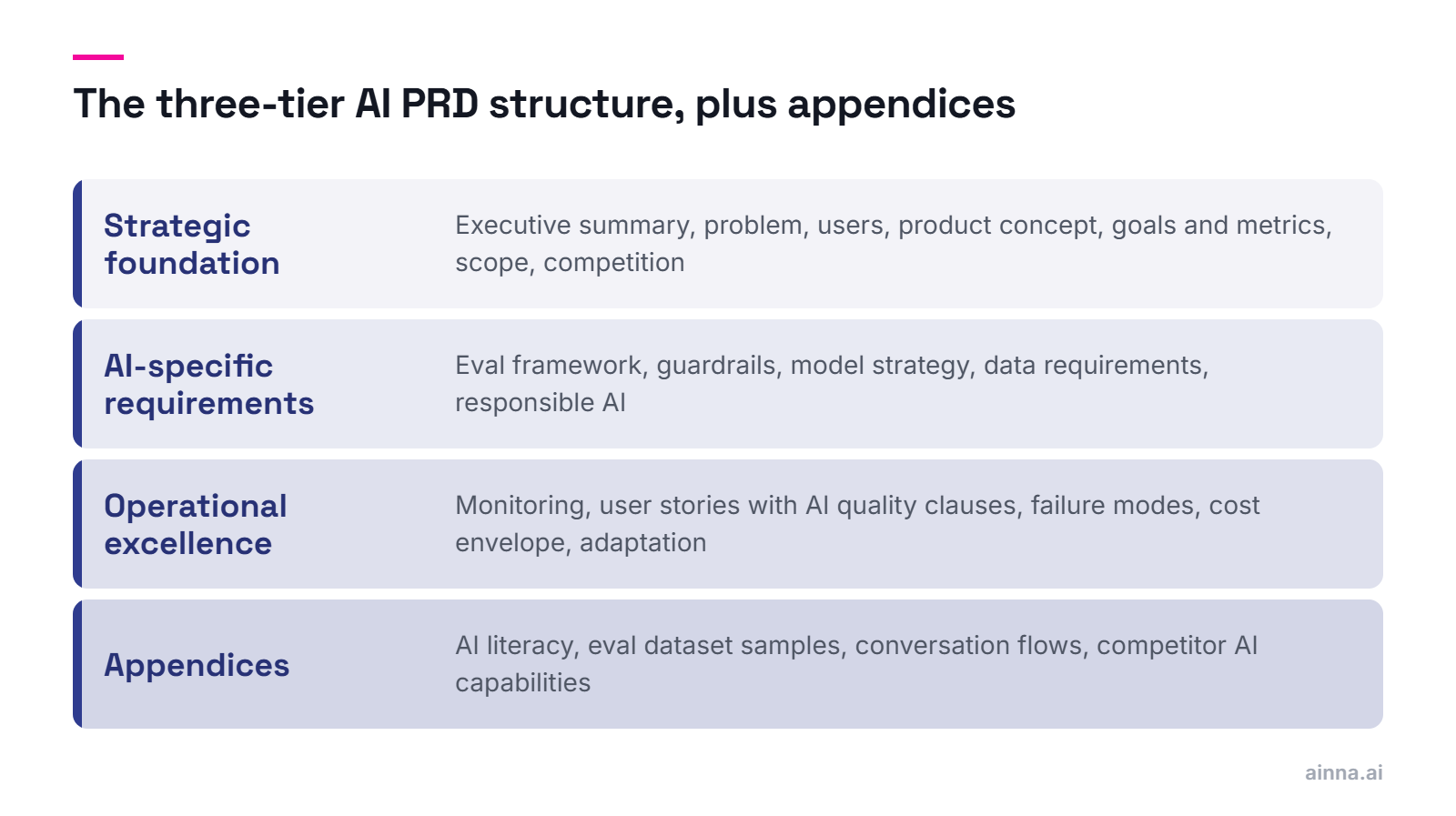
A complete AI PRD has three tiers: the standard strategic sections every good PRD needs (problem, users, goals, scope), the AI-specific sections that address probabilistic requirements (eval framework, guardrails, model strategy, data requirements), and the operational sections that keep the product healthy post-launch (monitoring, adaptation, cost management). Here's the recommended structure.

  • Tier 1 - Strategic Foundation: Executive summary, problem statement (use The Problem Framing Template), target users and personas, product concept (use The Universal Idea Model), goals and success metrics, scope and key features, competitive context
  • Tier 2 - AI-Specific Requirements: Eval framework (quality dimensions, measurement methods, pass thresholds), guardrails specification (input filtering, output validation, action boundaries, escalation triggers), model strategy (selection rationale, cost model, upgrade path, fallback), data requirements (knowledge bases, eval datasets, user data, privacy), responsible AI (bias, fairness, transparency, compliance)
  • Tier 3 - Operational Excellence: Monitoring plan (production evals, drift detection, alerting), user stories with AI quality clauses, failure modes and fallback behavior, infrastructure and cost envelope, adaptation strategy (model upgrades, eval evolution, living document cadence)
  • Appendices: AI literacy section for non-technical reviewers, eval dataset samples, conversation flow examples, competitor AI capability matrix
  • Keep the main document lean - use appendices and linked documents for detail that would bloat the core specification
  • Review and update Tier 1 quarterly, Tier 2 monthly, Tier 3 with each significant change
Key Takeaway

This structure acknowledges that an AI PRD serves multiple audiences: leadership needs Tier 1, cross-functional teams need Tier 2, and engineering/operations needs Tier 3. Each tier should stand on its own while connecting to the others.

What's the recommended process for writing an AI PRD?

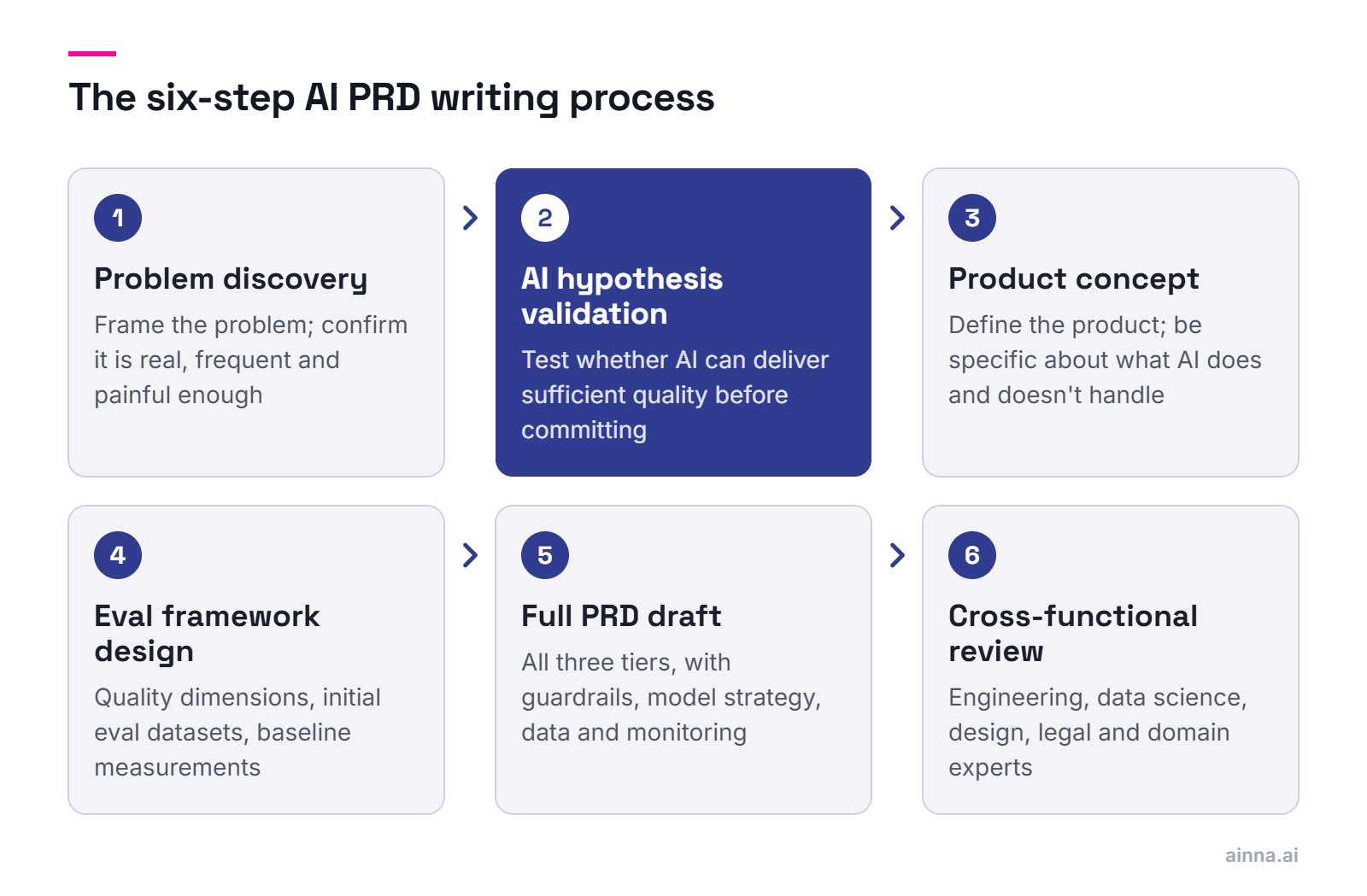
Writing an AI PRD follows a modified version of the product discovery process, with additional steps for AI-specific validation. The sequence matters: start with problem framing and user research (same as any product), then validate the AI hypothesis (can AI actually solve this problem well enough?), then specify the full requirements including evals, guardrails, and model strategy.

  • Step 1 - Problem Discovery: Frame the problem using The Problem Framing Template. Validate that the problem is real, frequent, and painful enough to warrant an AI solution
  • Step 2 - AI Hypothesis Validation: Before committing to a PRD, test whether AI can deliver sufficient quality. Use the Business Experiment Template to structure your validation. Run prompt experiments, build quick prototypes, evaluate model outputs against your quality bar
  • Step 3 - Product Concept: Define the product using The Universal Idea Model. Be specific about what AI does and doesn't handle
  • Step 4 - Eval Framework Design: Define quality dimensions, create initial eval datasets, establish baseline measurements. This is the foundation everything else builds on
  • Step 5 - Full PRD Draft: Write all three tiers, incorporating learnings from steps 1-4. Include guardrails, model strategy, data requirements, and monitoring plan
  • Step 6 - Cross-Functional Review: Get feedback from engineering, data science, design, legal, and domain experts. Iterate based on feasibility and risk feedback
Key Takeaway

The critical difference from a traditional PRD process is Step 2 - validating the AI hypothesis before committing to a full specification. Too many teams skip this and discover months later that the AI can't deliver the quality their PRD promised.

What are the most common mistakes in AI PRDs?

After working on dozens of AI product initiatives, the most common AI PRD mistakes fall into three categories: specifying AI like traditional software (deterministic thinking), being either too vague or too prescriptive about model behavior, and ignoring the operational reality of AI products. These mistakes are expensive because they're often discovered only after months of development.

  • Using traditional acceptance criteria instead of evals: 'the AI correctly answers customer questions' is not testable. 'The AI achieves 90% accuracy on our 500-question eval set across these 5 quality dimensions' is testable
  • Skipping the AI hypothesis validation: committing to a full product without first testing whether the model can deliver adequate quality for the specific use case
  • Vague quality specifications: 'the AI should be helpful and accurate' gives engineering nothing to build against. Specify concrete quality dimensions with measurable thresholds
  • Ignoring guardrails until post-launch: safety and boundary specifications belong in the PRD from day one, not as a patch after the first incident
  • Over-specifying model behavior: trying to script every possible AI response defeats the purpose of a probabilistic system. Define boundaries and quality standards, not exact outputs
  • Treating the PRD as static: AI products evolve faster than traditional products. Build in a review cadence and update triggers from the start
Key Takeaway

The root cause of most AI PRD mistakes is applying traditional product thinking to a fundamentally different type of product. If you catch yourself writing 'the system should always...' for an AI feature, pause and ask: 'What does always mean when outputs are probabilistic?'

Can you walk through a real-world example of an AI PRD section?

Consider an AI-powered customer support chatbot. Here's how the eval framework section might look compared to what a traditional PRD would specify for the same feature - illustrating the fundamental shift from binary acceptance to quality-spectrum measurement.

  • Traditional PRD would say: 'The chatbot answers customer questions accurately and escalates complex issues to human agents.' AI PRD instead specifies three measurable eval dimensions with concrete thresholds
  • Eval Dimension 1 - Factual Accuracy: 'Responses are factually correct based on our knowledge base. Measured by AI-as-judge against 200 golden Q&A pairs. Target: 93% pass rate. Below 88% triggers investigation'
  • Eval Dimension 2 - Response Completeness: 'Responses address all aspects of the customer's question. Measured by deterministic checklist (required fields present) plus AI judge for comprehensiveness. Target: 90% pass rate'
  • Eval Dimension 3 - Safety Compliance: 'Responses never include unauthorized commitments, incorrect policy information, or inappropriate content. Measured by adversarial test suite of 100 attack scenarios. Target: 99.5% pass rate. Below 98% triggers emergency review'
  • Guardrails section would specify: 'When confidence is below 0.7, the chatbot must acknowledge uncertainty and offer to connect the user with a human agent rather than guessing'
  • Monitoring section would specify: 'Run 50 random production conversations through the eval suite daily. Alert the PM if any dimension drops more than 3% below target for two consecutive days'
Key Takeaway

Notice how the AI PRD transforms subjective quality expectations into specific, measurable, and actionable specifications. This is the core skill of AI product management - translating 'make it good' into 'measure these signals against these thresholds.'

What tools and resources help write better AI PRDs?

Writing a great AI PRD requires tools for product discovery, prompt experimentation, eval framework management, and documentation. The right combination lets you validate AI feasibility before committing to a full specification, and keeps your PRD connected to real model performance data as the product evolves.

  • Product discovery and framing: Ainna helps you discover, frame, and document AI product opportunities - generating the strategic foundation (problem statement, product concept, competitive context) that grounds your PRD. Free to explore, no credit card required
  • Innovation frameworks: The Innovation Toolkit provides templates for problem framing, idea assessment, and product concept definition - the pre-PRD work that determines PRD quality
  • Eval frameworks: dedicated eval platforms help design, run, and track the structured evaluations that become your AI acceptance criteria. The key capability is running automated quality assessments across your defined dimensions
  • Prompt engineering: playgrounds from model providers (OpenAI, Anthropic, Google) let you test model capabilities against your use case before committing to a PRD
  • Documentation: use your existing PRD tools (Notion, Confluence, Google Docs) with AI-specific template sections added
  • Use code AINNA.AI to explore Ainna's full product discovery experience and generate your documentation package
Key Takeaway

The best AI PRD is built on validated insights, not assumptions. Use discovery tools to understand the problem, experimentation tools to validate AI feasibility, and eval tools to make quality measurable - then write the PRD with confidence.

Meet Ainna

Ready to Define Your AI Product?

Ainna applies The Innovation Mode methodology to help you discover and frame AI product opportunities - generating complete documentation packages so you can focus on strategy, not formatting.

Ideas in.
Opportunities out.