How Do You Create a Pitch Deck That Wins Investor Meetings?
TL;DR
A great pitch deck is not a summary of your business plan - it is a structured story that answers the investor's four core questions: Is this a real problem? Is this the right solution? Is this a big enough market? Is this the right team? Every slide exists to answer one of those questions with evidence, clarity, and conviction.
33 min read·Updated | Based on the Innovation Mode methodology
What you'll learn
What a pitch deck is, how it differs from a business plan and a one-pager, and how many slides
The narrative structure the best decks follow, starting with the problem slide
Slide by slide: product, market size, competition, traction, team and the ask
The four questions investors are always asking, and their red flags by stage
How to deliver the pitch, handle questions, and use AI to build a living deck
Share this guide
Pitch Deck Foundations
What a pitch deck is, what it is not, and why getting the basics right is the most important investment a founder can make.
If you're asking 'what is a pitch deck?' - it's a concise visual presentation, typically 10 to 16 slides, that tells the story of your startup to potential investors. The deck itself isn't the hard part. The hard part is the thinking that goes into it. A pitch deck's purpose is not to close a funding round - it's to earn the next conversation. Every slide, every sentence, every data point exists to move an investor from skeptical to curious.
A pitch deck is a storytelling tool, not a data dump - it communicates vision, opportunity, and conviction through a narrative arc that makes investors lean forward
Investors skim decks quickly, so yours needs to be immediately clear, visually clean, and narratively compelling enough to stand out
A pitch deck is different from a business plan: a business plan is exhaustive documentation for due diligence; a pitch deck is a curated story designed for a 10-20 minute window
Many founders maintain two versions: a 'reading deck' with enough detail to stand alone in an email, and a 'presentation deck' stripped down to support a live conversation
Beyond fundraising, pitch decks are used for partnership proposals, accelerator applications, hackathon finals, board updates, and corporate innovation programs
Think of it as the output of your product discovery documentation process - packaged for an investor audience rather than an engineering team
Key Takeaway
Your pitch deck has exactly one job: earn the next meeting. Not close the deal, not explain every feature, not impress with design. Just make the investor curious enough to say 'tell me more.' Everything in the deck should serve that single goal.
What is the difference between a pitch deck, a business plan, and a one-pager?
#
Pitch deck vs. business plan vs. one-pager - which do you actually need? All three, but they serve completely different audiences at different moments. A business plan is written for operational completeness. A pitch deck is written for investor attention. A one-pager is the cold-email weapon that gets you the meeting where you present the deck.
A pitch deck is 10-16 slides of curated narrative - your primary tool for investor meetings, demo days, and accelerator applications
A one-pager is a single-page summary for cold outreach and quick introductions - it gets you the meeting where you present the deck. Our one-pager guide covers how to write one that converts
A business plan is 20-50 pages of detailed strategy, financials, and operations - primarily useful for internal planning and lender due diligence, rarely for initial investor outreach
A PRD (Product Requirements Document) is an internal alignment tool - not investor-facing, but the product thinking behind it often informs the product and roadmap slides of your deck
A pitch deck is the door; a business plan is what's behind it. Don't hand someone the whole house when they've only asked to see the entrance.
All of these documents share a common foundation: structured product discovery documentation. Get the thinking right once with a sharp problem statement and a structured product concept, then package it for each audience
Key Takeaway
Most founders should build in this order: one-pager first (to test interest), pitch deck second (to tell the story), business plan last (when investors ask for it). The discipline of compressing your idea into 12 compelling slides will reveal what you don't yet know - and force you to find out.
When do you need a pitch deck - and how early is too early?
#
Earlier than you think. You need a pitch deck before your first investor conversation - which for most founders means before you feel ready. You do not need a finished product, a revenue line, or a complete team. You do need a sharp problem, a credible solution, evidence of market opportunity, and a compelling reason why you are the right team to build it.
Pre-seed: You can pitch with a problem, a vision, early prototypes, and founder-market fit. Investors are betting on people and opportunity, not metrics.
Seed: Investors expect early traction - user interviews, MVP usage data, letters of intent, or waitlist numbers. Some revenue is a strong signal but not always required.
Series A and beyond: Traction, unit economics, and a credible path to scale are table stakes. The deck still needs to tell a compelling story, but data carries more weight.
You are never too early to start building your deck - the process of building it clarifies your thinking as much as it communicates it
A pitch deck built on a validated product concept and a rigorous problem statement is dramatically stronger than one built on intuition alone
If you cannot articulate your startup using the Universal Idea Model - one structured sentence covering object, users, function, goal, value, and context - you are not ready to pitch
Key Takeaway
The right time to build a pitch deck is when you understand the problem deeply and believe you have a compelling approach to solving it. That can happen at day one. What changes across funding stages is the evidence you bring to support that belief.
How many slides should a pitch deck have? Fewer than you think. Between 10 and 16 slides for most early-stage pitches. Guy Kawasaki's 10/20/30 rule - 10 slides, 20 minutes, 30-point font minimum - remains a useful anchor. In practice, many decks run 12-16 slides, with additional supporting slides in an appendix for due diligence deep-dives.
10 slides is the minimum for a complete story, which means combining some of the twelve essential slides below - for example, competition with market, and go-to-market with business model - rather than dropping them
12-16 slides is the practical range - allowing a go-to-market slide, competition slide, and roadmap without overloading
Beyond 20 slides signals that you haven't made the hard prioritization decisions yet - and that is itself a signal to investors
The appendix is your safety net: put detailed financials, technical architecture, expanded team bios, market sizing methodology, and competitive matrices there
For a reading deck sent via email, allow 14-18 slides with more supporting context; for a live presentation deck, strip to the core 10-12
Slide count matters less than whether every slide earns its place - if you cannot defend why a slide is in the deck, remove it
Key Takeaway
Fewer slides, done exceptionally well, will always outperform more slides done adequately. The discipline of cutting forces clarity. If a slide does not advance the story or answer an investor question, it is creating friction, not value.
The narrative arc that makes investors lean in - and how to build it before you design a single slide.
What narrative structure do the best pitch decks follow?
#
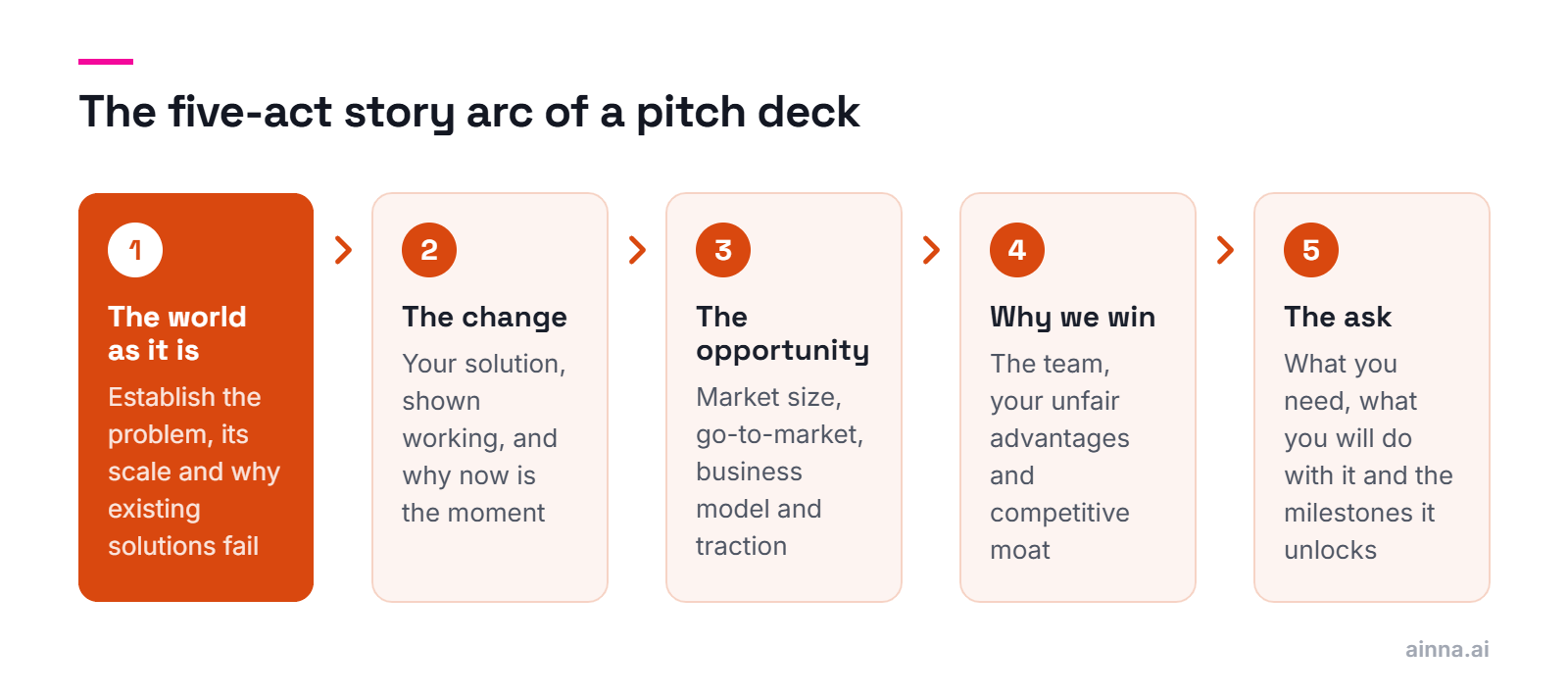
Nobody invests in a spreadsheet. They invest in a story they want to be part of. The best pitch decks follow a problem-solution-opportunity-execution arc across five acts. They open by making the investor feel the pain, present a compelling solution, prove the market is large enough to matter, demonstrate that this team can execute, and close with a specific, confident ask.
Act 1 - The World As It Is: Establish the problem, its scale, and why existing solutions fail. Make the investor feel the pain before they see the solution.
Act 2 - The Change: Introduce your solution, show it working, and explain why now is the moment this becomes possible.
Act 3 - The Opportunity: Show the market size, your go-to-market strategy, business model, and traction. Prove this is a business, not just a product.
Act 4 - Why We Win: Present the team, your unfair advantages, and competitive moat. Answer the investor's unspoken question: 'Why will this team beat everyone else?'
Act 5 - The Ask: State exactly what you need, what you will do with it, and what milestones it will unlock.
The biggest narrative mistake is leading with the solution before the investor has felt the problem - solutions without established problems feel like answers to questions nobody asked
Key Takeaway
A pitch deck that tells a great story is remembered. A pitch deck that lists great features is forgotten. The story is the pitch - the slides are just the medium it travels in.
Let the investor feel the problem before showing the solution; a solution without an established problem answers a question nobody asked.
Why is the problem slide the most important slide in the deck?
#
Ainna's founder, George Krasadakis, once watched a founder spend 8 minutes pitching an elaborate solution before an investor finally asked: 'Wait - what problem does this solve?' The meeting was over. The problem slide does more work than any other slide in your deck. It establishes that a real, painful, and widespread problem exists, makes the investor an emotionally invested audience, and sets up everything that follows.
The problem slide answers three investor questions simultaneously: Is this real? Is it painful enough? Is it large enough to build a business around?
Use the structure from the Problem Framing Template: who is affected, what the current experience is, and what the ideal state looks like
Quantify the pain: '$47B wasted annually on X' is more compelling than 'companies struggle with X'. Specific scenarios work too, such as this illustrative one: 'Product managers spend 40 hours per month writing documents that become outdated in weeks'
Make it relatable: if investors can picture a specific person experiencing this problem, the emotional connection is made
Avoid the common mistake of mixing the problem with the solution - the problem slide should create tension, not resolve it
The best problem slides come from founders who have lived the problem themselves or have deep, validated understanding from structured discovery
Key Takeaway
Nail the problem slide, and your solution slide practically writes itself. Rush it, and every subsequent slide is fighting uphill against investor skepticism.
How do I create a one-sentence description of my startup for the pitch deck?
#
Your one-sentence description is the most important sentence in the entire deck - it appears on the cover slide and sets the frame for everything that follows. If it requires explanation, it is not yet clear enough. The Universal Idea Model provides the exact structure: it forces you to define the form, the user, the function, the goal, the value, and the context of use in a single, clear statement.
The Universal Idea Model template: 'An [object] for [users] that [does something] in order to [achieve a goal]. Users benefit by [getting something back] when [they are in a specific situation].'
For the cover slide, compress this to a 5-7 word tagline: not a marketing slogan, but a plain description of what you do
Aim for plain, specific, and immediately understood: no jargon, and no explanation needed.
If your one-sentence description requires explanation, it is not yet clear enough - keep compressing until it stands alone
Test it: if a non-technical person cannot explain what your startup does after hearing your tagline once, rewrite it
Key Takeaway
The one-sentence pitch is a test of your own clarity, not just a communication tool. If you cannot say what you do in one sentence that anyone understands, you have a thinking problem, not a writing problem. The Universal Idea Model will surface that gap in under 5 minutes.
What belongs on each essential slide - and the most common mistake founders make on each one.
What are the essential slides every pitch deck must include?
#
What slides should a pitch deck include? Twelve slides are essential. Each answers a specific investor question. Missing any one of them leaves a gap in the story that investors will fill with their own - usually skeptical - assumptions.
1. Cover: Company name, one-line description, founding year, funding round. First impression - make it visually clean and immediately clear.
2. Problem: The pain you are solving, who experiences it, and why existing solutions fail. Quantify the cost of the problem.
3. Solution: What you built and how it solves the problem. One clear statement plus 2-3 key benefits.
4. Product: How it works - key features, user experience, differentiated capabilities. Screenshots, demo links, or a working prototype are powerful here.
5. Market Opportunity: TAM/SAM/SOM with credible sources and bottom-up methodology. Show why this is a large enough prize.
6. Business Model: How you make money. Revenue streams, pricing model, unit economics at scale.
7. Traction: Users, revenue, growth rate, retention, partnerships, pilots, LOIs. Often the most scrutinized slide - see our traction deep-dive.
8. Go-to-Market: How you will acquire customers at scale. Channels, sales motion, partnerships, and CAC assumptions.
10. Team: Why this specific group of people will win. Domain expertise, complementary skills, and founder-market fit.
11. Financials: 3-year projections with key assumptions visible. Revenue, costs, path to profitability.
12. The Ask: Exactly how much you are raising, spending buckets, and what milestones it will unlock.
Key Takeaway
These 12 slides are not a template - they are a checklist of investor questions that must be answered. How you answer them, in what order, and with what evidence is where your story becomes compelling or forgettable.
How do I make the product or demo slide convincing?
#
Can investors picture themselves using your product? That's the test your demo slide must pass. This is where investors stop hearing about your idea and start seeing it. Show the actual product - screenshots, a live demo, or a walkthrough of the core user flow. No product yet? A well-crafted prototype can be equally powerful when presented with confidence.
Show, don't tell: a 30-second walkthrough of your core user flow communicates more than three paragraphs of feature descriptions
If you have a working product: use real screenshots or a live demo that highlights the 'aha moment' - the point where the user gets value
If pre-product: build a high-fidelity prototype or clickable mockup. A design sprint can produce a testable prototype in five days
Focus on the core value loop: show the primary action a user takes and the outcome they get. Skip secondary features entirely - listing 15 features tells investors you don't know what matters most
If your product involves AI or machine learning, demystify it: show the input, the intelligence, and the output in plain language. Investors fund business value, not research demos
For technical products, consider a 'before vs. after' frame: show the user's current painful workflow, then show your solution handling the same task
Key Takeaway
If an investor can picture themselves using your product after seeing this slide, you've done your job. If they're still trying to understand what it does - you have more work to do on this slide than any other.
How do I size the market credibly in a pitch deck?
#
Market sizing is one of the most mishandled slides in early-stage decks. Founders either present an enormous TAM number with no supporting logic, or undersell the opportunity out of caution. The right approach is a bottom-up analysis that shows you understand your actual customer, not a top-down 'we need 1% of a $10 billion market' statement.
Show three layers: TAM (Total Addressable Market), SAM (Serviceable Addressable Market), and SOM (Serviceable Obtainable Market - your realistic 3-year target). Our TAM/SAM/SOM guide covers the methodology in depth
Bottom-up sizing is more credible. A hypothetical example: 'If there are 200,000 mid-market companies in North America, 25% match our ICP, and we charge $12K/year, our SAM is $600M.' Investors can follow the logic.
Top-down sizing from analyst reports ($X billion industry) is useful as context but insufficient on its own - it shows you can read a report, not that you understand your customer
Market timing matters: explain why this market is ready now. What tailwinds - regulatory, technological, behavioral - make this the right moment?
Investors want markets large enough for a venture-scale outcome but not so vague that the sizing is meaningless. A $1B credible SAM beats a $100B implausible TAM.
Reference established sources: industry analyst reports, government data, and comparable company disclosures are more credible than self-commissioned estimates
Key Takeaway
Market sizing is a test of your market understanding, not your ambition. Show that you know who your real customer is, how many of them exist, and how much they will pay. The rest follows.
How do I present the competitive landscape without looking naive?
#
The competitive slide isn't about your competitors; it's a credibility test about you. A SWOT overlay on your two strongest competitors is one way to show that understanding. Investors want to see that you understand the market landscape deeply - not that you've drawn a 2x2 matrix where you're conveniently in the top-right corner. Every experienced VC has seen that trick a thousand times.
Never say 'we have no competitors.' Every problem worth solving has competitors - existing solutions, workarounds, or the status quo itself. Claiming otherwise signals poor market understanding.
Map the real landscape: direct competitors, indirect alternatives, and the 'do nothing' option. Be specific about each - investors will check
Focus on differentiation, not superiority: 'We serve compliance teams in mid-size banks, where incumbents build for global enterprises' is stronger than 'We're better'
Use a framework investors recognize: competitive positioning maps, feature comparison tables, or value-chain analysis. Our Innovation Dictionary defines related terms such as disruptive, incremental and radical innovation
Show your unfair advantage: proprietary data, unique technology, network effects, regulatory moats, or founder-market fit. This is what makes competition irrelevant over time
Acknowledge strengths of competitors - it shows maturity. 'X has excellent distribution but their product is generic. We're building depth for a specific persona.' Investors respect honesty over spin
Key Takeaway
Pro tip: if an investor Googles your competitor during the pitch (and they will), what they find should match what you showed on the slide. Honesty about the competitive landscape builds more trust than the slickest positioning diagram ever could.
What makes a traction slide compelling - especially at early stage?
#
What counts as traction for a startup pitch deck? It depends entirely on your stage - but at any stage, the key is showing momentum, not just a snapshot. The traction slide answers the investor's most important risk question: 'Has anyone actually wanted this?' Early-stage founders often think they lack traction. They usually have more than they realize.
Traction is not only revenue - it is any evidence that the market is responding: signups, active users, retention rates, NPS, pilot agreements, strategic partnerships, hackathon wins, or design sprint validation. Hackathon teams can use even a weekend's worth of user testing as legitimate pre-seed traction
Show trajectory, not just a point in time: a chart showing 40% month-over-month growth from a small base is more compelling than a large static number
At pre-seed, qualitative traction counts: 50 customer interviews validating the problem, 200 waitlist signups, or a signed letter of intent from a design partner are legitimate proof points
Be transparent about early-stage limitations: investors who have backed early-stage companies understand nascent metrics - what they cannot forgive is misleading presentation
Connect traction directly to your MVP validation: your traction slide should make the market opportunity feel inevitable, not aspirational
Include logos of notable customers or partners if you have them - social proof is powerful, even at early stage
Key Takeaway
One real customer who loves your product is worth more than ten projected ones. Present what you have honestly, show the trajectory, and let the momentum speak.
What should the team slide communicate - and what do investors really read into it?
#
How do you make the team slide stand out? By answering the question investors are actually asking - not 'who are these people?' but 'why are these people the ones who will win this market?' The team slide is where investors make their most intuitive judgment call. Relevant experience and founder-market fit matter far more than impressive brand names.
Founder-market fit is the most powerful signal at early stage: have you lived this problem, worked in this industry, or built in this space before?
Include: names, roles, 1-2 most relevant credentials per person, any notable exits or domain expertise, and the complementarity of the team's skills
Address obvious gaps honestly: if you are missing a technical co-founder, say so and explain your plan to close that gap (what you can build without one, and where the limits are). Our team building guide covers the 'one team' mentality and complementary skill composition
Advisors can strengthen a team slide when they are genuinely involved and credible in your domain - not when they are simply names collected for optics
At seed stage, many investors will tell you they bet on the team more than the idea: a great team with a mediocre idea will pivot; a mediocre team with a great idea will struggle
The best team slides communicate not just capability but product leadership - the ability to see opportunities, handle ambiguity, and inspire a team to build something remarkable
Key Takeaway
Investors don't need to believe your team is perfect. They need to believe your team can learn fast enough to win. Show the combination of domain knowledge, technical chops, and relentless drive that makes you dangerous in this specific market.
How do I structure the ask slide - and what do investors need to see?
#
How much should you ask for in a pitch deck, and how do you present the use of funds? Be concrete. The ask slide is your closing argument and your business case rolled into one. It must state exactly how much you are raising, what you will spend it on, and what specific milestones those funds will unlock. 'Reach 1,000 paying customers and $50K MRR in 18 months' is a concrete plan. 'Growth and marketing' is a wish list.
State the exact amount: 'Raising $2.5M Seed Round' is professional. 'Raising somewhere between $1M and $5M' signals you have not done the financial modeling.
Show the spending split in clear buckets: e.g., 'Product development 40% - Go-to-market 40% - Operations 20%'. Investors are assessing whether you think commercially, not just technically.
Define the milestones this funding unlocks: '18-month runway to reach $1M ARR and 50 paying customers, positioning us for Series A.' Concrete milestones create confidence.
Connect the ask to the next round: show that this raise gets you to metrics that justify a larger follow-on investment
Include a target close date if you have one - it signals deal momentum and respects investor time
The ask slide is also an implicit test of your financial literacy: if your burn rate, runway, and milestone math do not add up, experienced investors will notice immediately
Key Takeaway
A confident, specific ask signals a founder who has done the planning. A vague ask signals a founder who has done the hoping. Be specific, be logical, and be clear about what success looks like on the other side of this funding round.
The investor's perspective - what they are really evaluating, what signals matter most, and what immediately kills a deal.
What four questions are investors always asking while watching a pitch?
#
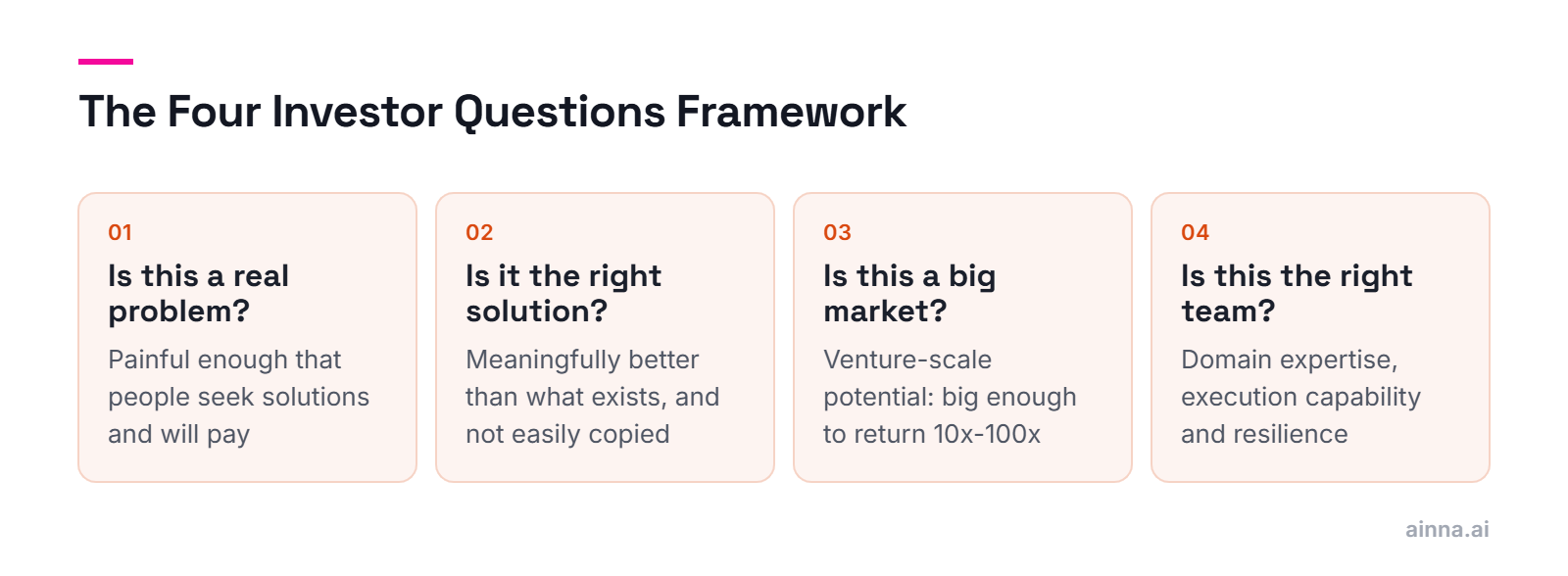
What do VCs look for in a pitch deck? Forget the surface-level advice about 'big markets' and 'strong teams.' Most investor evaluations come down to four core questions - and every slide in your deck should be answering at least one of them with evidence.
Question 1 - Is this a real problem?: Not just a problem someone has, but a problem so painful that people actively seek solutions and will pay to solve it
Question 2 - Is this the right solution?: Is it meaningfully better than what exists? Is the differentiation sustainable or easily copied?
Question 3 - Is this a big market?: Can it grow into a company big enough to return 10x-100x on the investment? Investors need venture-scale potential to justify the risk.
Question 4 - Is this the right team?: Do these founders have the domain expertise, execution capability, and resilience to navigate to success?
A fifth implicit question runs underneath all four: 'Why now?' What has changed - technologically, regulatorily, behaviorally - that makes this the right moment?
Map every slide in your deck to one of these questions. If a slide does not answer any of them, ask yourself whether it belongs in the deck at all.
Key Takeaway
Investors are not evaluating your slide design or your vocabulary. They are building a mental model of your startup's risk-return profile. Give them the evidence they need to answer these four questions confidently, and you have done your job.
Every slide should answer at least one of these; a fifth, implicit question runs under all four: why now?
What are the biggest red flags that make investors pass immediately?
#
The red flags that make investors pass immediately are claiming there is no competition, hockey-stick projections without assumptions, a vague problem, a solution-first narrative, confusing a project with a product, and defensive answers to hard questions. They appear with remarkable consistency, and most are not about weak products: they are about weak thinking made visible through the deck.
Claiming 'no competition': Every problem worth solving has competitors - existing solutions, workarounds, or the status quo itself. Claiming otherwise signals poor market understanding.
Unrealistic financial projections: Hockey-stick projections with no supporting assumptions are a credibility destroyer. Show your math and own your assumptions.
Vague problem definition: 'People struggle with productivity' is not a problem - it is a category. Investors fund specific, validated pain, not vague observations.
Solution-first narrative: Leading with features before the investor has felt the problem is a sign that you are in love with your solution, not your customer.
Confusing a product with a project - products evolve and scale, projects have an end date. This signals weak product thinking.
Defensive responses to questions: Investors ask hard questions on purpose. How founders respond to challenge reveals more about their character than any slide does.
Key Takeaway
Here's the thing about red flags: they're all fixable. Every single one traces back to insufficient preparation. More customer conversations. More market research. More structured thinking through your discovery documentation. Do that work, and the red flags disappear on their own.
How does what investors want differ at pre-seed, seed, and Series A?
#
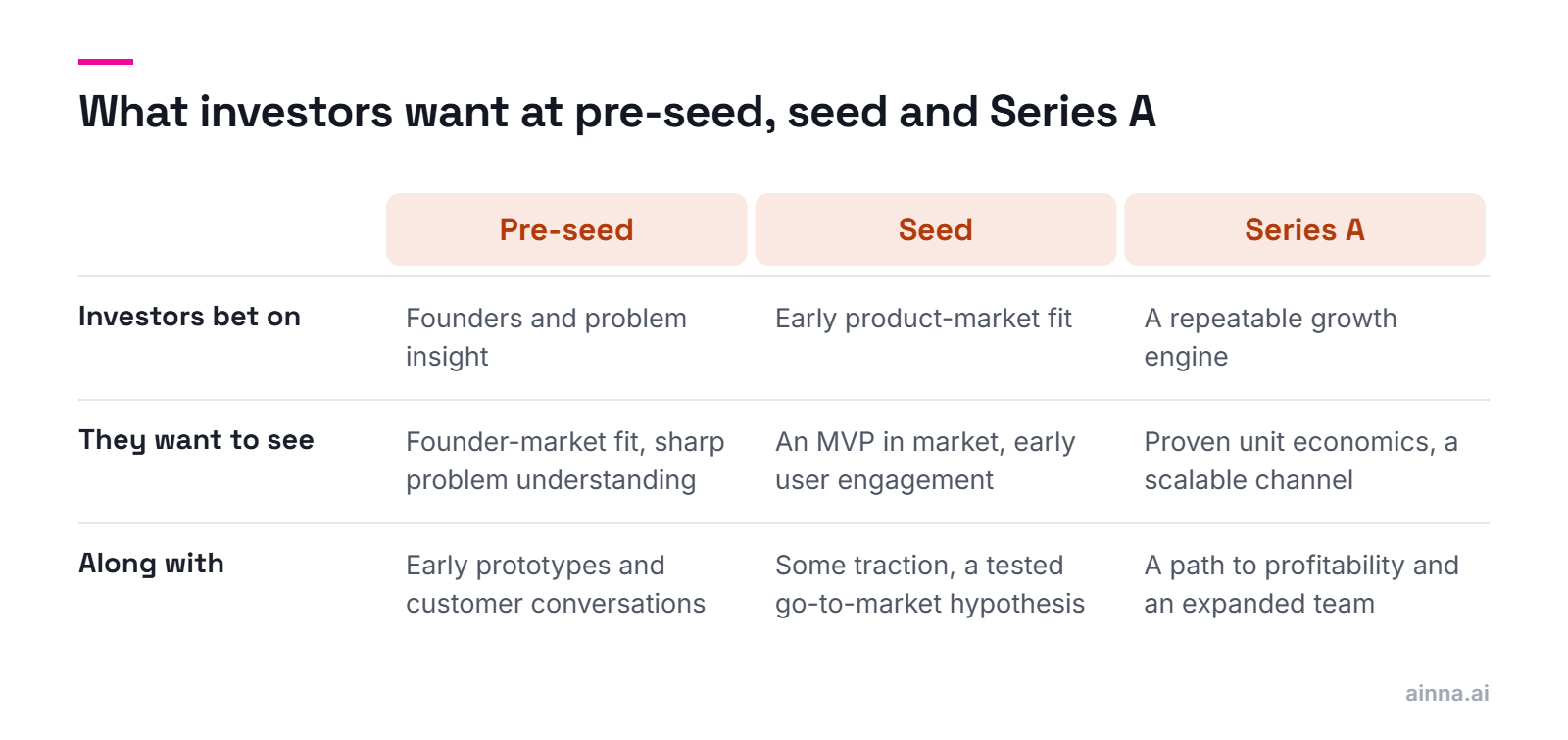
Each funding stage represents a different risk profile, and investors at each stage are paying for different kinds of evidence. Pitching a pre-seed story with a Series A deck structure looks premature. Pitching a Series A with no metrics looks unprepared. Understanding what stage you are at - and pitching accordingly - is as important as the content itself.
Pre-seed investors are betting on founders and problem insight: they want to see founder-market fit, a sharp problem understanding, early prototypes, and evidence you have spoken to potential customers
Seed investors are betting on early product-market fit: they want to see an MVP in market, early user engagement, some form of traction, and a go-to-market hypothesis that has been tested
Series A investors are betting on a repeatable growth engine: they want proven unit economics, a scalable acquisition channel, a path to profitability, and a team that has expanded to execute at scale
The narrative emphasis shifts: as a rough rule of thumb, pre-seed is about 80% story and team, 20% data; Series A is closer to 50% data, 50% story. By seed stage, have a clear product plan - a PRD or prioritized backlog - you can walk an investor through if asked
During the first half of 2025, investors poured about $145 billion into seed-through-growth rounds for US and Canadian startups, according to Crunchbase data - competition for attention at every stage is intense
The deck should match where you are, not where you hope to be - authenticity about your stage builds more trust than aspirational claims
Key Takeaway
The gap between pre-seed and seed is the gap between 'I believe this could work' and 'I have evidence this is working.' Bridge that gap with real users, real data, and real product - and make sure your deck reflects all three.
Rough rule of thumb: pre-seed is about 80% story and team, 20% data; Series A is closer to 50% data, 50% story.
How should I tailor my pitch for angel investors vs. VCs?
#
Should you pitch angel investors or VCs differently? Absolutely - but not by changing your story. Change the emphasis. In our experience, angel investors typically invest $25K-$250K, decide faster, and weight founder passion heavily. VCs invest $500K-$10M+, follow institutional processes, and fixate on market size, unit economics, and scalability.
Angels: emphasize vision, founder story, personal conviction, and potential for outsized return. They often invest in people they believe in
VCs: emphasize market size, defensibility, unit economics, and path to venture-scale returns ($100M+ revenue potential)
Angels may decide after one meeting; VCs typically require multiple meetings, partner discussions, and due diligence
For angels, a compelling one-pager and strong personal pitch can be enough to start the conversation
For VCs, prepare for deep dives: have your appendix slides, financial model, and customer data ready for follow-up
Corporate VCs (CVCs) add a third dimension: strategic fit with the parent company's business goals and technology roadmap
Key Takeaway
Before every pitch meeting, spend 15 minutes researching the investor's portfolio, thesis, and typical check size. A pitch tailored to the investor's worldview is dramatically more effective than a generic one - and the research signals that you're the kind of founder who does their homework.
The deck gets you in the room. The delivery keeps you there. How to present, handle Q&A, and follow up.
How do I deliver a pitch that investors remember?
#
Your slides are a crutch, not the main event. The best pitches feel like a conversation between two people exploring an exciting opportunity - not a scripted TED talk. We have seen founders with mediocre decks raise millions because they radiated genuine conviction. And we have seen founders with beautiful decks get passed on because they read their slides like a teleprompter.
Practice until the transitions between slides are invisible. Your narrative should flow like a conversation, not a slide-reading exercise
Speak to the investor, not the screen. Make eye contact (or camera contact for virtual pitches). Passion is conveyed through your face and voice, not your slides
Know your numbers cold: revenue, growth rate, CAC, LTV, burn rate, runway. Fumbling on numbers in Q&A destroys credibility instantly
Leave room for questions during the pitch, not just after. When investors ask questions mid-pitch, it means they're engaged - that's a positive signal
Tell a personal story: why do you care about this problem? The founder story is often what investors remember most
Time yourself. If you're allocated 20 minutes, plan for 12-15 minutes of presentation and 5-8 minutes of Q&A. Running over time signals poor preparation
Key Takeaway
Remember: investors are simultaneously evaluating your idea and imagining what it's like to work with you for the next 7-10 years. Every minute of your pitch is an audition for that relationship.
How do I handle tough investor questions during Q&A?
#
Tough questions during Q&A terrify most founders. They shouldn't. A hard question usually means the investor is engaged enough to probe - they are testing whether the risks have answers. A meeting with only polite questions is often the worse sign.
Prepare for the predictable hard questions: 'Why now?', 'What if Google builds this?', 'How do you get to $100M?', 'What's your unfair advantage?', 'Why should we invest in you vs. [competitor]?'
When you don't know, say so honestly: 'We haven't validated that yet. Here's how we plan to test it.' Guessing loses more deals than admitting uncertainty
Bridge from weakness to strength: 'Our current CAC is high, but we've identified three untested channels. Here's our testing plan for the next 90 days'
Use data from your discovery documentation to back up answers - investors respect founders who have done rigorous homework
If a question reveals a genuine blind spot, acknowledge it: 'That's a great question - we need to think about that more carefully.' It shows intellectual honesty
Keep answers concise: 60-90 seconds maximum. If the investor wants more detail, they'll ask a follow-up
Key Takeaway
The founders who ace Q&A aren't the ones with all the answers. They're the ones who show their thinking process in real time - reasoning through uncertainty with clarity and honesty. That's what investors are buying when they write a check.
What should I do after the pitch - and what materials should I have ready for due diligence?
#
Most founders think the pitch ends when they leave the room. It doesn't - it enters the most critical phase. What you do in the 24-48 hours after determines whether momentum carries forward or quietly dies. And investors who are seriously interested will move quickly to a set of standard diligence requests - being prepared before they ask signals execution capability.
Send a follow-up email within 24 hours: thank them, address any open questions from the meeting, and attach your one-pager for them to share with partners who weren't in the room
If they asked for your financial model, customer references, or PRD - send within 48 hours. Delays signal disorganization
Have these diligence materials ready before they're requested: financial model with documented assumptions, cap table, product specification demonstrating depth of product thinking, customer evidence (interview transcripts, NPS data, case studies), and legal foundation (incorporation docs, IP assignments)
Note what generated the most interest and the most skepticism - update your deck accordingly for the next pitch
Send genuine progress updates (not spam) every 2-4 weeks: new customers, milestones hit, key hires. This keeps you top-of-mind during the fundraising cycle
If they pass, ask for honest feedback and whether they'd consider investing at a later stage or can introduce you to someone who might be a better fit
Key Takeaway
Fundraising is a relationship, not a transaction. The founder who sends a crisp follow-up within 24 hours, delivers requested materials within 48, and sends genuine progress updates every few weeks - that's the founder who gets funded. Not because of the deck, but because of the pattern of competence the deck was just the beginning of.
Pitch Decks in the AI Era
How AI is changing how pitch decks are built, what it can and cannot do, and how to use it without losing your authentic founder voice.
How is AI changing how founders build pitch decks?
#
AI can draft a pitch deck in minutes, which is both a gift and a trap. The gift: founders can now iterate faster than ever. The trap: investors have seen a hundred AI-generated decks that all sound the same - professional, plausible, and completely forgettable. The bottleneck has shifted from production to strategy - from 'how do I fill these slides?' to 'do I understand my business well enough to give AI something worth generating?'
AI tools can generate initial deck structure, draft narrative slides, suggest market sizing frameworks, and produce consistent visual templates in a fraction of traditional time
The quality of AI-generated pitch decks is directly proportional to the quality of the input: a structured problem statement and product concept produce dramatically better outputs than a vague brief
AI cannot replace: authentic founder insight, validated customer evidence, real traction data, genuine team credentials, or the strategic judgment that makes an ask credible
AI excels at: narrative structure, consistent slide formatting, competitor landscape drafts, market sizing frameworks, and producing the visual coherence that amateur decks often lack
In 2026, investors are increasingly aware that AI-generated decks exist - what differentiates a funded deck is the depth of insight behind it, not the polish of its formatting
Key Takeaway
Garbage in, garbage out - that's as true for AI-generated pitch decks as it is for anything else. The founder who spends 30 minutes on the Universal Idea Model and then uses AI to generate the deck will produce something genuinely compelling. The founder who types 'make me a pitch deck for an AI startup' will produce something investors have already seen a hundred times this week.
What inputs do I need to give AI to generate a high-quality pitch deck?
#
The same principle that applies to AI-generated PRDs applies here: the quality of output mirrors the quality of input. To generate a pitch deck that reflects real insight rather than plausible-sounding generalities, you need five structured inputs before you prompt any AI tool.
Input 1 - Problem Statement: Use the Problem Framing Template to articulate the environment, current state, and ideal state. This feeds the problem, market opportunity, and solution slides.
Input 2 - Product Concept: Apply the Product Concept Template covering context, users, form factors, strategy, and monetization. This feeds the product, business model, and go-to-market slides.
Input 3 - Universal Idea Model sentence: 'An [object] for [users] that [does X] in order to [achieve Y]...' This becomes your cover tagline and solution slide anchor.
Input 4 - Traction evidence: Real numbers, even small ones. Signups, interviews conducted, pilot partners, revenue. AI cannot invent credible traction - you must supply it.
Input 5 - Team credentials: Names, roles, and the 1-2 most relevant facts per person. Founder-market fit signals if present.
With these five inputs structured, Ainna generates a complete pitch deck in minutes that reflects your actual startup - not a generic template dressed up with your logo
Key Takeaway
The 30 minutes spent completing a problem statement and product concept before prompting AI will save hours of revision afterward - and produce a deck that actually represents your company, not a category.
Should a pitch deck be a fixed document or a living one?
#
Your pitch deck is a living document - and if it's not evolving, you're doing it wrong. The deck you pitch in month one should be meaningfully different from the deck you pitch in month six, because you should know meaningfully more. We have seen founders go from 'polite passes' to term sheets after just 3-4 rounds of targeted refinements based on real investor reactions.
Maintain a master deck with all slides, then create tailored versions for different investor types: angels, seed funds, strategic corporates, and accelerator applications each prioritize different things
Update after every investor meeting: what questions were asked? What did you struggle to answer? Those gaps belong in the next version of the deck.
Never send an outdated traction slide - stale metrics signal a founder who is not paying attention to their own business
If you share the deck through a tool that tracks views, review the analytics - which slides do investors spend the most and least time on? That data should drive your revisions
AI tools dramatically reduce the cost of maintaining a living deck: updating a section and regenerating relevant slides takes minutes, not days
Maintain multiple formats: a full deck for meetings, a shorter version for email, and a one-pager for introductions. The living-document principle from The Innovation Mode applies: great documentation evolves continuously with what you learn
Key Takeaway
Version 1 of your pitch deck will be embarrassing by version 5. That's not failure - that's learning. Treat every investor meeting as a user test for your deck, just like you'd treat every customer conversation as a user test for your MVP.
The most costly pitch deck mistakes, how to avoid them, and the five tests that separate a deck that earns meetings from one that gets archived.
What are the most common pitch deck mistakes founders make?
#
The seven most common pitch deck mistakes are leading with the solution, market sizing by wishful thinking, a feature-heavy product slide, generic personas, no competitive differentiation, burying the ask, and starting with slides instead of thinking. They are remarkably consistent, and most are not about design. They are about clarity of thinking made visible - or invisible - through the deck.
Mistake 1: Leading with the solution - Opening with what you built before establishing why it matters. Fix: Make the investor feel the problem before you reveal the solution.
Mistake 2: Market sizing by wishful thinking - 'We need just 1% of a $100B market.' Fix: Bottom-up sizing from real customer numbers using our TAM/SAM/SOM methodology.
Mistake 3: The feature-heavy product slide - Listing 15 features tells investors you do not know what matters most. Fix: Pick your top 2-3 differentiated capabilities and explain why they are defensible.
Mistake 4: Generic personas - 'Our target user is a millennial who wants convenience.' Fix: Describe a real customer you have interviewed, their specific workflow, and exactly how you fit into their day.
Mistake 5: No competitive differentiation - A 2x2 matrix that puts you in the top-right corner without explaining why you belong there. Fix: Name real competitors, acknowledge their strengths, and articulate your specific moat.
Mistake 6: Burying the ask - Some founders are so uncomfortable asking for money that they make the ask slide vague or apologetic. Fix: State the number, show the math, own the confidence.
Mistake 7: Starting with slides instead of thinking - Jumping straight into a slide editor without first framing the problem, defining the product concept, and testing the Universal Idea Model. Fix: Write the one-pager and the discovery documents before opening any presentation software.
Key Takeaway
Every mistake on this list traces back to the same root cause: not enough time in the problem space. The fix isn't better slides - it's better thinking. Fix the thinking and the slides become easy.
How do I know if my pitch deck is actually good before I send it to investors?
#
A great pitch deck passes five tests that have nothing to do with design. Used as a quality checklist, they reliably expose the work still to be done. If your deck fails any of them, you have found your next priority.
Test 1 - The stranger test: Show the deck to a smart person who knows nothing about your industry. Can they explain the problem, solution, and why your startup will win - without any help from you?
Test 2 - The single-slide question test: Cover every slide except one and ask a colleague what question that slide is answering for an investor. If they cannot answer in 10 seconds, the slide lacks focus.
Test 3 - The competitor test: Find the best competing startup's pitch deck online. Is your differentiation immediately clear when the two decks are compared? If not, your moat is not communicated yet.
Test 4 - The math test: Does your ask + spending buckets + milestones + runway + financial projections all tell a consistent numerical story? Any investor will do this arithmetic - you should do it first.
Test 5 - The question anticipation test: List the 10 hardest questions an investor could ask after seeing this deck. Are the answers in the deck or its appendix, or will you be surprised in the room?
Key Takeaway
The best pre-investor review is a mock pitch session with someone who will challenge you harder than any investor would. The goal is to fail every possible way in a safe room, so you do not fail in the room that matters.
What design principles make a pitch deck visually compelling without overcomplicating it?
#
What makes a pitch deck look professional? Three words: clean, consistent, scannable. Pitch deck design should serve clarity, not demonstrate creativity. The goal is zero friction between the investor's eye and your message. Guy Kawasaki's 30-point font minimum rule exists for exactly this reason: if you need small text, you have too many words on the slide.
One idea per slide: every slide has a single main message. If a slide requires two headline statements, it should be two slides.
Data visualization over data tables: a well-designed growth chart communicates momentum in seconds; a table of monthly numbers requires minutes
Use product screenshots, not descriptions: showing what the product actually looks like is always more compelling than describing it in words
Consistent visual identity: same fonts, same color palette, same slide structure throughout. Visual inconsistency signals rushed execution.
30-point font minimum: if your content does not fit at 30 points, you have too much content - edit the content, not the font size
Narrative labels on slides, not generic titles: for example, 'The problem costs US businesses $47B annually' is a more compelling slide header than 'Problem'
Key Takeaway
Your deck's design is your startup's first design decision investors will judge. Design is not decoration - it is communication. A pitch deck that is hard to read, visually inconsistent, or cluttered signals that the team does not sweat the details. In a startup, details are everything.
Ainna applies the Innovation Mode methodology to your concept and builds the pitch deck with the market sizing and competitive analysis behind every slide, plus the one-pager and PRD from the same conversation.