What is AI-powered brainstorming?

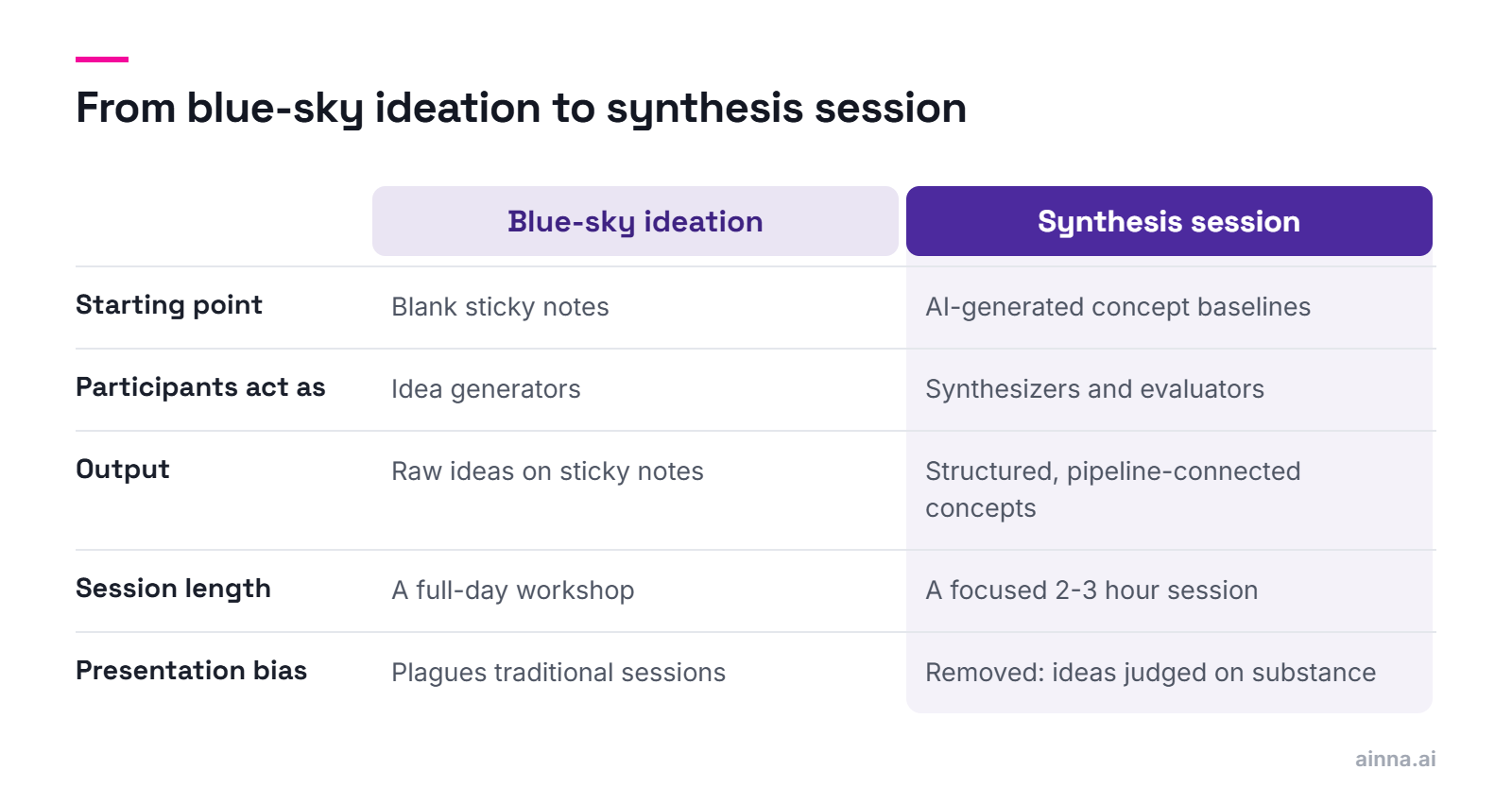
AI-powered brainstorming is what Innovation Mode 2.0 calls the evolution from 'blue-sky ideation' to a 'synthesis session.' Instead of a team generating ideas from scratch on sticky notes, AI generates concept baselines - and the team's energy shifts to evaluating, combining, refining, and strategizing around those concepts. As described in the book, 'classic business brainstorming is changing dramatically in the era of AI. It is morphing into a synthesis session versus a blue-sky ideation - a hybrid workshop aiming not only to generate ideas but primarily to synthesize, prioritize, and strategize.'

  • The core shift: human participants move from the role of idea generator to idea synthesizer. AI handles the volume and speed of concept generation; humans contribute the contextual judgment, strategic insight, and creative leaps that turn interesting ideas into viable opportunities
  • AI participates actively in the room. As described in Innovation Mode 2.0: 'you can have AI in the room that communicates via a smart speaker and interactive screens and contributes by listening, capturing, and organizing the ideas being described - all seamlessly. At the same time, AI acts as an innovator by generating and pitching ideas, matching not only the agenda of the session but also the evolving discussion'
  • The output changes: traditional brainstorming produces raw ideas on sticky notes. AI-powered brainstorming produces structured, enriched concepts - framed using the Universal Idea Model, de-duplicated, and connected to the Opportunity Discovery pipeline through the Innovation Graph
  • The pace changes: 'the whole process is accelerated, and the participants can focus their energy on assessing the potential of prototyped concepts versus starting from scratch and framing ideas themselves.' What took a full-day workshop can now happen in a focused 2-3 hour session
  • The inclusivity changes: AI-powered brainstorming removes the 'presentation skills' bias that plagues traditional sessions. Ideas are evaluated on substance rather than on how well their originator pitched them under time pressure
  • The Innovation Mode term for this evolved format is 'bionic brainstorming' - an AI-augmented workshop that can be standardized, repeated, and deployed across teams as a core innovation capability
Key Takeaway

AI-powered brainstorming is not 'brainstorming with better tools.' It's a fundamentally different format with a different purpose (synthesis over ideation), different participant roles (evaluators over generators), and different outputs (structured, pipeline-connected concepts over raw sticky notes). Understanding this distinction is essential for designing events that leverage AI's strengths without losing the human elements that make innovation culturally valuable.
What does the AI Ideator actually do during a brainstorming session?

The AI Ideator is not a passive tool that waits for prompts - it's an active participant that listens, contributes, and adapts in real-time. As described in Innovation Mode 2.0, the AI follows the discussion, captures feedback and questions, generates new ideas that match the evolving conversation, and visualizes and prototypes selected concepts on connected screens - allowing participants to provide verbal feedback and iterate instantly.

  • Active listening and capture: AI processes the live discussion, captures ideas as they're articulated, and organizes them in real-time. No more post-session decoding of sticky notes - every idea is captured with its context, attribution, and the feedback it received
  • Concept generation: 'the AI can take the lead, present ideas, and facilitate the discussion with the team, both in the room and among the online participants.' AI generates concepts that match the session's agenda and the evolving direction of the discussion - adapting in real-time rather than working from a static brief
  • Real-time visualization and prototyping: 'in an advanced scenario, the AI visualizes and prototypes selected ideas, which are then presented on connected screens, thus allowing participants to provide verbal feedback and improve them just in time.' Participants see their concepts come to life during the session itself
  • Supportive work: 'the AI facilitator also does the supportive work - it takes notes and organizes the evolving ideas seamlessly by processing the live discussion.' At the end of the session, ideas are automatically reflected in the Innovation Graph, attributed to the identified participant, and enriched with comments and feedback
  • Post-session processing: 'after the event, AI simplifies things again by processing, summarizing, and potentially scoring human-enriched ideas.' The brainstorming output includes executive summaries, detailed structured ideas, prioritization decisions, and links to visuals and prototypes generated during the session
  • While this scenario may sound futuristic, it is already feasible with current technology. The Innovation Mode approach connects commercially available AI capabilities (large language models, speech recognition, screen sharing, code generation) into a coherent experience through the Innovation Portal
Key Takeaway

The AI Ideator transforms the brainstorming room from a place where ideas are generated into a place where ideas are generated, visualized, prototyped, evaluated, and documented - all within a single session. The team leaves with structured, pipeline-ready concepts, not a wall of sticky notes to interpret later.

What is lost when brainstorming shifts from classic to AI-powered?

Something real is lost - and Innovation Mode 2.0 is honest about it. The creative process is the energizing factor for many innovators - the fun of innovation. When AI generates the baseline, the human experience shifts from 'creating something from nothing' to 'evaluating and improving what AI created.' For some participants, this is an upgrade (less pressure, more strategic). For others, it's a downgrade (less creative satisfaction, less ownership). Organizations must intentionally design for both.

  • Creative ownership: in traditional brainstorming, every idea belongs to someone. They conceived it, articulated it, defended it. In AI-powered sessions, many ideas originate from AI - and the human contribution is synthesis, evaluation, and refinement. This changes the emotional relationship participants have with the output
  • The surprise factor: traditional brainstorming produces unexpected ideas from unexpected people. The junior analyst who proposes a radical concept that changes the product direction - that's a career-defining moment that builds innovation culture. AI-powered sessions can diminish these moments by providing a comprehensive baseline that leaves less room for breakthrough human contributions
  • The social dynamic: brainstorming is partly about team building - people sharing ideas, building on each other's thinking, and experiencing creative flow together. When AI handles the generation, the social dynamic shifts from co-creation to co-evaluation. Both are valuable, but they feel different
  • As Innovation Mode 2.0 warns: 'there are concerns that overreliance on AI-generated content may diminish human creativity or impact the innovation culture. After all, the creative process is the energizing factor or, for some, the fun of innovation'
  • The bias risk: 'teams should remain vigilant about potential AI biases and critically evaluate AI-generated content rather than simply accepting it.' AI-generated concepts can anchor the group on patterns from training data, potentially narrowing the solution space rather than expanding it
  • The mitigation: 'organizations must intentionally preserve space for pure human creativity and implement practices that use AI as augmentation rather than a replacement for creative thinking.' This means designing sessions with explicit AI-free segments where human ideation is the only source of concepts. See the parent guide for the human-in-the-loop design principle
Key Takeaway

Acknowledging what's lost is not an argument against AI-powered brainstorming - it's a prerequisite for designing it well. The organizations that pretend nothing changes will find their innovation culture quietly eroding. The ones that design for both AI speed and human creative satisfaction will get the benefits of both.

Did you know? Ainna helps you identify silent assumptions hiding in your product concept — the untested beliefs that become the primary points of failure. Surface your assumptions

How does the Workshop Designer set up an AI-powered brainstorming session?

The AI-powered Workshop Designer transforms brainstorming setup from a weeks-long coordination project into a minutes-long configuration task. In the Innovation Mode methodology, the organizer provides a brief description of the brainstorming and instantly gets a well-defined session with an optimal agenda - based on the context of the company, its innovation agenda, and related data from the public domain and market intelligence.

  • Participant recommendation: the Workshop Designer uses the company's directory and innovation performance data to recommend the right participants. It optimizes for cognitive diversity, domain relevance, and collaborative track record - not just seniority and availability
  • Content package creation: AI automatically creates a pre-read package of 'related ideas, research findings, and stories from the market to consider as context and source of inspiration.' This replaces the manual process of curating preparation materials, which often gets skipped due to time pressure
  • Event page generation: the portal creates a dedicated webpage for the session presenting its agenda, rules, resources, and context. 'Instead of compiling multiple attachments and long email texts, the organizer simply confirms the audience and triggers the invite that shares the link to the event's page'
  • Problem statement baseline: using The Problem Framing Template, AI generates a draft problem statement based on available context, giving the team a strong starting point to refine rather than starting from scratch
  • Communication automation: AI generates the invitation sequence and follow-up communications, ensuring participants arrive prepared and aligned on the session's objectives
  • For teams without a full Innovation Portal, Ainna provides much of this capability: generating problem statements, competitive analysis, product concepts, and documentation packages that serve as excellent brainstorming preparation materials
Key Takeaway

The Workshop Designer doesn't just save time - it raises the quality floor. Every brainstorming session starts with better-prepared participants, clearer context, and a stronger problem statement. The effort that used to go into logistics now goes into the creative work itself.

What does a 'bionic brainstorming' session look like in practice?

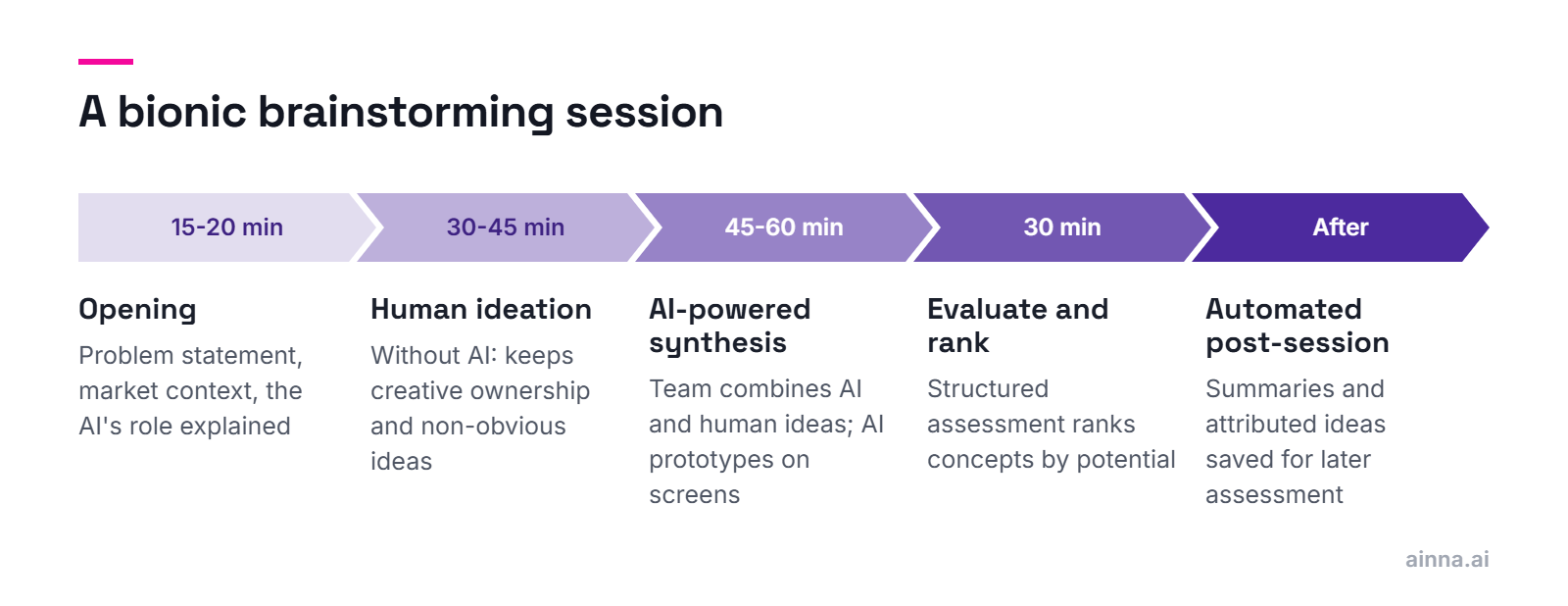
A bionic brainstorming session combines human creativity with AI capability in a structured format that can be standardized and repeated across teams. In the Innovation Mode methodology, the format is designed to be packaged as an organizational capability - a 'standard and efficient innovation workshop' available to any team - connected to the Opportunity Discovery pipeline so outputs automatically feed into the broader innovation program.

  • Opening (15-20 min): facilitator presents the problem statement (pre-generated by the Workshop Designer, refined by the organizer). Market intelligence and competitive context are shared. The AI Ideator is introduced as a participant - its role and limitations are explained transparently
  • Human ideation segment (30-45 min): participants ideate without AI assistance - sketching, discussing, and pitching concepts in the traditional format. This preserves creative ownership and produces the unexpected, non-obvious ideas that AI-powered generation often misses. Ideas are captured digitally in real-time
  • AI-powered synthesis (45-60 min): AI presents its generated concepts alongside human ideas. The team evaluates, combines, and refines. AI visualizes and prototypes selected concepts on connected screens. Participants provide verbal feedback and iterate. The focus shifts from 'what should we create?' to 'which of these concepts has the most potential?'
  • Evaluation and prioritization (30 min): the team applies structured assessment - potentially using elements of the Nine-Dimension Idea Assessment Model - to rank concepts by potential. Unlike traditional brainstorming where voting is influenced by presentation skills and group dynamics, AI-generated summaries of each concept ensure evaluation is based on substance
  • Post-session (automated): AI processes all ideas, generates executive summaries, reflects structured concepts in the Innovation Graph with contributor attribution, and connects outputs to the Opportunity Discovery pipeline. Documentation that traditionally took days is completed automatically
  • The total session runs 2-3 hours rather than a full day - because AI handles the preparation, documentation, and idea structuring that traditionally consumed most of the time. Teams can run these sessions monthly as part of the Innovation Calendar
Key Takeaway

The bionic brainstorming format is designed to be repeated, not just experienced once. When standardized and connected to the Opportunity Discovery pipeline, each session builds on the accumulated intelligence of all previous sessions. Session #8 starts with richer context, better participant matching, and more refined AI baselines than Session #1.

How are brainstorming ideas preserved and made actionable through the Innovation Graph?

In traditional brainstorming, the organizer is left with a pile of sticky notes and the task of making sense of them. Most ideas are lost or forgotten within days. In the Innovation Mode methodology, AI automatically processes, structures, and connects every idea to the Innovation Graph - making them discoverable, assessable, and actionable across the entire organization, indefinitely.

  • During the session: AI captures ideas in real-time, structures them using the Universal Idea Model, and attributes them to their contributors. Feedback, questions, and refinements are linked to the ideas they reference
  • Post-session automation: 'ideas are automatically reflected in the Innovation Graph, attributed to the identified participant, and enriched with comments and feedback captured in the session.' The output is available through the Innovation Portal with executive summaries and detailed structured concepts
  • De-duplication and linking: AI identifies overlap between new ideas and existing concepts in the Innovation Graph. An idea that echoes something proposed in a previous session or design sprint is linked rather than duplicated - preserving the evolution of thinking across events
  • Assessment pipeline: structured ideas can be evaluated using the Nine-Dimension Idea Assessment Model by the network of evaluators. Ideas that score high on the Opportunity Score are flagged for further exploration through design sprints or venture building
  • Cross-event discovery: an idea from a January brainstorming can be automatically surfaced during a March hackathon if it's relevant to the hackathon's theme. The Innovation Graph makes cross-pollination between events automatic rather than accidental
  • IP identification: ideas with high novelty scores are flagged for patent review. The digital capture with timestamps and attribution supports the invention disclosure process
Key Takeaway

The Innovation Graph transforms brainstorming from a one-time event into a continuous contribution to the organization's innovation knowledge base. Every session adds to the collective intelligence. No idea is lost, every contributor is attributed, and every concept is available for future discovery.

How do I introduce AI-powered brainstorming to a team that's never done it?

Start with AI in the preparation and post-processing phases, not in the room. The first session should feel familiar to participants - traditional brainstorming with better preparation and faster documentation. Then gradually introduce AI as a participant in subsequent sessions. In the Innovation Mode approach, the progression mirrors the general framework described in the parent guide: AI as organizer, then documenter, then co-ideator.

  • Session #1: use AI only for preparation (problem statement, competitive context, pre-read package) and post-session processing (idea structuring, summary generation, Innovation Graph integration). The session itself runs as traditional brainstorming. This demonstrates AI's value without changing the creative experience
  • Session #2: introduce AI-generated concept baselines as pre-session reading. Participants arrive having reviewed AI-generated ideas alongside market data. The session opens with a brief discussion of the AI concepts before moving to human ideation. This normalizes AI as a contributor without giving it a live role
  • Session #3: bring AI into the room as a real-time participant - capturing ideas, generating complementary concepts, and visualizing prototypes on connected screens. Frame the AI's role explicitly: 'AI provides raw material; you provide the judgment about what matters'
  • At each step, debrief: did participants feel their contributions mattered? Did AI enhance or diminish the creative energy? Was the output quality better? These signals determine the pace of further integration
  • Common mistake: introducing AI as a co-ideator before the team has experienced it as an organizer and documenter. The cultural shock of 'AI generates ideas too' is much better absorbed when the team has already seen AI handle administrative tasks effectively
  • For an immediate, zero-infrastructure starting point: use Ainna to generate problem statements, competitive analysis, and product concept drafts as pre-session materials. Share these with participants 48 hours before the brainstorming and open the session by discussing them
Key Takeaway

The introduction should feel like evolution, not revolution. Each session builds on the previous one. If at any point the team's creative energy declines, slow down the integration. The goal is AI-enhanced brainstorming that participants actively want to do again - not AI-powered brainstorming that participants tolerate.

When curiosity is there, openness to change rises, and fear of failure drops.

Justified, well-intended critique is what true innovators should be looking for.

Most AI says yes.
Ainna says prove it.

The same methodology behind these guides — structured into an AI platform that frames opportunities, challenges assumptions, and produces stakeholder-ready documents in minutes.

Put Your Idea to the Test Free to explore · No credit card
Ideas in.
Opportunities out.