What is a go-to-market strategy and why does every product need one?

A go-to-market (GTM) strategy is a comprehensive plan that outlines how you will bring a product to market, reach your target customers, and achieve competitive advantage. It answers four fundamental questions: who are you targeting, what problem are you solving, why should they choose you, and how will you reach them. Without one, even brilliant products fail because they reach the wrong people with the wrong message at the wrong time.

  • A GTM strategy aligns product, marketing, sales, and customer success around a single launch objective rather than fragmented execution
  • It connects your product discovery insights to market action - translating what you learned about customers into how you reach them
  • It reduces launch risk by validating market alignment, pricing, channel fit, and messaging before you invest heavily
  • Research consistently shows that the majority of product failures stem from go-to-market issues - misaligned targeting, unclear positioning, wrong channels - not product quality
  • A GTM strategy is time-bound and launch-specific, unlike a marketing strategy which is ongoing and portfolio-wide
  • For startups, your GTM strategy is often the most scrutinized section of your pitch deck - investors fund teams who understand how to reach customers, not just how to build products
Key Takeaway

Building a product without a GTM strategy is like building a house without knowing who will live in it. The product might be structurally sound, but if nobody moves in, it doesn't matter. GTM is how products find their people.

What's the difference between a GTM strategy and a marketing strategy?

A marketing strategy is your long-term plan for building brand awareness and generating demand across your entire portfolio. A GTM strategy is your focused, time-bound plan for launching a specific product into a specific market. Think of the marketing strategy as the operating system and the GTM strategy as a specific application running on it.

  • GTM is product-specific and launch-focused; marketing strategy is portfolio-wide and ongoing
  • GTM is cross-functional by nature (product, marketing, sales, customer success); marketing strategy is primarily marketing-led
  • GTM has a clear start and end tied to a launch window; marketing strategy is continuous
  • GTM metrics include customer acquisition cost (CAC), time-to-value, and sales velocity; marketing metrics include brand awareness, lead volume, and engagement
  • A GTM strategy lives inside your broader marketing strategy - it borrows brand positioning, visual identity, and audience insights from the marketing foundation
  • You create a new GTM strategy every time you launch a product, enter a new market, or significantly reposition an existing product
Key Takeaway

The most common mistake is treating GTM as a marketing-only activity. A GTM strategy without sales input produces leads nobody can close. A GTM strategy without product input promises things the product can't deliver. It is inherently cross-functional or it is incomplete.

When do you need a go-to-market strategy?

You need a GTM strategy any time you are asking the market to change its behavior - to try something new, switch from something familiar, or pay for something they currently get for free. The most critical moments are launching a new product, entering a new market, repositioning an existing product, or launching a major feature that changes your competitive positioning.

  • New product launch: the classic GTM scenario - defining who, why, and how for a product entering the market for the first time
  • New market entry: taking an existing product into a new geography, vertical, or customer segment requires a fresh GTM approach
  • Product repositioning: when your product evolves or competitive dynamics shift, your GTM strategy must evolve with it
  • Major feature launch: not every feature needs a GTM strategy, but features that change your competitive position or target new buyers do
  • Pricing or packaging changes: significant changes to how customers buy deserve GTM treatment - messaging, channel preparation, and sales enablement
  • Post-MVP scaling: the transition from early adopters to mainstream market requires a fundamentally different GTM approach than the initial launch
Key Takeaway

The rule of thumb: if the change is significant enough that your sales team needs to tell a different story, you need a GTM strategy. If it is incremental enough that existing positioning and messaging still work, you probably don't.

What are the essential components of a GTM strategy?

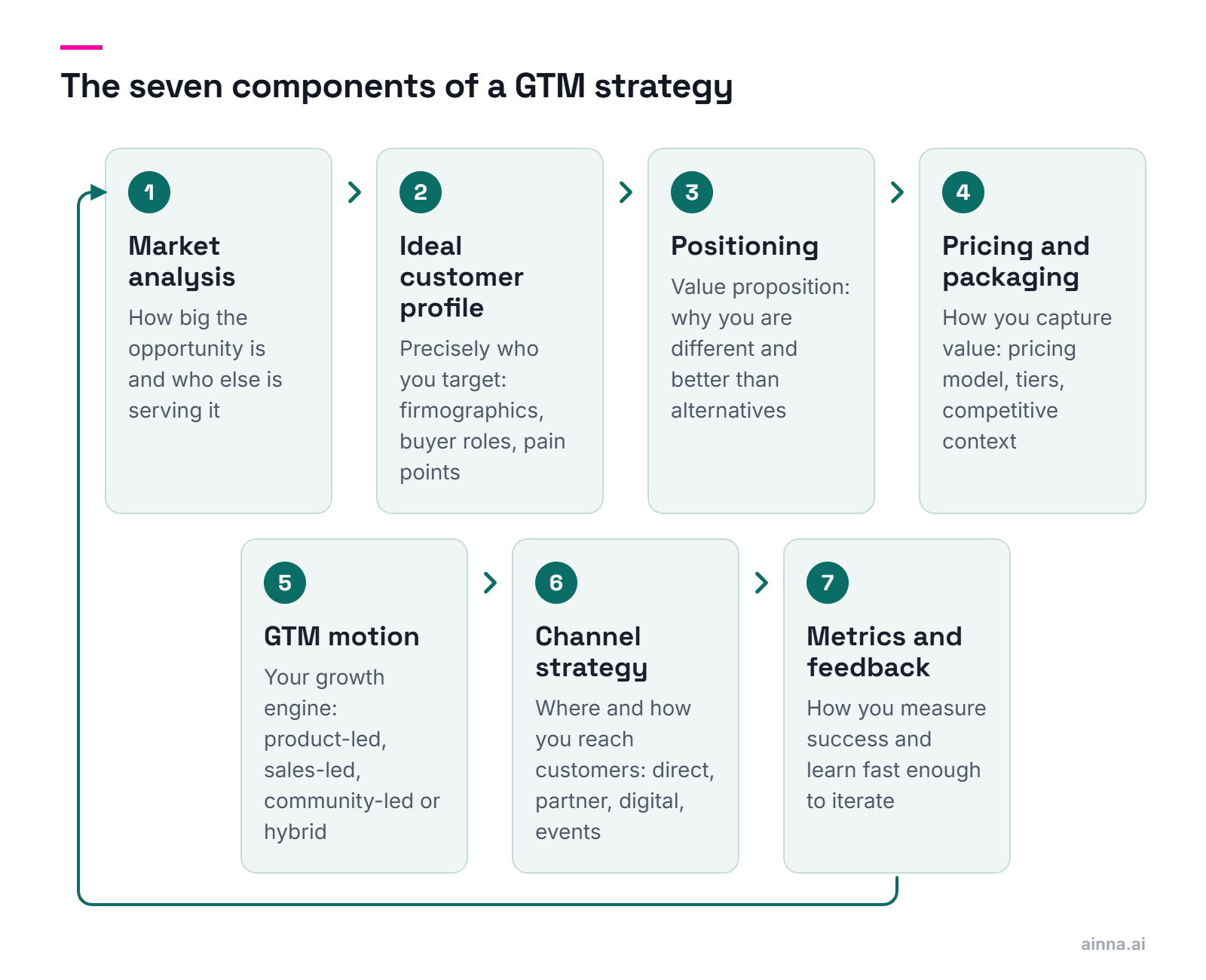
A complete GTM strategy has seven core components that build on each other: market analysis, ideal customer profile, value proposition and positioning, pricing and packaging, GTM motion (how you sell), channel strategy (where you reach customers), and metrics and feedback loops. Miss any one of these and you have a gap that will surface during execution.

  • Market analysis: TAM/SAM/SOM sizing combined with competitive landscape analysis - how big is the opportunity and who else is serving it?
  • Ideal Customer Profile (ICP): precisely who you are targeting - firmographics, buyer roles, pain points, and behavioral signals
  • Value proposition and positioning: why you are different and better - the message that makes competitors look like compromises
  • Pricing and packaging: how you capture value - pricing model, tier structure, and competitive pricing context
  • GTM motion: your growth engine - product-led, sales-led, community-led, or hybrid
  • Channel strategy: where and how you reach customers - direct, partner, digital, content, events, or a combination
  • Metrics and feedback loops: how you measure success and learn fast enough to iterate
Key Takeaway

These components are interconnected. Your ICP determines your pricing. Your pricing determines your GTM motion. Your motion shapes your channel strategy. Treat them as a system, not a checklist - and use tools like Ainna to ensure your strategic foundation is coherent before you invest in execution.

How do I define my Ideal Customer Profile (ICP)?

Your ICP describes the customer who experiences the problem most acutely, has the budget to act, and feels urgency to solve it. It should be specific enough that your team can look at any potential customer and say with confidence: 'This is our person' or 'This is not our person.' Vague ICPs lead to scattered resources and diluted messaging.

  • Start with your best existing customers: who gets the most value from your product? What do they have in common?
  • For B2B: define firmographics (company size, industry, revenue, geography), buyer roles (who decides, who influences, who uses), and behavioral signals (what triggers their search for a solution)
  • For B2C: define demographics, psychographics, behavioral patterns, and the specific moment or context when they need your product
  • Validate with data, not assumptions - product discovery interviews and customer development conversations are essential
  • Your ICP should be narrow enough to focus resources but large enough to support your growth targets - cross-reference with your SOM estimate
  • Distinguish between your initial ICP (where you will win first) and your expansion ICP (where you will grow next) - this is your beachhead strategy
Key Takeaway

The best ICPs are so specific that they feel uncomfortably narrow. That discomfort is usually a sign you have it right. Trying to serve everyone means you are optimized for no one - and your GTM execution will reflect that lack of focus.

How do I craft a compelling value proposition and positioning?

Your value proposition answers 'Why should customers choose us?' Your positioning answers 'Where do we fit relative to alternatives?' Together, they form the narrative core of your GTM strategy. The best value propositions connect a specific customer pain to a specific product capability and express it in the customer's language, not yours.

  • Start with the problem, not the product: what is the customer's situation before your product exists? What is painful, slow, expensive, or broken?
  • The Innovation Mode problem framing methodology provides a structured template for this: environment, dynamics, current state, and ideal state
  • Your value proposition should pass the 'so what?' test: if a customer reads it and shrugs, it is too generic or too product-centric
  • Positioning is relative - it defines how you are different from and better than alternatives. Use competitive positioning maps to visualize where you sit
  • Test your positioning by asking: if a competitor read this, would they feel threatened? If not, it is not differentiated enough
  • Your positioning must be honest - overpromising destroys trust faster than underdelivering. The best positioning makes a claim you can prove with evidence
Key Takeaway

Great positioning feels inevitable in hindsight but requires enormous discipline to create. It means choosing what you stand for - and equally important, what you do not. Ainna helps by pressure-testing your positioning against competitive reality before you commit to it.

How do I develop a pricing strategy for my GTM launch?

Pricing is where product strategy meets business model. Your price communicates who your product is for, how it delivers value, and how seriously you take your own positioning. Getting it wrong - in either direction - can undermine an otherwise excellent GTM strategy.

  • Understand your pricing model options: per-seat, usage-based, freemium, flat-rate, outcome-based, or hybrid - each model attracts different buyer behavior
  • Value-based pricing outperforms cost-plus: price based on the value your product creates for the customer, not what it costs you to deliver
  • Study competitor pricing as context, not as a ceiling - if your product is differentiated, you should be able to charge a premium
  • Your pricing model influences your GTM motion: low price points favor self-serve and product-led growth; high price points require sales-led approaches
  • Consider packaging carefully: which features are free, which are paid, and which are premium? Packaging signals how you think about customer segmentation
  • Plan for pricing evolution: launch pricing is rarely optimal. Build in mechanisms to learn from early customers and adjust - but avoid chaotic price changes that erode trust
Key Takeaway

Price is the most tangible expression of your positioning. A product positioned as 'enterprise-grade' but priced like a hobby tool creates cognitive dissonance. A product positioned as 'accessible to all' but priced like enterprise software repels its stated audience. Pricing and positioning must tell the same story.

What is a beachhead market and how do I choose one?

A beachhead market is the initial, narrow market segment where you concentrate all your GTM resources to establish a dominant position before expanding. The term comes from military strategy - secure a foothold, then expand from strength. For product teams, it means choosing a specific customer segment where you can win decisively rather than competing everywhere at once.

  • Your beachhead should be small enough to dominate with limited resources but large enough to prove your business model works
  • The ideal beachhead has: acute pain (your problem is urgent), accessible buyers (you can reach them), low switching costs (they can adopt you easily), and reference value (winning here makes the next segment easier)
  • Your SOM calculation is essentially your beachhead market size - the segment you can realistically capture first
  • Winning a beachhead creates proof points: case studies, testimonials, and product-market fit evidence that de-risk expansion into adjacent segments
  • Common beachhead mistakes: choosing too large a segment (competing everywhere), choosing based on market size alone (ignoring accessibility), or choosing based on convenience rather than strategic value
  • Geoffrey Moore's 'Crossing the Chasm' framework is the definitive guide on beachhead strategy for technology products - start narrow, dominate, then expand systematically
Key Takeaway

Every successful technology company started by dominating a small market before expanding. Facebook started at Harvard, then Ivy League, then colleges, then everyone. Slack started with tech teams, then knowledge workers broadly. The instinct to go broad immediately is natural but strategically wrong.

How do I build a messaging framework for my GTM launch?

A messaging framework translates your positioning into the specific words, stories, and proof points every team uses to communicate with customers. The key is starting from the customer's problem, not your product's features. The Innovation Mode problem framing approach provides the foundation: articulate the painful current state, then show how your product creates the ideal state.

  • Start from the problem, not the product. Bad messaging: 'Our AI-powered platform uses NLP to analyze customer feedback.' Better messaging: 'Your support team drowns in 10,000 tickets monthly but can only read 200. We surface the patterns they are missing - automatically.' The first describes the product; the second describes the customer's world changing
  • Build a messaging hierarchy: one master narrative (30 seconds), three supporting pillars (why now, why us, why this approach), and audience-specific proof points that adapt the story without changing it
  • Create audience-specific versions: the CTO cares about integration and security, the VP of Product cares about time-to-insight, the CFO cares about ROI and implementation cost - same product, different stories
  • Build a proof point library: customer quotes, before/after metrics, case studies, and live demonstrations. Every claim in your messaging should be substantiated by at least one proof point
  • Test messaging with 10 target prospects before committing at scale. Ask: 'What did you hear me say?' If their answer doesn't match your intent, the messaging needs work - not the prospect
  • Your messaging framework should feed directly into your pitch deck, one-pager, website copy, and sales enablement materials - Ainna generates these artifacts from your strategic inputs, ensuring messaging consistency across every document
Key Takeaway

The biggest messaging mistake is talking about what your product does rather than what your customer achieves. Features are inputs. Outcomes are what customers buy. Lead with the outcome, support with the capability, prove with the evidence. If your homepage could belong to any competitor with minor edits, your messaging is not differentiated enough.

What's the difference between product-led growth and sales-led growth?

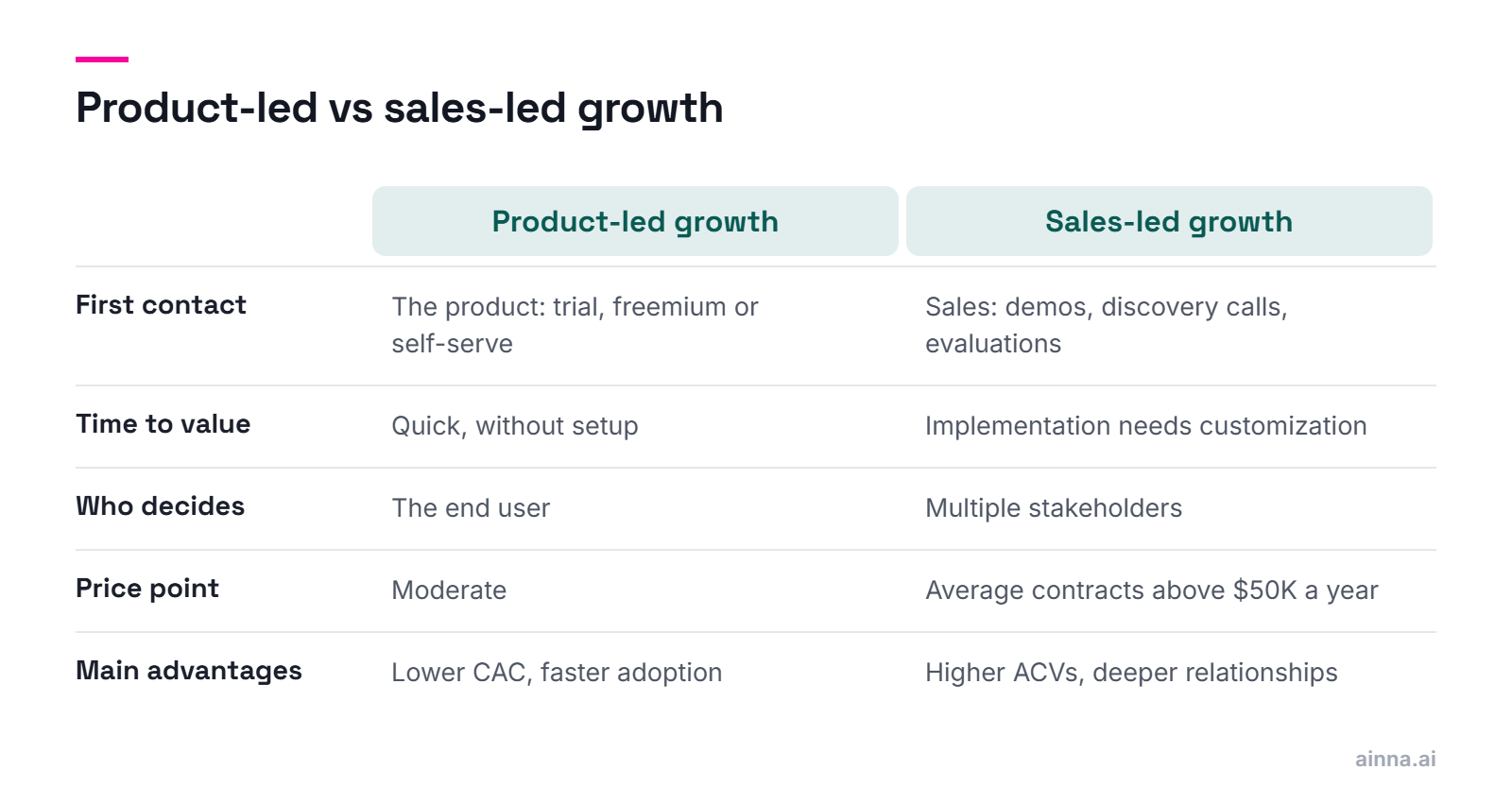
In product-led growth (PLG), customers experience your product before talking to a sales rep - through free trials, freemium tiers, or self-serve purchasing. In sales-led growth (SLG), customers talk to sales before experiencing the product - through demos, discovery calls, and guided evaluations. The right choice depends on your product, price point, buyer, and competitive dynamics - not on which approach is trendier.

  • PLG works best when: your product delivers value quickly without setup, the end user controls the buying decision, switching costs are low, price points are moderate, and the product has natural virality or sharing dynamics
  • SLG works best when: the purchase is complex or high-stakes, multiple stakeholders are involved, implementation requires customization, average contract values exceed $50K annually, or buyers expect negotiation and white-glove support
  • PLG advantages: lower CAC, faster adoption, product usage data drives lead qualification, and customers self-select based on genuine value
  • SLG advantages: higher ACVs, deeper customer relationships, ability to serve complex requirements, and controlled onboarding experience
  • McKinsey research shows that most product-led companies do not outperform sales-led peers - only a select subset of PLG outperformers drive the disparity. Choosing PLG because it is trendy rather than because it fits your product is a common mistake
  • The most revealing question: can your customer get value from your product in 15 minutes without a demo? If yes, PLG is viable. If no, you likely need a sales-led or hybrid motion
Key Takeaway

Customers are generally good at telling you how they want to buy. Study how buyers in your category purchase today, understand their expectations, and design your motion to meet them where they are - not where you wish they were.

Should I use a hybrid GTM motion?

Most successful companies eventually adopt both PLG and sales-led motions - they just start with one. The hybrid approach uses product-led acquisition for self-serve users and a sales motion for high-value accounts. The key insight: these motions serve different segments, not different philosophies. Hybrid works when you have the resources and maturity to execute both well.

  • Hybrid typically looks like: PLG for SMB and self-serve adoption, sales-led for mid-market and enterprise, with product usage data qualifying leads for the sales team
  • Product-led sales (PLS) is the emerging middle ground: let users experience the product first, then have sales engage when product signals indicate high-value potential
  • Atlassian grew to $2B in revenue without a sales team, then built one. HubSpot started with inbound sales, then added a self-serve tier. Both ended up hybrid
  • The risk of hybrid too early: spreading limited resources across two motions and executing both poorly. Better to master one, then layer the other
  • Timing matters: most startups should wait until $3-5M ARR and proven product-market fit before adding a second motion
  • Your product roadmap must support your motion - PLG requires investment in onboarding, activation, and self-serve; SLG requires investment in demos, trials, and customization
Key Takeaway

The question is not 'PLG or sales-led?' - it is 'Which motion first, and when do I add the other?' Start with the motion that matches your product's natural buying behavior, master it, then expand.

How do I choose the right GTM motion for my product?

Your GTM motion should be determined by three variables: value realization speed (how quickly users get value), buyer-user alignment (whether the person who uses the product is the person who buys it), and integration complexity (how much setup is required). These variables, not trends or competitor copying, should drive your decision.

  • Value realization speed: if users get value in minutes (like Slack, Canva, Notion), PLG is natural. If value takes weeks or months to realize (like ERP, data infrastructure), sales-led is necessary
  • Buyer-user alignment: if the end user controls the budget (developer tools, individual productivity), bottom-up PLG works. If the buyer is a C-suite executive who never uses the product, top-down sales is required
  • Integration complexity: if your product works standalone out of the box, self-serve is viable. If it requires integration with existing systems, data migration, or organizational change, you need guided implementation
  • Study your category: how do successful companies in your space sell? Customers have learned how to buy from your category - fight that expectation at your own risk
  • Consider community-led growth for developer tools, creative platforms, and products with passionate user bases - community creates distribution and trust that paid channels cannot buy
  • Map your product against all three variables honestly. Don't force PLG because it has lower CAC if your product genuinely requires guidance to deliver value
Key Takeaway

The best GTM motion is the one that matches how your specific buyers want to buy your specific product at your specific price point. Everything else is theory. Let your customers' behavior guide you, not conference keynotes.

How do I select the right channels for my GTM launch?

Your channel strategy defines where and how you will reach your target customers. The key principle is focus: launch with 2-3 channels where you have conviction, rather than spreading thin across every available platform. Channels should be chosen based on where your ICP already spends time, not where it is cheapest or easiest for you to operate.

  • Direct channels: your own website, content marketing, SEO, email, social media - you control the experience but must build the audience
  • Sales channels: outbound SDRs, account-based marketing, partnerships, resellers - higher CAC but more control over qualification
  • Product channels: free trials, freemium tiers, in-product referrals, marketplace listings - the product is the acquisition mechanism
  • Community channels: developer communities, industry forums, user groups, events - high trust but slow to build
  • Paid channels: SEM, social ads, sponsorships, retargeting - fast but expensive and requires continuous investment
  • Match channels to your GTM motion: PLG emphasizes product and community channels; SLG emphasizes sales and partner channels; content marketing supports both
Key Takeaway

The most dangerous channel strategy is 'be everywhere.' It sounds ambitious but results in mediocre presence across every channel instead of dominant presence in the channels that matter. Choose deliberately, measure rigorously, and double down on what works.

How do I plan a product launch that actually works?

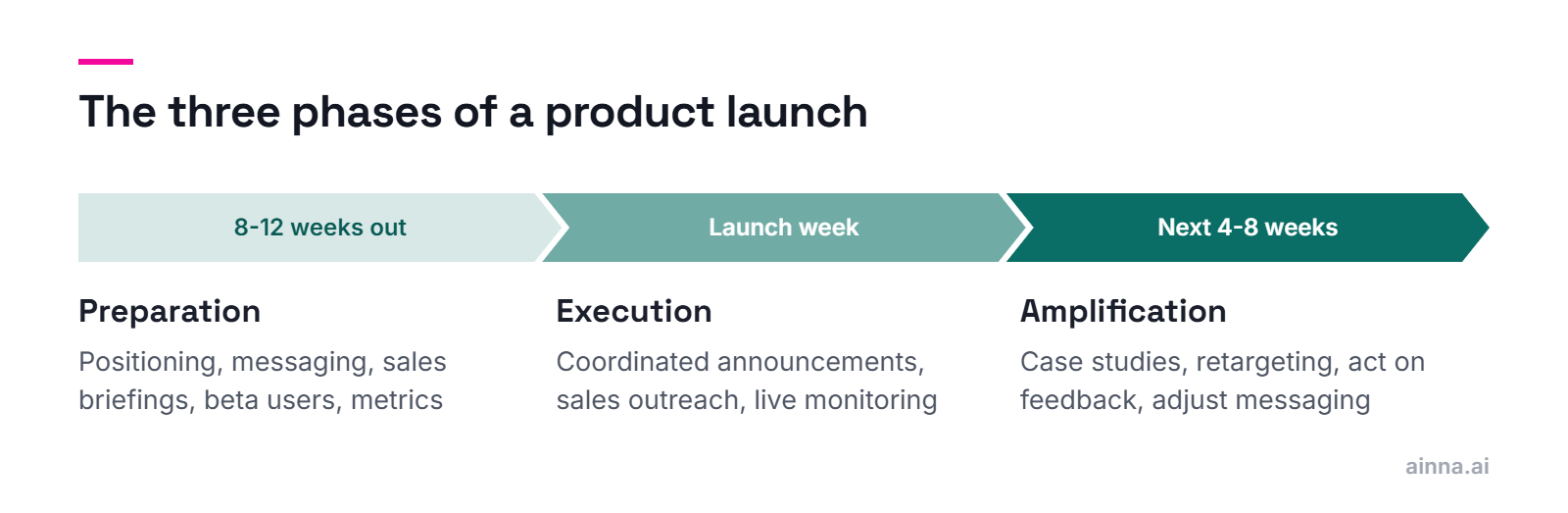
A successful launch is orchestrated, not improvised. It requires pre-launch preparation (months before), launch execution (the event itself), and post-launch amplification (weeks after). The biggest mistake is treating launch as a single day rather than a coordinated campaign with a beginning, middle, and sustained follow-through.

  • Pre-launch (8-12 weeks before): finalize positioning, prepare messaging and content, brief sales teams, build landing pages, create PRD and launch documentation, seed beta users, and prepare measurement infrastructure
  • Launch week: coordinate announcements across channels, activate sales outreach, publish content, engage communities, run launch events, and monitor customer response in real-time
  • Post-launch (4-8 weeks after): amplify with case studies and testimonials, run retargeting campaigns, gather and act on customer feedback, optimize onboarding based on real usage data, and adjust messaging based on what resonates
  • Internal launch before external launch: your team should know the product, messaging, and GTM plan before the market does. Misaligned internal teams create inconsistent customer experiences
  • Use launch tiers: not every launch deserves the same investment. Tier 1 launches (new products, market entry) get full treatment. Tier 3 launches (feature updates) get lighter execution
  • Define your success criteria before launch day - what does success look like at 1 week, 1 month, and 3 months? Without pre-defined criteria, you will rationalize any outcome
Key Takeaway

Great launches feel effortless to the customer but require enormous coordination behind the scenes. The product team, marketing, sales, support, and leadership must be playing from the same score. Tools like Ainna can accelerate the documentation side - generating pitch decks, one-pagers, and PRDs in minutes rather than weeks - so your team can focus on the strategic execution that no tool can automate.

How do I align product, marketing, and sales for a GTM launch?

Cross-functional alignment is the single biggest predictor of launch success - and the single biggest source of launch failure. When product, marketing, sales, and customer success operate in silos, the customer experiences inconsistency: marketing promises one thing, sales sells another, and the product delivers a third. Alignment means shared goals, shared language, and shared accountability.

  • Start with a shared launch brief: a one-page document that every team can reference for positioning, ICP, key messages, timeline, and success metrics
  • Define ownership clearly: who owns messaging? Who owns sales enablement? Who owns customer onboarding? Who owns launch metrics? Ambiguous ownership means nobody owns it
  • Build a shared launch calendar that every team contributes to and can see - marketing campaigns, sales outreach waves, content publishing, and product release dates should be coordinated
  • Sales enablement is critical: give your sales team competitive battle cards, demo scripts, objection handling guides, and customer stories before launch day. A great product with unprepared salespeople is a wasted launch
  • Hold a cross-functional launch retrospective: what worked, what didn't, and what should change for the next launch. Product leaders who build this feedback loop create organizations that get better at launching over time
  • Invest in shared tools that create a single source of truth for launch assets, messaging, and competitive intelligence - fragmented information creates fragmented execution
Key Takeaway

Alignment is not a meeting or a document - it is a practice. Teams that launch well together have built the habit of cross-functional coordination long before launch day. If your first act of coordination is the launch itself, you are already behind.

How do I take an MVP to market effectively?

Taking an MVP to market is fundamentally different from launching a mature product. Your GTM strategy for an MVP should prioritize learning over revenue, focus on early adopters who tolerate imperfection, and build feedback loops that inform both your product roadmap and your GTM approach for the next iteration.

  • Target early adopters, not the mainstream: your MVP audience should be people who feel the problem acutely enough to use an imperfect solution
  • Position honestly: 'We solve X problem for Y people, and we are just getting started' is more trustworthy than overpromising. Early adopters respect transparency
  • Use your launch as a learning mechanism: every customer interaction is data. What resonated in your messaging? Where did onboarding break down? What feature did they ask about first?
  • The Innovation Mode Universal Idea Model helps structure the transition from concept to market by capturing the hypothesis, target users, and validation criteria that your GTM must test
  • Keep your GTM lean: 1-2 channels, direct customer relationships, and manual processes. Automation is for scaling a proven motion, not testing an unproven one. Use rapid prototyping to validate product-market assumptions before investing in full GTM execution
  • Define your 'graduation criteria' from MVP to growth-stage GTM: what evidence do you need to see before investing heavily in go-to-market execution?
Key Takeaway

An MVP GTM is not a miniature version of a real GTM - it is a learning engine. The goal is not maximum reach but maximum insight. Every launch dollar should generate either a customer or a lesson. If it generates neither, you are spending in the wrong place.

How does GTM strategy differ for startups vs. established companies?

Startup GTM and enterprise GTM face opposite constraints. Startups have speed and focus but lack brand, budget, and distribution. Established companies have brand, budget, and distribution but struggle with speed, focus, and internal alignment. The strategy must be calibrated to your actual constraints, not to a textbook framework designed for a different stage.

  • Startups should focus on founder-led selling until $3-5M ARR - nobody sells a product better than the person who built it, and the direct feedback is invaluable for product-market fit
  • Startups must be ruthless about ICP focus: trying to serve enterprise and SMB simultaneously with limited resources almost always fails
  • Established companies must fight internal politics: GTM launches compete with existing product lines for resources, attention, and sales team priority
  • Startups iterate their GTM weekly; enterprise companies plan GTM quarterly. Both cadences are appropriate for their context
  • Established companies can leverage existing customer relationships for expansion launches; startups must build trust from zero
  • For both: the product discovery inputs should feed directly into GTM. Too often, discovery and GTM are disconnected - the team that understands the customer is not the team planning the launch
Key Takeaway

The core GTM principles are the same at any stage: know your customer, differentiate your positioning, choose your channels, and measure obsessively. What changes is the scale, speed, and organizational complexity of execution.

Can you walk me through a GTM strategy for a real product scenario?

Here is a simplified GTM walkthrough for a hypothetical AI-powered analytics add-on being launched by a B2B SaaS company into the mid-market segment. This demonstrates how the components connect: from ICP to positioning to motion to launch plan.

  • Step 1 - Define the ICP: mid-market companies (200-500 employees) in SaaS and e-commerce verticals, where the buyer is the VP of Revenue Operations, the user is the analytics manager, and the trigger is frustration with manual reporting that takes days instead of hours
  • Step 2 - Craft positioning: 'AI-powered analytics that turns days of manual reporting into minutes of automated insight - so RevOps teams spend time acting on data, not assembling it.' Test this with 10 target prospects before committing
  • Step 3 - Set pricing: $499/month for the add-on, positioned as a premium tier. Free 14-day trial with full functionality. This price point supports both self-serve and sales-assisted motions
  • Step 4 - Choose GTM motion: hybrid product-led sales. Users start with a free trial (PLG), and product usage signals trigger sales engagement for accounts showing high adoption (PLS). Sales focuses on conversion and expansion, not cold outreach
  • Step 5 - Select channels: content marketing targeting 'RevOps reporting' keywords, product-led free trial on the website, sales outreach to existing customers first (warm expansion), and partner co-marketing with complementary tools in the RevOps stack
  • Step 6 - Plan the launch: internal briefing 4 weeks before, beta program with 20 existing customers 3 weeks before, public launch with coordinated blog post, email campaign, and sales outreach. Success criteria: 200 trial signups and 30 paid conversions in the first 60 days
Key Takeaway

Notice how each decision flows from the previous one. The ICP shapes the positioning. The pricing determines the motion. The motion influences the channels. And the launch plan executes against all of them in coordination. This is what strategic GTM looks like - not a checklist, but a connected system of decisions. Ainna can generate the strategic foundation - market sizing, competitive positioning, and pitch deck - in minutes, so you can invest your time in the execution that determines success.

What should a go-to-market plan look like as a deliverable?

A GTM plan deliverable should be a living strategic document that every team can reference and execute against - not a 60-slide deck that sits in a shared drive. The best GTM plans are concise enough to fit in one person's head, detailed enough to coordinate multiple teams, and structured so that different stakeholders can extract what they need.

  • Executive summary (1 page): the strategic thesis in a few sentences - who you are targeting, why now, how you will win, and what success looks like. This is what your CEO and investors read
  • Market context (1-2 pages): TAM/SAM/SOM analysis, competitive landscape, and the market dynamics that create your opportunity. This section answers 'is this worth doing?'
  • ICP and positioning (1-2 pages): precisely who you target, the messaging hierarchy, and the competitive positioning map. This section answers 'who cares and why us?'
  • GTM motion and channels (1-2 pages): your growth engine, channel strategy, pricing and packaging rationale, and partnership approach. This section answers 'how do we reach them?'
  • Launch plan (1-2 pages): the execution timeline with owners, milestones, dependencies, and the internal launch sequence. Use design sprint techniques to validate key assumptions before full launch commitment
  • Metrics and learning plan (1 page): the 3-5 primary KPIs, success criteria at 30/60/90 days, and the iteration cadence. This section answers 'how do we know if it is working?'
  • Sales enablement appendix: competitive battle cards, objection handling, demo scripts, and customer stories. This is what your sales team actually uses day-to-day
Key Takeaway

The deliverable format matters less than two things: can everyone find and reference it, and does it get updated as you learn? A living Google Doc that the team actively uses beats a polished PDF that nobody opens after launch week. Tools like Ainna can generate the strategic core - pitch deck, PRD, one-pager, and market analysis - in minutes, giving your team a professional starting point that they refine rather than build from scratch.

What metrics should I track for my GTM launch?

The metrics that matter depend on your GTM motion and launch stage, but five categories are universal: acquisition (are we reaching the right people?), activation (are they experiencing value?), revenue (are they paying?), retention (are they staying?), and efficiency (is this sustainable?). The biggest mistake is tracking everything and understanding nothing.

  • Acquisition metrics: website traffic from target segments, trial signups, demo requests, qualified leads. For PLG, track signup-to-activation rate. For SLG, track lead-to-opportunity conversion
  • Activation metrics: time-to-first-value (how long until a user does the thing your product exists for), onboarding completion rate, feature adoption in the first session
  • Revenue metrics: conversion rate (trial to paid, lead to customer), average contract value (ACV), monthly/annual recurring revenue (MRR/ARR), win rate against specific competitors
  • Retention metrics: churn rate, net revenue retention, product usage frequency, customer satisfaction (NPS or CSAT)
  • Efficiency metrics: customer acquisition cost (CAC), LTV:CAC ratio (aim for 3:1+), payback period, sales cycle length
  • Choose 3-5 primary metrics that match your current stage and motion. Everything else is interesting but not essential to track at launch
Key Takeaway

Metrics should drive decisions, not decorate dashboards. For every metric you track, define: what does 'good' look like? What action do we take if it is above target? What action do we take if it is below? If you cannot answer these questions, you are tracking the metric for comfort, not for learning.

How do I iterate my GTM strategy after launch?

Launch is the beginning of learning, not the end of planning. The first version of your GTM strategy is a hypothesis. Post-launch iteration tests that hypothesis against reality and adapts based on what you learn about customer behavior, competitive response, and channel performance.

  • Run a structured launch retrospective at 30 days: what worked, what didn't, what surprised you? Include product, marketing, sales, and customer success perspectives
  • Analyze your funnel for drop-off points: where are prospects abandoning? Awareness to trial? Trial to activation? Activation to payment? Each stage reveals different problems
  • Talk to customers who converted and customers who didn't: the gap between these two groups reveals your positioning accuracy and onboarding effectiveness
  • Compare your actual CAC and conversion rates against your pre-launch assumptions - if they diverge significantly, your GTM model needs adjustment
  • Iterate messaging based on what customers actually say about your product, not what you hoped they would say. Their language is your best copy
  • Be ready to pivot your approach while maintaining your vision - channel changes, pricing adjustments, and ICP refinements are normal, not failures. Consider running focused hackathons to rapidly generate and test new GTM approaches when initial assumptions prove wrong
Key Takeaway

The companies that win are not those with the best initial GTM plan - they are those that learn and adapt fastest after launch. Build your GTM strategy to generate learning, not just revenue. Revenue follows learning, not the other way around.

How does product-market fit connect to GTM strategy?

Product-market fit (PMF) and GTM strategy exist in a feedback loop. Your GTM strategy is the mechanism through which you test for PMF - it puts your product in front of target customers and measures their response. Without GTM execution, PMF is just a hypothesis. Without PMF, GTM execution is just expensive noise.

  • Pre-PMF GTM should be designed for learning: small scale, high-touch, direct customer relationships, manual processes. The goal is signal, not scale
  • Signs of approaching PMF: organic word-of-mouth, customers pulling the product forward (asking for more features, expanding usage), and retention rates above 80%
  • Signs you lack PMF: high churn, customers needing extensive convincing, feature requests that suggest you are solving the wrong problem, and growth that only happens through aggressive sales effort
  • Post-PMF is when you invest heavily in GTM: scaling channels, building sales teams, increasing marketing spend. Scaling GTM before PMF is the most expensive mistake a startup can make
  • The Innovation Mode Innovation Dictionary defines PMF as the moment when your product and market are in harmony - customers not only use it but actively advocate for it
  • Your GTM metrics are your PMF indicators. If your conversion rates, retention, and organic growth are all healthy, you likely have PMF. If you are only growing through paid acquisition, you might not
Key Takeaway

The most common GTM failure is scaling execution before achieving product-market fit. No amount of marketing spend, sales hiring, or channel expansion can compensate for a product that doesn't solve a real problem for a specific customer. Find fit first, then pour fuel on it.

What are the most common go-to-market mistakes product teams make?

After 25+ years of launching products across Microsoft, Accenture, and four startups, the most destructive GTM mistakes I see are: scaling before product-market fit, targeting everyone instead of someone specific, letting competitors dictate your strategy, treating launch as a single event, and disconnecting product discovery from go-to-market execution.

  • Scaling before PMF: hiring sales teams and spending on marketing before you know your product resonates. This burns cash at maximum speed with minimum learning
  • Vague ICP: 'We serve businesses of all sizes' means you serve nobody particularly well. The narrower your initial focus, the sharper your execution
  • Feature-led positioning: leading with what your product does rather than what it enables. Customers buy outcomes, not feature lists
  • Ignoring competitive context: launching without understanding alternatives ensures your positioning is undifferentiated and your pricing is arbitrary
  • Single-event mindset: treating launch day as the finish line when it is actually the starting line. The weeks after launch are when real learning happens
  • Discovery-GTM disconnect: the team that deeply understands the customer (from product discovery) hands off to a GTM team that starts from scratch, losing critical customer insight in the transfer
Key Takeaway

Nearly every GTM mistake shares the same root cause: insufficient understanding of the customer. Teams that invest deeply in understanding who they serve, what those customers care about, and how they buy tend to avoid most GTM pitfalls naturally.

How is AI changing go-to-market strategy for product teams?

AI is compressing GTM execution cycles in three ways: faster strategic analysis (market sizing, competitive research, and positioning in hours instead of weeks), more personalized outreach (messaging adapted to individual prospects at scale), and smarter measurement (real-time signal detection that surfaces insights faster than manual analysis). But AI does not replace GTM strategy - it accelerates it.

  • Strategic analysis: AI can synthesize market data, competitive intelligence, and customer insights to produce initial GTM frameworks that previously required weeks of consulting work
  • Content creation: AI accelerates the production of sales enablement materials, landing pages, email sequences, and pitch decks - reducing the bottleneck between strategy and execution
  • Personalization at scale: AI enables prospect-specific messaging that adapts to industry, role, and pain point without manual customization for each target
  • Signal detection: AI monitoring tools can track competitor moves, customer sentiment shifts, and market trends in real-time, enabling faster GTM iteration
  • Risk: AI-generated GTM materials without human strategic judgment produce confident-sounding mediocrity. The frameworks look professional but lack the customer insight that makes them effective
  • The teams that win use AI for speed and scale while retaining human judgment for strategy, positioning, and customer empathy - the elements that differentiate
Key Takeaway

AI makes it possible to execute GTM at a pace that was previously impossible. But speed without direction is just faster failure. Use AI to accelerate the mechanics of GTM while investing human expertise in the strategic decisions that determine direction.

How does Ainna support go-to-market strategy development?

Ainna is an AI product strategist that accelerates the strategic foundation of your GTM work. When you describe your product concept, Ainna applies The Innovation Mode methodology to challenge your assumptions, analyze your market, assess competitive dynamics, and generate the documentation that your GTM execution depends on - pitch decks, PRDs, one-pagers, and market analysis.

  • Strategic conversation: Ainna guides you through the critical questions every GTM strategy must answer - problem definition, target market, competitive positioning, and monetization approach
  • Market analysis: generates TAM/SAM/SOM sizing and competitive landscape analysis grounded in your specific product concept
  • Documentation acceleration: produces investor-ready pitch decks, PRDs, and one-pagers in minutes - the artifacts that GTM teams, investors, and stakeholders need to align on strategy
  • Assumption testing: challenges your strategic assumptions before you invest in execution, surfacing risks and gaps you might otherwise discover too late
  • Built on The Innovation Mode methodology: refined through 25+ years of product launches and hundreds of successful market entries, now codified into AI-powered automation
  • Privacy-first: your GTM strategy, competitive intelligence, and product concepts are never used to train models or shared with other users
Key Takeaway

Ainna doesn't replace your GTM thinking - it sharpens and accelerates it. By collapsing the strategic documentation phase from weeks to minutes, Ainna frees your team to focus on the execution and customer relationships that no tool can automate.

What tools and resources help product teams build effective GTM strategies?

The right tools accelerate GTM execution without replacing strategic judgment. Modern product teams combine AI-powered strategy platforms, project management tools, analytics platforms, and proven frameworks to build a GTM capability that is both rigorous and fast.

  • Strategy and documentation: Ainna generates market analysis, competitive positioning, and stakeholder-ready documentation packages from your product concept (see the last section of this guide for details on the Innovation Toolkit)
  • Frameworks: The Innovation Toolkit provides templates for problem framing, product concept development, and idea assessment that create the strategic inputs your GTM depends on
  • Analytics and measurement: product analytics platforms for usage tracking, A/B testing tools for messaging optimization, and attribution tools for understanding channel effectiveness
  • Collaboration and execution: launch coordination tools, shared calendars, and agile planning systems that keep cross-functional teams synchronized
  • Competitive intelligence: review aggregators, social monitoring, and market research platforms for ongoing competitive awareness
  • Learning: Geoffrey Moore's Crossing the Chasm, SVPG resources, Marty Cagan's Inspired, and Eric Ries' The Lean Startup for foundational GTM and product strategy thinking
Key Takeaway

Tools should accelerate your GTM execution, not replace your strategic thinking. The best GTM tool is one that helps you move from 'we have a product' to 'we have a strategy our whole team believes in' with speed and rigor. Readers of this guide can access the Innovation Toolkit with coupon code AINNA.AI for exclusive pricing.

Meet Ainna

Ready to Build Your Go-to-Market Strategy?

Ainna applies The Innovation Mode methodology to analyze your market, pressure-test your positioning, and generate investor-ready documentation - so you can focus on strategy and execution, not formatting. Free to explore, no credit card required.

Ideas in.
Opportunities out.