Design Sprint Fundamentals

Understanding what design sprints are, when to use them, and what they deliver.

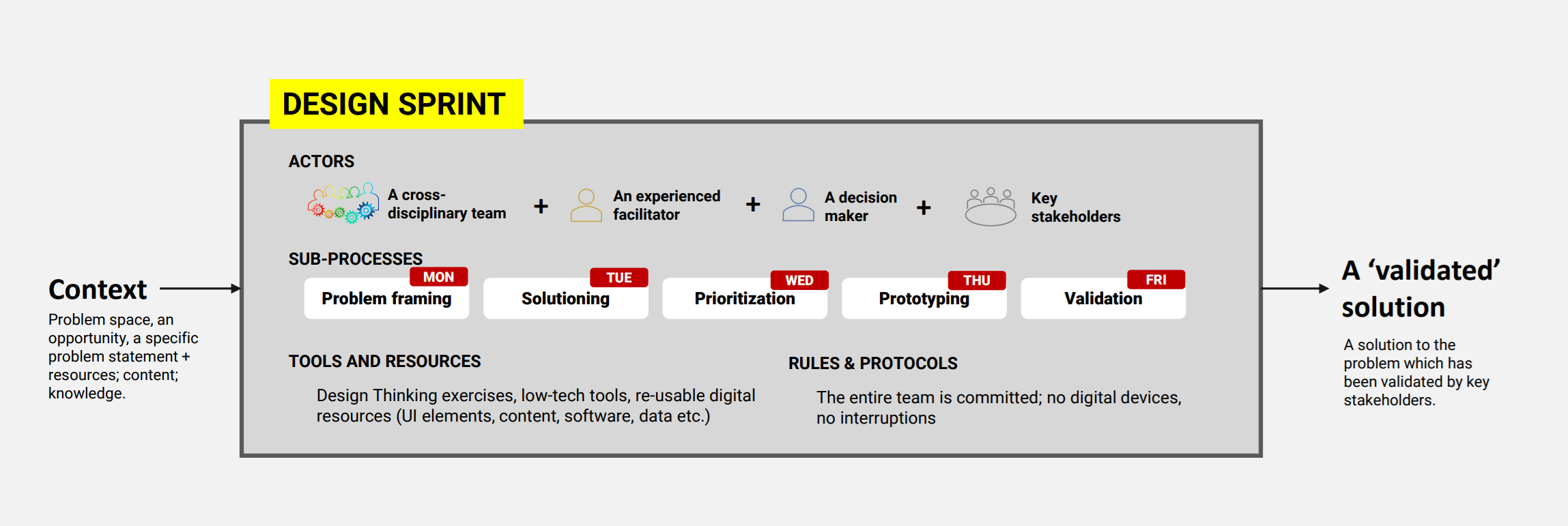
A design sprint is an intense, time-boxed innovation process where a small multidisciplinary team moves from a problem to validated prototypes in just a few days. It uses design thinking principles to rapidly generate solutions, build functional prototypes, and test them with real users—compressing months of work into roughly a week.

  • Typically runs 3–5 days with a dedicated, co-located team of 5–7 people
  • Follows a structured process: understand, diverge, converge, prototype, test
  • Outputs include validated prototypes, a backlog of ideas, and real customer feedback
  • Uses design thinking principles with specific techniques, tools, and rules
  • Goes from problem definition to tested solutions without lengthy development cycles
  • Can target products, components, systems, services, or processes

A design sprint is essentially a shortcut through the most uncertain phase of product development—getting from 'we think this is the problem' to 'here's evidence from real users about our proposed solution.'

A well-run design sprint produces a shortlist of inexpensive, realistic prototypes of high-potential concepts—each enriched with feedback from real users. Beyond prototypes, sprints generate a backlog of impactful ideas, key customer insights, learning about the problem space, and often real business opportunities and IP.

  • Functional prototypes tested with real users—not just wireframes or mockups
  • A ranked backlog of ideas that serves as a long-term innovation asset
  • Customer feedback and signals that inform product strategy decisions
  • Learning and insights about the problem space and potential solutions
  • Business opportunities and potential IP (patents, defensible innovations)
  • Cultural benefits—teams learn to collaborate across disciplines and think innovatively

The most valuable output isn't always the prototype itself—it's the validated learning. You gain enough evidence to make informed investment decisions rather than betting on assumptions. Over time, successive sprints also drive significant cultural improvements toward an innovation mindset.

Traditional processes involve consulting experts, assigning work streams to different teams, coordinating across departments, scheduling brainstorming meetings, queuing for UI designs, then developing prototypes—a lengthy process with dependencies, bottlenecks, and risks. A design sprint replaces all of that by locking a powerful multidisciplinary team in a room with a clear goal, compressing weeks or months into days.

  • Traditional: sequential handoffs between teams; Sprint: parallel collaboration in one room
  • Traditional: weeks to months for first prototype; Sprint: functional prototype in 3–5 days
  • Traditional: assumptions validated late (if at all); Sprint: real user feedback by day 5
  • Traditional: high coordination overhead; Sprint: self-contained team with full authority
  • Traditional: decisions made on opinions; Sprint: decisions informed by user evidence
  • Traditional: high sunk cost before validation; Sprint: low-cost learning before big investments

The design sprint doesn't replace all traditional product development—you still need engineering, QA, and scaling. But it dramatically de-risks the front end of the process by validating concepts before you commit major resources.

Run a design sprint when you face a significant, real-world problem that needs a novel solution better than anything currently available—and you want validated evidence before committing to a full build. They're especially valuable when the problem is complex, the stakes are high, or when cross-functional alignment is needed.

  • When facing a major customer or business problem with no obvious solution
  • When you need to validate concepts before significant investment
  • When multiple departments or perspectives need to align on a direction
  • When speed matters—you can't afford months of traditional discovery
  • When exploring new markets, technologies, or business models
  • When existing approaches have stalled and fresh thinking is needed

Don't run a sprint for minor incremental improvements or when the solution is already clear. Sprints shine when uncertainty is high and the cost of being wrong is significant. They're about discovering the right product to build, not optimizing what you already have.

A design sprint is a serious investment—consider the fully loaded cost of 5–7 people dedicated full-time for 3–5 days, plus facilities, materials, and any external expertise. For a typical team, that can easily be $20K–$50K+ in direct and opportunity costs. This is precisely why measuring sprint success matters and why you need to ensure every sprint delivers real value.

  • Direct costs: team salaries, facilities, materials, prototyping tools and equipment
  • Opportunity costs: 5–7 people pulled from their normal responsibilities for a week
  • External costs: facilitator fees, user recruitment for testing, specialized equipment
  • Cost scales with team seniority—senior leaders cost more but bring better judgment
  • Much cheaper than building the wrong product (10x–100x less than failed development)
  • ROI should be measured through business opportunities and outcomes, not just outputs

The question isn't whether sprints are expensive—they are. The question is whether they're cheaper than the alternative: building products based on assumptions and discovering they're wrong after months of development.

Problem Statement & Preparation

How to define the problem clearly and prepare your team for a productive sprint.

A poorly defined problem statement is the single most common reason design sprints fail. Without clarity on what you're solving, the team wastes time on unfocused discussions, unnecessary iterations, and regression—turning an expensive multi-day sprint into nothing more than a costly brainstorming session. Sprints that start with a clear problem statement move rapidly toward impressive solutions and prototypes.

  • The #1 single point of failure across unsuccessful design sprints is a vague problem statement
  • Poor problem definition triggers time-consuming discussions and unnecessary regression
  • A solid problem statement upfront enables the team to converge faster on solutions
  • Day 1 of most sprints is about framing the problem—but starting with a draft accelerates everything
  • The team should remain open to reframing, but a strong baseline makes all the difference
  • Don't let the problem statement become your real problem

Invest time before the sprint to define a clear problem statement. Describe the current situation versus the ideal state and the implications for involved users. You can always revise during the sprint, but a solid foundation prevents the most common failure mode.

A good problem statement describes the current situation versus the ideal state, identifies the users affected, and articulates the implications of the gap. It should be specific enough to focus the team but open enough to allow creative solutions. Several templates and frameworks exist to help structure this—the key is that every team member should understand and agree on the problem before solutions begin.

  • Describe the current state: what's happening now and why it's insufficient
  • Define the ideal state: what the world looks like when this problem is solved
  • Identify who is affected: specific users, customers, or stakeholders
  • Articulate the impact: what happens if this problem remains unsolved
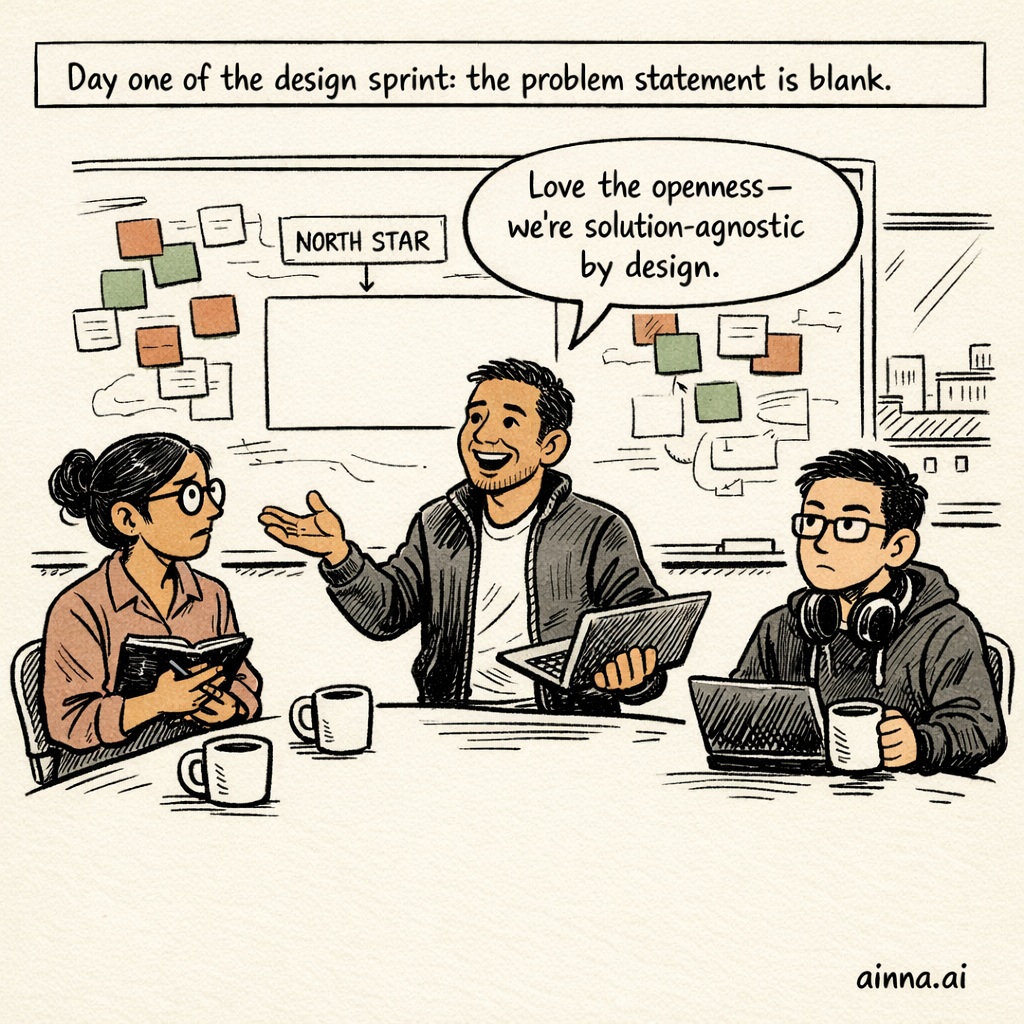
  • Keep it solution-agnostic: describe the problem, not the solution you want
  • Validate with stakeholders before the sprint to ensure alignment

The problem statement is your sprint's North Star. If someone asks 'what are we trying to solve?' at any point during the sprint, every team member should give the same answer. If they can't, your problem statement needs work.

Design sprints are fast and intense—even domain experts and senior leaders need deliberate preparation. Every team member should fully understand the problem and its wider context, the relevant technology landscape, the competitive environment, and global trends. Communicate the rules, expectations, and the need for preparation well in advance.

  • Brief every participant on the problem statement, context, and sprint objectives
  • Share relevant market research, customer data, and competitive analysis beforehand
  • Ensure team members understand the sprint methodology and rules
  • Assign pre-reading: industry reports, user research, technical constraints
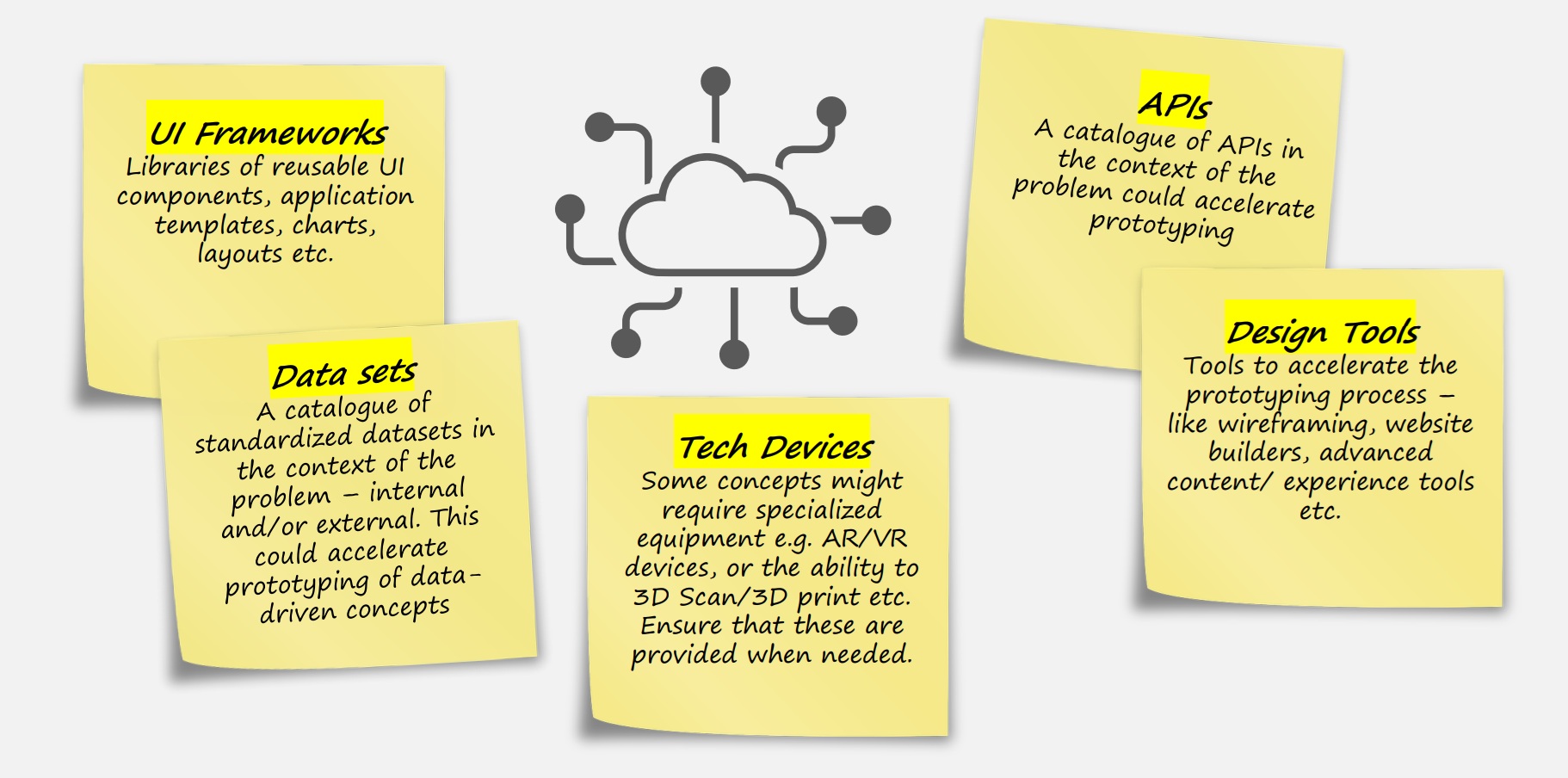
  • Prepare prototyping resources: tools, environments, reusable components, datasets
  • Set expectations about intensity, time commitment, and decision-making process

An unprepared team wastes Day 1 getting up to speed instead of framing solutions. The sprint clock is expensive—every hour of preparation saves multiple hours of confusion during the sprint itself.

You need a dedicated room with enough space for the team to move around, collaborate, and visualize concepts freely. Writable walls, whiteboards, and plenty of sticky notes are essential. The room should be bookable for the entire sprint duration—not shared or interrupted. Think of it as the team's 'war room' for the week.

  • Dedicated room booked for the full sprint duration—no room-sharing or interruptions
  • Writable surfaces: whiteboards, writable walls, or large paper rolls
  • Sticky notes in multiple colors and sizes, markers, dot stickers for voting
  • Timer or clock visible to the team for time-boxed exercises
  • Prototyping equipment as needed: laptops, 3D printers, AR devices, etc.
  • Comfortable basics: good lighting, temperature control, snacks, coffee

The space should encourage spontaneous collaboration, random thinking, and quick visualization. If your team can't freely stand up, sketch on walls, and rearrange sticky notes, the room is too constrained.

Team Composition & Dynamics

Building the right team and managing group dynamics for productive sprints.

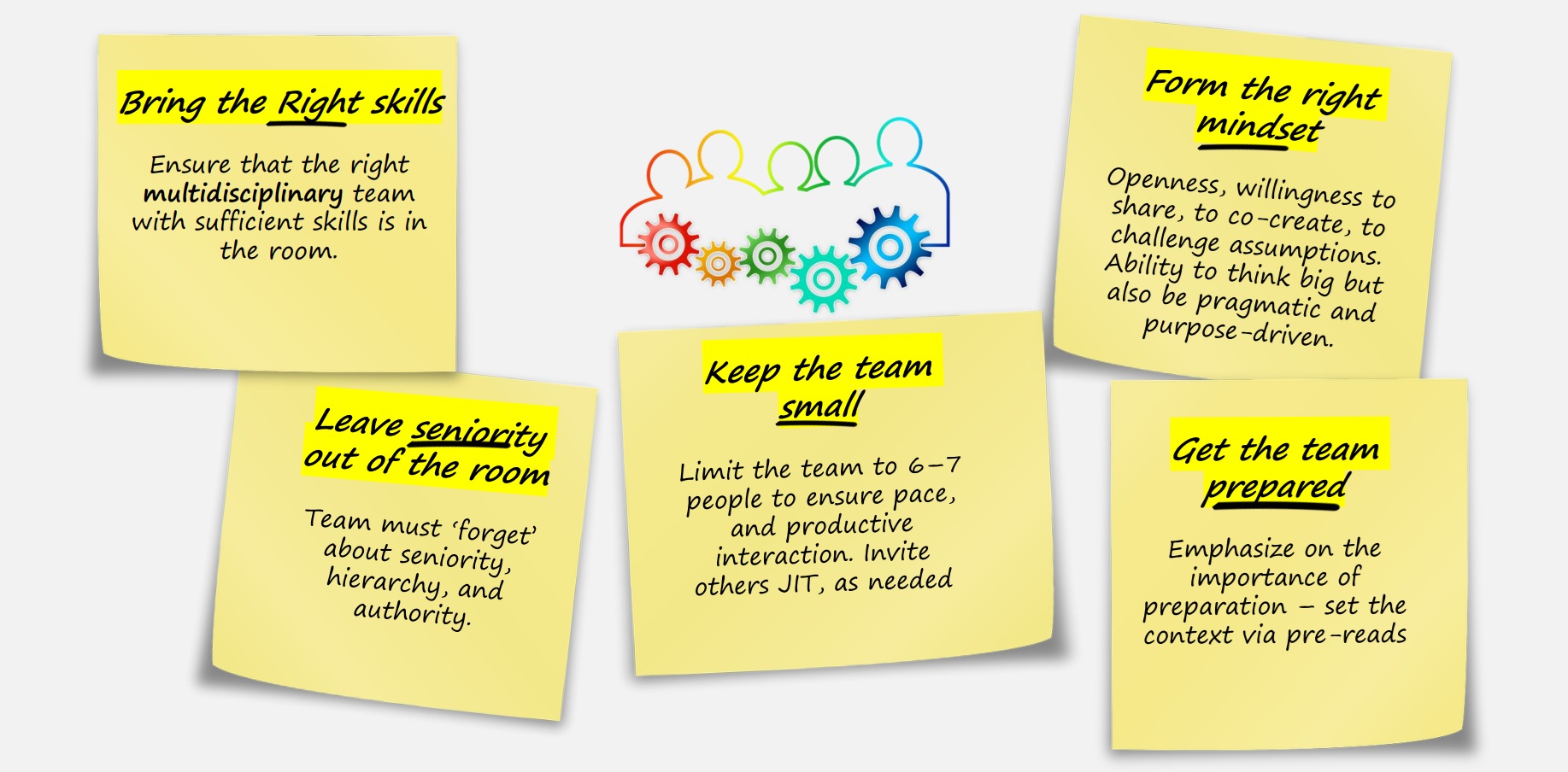
You need diversity of thought, skills, and perspectives combined in a small multidisciplinary team of 5–7 people with the right culture. The team should be willing to share, collaborate, challenge assumptions, and think big while remaining pragmatic and purpose-driven. Expertise matters, but the team's dynamics and mindset matter more.

  • Keep it small: 5–7 people maximum; more than that creates coordination overhead
  • Diverse disciplines: product, design, engineering, business, domain expertise
  • The right culture: openness, willingness to share and be influenced, pragmatism
  • Include someone who deeply understands the customer and the problem space
  • Include someone who can build realistic prototypes quickly
  • Avoid assembling a team of only senior leaders or only individual contributors

The ideal sprint team is like a startup within your company—small, diverse, capable, and empowered to make decisions. Building the right team is foundational to the entire sprint. Read more about assembling the innovation dream team.

Three dynamics kill sprints most often: wrong power dynamics where junior members self-censor around senior people, oversized teams that create coordination chaos, and a protective mindset where people hoard ideas rather than sharing them or believe they already know the right answer before the sprint begins.

  • Wrong dynamics: team members don't express ideas for fear of criticism by senior members
  • Oversized teams: more than 6–7 people introduces more problems than solutions
  • Protective mindset: people guarding their ideas instead of sharing and building on others'
  • Assumed expertise: people believing they already know the right answer, closing themselves to new ideas
  • Seniority bias: hierarchy and authority suppressing creative contributions from the team
  • Groupthink: the team converging too quickly without exploring diverse perspectives

Team members must 'forget' about seniority, hierarchy, and authority. They need to be open to new perspectives, ready to influence and be influenced, and willing to minimize the impact of their biases. The facilitator plays a critical role in maintaining these healthy dynamics.

The decider is the person with final authority on which concepts move forward—often a product leader or business executive. The standard decision-making process with super-voting and sticky dot votes can be oversimplified and highly sensitive to team dynamics. Given their outsized influence, deciders must demonstrate deep understanding of the concepts, strategic thinking, and clear communication—you need a real leader, not just someone with authority.

  • The decider has final say on which ideas get prototyped and tested
  • Standard voting mechanisms (dot voting, super-votes) can be overly simplistic
  • Decisions are highly sensitive to the team's energy and state at that moment
  • A 'political' decider who picks popular ideas over promising ones wastes the sprint
  • The facilitator and team should feel comfortable challenging the decider's reasoning
  • Every decision should be backed by business or technical justification, not just preference

The best deciders earn their authority through insight, not title. They ask sharp questions, explain their reasoning, and welcome challenges. If your decider picks ideas based on who suggested them rather than their merit, your sprint has a serious structural problem.

Ideation & Prototyping

Maximizing idea generation and building prototypes that produce meaningful feedback.

The backlog of ideas generated during a sprint is one of its most important outputs—a genuine innovation asset. Standard sprint schedules often underallocate time for idea generation, sketching, and pitching. By investing more time in ideation, you produce a richer set of concepts to evaluate and a larger pool of ideas that may prove valuable in the future, even if not selected for prototyping in this sprint.

  • Ideas are a lasting innovation asset—they have value beyond the current sprint
  • Standard sprint timelines can rush through ideation, producing shallow concepts
  • More time for sketching and pitching means more thoroughly developed ideas to evaluate
  • Non-selected ideas may become relevant for future sprints or product initiatives
  • Capture ideas in digital format with detailed descriptions—not just sticky notes
  • Feed ideas into a centralized ideation system to make them discoverable long-term

Ideas should not be left on sticky notes that get thrown away after the sprint. Even rejected concepts represent valuable thinking that could inform future decisions. Invest in ideation time and in properly documenting the output.

Design sprints are noisy—tons of sticky notes, sketches, stories on walls, discussions, arguments, decisions, and random thoughts. Unless you have a dedicated person capturing everything digitally, you'll end up frustrated, trying to decode colorful sticky notes and reverse-engineer random drawings after the sprint. Digital capture makes ideas discoverable, shareable, and actionable.

  • Physical artifacts (sticky notes, sketches) are hard to interpret after the sprint ends
  • A dedicated note-taker should capture ideas, decisions, and key discussions digitally in real-time
  • Digital records make ideas discoverable by people who weren't in the room
  • Ideas stored in a centralized system can be revisited for future sprints and projects
  • Photos of walls and boards are helpful but insufficient without context and descriptions
  • The 'controlled chaos' of a sprint is exciting—but chaotic outputs without documentation are useless

Assign someone the explicit role of digital note-taker for the entire sprint. Their job isn't to participate in ideation—it's to ensure that the thinking, decisions, and creative output survives beyond the sprint room walls.

Your team must be capable of building realistic user experiences in just a couple of days or less. A great concept that gets negative feedback due to a poor prototype implementation can mislead decisions and undermine the entire sprint's value. Rapid prototyping requires the right people, tools, reusable components, and general technological readiness—all prepared before the sprint begins.

  • Prototypes must be realistic enough to generate meaningful user feedback
  • Poor prototypes can kill good ideas by misrepresenting the intended experience
  • Prepare reusable software components, UI elements, APIs, standardized datasets
  • Have development environments, wireframing tools, and DevOps capabilities ready
  • For physical products: 3D printers, AR devices, and related templates and documentation
  • Include skilled prototypers on the team—not just designers and strategists

Prototyping readiness is about preparation, not improvisation. The sprint timeline is too compressed to set up development environments or learn new tools. Everything should be ready to go on Day 1. For detailed practices, see the software prototyping guide.

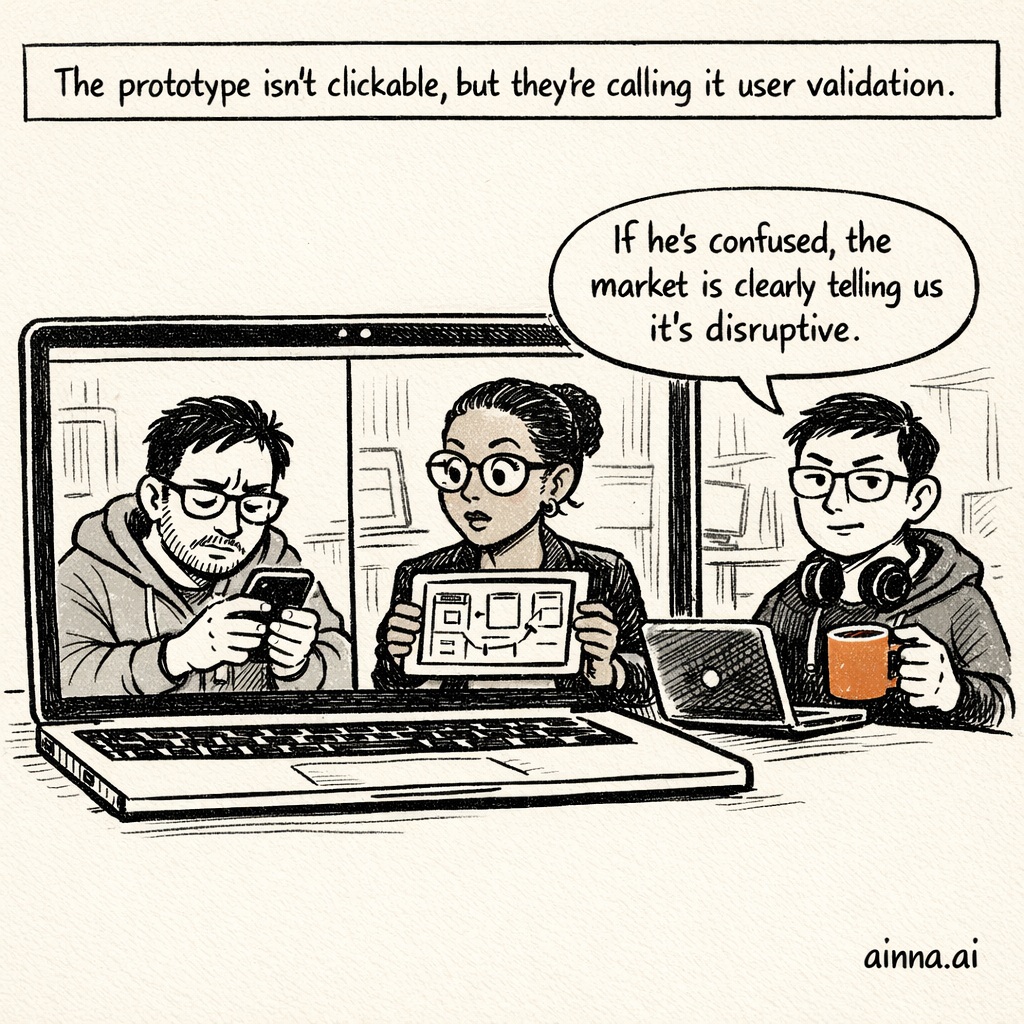
Realistic enough to generate honest, meaningful feedback from real users. The prototype doesn't need to be production-ready, but it needs to convincingly simulate the core experience. If users can't understand or engage with the prototype naturally, their feedback won't tell you whether the concept works—only that the prototype was confusing.

  • High enough fidelity that users react to the concept, not the prototype quality
  • Interactive: users should be able to click, navigate, and experience the key flow
  • Visual enough to convey the intended experience without extensive explanation
  • Fake the backend: use static data, wizard-of-oz techniques, or scripted responses
  • Focus on the critical path—prototype the 20% that validates the core assumption
  • Over-polishing wastes time; under-building produces unreliable feedback

The sweet spot is a prototype that feels real to the user while being achievable in 1–2 days. If your user forgets they're using a prototype, you've nailed it.

Facilitation & Execution

Running the sprint effectively with the right pace, energy, and decision-making.

The facilitator is the real protagonist of the design sprint. They must maintain the right pace, direction, energy levels, and interaction patterns to lead the team toward a clear, shared goal. It's a rare profile—you need someone who masters the sprint process, deeply understands the problem and business context, and can read the room to ensure all voices are heard.

  • Controls pace: keeps exercises on time and the team moving forward with urgency
  • Sets direction: refocuses the team when discussions drift from the core problem
  • Manages energy: knows when to push harder and when the team needs a break
  • Reads the room: identifies when people are holding back and draws them out
  • Enforces rules: ensures the sprint methodology is followed, not shortcutted
  • Challenges the decider: ensures decisions are justified, not just authoritative

A great facilitator turns a group of smart individuals into a high-performing sprint team. A weak facilitator lets the loudest voices dominate, the clock run out on critical phases, and the team converge on mediocre ideas.

A facilitator needs three layers of competence: mastery of the sprint process itself, deep understanding of the business problem and context, and strong interpersonal skills to manage diverse personalities and power dynamics. It's genuinely difficult to find all three in one person—which is why great facilitators are so valuable.

  • Process mastery: knows every exercise, timing, transition, and contingency plan
  • Domain knowledge: understands the business context, customer, and competitive landscape
  • Emotional intelligence: reads body language, detects tension, manages personalities
  • Neutrality: doesn't push their own ideas; focuses on drawing out the team's best thinking
  • Decisiveness: can cut unproductive discussions and redirect energy efficiently
  • Communication clarity: gives crisp instructions and summarizes complex discussions

If you can't find one person with all these skills, consider co-facilitation: a process expert paired with a domain expert who share facilitation duties throughout the sprint.

Design sprints are mentally exhausting—energy typically peaks on Day 1 and drops significantly by Day 3-4. The facilitator must manage pace, alternate between intense focused work and lighter collaborative exercises, build in breaks, and celebrate small wins. The physical environment, food, and even room temperature all affect team energy.

  • Alternate between high-intensity (ideation, critiques) and lower-intensity (sketching, review) activities
  • Schedule the most demanding creative work for morning sessions when energy is highest
  • Build in regular breaks—sprinters aren't productive when they're exhausted
  • Use physical movement: stand-up exercises, wall-based activities, room changes
  • Celebrate progress: show what's been accomplished at the end of each day
  • Keep the problem and goal visible at all times—purpose drives energy

A sprint that burns out its team by Day 3 produces poor prototypes and unreliable decisions. Sustainable intensity beats unsustainable sprinting every time. The facilitator's job is to maintain a marathon pace for a sprint timeframe.

The biggest mistakes are letting the problem statement stay vague, allowing dominant personalities to control discussions, skipping or rushing through ideation to 'get to the prototype faster,' and treating the sprint as a democracy rather than a structured process. Many facilitators also fail to capture ideas digitally, losing valuable outputs.

  • Not resolving the problem statement on Day 1—the team sprints toward different targets
  • Letting the HiPPO (highest-paid person's opinion) override the process
  • Rushing ideation: 'we already know the solution' shortcuts the most valuable thinking
  • Not time-boxing exercises: discussions that run long steal time from critical phases
  • Forgetting to capture: ideas left on sticky notes are ideas lost permanently
  • Not testing with real users: internal demos replace actual validation

Most facilitation mistakes come from the same root cause: not trusting the process. The sprint methodology exists for a reason. When time feels short, it's tempting to skip steps—but those steps are what make sprints produce real value instead of just opinions.

Measuring Success & Scaling

How to evaluate sprint outcomes and build a sustainable sprint program.

For isolated sprints, measure success through direct feedback quality, outputs produced (prototypes, ideas, insights), and mid-term outcomes—particularly business opportunities and success stories linked to sprint deliverables. For successive sprints, you need a framework to capture and quantify outputs and impact over time, with specialized KPIs tracking the overall innovation program.

  • Immediate: Were prototypes produced? Did user testing happen? What did users say?
  • Short-term: How many ideas were generated? How many moved to development backlog?
  • Medium-term: Did any sprint concepts become real products or features?
  • Financial: What revenue or cost savings resulted from sprint-originated initiatives?
  • Cultural: Did the sprint improve cross-functional collaboration and innovation mindset?
  • Process: Was the sprint well-organized? Would participants recommend doing another?

The ultimate measure is whether the sprint produced evidence that improved a real business decision. A sprint where you learn 'this concept won't work' has succeeded—you've saved months of building the wrong thing.

Running successive sprints requires a framework to capture and quantify outputs, track real business outcomes, and demonstrate ROI over time. You need a centralized idea and knowledge repository that feeds from each sprint, enabling full tracking of business opportunities and financial gains—along with specialized KPIs to measure the health of your overall innovation program.

  • Build a centralized idea repository that accumulates knowledge across sprints
  • Track ideas from sprint sticky note to shipped product to business impact
  • Define KPIs: ideas generated, concepts validated, products launched, revenue impact
  • Establish a cadence: quarterly sprints work well for most organizations
  • Train internal facilitators to reduce dependency on external consultants
  • Create a baseline to compare 'quantified innovation output' across sprints

A sprint program becomes powerful when each sprint builds on the accumulated knowledge of previous ones. The combination of a growing idea backlog, trained facilitators, and measurable outcomes transforms sprints from isolated events into a continuous innovation engine.

Absolutely. When run properly and frequently, design sprints drive significant cultural improvements toward what we call the 'innovation mode'—a mindset where cross-functional collaboration, rapid experimentation, and customer-centered thinking become normal rather than exceptional. People who've been through a great sprint carry those habits back to their day-to-day work.

  • Breaks down silos: people from different departments collaborate intensely
  • Builds empathy: team members hear directly from customers during testing
  • Normalizes experimentation: failure becomes learning, not career risk
  • Reduces hierarchy: sprint dynamics level the playing field for junior and senior alike
  • Creates shared language: teams develop common frameworks for discussing innovation
  • Builds momentum: successful sprints generate enthusiasm for more innovation activities

The cultural impact often outlasts the sprint's direct outputs. A team that's experienced the sprint mindset—fast, collaborative, evidence-based—rarely wants to go back to the old way of working. Learn more about building product leadership culture across your organization.

Yes—design sprints frequently produce patentable inventions, novel processes, and defensible innovations. The intense creative pressure combined with diverse expertise often leads to genuinely novel solutions. Organizations that track IP output from sprints find it's one of the most cost-effective ways to generate patent-worthy ideas.

  • Novel solutions created during sprints may be patentable as inventions or processes
  • The multidisciplinary environment produces unique combinations that individual teams miss
  • Digital capture of ideas is essential for establishing invention disclosure timelines
  • Include IP awareness in sprint briefings so team members flag potentially patentable concepts
  • Even non-selected ideas from a sprint may have independent IP value
  • Proper documentation during the sprint supports patent application processes

If your organization values IP, build patent review into your post-sprint process. Some of the most valuable sprint output isn't the prototype that gets built—it's the novel concept that gets patented.

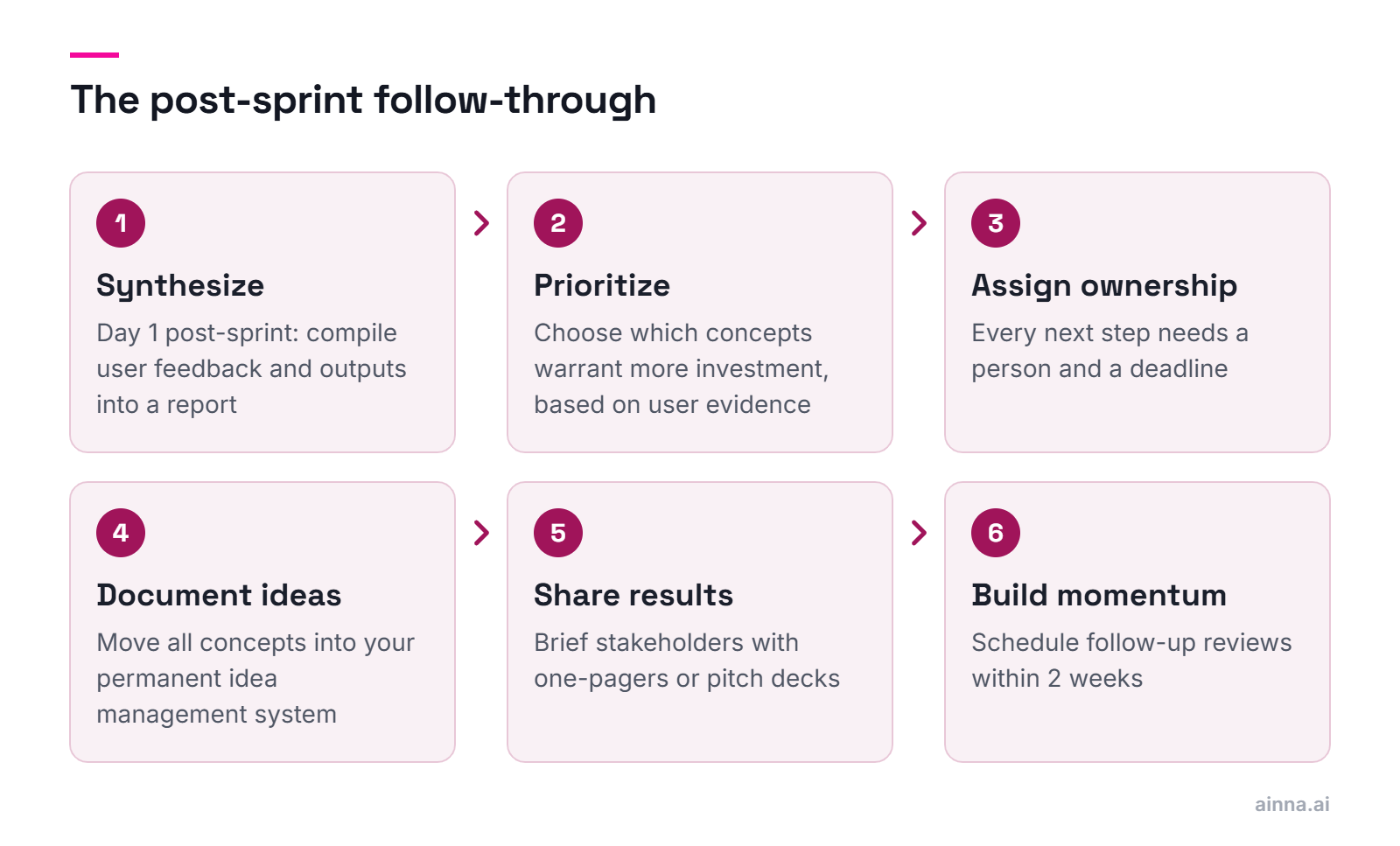
The sprint ending is the beginning of the real work. You need to synthesize user feedback, prioritize concepts for further development, document everything properly, and create actionable next steps with clear ownership. The biggest risk post-sprint is momentum loss—if decisions aren't made and actions assigned within days, sprint energy dissipates and outputs get shelved.

  • Day 1 post-sprint: synthesize user feedback and compile sprint outputs into a clear report
  • Prioritize: which concepts warrant further investment based on user evidence?
  • Assign ownership: every next step needs a person and a deadline
  • Document ideas: move all concepts into your permanent idea management system
  • Share results: brief stakeholders and leadership on sprint findings and recommendations
  • Build momentum: schedule follow-up reviews within 2 weeks to maintain energy

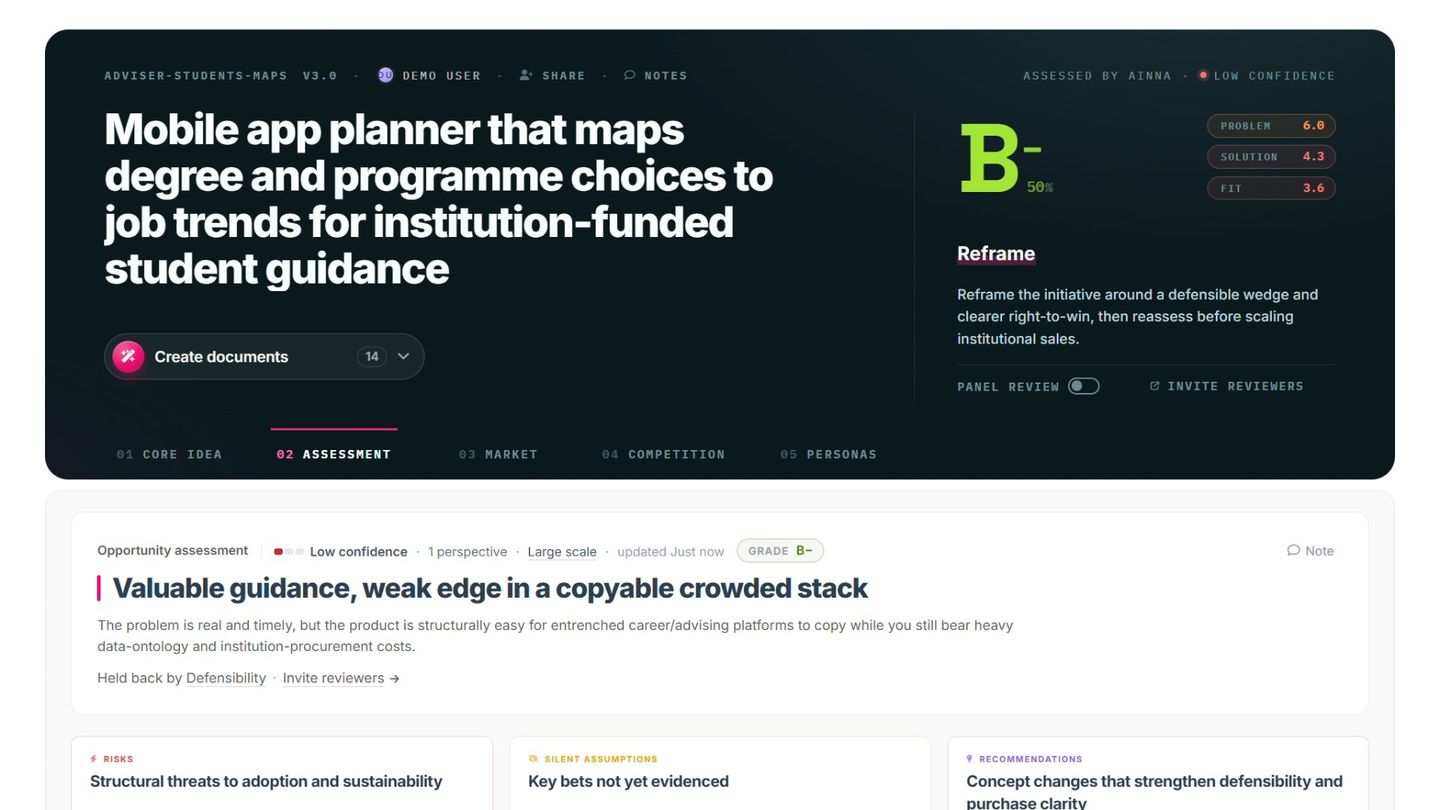
A sprint with great output but no follow-through is a waste of investment. The facilitator's final responsibility is ensuring that sprint energy converts into organizational action. Tools like Ainna can help rapidly convert sprint concepts into professional documentation packages for stakeholder buy-in.

Risks & Common Pitfalls

What goes wrong in design sprints and how to prevent it.

The top risks are: an unclear problem statement that wastes the entire first day or more, wrong team composition that limits creative output, poor facilitation that lets dominant voices control outcomes, lack of prototyping readiness that produces weak prototypes, and not testing with real users—substituting internal opinions for actual validation.

  • Vague problem statement: the #1 sprint killer, causing regression and unfocused work
  • Wrong team: too large, too homogeneous, or with toxic power dynamics
  • Weak facilitation: can't control pace, energy, or dominant personalities
  • Prototyping unreadiness: tools not set up, skills not available, fidelity too low
  • No real users: testing with colleagues instead of actual target users
  • No follow-through: great outputs that sit on a shelf because nobody owns next steps

Most sprint failures are preventable with proper preparation. If you invest adequately in problem definition, team selection, facilitator quality, and prototyping readiness before the sprint starts, you've addressed the majority of risk factors.

The difference between a sprint and an expensive brainstorming session is structure, prototyping, and validation. Without a clear problem, structured process, real prototypes, and actual user testing, you're just having meetings with sticky notes. Ensure every sprint produces tangible, tested output—not just a wall of ideas that felt good in the moment.

  • Start with a crisp problem statement—not a vague theme or open-ended exploration
  • Follow the structured sprint process; don't let it devolve into freeform discussion
  • Insist on real prototypes, not just descriptions or sketches of ideas
  • Test with actual target users, not internal stakeholders playing the role
  • Capture everything digitally with context—not just sticky notes and photos
  • End with clear decisions and assigned actions, not just 'interesting discussions'

If your sprint doesn't produce a prototype that was tested with a real user, it wasn't a sprint—it was a meeting. Protect the process elements that differentiate sprints from brainstorming: prototyping and validation.

Remote sprints are possible but significantly harder than in-person ones. The loss of physical collaboration, spontaneous interaction, and shared energy makes facilitation much more demanding. Digital tools like Miro, Figma, and video conferencing can substitute for physical whiteboards, but the facilitator needs to work twice as hard to maintain engagement, manage turn-taking, and prevent multitasking.

  • Use digital collaboration tools: Miro, FigJam, or MURAL for virtual whiteboards
  • Shorter sessions: break the sprint into half-day blocks across more days
  • Over-communicate: state what's happening, what's next, and who should do what constantly
  • Cameras on: visual cues are critical for the facilitator to read the room
  • More structured exercises: less freeform discussion, more time-boxed individual work
  • Asynchronous work: use off-session time for sketching, research, and ideation

Remote sprints work best with experienced facilitators and teams that already have good collaboration habits. If it's your first sprint, strongly consider doing it in person—the in-room energy and spontaneous interaction are genuinely hard to replicate digitally.

Frame the sprint as a de-risking investment, not a creative experiment. Stakeholders care about cost, time, and outcomes—so quantify the sprint investment against the cost of building the wrong product. Show that 5 days and $30K is dramatically cheaper than 6 months and $500K on an unvalidated concept. Present previous sprint outcomes if available.

  • Frame as risk reduction: 'validate before we invest' resonates with executives
  • Quantify the alternative: compare sprint cost to the cost of failed product development
  • Show the output: prototypes, user feedback, and strategic decisions—not just 'we brainstormed'
  • Include the decider: giving a stakeholder the decider role creates automatic buy-in
  • Start small: a pilot sprint on a lower-stakes problem builds organizational confidence
  • Share success stories: case studies from other companies or previous internal sprints

The strongest pitch for a design sprint is simple: for a fraction of what we'd spend building something, we can find out if it's worth building at all. When you frame it as smart investment rather than creative indulgence, buy-in becomes much easier.