How does AI accelerate design sprint setup and preparation?

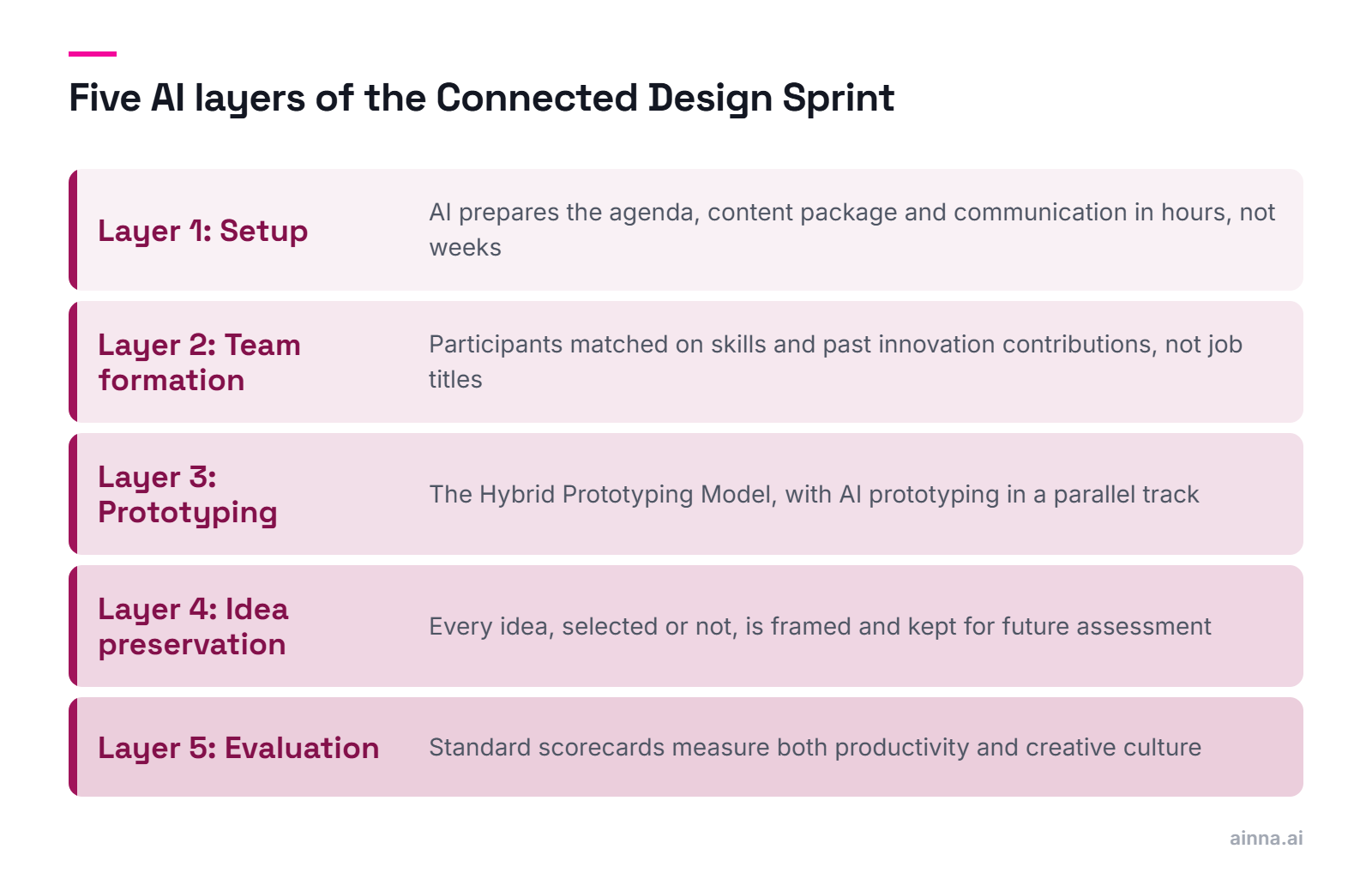
Setting up a design sprint traditionally requires weeks of preparation - defining the agenda, selecting participants, compiling content packages, coordinating communication. In the Innovation Mode methodology, the AI-powered Workshop Designer compresses this into minutes. The organizer provides a brief description, and the system generates a complete event setup: optimal agenda, participant recommendations, a dedicated event page in the Innovation Portal, content packages, and communication templates.

  • The Workshop Designer creates a dedicated sprint page in the Innovation Portal containing critical dates, context, participant list, preparation content, and the high-level problem statement as the primary input. Participants receive a link with general instructions that help newcomers understand the process and essential rules
  • AI compiles a content package for pre-reading: related ideas from the Innovation Graph, research findings, competitor analysis, and 'stories from the market' that provide context and inspiration. This replaces the manual process of curating preparation materials
  • Market intelligence integration: the innovation intelligence team can provide instant competitive analysis, market sizing, and trend reports specifically for the sprint context. As Innovation Mode 2.0 describes, they can even present the 'market state and dynamic' during the sprint kick-off
  • Communication automation: AI generates the invitation sequence, preparation reminders, and post-sprint follow-up emails using branded templates. This eliminates the coordination overhead that traditionally consumes days of the organizer's time
  • The Problem Framing Template can be pre-populated with AI-generated context about the target problem, giving the team a strong baseline to refine rather than starting from a blank statement
  • Practical starting point: even without a full Innovation Portal, you can achieve 80% of this by using AI tools like Ainna to generate problem statements, competitive analysis, and documentation packages as sprint preparation materials
Key Takeaway

AI-powered setup doesn't just save time - it improves sprint quality by ensuring every participant arrives with better preparation, clearer context, and a stronger problem statement baseline. The sprint clock is expensive; every hour of AI-accelerated preparation saves multiple hours of confusion during the sprint itself.

How does AI help form the ideal sprint team?

Team composition is the foundation of a successful design sprint - the wrong team produces the wrong answers with false confidence. In the Innovation Mode methodology, the AI-powered Workshop Designer assists organizers in selecting participants not just based on job titles and static profiles, but based on people's actual innovation performance, activity history, and the impact of their ideas across the organization.

  • AI analyzes the company's innovation data to recommend participants who bring the right combination of domain expertise, creative track record, and collaborative skills. This goes beyond 'who is available' to 'who will contribute most effectively to this specific problem'
  • The system provides a shortlist of specialists on standby in case they're needed during the sprint. Instead of discovering on Day 3 that you need a data architect, you have one pre-identified and briefed
  • AI can also surface just-in-time expertise from the broader innovation community through the Innovation Portal. If the team hits a technical blocker, they can find the right expert in minutes rather than losing hours
  • The Dream Team concept from Innovation Mode 2.0 emphasizes cognitive diversity over seniority: diversity of thought, willingness to share, and a collaborative mindset matter more than hierarchy. AI can help identify people with these characteristics based on their participation patterns in previous innovation events
  • For sprint formats that require specific prototyping skills, AI can match team composition to the likely technology stack - ensuring the team can actually build what they envision, not just ideate about it
  • Read more about assembling the Innovation Dream Team and the product development team guide for broader principles
Key Takeaway

The right team is the single biggest predictor of sprint success - more than the problem statement, the facilitation, or the prototyping tools. AI doesn't replace the judgment call of who to include, but it surfaces options and patterns that manual team selection misses.

How does AI transform prototyping during a design sprint?

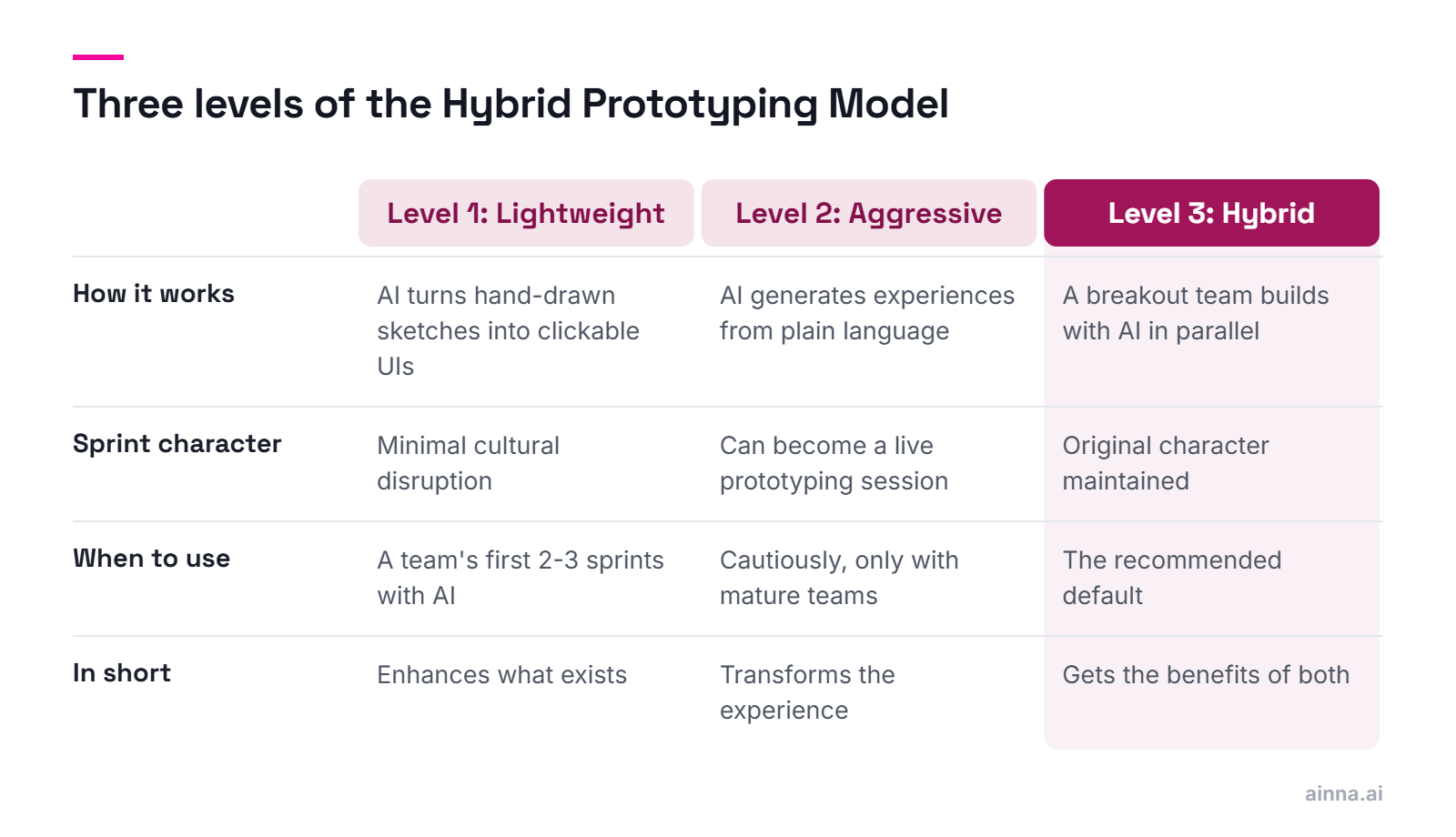
This is where AI's impact on design sprints is most visible - and most culturally sensitive. In Innovation Mode 2.0, I describe three levels of AI prototyping integration, from lightweight to aggressive, and recommend a hybrid approach that preserves the sprint's focused creative character while leveraging AI for speed. The key insight: how you integrate AI prototyping determines whether you enhance the sprint or fundamentally change its nature.

  • Level 1 - Lightweight AI engagement: introduce sketch-to-prototype conversion tools that digitize hand-drawn wireframes into clickable UIs, storyboards, and user flows. This preserves the hands-on creative process (people still sketch) while accelerating the transition from sketch to testable prototype. Minimal cultural disruption
  • Level 2 - Aggressive AI generation: use AI code generation tools (Claude, Software Development Agents, interactive Prototype Builders) where participants describe functionality in natural language and AI generates a functional experience. As Innovation Mode 2.0 notes, 'this could significantly change the character of the workshop - from a focused, deep, cross-disciplinary, intense collaboration to a live prototyping session'
  • Level 3 - The Hybrid Model (recommended): 'maintain the original character of the Design Sprint and, when the solutions are defined and sketched, outsource the prototyping activity to another team that leverages AI tools and builds functional prototypes rapidly.' A breakout team uses AI to convert concepts into functional prototypes while the core team continues the sprint's creative phases. They merge back to review prototypes together
  • The hybrid approach is powerful because it maintains the low-tech, focused creative core - where the best thinking happens - while compressing prototyping from days to hours. Participants still own the creative process; AI handles the translation from concept to functioning code
  • AI prototyping also changes what 'prototype fidelity' means in a sprint. When AI can generate functional apps from descriptions, the bar for what constitutes a 'realistic prototype' rises significantly. User testing becomes more meaningful because prototypes feel closer to real products. See our software prototyping guide for detailed practices
  • The Makerspace connection: for physical product sprints, AI-powered design tools combined with 3D printing, AR devices, and reusable templates from the Makerspace can produce physical prototypes in hours rather than days
Key Takeaway

The prototyping phase is where you must make a deliberate design choice about AI's role. Level 1 enhances what exists. Level 2 transforms the experience. Level 3 (the hybrid) gets you the benefits of both. Choose based on your team's maturity with AI, the sprint's objectives, and how much you value preserving the traditional sprint character.

How does AI prevent design sprint ideas from being lost?

This is one of the most underappreciated AI applications in design sprints - and potentially the most valuable. Design sprints produce dozens of ideas, but only 1-2 get prototyped. The rest die on sticky notes. In the Innovation Mode methodology, AI connects the sprint to the Opportunity Discovery pipeline: every idea, selected or not, is decoded, framed, and fed into the Innovation Graph where it becomes discoverable, assessable, and actionable - far beyond the sprint room and long after the sprint ends.

  • The problem is structural: idea selection in sprints happens under intense, noisy conditions. Articulation on sticky notes is poor or incomplete. Votes are influenced by strong opinions, information overload, and time pressure. As Innovation Mode 2.0 describes, 'it may allow for missed opportunities' because the best idea isn't always the most clearly pitched idea
  • The Innovation Mode solution: instead of archiving or overlooking non-selected ideas, the team 'decodes and feeds the draft ideas directly into the opportunity discovery platform, which then applies the AI-powered processes to frame the ideas, de-duplicate them, and make them available for assessment and discovery'
  • Ideas are tagged as coming from the specific sprint, and contributors are attributed and invited to review or enrich them. This preserves both provenance and ownership - essential for the human-in-the-loop principle
  • Having all sprint ideas in the Innovation Graph enables the network of evaluators to provide additional assessment using the Nine-Dimension Idea Assessment Model. Ideas that scored low during the sprint's time-pressured voting may score high when evaluated thoughtfully by domain experts
  • Sprint sponsors and stakeholders can take a second pass over the full idea set, rethink them as extensions of the selected concept, or explore combinations that were missed during the sprint. The Innovation Mode framework treats the complete idea backlog as a lasting innovation asset, not disposable output
  • Structure ideas using the Universal Idea Model so they're consistently framed and machine-readable. This makes them discoverable for future sprints, product initiatives, and even patent evaluation
Key Takeaway

A design sprint that preserves only its winning idea wastes 90% of its creative output. AI-powered idea preservation transforms sprints from isolated events into continuous contributors to the organization's innovation portfolio. The idea that didn't win Sprint #3 might be exactly what Sprint #8 needs.

Did you know? Ainna applies the same structured methodology whether you're framing one idea or evaluating twenty — consistency across your innovation portfolio. See the Board Pack

How do you integrate AI without destroying the design sprint's character?

This is the central design challenge of AI-powered design sprints. Design sprints work because they force a small team into intense, focused collaboration with no escape. The low-tech environment (sticky notes, sketches, writable walls) is deliberate - it removes distractions and puts all energy into thinking. AI threatens this by introducing a faster, more capable creative participant that can make the human contributions feel redundant. In the Innovation Mode methodology, the solution is deliberate restraint: use AI where it accelerates without altering the creative dynamic, and keep it out of the phases where human immersion matters most.

  • Protect the divergent thinking phase: Days 1-2 of a sprint (understanding, diverging, ideating) are where the team's diverse perspectives create the most value. AI should not generate ideas during this phase - it should support with context, market data, and competitive intelligence, but the creative generation should be human
  • Introduce AI at the convergence point: once the team has selected concepts to prototype, AI accelerates the translation from sketch to functional prototype. This is where the hybrid model from Innovation Mode 2.0 applies - a breakout team builds AI-powered prototypes while the core team continues sprint activities
  • Keep AI invisible during testing: user testing sessions should present prototypes without revealing whether they were built by humans or AI. The feedback should be about the concept, not the production method
  • Use AI for the work nobody loves: event setup, note-taking, idea documentation, post-sprint report generation. These tasks are administrative, not creative. Automating them with AI gives humans more time for the high-value creative work
  • Watch for the 'spectator effect': if participants start watching AI generate solutions rather than creating their own, the sprint has shifted from human-led to AI-led. As described in the parent guide on AI-powered innovation events, this is the cultural risk that must be managed actively
  • The facilitation adjustment: facilitators of AI-powered sprints need an additional skill - knowing when to introduce AI tools and when to keep them out of the room. This is a design decision made before the sprint, not an improvisation during it
Key Takeaway

The sprint's character - intense, focused, human-driven collaboration - is not a limitation to be overcome. It's the feature that makes sprints produce insights no other process can. AI should amplify this character, not replace it. The organizations that get the best results will be those that are most thoughtful about where AI enters the sprint and where it stays outside.

How does AI change the facilitator's role in a design sprint?

AI doesn't replace the facilitator - it adds a new dimension to an already complex role. The facilitator of an AI-powered sprint must make deliberate decisions about when to introduce AI tools, when to keep them out, and how to maintain the team's creative ownership when AI can generate competing solutions in seconds. In the Innovation Mode framework, this makes facilitation harder, not easier - because the facilitator now manages both the human dynamics and the human-AI dynamic.

  • New skill: AI timing decisions. The facilitator decides when AI enters the room (prototyping phase? ideation? preparation only?) and enforces those boundaries. This requires understanding both the sprint methodology and the AI tools' capabilities and limitations
  • New challenge: managing the 'wow factor.' When AI generates a functional prototype in minutes, the team's reaction can distort the evaluation process. The facilitator must redirect attention from 'that's impressive' to 'does this solve the user's problem?' - the same question that drives every sprint
  • New responsibility: preserving human ownership. If the facilitator lets AI dominate the creative phases, participants will self-select out of future sprints. The facilitator must ensure that human contributions remain visible, valued, and clearly attributed
  • Enhanced capability: real-time intelligence. AI can provide the facilitator with instant market data, competitive information, or technical feasibility checks during discussions - allowing more informed facilitation without stopping the sprint for research
  • Documentation upgrade: AI can capture discussions, decisions, and ideas in real-time, freeing the facilitator from the dual burden of facilitating and note-taking. This is one of the clearest wins - a facilitator who doesn't have to worry about documentation can focus entirely on the team's energy and direction
  • The core skills don't change: reading the room, managing power dynamics, controlling pace, enforcing time-boxes, and challenging the decider. See the design sprint guide for foundational facilitation practices
Key Takeaway

The best AI-powered sprint facilitators will be those who view AI as another team member to manage, not a tool to deploy. They'll know when AI helps and when it hinders, when to bring it into the room and when to shut it off. This is a higher-order facilitation skill than anything the pre-AI sprint required.

What does a 5-day AI-powered design sprint schedule look like?

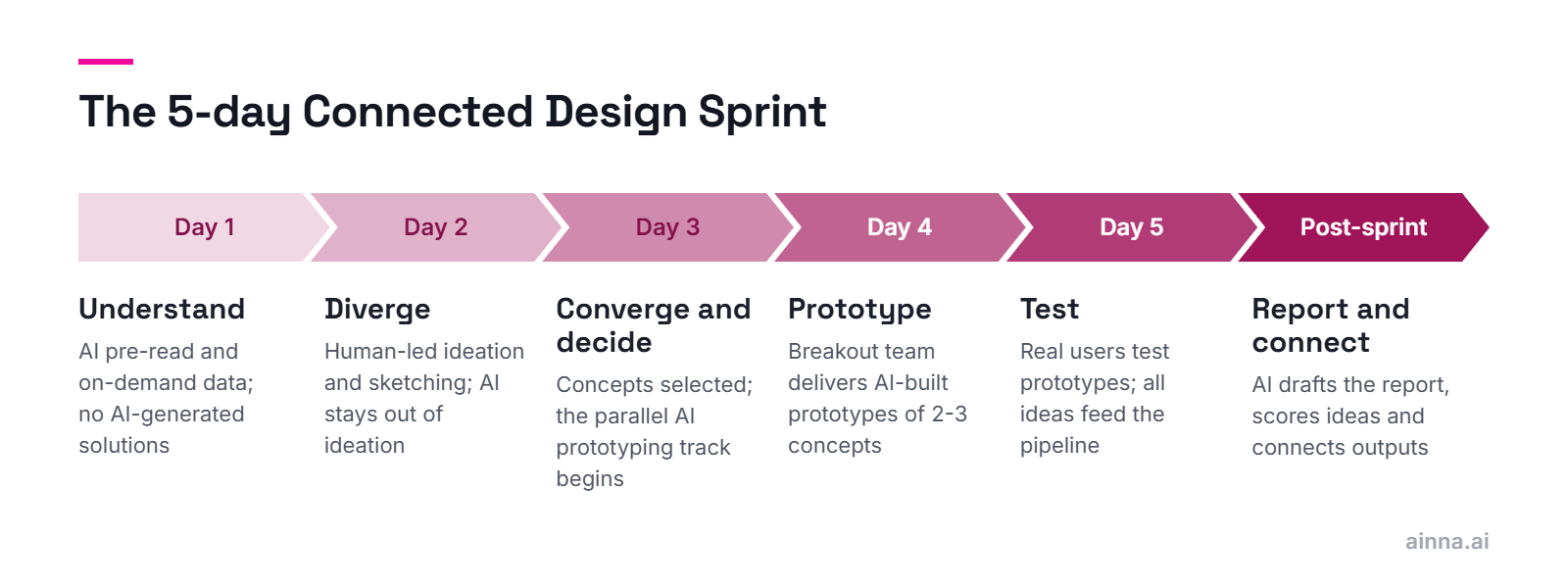
An AI-powered sprint follows the same 5-day structure as a traditional sprint - understand, diverge, converge, prototype, test - but with AI accelerating specific phases. In the Innovation Mode Hybrid Prototyping Model, the biggest change is on Days 3-4: once concepts are selected, a parallel AI prototyping track runs alongside the core sprint, producing higher-fidelity prototypes in less time. This can compress the effective prototyping window from 1.5 days to half a day.

  • Day 1 - Understand: AI-generated market intelligence, competitive analysis, and problem context are available as pre-read (prepared by Workshop Designer). The team focuses on understanding the problem and setting sprint goals. AI provides on-demand data during discussions but does not generate solutions
  • Day 2 - Diverge: human-led ideation, sketching, and concept development. This is the phase where the low-tech, focused character of the sprint is most valuable. AI stays out of ideation to preserve diverse human perspectives. Ideas are captured digitally in real-time using the Universal Idea Model
  • Day 3 - Converge and decide: the team evaluates, discusses, and selects concepts for prototyping. AI can support with quick feasibility assessments and market data. Once concepts are selected, the parallel prototyping track begins - a breakout team starts converting selected concepts into functional prototypes using AI tools
  • Day 4 - Prototype: the breakout team delivers AI-generated prototypes for review. The core team refines, provides feedback, and iterates. Because AI compresses the prototyping timeline, teams can potentially prototype 2-3 concepts instead of the traditional 1 - providing richer options for user testing on Day 5
  • Day 5 - Test: prototypes are presented to real users exactly as in a traditional sprint. AI supports by analyzing user feedback in real-time, but the testing methodology remains human-led. All ideas (selected and non-selected) are fed into the Opportunity Discovery pipeline
  • Post-sprint: AI auto-generates the sprint report, processes feedback, scores ideas, and connects outputs to the Innovation Graph. Documentation that traditionally took days is completed in hours. Tools like Ainna can convert sprint concepts into complete PRDs, pitch decks, and one-pagers in 60 seconds
Key Takeaway

The AI-powered sprint doesn't change the structure - it changes the throughput. More concepts prototyped, higher-fidelity prototypes, better-prepared participants, and complete documentation at the end. The 5-day frame remains, but what you accomplish within it expands significantly.

With the rise of AI, expertise is becoming a commodity.

How do I introduce AI into our design sprints for the first time?

Start with the phases where AI has the least cultural friction and the highest immediate value: preparation and post-sprint processing. Then gradually introduce AI into prototyping. Save AI-assisted ideation for last. In the Innovation Mode approach, the progression follows the same principle described in the parent guide on AI-powered innovation events: AI as organizer first, then documenter, then prototyper, and finally co-ideator.

  • Sprint #1 with AI: use AI only for preparation (generating problem context, competitive analysis, and preparation materials) and post-sprint documentation (report generation, idea structuring). The sprint itself runs traditionally. This lets the team experience AI's value without changing the creative experience
  • Sprint #2-3 with AI: introduce Level 1 AI prototyping - sketch-to-prototype conversion tools that digitize hand-drawn wireframes into clickable interfaces. The creative process stays the same; the translation from sketch to testable prototype gets faster
  • Sprint #4+ with AI: implement the hybrid prototyping model - a breakout team uses AI code generation to build functional prototypes in parallel with the core sprint activities. This is where the throughput gains become dramatic
  • Advanced: introduce AI-generated concept baselines as pre-sprint input. AI generates initial concepts based on the problem statement, and participants evaluate and build on them. Only attempt this after the team has experience with AI-enhanced sprints and understands the synthesis vs. ideation dynamic
  • At each stage, debrief the team on how AI affected their experience. Did they feel their contributions mattered? Did AI help or hinder their creative process? Was the output quality better? These signals should gate progression to the next level
  • For immediate impact with zero process change: use Ainna to generate sprint preparation materials (problem statements, competitive analysis, product concepts) and post-sprint documentation (PRDs, pitch decks) - the phases that surround the sprint rather than the sprint itself
Key Takeaway

The goal is progressive integration, not sudden transformation. Each sprint with AI should feel like a natural evolution of the previous one, not a disruption of it. If at any point the team's creative energy declines, slow down the integration.

How do AI-powered sprint outputs connect to the venture building pipeline?

In the Innovation Mode methodology, the design sprint is not an isolated event - it's a node in the Opportunity Discovery and Validation pipeline. AI-powered sprints strengthen this connection by automatically structuring and routing outputs to downstream processes: validated concepts flow to the Venture Studio for MVP development, non-selected ideas enter the Innovation Graph for future assessment, and user testing data feeds into the product-market fit measurement framework.

  • Validated concepts from the sprint are assessed using the Nine-Dimension Idea Assessment Model. The sprint's user testing data provides direct evidence for dimensions like Effectiveness and Certainty of Demand. If the Opportunity Score is high enough, the concept enters the venture building pipeline
  • The Venture Studio receives a complete package: validated problem statement, framed product concept (using the Universal Idea Model), prototype, user testing results, and identified risks and uncertainties. This is the handoff that transitions from Opportunity Validation to Opportunity Realization
  • Non-selected sprint ideas enter the Innovation Graph for ongoing assessment. They're tagged with their sprint origin, attributed to contributors, and available for future evaluators. An idea that was non-obvious during Sprint #3 may be exactly what Sprint #8 needs
  • AI accelerates the handoff documentation: tools like Ainna can generate complete PRDs, pitch decks, and go-to-market strategy drafts from sprint outputs in 60 seconds - solving the documentation bottleneck where sprint energy stalls
  • Sprint performance data feeds into the Innovation Performance Framework: how many concepts progressed, what was the time from sprint to MVP, what revenue resulted from sprint-originated products. These metrics justify continued investment in the sprint program
  • The Innovation Calendar from Innovation Mode 2.0 ensures sprints are strategically sequenced: a market intelligence briefing informs the sprint problem statement, the sprint outputs feed into an opportunity review, and the review triggers MVP development for validated concepts
Key Takeaway

The sprint that produces a great prototype but no pipeline connection has delivered a fraction of its potential value. AI makes the connection between sprint output and venture building pipeline seamless - so the energy generated in the sprint room translates directly into organizational action.

How do you measure whether AI improved your design sprint?

Measuring AI's impact on sprints requires comparing both productivity metrics (did the sprint produce more, faster, better?) and cultural metrics (did participants feel their contributions mattered?). In the Innovation Mode methodology, the sprint performance scorecard tracks both dimensions because a sprint that's more productive but less energizing is trading short-term output for long-term cultural decline.

  • Productivity metrics: number of concepts prototyped (AI-powered sprints should enable 2-3 vs. the traditional 1), prototype fidelity level (AI should produce higher-fidelity prototypes), ideas captured and structured (should be 100% vs. the typical 20-30% that survive sticky notes), and time from sprint to stakeholder-ready documentation
  • Quality metrics: user testing feedback quality (higher-fidelity prototypes should generate more meaningful feedback), Opportunity Scores of sprint-originated concepts (assessed using the Nine-Dimension Idea Assessment Model), and pipeline conversion rate (what percentage of sprint concepts progress to MVP?)
  • Cultural metrics: participant satisfaction with their creative contribution (not just overall satisfaction), volunteer rate for future sprints, and specific feedback on whether AI enhanced or diminished the creative experience
  • Efficiency metrics: preparation time (AI vs. manual setup), documentation time (post-sprint report generation), and total sprint cost per validated concept - the key ROI metric
  • As described in Innovation Mode 2.0, innovation events should produce standardized performance scorecards that enable cross-event comparison. Sprint #8 should be measurably more effective than Sprint #1 - and the data should show exactly where AI made the difference
  • The most important metric: did the sprint produce evidence that improved a real business decision? A sprint where you learn 'this concept won't work' has succeeded. A sprint where AI produced an impressive prototype but nobody acted on it has failed
Key Takeaway

Don't measure AI's impact by asking 'did we use AI?' Measure it by asking 'did we produce better outcomes, faster, without damaging the creative culture?' If the answer is yes on all three counts, AI integration is working.

Did you know? Ainna compresses weeks of consultant-grade analysis into minutes — not by cutting corners, but by applying structured methodology at the speed of software. Try it with your idea

A product visionary with general technical skills and a great product concept can use a few powerful AI assistants to build, launch, and grow products that would otherwise require entire teams.

Most AI says yes.
Ainna says prove it.

The same methodology behind these guides — structured into an AI platform that frames opportunities, challenges assumptions, and produces stakeholder-ready documents in minutes.

Put Your Idea to the Test Free to explore · No credit card
Ideas in.
Opportunities out.