Foundations of Product Discovery Documentation

Understanding why structured documentation matters for innovation success.

Product discovery documentation captures the structured outputs of your innovation process—problem statements, business ideas, product concepts, and validation results. It creates a shared 'innovation language' that enables teams to communicate clearly, evaluate objectively, and make informed decisions about which ideas to pursue.

  • Captures problems, ideas, and concepts in consistent, shareable formats
  • Creates alignment across teams, departments, and stakeholders
  • Enables objective evaluation and prioritization of opportunities
  • Builds institutional knowledge that compounds over time
  • Prevents ideas from getting lost or misunderstood
  • Accelerates decision-making by providing clarity upfront

Without structured documentation, innovation becomes chaotic—good ideas get lost, problems are misunderstood, and teams waste resources solving the wrong things. Documentation is the foundation of systematic innovation.

An innovation language is a standardized way of describing problems, ideas, and concepts across your organization. It uses consistent templates and terminology so that anyone can quickly understand, evaluate, and discuss innovation opportunities—regardless of their role or department.

  • Standardized templates ensure everyone describes problems and ideas the same way
  • Removes ambiguity—'idea' means the same thing to engineering, marketing, and leadership
  • Makes ideas discoverable—you can search, categorize, and compare systematically
  • Accelerates collaboration—less time explaining, more time developing
  • Enables objective evaluation using consistent criteria
  • Builds over time as templates become embedded in organizational culture

Creating an innovation language starts with adopting consistent templates for problems, ideas, and concepts. The Innovation Toolkit provides ready-made templates that establish this common language.

Documentation forces clarity. Writing down your problem statement, idea, and product concept exposes gaps in thinking that would otherwise only surface during expensive development. It's far cheaper to iterate on a document than on code or prototypes.

  • Writing forces you to articulate what you actually mean—vague ideas become concrete
  • Gaps and assumptions become visible when you have to write them down
  • Stakeholder alignment is easier with documents than verbal descriptions
  • Documentation creates a baseline for evaluating whether you achieved your goals
  • Changes to documents cost nothing; changes to products cost everything
  • Documentation becomes institutional memory—learnings persist beyond individuals

The discipline of documentation is an investment that pays back throughout the product lifecycle. Teams that skip documentation often find themselves rebuilding because they misunderstood the problem or solution.

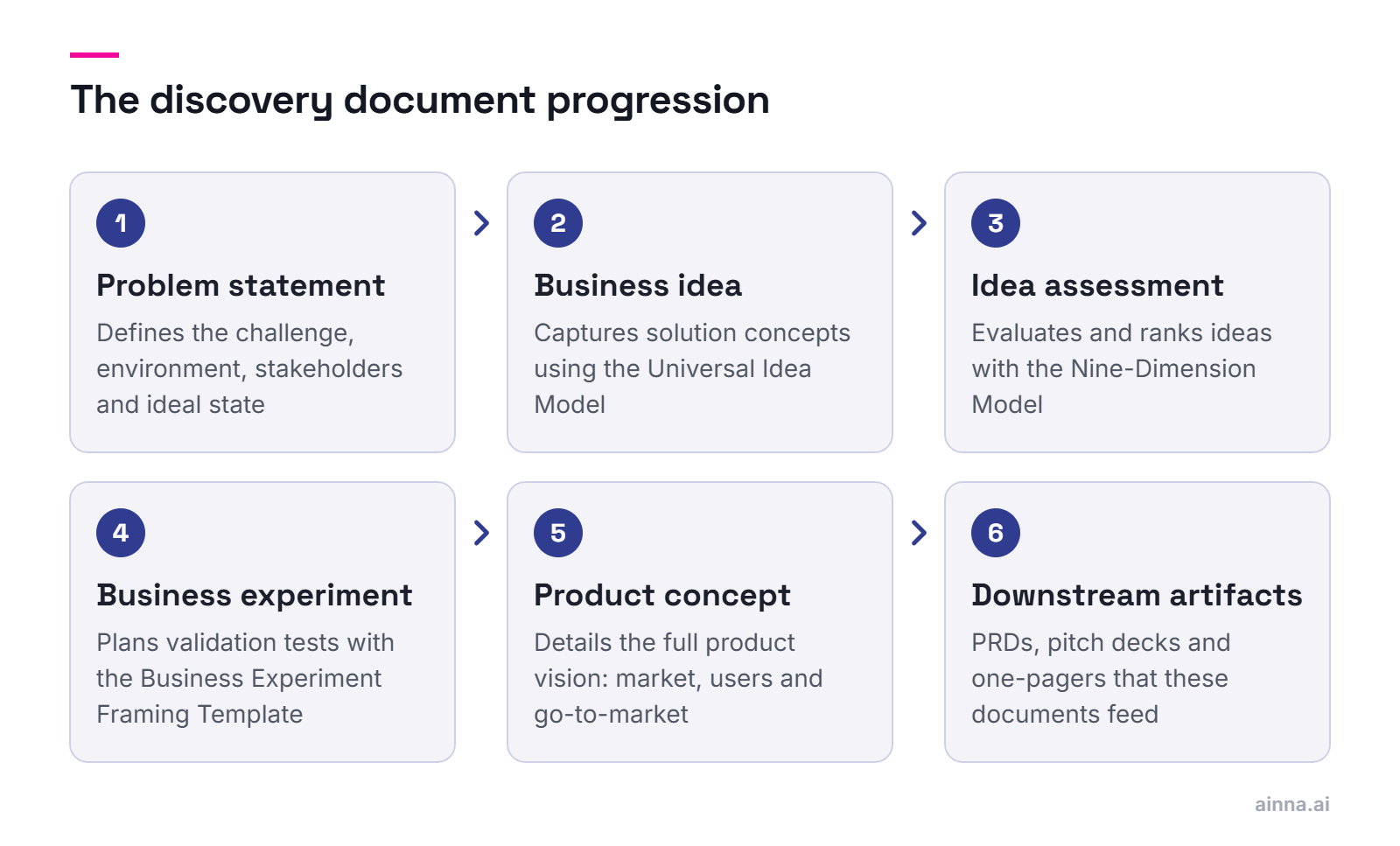
Product discovery documentation typically flows from problem to solution: Problem Statements define challenges worth solving, Business Ideas capture potential solutions, Product Concepts detail how solutions would work, and Experiment Designs plan how to validate assumptions. Each serves a distinct purpose in the innovation journey.

  • Problem Statement — Defines the challenge, environment, stakeholders, and ideal state
  • Business Idea — Captures solution concepts in a consistent, shareable format
  • Idea Assessment — Evaluates and ranks ideas objectively against criteria
  • Product Concept — Details the full product vision including market, users, and go-to-market
  • Business Experiment — Plans validation tests for critical assumptions
  • Workshop Documentation — Captures brainstorming and hackathon outputs

These document types form a progression: understand the problem deeply, generate solution ideas, evaluate and select the best ones, define the product concept, and plan validation experiments.

Problem Framing

Defining challenges worth solving before jumping to solutions.

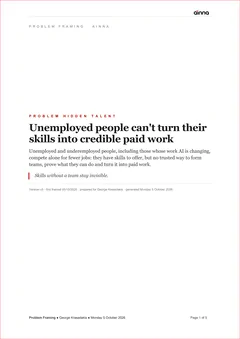
Problem framing is the discipline of defining and understanding a challenge before attempting to solve it. Most innovation failures stem from rushing to solutions without fully grasping the problem—its context, affected users, root causes, and dynamics. Good problem framing ensures you're solving something worth solving.

  • Prevents the most common innovation mistake: solving the wrong problem
  • Distinguishes root causes from symptoms—treating symptoms doesn't solve problems
  • Identifies who is affected and how—essential for designing valuable solutions
  • Clarifies what success looks like before you start building
  • Creates alignment across teams about what you're actually trying to achieve
  • Saves resources by filtering out problems not worth solving

Invest time in problem framing. A well-defined problem is half-solved; a poorly-defined problem leads to wasted resources and missed opportunities, regardless of how good your solution is.

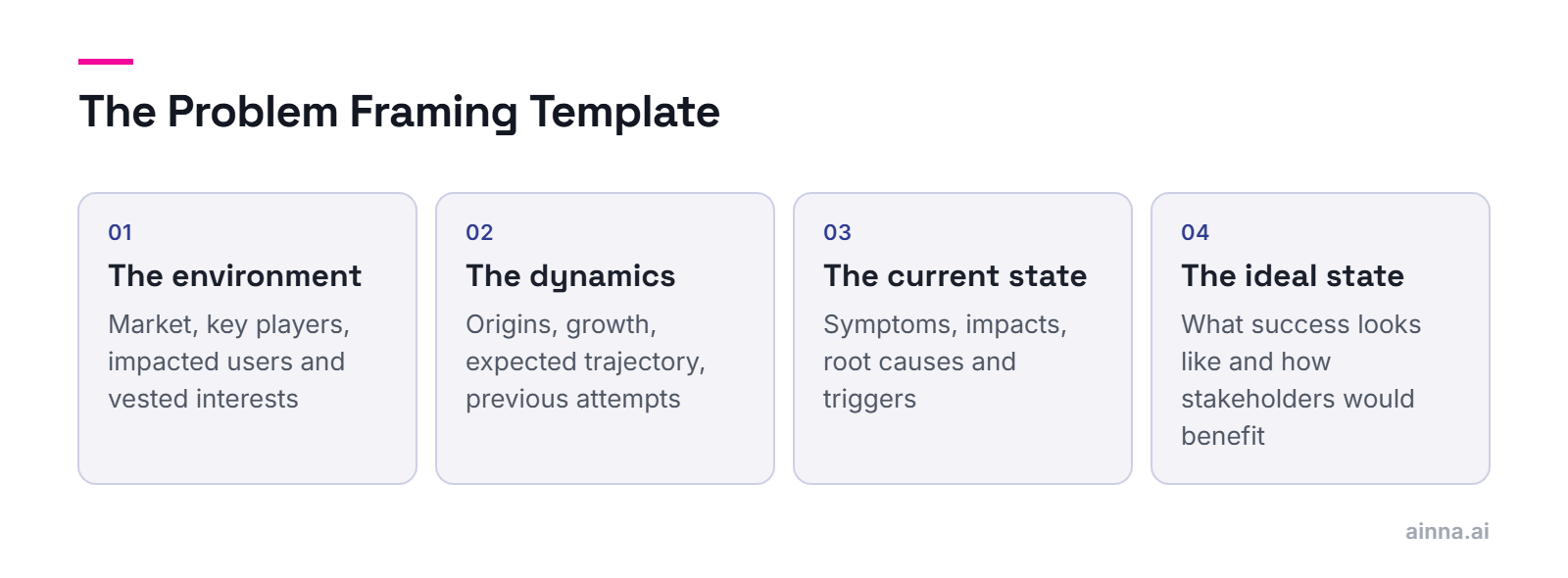
An effective problem statement covers four dimensions on a single page: the Environment (ecosystem, stakeholders, affected users), the Dynamics (history, trends, previous attempts), the Current State (symptoms, root causes, triggers), and the Ideal State (what success looks like). This structure ensures comprehensive understanding before ideation begins.

  • The Environment — Market dynamics, key players, impacted users, entities with vested interest
  • The Dynamics — When the problem emerged, how it has grown, expected trajectory, previous solution attempts
  • The Current State — Symptoms, impacts, how affected parties experience it, root causes, triggers
  • The Ideal State — What success looks like, how stakeholders would benefit if solved
  • Keep it to one page—forces clarity and prioritization of what matters most
  • Use plain language—no jargon, no technical terms that exclude stakeholders

Share your problem statement with brainstorming participants before sessions. When everyone understands the problem deeply, ideation becomes focused and productive rather than scattered.

The biggest mistakes are: jumping to solutions before understanding the problem, confusing symptoms with root causes, defining problems too broadly or too narrowly, ignoring stakeholder perspectives, and failing to articulate what success looks like. Each leads to wasted effort on solutions that don't address the real challenge.

  • Solution-first thinking — Starting with 'we need an app' instead of understanding the underlying need
  • Symptom focus — Treating visible symptoms rather than underlying root causes
  • Scope issues — Problems too broad are unsolvable; too narrow miss the real opportunity
  • Missing stakeholders — Not considering all affected parties leads to incomplete understanding
  • Vague success criteria — Without clear outcomes, you can't evaluate whether you've succeeded
  • Static view — Ignoring how the problem is evolving and where it's heading

Force yourself to complete a problem statement template before ideation. The structure prevents these mistakes by requiring you to address each dimension systematically.

A problem worth solving has significant impact on identifiable users, is getting worse or more prevalent over time, lacks adequate existing solutions, aligns with your capabilities and strategy, and has a plausible path to a viable business model. Not every problem deserves your resources—filter ruthlessly.

  • Impact magnitude — How much does this problem cost users in time, money, or frustration?
  • Frequency — How often do users encounter this problem?
  • Trend direction — Is the problem growing, stable, or declining?
  • Solution gap — Are existing solutions inadequate? Why?
  • Strategic fit — Does solving this align with your capabilities and business goals?
  • Monetization potential — Can a solution become a viable business?

Use these criteria to prioritize which problems to pursue. The best innovations solve important, frequent, growing problems with inadequate current solutions.

Business Idea Documentation

Capturing and communicating ideas in consistent, actionable formats.

A business idea template captures four key dimensions: the Problem being solved (context and situation), the Users and Value (who benefits and how, including form factors), the Logic (how the idea works mechanically), and the Big Unknowns (uncertainties and risks). This structure ensures ideas are complete and actionable.

  • Idea Title and Problem — Clear name plus the problem being addressed and why it matters
  • Users, Value, and Form Factors — Who benefits, what value they get, how the company benefits, possible implementation forms
  • Logic and Execution — How the idea actually works, technical aspects, data requirements
  • Big Unknowns — Key uncertainties, risks, questions that need answers before proceeding
  • Keep it concise — A single page forces prioritization of essential information
  • Use consistent format — Enables comparison and evaluation across many ideas

The business idea template creates a standard 'innovation language' that makes ideas easy to share, discover, and evaluate across teams and stakeholders.

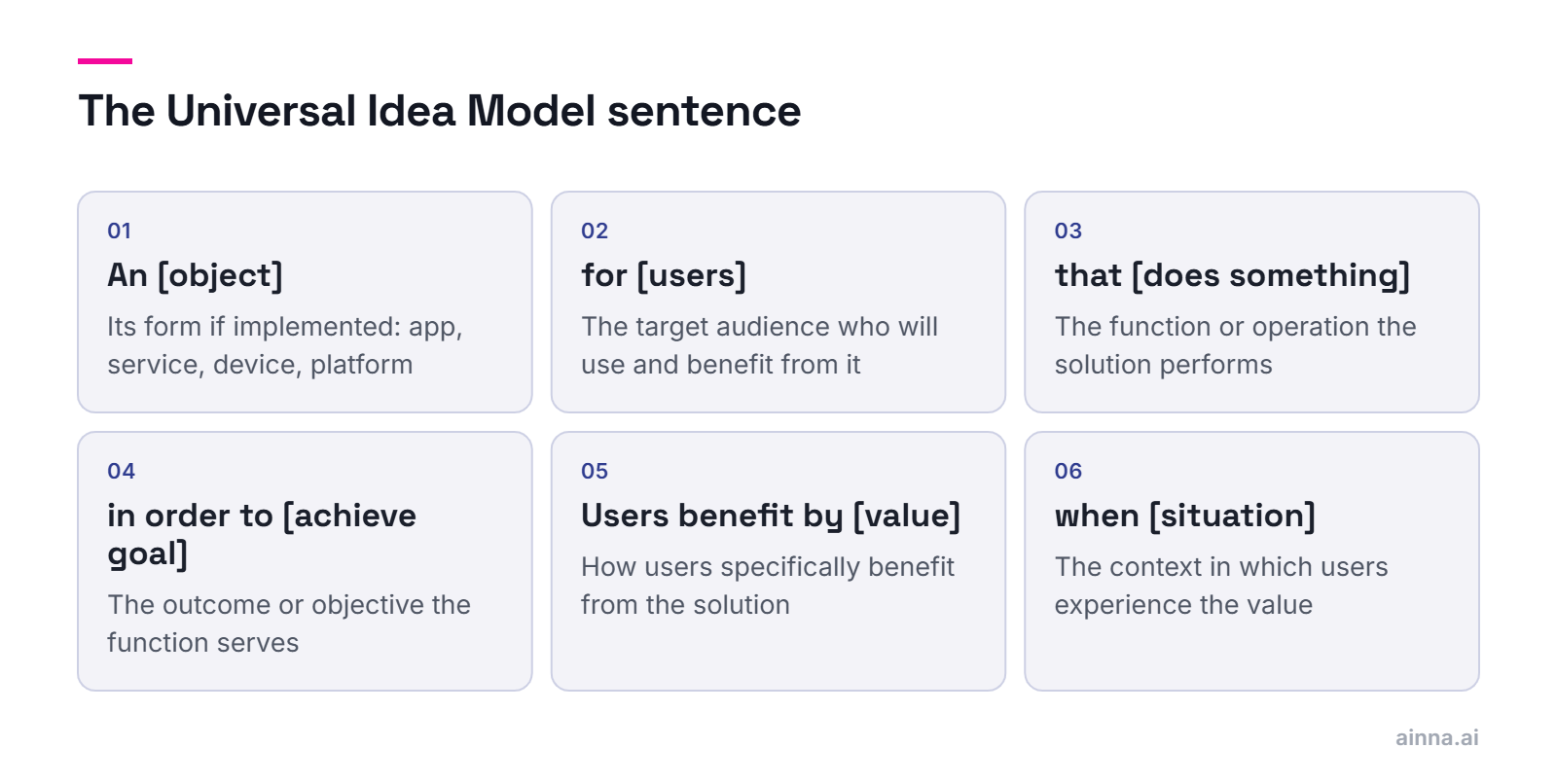
The Universal Idea Model is a sentence-based framework for creating executive summaries of ideas. It follows the structure: 'An [object] for [users] that [does something] in order to [achieve goal]. Users benefit by [value] when [situation].' This format forces clarity about form, audience, function, purpose, value, and context.

  • [object] — The form the idea takes if implemented (app, service, device, platform)
  • [users] — The target audience who will use and benefit from it
  • [does something] — The function or operation the solution performs
  • [achieve goal] — The outcome or objective the function serves
  • [value] — How users specifically benefit from the solution
  • [situation] — The context or conditions in which users experience the value

The Universal Idea Model transforms vague concepts into concrete, communicable ideas. Use it to quickly articulate any idea in a way stakeholders can immediately understand and evaluate.

Here are real examples: 'An intelligent component for business users that captures meeting context and recommends suitable participants in order to organize better meetings. Users benefit by instantly finding the right experts and decision-makers when setting up business events.' The model works for any idea—apps, platforms, devices, services.

  • Meeting Optimizer — An intelligent component for business users that recommends meeting participants to organize better meetings with the right people
  • AR Shopping Assistant — An app for consumers that synthesizes personalized pricing as augmented reality to offer special discounts when exploring products in stores
  • Fake News Detector — A decentralized system for online users that identifies misleading content to help users realize their exposure to misinformation on social media
  • Smart Do Not Disturb — A software component that identifies noise-sensitive occasions to minimize disturbance when users are in places requiring quiet
  • Each example specifies: what it is, who uses it, what it does, why, and when
  • The structure makes completely different ideas comparable and evaluable

Practice writing your ideas in this format. The discipline of completing each element reveals gaps in your thinking and sharpens your concept.

Every new idea carries uncertainties—technical feasibility, market demand, user behavior, regulatory issues. Documenting Big Unknowns forces honest assessment of risks and creates a prioritized list of questions to answer before committing significant resources. Ideas with unaddressed unknowns often fail expensively.

  • Makes risks visible — Unknowns you don't acknowledge still affect your project
  • Prioritizes validation — Some unknowns are critical; others can wait
  • Informs experiment design — Each unknown suggests a hypothesis to test
  • Sets realistic expectations — Stakeholders understand what's uncertain
  • Prevents false confidence — Good ideas can still fail if key unknowns go wrong
  • Creates learning agenda — Unknowns become research and validation priorities

Treat Big Unknowns as the agenda for your MVP and validation experiments. The goal isn't to eliminate all unknowns—it's to address the most critical ones before scaling.

Idea Assessment & Prioritization

Objectively evaluating and ranking ideas to focus on the best opportunities.

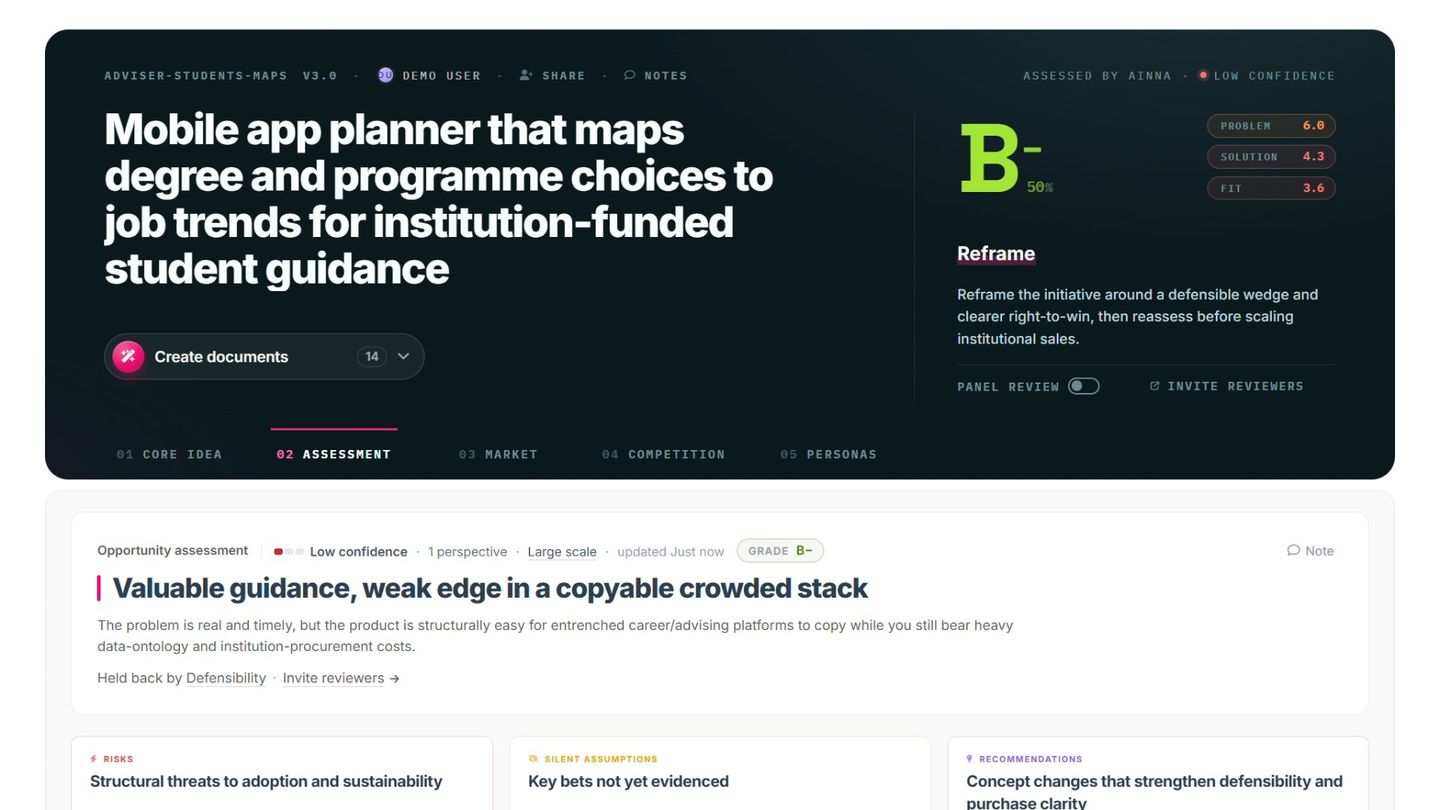
Effective idea assessment uses nine key criteria: Problem Importance, Strategic Alignment, Solution Effectiveness, Technical Feasibility, Economic Feasibility, Ease of Development, Operational Simplicity, Business Impact, Novelty, and Market Demand Certainty. Each criterion captures a different dimension of idea potential.

  • Problem Importance — How significant is the problem being solved?
  • Strategic Alignment — Does it fit your company's direction and capabilities?
  • Solution Effectiveness — How well does the proposed solution address the problem?
  • Technical Feasibility — Can it actually be built with available technology?
  • Economic Feasibility — Does the business model make financial sense?
  • Ease of Development — How complex and resource-intensive is implementation?
  • Operational Simplicity — How easy is it to run and maintain once launched?
  • Business Impact — What's the potential scale of positive outcomes?
  • Market Demand Certainty — How confident are you that customers will want it?

Use weighted scoring across these criteria to rank ideas objectively. Different organizations may weight criteria differently—a startup might prioritize impact and novelty; an enterprise might emphasize strategic alignment and feasibility.

Weighted scoring assigns importance multipliers to each evaluation criterion, then calculates a total score by multiplying each criterion score by its weight. This allows you to customize evaluation to your priorities—if feasibility matters most, weight it heavily; if innovation is key, weight novelty higher.

  • Assign weights (1-10) to each criterion based on your organizational priorities
  • Score each idea (1-10) against each criterion
  • Multiply scores by weights and sum for total weighted score
  • Rank ideas by total score for objective prioritization
  • Adjust weights for different contexts—innovation vs. optimization initiatives
  • Use the same weights consistently within a portfolio for fair comparison

Weighted scoring doesn't replace judgment—it structures it. The value is in forcing explicit conversations about what matters and applying those priorities consistently across many ideas.

Use a tiered evaluation process: quick screening to eliminate clearly unsuitable ideas, then structured assessment of survivors using weighted criteria. Standardized templates and automated scoring (via spreadsheets) make it possible to process large volumes while maintaining objectivity.

  • First pass — Quick screening against deal-breaker criteria (strategic fit, basic feasibility)
  • Second pass — Structured scoring of remaining ideas using full criteria
  • Use spreadsheet templates with automated scoring formulas
  • Involve multiple evaluators to reduce individual bias
  • Calibrate evaluators by scoring a few ideas together first
  • Document scores and rationale for future reference and learning

The goal isn't to evaluate every idea deeply—it's to reliably identify the top candidates for deeper investment. Efficient screening lets you process more ideas and find better opportunities.

Combat bias through structured criteria, multiple evaluators, blind evaluation where possible, calibration exercises, and explicit documentation of reasoning. The goal is consistency—the same idea should score similarly regardless of who evaluates it or when.

  • Use explicit criteria — Vague evaluation invites bias; specific criteria constrain it
  • Multiple evaluators — Average scores across several people to reduce individual bias
  • Blind evaluation — Remove identifying information where possible
  • Calibration — Have evaluators score the same ideas and discuss differences
  • Document reasoning — Writing rationale forces more careful thinking
  • Separate ideation from evaluation — Don't let idea authors evaluate their own ideas

Perfect objectivity is impossible, but structured evaluation dramatically improves consistency and reduces the impact of individual biases on which ideas advance.

Product Concept Documentation

Defining complete product visions ready for development and stakeholder alignment.

A product concept is a detailed articulation of a product vision—it expands a validated business idea into a comprehensive description including market context, user personas, competitive landscape, user stories, technology approach, go-to-market strategy, and monetization model. Ideas are starting points; product concepts are development-ready blueprints.

  • Ideas are hypotheses; product concepts are validated and detailed plans
  • Product concepts include market context, competition, and positioning
  • They define specific user personas and their needs
  • They articulate epic-level <a href='/resources/faq/user-stories-agile-faq'>user stories</a> as a foundation for development
  • They specify technology approach, form factors, and implementation strategy
  • They include go-to-market plans and monetization strategies

Don't skip from idea to development. The product concept stage forces you to think through all the dimensions that determine success—before you invest heavily in building.

A comprehensive product concept template covers: Market Context (landscape, players, trends), Problem and Opportunity, Competitive Analysis, Target Audience and Personas, User Needs and Stories, Product Vision and Features, Form Factors and Technology, Implementation Strategy, Go-to-Market Plan, Monetization Model, and Growth Opportunities.

  • Market Context — Industry landscape, key players, market dynamics and trends
  • Problem and Opportunity — The challenge being addressed and why now is the right time
  • Competitive Landscape — Existing solutions, their strengths and weaknesses, your differentiation
  • Target Audience — Specific user segments, personas, their characteristics and behaviors
  • User Needs and Stories — What users need to accomplish, framed as epic user stories
  • Product Vision — Features, capabilities, and the overall product proposition
  • Form Factors and Technology — How the product manifests and what tech stack supports it
  • Go-to-Market — How you'll reach customers and drive adoption
  • Monetization — How the product generates revenue and becomes sustainable

The product concept template ensures nothing important is forgotten. It becomes the source of truth for aligning all stakeholders on what you're building and why.

A product concept is the strategic foundation; a PRD (Product Requirements Document) is the tactical specification. The concept defines what you're building and why; the PRD details exactly how it should work, with specific requirements, acceptance criteria, and technical specifications that engineering can implement.

  • Product concept = strategic 'what and why'; PRD = tactical 'how exactly'
  • Concepts inform PRDs—you can't write requirements without a clear concept
  • PRDs add specificity: detailed user stories, acceptance criteria, edge cases
  • PRDs include technical specifications, data models, and integration requirements
  • Concepts are for stakeholder alignment; PRDs are for engineering execution
  • Both are essential—skipping either leads to misalignment or ambiguous implementation

Start with the product concept to get strategic alignment, then develop the PRD for implementation details. Ainna generates both—comprehensive PRDs built on solid product concepts.

Product concepts serve as alignment tools by making the product vision explicit and shareable. Present concepts to stakeholders for feedback before development begins, use them to resolve disagreements about direction, and reference them throughout development to keep teams focused on the original vision.

  • Share concepts early—get buy-in before investing in development
  • Use concept reviews to surface and resolve disagreements about direction
  • Concepts give stakeholders something concrete to react to and improve
  • Reference concepts when scope creep threatens—'is this in our concept?'
  • Update concepts as you learn—they're living documents, not static specs
  • Different stakeholders focus on different sections—execs on market and monetization, engineers on technology

The product concept is your alignment artifact. When stakeholders disagree during development, return to the concept to resolve conflicts and maintain coherence.

Business Experiments

Validating assumptions before scaling through structured experimentation.

A business experiment is a controlled test designed to validate critical hypotheses about your idea before committing significant resources. You need experiments when you have assumptions that, if wrong, would invalidate your entire approach—testing these early prevents expensive failures later.

  • Tests specific hypotheses about user behavior, market demand, or technical feasibility
  • Uses controlled conditions to isolate what you're learning
  • Produces data and insights that inform go/no-go decisions
  • Focuses on the riskiest assumptions—the ones that would kill your idea if wrong
  • Should be cheap and fast relative to full development
  • Results in actionable learning, not just data collection

Every idea has assumptions. Experiments convert assumptions into evidence. Run experiments before scaling to avoid building products nobody wants.

A well-structured experiment includes: Learning Objectives (what you want to discover), Hypotheses (specific, testable predictions), Metrics and Targets (how you'll measure success), Experiment Plan (methodology and timeline), Target Audience (who you'll test with), User Experience Design, and Data Collection Tools.

  • Learning Objectives — What questions are you trying to answer?
  • Hypotheses — Specific, falsifiable predictions to test
  • Metrics and Targets — Quantitative measures and success thresholds
  • Experiment Plan — Timeline, methodology, sample size, control conditions
  • Target Audience — Who participates and how you'll recruit them
  • User Experience — What participants will actually do and see
  • Data Collection — Tools and processes for capturing results

Define success criteria before running experiments. If you don't know what results would change your decision, you're not ready to experiment.

Prioritize assumptions by risk and impact: assumptions that are most uncertain AND most critical to success should be tested first. Ask: 'If this assumption is wrong, does our entire approach fail?' Those are your riskiest assumptions—test them before investing in less critical validations.

  • List all assumptions underlying your idea—there are always more than you think
  • Rate each assumption on uncertainty (how confident are you it's true?)
  • Rate each assumption on impact (how bad if it's wrong?)
  • Prioritize: high uncertainty + high impact = test immediately
  • Common critical assumptions: user demand exists, users will pay, technology works
  • Don't test assumptions you're already confident about—that's not learning

Focus experiments on 'leap of faith' assumptions—the ones where being wrong is catastrophic. Validating these first either gives confidence to proceed or saves you from expensive failure.

Experiment results should map directly to decisions: if hypothesis A is validated, proceed with approach X; if invalidated, pivot to approach Y or kill the idea. Define these decision rules before running experiments—otherwise you'll rationalize whatever results you get.

  • Define decision criteria before experimenting—what results mean 'go' vs. 'no-go'?
  • Be honest about results—don't cherry-pick data that supports your preference
  • Negative results are valuable—they prevent expensive mistakes
  • Consider: pivot (change approach), persevere (continue), or kill (abandon)
  • Document learnings regardless of outcome—institutional knowledge compounds
  • Share results broadly—others may benefit from your validated or invalidated assumptions

Experiments without predetermined decision rules become theater. Define what you'll do with each possible outcome before you start collecting data.

Brainstorming & Innovation Workshops

Running effective ideation sessions that produce actionable outputs.

Effective brainstorming requires preparation: share the problem statement in advance, clearly explain objectives and desired outcomes, select the right participants (experts plus fresh perspectives), provide inspirational materials, and establish clear rules. Without preparation, even talented groups produce noise instead of valuable ideas.

  • Share the problem statement with participants before the session—let them think in advance
  • Clearly explain the motivation and desired outcomes—what does success look like?
  • Use plain language—avoid jargon that excludes participants or creates confusion
  • Select 4-8 participants: domain experts plus outsiders who bring fresh perspectives
  • Provide inspirational content—examples, trends, analogies from other industries
  • Establish rules: no devices, communication guidelines, evaluation criteria

Summarize preparation on a single page and distribute to participants in advance. Well-prepared participants generate better ideas in less time.

The ideal brainstorming group combines domain experts who understand the problem deeply with outsiders who bring fresh perspectives. Include recognized creative thinkers, but also people not directly involved in the problem—they often spark innovative solutions by asking naive questions.

  • Domain experts — Deep knowledge of the problem space and constraints
  • Creative thinkers — Track record of generating novel ideas
  • Fresh perspectives — People outside the immediate problem area
  • Decision influencers — People who can champion ideas afterward
  • Keep groups small (4-8 people) for productive discussion
  • Avoid hierarchy imbalances—junior people won't speak freely if executives dominate

The magic happens when expertise meets fresh perspective. Don't fill the room only with people who already agree—constructive diversity drives innovation.

Use standardized idea templates during sessions so outputs are immediately documented in a consistent, actionable format. Assign a dedicated note-taker, capture ideas in real-time using the business idea template structure, and consolidate all outputs into your idea management system immediately after the session.

  • Use the business idea template during the session—not just sticky notes
  • Assign a dedicated facilitator/note-taker who isn't generating ideas
  • Capture in real-time—don't rely on memory reconstruction after
  • Record the rationale and discussion, not just the final idea
  • Consolidate into your idea management system immediately after
  • Include 'Big Unknowns' for each idea—critical for evaluation and next steps

Ideas from brainstorming sessions are worthless if they're lost on sticky notes or in memory. Structured capture ensures every idea enters your innovation pipeline in actionable form.

Brainstorming is just the beginning. After sessions: consolidate and deduplicate ideas, run them through idea assessment criteria, prioritize based on scores, assign owners to top ideas, define next steps (usually validation experiments), and schedule follow-up reviews. Ideas without owners and deadlines don't progress.

  • Consolidate — Merge duplicates and similar ideas, clarify ambiguous ones
  • Assess — Score all ideas using your weighted criteria
  • Prioritize — Rank by score and select top candidates for advancement
  • Assign ownership — Every advancing idea needs someone accountable
  • Define next steps — Usually validation experiments or deeper research
  • Schedule reviews — Check progress and make go/no-go decisions

Brainstorming generates raw material; the value comes from processing it systematically. Without a clear path from session to action, brainstorming becomes innovation theater.

Hackathon Documentation

Planning, running, and capturing value from corporate hackathons.

A hackathon setup template defines: Purpose and Objectives, Theme and Focus Areas, Format (internal/public, physical/virtual/hybrid), Participant Eligibility, Team Composition Rules, Deliverable Requirements (e.g., functional prototypes), Timeline, Judging Criteria, and Prizes. Clear setup prevents the common hackathon failures.

  • Purpose and Objectives — What does success look like for this hackathon?
  • Theme and Focus — What problem space should teams explore?
  • Format — Internal vs. public, physical vs. virtual vs. hybrid
  • Eligibility — Who can participate? Team size limits?
  • Deliverables — What must teams produce? Functional prototypes required?
  • Timeline — Duration, milestones, submission deadlines
  • Judging Criteria — How will projects be evaluated?
  • Prizes and Recognition — What do winners receive?

Many hackathons fail due to unclear objectives or poor organization. The setup template ensures every aspect is planned before you invite participants.

Effective hackathon judging uses structured criteria: Problem Importance, Theme Alignment, Feasibility, Concept Effectiveness, Ease of Development, Operational Simplicity, Potential Impact, Innovation Level, and Market Demand Certainty. Judges should also provide constructive feedback on concept, presentation, design, prototyping, and teamwork.

  • Problem Importance — Is the problem being solved significant?
  • Theme Alignment — Does the project address the hackathon's focus area?
  • Feasibility — Can this actually be built and deployed?
  • Concept Effectiveness — How well does the solution address the problem?
  • Potential Impact — What's the scale of positive outcomes if successful?
  • Innovation Level — Is this genuinely novel or incremental?
  • Include feedback on presentation, design, and prototyping quality
  • Note team collaboration and dynamics

Structured assessment ensures fairness and provides participants with actionable feedback for improvement—whether they win or not.

Most hackathon projects don't become products—and that's fine. For the few with potential: document them thoroughly using business idea and product concept templates, assign ongoing ownership, plan validation experiments, and create a path into your regular product development process. Without intentional follow-through, hackathon momentum dissipates.

  • Document winning projects using standard business idea templates immediately
  • Assign owners who will champion the project beyond the hackathon
  • Identify and plan validation for critical assumptions
  • Allocate resources for continued development—time and budget
  • Integrate into existing product processes—don't create parallel tracks
  • Set milestones and review points—momentum fades without structure

Hackathons are idea generators, not product launchers. The real work starts after the event—and requires the same disciplined documentation and validation as any other product opportunity.

Measure hackathons on multiple dimensions: participation (engagement, diversity), outputs (number and quality of ideas), outcomes (projects that advance to development), and cultural impact (innovation culture boost, cross-team connections). Don't judge hackathons solely on whether winning projects ship—the secondary benefits often outweigh direct outputs.

  • Participation metrics — Attendance, team diversity, engagement levels
  • Output metrics — Number of submissions, average quality scores, standout projects
  • Outcome metrics — Projects that advance, eventually ship, or influence roadmaps
  • Cultural metrics — Employee satisfaction, cross-team connections formed, innovation culture perception
  • Learning metrics — Skills developed, new techniques tried, lessons shared
  • Track over multiple hackathons to see trends and improvements

The best hackathons strengthen innovation culture even when individual projects don't ship. Measure what matters for your objectives—direct outputs, cultural impact, or both.