What is competitive analysis and why does it matter for product teams?

Competitive analysis is the systematic process of identifying, evaluating, and understanding your competitors' strengths, weaknesses, strategies, and market positioning. It matters because products don't exist in isolation - they compete for attention, adoption, and budget within a landscape of alternatives. Understanding that landscape is how you make sharper strategic decisions.

  • It reveals where your product fits in the market - and where the gaps are that you can exploit
  • It informs roadmap prioritization: build what differentiates, not what duplicates
  • It helps you anticipate competitive threats before they become crises
  • It grounds your market sizing in reality - TAM means nothing without competitive context
  • It sharpens your positioning and messaging by highlighting what makes your product uniquely valuable
  • It prevents the most expensive product mistake: building something nobody needs because competitors already solve it well enough
Key Takeaway

Competitive analysis is not about obsessing over competitors. It is about understanding the landscape deeply enough to make better decisions about where to invest, how to differentiate, and when to move. Products that ignore competitive context don't fail because of bad execution - they fail because of bad strategy.

What's the difference between competitive analysis and market research?

Market research asks 'What do customers need and how big is the opportunity?' Competitive analysis asks 'Who else is serving those needs and how well?' They are complementary lenses on the same strategic question - and the best product teams use both together.

  • Market research focuses on customers: their needs, behaviors, pain points, and willingness to pay
  • Competitive analysis focuses on alternatives: what other solutions exist, their strengths, and their gaps
  • Market sizing (TAM/SAM/SOM) becomes far more credible when grounded in competitive reality
  • Product discovery integrates both: you need to understand the problem space and the solution landscape
  • Market research without competitive context leads to building what already exists
  • Competitive analysis without market research leads to feature parity wars instead of solving real problems
Key Takeaway

Think of them as two sides of the same coin. Market research tells you the opportunity exists. Competitive analysis tells you how to capture it. The best product strategies weave both into a unified view of the landscape.

What are the different types of competitors I should analyze?

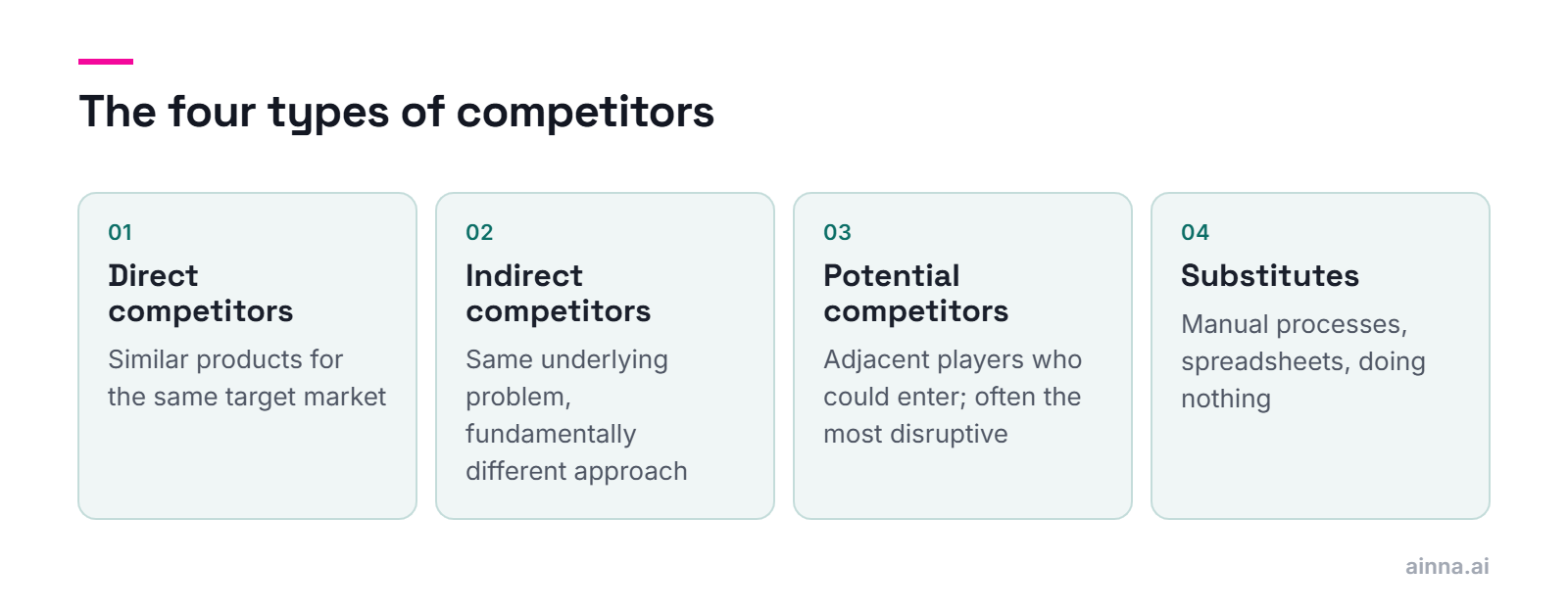
Most product teams only watch direct competitors - companies with similar products targeting the same customers. But the most dangerous competitive threats often come from indirect competitors, potential entrants, and substitutes. A complete analysis covers all four types.

  • Direct competitors offer similar products to the same target market - these are the obvious ones (e.g., Slack vs. Microsoft Teams)
  • Indirect competitors solve the same underlying problem with a fundamentally different approach (e.g., Slack vs. email, or Zoom vs. in-person meetings)
  • Potential competitors are adjacent players who could enter your space - the most overlooked and often the most disruptive threat
  • Substitutes are non-product alternatives: manual processes, spreadsheets, 'doing nothing' - often the real competitor for early-stage products
  • For startups, the biggest competitor is frequently the status quo - people's existing habits and workarounds (see Innovation Dictionary for more on disruptive vs. sustaining innovation dynamics)
  • The Innovation Mode methodology emphasizes analyzing the full ecosystem: key market players, differentiators, monetization models, technology, and the partner landscape
Key Takeaway

Track all four types, but allocate your attention strategically. Direct competitors deserve the most detailed analysis. Potential entrants deserve the most vigilant monitoring. And never forget that for many products, the status quo is the real enemy.

When should product teams conduct competitive analysis?

Competitive analysis is not a one-time event - it is a continuous practice. That said, there are specific moments when it matters most: before entering a market, before major roadmap decisions, when preparing a pitch deck, and whenever you notice changes in win/loss patterns.

  • During product discovery - before committing resources to a new product or feature area
  • As input to design sprints - competitive context sharpens the problem definition and ensures your sprint solutions are differentiated, not duplicative
  • Before building your PRD - competitive context informs what to build and what to skip
  • When preparing investor materials - VCs expect you to know your landscape cold
  • Quarterly as a lightweight refresh - track competitor releases, pricing changes, and positioning shifts
  • When win/loss rates change - something shifted in the landscape and you need to understand what
  • Before major pricing or packaging decisions - competitive pricing context prevents expensive mistakes
Key Takeaway

The most effective product teams treat competitive intelligence like a living system - always running in the background, with deeper dives at critical decision points. The worst time to start competitive analysis is when a competitor has already taken your customers.

How does competitive analysis connect to market sizing?

Market sizing without competitive context is like estimating the size of a fishing spot without knowing how many boats are already there. Your TAM/SAM/SOM analysis becomes dramatically more credible when it accounts for competitive dynamics - who captures what share, where the whitespace exists, and what switching costs protect incumbents.

  • TAM gives you the total opportunity; competitive analysis tells you how much is already captured and by whom
  • SAM narrows to your serviceable market - competitive positioning determines which segments you can realistically win
  • SOM (obtainable market) is impossible to estimate without knowing competitive intensity in your target segment
  • Competitor market share data validates or challenges your bottom-up sizing assumptions
  • Competitive gaps reveal underserved segments that inflate your realistic SOM
  • Ainna combines both analyses - generating market sizing alongside competitive landscape assessment so your strategy is grounded in reality
Key Takeaway

The strongest market sizing narratives - the ones that convince investors and guide real decisions - are always grounded in competitive reality. A $5B TAM with three entrenched players is a very different opportunity than a $500M TAM with no dominant solution.

What frameworks should I use for competitive analysis?

No single framework captures the full competitive picture. The best product teams select from a toolkit of frameworks based on what they need to decide. The six most valuable for product strategy are: SWOT analysis, Porter's Five Forces, feature comparison matrices, competitive positioning maps, customer journey comparison, and value curve analysis.

  • SWOT Analysis - evaluates each competitor's strengths, weaknesses, opportunities, and threats holistically
  • Porter's Five Forces - assesses industry-level competitive dynamics and profitability drivers
  • Feature Comparison Matrix - maps specific capabilities across competitors for roadmap decisions
  • Competitive Positioning Map - visualizes where competitors sit on dimensions customers care about
  • Customer Journey Comparison - analyzes end-to-end user experience across competing products
  • Value Curve Analysis - borrowed from Blue Ocean Strategy, reveals where competitors over-invest and under-invest relative to customer needs
Key Takeaway

Choose your framework based on your question. Roadmap prioritization calls for feature matrices. Market entry decisions call for Five Forces. Positioning and messaging call for positioning maps. In practice, most strategic decisions benefit from combining two or three frameworks for a richer picture.

How do I use SWOT analysis effectively for product decisions?

SWOT (Strengths, Weaknesses, Opportunities, Threats) is the most widely used competitive framework - and the most commonly misused. Done well, it gives you a structured holistic view of each competitor. Done poorly, it produces vague lists that inform nothing.

  • Strengths: identify what the competitor does exceptionally well - brand, technology, distribution, user experience, data network effects
  • Weaknesses: pinpoint where they fall short - slow iteration, legacy architecture, poor mobile experience, missing integrations, customer complaints
  • Opportunities: find external factors they could exploit - market trends, regulatory changes, adjacent markets, emerging technologies
  • Threats: spot external risks they face - new entrants, technology shifts, changing customer expectations, platform dependency
  • The key to useful SWOT: be specific, evidence-based, and focused on what is actionable for your product decisions
  • Bad SWOT: 'Strong brand' (so what?). Good SWOT: 'Brand awareness drives 60% of organic traffic, creating high customer acquisition cost barrier for new entrants'
Key Takeaway

Create a SWOT for each major competitor, but also create one for your own product. The most valuable insight often comes from overlaying your weaknesses against their strengths - and vice versa. That is where the strategic opportunity lives.

How does Porter's Five Forces apply to product strategy?

Porter's Five Forces framework, first published in 1979 at Harvard Business School, examines five competitive dynamics that determine industry profitability: competitive rivalry, threat of new entrants, threat of substitutes, bargaining power of buyers, and bargaining power of suppliers. For product teams, it answers the macro question: 'Is this industry worth competing in, and where are the structural advantages?'

  • Competitive Rivalry - how intense is direct competition? High rivalry means pressure on pricing, features, and margins
  • Threat of New Entrants - how easy is it for new competitors to enter? Low barriers mean your advantage is temporary
  • Threat of Substitutes - what alternatives could replace your product entirely? The most disruptive threats often come from outside your category
  • Buyer Power - how much leverage do your customers have? High buyer power compresses margins and demands more value
  • Supplier Power - how dependent are you on key suppliers, platforms, or technologies? Platform dependency (e.g., app store rules, API access) is a modern form of supplier power
  • For digital products, add a sixth force: network effects and data advantages that create winner-take-most dynamics
Key Takeaway

Five Forces is best used at market entry or during strategic pivots - not for week-to-week product decisions. It tells you about the battlefield, not the battle. Combine it with product-level frameworks like feature matrices and positioning maps for complete strategic clarity.

How do I build a useful feature comparison matrix?

A feature comparison matrix maps specific capabilities across your product and its competitors. It is the most immediately actionable competitive framework for roadmap prioritization - but only if you go beyond checkbox comparisons to assess quality, depth, and user value.

  • Define the rows: list features that matter to customers, not just features competitors happen to have - start from user needs
  • Define the columns: include your product, 3-5 key competitors, and the 'status quo' (spreadsheets, manual processes) as a baseline
  • Go beyond yes/no: rate implementation quality (basic, good, excellent, best-in-class) rather than just presence/absence
  • Weight features by customer importance: a critical capability gap matters more than a nice-to-have gap
  • Identify 'table stakes' vs. 'differentiators' - table stakes you must match; differentiators you must lead
  • Update quarterly - feature landscapes shift fast, especially in competitive SaaS markets
Key Takeaway

The goal is not the longest feature checklist. It is identifying where competitors are ahead on things customers care about, where they are behind on things you can exploit, and where nobody serves the need well at all. That last category is where the biggest strategic opportunity lives.

What is a competitive positioning map and how do I create one?

A positioning map (or perceptual map) is a two-dimensional visualization that plots competitors along the axes customers care about most. It instantly reveals crowded zones, whitespace opportunities, and where your product can stake a distinctive claim. It is one of the most powerful tools for pitch deck storytelling.

  • Choose two axes that represent the dimensions your target customers use to evaluate solutions (e.g., ease-of-use vs. depth of functionality, or price vs. customization)
  • Plot every relevant competitor including substitutes and the status quo
  • Look for clusters (crowded zones where many competitors sit), whitespace (empty quadrants that may represent unmet demand), and your positioning relative to the pack
  • Test multiple axis combinations - different customer segments evaluate differently. What matters to enterprise buyers may not matter to startups
  • Use positioning maps to inform your messaging: if you occupy a unique position, your marketing should emphasize the axes where you stand apart
  • Positioning maps are powerful in pitch decks and one-pagers - investors immediately see where you fit and why it matters
Key Takeaway

The best positioning maps make strategy visible. If your product sits in a crowded cluster, you have a differentiation problem. If you sit in whitespace, you either have a strategic advantage or the whitespace exists for a reason (no demand). Validate with customer research before celebrating your unique position.

What is value curve analysis and when should I use it?

Value curve analysis, from Blue Ocean Strategy, plots how much value competitors deliver across key factors that customers care about. Unlike feature matrices that ask 'what exists,' value curves ask 'how much emphasis does each competitor place on each factor?' This reveals where the entire industry over-invests (commodity zones) and under-invests (opportunity zones).

  • List the key competing factors in your industry (price, speed, customization, support, integrations, simplicity, etc.)
  • Rate each competitor's investment/emphasis on each factor from low to high
  • Plot the curves - competitors with similar curves are strategic clones competing on marketing, not differentiation
  • Look for the 'Blue Ocean' move: can you eliminate factors the industry takes for granted, reduce factors overserved, raise factors underserved, and create factors nobody offers?
  • This framework excels during product discovery when you are defining your strategic positioning from scratch
  • Ainna's strategic analysis helps identify these value gaps by examining what competitors emphasize and where customer needs remain underserved
Key Takeaway

Value curve analysis is most powerful when you are trying to break out of a crowded market. If all competitors' curves look the same, the industry has converged on a formula - and the opportunity is to draw a fundamentally different curve that serves customer needs the industry has ignored.

How do I compare customer journeys across competing products?

Customer journey comparison analyzes the end-to-end experience across competing products - not just what features exist, but how it feels to go from 'I have a problem' to 'this product solved it.' It is one of the most underused competitive frameworks and often reveals opportunities that feature matrices completely miss.

  • Map the full journey: discovery, evaluation, signup, onboarding, first value moment, routine usage, collaboration, scaling, support, and renewal
  • For each stage, assess: how long does it take? How much friction exists? How much guidance is provided? Where do users drop off?
  • Time-to-value is the single most revealing metric: how quickly does each competitor get a new user from signup to 'aha, this is useful'? Products that deliver value in minutes beat products that require days of setup
  • Onboarding quality often differentiates more than feature depth - a simpler product with great onboarding wins against a powerful product with a steep learning curve
  • Compare support experiences: response times, quality of documentation, community resources, and self-service capabilities
  • Pay special attention to moments of delight and moments of friction - these emotional peaks and valleys drive retention, referrals, and churn more than feature completeness
Key Takeaway

Journey comparison reveals something feature matrices cannot: the experience gap. Two products with identical feature checklists can deliver radically different user experiences. The product that makes users feel competent and successful faster will win - even if it has fewer features on paper.

Can you walk me through a competitive analysis for a real product scenario?

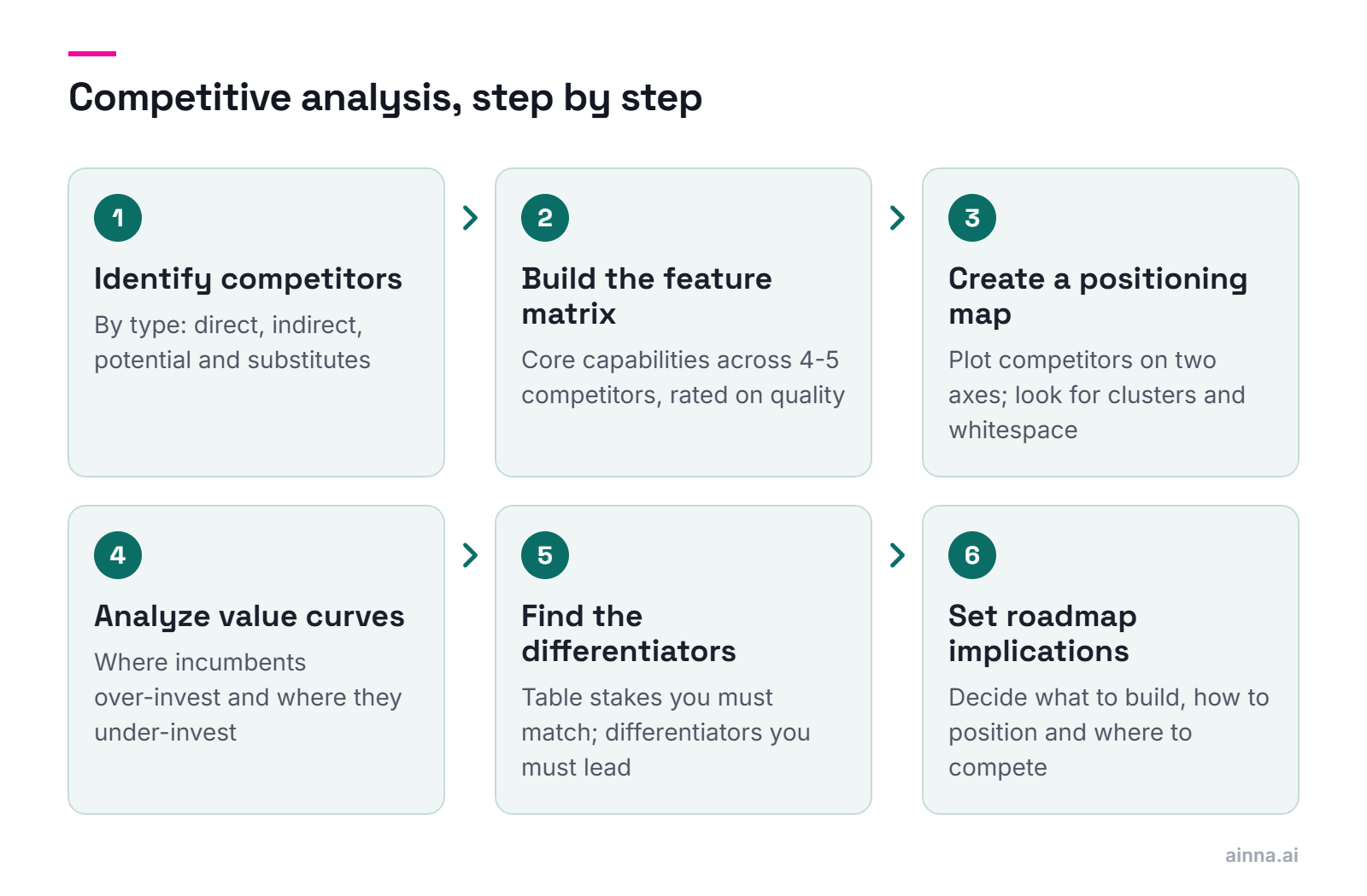
Here is a simplified competitive analysis for a hypothetical AI-powered project management tool entering a market dominated by established players. This walkthrough applies the key frameworks - competitor identification, feature matrix, positioning map, and strategic implications - to show how the process works in practice.

  • Step 1 - Identify competitors by type: Direct (Asana, Monday.com, Jira), Indirect (Notion, spreadsheets, email threads), Potential (AI-native tools expanding from adjacent categories), Substitutes (sticky notes, whiteboards, 'we just use Slack')
  • Step 2 - Build the feature matrix: map core capabilities (task management, timeline views, resource allocation, reporting, AI assistance, integrations) across 4-5 competitors. Rate quality, not just presence. Asana has strong task management but basic AI; Notion has flexibility but weak project-specific workflows
  • Step 3 - Create a positioning map: plot competitors on 'Ease of use' vs. 'AI-powered intelligence.' Most incumbents cluster in the 'easy but not smart' quadrant. The whitespace is 'easy AND smart' - but only if you can deliver AI that genuinely helps rather than adding complexity
  • Step 4 - Analyze value curves: incumbents over-invest in manual task management features (commodity zone) and under-invest in predictive intelligence and automated workflows (opportunity zone). Your differentiation: eliminate manual status updates, reduce reporting overhead, raise predictive risk detection, create AI-generated project insights
  • Step 5 - Identify table stakes vs. differentiators: task creation, assignments, and timeline views are table stakes you must match. AI-powered resource optimization and automated risk alerts are differentiators you must lead
  • Step 6 - Strategic implications for roadmap: MVP must include table stakes at parity quality plus one compelling AI differentiator. PRD should define the AI-powered workflow that makes the product feel categorically different, not incrementally better
Key Takeaway

Notice how the analysis moves from landscape (who is out there?) to structure (how do they compare?) to strategy (where do we play and how do we win?). Each framework builds on the previous one. The output is not a report - it is a set of specific decisions about what to build, how to position, and where to compete. This is exactly the kind of strategic thinking that Ainna accelerates - moving from concept to competitive positioning in minutes rather than weeks.

Where do I find reliable competitive intelligence?

The best competitive intelligence comes from combining public sources (websites, reviews, press), customer-facing signals (win/loss interviews, support forums), and hands-on product experience (free trials, demos). No single source gives you the full picture - triangulation is essential.

  • Competitor websites and blogs: positioning, messaging, feature announcements, pricing pages, job postings (which reveal strategic priorities)
  • Customer reviews on G2, Capterra, Trustpilot: unfiltered feedback about what works and what doesn't - focus on patterns, not individual reviews
  • Win/loss interviews: ask customers (especially lost prospects) why they chose a competitor - this is the highest-signal source
  • Industry analyst reports from Gartner, Forrester, IDC: structured comparisons with methodology, though often behind paywalls
  • Patent filings and technical publications: reveal future product direction and technology investments
  • Social media, community forums, and subreddits: unguarded customer sentiment and competitor employee commentary
Key Takeaway

The most underused source is your own sales and support teams. They hear competitive mentions daily but rarely have a structured way to capture and share those insights. Build a lightweight system to collect competitive signals from customer-facing teams and you will have a real-time intelligence advantage.

How do I analyze competitor pricing and business models?

Pricing is one of the most strategically revealing signals a competitor sends. It tells you who they target (enterprise vs. SMB), how they capture value (seats, usage, outcomes), what they consider 'core vs. premium,' and how aggressively they are pursuing market share vs. profitability.

  • Map their pricing model: per-seat, usage-based, freemium, flat-rate, outcome-based, or hybrid
  • Identify what is free vs. paid - this reveals their growth strategy and where they see monetization leverage
  • Calculate effective price-per-user across tiers - published pricing often obscures the real unit economics
  • Study their packaging: which features are bundled together? This reveals how they think about customer segmentation
  • Monitor pricing changes over time - price increases signal confidence; discounting signals desperation or market-share strategy
  • Analyze their business model innovation: are competitors exploring new revenue streams, marketplace models, or platform plays that could reshape the economics of your market?
Key Takeaway

Don't just compare prices - compare value delivery models. A competitor at 2x your price but with dramatically better onboarding and time-to-value may actually be the better deal. Understanding this is how you develop commercial acumen and avoid racing to the bottom on price.

How do I assess a competitor's product experience without insider access?

You don't need insider access to understand a competitor's product experience. Free trials, demo recordings, customer reviews, and user community discussions give you a remarkably detailed picture. The most valuable assessment focuses on the end-to-end customer journey, not just the feature set.

  • Sign up for free trials or freemium tiers - experience onboarding, first-use flow, and time-to-value firsthand
  • Watch product demos on YouTube and webinar recordings - note what they emphasize and what they skip
  • Read customer reviews with a product eye: recurring complaints reveal UX friction, missing features, and reliability issues
  • Map the customer journey: discovery, signup, onboarding, first value moment, advanced usage, collaboration, support
  • Check their documentation and help centers - quality of docs correlates with product maturity and user empathy
  • Monitor their changelog and release notes - frequency, focus areas, and responsiveness to user requests reveal their product culture
Key Takeaway

Document your findings in a structured format that your entire product team can reference. Screenshots, journey maps, and annotated comparisons are far more useful than summary paragraphs. Create a shared competitive intelligence repository that stays current.

How do I track competitor moves systematically over time?

Competitive intelligence loses value when it is stale. Build a lightweight, always-on monitoring system rather than relying on periodic deep dives. The goal is to detect significant changes - product launches, pricing shifts, funding rounds, leadership changes, messaging pivots - early enough to respond strategically.

  • Set up Google Alerts for competitor names, product names, and key industry terms
  • Follow competitor blogs, changelogs, and social accounts - many product teams announce roadmap direction publicly
  • Monitor job postings: a competitor hiring ML engineers or sales leaders in new geographies signals strategic direction
  • Track funding rounds and investor activity via Crunchbase or PitchBook - fresh capital often precedes aggressive moves
  • Subscribe to industry newsletters and analyst briefings that aggregate competitive landscape changes
  • Hold monthly 'competitive pulse' meetings with sales, support, and marketing to surface what they are hearing from the field
Key Takeaway

The best competitive monitoring systems are low-effort but high-awareness. You are not trying to document everything - you are trying to detect the signals that change your strategy. A 15-minute weekly scan is more valuable than a 40-page quarterly report that nobody reads.

How do I identify my product's competitive advantage?

Your competitive advantage lives at the intersection of three things: what customers need, what you do exceptionally well, and what competitors do poorly or not at all. The Innovation Mode methodology calls this 'seeing the critical differences between a superior product and an average one' - identifying the dimensions where your product creates value that others cannot easily replicate.

  • Start with customer jobs-to-be-done: what is the core problem they hire your product to solve?
  • Map your strengths against competitor weaknesses using your SWOT analysis - the overlaps are your advantage zones
  • Competitive advantages fall into categories: technology (proprietary data, algorithms), experience (dramatically better UX), distribution (unique channels), network effects (value increases with users), and methodology (unique approach to the problem)
  • Test whether your advantage is defensible: can a well-funded competitor replicate it in 12-18 months? If yes, it is a temporary advantage, not a moat
  • Ask your best customers why they chose you - their words often reveal advantages you take for granted
  • Your competitive advantage must be relevant to customers, not just interesting to your team - a technical edge nobody values is not an advantage
Key Takeaway

The strongest competitive advantages are those that compound over time. Data network effects, customer switching costs, and methodology-driven quality are harder to replicate than features. Build your product strategy around advantages that get stronger as you grow.

What is competitive differentiation and how do I achieve it?

Differentiation means your product delivers value in a way that competitors cannot easily match. It is not about being different for its own sake - it is about being different on the dimensions that matter most to your target customers. The best differentiation makes alternatives look like compromises.

  • Feature differentiation is the weakest form - features can be copied. Focus on deeper sources of uniqueness
  • Methodology differentiation: a unique approach to solving the problem, like The Innovation Mode's structured discovery-to-documentation methodology, is harder to replicate than individual features
  • Experience differentiation: dramatically simpler, faster, or more delightful - Ainna generating strategic documentation in 60 seconds vs. days of manual work is an experience advantage
  • Data differentiation: proprietary data or insights that improve your product in ways competitors cannot access
  • Integration differentiation: being deeply embedded in customer workflows creates switching costs
  • Audience differentiation: serve a specific segment so well that generalist competitors cannot match your depth
Key Takeaway

Sustainable differentiation comes from making strategic choices about what you will do - and equally important, what you will not do. Trying to serve every segment with every feature leads to a mediocre product that differentiates on nothing. Choose your battles.

How do I find and exploit gaps in the competitive landscape?

Competitive gaps are unserved or underserved needs that exist between what customers want and what current solutions provide. Finding them requires looking at the landscape through the customer's eyes, not the competitor's feature list. The Innovation Mode problem framing methodology is specifically designed to reveal these gaps.

  • Analyze competitor reviews for recurring complaints and feature requests that remain unaddressed
  • Interview churned customers of competitors - why did they leave? What was missing?
  • Use value curve analysis to find factors where every competitor under-invests relative to customer importance
  • Look at adjacent markets and industries for solutions that haven't crossed over yet
  • Examine the 'non-consumption' market: who should use a product in your category but doesn't? Why not?
  • Study competitor positioning maps for whitespace - empty quadrants that may represent genuine unmet demand
Key Takeaway

Not every gap is an opportunity. Some gaps exist because there is no demand. Before building into whitespace, validate with real customers that the gap represents a genuine unmet need worth paying for. Use rapid prototyping and product discovery to separate real gaps from mirages.

What are competitive moats and how do product teams build them?

A competitive moat is a structural advantage that protects your product from being displaced by competitors, even well-funded ones. While features can be copied in months, moats take years to build and become stronger over time. Building moats is one of the most important long-term jobs of a product leader.

  • Network effects: your product becomes more valuable as more people use it (e.g., marketplaces, collaboration tools, data platforms)
  • Switching costs: deep integration into customer workflows makes switching painful and risky (e.g., CRM data, workflow automation)
  • Data advantages: proprietary data that improves your product in ways competitors cannot access (e.g., usage patterns, training data, benchmark insights)
  • Brand and trust: established credibility in a category where trust matters (e.g., security, financial products, enterprise decisions)
  • Methodology and IP: a unique, validated approach to solving the problem that competitors cannot simply adopt - this is what separates Ainna from generic AI tools
  • Cost advantages: economies of scale or structural cost advantages that enable better pricing or margins
Key Takeaway

Every product decision should be evaluated through the moat lens: does this feature strengthen our moat or is it just keeping up? The strongest product strategies invest heavily in moat-building activities even when they are not the most immediately exciting roadmap items.

How do I handle competitive threats from adjacent markets?

The most dangerous competitors are often those you don't see coming - companies from adjacent markets who decide to expand into your space. They bring existing customers, brand trust, and distribution advantages that purpose-built competitors lack. Monitoring adjacent markets is a strategic necessity, not a luxury.

  • Identify adjacent categories where players have the technology, distribution, or customer relationships to enter your market
  • Watch for 'platform creep' - large platforms adding features that overlap with your core value (e.g., Slack adding project management, Notion adding databases)
  • Monitor acqui-hires and acquisitions in adjacent markets - they signal expansion intent
  • The best defense is deep expertise and customer relationships in your specific domain - generalists expand broadly but rarely deeply
  • Consider whether you should be the one expanding adjacently, not just defending against it
  • Stay close to your customers and solve their problems so well that an adjacent entrant's generic version feels like a step backward
Key Takeaway

Adjacent market threats are a feature of digital markets, not a bug. Every product exists in an ecosystem where boundaries are fluid. The strategic response is not paranoia but focus: deepen your advantage in your core domain while building switching costs that make your product indispensable.

How do I turn competitive insights into roadmap decisions?

Competitive analysis is only valuable if it changes decisions. The bridge from insight to action requires mapping competitive findings to specific roadmap implications: what to prioritize, what to deprioritize, what positioning to adopt, and what customer segments to focus on.

  • Categorize competitive gaps into 'table stakes' (must match to compete), 'differentiators' (invest to lead), and 'ignore' (not valued by your target segment)
  • Use competitive intelligence to challenge or validate your MVP scope - are you building features that already have excellent free alternatives?
  • For each roadmap item, answer: does this strengthen our differentiation, close a critical gap, or build our moat? If none of the above, question its priority
  • Create a 'competitive response playbook' for predictable competitor moves - pre-planned responses are faster and calmer than reactive scrambles
  • Feed competitive insights into user story creation and PRD writing - the 'why now' section of every PRD should reference competitive context
  • Never let competitive analysis become the sole driver of your roadmap - customer needs and strategic vision should lead, with competitive awareness as a shaping input
Key Takeaway

The most common mistake is treating competitive analysis as a document rather than a decision input. Every competitive insight should answer the question: 'So what should we do differently?' If it doesn't lead to an action or a validated non-action, it is not analysis - it is trivia.

How should I communicate competitive findings to stakeholders?

Different stakeholders need different competitive stories. Your engineering lead needs to understand technical differentiation. Your CEO needs the strategic positioning narrative. Your sales team needs talk tracks for competitive objections. Effective communication means translating one analysis into multiple targeted outputs.

  • For executives: lead with strategic implications - market positioning, competitive threats to revenue, and investment priorities. Use positioning maps and market share data
  • For engineering: focus on technical differentiation, architecture advantages, and feature gaps that inform build priorities
  • For sales teams: create competitive battle cards with key differentiators, common objections, and suggested responses
  • For marketing: provide positioning language, competitor messaging analysis, and content gap opportunities
  • For product teams: share the full feature comparison, customer journey analysis, and prioritized gap list
  • Use pitch deck and one-pager formats for executive consumption - Ainna can generate stakeholder-ready competitive positioning documents from your strategic inputs
Key Takeaway

Never provide raw intelligence without analysis. Anyone can forward a link. A product leader adds context: what this means for the product, what it means for the customer, and what it means for the business. That interpretation is the value you add.

How often should competitive analysis be updated?

Competitive analysis should operate at three cadences: continuous monitoring (always-on alerts), quarterly refreshes (structured updates to your competitive landscape), and deep dives (triggered by specific strategic decisions). The biggest risk is not doing too little analysis - it is doing analysis that never gets refreshed.

  • Continuous: Google Alerts, social monitoring, changelog tracking - takes 15 minutes per week to scan
  • Monthly: brief competitive pulse check with sales and support teams - what are they hearing?
  • Quarterly: structured refresh of feature matrix, pricing comparison, and positioning map. Update your competitive document and share with the team
  • Strategic deep dive: before major roadmap decisions, market entry, pricing changes, or investor presentations
  • Trigger-based: immediately when a competitor launches a major product, raises significant funding, changes pricing, or makes an acquisition
  • Review your competitive analysis artifacts alongside your product roadmap every quarter to ensure they remain aligned
Key Takeaway

The goal is awareness, not exhaustive documentation. Your team should always have a current, shared understanding of the competitive landscape that informs daily decisions - not a stale 50-page deck from six months ago.

How do I avoid letting competitive analysis drive me into feature parity?

Feature parity is the most common trap of competitive analysis: the reflexive impulse to match every feature a competitor ships. This leads to bloated products with no distinctive identity, exhausted engineering teams, and a strategy driven by someone else's vision. Competitive analysis should inform differentiation, not imitation.

  • Remember: your goal is to win customers, not feature counts. Customers choose products for the combination of value, experience, and trust - not for checkbox completeness
  • For every 'competitor has it, we should too' conversation, ask: 'Do our target customers need it, and will it strengthen our positioning?'
  • Separate 'must-have' table stakes from 'nice-to-have' feature matching - invest in table stakes, invest more in differentiation
  • Use value curve analysis to deliberately under-invest in areas competitors over-serve, freeing resources for areas you want to dominate
  • The MVP mindset applies here: what is the minimum competitive parity needed, and where should all remaining effort go toward differentiation?
  • If you find yourself constantly playing catch-up, you may have a positioning problem rather than a feature problem - revisit your strategic foundation
Key Takeaway

The strongest products are those that make deliberate choices about what NOT to build. Saying no to competitive feature parity requires courage and clarity about your own vision. That clarity is what separates product leaders from product followers.

What are the most common competitive analysis mistakes product teams make?

After 25+ years of product leadership across Microsoft, Accenture, and four startups, the most common competitive analysis mistakes I see are: analyzing too many competitors with too little depth, focusing on features rather than strategy, letting analysis become a spectator sport that never drives decisions, and ignoring the most dangerous competitor of all - the status quo.

  • Analyzing too broadly: deep analysis of 3-5 key competitors beats shallow analysis of 15. Focus on the ones that actually compete for your customers
  • Feature obsession: cataloging every competitor feature without assessing quality, adoption, or customer importance produces noise, not insight
  • Analysis paralysis: spending months on competitive research instead of building, testing, and learning from customers directly
  • Ignoring indirect competitors and substitutes: the spreadsheet, the email thread, the manual workaround - these 'non-products' are often your real competition
  • Stale analysis: a competitive landscape from 6 months ago is dangerously misleading in fast-moving markets
  • Confirmation bias: seeking competitive intelligence that validates your existing strategy while ignoring evidence that challenges it
Key Takeaway

The antidote to all these mistakes is the same: stay focused on decisions. Every competitive insight should make you more confident about a specific decision or expose a specific risk. If it does neither, move on and invest your time in talking to customers.

How should I respond when a competitor copies my feature, drops their price, or raises a big round?

Competitive moves feel urgent but rarely require immediate reaction. The biggest mistake is reflexive response - matching their price cut, rushing a counter-feature, or panicking about their funding. The best product teams have pre-planned response frameworks that distinguish signal from noise and protect strategic focus.

  • When a competitor copies your feature: assess whether they matched the capability or just the surface. Execution quality, integration depth, and user experience often remain your advantage. Accelerate your next differentiator rather than defending the last one
  • When a competitor drops pricing: do not reflexively match. Analyze whether they are buying market share (unsustainable), signaling desperation, or genuinely operating at lower cost. Often the right response is to emphasize your value rather than compete on price
  • When a competitor raises a big round: funding is potential, not execution. It signals intent to invest aggressively, but most funded competitors spend 12-18 months hiring and building before the impact hits your market. Use that window to deepen your moat
  • When a competitor launches a new product in your space: evaluate honestly - is it better? If yes, learn from it. If no, stay your course. Most competitive launches underperform their press coverage
  • Build a 'competitive response playbook' in advance: pre-defined criteria for when to respond, when to monitor, and when to ignore. Decisions made calmly in advance are better than decisions made reactively under pressure
  • Always ask: 'Does this competitive move change what our customers need from us?' If the answer is no, your strategy holds. If yes, adapt - but adapt to customer needs, not competitor tactics
  • Use hackathons to rapidly generate and validate differentiation ideas when competitive pressure intensifies - a focused two-day sprint can produce validated concepts faster than months of reactive planning
Key Takeaway

The best competitive response is almost never a direct counter-move. It is doubling down on what makes you uniquely valuable to your customers. Competitors who spend their energy reacting to each other's moves lose focus on the only thing that matters: solving customer problems better than anyone else.

What should a competitive analysis deliverable look like?

A competitive analysis deliverable should be a living document - not a one-time report. The best format combines a concise executive summary with structured detail that different stakeholders can drill into. Think of it as a competitive intelligence system, not a competitive intelligence document.

  • Executive summary (1 page): your competitive position in 3-4 sentences, the top 3 strategic implications, and the recommended actions. This is what your CEO reads
  • Competitor profiles (1 page each): for each key competitor, cover positioning, target market, strengths, weaknesses, recent moves, estimated market share, and what they do better/worse than you
  • Feature comparison matrix: the detailed capability comparison with quality ratings, weighted by customer importance - this drives roadmap conversations
  • Positioning map: the visual snapshot showing where each competitor sits on the dimensions your customers care about most - essential for pitch decks and investor conversations
  • Competitive battle cards (for sales): one-page sheets per competitor with key differentiators, common objections and responses, and 'why us' talking points. These should live where your sales team actually works, not in a shared drive nobody opens
  • Strategic action items: the specific roadmap, pricing, positioning, or messaging changes this analysis recommends - without these, the deliverable is an interesting read that changes nothing. Feed strategic actions directly into your product discovery documentation so competitive context travels with the opportunity, not in a separate file
Key Takeaway

The deliverable format matters less than the habit. A lightweight competitive dashboard updated monthly beats a polished 50-page deck updated annually. Tools like Ainna can generate the strategic positioning and competitive context sections of your pitch decks and PRDs in minutes - so your competitive intelligence flows directly into the artifacts that drive decisions, rather than sitting in a separate document nobody references.

How is AI changing competitive analysis for product teams?

AI is collapsing the time and cost of competitive intelligence gathering and analysis. What previously required expensive analyst reports, weeks of manual research, and dedicated competitive intelligence teams can now be accomplished in hours. But AI changes the mechanics, not the strategy - the judgment about what competitive insights mean and what to do about them remains fundamentally human.

  • AI can scan and synthesize competitor websites, reviews, documentation, and social mentions at scale - surfacing patterns that manual research misses
  • Large language models can generate initial SWOT analyses, feature comparisons, and positioning assessments that serve as strong first drafts for human refinement
  • AI-powered monitoring tools can track competitor changes in real-time: pricing page updates, feature launches, messaging shifts, job postings
  • Sentiment analysis of customer reviews across competitors reveals satisfaction patterns and pain points at a scale impossible to read manually
  • AI does not replace competitive judgment: interpreting what competitor moves mean strategically, deciding how to respond, and choosing where to differentiate still requires experienced product thinking
  • The risk of AI-generated analysis is false confidence: AI can produce convincing-looking analyses from insufficient data. Human validation remains essential
Key Takeaway

AI makes competitive analysis faster and more comprehensive, but not necessarily smarter. The teams that win are those that combine AI-powered intelligence gathering with experienced strategic judgment. Speed of analysis without quality of interpretation is just fast noise.

How does Ainna help with competitive landscape analysis?

Ainna is an AI product strategist - not a document generator. When you describe your product concept, Ainna applies The Innovation Mode methodology to analyze your competitive environment, identify positioning opportunities, assess market dynamics, and generate stakeholder-ready documentation that includes competitive context as part of a complete strategic package.

  • Ainna guides you through strategic questions about your competitive landscape as part of the discovery conversation - surfacing considerations you might miss
  • The Market Outlook component generates TAM/SAM/SOM analysis grounded in competitive reality, not isolated from it
  • Ainna's strategic assessment challenges your assumptions about differentiation and competitive positioning before you invest in building
  • Output includes competitive context in pitch decks, PRDs, and one-pagers - so every stakeholder document reflects competitive awareness
  • Built on The Innovation Mode methodology refined through 25+ years of product innovation consulting and hundreds of product launches
  • Privacy-first: your competitive intelligence and product concepts are never used to train models or shared with other users
Key Takeaway

Ainna doesn't replace your competitive thinking - it accelerates and structures it. By embedding competitive analysis into the broader product strategy workflow, Ainna ensures that competitive context informs every strategic document you produce, not just a standalone spreadsheet that lives in isolation.

What tools and resources help product teams with competitive analysis?

The right tools accelerate competitive analysis without replacing strategic judgment. Modern product teams combine AI-powered strategy platforms, review aggregators, monitoring tools, and proven methodologies to build a competitive intelligence capability that is both comprehensive and sustainable.

  • Strategy and documentation: Ainna generates competitive landscape analysis alongside complete product strategy packages - from pitch decks to PRDs (see the last section of this guide for details on the Innovation Toolkit)
  • Frameworks: The Innovation Toolkit provides templates for problem framing, product concept development, and idea assessment that embed competitive thinking into the discovery process
  • Review intelligence: G2, Capterra, and Trustpilot for aggregated customer feedback on competitors
  • Market data: Gartner, Forrester, and Statista for industry sizing and competitive landscape reports
  • Monitoring: Google Alerts, Crunchbase, and LinkedIn for tracking competitor moves, funding, and hiring patterns
  • Learning: SVPG resources, Marty Cagan's Inspired and Empowered, and Porter's Competitive Strategy for foundational strategic thinking
Key Takeaway

Tools should amplify your competitive intelligence, not replace your judgment. The best competitive analysis tool is one that helps you move from insight to decision faster - reducing the time between 'we noticed something' and 'here is what we are doing about it.' Readers of this guide can access the Innovation Toolkit with coupon code AINNA.AI for exclusive pricing.

Meet Ainna

Ready to Understand Your Competitive Landscape?

Ainna applies The Innovation Mode methodology to analyze your competitive environment, identify positioning opportunities, and generate stakeholder-ready documentation - so you can focus on strategy, not spreadsheets. Free to explore, no credit card required.

Ideas in.
Opportunities out.