How is AI transforming the product manager's role?

AI eliminates the overhead around product management judgment - not the judgment itself. I wrote my first classification algorithm in 1996, built my first production-ready predictive system in 1999, and have been building data-driven products ever since - from blockchain-based systems to pure AI products, resulting in 20+ patents in AI and analytics (including US20170287038A1 on intelligent content recommendations). So when I say that AI changes everything about how PMs work while changing nothing about what makes PMs great, I am speaking from three decades on both sides of that equation. In my Innovation Mode methodology, AI accelerates all three essential innovation capabilities - Opportunity Discovery, Opportunity Validation, and Opportunity Realization - while the human PM remains the judgment layer that connects them.

  • The bottleneck shifts from production to clarity: AI can generate any document in minutes, so the scarce resource becomes the quality of thinking that goes into it
  • PMs shift from writers to editors and strategic thinkers - the human judgment layer becomes more valuable, not less
  • Documentation overhead collapses: PRDs, pitch decks, one-pagers, and competitive analysis that took days now take minutes to draft
  • Research bandwidth expands: AI can synthesize customer feedback, analyze competitor positioning, and identify market patterns at a scale no human PM could match
  • Prototyping democratizes: non-technical PMs can now build functional prototypes through conversation rather than code
  • The danger: AI makes it easy to produce plausible-sounding work without the underlying thinking. The gap between AI output that looks impressive and AI output that is genuinely useful comes down entirely to the quality of the human thinking behind it
Key Takeaway

As I wrote in Innovation Mode 2.0, AI has triggered an identity crisis for the PM profession: the traditional PM toolkit of documentation, coordination, and information synthesis is exactly what AI automates best. PMs who respond by doubling down on strategic judgment, user empathy, and innovation instinct will thrive. PMs who were primarily document producers will struggle.
What is the difference between methodology-first and prompt-first AI usage?

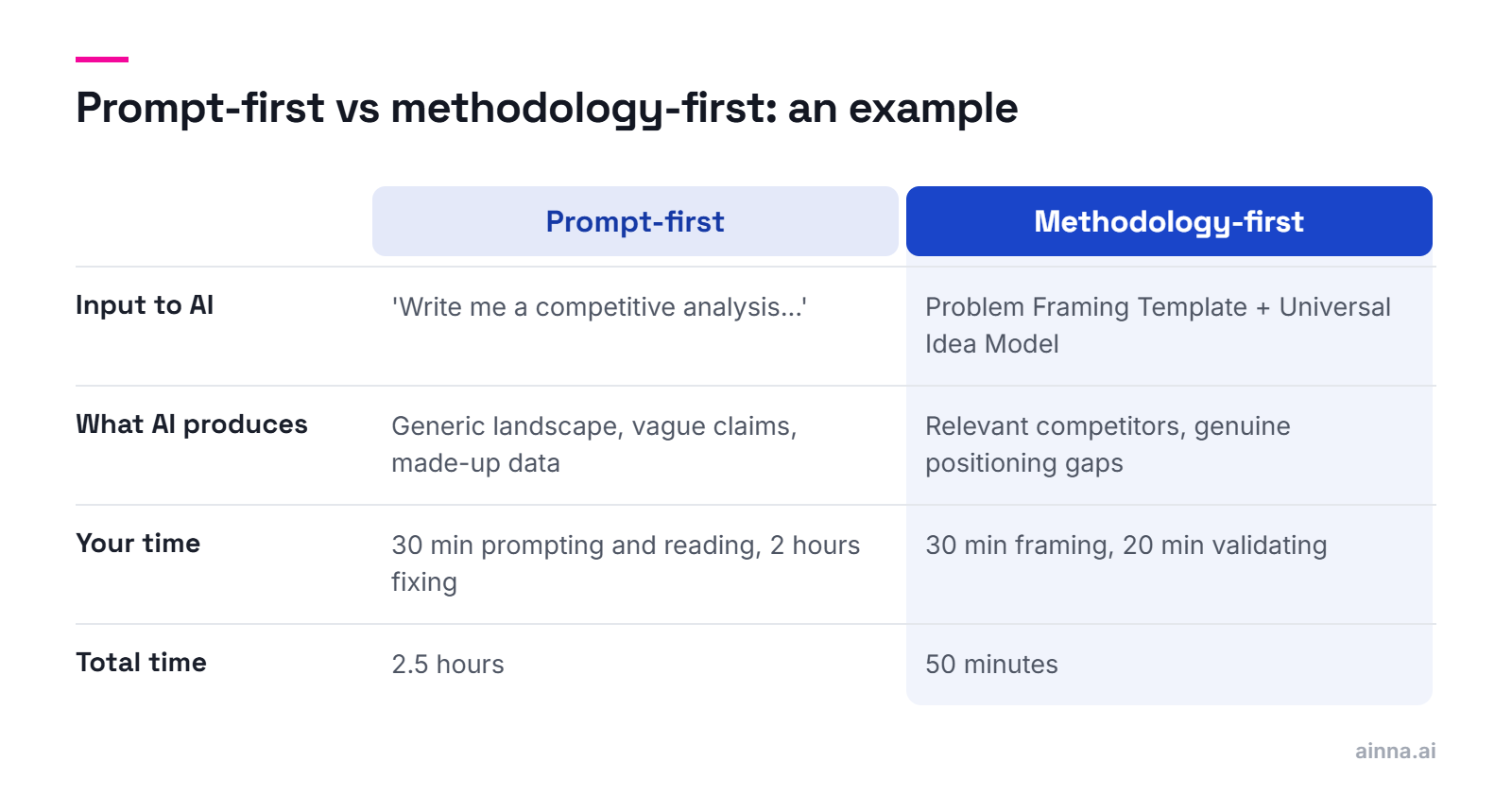
Methodology-first means structuring your thinking before asking AI to generate anything. Prompt-first means typing a request and hoping for something useful. The difference in output quality is not marginal - it is the difference between a document investors take seriously and one they have seen a hundred times. Here is a concrete example I use in every workshop:

  • Prompt-first: 'Write me a competitive analysis for my SaaS product that helps product managers.' AI produces a generic landscape with obvious competitors, vague differentiation claims, and made-up market data. You spend two hours fixing it. Total time: 2.5 hours
  • Methodology-first: you spend 30 minutes completing a Problem Framing Template (environment: PM teams in companies with 50-500 employees; current state: documentation takes 40 hours/month; ideal state: strategic documentation in minutes). You add a Universal Idea Model sentence. You feed both to AI. Output: a competitive analysis grounded in your specific market, with relevant competitors and genuine positioning gaps. You spend 20 minutes validating. Total time: 50 minutes - and the output is dramatically better
  • My Innovation Mode documentation stack is designed as structured AI input: each template produces exactly the context AI needs to generate meaningful, specific output
  • This is why Ainna applies the Innovation Mode methodology as its generation framework: the methodology IS the prompt engineering. You do not write prompts - you think through frameworks, and the AI handles the rest
  • A 2025 Productboard survey found that 94% of enterprise PMs use AI tools daily - but the gap between PMs who find AI transformative and PMs who find it 'helpful but not game-changing' is almost always the quality of their inputs, not the quality of their tools. Methodology-first usage closes that gap
Key Takeaway

The best AI-powered PMs are not prompt engineers. They are methodology-powered thinkers who use structured frameworks as AI inputs. The methodology does the heavy lifting; AI handles the formatting and expansion.

AI for product management workflow diagram showing an AI engine connecting to five PM phases - Discovery, Validation, Documentation, Strategy, and Execution - producing methodology-driven outputs. The Innovation Mode framework for AI-powered product strategy.
Figure 1: AI transforms every phase of product management - from discovery and validation through documentation and strategy to execution - when grounded in a structured methodology like the Innovation Mode framework.

What is the biggest mistake PMs make when adopting AI?

Treating AI as a replacement for thinking rather than an accelerator for it. I have reviewed hundreds of product documents across Microsoft, Accenture, and four startups I founded. The pattern of weak thinking was always visible - but AI has made it worse by making weak thinking look polished. Last month I reviewed an AI-generated PRD that was beautifully structured - three named personas with job titles, specific success metrics, two competitor analyses. Every word was plausible. None of it was validated. The PM had spent 10 minutes generating it and zero minutes questioning it.

  • AI makes it cheaper to produce bad work at scale: a generic competitive analysis, a plausible-but-wrong persona, a confident-sounding market size with no real basis
  • The fix is not better prompts - it's better inputs. Structured product discovery documentation gives AI the context it needs to produce genuinely useful output
  • Skipping validation is more tempting than ever: when AI can generate a complete product strategy in minutes, the discipline to actually talk to users feels slower than ever - but it remains the only source of real insight
  • AI-generated personas are particularly dangerous: they sound specific but are synthesized from training data, not from real user research. Always validate against actual user conversations
  • My Innovation Mode methodology guards against this by requiring structured problem framing before any solution work - a discipline that becomes even more important when AI makes solution work cheap
  • The quality test: would a senior PM or experienced investor see through this document? If yes, AI has produced theater, not strategy
Key Takeaway

AI amplifies whatever you feed it. Feed it clarity and it produces brilliance. Feed it vagueness and it produces polished vagueness. The PM's job in the AI era is to be the source of clarity.

What skills do product managers need to thrive in the AI era?

The skills AI cannot replicate become the skills that matter most. Strategic judgment. Authentic user empathy. The ability to navigate ambiguity. The courage to kill ideas that data does not support. These are not new PM skills - they are the skills that always mattered most but were crowded out by documentation overhead. AI gives them room to breathe.

  • Strategic judgment: AI provides options and analysis; humans make decisions with incomplete information and competing priorities. This is what separates product leaders from product administrators - and it is the central argument I make in Chapter 5 of Innovation Mode 2.0
  • User empathy: AI can synthesize feedback patterns but cannot feel the frustration of a real user struggling with your product. Customer conversations remain irreplaceable
  • Structured thinking: the ability to decompose problems into environment, dynamics, current state, and ideal state - this is what makes AI outputs useful rather than generic
  • AI orchestration: knowing which tool to use for which task, how to chain AI outputs across workflows, and when AI output needs human verification
  • Innovation instinct: recognizing opportunities that data doesn't yet show - the pattern-matching and imagination that makes great PMs see what others miss
  • Cross-functional leadership: as AI handles more individual contributor tasks, the PM's value shifts toward aligning teams, resolving ambiguity, and inspiring conviction
Key Takeaway

The irony of AI in product management: the more AI handles the mechanical work, the more the role becomes about the deeply human skills that AI cannot do. Great PMs in 2026 are more strategic, more empathetic, and more creative than ever - because AI has freed them from the work that was crowding those capabilities out.

Did you know? Ainna is built on a human-in-the-loop architecture — AI provides the analytical framework, humans provide the judgement. This isn't an afterthought; it's the core design principle. See how it works

How can AI help with problem framing and opportunity discovery?

AI can enrich your problem understanding with data you could never gather manually - but it cannot tell you which problems are worth solving. That judgment requires market instinct, strategic fit assessment, and the founder's conviction that the world needs to change in a specific way. In my Innovation Mode methodology, the Problem Framing Template structures the human thinking; AI then enriches each dimension with evidence.

  • AI for environment analysis: feed AI your industry and it can map key players, regulatory landscape, technology trends, and stakeholder ecosystem in minutes - work that used to take a week of desk research. When I was at Accenture, this kind of market mapping was a team effort; now a single PM with AI can produce comparable breadth in an afternoon
  • AI for dynamics research: AI can trace how a problem has evolved, identify inflection points, and surface analogous problems from other industries
  • AI for current state synthesis: point AI at customer reviews, support tickets, or forum discussions and it can extract pain patterns, frequency data, and severity signals at scale. This is how I discovered that product managers in mid-market companies spend 40+ hours monthly on documentation - a signal from thousands of data points that became the foundation for building Ainna
  • AI for ideal state exploration: AI can generate multiple visions of 'what success looks like' - but the PM must judge which resonates with real users
  • The critical human layer: AI cannot determine whether a problem is worth YOUR team solving - that requires strategic fit assessment, capability analysis, and the Nine-Dimension Idea Assessment Model
  • Workflow: human completes the Problem Framing Template structure, AI enriches each section with data and analysis, human validates and sharpens
Key Takeaway

The best AI-assisted problem framing starts with the PM's instinct about what matters and uses AI to pressure-test that instinct with data. Starting with AI ('find me a problem to solve') produces generic opportunities that lack conviction.

How does AI change brainstorming and ideation?

AI makes idea generation abundant and idea curation scarce. A traditional brainstorming session produces 20-40 ideas in two hours. AI can generate 200 in two minutes. That changes the game entirely - the PM's value shifts from 'can we think of enough ideas?' to 'can we identify the three that actually matter?' In Innovation Mode 2.0, I call this the Ideation-to-Synthesis Shift.

  • AI as infinite ideation partner: generate 50 solution concepts for a structured problem statement in minutes - something no human group could match for breadth
  • Cross-domain inspiration: AI can suggest solutions from adjacent industries ('how does healthcare solve this kind of problem?') that human teams would never consider
  • The Ideation-to-Synthesis Shift: when ideas are abundant, the PM's value moves from generating ideas to assessing, combining, and selecting them
  • Structured AI brainstorming: feed AI your problem statement + constraints + the Universal Idea Model format and get ideas that are immediately assessable
  • Bionic brainstorming: AI generates between and during human sessions, expanding the team's collective thinking without replacing the creative friction that produces breakthrough ideas
  • For hackathon and design sprint contexts, AI pre-generates idea banks that teams then curate and build upon
Key Takeaway

AI doesn't make brainstorming obsolete - it makes bad brainstorming obsolete. Teams that relied on a few vocal participants generating obvious ideas are replaced by AI. Teams that use diverse perspectives, cross-domain thinking, and rigorous assessment become even more powerful with AI as an input generator.

Can AI evaluate and prioritize product ideas?

AI can score ideas against structured criteria and surface patterns across large portfolios - but it cannot replace the strategic judgment that determines which ideas deserve investment. Having assessed thousands of product ideas across corporate innovation programs, hackathons, and my own startups, the most dangerous AI assessment failure I have seen is this: an AI scored a derivative feature improvement higher than a genuinely novel concept because the feature had more supporting data. The novel concept went on to become the company's fastest-growing product line.

  • AI for screening: when a hackathon produces 200 ideas, AI can score them against the Nine-Dimension Model to identify the top 20 for deeper human review
  • AI for market demand analysis: AI can estimate demand certainty by analyzing search trends, competitor traction, customer feedback volume, and market timing signals
  • AI for feasibility assessment: AI can evaluate technical feasibility by analyzing current technology capabilities, similar implementations, and complexity indicators
  • Human-owned dimensions: strategic alignment (does this fit our mission?), innovation potential (is this genuinely novel?), and operational judgment (can our team actually execute this?) require human context AI doesn't have
  • AI for pattern detection: across a portfolio of ideas, AI can identify clusters, find complementary concepts, and spot gaps the team hasn't considered
  • The risks vs uncertainties vs silent assumptions framework is particularly important in AI-assisted assessment: AI is good at surfacing known risks but poor at identifying silent assumptions - the things nobody has thought to question
Key Takeaway

Use AI to handle the analytical heavy-lifting of idea assessment. Use humans to make the judgment calls that determine which ideas become products. The combination is more rigorous than either alone.

How does AI change the prototyping and validation process?

AI has compressed the gap between 'I have an idea' and 'I have something users can touch' from weeks to hours. That is not an incremental improvement - it fundamentally changes the economics of validation. When a prototype costs two hours instead of two weeks, you stop debating whether to test an idea and just test it.

  • AI code generation (Bolt.new, Cursor, Claude) can produce functional prototypes from descriptions in minutes rather than days
  • Non-technical PMs can now build prototypes: this is the inclusivity breakthrough I describe in Innovation Mode 2.0 - when product managers and domain experts can prototype, the concept space expands dramatically because ideas no longer die in the gap between imagination and implementation
  • The PM's role shifts from specifying prototypes to directing them: 'make the header sticky, add a loading state, simplify the onboarding' is faster than writing a spec and waiting for engineering
  • The Hybrid Prototyping Model from the AI design sprints methodology: AI builds the first version, humans refine the UX and ensure it tests the right assumption, real users provide the validation data
  • Warning: fast prototyping can bypass validation discipline. I have watched teams fall in love with their AI-generated prototype and start treating it as the product. The prototype is a tool for learning, not shipping. Use it to inform the MVP definition, not replace it
Key Takeaway

AI makes prototyping so fast that the excuse 'we don't have time to prototype' disappears entirely. The question shifts from 'can we afford to build a prototype?' to 'can we afford not to?'

How can AI enhance user research without replacing it?

AI can process user research data at a scale that was impossible before - synthesizing thousands of interviews, reviews, and support tickets to surface patterns no human could find manually. But here is what 25 years of product work has taught me: the insights that change product direction almost never come from pattern analysis. They come from watching one user struggle and understanding why.

  • AI for qualitative synthesis: feed AI 50 user interview transcripts and get structured themes, pain point frequency, and sentiment patterns in minutes instead of weeks
  • AI for quantitative pattern detection: AI can correlate product usage data with feedback to identify which features drive satisfaction and which create frustration
  • AI for competitive user research: AI can analyze competitor reviews at scale to identify unmet needs, common complaints, and positioning gaps
  • AI for persona enrichment: start with real user data and let AI identify behavioral segments, usage patterns, and need clusters that inform persona development
  • What AI cannot do: observe body language, hear the pause before a user says 'it's fine', or sense the frustration behind a polite response. These micro-signals drive the deepest product insights
  • The discipline: never skip real user conversations just because AI can synthesize existing data. Existing data tells you what happened; conversations tell you why
Key Takeaway

Use AI to process the data volume that humans can't handle. Use humans to gather the insights that AI can't access. The combination produces user understanding that neither could achieve alone.

How can AI help design better product experiments?

AI makes experiments cheaper to design, faster to analyze, and harder to run badly. It can suggest hypotheses you had not considered, catch methodology flaws before you waste time on a poorly designed test, and detect patterns in results that a human analyst would miss. But the decision of which experiments to run - and the courage to act on negative results - remains entirely human.

  • AI for hypothesis generation: given a product concept and its risks, uncertainties, and silent assumptions, AI can generate specific, testable hypotheses for each
  • AI for experiment methodology: AI can suggest appropriate experiment types (A/B test, fake door, concierge MVP, Wizard of Oz) based on what you're trying to learn
  • AI for sample size estimation: AI can calculate the statistical significance requirements for your experiment design, preventing the common mistake of under-powered tests
  • AI for results analysis: feed experiment data to AI for rapid pattern detection, segment analysis, and statistical interpretation
  • The human judgment layer: deciding which experiments to run first (highest uncertainty + highest impact), interpreting ambiguous results, and making the go/no-go call
  • The Business Experiment Framing Template structures experiment design for both human review and AI assistance
Key Takeaway

AI makes experiments cheaper to design and faster to analyze. This means you can run more experiments, learn faster, and make better-informed product decisions. But the courage to kill an idea based on negative results remains entirely human.

Did you know? Every strategic conversation in Ainna follows the Innovation Mode methodology — the same published framework used to design innovation centres at global scale. See the methodology in action

How does AI change how PRDs are written?

AI doesn't replace the thinking in a PRD - it eliminates the formatting overhead. A PM who once spent three days writing a PRD from scratch now spends three hours refining one that AI drafted. But the quality of the AI-generated PRD depends entirely on the quality of the structured inputs: a problem statement, a product concept, and a Universal Idea Model sentence.

  • AI excels at: structure generation, persona drafting, user story expansion, acceptance criteria suggestions, and boilerplate sections
  • AI still requires humans for: validated user insights, authentic problem understanding, strategic priorities, and stakeholder-specific nuance
  • The methodology-first approach: complete the Innovation Mode documentation stack (problem statement + product concept) first, then use these as structured AI inputs
  • For AI-native products, see the dedicated AI PRD guide which covers additional considerations like model behavior specifications and evaluation criteria
  • Ainna generates complete PRDs from structured product concept inputs in 60 seconds - applying the Innovation Mode methodology as the generation framework
  • The living PRD: AI makes continuous updating practical. PRDs evolve with every user insight, sprint review, and strategy shift rather than becoming stale documents
Key Takeaway

AI-generated PRDs are fast and structurally sound. But structure without substance is theater. The PM who reviews, challenges, and enriches the AI draft with real insight is the one whose PRD actually drives great products.

How should founders use AI to build pitch decks?

AI has collapsed pitch deck creation from weeks to minutes - and that's both a gift and a trap. The gift: founders can iterate faster than ever. The trap: investors have seen hundreds of AI-generated decks that all sound the same. The differentiator is the depth of insight behind the deck, not the polish of its formatting.

  • AI excels at: narrative structure, consistent slide formatting, competitor landscape drafts, market sizing frameworks, and visual coherence
  • AI cannot replace: authentic founder insight, validated customer evidence, real traction data, genuine team credentials, or the strategic judgment that makes an ask credible
  • Five structured inputs for methodology-driven AI generation: problem statement, product concept, Universal Idea Model sentence, traction evidence, and team credentials
  • Ainna generates complete pitch decks, PRDs, and one-pagers simultaneously from a single structured input - in 60 seconds
  • The living pitch deck: update after every investor meeting, never send an outdated traction slide, track which slides get the most engagement
  • In 2026, investors are increasingly aware that AI-generated decks exist - what earns the next meeting is the depth of thinking behind the slides
Key Takeaway

Garbage in, garbage out. The founder who spends 30 minutes on the Universal Idea Model and then uses AI to generate the deck produces something genuinely compelling. The founder who types 'make me a pitch deck for an AI startup' produces something forgettable.

How can AI transform competitive analysis?

AI turns competitive analysis from a periodic project into a continuous intelligence feed. Before AI, competitive analysis meant a junior analyst spending two weeks building a spreadsheet that was outdated by the time it was presented. Now AI can monitor competitor activity in real time, analyze customer sentiment about alternatives at scale, and identify positioning gaps automatically.

  • AI for competitor monitoring: track pricing changes, feature launches, messaging shifts, job postings, and customer reviews across your competitive landscape continuously. The competitive analysis guide covers the full methodology
  • AI for positioning analysis: feed AI competitor websites, marketing materials, and product descriptions to identify positioning gaps and differentiation opportunities
  • AI for customer sentiment: analyze competitor reviews at scale to identify what users love, what they complain about, and where unmet needs create openings
  • AI for market mapping: generate structured competitive landscapes showing feature comparisons, pricing tiers, and market segment coverage
  • The human layer: 'so what?' - AI tells you what competitors are doing; you decide what it means for your strategy, positioning, and roadmap priorities
  • Ainna generates structured competitive analysis as part of every product documentation package - identifying competitors, analyzing positioning, and surfacing differentiation opportunities automatically
Key Takeaway

AI makes competitive intelligence continuous rather than periodic. Instead of running competitive analysis once per quarter, AI keeps your understanding current. Your job shifts from gathering intelligence to acting on it.

How can AI improve market sizing and TAM/SAM/SOM analysis?

AI accelerates TAM/SAM/SOM analysis by aggregating data from analyst reports, government databases, and company filings in minutes. But here is the uncomfortable truth: AI-generated market sizes are not inherently more accurate than human-generated ones. They are faster and more data-rich, but they rest on the same assumptions - and bad assumptions scale just as fast as good ones.

  • AI for data aggregation: compile market size estimates from multiple analyst reports, cross-reference with public filings, and identify consensus ranges
  • AI for bottom-up modeling: given your ICP definition, AI can estimate the number of potential customers using LinkedIn data, industry databases, and company registries
  • AI for comparable analysis: identify similar companies' revenue trajectories to validate your market size assumptions
  • AI for trend projection: analyze historical market data to project growth rates and identify inflection points
  • Critical human judgment: AI market sizing is only as good as the assumptions it's given. 'We need 1% of a $100B market' is no more credible when AI produces it than when a human does
  • Always request citations and sources from AI-generated market data - hallucinated statistics in pitch decks destroy credibility instantly
Key Takeaway

AI makes market sizing faster and more data-rich. It does not make it more accurate unless you validate the assumptions. Use AI to gather and structure the data; use your market understanding to determine what it means.

How can AI accelerate go-to-market strategy?

AI's biggest GTM contribution is something most guides miss: it lets you test positioning hypotheses at scale before you commit budget to any channel. Instead of guessing which message resonates and spending $50K to find out, AI can generate 30 positioning variations and analyze which themes get traction in comparable markets - before you spend a dollar.

  • AI for channel analysis: evaluate which acquisition channels work for comparable products and predict likely performance for yours
  • AI for messaging optimization: generate dozens of positioning variations and use A/B testing to identify what resonates with each segment. The go-to-market guide covers the full strategic framework
  • AI for segment identification: analyze your existing user data to identify high-value segments, common characteristics of power users, and expansion opportunities
  • AI for pricing research: analyze competitor pricing, willingness-to-pay signals from user research, and market benchmarks to model pricing scenarios
  • AI for launch planning: generate structured launch timelines, asset checklists, and channel-specific content plans
  • The human strategy layer: which segments to prioritize, what positioning to own, and how to sequence market entry - these remain judgment calls informed by AI data. Across four startups, I have seen AI compress GTM planning from weeks to days - but the strategic choices that determine success have not gotten faster, just better-informed
Key Takeaway

AI compresses GTM planning timelines but does not replace the strategic choices that determine success. Use AI to generate options and model scenarios; use your market instinct to choose the path.

Can AI help find product-market fit?

AI can detect signals of product-market fit earlier and more precisely than manual analysis - but it cannot create PMF. PMF comes from building something people genuinely want, which requires the human loop of observation, empathy, and iteration. In my PMF Signal Convergence Model, AI can monitor all four signal dimensions continuously while humans interpret what the signals mean and decide how to respond.

  • AI for signal detection: monitor retention curves, NPS trends, organic growth rates, and usage patterns to identify early PMF signals or warning signs
  • AI for segment analysis: identify which user segments show the strongest PMF signals - not all users experience the same product the same way
  • AI for churn prediction: detect patterns in user behavior that precede churn, enabling proactive intervention before users leave
  • AI for feature impact analysis: correlate feature adoption with retention and satisfaction to understand which capabilities drive PMF
  • What AI cannot do: determine WHY users love or leave your product at the emotional level, decide whether to pivot or persevere, or replace the founder's conviction about what the product should become
  • My Three-Layer PMF Journey framework from Innovation Mode 2.0 - functional fit, emotional fit, market fit - requires human judgment at each transition point. AI measures progress along the journey; humans choose the direction
Key Takeaway

AI makes PMF measurable and monitorable in real-time rather than something you detect retroactively. But achieving PMF still requires the same ingredients it always did: deep user understanding, rapid iteration, and the courage to change direction when signals demand it.

How can AI improve roadmap prioritization?

AI solves the HiPPO problem - Highest Paid Person's Opinion. When the VP of Sales wants Feature A and the CPO wants Feature B, AI can ground the debate in evidence: user feedback volume, impact modeling, competitive necessity, and resource trade-offs. That does not make the decision - but it makes the decision a lot harder to make based on politics alone.

  • AI for feedback aggregation: synthesize thousands of feature requests, support tickets, and user interviews into prioritized themes with frequency and sentiment data
  • AI for impact prediction: use historical data to model which features are likely to drive the metrics that matter - retention, activation, revenue
  • AI for resource modeling: estimate development effort by analyzing codebase complexity, team velocity patterns, and similar past features
  • AI for opportunity cost analysis: model the impact of NOT building something - what happens to churn, NPS, or competitive position if a feature is deferred
  • AI for stakeholder alignment: generate data-backed narratives that explain prioritization decisions to executives, customers, and engineering teams
  • My Innovation Mode approach: roadmap items should map to validated opportunities from the Opportunity Discovery pipeline - AI helps connect the dots between user needs and roadmap decisions
Key Takeaway

Data without strategy produces an incoherent product - a collection of features that each tested well individually but do not add up to a coherent vision. Use AI to inform the conversation. Use product leadership judgment to make the calls that data alone cannot make.

Did you know? Ainna generates executive one-pagers that distil your entire strategic analysis into a single page — different audiences need different stories from the same underlying work. Create your one-pager

A product visionary with general technical skills and a great product concept can use a few powerful AI assistants to build, launch, and grow products that would otherwise require entire teams.

How does AI change hackathons and design sprints?

AI turns hackathons from coding competitions into opportunity discovery engines. When everyone can build a prototype with AI in two hours, the differentiator is no longer 'who can code fastest' but 'who found the best problem and the most compelling solution.' That is a fundamental shift in what hackathons are actually measuring - and producing.

  • Inclusivity breakthrough: when AI generates code, non-technical participants (product managers, domain experts, business strategists) can build functional prototypes - expanding the concept space dramatically
  • Judging shifts: from evaluating prototype quality to evaluating opportunity quality using the Nine-Dimension Idea Assessment Model
  • Speed compression: AI-powered design sprints produce in 2-3 days what traditional sprints produce in 5, using the Hybrid Prototyping Model I describe in Innovation Mode 2.0
  • My Workshop Designer concept can generate complete hackathon or sprint setups from an initial brief - themes, judging criteria, deliverable requirements, and timeline
  • The Connected Hackathon Model: AI connects hackathon outputs to the venture building pipeline, tracking ideas from submission through assessment to commercialization
  • For organizations running regular innovation events, AI creates an Innovation Graph - a persistent, searchable repository of all ideas generated across events
Key Takeaway

AI doesn't just make hackathons faster - it makes them more strategically valuable. When the prototype is no longer the bottleneck, the quality of the problem and the business model become the differentiators.

How can AI help organizations innovate at scale?

Individual PMs using AI get faster. Organizations that embed AI into their innovation system get systematically better at discovering and capitalizing on opportunities. That is the difference between AI as a productivity tool and AI as an innovation engine. My Innovation Mode methodology identifies three organizational capabilities required for this: Opportunity Discovery, Opportunity Validation, and Opportunity Realization. AI amplifies all three.

  • AI for Opportunity Discovery at scale: continuous market scanning, automated problem identification, cross-business-unit idea synthesis through the Innovation Graph
  • AI for Opportunity Validation at scale: the prototype factory model accelerated by AI - testing dozens of concepts simultaneously rather than sequentially
  • AI for Opportunity Realization at scale: automated documentation generation (PRDs, pitch decks, business cases) for every validated opportunity, enabling faster investment decisions
  • AI for portfolio management: track all active innovation initiatives, compare progress against milestones, and identify portfolio gaps or overlaps
  • AI for knowledge preservation: every idea, experiment, and validation result is structured and searchable - preventing the 'reinventing the wheel' problem that plagues large organizations
  • My Innovation Calendar concept from Innovation Mode 2.0: AI coordinates a year-round rhythm of innovation events - hackathons, design sprints, brainstorming sessions - each feeding into the organization's opportunity pipeline
Key Takeaway

The organizations that will dominate the next decade are not the ones with the best AI tools. They are the ones with the best innovation systems - where AI is embedded in a methodology that connects discovery to validation to realization. That is what I designed The Innovation Mode methodology to build.

What can AI NOT do for product managers?

AI cannot feel what users feel, make courage-based decisions, navigate political complexity, inspire teams with genuine conviction, or recognize opportunities that data does not yet show. I have watched AI produce a flawless competitive analysis that completely missed the market shift that would define the next two years - because the shift had not happened yet and AI only sees what has already occurred. These human capabilities define great product leaders, and they become more valuable in the AI era because everything else is being automated away.

  • User empathy at the emotional level: AI processes sentiment data; humans sense the frustration behind a forced smile during a usability test
  • Courage-based decisions: killing a feature the CEO loves, pivoting away from a product with sunk costs, saying 'no' to a lucrative customer who would distort the product direction
  • Political navigation: understanding stakeholder motivations, building coalitions for controversial decisions, managing up when the data contradicts leadership's preferences
  • Innovation instinct: recognizing that a pattern of user workarounds signals an unmet need, seeing connections between adjacent markets, timing a product bet before the market data confirms it. After three decades of building AI systems, I can say with confidence: the pattern-matching that drives innovation is fundamentally different from the pattern-matching AI does
  • Team inspiration: AI can generate a vision document, but it cannot walk into a room and make a demoralized team believe that what they're building matters
  • Ethical judgment: deciding what your product should NOT do, even if it could - the responsibility choices that define whether AI products serve users or exploit them
Key Takeaway

As I wrote in Innovation Mode 2.0: 'Disrupted by AI, innovation itself becomes what we must innovate.' The PM role is not disappearing - it is being elevated to where it should have always been: the strategic, empathetic, courageous human layer that determines whether products serve real human needs.

What are the risks of over-relying on AI in product management?

The biggest risk is not AI failure - it is AI-enabled complacency. When producing a polished PRD, competitive analysis, and pitch deck takes 10 minutes, the temptation to skip the underlying thinking is enormous. The result is an emerging generation of PMs who produce professional-looking work that lacks the user insight, strategic depth, and innovative thinking that actually builds great products. I call this 'AI theater' - it looks like product management but the substance is hollow.

  • Validation theater: AI-generated documents that look validated but aren't - polished personas from training data instead of real users, confident market sizes without verified assumptions
  • Skill atrophy: PMs who never write a PRD from scratch may lose the structured thinking that writing enforces. The process of writing is how many PMs discover gaps in their own understanding
  • Homogeneous thinking: if every PM uses the same AI tools with similar prompts, product strategies converge - reducing the diversity of approaches that drives innovation
  • Hallucination risk: AI confidently generates false statistics, invented competitor data, or plausible-sounding user insights with no real basis. Unverified AI output in investor-facing or customer-facing materials creates serious credibility risk
  • Speed bias: when producing work is cheap, the temptation is to produce more rather than think deeper. Ten AI-generated concepts evaluated superficially may be worse than two concepts explored with genuine rigor
  • The antidote: methodology-first AI usage. My Innovation Mode documentation stack forces structured thinking before AI generation, ensuring that AI amplifies real insight rather than generating plausible fiction
Key Takeaway

AI is a power tool. Like any power tool, it amplifies whatever you bring to it - skill or carelessness, insight or assumption, rigor or shortcuts. The PMs who thrive will be the ones who use AI to move faster while maintaining the thinking discipline that makes speed valuable.

Did you know? Every strategic conversation in Ainna follows the Innovation Mode methodology — the same published framework used to design innovation centres at global scale. See the methodology in action

Where should a product manager start with AI?

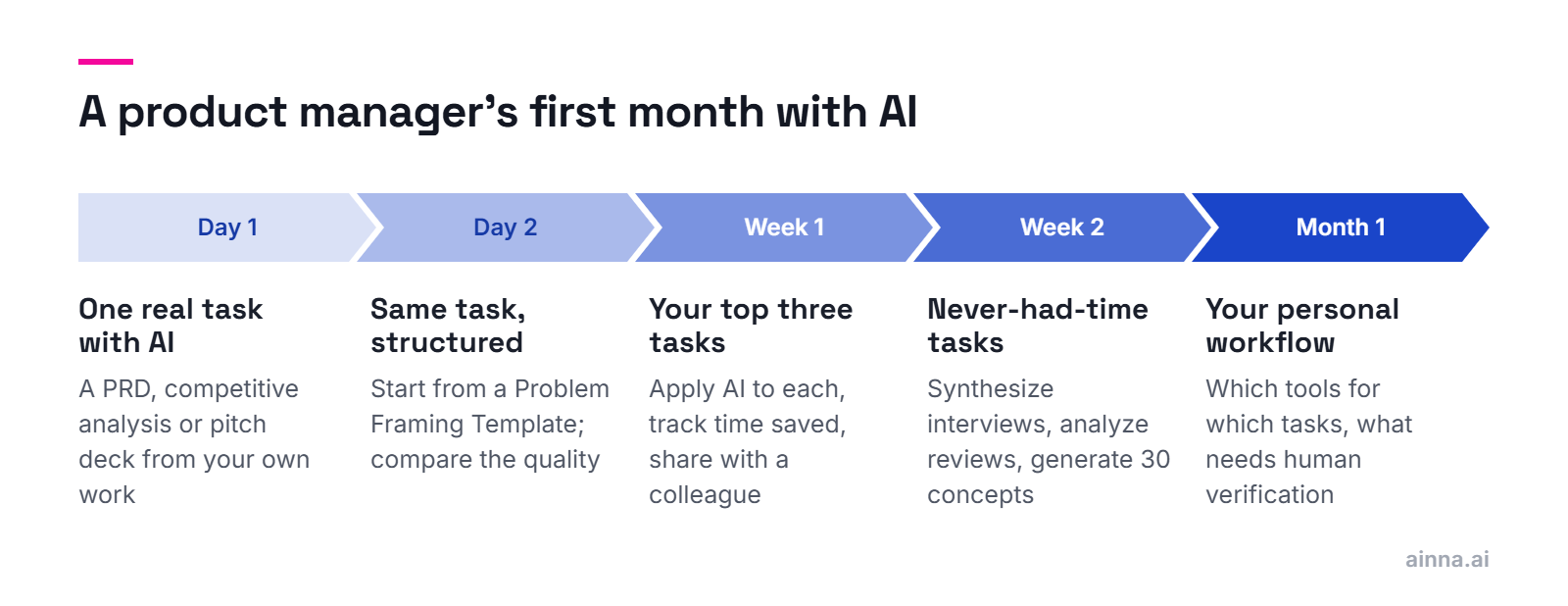
Do not start with a 30-day plan. Start with one task, today. Take the next PRD, competitive analysis, or pitch deck on your to-do list and do it with AI instead of manually. That single experience will teach you more than any framework. Then do it again tomorrow with a structured input and see the quality difference. That is when the lightbulb goes on.

  • Day 1: take a real task from your actual work and do it with AI. Generate a PRD, a competitive analysis, or a pitch deck using Ainna or Claude. Do not learn theory first - experience the speed difference on work you recognize
  • Day 2: do the same task again, but this time start with a structured input - a completed Problem Framing Template or a Universal Idea Model sentence. Compare the output quality. This is where methodology-first AI usage becomes visceral, not theoretical
  • Week 1: identify the three tasks you do most frequently and apply AI to each. Track time saved. Share the results with one colleague
  • Week 2: use AI for something you have never had time for - synthesize all your customer interviews, analyze 500 competitor reviews, generate 30 solution concepts for a problem you have been sitting on. Use the Nine-Dimension Model to assess them
  • Month 1: establish your personal AI workflow - which tools for which tasks, which outputs need human verification, which ones you can trust. Share your workflow with your team
  • The methodology layer: download the Innovation Toolkit templates. Complete them for your current product. Use them as AI inputs. The quality difference will be obvious immediately
Key Takeaway

The PMs who adopt AI successfully do not follow plans - they start immediately, experience the acceleration, and then build habits around what works. Start today. One task. Real work. See what happens.

What does the ideal AI tool stack look like for a product manager in 2026?

Smaller than you think. Three to four tools, not fifteen. I have watched PM teams accumulate a dozen AI subscriptions and end up with more context-switching overhead than they saved. The ideal stack covers the product lifecycle end-to-end with the fewest tools possible. The tool matters less than the methodology you bring to it.

  • Product strategy and documentation: Ainna - generates complete documentation packages (PRDs, pitch decks, competitive analysis, one-pagers) from structured product concepts using the Innovation Mode methodology
  • General-purpose AI assistant: Claude or ChatGPT - for ad-hoc analysis, brainstorming, synthesis, and writing tasks that don't fit a specialized tool
  • Prototyping: Bolt.new, Cursor, or v0 - for rapid prototype creation and concept validation
  • User research synthesis: Dovetail or your AI assistant - for pattern extraction from qualitative data at scale
  • The anti-pattern: collecting 15 AI tools creates more overhead than it saves. Each tool adds context switching, learning curves, and subscription costs. Consolidate ruthlessly
  • The methodology layer: the Innovation Toolkit templates provide the structured inputs that make any AI tool produce better output - they are tool-agnostic
Key Takeaway

The best AI tool stacks in 2026 will look boring: a small number of tools used consistently with clear purpose. The magic is not in the tools - it's in the structured thinking you bring to them.

How do I get my product team to adopt AI effectively?

The same way you would launch any product: find early adopters, demonstrate value on real work, remove friction, and build social proof. Do not send a memo about AI adoption. Generate a PRD for a product your team is actually building and show it to them. When they see their own product described accurately in 60 seconds, the adoption conversation is over.

  • Start with a live demonstration: generate a PRD or competitive analysis for a product your team is actually working on. The 'aha moment' is seeing your own product described accurately in 60 seconds
  • Create shared prompt templates: standardize the structured inputs (problem statements, product concepts) your team uses so AI quality is consistent across PMs
  • Establish review standards: AI-generated work needs the same cross-functional review as human-produced work. A polished AI PRD still needs engineering and design input
  • Address the fear: some PMs worry AI will replace them. Reframe: AI replaces the parts of your job you like least (formatting, boilerplate, data gathering) and frees you for the parts that matter most (strategy, user insight, innovation). A 2026 Harvard Business Review study found that the PM skills of defining problems, evaluating solutions, and experimenting are exactly what makes AI adoption successful - not technical AI skills
  • Build a shared learning loop: when a team member discovers an effective AI workflow, share it. When AI produces something wrong, share that too - it builds collective judgment about where AI is trustworthy and where it needs verification
  • Measure and celebrate: track time saved, documents produced, and quality improvements. Make the case for AI adoption with data, not evangelism
Key Takeaway

Team AI adoption follows the same pattern as any product launch: find early adopters, demonstrate value on real work, remove friction, and build social proof. Strong product leaders model the behavior they want to see.

In the fast-paced world of AI, execution matters more than ever. What defines winning companies is the courage to experiment and the ability to execute, learn, and adapt at speed and scale.

Most AI says yes.
Ainna says prove it.

The same methodology behind these guides — structured into an AI platform that frames opportunities, challenges assumptions, and produces stakeholder-ready documents in minutes.

Put Your Idea to the Test Free to explore · No credit card
Ideas in.
Opportunities out.