
Why does corporate innovation fail? #
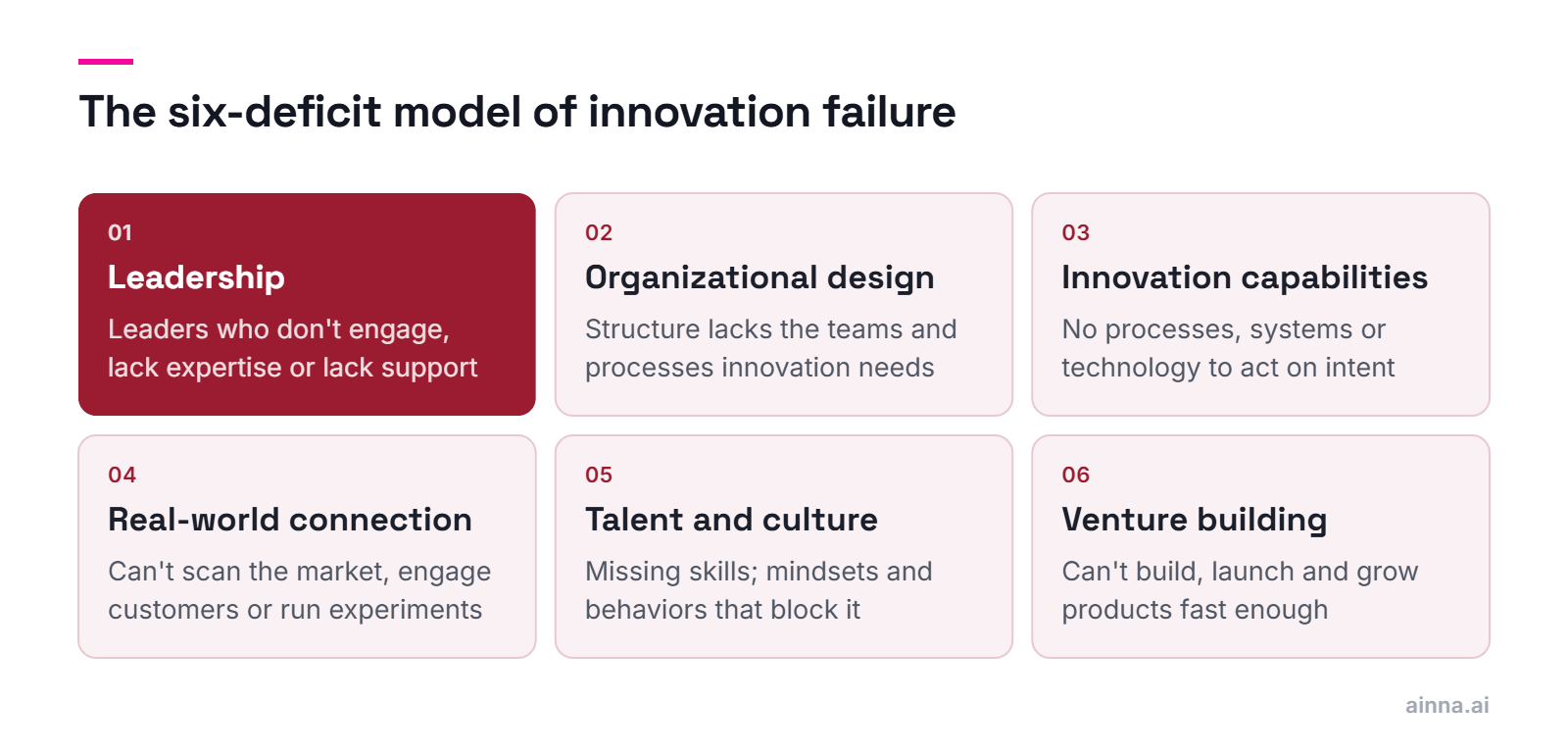
Corporate innovation rarely fails for lack of ideas, money or methods. It fails because of deficits in the organization around the ideas. In Innovation Mode 2.0 I group more than 30 failure patterns into six deficits: leadership, organizational design, innovation capabilities, real-world connection, talent and culture, and venture building. Leadership is the primary one. The result is familiar to anyone who has run a program: plenty of activity, few outcomes. In a 2019 BCG survey, 80% of innovation executives said innovation was a top-three priority, but only 30% said their organizations were good at it.
- Leadership: leaders who are complacent, risk-averse or indecisive, or who back innovation in words but not with resources, protection and the right metrics
- Organizational design: fragmented units, too many management layers, weak knowledge exchange and no clear answer to who owns innovation
- Innovation capabilities: no defined innovation function, legacy technology that blocks fast releases and experiments, and funding locked into annual cycles
- Real-world connection: a partial view of customers, markets and competitors, so teams solve the wrong problem or learn the market's verdict too late
- Talent and culture: skill gaps at leadership, management and team level, a culture people no longer trust, and careers that do not reward innovation
- Venture building: no capability to take validated opportunities to market, unclear ownership of projects, and handovers where promising products stall
- The deficits compound. A culture of fear and a fragmented organization block information flows, discourage innovative behavior and slow down decisions, which is how capable companies with good ideas still fall behind
Innovation failure is an organizational outcome, not bad luck with ideas. Name the deficits precisely and the fix stops being a matter of running more workshops.