Why do great ideas fail to become great products?

A CBInsights analysis of failed startups found that 35% identified 'no market need' as their top reason for failure. They built something nobody wanted-and the painful irony is that structured problem framing would have caught this before a single line of code was written. The most common reason great ideas die is not lack of talent, budget, or technology. It is the absence of documentation discipline at the stages that matter most.

  • In 2026, AI has made building software cheaper and faster than ever. That means the new competitive advantage is not execution speed-it is the quality of thinking that precedes execution. Problem framing, structured ideation, and rigorous validation are now the differentiating skills, not coding ability.
  • Most innovation programs generate plenty of ideas. The bottleneck is not ideation-it is the structured development of ideas into something concrete enough to assess, fund, and build. Ideas that are never properly articulated cannot be compared. Ideas that skip validation get built before they are understood.
  • Jumping to solutions before deeply understanding the problem is the single most costly mistake in product innovation. It produces solutions that are well-built answers to the wrong questions.
  • Without structured documentation at each stage, the insights from product discovery evaporate between the research session and the engineering kickoff-re-discovered at significant cost.
  • The organizations that innovate most consistently are not the ones with the most creative people-they are the ones with the best systems for capturing, assessing, and developing creative output into viable products.
  • As George Krasadakis writes in Innovation Mode 2.0 (Springer, 2026): reflecting on two decades of innovation work, the weakest points of innovation programs almost always refer to the absence of solid innovation tools and shared definitions.
Key Takeaway

In the AI era, everyone can build fast. The teams that win are the ones that frame the right problem, describe the right idea, and validate the right assumptions before building anything. These templates are the tools hundreds of product managers, founders, and innovation leaders use right now to do exactly that. And for Ainna users, every single one of them is free.

What is The Innovation Toolkit 3.0 and how do I get it free?

The Innovation Toolkit 3.0 is a collection of 10 professional, fully editable templates used by hundreds of product managers, founders, and innovation leaders to structure the complete innovation process-from problem framing to hackathon judging. Built on The Innovation Mode methodology by George Krasadakis and grounded in 25+ years of hands-on corporate innovation practice. The complete toolkit is free for all Ainna users-see the last section of this guide for details.

  • 10 fully editable MS Word and MS Excel templates, professionally designed and immediately usable-customizable to any organization's branding and context.
  • Free for Ainna users: the complete toolkit is available at no cost for all Ainna users-see the last section of this guide for details.
  • Also available with sign-up at The Innovation Mode website. Individual templates (Problem Statement and Business Idea) are available as free PDF downloads without sign-up.
  • The toolkit covers the complete innovation lifecycle: Problem Statement -> Business Idea -> Brainstorming Workshop -> Idea Assessment -> Business Experiment -> Product Concept -> Hackathon Setup -> Hackathon Assessment -> Universal Idea Model -> Innovation Dictionary.
  • Built on 25+ years of hands-on corporate innovation practice at Microsoft, Accenture, and four startups-distilled into ready-to-use tools that any team can implement immediately.
  • The same methodology forms the foundation of Ainna-the AI-powered product documentation platform. Completing toolkit templates and feeding them into Ainna generates complete PRDs, pitch decks, and one-pagers in 60 seconds.
  • No proprietary software required. No recurring license. No per-seat fee. The templates are yours once downloaded-use them across any number of projects, teams, and events.
Key Takeaway

The Innovation Toolkit is free because structured innovation tools should be accessible to every team, not just the ones with budget for expensive methodology licenses. Ainna users get the entire toolkit free right now-see the last section of this guide for details. Download it, run your first structured session this week, and experience firsthand what happens when great thinking meets great structure.

What document do I need before running a brainstorming session or hackathon?

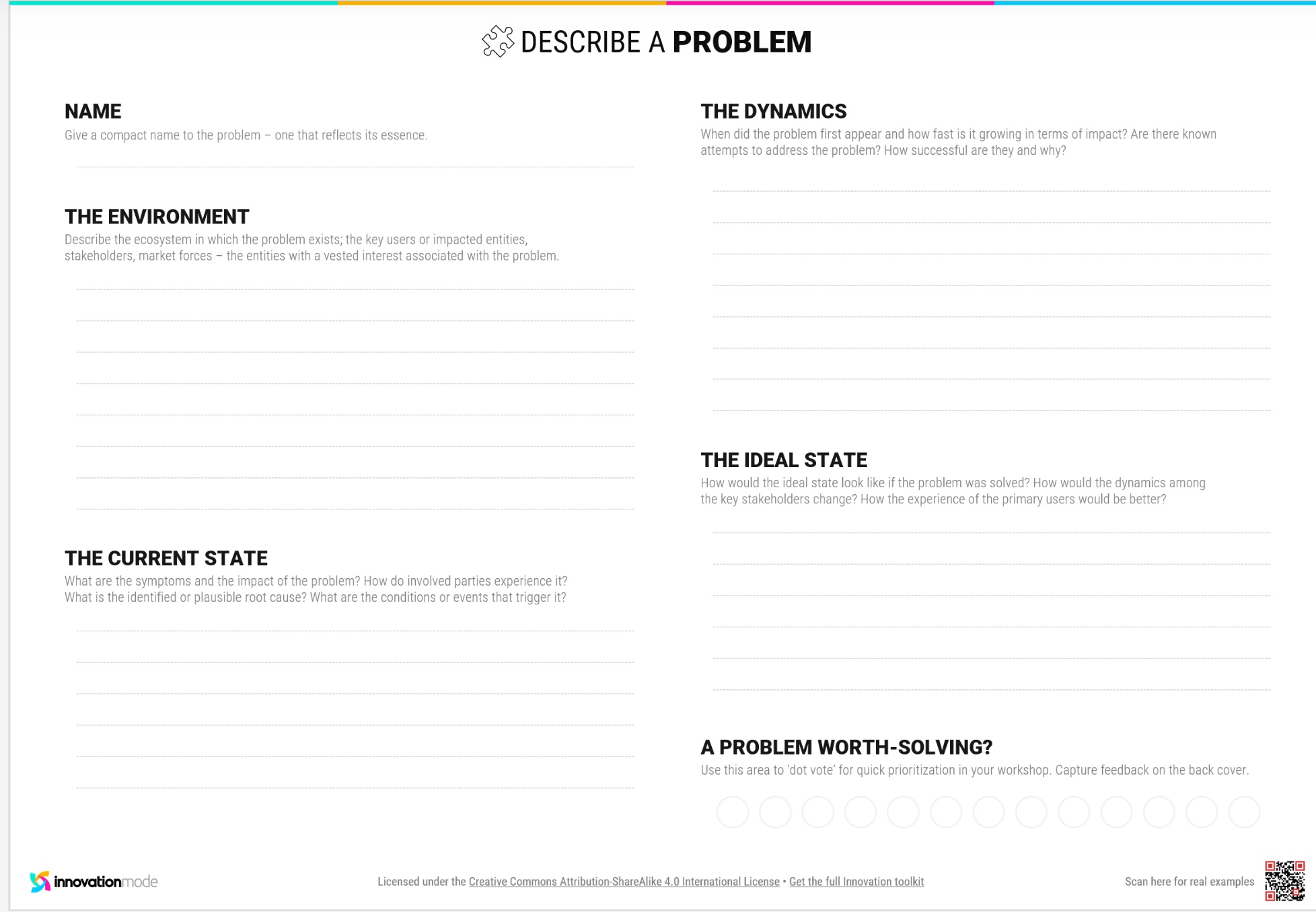
The Problem Statement Template. Distributed to participants before the session, it is the single document that determines whether your brainstorming produces relevant, high-quality ideas or a collection of disconnected solutions to vaguely understood problems. Teams that skip problem framing generate more ideas-and fewer good ones.

  • The Problem Statement Template is a one-page structured document built around four dimensions: the Environment (who is affected and what is the ecosystem), the Dynamics (how the problem has evolved and grown), the Current State (symptoms, root causes, and user workarounds), and the Ideal State (what success looks like for every stakeholder).
  • It is designed to be completed by the session organizer in advance and distributed to participants at least 24 hours before the event-giving them context to arrive with informed, specific ideas rather than generating surface-level solutions in the room.
  • The template directly addresses the most common brainstorming failure mode: participants jumping to solutions for problems they have only heard described verbally in the opening five minutes of a session.
  • For corporate hackathons, the Problem Statement Template defines the challenge brief-making the theme specific enough to focus creativity while open enough to allow unexpected solutions.
  • A well-completed problem statement is also the foundational input for product discovery: it captures the environment, dynamics, and user context that all subsequent discovery work builds on.
  • Free PDF (no sign-up required): download the Problem Statement Template free. Free for Ainna users: the full editable Word version plus all 9 other templates are free on Ainna-see the last section of this guide for details.
Key Takeaway

The quality of ideas you receive from any ideation event is determined almost entirely by the quality of problem framing that precedes it. This template is not overhead-it is the investment that makes every subsequent hour of ideation worth the participants' time.

Innovation Mode problem template for defining business challenges, identifying opportunities, and structuring innovation strategy
Figure 1: The Innovation Mode problem template helps teams clearly define business challenges, uncover opportunities, and structure innovation initiatives for better outcomes.

What makes a problem statement good enough to drive real innovation?

A good problem statement passes a single test: a smart person who has never heard of your problem can read it and understand who is affected, why the current situation is painful, and what success looks like-without any additional explanation from you. Most problem statements fail this test because they describe symptoms instead of root causes, or they describe the desired solution while calling it a problem.

  • Symptom vs. root cause: 'Our customer satisfaction scores are declining' is a symptom. 'Customers cannot find the information they need during onboarding because our knowledge base uses internal taxonomy rather than customer language' is a root cause worth solving.
  • The Ideal State section is the most commonly underdeveloped. Teams describe the problem vividly then write 'users would be happier' as the ideal state. A powerful ideal state paints a specific picture: what would a user's day look like if this were solved? What would they stop doing, start doing, feel differently about?
  • Quantification matters: 'customers are frustrated' is weak; 'customers contact support an average of 3.2 times before resolving their first onboarding question, with 34% abandoning before resolution' is a problem worth funding.
  • The best problem statements come from direct user contact-the discovery process that precedes problem framing is what makes the statement credible rather than assumed.
  • In the context of AI hackathons and innovation events, a specific, evidence-backed problem statement produces dramatically better team submissions than a vague theme.
  • A completed Problem Statement Template feeds directly into the Business Idea Template, the Brainstorming Workshop Template, and ultimately the PRD-it is the foundation every subsequent document is built on.
Key Takeaway

The test of a great problem statement is not whether you find it compelling-it is whether someone who was not in the room when it was written can act on it without asking you questions. That standard is harder to meet than it sounds, and worth every minute spent achieving it.

What template should I use to describe a product or startup idea clearly?

The Business Idea Template-built on the Universal Idea Model from The Innovation Mode. It is a one-page structured format that forces any product idea to be articulated across four dimensions: the problem being solved, the users and value created, the logic and execution, and the big unknowns. Completing it takes 15 minutes and produces something assessable, shareable, and actionable.

  • At the heart of the template is the Universal Idea Model sentence: 'An [object] for [class of users] that [does something] in order to [achieve a goal]. Users benefit by [getting something back] when [they are in a specific situation].' This single sentence forces six critical decisions simultaneously.
  • The four sections of the template mirror the questions every decision-maker will ask: What problem are you solving? Who benefits and how? How does it actually work? And what do you not yet know?
  • The Big Unknowns section is the most underused and most valuable: listing what you do not know before you have invested in an idea is the most efficient way to identify what you need to discover next-directly feeding the Business Experiment Template.
  • The template creates a standard 'innovation language' across teams: when everyone describes ideas using the same format, cross-functional teams can understand, compare, and assess them without domain expertise in every area.
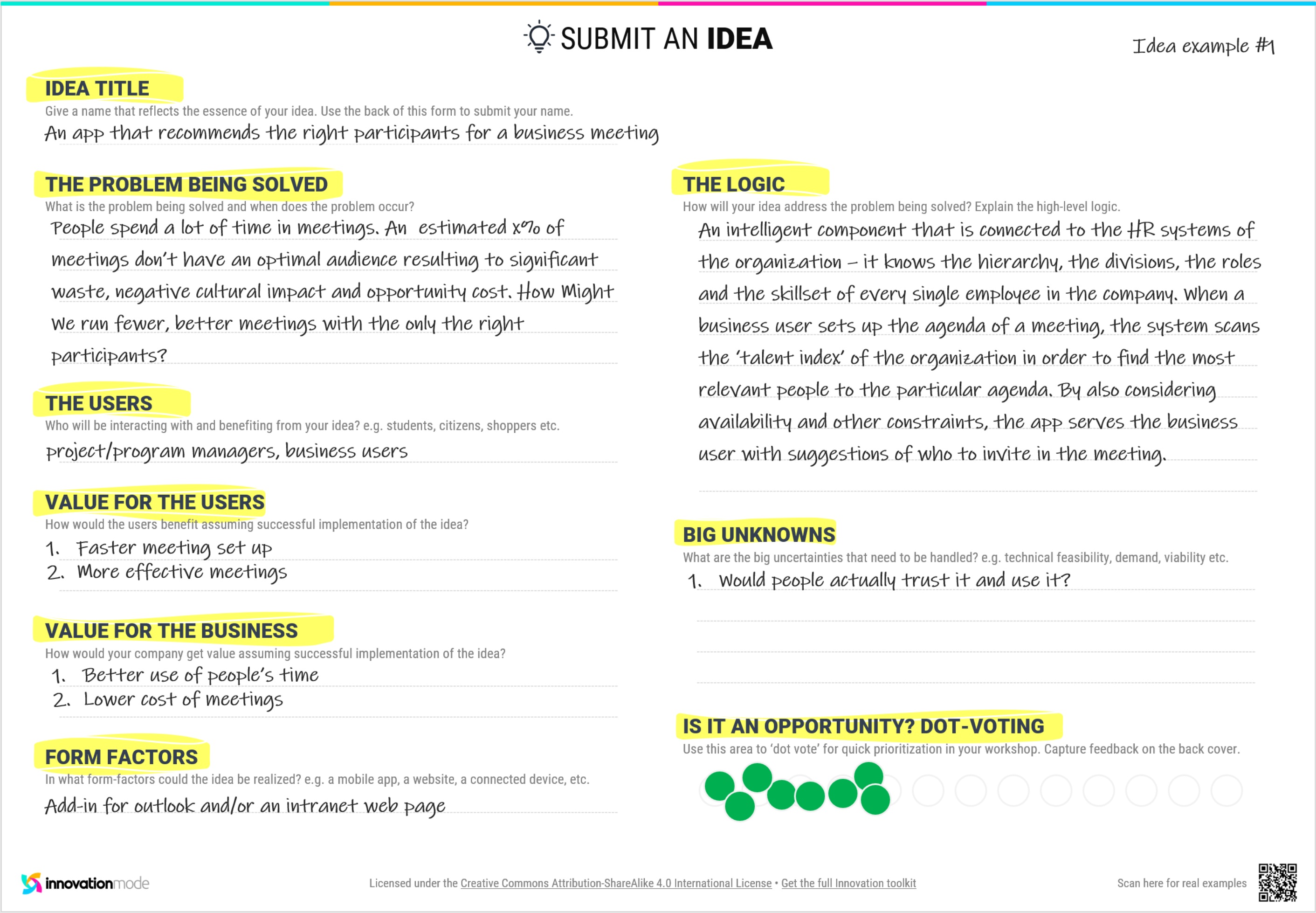
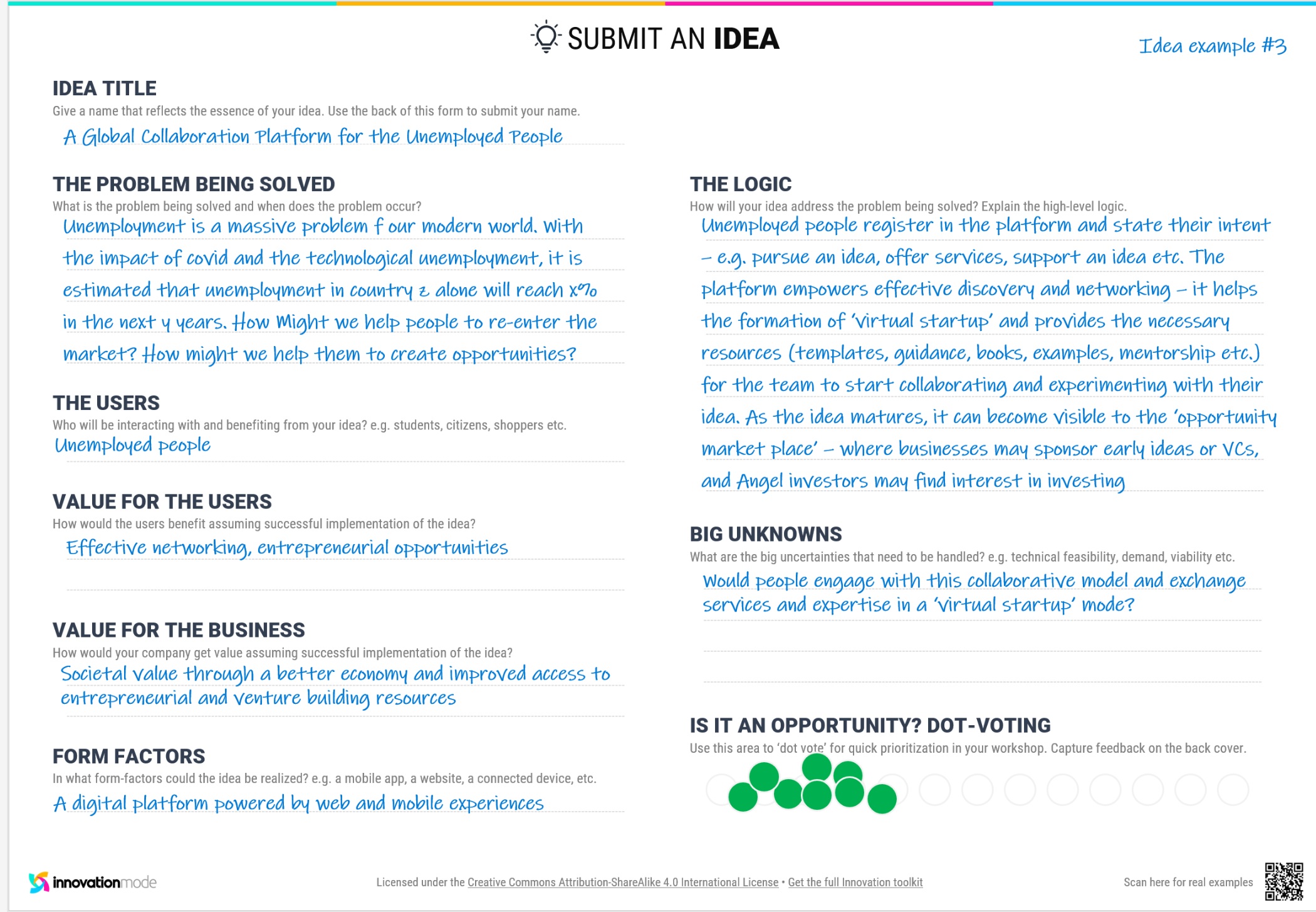
  • Real examples from The Innovation Mode show the model applied to: an AI meeting participant recommender, an AR in-store shopping assistant, and a global collaboration platform for unemployed people-three radically different ideas, all crystallized in the same one-page format.
  • Free PDF (no sign-up required): download the Business Idea Template free. Free for Ainna users: the full editable Word version and all 9 other templates are free on Ainna-see the last section of this guide for details.
Key Takeaway

The Business Idea Template is the most frequently used document in the toolkit-and the one with the most immediate visible impact. Ideas that are described well get funded. Ideas that are described poorly get forgotten. The template is the difference.

Innovation Mode idea template example for a business meeting app recommending participants using structured idea framework
Figure 2: An example of a business app idea that recommends meeting participants, structured using The Innovation Mode idea template to clearly define value, functionality, and use case.

What document do I need to run a structured brainstorming session?

The Brainstorming Workshop Setup Template-a pre-session facilitator document that covers participant briefing, session structure, ground rules, and idea capture format. Used in combination with the Problem Statement Template, it transforms an ad-hoc brainstorm into a focused innovation session that produces structured, assessable outputs rather than a whiteboard full of sticky notes.

  • The template is structured around five preparation elements: the problem context (referencing the Problem Statement), session motivation and desired outcomes, participant selection rationale, inspirational resources to distribute in advance, and ground rules for the session itself.
  • Participant selection guidance: the toolkit recommends 4-8 participants per session, deliberately mixing domain experts with fresh perspectives-people not directly involved in the problem whose outsider viewpoint often produces the most surprising, valuable ideas.
  • The session structure template covers: opening and warm-up, problem review, individual ideation rounds, group discussion and building, idea presentation, clustering by theme, and first-pass prioritization-each phase with a suggested time allocation.
  • The key output of the session is a set of completed Business Idea Templates-one per concept generated-captured immediately after ideation while context is fresh. This is the direct link between brainstorming and the idea assessment stage.
  • In the AI era, AI tools can accelerate ideation dramatically-but they amplify the quality of problem framing, not substitute for it. A well-run structured session with a clear problem brief consistently outperforms open-ended AI ideation.
  • Download: included in the full toolkit and available individually at The Innovation Mode brainstorming tools page. Free for Ainna users-see the last section of this guide for details.
Key Takeaway

The best brainstorming sessions look effortless. They are not. They are the result of preparation that makes the spontaneity productive. This template encodes that preparation so any team lead can run a high-quality innovation session without years of facilitation experience.

How do I objectively evaluate and rank innovation ideas across a team?

The Idea Assessment Template-an MS Excel scoring model with a weighted nine-criteria framework designed to evaluate hundreds of ideas objectively and produce a ranked prioritization that replaces gut-feel decisions with structured, transparent scoring. It is the antidote to the HiPPO problem: where the Highest Paid Person's Opinion determines which ideas advance.

  • The nine evaluation criteria cover every dimension of idea viability: problem importance, strategic alignment, solution effectiveness, technical feasibility, economic feasibility, ease of development, operational simplicity, business impact, novelty, and market demand certainty.
  • Each criterion carries an adjustable weight-so your organization can reflect its actual strategic priorities. A corporate team optimizing for strategic alignment weights it differently than a startup optimizing for market demand certainty.
  • The automated scoring system calculates composite scores and ranks all submitted ideas, producing a defensible shortlist that reduces the political pressure on judges and builds contributor trust in the process.
  • Designed to handle large-scale programs: whether you have 20 ideas from a team session or 200 submissions from a company-wide hackathon, the template applies consistent criteria across all of them without additional work per idea.
  • The same nine criteria appear in the Hackathon Assessment Template-creating scoring continuity across the innovation pipeline, from pre-hackathon ideation all the way through to event judging.
  • Transparency is its most undervalued feature: when contributors understand the criteria their ideas are assessed against, they submit better ideas and accept assessment outcomes with more confidence, which is essential for maintaining participation in ongoing innovation programs.
  • Download: included in the full toolkit as an MS Excel file. Free for Ainna users-see the last section of this guide for details.
Key Takeaway

Objective idea assessment is innovation culture infrastructure. Teams that assess transparently build contributor trust. Teams that assess arbitrarily see submission quality and participation decline over time. This template makes fairness systematic rather than aspirational.

What document do I need to validate a product idea before investing in development?

The Business Experiment Template-a structured plan for testing the riskiest assumption behind any product idea through a minimum viable test, before a single line of production code is written. It transforms the vague intention to 'validate' into a specific, time-bounded, measurable test with predefined success and failure criteria.

  • The template is structured around six elements: learning objective (what specific question does this answer?), hypothesis statement (what do we believe, and how will we know if we are right?), success metrics and target values, experiment plan (the minimum viable test), target audience, and required digital tools.
  • A well-formed hypothesis follows a specific structure: 'We believe that [target users] will [take this action] because [this motivation]. We will know we are right when [specific measurable outcome] occurs within [specific time window].'
  • The template enforces a critical discipline: success and failure criteria are defined before the experiment runs, not after the results come in. Post-hoc redefinition of success is the most common form of confirmation bias in product development.
  • The experiment plan section asks for the cheapest possible test-smoke test, landing page, concierge service, Wizard of Oz prototype, or user interview series. The goal is a valid answer, not a thorough one.
  • A completed Business Experiment Template directly feeds the MVP development process: validated assumptions inform what the MVP must prove, and invalidated ones reveal what the product concept must change before any further investment.
  • In the product discovery workflow, the Business Experiment Template is the bridge between a promising idea and a development-ready product concept-it is how teams graduate from assumption to evidence.
Key Takeaway

A business experiment that costs EUR500 and answers the critical question in two weeks will always outperform an MVP that costs EUR50,000 and answers it in six months. This template makes designing the cheaper, faster validation approach the path of least resistance.

What template do I use to turn a validated idea into a product brief?

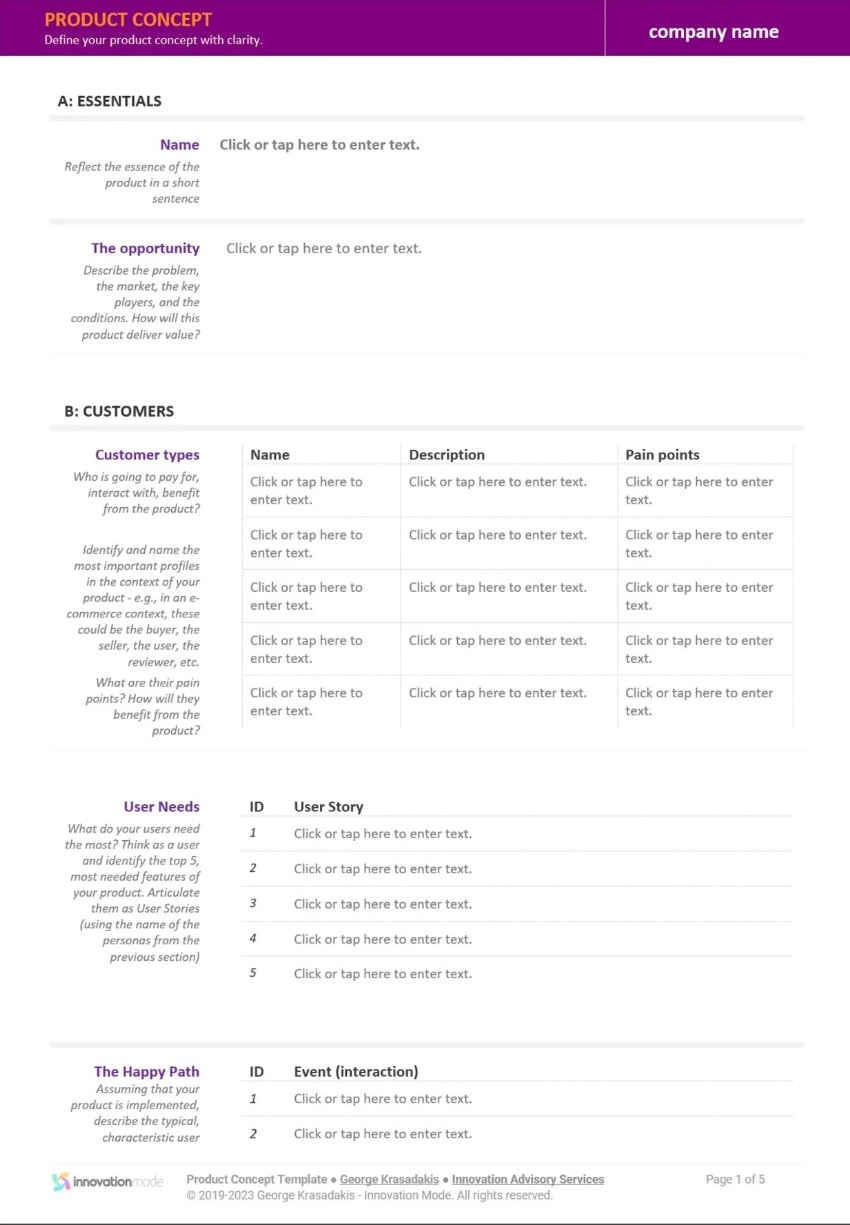
The Product Concept Template-a six-section structured document that captures your validated product vision in the format that engineering teams, investors, and stakeholders need to move forward. It is the most complete product thinking artifact you can produce before engineering investment begins, and the direct input to your PRD, pitch deck, and investor conversations.

  • The six sections answer the six questions every decision-maker will ask: Why now? (Context), For whom? (Users and Needs), In what form? (Form Factors), How will it reach market? (Strategy and Execution), How will it make money? (Monetization and Growth), and What do you still not know? (Open Questions).
  • Context: the problem, key market players, competitive landscape, and the strategic case for investing in this product right now-not in six months.
  • Users and Needs: named personas with specific pain points and the top five Epic user stories that capture the core value delivered. Generic personas ('busy professionals') are explicitly rejected by the template's structure.
  • Form Factors: the product's delivery mechanism and intended experience-mobile, web, API, voice, physical device, or hybrid-with rationale for the choice that connects to user context.
  • Open Questions: the known unknowns that must be answered before full development commitment. This section is as valuable as the rest combined-it shows intellectual honesty and directly maps to the next experiment or research sprint.
  • A completed Product Concept Template is the primary input for PRD generation, pitch deck creation, and investor conversations. In the AI era, tools like Ainna can generate all three from this single document in 60 seconds.
  • Download: download it at The Innovation Mode. Free for Ainna users-see the last section of this guide for details.
Key Takeaway

The Product Concept Template is where discovery ends and development begins. Completing it well takes 1-2 hours and produces the one document that every subsequent stakeholder-engineer, investor, or executive-needs to move forward with confidence.

Innovation Mode product concept template for defining product ideas, value propositions, and market fit
Figure 3: The Innovation Mode product concept template helps structure product ideas by defining value propositions, target users, and market fit for innovation initiatives.

What documents do I need to plan and run a corporate hackathon?

Two templates work together: the Hackathon Setup Template for event planning, and the Problem Statement Template for the challenge brief. Together they answer every design decision that determines whether your hackathon produces innovation worth funding or just enthusiasm worth celebrating.

  • The Hackathon Setup Template covers eight design dimensions: event purpose and theme, format (physical, online, or hybrid), timeline and structure, participant eligibility and team composition, deliverable requirements, judging criteria, awards strategy, and post-hackathon follow-through plan.
  • The format decision alone has major downstream consequences: internal-only events produce better organizational learning; public or cross-industry events produce more surprising solutions. Hybrid formats are increasingly common and require specific facilitation design.
  • Deliverable requirements deserve careful thought: requiring functional prototypes raises the technical barrier and excludes non-developers; requiring a structured pitch using the Business Idea Template format makes submissions comparable and accessible to all participants regardless of technical background.
  • The post-hackathon follow-through plan is the most frequently missing section in hackathon planning-and the one that determines whether winning ideas become products or trophies. The template makes it mandatory.
  • For the challenge brief, distribute the Problem Statement Template to all participants at least 24 hours before the event. Teams that arrive understanding the problem produce dramatically better submissions than teams that hear it for the first time in the opening session.
  • See the complete Corporate Hackathon Guide and our AI hackathon ideas guide (coming soon) for domain-specific themes and challenge briefs ready to use.
Key Takeaway

A hackathon without a setup template is a party with a deadline. A hackathon with one is a structured innovation event with a defined purpose, measurable outcomes, and a path from the winning demo to a funded product. The difference is in the planning document.

What template makes hackathon judging fair, fast, and transparent?

The Hackathon Assessment Template-a structured scoring framework that gives judges consistent criteria, composite scoring, and mandatory constructive feedback sections for every submission. It makes the judging process defensible to participants and dramatically faster for judges handling large numbers of submissions.

  • Judges score each submission across nine criteria that match the Idea Assessment Template: problem importance, theme alignment, feasibility, concept effectiveness, ease of development, operational simplicity, potential impact, innovation level, and market demand certainty.
  • The composite scoring system produces a ranked list that gives judges a data-backed starting point while preserving room for contextual judgment on borderline submissions-the optimal balance of structure and discretion.
  • Mandatory feedback sections prompt judges to comment on concept quality, presentation quality, design and prototyping effort, and team collaboration. Every team receives substantive feedback, not just a score-which is critical for maintaining participant engagement in repeat events.
  • The criteria continuity with the Idea Assessment Template is deliberate: submissions that were generated using the Business Idea Template and assessed using the Idea Assessment Template arrive at judging already in familiar structured format, making the judge's job significantly faster.
  • For participants, visible judging criteria raise the quality of submissions: when teams know they will be scored on theme alignment and market demand certainty, they address those dimensions in their pitch preparation.
  • Download: included in the full toolkit. Free for Ainna users-see the last section of this guide for details.
  • See How to Win a Hackathon for the participant perspective on what judges using this template are actually looking for in each scoring dimension.
Key Takeaway

Judging credibility is hackathon program credibility. The Hackathon Assessment Template makes fairness structural rather than dependent on individual judge generosity. That is the foundation of a hackathon program that participants trust enough to return to.

What is the Universal Idea Model and why does every innovator need to know it?

The Universal Idea Model is a structured sentence template that forces any product or business idea to be expressed completely in a single, testable statement. It is the common grammar that connects every template in the Innovation Toolkit, and the fastest test of whether an idea is actually clear or just sounds compelling.

  • The model: 'An [object] for [class of users] that [does something] in order to [achieve a goal]. Users benefit by [getting something back] when [they are in a specific situation].'
  • Six decisions in one sentence: what form does the product take, who is it for, what does it do, what outcome does it achieve, what value do users receive, and in what context. If any element is vague or missing, the idea is not yet clearly defined.
  • It is both a communication tool and a quality gate: if a team cannot complete the sentence cleanly after their discovery work, they have not yet discovered what they need to know-the gaps in the sentence map directly to the gaps in understanding.
  • The model creates organizational alignment: when every team member describes ideas using the same structure, cross-functional collaboration becomes faster because everyone is speaking the same language. This is the 'innovation language' effect described throughout the toolkit.
  • In the AI era, the Universal Idea Model sentence is the ideal structured prompt for AI documentation tools. A complete, well-formed model sentence generates dramatically better PRDs, pitch decks, and one-pagers than vague briefs.
  • Explore the model in action at The Innovation Mode-with real examples across radically different product types including AI agents, hardware devices, and social platforms.
Key Takeaway

Learn the Universal Idea Model once and it will change how you describe every product idea you ever have. It takes five minutes to learn and produces measurably clearer, more fundable idea descriptions for the rest of your career.

Innovation Mode idea template for structuring business ideas including digital collaboration platform concepts and value propositions
Figure 4: An example of a digital collaboration platform idea for unemployed individuals, structured using The Innovation Mode idea template to clearly define value proposition, functionality, and target users.

Why does a shared innovation vocabulary matter-and what terms should my team know?

When different people in the same organization mean different things by 'MVP,' 'prototype,' 'experiment,' or 'innovation,' they are not having the same conversations even when they think they are. The Innovation Dictionary resolves this by providing a common reference that aligns vocabulary before misalignment becomes conflict.

  • The dictionary covers five vocabulary domains: core innovation concepts (MVP, PMF, innovation types), methodologies (Agile, Lean Startup, Design Thinking, Continuous Discovery), organizational models (centralized vs. decentralized innovation), experimentation practices (hackathons, rapid prototyping, business experiments), and business analysis terms (TAM, SAM, unit economics, business model canvas).
  • Distributing the relevant dictionary sections to participants before any innovation event-hackathon, brainstorming session, or design sprint-eliminates the definitional debates that consume the first hour of many innovation sessions.
  • For organizations starting an innovation program, the dictionary is the first artifact to distribute. Teams that align on vocabulary before process are measurably faster at executing the process.
  • The most frequently misused terms in innovation programs: 'prototype' (often confused with MVP and with fully functional software), 'experiment' (often used to mean any uncertain project rather than a structured hypothesis test), and 'innovation' itself (often conflated with novelty or technology adoption).
  • Explore the complete interactive Innovation Dictionary on Ainna-covering 50+ terms with PM-focused definitions, examples, and context for the AI era.
  • In AI-assisted workflows, precise terminology matters even more: ambiguous prompts produce ambiguous outputs. Teams with shared vocabulary generate better AI-assisted documentation because their inputs are more precise.
Key Takeaway

Language is the infrastructure of innovation. Organizations that align vocabulary early move faster, debate less, and produce better outcomes. The dictionary is the cheapest infrastructure investment your innovation program can make.

In what order should I use these templates for maximum impact?

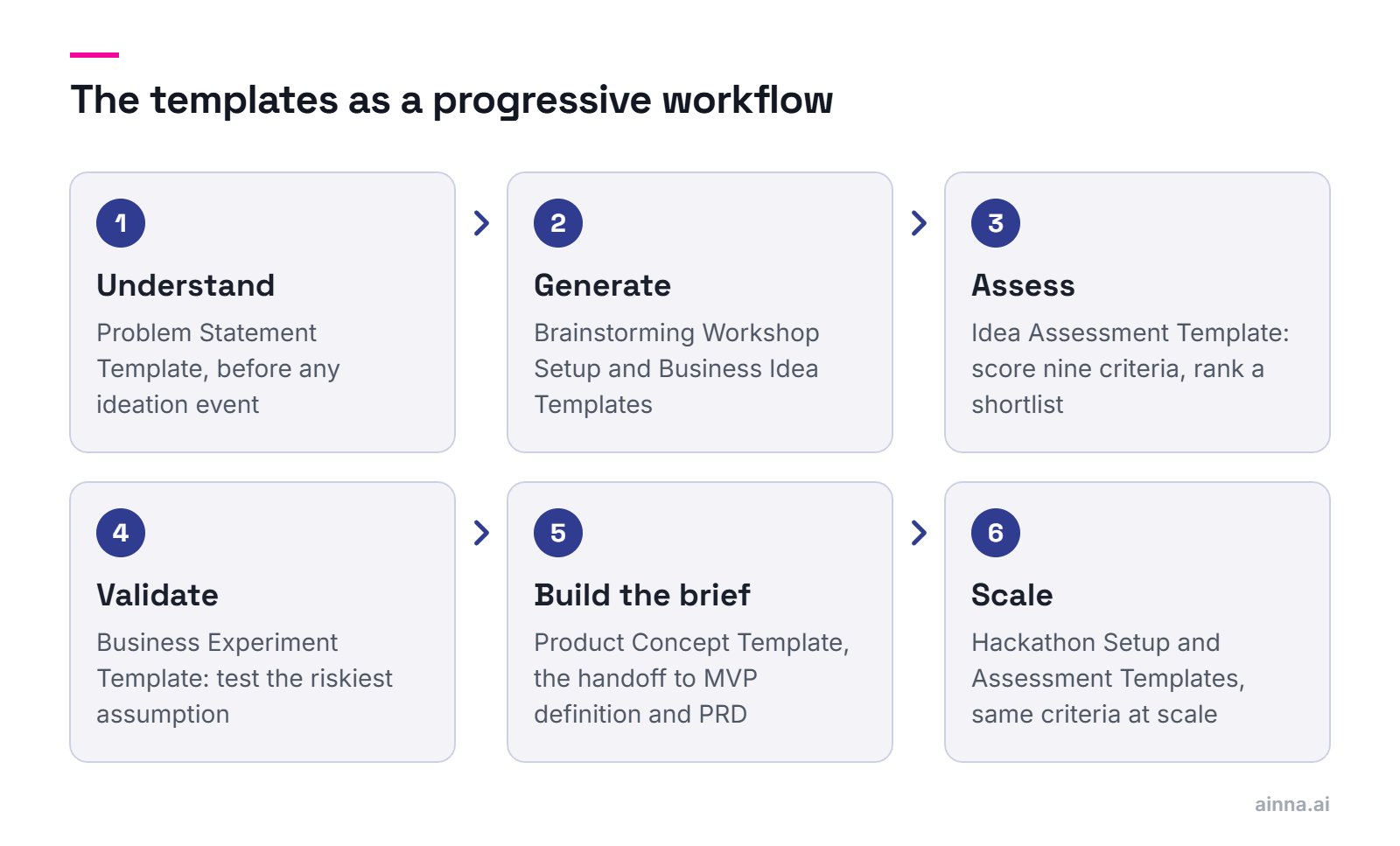
The templates are not independent tools-they are a progressive workflow where each document builds on the previous one. The sequence follows the natural logic of innovation: understand the problem before generating ideas, generate ideas before assessing them, assess before validating, validate before building. Skipping stages does not save time-it borrows it from later.

  • Stage 1 - Understand: Problem Statement Template. Always start here. Distribute to participants before any ideation event. A completed problem statement is the most valuable hour you will invest in any innovation initiative.
  • Stage 2 - Generate: Brainstorming Workshop Setup Template + Business Idea Template. Run the session with the structured facilitation guide. Capture every output in the Business Idea Template format immediately after the session.
  • Stage 3 - Assess: Idea Assessment Template. Score all submissions across the nine criteria. The ranked output is your shortlist for deeper development. Share the scores and rationale with all contributors.
  • Stage 4 - Validate: Business Experiment Template. For each shortlisted idea, design the minimum viable test of its riskiest assumption. Run it before committing to development.
  • Stage 5 - Build the Brief: Product Concept Template. For ideas that have passed validation, complete the six-section product concept. This is the handoff document to engineering, investors, or the PRD writing process.
  • Stage 6 - Scale: Hackathon Setup + Assessment Templates. Apply the full workflow at organizational scale through structured innovation events, using the same assessment criteria for consistency across the program.
Key Takeaway

The power of the toolkit is not in any single template-it is in the cumulative effect of using them in sequence. Each stage makes the next one faster and more productive. A team that runs through all six stages once will run them twice as fast the second time.

How do these templates work with AI tools in 2026?

The templates and AI tools are complementary, not competing. The templates capture the structured human thinking that AI needs to produce high-quality outputs. A completed Problem Statement or Product Concept Template is the ideal AI prompt. The combination compresses weeks of documentation work into hours-with quality that neither the templates alone nor AI alone could match.

  • The fundamental principle: AI output quality is directly proportional to input structure. A vague brief generates a plausible-sounding but generic document. A completed Product Concept Template generates a document with genuine insight-because the insight is in the input.
  • Practical workflow: complete the Problem Statement Template (30 mins) -> complete the Business Idea Template using the Universal Idea Model (15 mins) -> complete the Product Concept Template (60 mins) -> feed into Ainna -> receive a complete PRD, pitch deck, and one-pager in 60 seconds.
  • In hackathon contexts, the templates + AI combination is transformative: teams that use the Business Idea Template as their structured brief and Ainna to generate documentation produce polished, investor-ready submissions within a 48-hour event window.
  • AI can also accelerate the templates themselves: tools like Ainna can pre-populate template sections from rough notes, suggest completion for the Open Questions section, and identify which assumptions in the Product Concept Template are highest priority for the Business Experiment stage.
  • The templates are not pre-AI artifacts that AI has made obsolete. They are pre-AI artifacts that AI has made more powerful-because AI has no memory, no organizational context, and no user understanding of its own. The templates provide exactly what AI needs to perform.
  • Explore AI hackathon ideas to see how the Universal Idea Model pattern is applied across product development use cases-each idea described in the same structured format that feeds directly into AI documentation tools.
Key Takeaway

Templates make thinking structured. AI makes structured thinking fast. In 2026, the teams that combine both have a decisive documentation and communication advantage over teams that rely on either alone. This is why Ainna and the Innovation Toolkit were designed to work together.

How do I get all 10 Innovation Toolkit templates free?

The complete Innovation Toolkit 3.0 is free for all Ainna users. Visit theinnovationmode.com/innovation-toolkit, add the toolkit to your cart, and enter code AINNA.AI at checkout. All 10 editable templates unlock instantly at zero cost. This offer is available for a few more days.

  • Free for Ainna users - step by step: (1) go to theinnovationmode.com/innovation-toolkit, (2) add the toolkit to your cart, (3) enter code AINNA.AI at checkout. Zero cost. Offer available for a few more days.
  • Full toolkit (10 templates, all editable): also available with sign-up at The Innovation Mode toolkit page without the coupon. Delivered as MS Word (.docx) and MS Excel (.xlsx) files, fully customizable.
  • Problem Statement Template (free PDF, no sign-up): download the Problem Statement Template free - the most important template in the toolkit, available immediately.
  • Business Idea Template (free PDF, no sign-up): download the Business Idea Template free - includes three real-world examples showing the Universal Idea Model applied to different product types.
  • Once downloaded, all templates are yours to use without restriction-across any number of projects, teams, events, and programs. No per-use licensing, no subscription, no expiry.
  • After your first session: use the completed Business Idea Template outputs as inputs to Ainna-and generate your first AI-powered PRD or pitch deck from structured discovery in under 60 seconds.
Key Takeaway

Hundreds of product managers, founders, and innovation leaders are using these templates right now. The ones who downloaded them last week are running better brainstorming sessions, submitting more compelling hackathon projects, and pitching more fundable product concepts than they were the week before. The templates are free. The only cost is the 30 minutes you invest in your first problem statement.

Meet Ainna

Stop Guessing Which Ideas Are Worth Building.

Ainna is the AI product strategist that challenges your assumptions, sizes your market, maps your competition, and pressure-tests your concept before you commit a single engineering hour. The depth of a seasoned consultant. The speed of software. Used by hundreds of PMs and founders right now. Free to explore, no credit card required.

Ideas in.
Opportunities out.