Foundations of Great Product Teams

The fundamental principles that power successful product development teams.

A great, shared purpose and a bold vision. No matter the methodologies, tools, or practices, successful product teams are powered by a single thing: everyone believing in and working toward a meaningful objective.

  • Shared purpose is the foundation—everything else builds on this
  • The vision must be bold enough to inspire genuine commitment
  • Every team member needs to understand the 'what and why'
  • Talented teams especially need a great purpose to stay engaged
  • Success criteria should include making the entire team proud of the outcome

As a product leader, you need an inspired, talented team that believes in your product vision and works with passion toward the shared goal. The destination matters as much as how you get there.

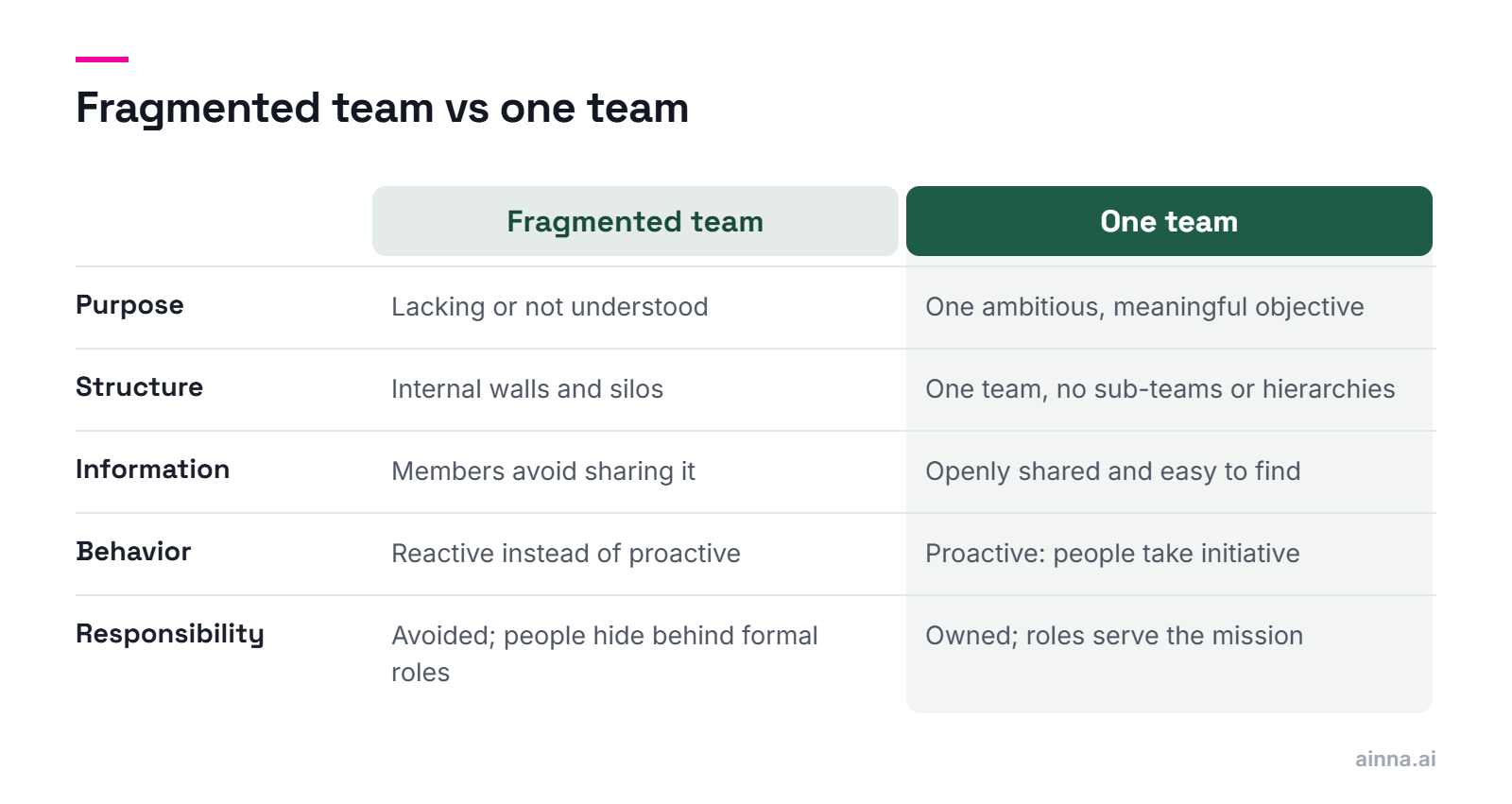
Team fragmentation is a state characterized by internal 'walls' and 'silos'—it's far from optimal and can become dysfunctional or even toxic. It's caused by deeper cultural and organizational issues and/or lack of purpose.

  • Internal walls and silos develop between team members or groups
  • Team members avoid sharing information with each other
  • People become reactive instead of proactive
  • Responsibility avoidance becomes common—hiding behind formal roles
  • Root causes: cultural issues, organizational problems, or lack of understood purpose
  • It's one of the most important risks in product development

After 20 years of leading software engineering teams in both project and product setups, team fragmentation stands out as one of the most critical risks to address. Preventing it requires intentional culture-building from day one.

There should be only ONE team, working for an ambitious, meaningful objective. Introducing sub-teams, hierarchies, authorities, politics, and bureaucracy undermines efforts and reduces chances for success.

  • One unified team, one shared objective—no artificial divisions
  • Sub-teams and hierarchies create 'little boxes' that fragment the group
  • Additional structure often leads to responsibility avoidance
  • Separation of concerns at the team level is a symptom of fragmentation
  • The team should feel like a cohesive unit, not a collection of specialists

Add a few 'little boxes' and some additional structure, and get ready to experience symptoms like responsibility avoidance and separation of concerns at the team level. Keep it simple: one team, one mission.

Vision & Communication

How to communicate product vision and keep the team aligned and inspired.

Make sure the team can see the big picture, understand the strategy, and grasp the rationale behind significant decisions. Every member needs access to the 'what and why' and must be able to relate to the mission.

  • Share the big picture—not just tasks, but the overall vision
  • Explain the strategy and reasoning behind major decisions
  • Ensure every team member understands 'what and why'
  • Connect the work to a mission people can relate to
  • The more talented the team, the stronger the need for bold vision
  • Repeat core messages frequently—don't assume one communication is enough

Whatever you are building—a product, a solution, a component, a prototype—make sure the team can see beyond their immediate tasks to the meaningful objective they're contributing to.

As a product leader, communicate the big thinking and articulate the opportunity clearly. Show how success benefits customers, drives profits, and creates value for the company, the team, and each individual.

  • Connect success to customer impact—how will their lives improve?
  • Show the business value—revenue, growth, market position
  • Explain value for the team—recognition, learning, career growth
  • Make individual contribution visible—how each person's work matters
  • Paint a picture of what success looks like
  • Be specific about outcomes, not just activities

People work harder when they understand what's at stake. Communicate how a successful release will serve customers while creating value at every level—company, team, and individual.

While sharing big thinking and opportunities is important, you also need to prove you're down to earth. Communicate the risks, challenges, and your strategy for minimizing exposure. Teams need to see readiness to make hard decisions.

  • Share the vision AND the risks—both are essential
  • Acknowledge challenges openly—don't pretend they don't exist
  • Present your strategy for managing and minimizing risk
  • Demonstrate willingness to make hard decisions when needed
  • Balance optimism with realism—credibility requires both
  • Show that you've thought through the difficult scenarios

Teams respect leaders who are honest about challenges. Being pragmatic doesn't undermine your vision—it makes it credible. Show you can dream big AND execute in reality.

Keep communicating the core vision and key messages frequently. Don't assume one all-hands meeting is enough. Repetition builds alignment, especially as teams grow and evolve.

  • Communicate frequently—weekly reinforcement, not just quarterly updates
  • Repeat core messages in different contexts and formats
  • New team members especially need vision context
  • Link daily decisions back to the bigger vision
  • Use multiple channels: meetings, documents, informal conversations
  • Make sure dynamics reflect the entrepreneurial spirit you're building

Effective communication isn't a one-time event. The vision should be a constant presence—referenced in decisions, celebrated in wins, and reinforced in challenges.

Building the Right Culture

How to build the entrepreneurial, collaborative culture that powers great product teams.

Modern product managers and leads must think, feel, and act as entrepreneurs—or better, 'intrapreneurs.' The company provides the mission and resources; the team must utilize them in the best possible way to make great things happen.

  • Think like a startup founder—even inside a large company
  • Treat resources (talent, equipment, code) as investments to maximize
  • Foster the 'intrapreneur' mindset across the entire team
  • Every member should feel ownership, not just following orders
  • Encourage initiative and creative problem-solving
  • Celebrate 'making things happen' over following process

This startup and innovation mentality must be inherited by every single member of the team. It's not just for leaders—everyone should feel like they're building something that matters.

Members need to join the team and forget about formalities, roles, and levels. Employees need to deeply understand the shared objective—to build a great product—and believe in that. Leadership must establish this special culture.

  • Break down role-based barriers—everyone contributes to the goal
  • Don't let titles determine who can have good ideas
  • Minimize approval chains and sign-off requirements
  • Focus on outcomes, not process compliance
  • Create space for direct communication at all levels
  • Lead by example—leaders should be informal and accessible too

It is the role of leadership to properly communicate the vision and establish this special culture where formalities fade and shared purpose takes over.

Establish a flow of updates, resources, and ideas to encourage collaboration and meaningful interactions. The team should easily discover and access updates, decisions, strategies, and anything that could significantly impact development.

  • Create systems for easy information discovery and access
  • Share updates, ideas, critical decisions and their justification
  • Make planning and strategies visible to the team
  • Establish a general feeling of openness and sharing
  • The team needs to know 'what's next and why'
  • Limit 'need-to-know' restrictions to truly sensitive material

Information sharing is critical for a powerful product development team. Yes, some material should only be shared on a need-to-know basis, but there must be a general feeling of openness and transparency.

Setting up an inspired, talented product development team is not easy—you need to combine the right skills, characters, and culture. Technical expertise alone isn't enough; you need people whose characters fit the entrepreneurial pace.

  • Technical skills are necessary but not sufficient
  • Characters must be compatible with fast-paced, informal culture
  • Look for people who thrive with ambiguity and change
  • Diversity of skills creates more robust teams
  • Shared cultural values matter more than identical personalities
  • One misaligned character can poison team dynamics

You need talent, the right conditions, and a strong culture to unleash energy and creativity in the right direction. The combination matters—brilliant individuals with conflicting values create friction, not velocity.

Day-to-Day Leadership Practices

Practical leadership behaviors that enable product teams to thrive.

Micromanagement is bad, especially for talented engineering teams. It signals distrust, kills initiative, and wastes leadership capacity on the wrong level of work.

  • Talented engineers disengage when constantly second-guessed
  • Micromanagement prevents people from developing ownership
  • It consumes leader time that should go to strategy and vision
  • It creates bottlenecks—everything depends on the manager
  • Teams stop taking initiative if decisions will be overridden anyway

If you realize there's a need to micromanage, start searching for the root cause—particular characters (including yours), dynamics, or the specific state of the team. The need to micromanage is a symptom of a deeper problem.

As a product lead—as an intrapreneur—you must use people's time effectively. Meetings must be meaningful and actionable. Avoid unnecessary meetings, and for those that must happen, ensure the right people are there with clear outcomes.

  • Question whether each meeting is truly necessary
  • Invite just the right people—no more, no less
  • Ensure participants join prepared with relevant context
  • Leave every meeting with clear action items and ownership
  • Assess meetings and provide constructive feedback to organizers
  • Make it safe to decline or leave meetings that aren't valuable

It's so common to join a meeting and instantly feel there's a waste of precious time. Don't let that become normal. Every meeting should earn its place on the calendar.

Teams need to see your readiness and willingness to make hard decisions when needed. Being able to make tough calls—and communicate the reasoning—is essential to maintaining team confidence and momentum.

  • Don't avoid or delay difficult decisions—teams notice hesitation
  • Gather input, but don't use consensus as an excuse for inaction
  • Communicate your reasoning transparently when making tough calls
  • Own the outcomes of your decisions—good and bad
  • Create psychological safety for others to make decisions too
  • Learn from decisions that don't work out—adjust without blame

Hard decisions are inevitable. How you handle them defines your leadership. Be decisive, be transparent about your reasoning, and be accountable for results.

Team Structure & Composition

How to structure and scale product development teams effectively.

Small enough to maintain the 'one team' mentality, large enough to cover essential skills. Typically 5-9 people is the sweet spot for a single product team. Beyond that, communication overhead grows faster than productivity.

  • 5-9 people is the typical optimal range for a single team
  • Smaller teams (3-5) work for focused, well-scoped products
  • Beyond 9 people, coordination costs escalate quickly
  • Amazon's 'two-pizza team' rule captures this intuition
  • Growth should come from more teams, not bigger teams
  • Every addition should have clear justification

The goal is small enough to stay cohesive, large enough to be effective. When you need more capacity, consider splitting into multiple 'one teams' with clear boundaries rather than growing a single team past its effective size.

Core roles typically include product leadership, engineering, design, and quality—but remember, roles should serve the mission, not create silos. The 'one team' mentality matters more than perfect role coverage.

  • Product Owner/Manager: vision, priorities, stakeholder management
  • Engineering Lead: technical direction, architecture decisions
  • Engineers: building the product—frontend, backend, full-stack
  • Designer: user experience, interface design, user research
  • Quality/Test: ensuring the product works as intended
  • Roles can overlap in smaller teams—specialization comes with scale

Don't let role definitions create the silos you're trying to avoid. Everyone contributes to the shared objective of building a great product. Roles are starting points, not boundaries.

Scale through multiplication, not expansion. Create multiple small teams with clear ownership rather than growing a single team. Culture scales through people—new team members must absorb and carry forward the values.

  • Split into multiple small teams rather than one large team
  • Each team needs clear ownership and autonomy
  • Seed new teams with culture carriers from existing teams
  • Maintain lightweight coordination between teams
  • Preserve the 'one team' mentality within each team
  • Culture transmission is an explicit leadership responsibility

The biggest risk in scaling is diluting the culture that made the original team effective. Be intentional about how values and practices transfer to new teams.

Modern Team Challenges

Navigating distributed teams, AI tools, and evolving work patterns.

Remote work makes culture-building harder but not impossible. The same principles apply—shared vision, open communication, minimal bureaucracy—but require more intentional effort and better tooling.

  • Over-communicate: what happens naturally in-person must be made explicit remotely
  • Create virtual spaces for informal interaction—not just meetings
  • Document decisions and context so async team members stay aligned
  • Use video for important discussions—faces build connection
  • Be mindful of timezone equity—rotate meeting times
  • Occasional in-person time (if possible) accelerates relationship building

Distance makes fragmentation easier to develop unnoticed. Leaders must work harder to maintain visibility into team dynamics and address silos before they solidify.

AI tools accelerate execution and lower barriers to building, but the fundamentals remain: you still need shared vision, great communication, and the 'one team' mentality. AI changes what teams can do, not how teams should work together.

  • AI accelerates prototyping—teams can validate ideas faster
  • Documentation and communication can be AI-assisted but not AI-replaced
  • Smaller teams can tackle bigger scope with AI augmentation
  • Risk: AI can amplify fragmentation if team members work in isolation
  • Opportunity: AI-generated artifacts can create shared understanding faster
  • Human judgment on vision, priorities, and culture remains essential

AI is a powerful tool for product teams, but it doesn't change the fundamental dynamics. A fragmented team with AI tools is still fragmented. A cohesive team with AI tools is dramatically more productive.

Sources:The Innovation Mode 2.0AI-augmented product development

Alignment shouldn't require heavy process. Lightweight rituals, clear shared artifacts, and high-bandwidth communication channels let teams move fast while staying coordinated.

  • Shared artifacts: one-pagers, PRDs, pitch decks everyone can reference
  • Brief daily syncs: 15-minute standups, not hour-long status meetings
  • Decision logs: quick notes on what was decided and why
  • Async-first updates: written updates that don't require scheduling meetings
  • Clear ownership: everyone knows who decides what
  • Easy escalation: quick path to resolve disagreements without bureaucracy

Alignment is a feature, not a process. The goal is shared understanding and coordinated action—achieve that with the minimum structure necessary.

Common Problems & How to Solve Them

Recognizing and addressing the issues that derail product development teams.

Watch for information hoarding, responsibility avoidance, 'that's not my job' attitudes, and people hiding behind formal roles. These symptoms indicate deeper cultural or purpose problems developing.

  • Information hoarding: people not sharing what they know
  • Responsibility avoidance: passing problems instead of solving them
  • Role hiding: 'that's not in my job description'
  • Reactive behavior: waiting to be told instead of taking initiative
  • Us vs them: subgroups forming competing identities
  • Meetings about meetings: process substituting for progress

When team members avoid sharing information, become reactive, and hide behind formal roles—fragmentation is already happening. Address the root cause: usually unclear purpose or cultural problems.

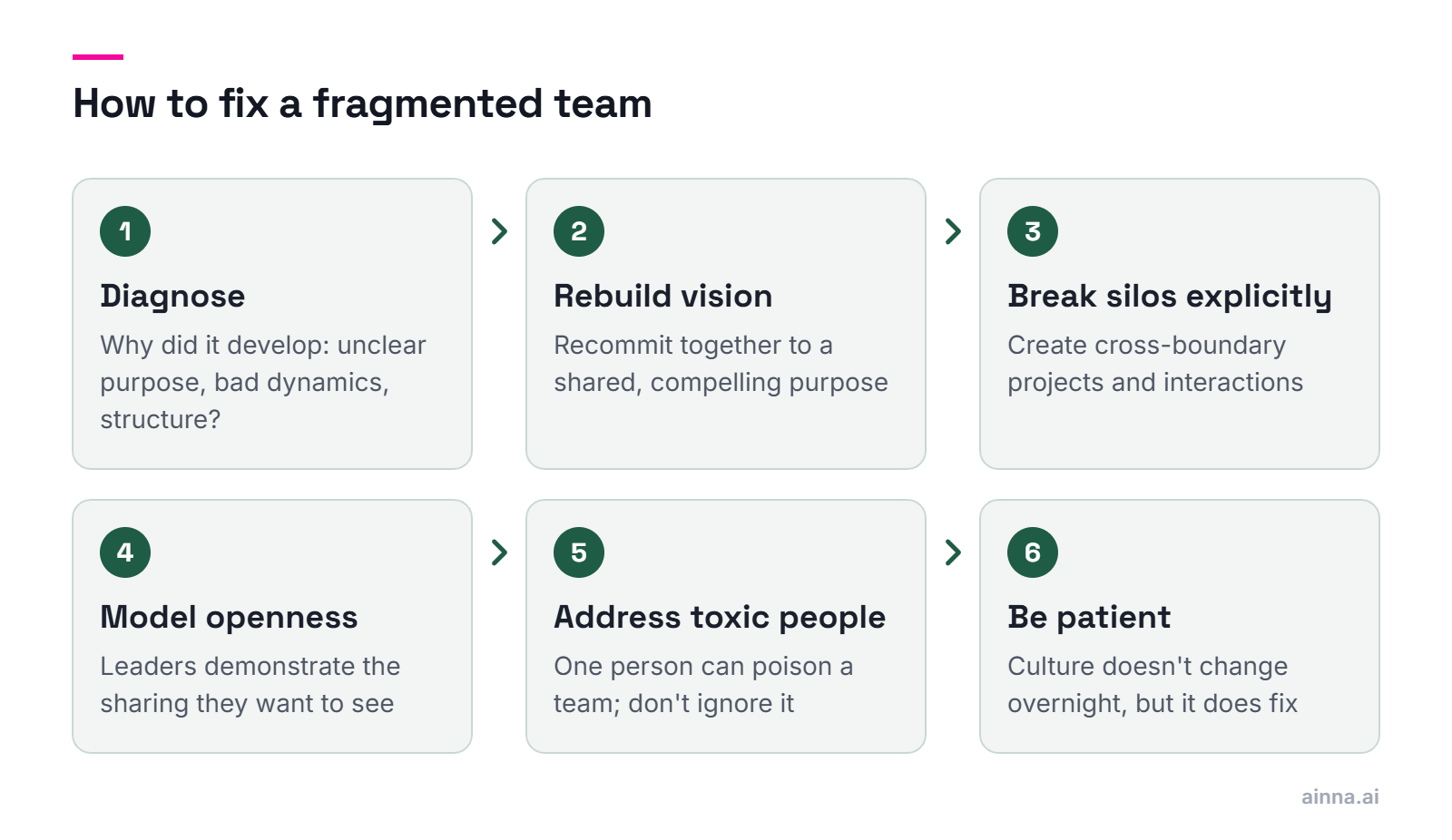
Start with diagnosis—understand why fragmentation developed. Then rebuild shared purpose, break down the silos explicitly, and model the culture you want to see. It takes time but is recoverable.

  • Diagnose: why did fragmentation develop? unclear purpose? bad dynamics? structural issues?
  • Rebuild vision: recommit to a shared, compelling purpose together
  • Break silos explicitly: create cross-boundary projects and interactions
  • Model openness: leaders must demonstrate the sharing they want to see
  • Address toxic individuals: one person can poison a team—don't ignore it
  • Patience required: culture doesn't change overnight

Fragmentation usually develops over time and fixes over time too. But it does fix—with intentional effort, clear purpose, and consistent modeling of the culture you want.

Motivation problems usually trace back to purpose problems. If people don't see why their work matters, they disengage. Reconnect the work to meaningful outcomes and ensure people feel ownership, not just execution.

  • Check purpose clarity: does everyone understand why the work matters?
  • Check ownership: do people feel like contributors or just task-doers?
  • Check recognition: is good work acknowledged and celebrated?
  • Check autonomy: are people empowered to make decisions?
  • Check obstacles: is bureaucracy or dysfunction draining energy?
  • Check leadership: are YOU bringing energy and belief?

Talented people want to do meaningful work with autonomy and impact. If motivation is low, something is interfering with that. Find and remove the interference.

Meeting overload is a symptom of unclear ownership, poor async communication, or lack of trust. Address the root cause while ruthlessly cutting unnecessary meetings in the short term.

  • Audit: list all recurring meetings and justify each one's existence
  • Kill mercilessly: eliminate meetings that don't produce clear value
  • Shorten defaults: 25-minute meetings instead of 30, 50 instead of 60
  • Improve async: better documentation reduces need for synchronous alignment
  • Clarify ownership: fewer people need to weigh in when decisions are clear
  • Protect focus time: block no-meeting periods for deep work

Every meeting should earn its place. If joining a meeting instantly feels like a waste of precious time, something is wrong. Fix it or kill it.