How is AI transforming innovation events? #
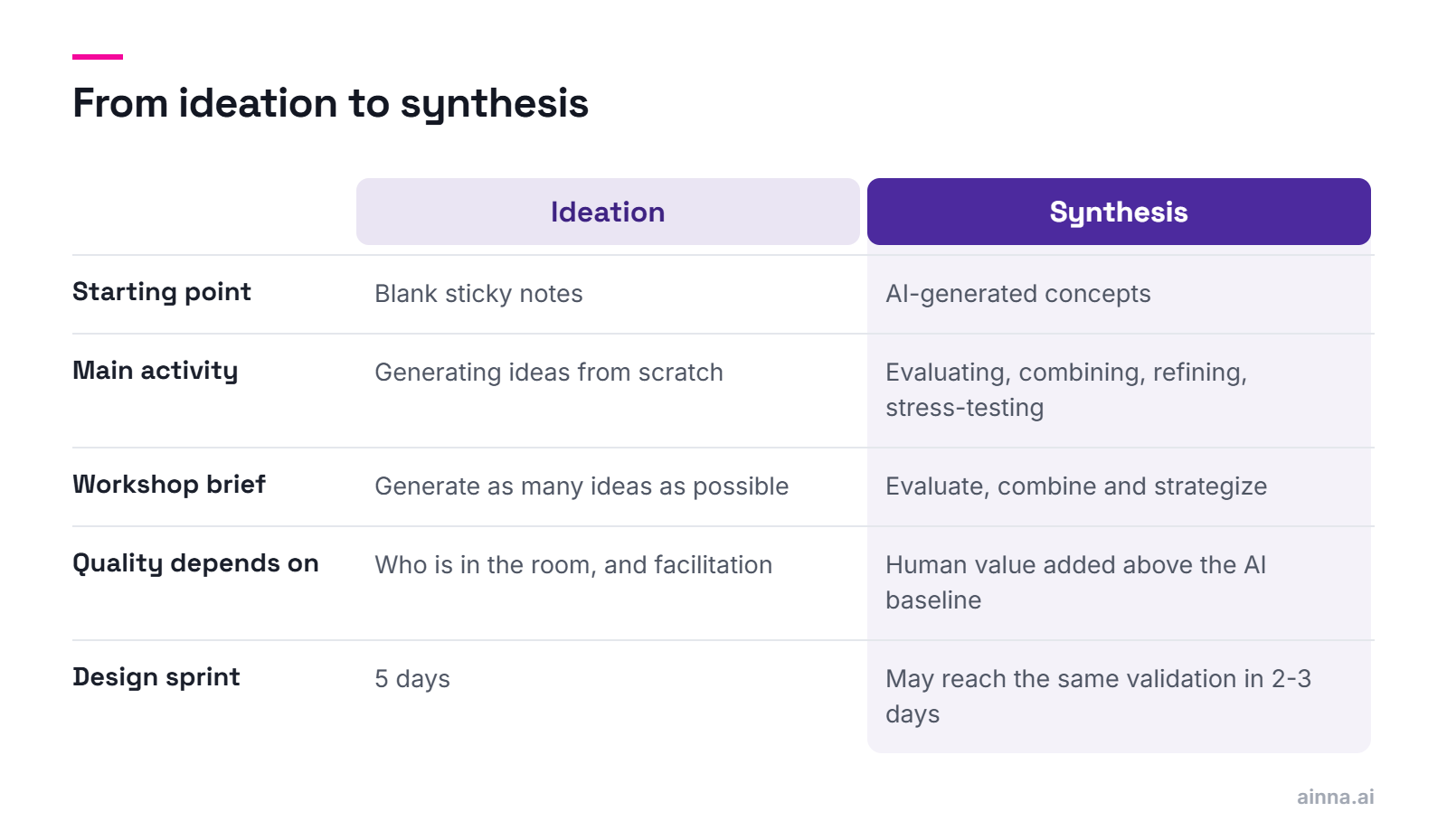
AI transforms innovation events at three levels: it accelerates the logistics (setting up, organizing, and measuring events), it amplifies the creative output (generating ideas, building prototypes, and analyzing concepts faster), and - most profoundly - it changes the fundamental role of human participants. In the Innovation Mode methodology, this is the central insight of Chapter 5 of Innovation Mode 2.0: AI shifts innovation events from ideation (humans generating ideas from scratch) to synthesis (humans curating, validating, and strategizing around AI-generated concepts). This is not a minor efficiency gain. It is a redefinition of what 'being an innovator' means.
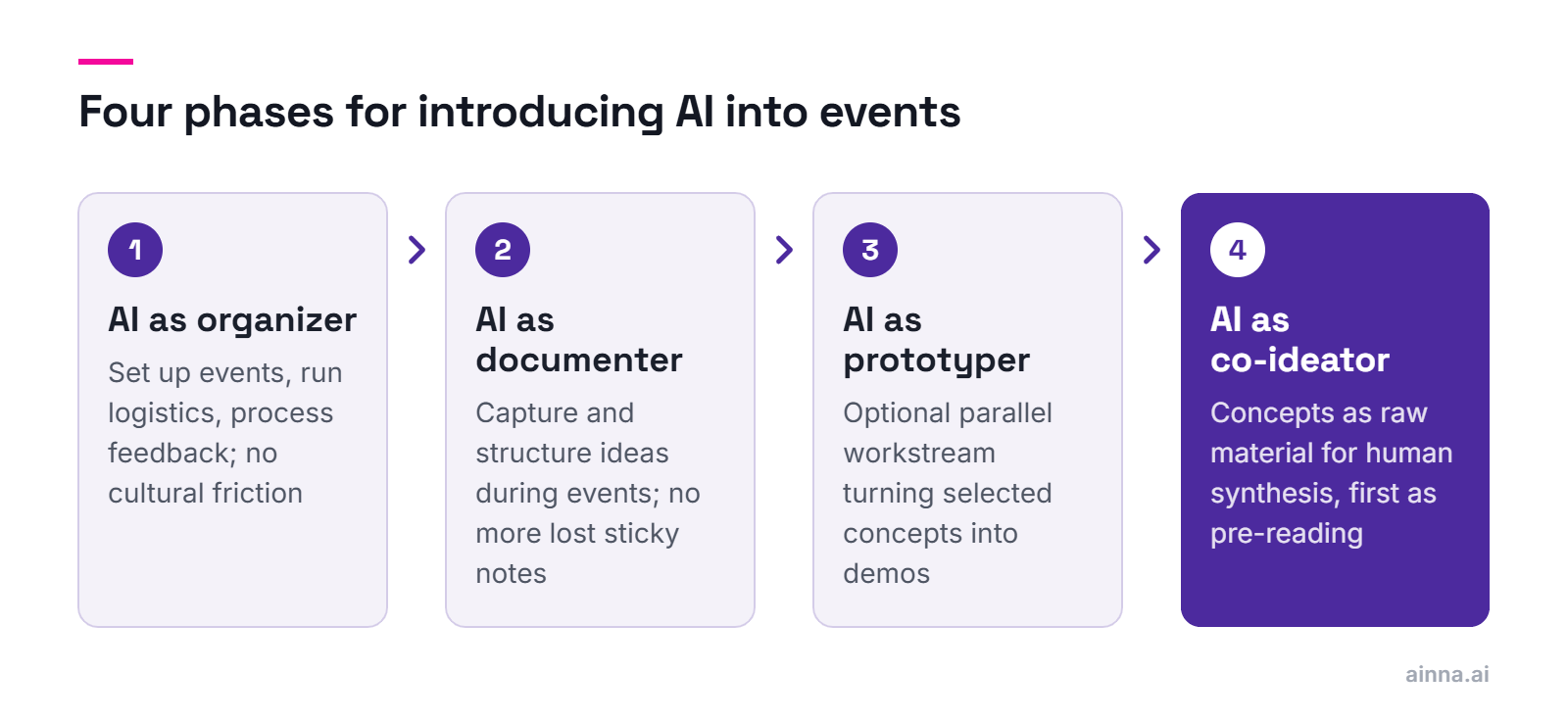
- The logistics revolution: the Innovation Mode concept of the AI-powered Workshop Designer can set up a complete innovation event in minutes - generating agendas, content packages, communication templates, participant recommendations, and dedicated event pages in the Innovation Portal, all from an initial brief
- The creative revolution: AI acts as an active co-innovator in the room. During brainstorming, AI can listen, capture ideas, generate new ones in real-time, visualize and prototype concepts on connected screens, and facilitate discussions - all seamlessly. As described in Innovation Mode 2.0, this transforms brainstorming from 'blue-sky ideation' into a 'synthesis session'
- The inclusivity revolution: AI tools remove technical barriers that previously excluded non-technical participants. Non-developers can now create functional prototypes through natural language descriptions, making hackathons and design sprints genuinely accessible to anyone in the organization
- The pipeline revolution: AI-powered events connect to the broader innovation infrastructure. Ideas generated during events feed directly into the Opportunity Discovery pipeline through the Innovation Graph, where they are framed, de-duplicated, assessed, and made discoverable using the Nine-Dimension Idea Assessment Model
- The measurement revolution: AI processes participant feedback, analyzes event performance, and generates standardized scorecards automatically - enabling systematic comparison across events and continuous improvement of the innovation program
- But the most important transformation is cultural - and it's not entirely positive. When AI can generate remarkable ideas in seconds, innovators may begin to question their own ability to contribute. This demands careful organizational design, not just better tools
AI doesn't simply improve innovation events - it fundamentally restructures them. The organizations that thrive will be those that embrace the speed and inclusivity while deliberately protecting the human elements that give innovation its cultural and psychological value.