What is product discovery?

Product discovery is the evidence-informed process of reducing uncertainty as you identify problems worth solving and validate solutions worth building. It answers two fundamental questions before your engineering team writes a single line of production code: Are there real users who want this? And can we design a solution that is valuable, usable, feasible, and viable?

  • Product discovery means uncovering what creates value - product delivery means producing what creates value. These are fundamentally different activities requiring different mindsets and techniques.
  • Discovery is not a phase that happens before delivery - it is a continuous, parallel practice. The best teams run discovery and delivery simultaneously at all times.
  • The goal of discovery is not to validate your assumptions - it is to test whether your assumptions are worth keeping or should be replaced with better ones.
  • Discovery addresses four categories of risk: value risk (do users want this?), usability risk (can they use it?), feasibility risk (can we build it?), and viability risk (does it work for the business?)
  • A CBInsights study found that 35% of failed startups identified 'no market need' as the top reason for failure - a problem rigorous discovery would have caught long before launch.
  • Without discovery, teams use their full engineering capacity as 'a very expensive prototype' - building at production cost to learn what could have been learned in days with a prototype and five user interviews
Key Takeaway

Product discovery is not overhead - it is risk management. Every week spent in discovery is a week of engineering time protected from being spent on the wrong thing. The teams that treat discovery as optional almost always discover this truth the expensive way.
What is the difference between product discovery and product delivery?

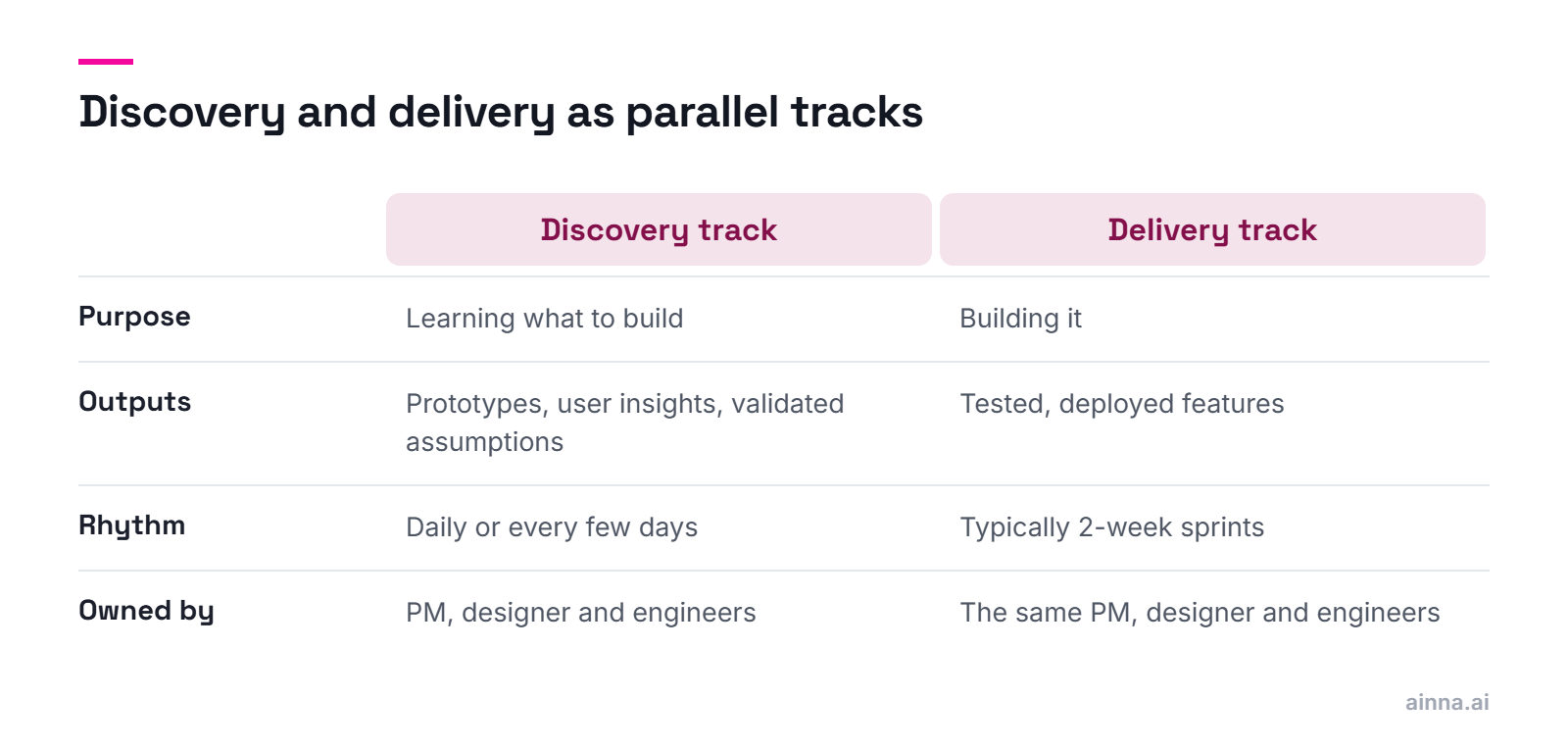
Discovery is about learning what to build. Delivery is about building it. They are complementary, parallel activities - not sequential phases. The most common organizational mistake is treating discovery as a 'phase' that ends when delivery begins. That is waterfall thinking with an agile label.

  • Discovery outputs are prototypes, user insights, validated assumptions, and documented product concepts - not production code.
  • Delivery outputs are tested, deployed features - not validated ideas.
  • In dual-track agile, the discovery track continuously generates validated backlog items while the delivery track continuously builds and deploys them in parallel.
  • The same cross-functional team - PM, designer, and engineers - should own both tracks. Separating discovery and delivery into different teams destroys ownership and creates a new form of handoff dysfunction.
  • Discovery iterations run daily or every few days; delivery iterations typically run in 2-week sprints. They operate at different rhythms and require different tools.
  • Product optimization (A/B testing, analytics-driven improvements) is a third practice distinct from both discovery and delivery - using instrumentation on live products to make iterative improvements to known functionality
Key Takeaway

Think of discovery and delivery as two engines running simultaneously in the same vehicle. Discovery tells you where to steer. Delivery takes you there. Turning off either engine does not make the vehicle faster - it makes it dangerous.

Why do most product teams do discovery wrong?

Most teams that believe they are doing discovery are actually doing something else: just-in-time spec writing, premature solution design, or confirmation-seeking user interviews. True discovery is genuinely uncertain, uncomfortable, and sometimes slow - qualities that conflict with the management instinct to keep engineers busy and show progress.

  • Anti-pattern 1: Discovery as a phase - Treating discovery as something that happens before development begins, rather than continuously alongside it.
  • Anti-pattern 2: Solution-first discovery - Starting with a solution in mind and conducting user research to confirm it, rather than to genuinely test whether the problem is real and the solution appropriate.
  • Anti-pattern 3: Keeping engineers busy - Management pressure to always have engineers building something drives teams to skip discovery and jump to delivery, using the full engineering team as an expensive validation mechanism.
  • Anti-pattern 4: Skipping problem framing - Jumping straight to ideation without first achieving a deep, shared understanding of the problem. One of the most common innovation mistakes across 25+ years of innovation consulting. Aligning on terminology through an innovation dictionary helps teams frame problems consistently.
  • Anti-pattern 5: Separating discovery from delivery teams - Creating a 'discovery team' that hands off to a 'delivery team' destroys ownership and recreates waterfall dynamics with agile terminology.
  • Anti-pattern 6: Treating every idea equally - Not all discovery opportunities warrant equal investment. Teams waste time running full discovery sprints on low-risk, low-impact ideas that could proceed directly to delivery.
Key Takeaway

The root of most discovery failures is organizational: management that is uncomfortable with uncertainty, teams that are rewarded for shipping rather than learning, and cultures that treat user research as a checkbox rather than a decision-making system. Fixing the process starts with fixing what gets celebrated.

What documentation should product discovery produce?

Great discovery generates structured insight at every stage - not a pile of notes, not a 50-page requirements document, but a lean, progressive documentation stack that captures what you have learned and what you have decided. The Innovation Mode documentation stack moves in three stages: Problem Statement -> Product Concept -> PRD.

  • Stage 1 - Problem Statement: A one-page structured articulation of the problem, its environment, dynamics, current state, and ideal state. This is the anchor for all subsequent discovery work.
  • Stage 2 - Business Idea: A structured description of the solution concept using the Universal Idea Model - one clear sentence defining the object, users, function, goal, value, and context.
  • Stage 3 - Product Concept: A six-section document covering context, users and needs, form factors, strategy and execution, monetization, and open questions. The bridge between idea and PRD.
  • Stage 4 - Business Experiment: A structured experiment plan defining the hypothesis, success criteria, measurement approach, and target audience - for testing key assumptions before committing to full development.
  • Stage 5 - PRD: The full Product Requirements Document, built on the foundation of everything validated in stages 1-4.
  • Each stage builds on the previous one - no stage is skipped, but each can be as lean as the situation requires. A startup with a well-validated idea might compress stages 1-3 into a single afternoon.
Key Takeaway

Discovery documentation is not bureaucracy - it is the mechanism that prevents insights from evaporating and ensures the best thinking from discovery actually reaches engineering. The goal is clarity at every handoff, not completeness for its own sake. For a template-by-template deep dive, see the product discovery documentation guide.

How do I frame a product problem for discovery?

Problem framing is the most important step in product discovery - and the most frequently skipped. A well-framed problem creates shared organizational understanding before solution ideation begins, preventing the expensive mistake of building the right answer to the wrong question.

  • The Problem Framing Template structures discovery across four dimensions: environment, dynamics, current state, and ideal state.
  • Environment: Who is affected? What is the ecosystem - market players, stakeholders, users, and their relationships? What conditions created this problem?
  • Dynamics: When did this problem emerge? How has it grown? What trends are amplifying or containing it? How might it evolve if left unsolved?
  • Current State: What are the symptoms users experience today? What are the root causes? What workarounds exist, and what do they reveal about user priorities?
  • Ideal State: What does success look like for every stakeholder? What would change in users' daily lives if this problem were solved?
  • A one-page problem statement creates a shared language within the team and with stakeholders - ensuring everyone is solving the same problem before a single solution is proposed
Key Takeaway

You cannot discover the right solution to a problem you have not clearly defined. Problem framing is not the start of discovery - it is the foundation discovery is built on. Invest in it proportionally to the size of the bet you are about to make.

How does the Universal Idea Model help structure discovery insights?

Once you have a validated problem, the Universal Idea Model provides the exact structure for articulating your proposed solution in one clear, testable sentence. It is the bridge between problem insight and product concept - and a forcing function for clarity before any design or engineering investment begins.

  • Template: 'An [object] for [class of users] that [does something] in order to [achieve a goal]. Users benefit by [getting something back] when [they are in a specific situation].'
  • This sentence forces six decisions simultaneously: the form factor, the target user, the core function, the desired outcome, the user value, and the context of use.
  • If any element of the sentence is vague or contested, it surfaces a discovery gap that needs resolution before proceeding - not after engineering has started.
  • Example from a real discovery session: 'An AI component for business meeting organizers that captures meeting context and recommends the most suitable participants in order to improve meeting quality. Users benefit by instantly finding the right experts when setting up a business event.'
  • Each element of the model maps directly to a PRD section: object -> product description, users -> personas, does something -> features, goal -> success metrics, value -> user stories.
  • Teams that cannot fill in the Universal Idea Model cleanly after a discovery sprint have identified their own discovery gap - the most honest form of progress tracking available
Key Takeaway

The Universal Idea Model is a discovery quality gate, not just a communication template. If your team cannot complete it cleanly and confidently after discovery work, you have not yet discovered what you need to know.

What is a product concept and when should I create one?

A product concept is the structured output of your discovery work - the document that captures the validated product idea in six dimensions and hands it off to engineering, stakeholders, or the PRD-writing process. Create it when you have validated enough of the problem and solution space to make a credible case for investment.

  • The Product Concept Template is structured across six sections that directly map to the key questions any stakeholder or engineering team will ask.
  • Section 1 - Context: The problem, key market players, market sizing, and the conditions that justify developing this product now.
  • Section 2 - Users and Needs: Target personas, their most pressing needs, and the top five Epic user stories that capture the value delivered.
  • Section 3 - Form Factors: The product's intended experience - mobile, web, API, physical device, or hybrid. What does it look and feel like?
  • Section 4 - Strategy and Execution: Go-to-market approach, implementation roadmap, key technologies, and the phasing plan.
  • Section 5 - Monetization and Growth: Revenue model, pricing hypothesis, growth mechanisms, and key assumptions to validate.
  • Section 6 - Open Questions: The known unknowns - what must be answered before the team commits to full development. This section is as valuable as the rest combined.
Key Takeaway

The product concept is not a heavy document - a well-executed one fits on two pages. Its value is not completeness but structure: it ensures discovery insights are captured in a format that decision-makers, engineers, and investors can all act on.

What user research methods work best in product discovery?

Discovery research is fundamentally different from usability testing or market research. Its goal is not to measure what users do with something you have built - it is to understand the problem space deeply enough to know what is worth building. The methods that work best are qualitative, fast, and focused on behavior over preference.

  • Problem interviews: Structured conversations focused entirely on understanding users' current workflows, pain points, and workarounds - not on your product idea. The goal is to validate that the problem is real and painful.
  • Contextual inquiry: Observing users in their natural environment doing the actual task you are trying to improve. What people do differs significantly from what they say they do.
  • Jobs to Be Done interviews: Uncovering the underlying motivation behind behavior - the 'job' the user is hiring a product to do - rather than just capturing feature preferences.
  • Prototype testing: Presenting a low-fidelity prototype to 5-8 users and observing whether they can accomplish key tasks without guidance. Five users consistently surface 85% of usability issues.
  • Survey research: Useful for quantifying what qualitative research has already identified, not for discovering unknown problems. Surveys confirm; they rarely discover.
  • Diary studies and longitudinal research: Particularly valuable for products used repeatedly over time, where the cumulative experience matters as much as individual interactions
Key Takeaway

The best discovery research method is the one you will actually do with real users in the next two days. Perfect methodology executed slowly is always worse than good-enough methodology executed quickly. Bias toward talking to users, not toward planning how to talk to users.

How many users do I need to interview in discovery?

Far fewer than most teams think. Five well-conducted problem interviews will surface the dominant themes in your target user population. The goal is not statistical significance - it is pattern recognition. When you hear the same insight from five different people, you have found something real.

  • For problem validation: 5-8 interviews per distinct user segment is typically sufficient to identify dominant patterns and the most pressing pain points.
  • For prototype testing: 5 users will surface approximately 85% of critical usability issues. Adding more users yields diminishing returns for the same investment.
  • For Jobs to Be Done research: 10-15 interviews per segment are often needed to reach saturation on the underlying motivations and job switching triggers.
  • Segment carefully: 5 interviews with the exact right users is more valuable than 50 interviews with the wrong ones. Define your target persona before recruiting, not after.
  • Continuous discovery changes the math: rather than conducting large-scale research in bursts, teams doing continuous discovery maintain weekly user touchpoints with a small number of users - building cumulative insight over time.
  • The question to ask after each interview is not 'did we get enough data?' but 'did we learn anything that changes what we believe?'
Key Takeaway

User research in discovery is about quality of insight, not quantity of data. Talk to fewer people, more deeply, more often. The failure mode is not doing too little research - it is doing a lot of shallow research and mistaking volume for validity.

How do I identify and prioritize the assumptions my discovery must test?

Every product idea is built on a stack of assumptions. Discovery's job is to identify which assumptions are most likely to be wrong and most critical to be right - and test those first. Testing your riskiest assumptions early is what separates efficient discovery from expensive experimentation.

  • Map your assumptions across the four risk categories: value (will users want this?), usability (can they use it?), feasibility (can we build it?), and viability (will the business support it?)
  • Prioritize assumptions using two dimensions: how confident are you that the assumption is true? And how important is it to the success of the product if it is wrong?
  • The highest-priority assumptions are those you are least confident about AND that would invalidate the product concept if false - test these first, before any others.
  • Use the Business Experiment Template from The Innovation Toolkit to design structured tests: hypothesis, success criteria, measurement method, and target audience.
  • A good assumption test answers a specific binary question: 'We believe X. We will know we were right when Y. We will know we were wrong when Z.'
  • Teams often gravitate toward testing technology and usability assumptions because they are comfortable - but value assumptions ('do users actually want this?') are almost always the most dangerous ones to leave untested
Key Takeaway

Assumption mapping is the most important strategic act in discovery. The team that tests their most dangerous assumptions first will learn faster and spend less. The team that tests what is comfortable will build confidently toward a product nobody wanted.

What is continuous discovery and how does it work in practice?

Continuous discovery means maintaining a regular cadence of customer touchpoints that inform product decisions at every stage of development - not just at the start. Rather than running a discovery 'phase' every six months, the team talks to real users every week, learns continuously, and feeds that learning into both the discovery and delivery tracks simultaneously.

  • Continuous discovery is built on a simple weekly practice: at least one customer conversation per week, with insights shared across the product team.
  • The goal is not to gather data - it is to maintain a live, evolving understanding of users' problems, contexts, and needs that directly informs what gets built next.
  • In continuous discovery, the discovery backlog is always full: the team is never starting a new feature from zero customer understanding, because understanding is being accumulated continuously.
  • Opportunity Solution Trees (from Teresa Torres' Continuous Discovery Habits) provide a structured way to map customer outcomes to opportunities to potential solutions, making the discovery-to-delivery connection explicit and visual.
  • Continuous discovery shifts from Scrum (best for discrete delivery work) toward Kanban-influenced models that handle the continuous flow of discovery outputs feeding delivery work.
  • For corporate innovators, continuous discovery maps directly to the innovation culture described in The Innovation Mode: structured channels for idea submission, transparent assessment, and regular experimentation cycles
Key Takeaway

Continuous discovery is a habit, not a process. It does not require new tools or a redesigned workflow - it requires a commitment to talking to users regularly enough that product decisions are never made in a vacuum. Start with one customer conversation per week. Everything else follows.

What is a discovery sprint and when should you run one?

A discovery sprint is a one-week, time-boxed, intensive discovery effort designed to tackle at least one substantial problem or risk in your product definition. It is not the default mode of discovery - it is a special tool for moments when a big decision needs to be made quickly, or when the team is stuck.

  • A discovery sprint produces a validated prototype and user insights within five days - enough to make a major product direction decision without months of development.
  • Use a discovery sprint when: the team faces a high-risk, high-uncertainty decision; product direction needs to change quickly; or the team needs to build discovery skills.
  • The GV (Google Ventures) Sprint methodology - popularized in the book Sprint by Jake Knapp - provides a well-tested five-day structure that has been used by hundreds of startups and established companies.
  • Discovery sprints are not the same as design sprints, though there is significant overlap. A discovery sprint may go beyond design to include technical feasibility and business viability exploration.
  • The output of a discovery sprint is not a finished product - it is a validated learning and a confident direction, documented in a product concept ready to feed the PRD process.
  • Discovery sprints should be the exception, not the rule: continuous discovery maintains baseline understanding; sprints are for moments of strategic decision-making
Key Takeaway

A discovery sprint compresses months of learning into five days. Use it for your most important, most uncertain product decisions - not as a substitute for the continuous discovery that should be happening every week regardless. For a detailed sprint structure, see the design sprint guide.

How does product discovery connect to OKRs and business outcomes?

Product discovery is the natural mechanism through which business objectives get translated into specific, validated product bets. OKRs define where the business needs to go; discovery identifies which product moves will get it there. The teams that connect these two practices consistently outperform those that keep them separate.

  • Leadership sets the objective ('increase customer retention from 65% to 75%') - discovery is the process through which the team finds the right solution to achieve it.
  • In the SVPG product operating model, leadership allocates objectives to empowered teams; discovery determines the key results those teams will pursue to deliver the objective.
  • Discovery prevents the worst OKR failure mode: teams that write key results around outputs (features shipped) rather than outcomes (user behavior changed).
  • A validated product concept from discovery directly feeds the key results definition: 'We believe building X will move metric Y by Z, based on these validated assumptions.'
  • Connecting discovery to OKRs gives discovery work urgency and prioritization criteria: which discovery questions matter most depends on which objectives are most strategically important right now.
  • Teams that run continuous discovery in service of OKRs never start a sprint without knowing why they are building what they are building - and have evidence to support that reasoning
Key Takeaway

Discovery without business objectives is research with no destination. OKRs without discovery are goals with no validated path. Together, they form the core of how empowered product teams operate - setting direction from leadership, finding the route through discovery, and building with conviction through delivery.

What is the difference between a prototype and an MVP in the context of discovery?

A prototype is a discovery tool - it answers questions. An MVP is the smallest thing worth shipping to real users - it generates business value and learning simultaneously. Prototypes live in discovery; MVPs live at the boundary of discovery and delivery. Confusing the two leads to either over-investing in validation or under-validating before launch.

  • A prototype is disposable: its purpose is to generate learning, not to become the product. High-fidelity prototypes can look and feel like real products without a single line of production code.
  • An MVP is the minimum product that is valuable, usable, and feasible enough to release to real users and generate real learning from real usage - not a demo, not a pilot, not a prototype.
  • In discovery, prototypes answer: 'Can users understand this? Can they accomplish the key task? Is the value proposition clear?' These questions do not require working software.
  • The MVP question is: 'What is the smallest thing we can build and ship that tests our most important business assumption with real users in a real context?'
  • A common and expensive mistake: treating a prototype as an MVP and releasing something that was only meant to answer a design question. A prototype does not need to scale; an MVP must.
  • See the MVP Guide and Prototyping Guide for deep dives into each practice
Key Takeaway

Prototypes and MVPs serve different masters. A prototype serves discovery - use it fast, learn from it, and throw it away. An MVP serves delivery - build it with production quality, ship it to real users, and iterate based on real usage data. The sequencing matters enormously.

How do I design a business experiment to validate a product assumption?

A business experiment is a structured, time-bounded test of a specific hypothesis about your product or business model. Unlike user research, which explores, a business experiment is designed to produce a binary answer: the assumption holds, or it does not. Good experiments are cheap, fast, and decisive.

  • The Business Experiment Template from The Innovation Toolkit structures experiments across six elements: learning objective, hypothesis, success metrics and target values, experiment plan, target audience, and required tools.
  • A well-formed hypothesis: 'We believe that [target users] will [take this action] because [this motivation]. We will know we are right when [specific measurable outcome] occurs within [specific time window].'
  • Define failure criteria before running the experiment - not after seeing the results. Deciding in advance what 'it didn't work' looks like prevents motivated reasoning from corrupting interpretation.
  • Choose the minimum viable experiment: a smoke test, landing page, concierge service, or Wizard of Oz prototype can validate a business assumption in days with no engineering investment.
  • The riskiest assumptions to test with experiments are value assumptions: 'Will users pay for this?' 'Will users change their current behavior for this?' These cannot be fully validated with user interviews alone.
  • Document every experiment and its results - successful experiments and failed ones are both organizational assets that prevent the same assumptions from being tested repeatedly
Key Takeaway

A well-designed business experiment is the most efficient investment a product team can make. It answers a specific question with minimum effort - and the answer, whatever it is, makes the next decision clearer. The only failed experiment is one whose results are not acted on.

How do I know when discovery is done and it is time to build?

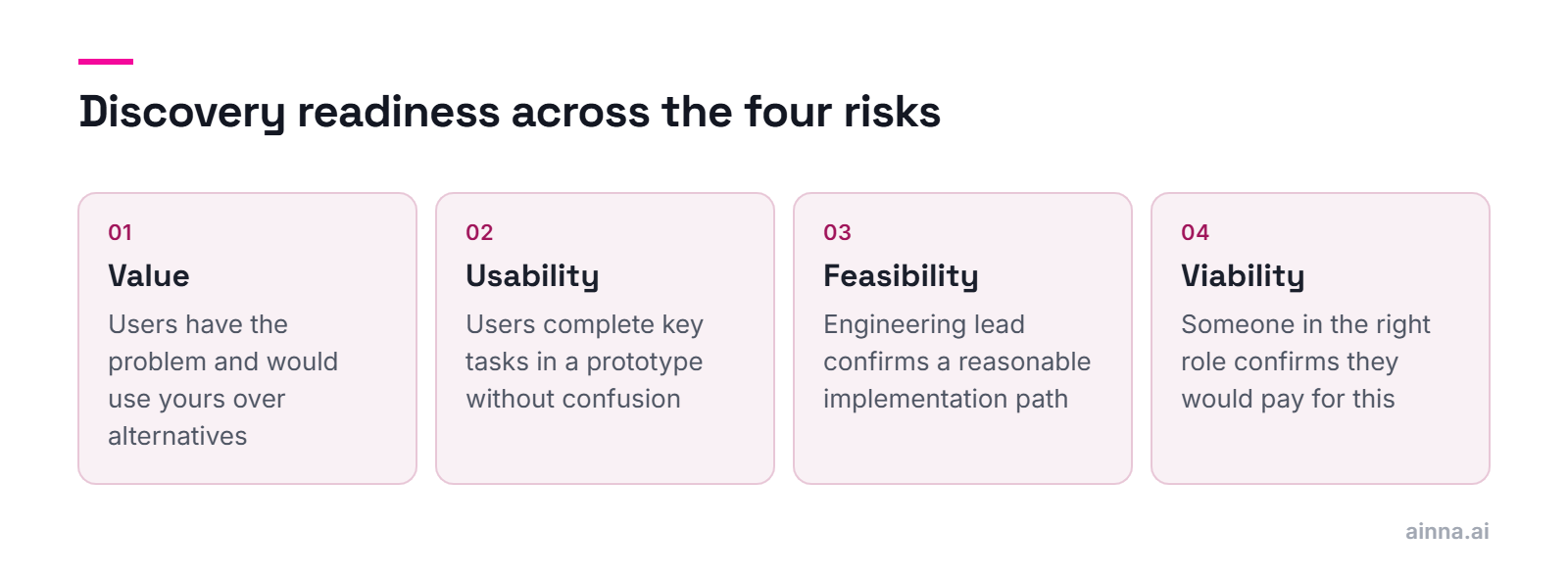
Discovery is never fully done - but there is a point at which you have validated enough to proceed to delivery without unacceptable risk. That point is when your four risk categories are adequately addressed: you have evidence the product is valuable, usable, feasible, and viable. Not perfect evidence - adequate evidence for the investment size.

  • Value: You have spoken to enough real users to be confident that a meaningful segment has the problem, wants a solution, and would use yours over alternatives.
  • Usability: You have tested a prototype with real users and they can accomplish key tasks without significant friction or confusion.
  • Feasibility: Your engineering lead has reviewed the concept and confirmed that a reasonable implementation path exists within your resource constraints.
  • Viability: Your business model assumption has been validated at least at concept level - someone in the right role in your target organization has confirmed they would pay for this.
  • Red flags that more discovery is needed: the team is still debating the core user persona; the open questions list in your product concept document has critical, unanswered items; no engineer has reviewed the technical approach.
  • The practical test: if you handed the product concept and PRD to an empowered engineering team today and told them to start building, would they be able to proceed confidently? If not, that is where your discovery is incomplete.
Key Takeaway

Discovery readiness is not about certainty - it is about confidence commensurate with investment. You need more validation before committing a 10-person engineering team for six months than before committing one engineer for two weeks. Scale your discovery investment to the size of the delivery bet you are about to make.

How is AI changing the product discovery process?

AI is transforming product discovery in two ways: it dramatically accelerates the documentation and synthesis work that surrounds discovery, and it introduces a new category of product opportunities as AI capabilities become enabling technologies for products that were previously impossible. Both dimensions require product teams to develop new skills.

  • AI accelerates discovery synthesis: interview transcripts summarized in minutes, thematic patterns identified across dozens of user sessions, assumption maps generated from research notes, and competitor landscapes synthesized from public sources.
  • AI enables rapid prototype generation: what once required a designer and days of work can now be produced in hours, dramatically compressing the prototype-test-learn cycle.
  • AI creates new discovery categories: as LLMs, vision models, and agents become enabling technologies, product discovery must now include 'AI opportunity discovery' - identifying where AI capabilities can solve problems previously unsolvable.
  • What AI does not change: the need to talk to real users, the importance of understanding genuine problems before proposing solutions, the judgment required to prioritize which assumptions matter most.
  • In The Innovation Mode framework, AI accelerates every stage of the documentation stack - from generating structured problem statements to producing complete product concepts from discovery notes.
  • Tools like Ainna can take structured discovery outputs (problem statements, validated product concepts) and generate complete PRDs and pitch decks in 60 seconds - collapsing the documentation phase that previously consumed days of PM time
Key Takeaway

AI makes discovery faster and documentation cheaper. It does not make user understanding less important - it makes the quality of that understanding more differentiating, because every team now has access to the same AI tools. The competitive advantage is in the insight, not the instrument.

What AI tools are most useful for product discovery teams?

The most impactful AI tools for discovery are those that reduce the time between user research and actionable insight - not those that generate ideas in the absence of user understanding. The goal is to accelerate the learning cycle, not to replace the learning itself.

  • Interview synthesis: AI transcription and thematic analysis tools (Dovetail, Otter.ai, Grain) reduce interview synthesis from hours to minutes, making it practical to analyze all interviews rather than a sample.
  • Rapid prototyping: AI design tools (v0, Galileo, Framer AI) generate functional UI prototypes from text prompts, compressing the time from insight to testable prototype.
  • Market and competitor research: AI research assistants can synthesize competitive landscapes, regulatory environments, and market sizing data faster than manual research - useful as a starting point for the Problem Framing Template.
  • Documentation generation: Tools like Ainna transform structured discovery outputs (problem statements, product concepts) into complete PRDs, pitch decks, and one-pagers - eliminating the documentation overhead that often delays the transition from discovery to delivery.
  • Assumption testing: AI can run lightweight user surveys, analyze responses, and identify statistical patterns at a fraction of traditional research costs - useful for quantifying what qualitative discovery has identified.
  • Innovation Toolkit integration: The structured templates in The Innovation Toolkit are designed to produce the structured inputs that AI documentation tools need to generate high-quality outputs
Key Takeaway

The best AI tool for discovery is the one that reduces the time between a user insight and a product decision. Build your AI toolchain around that goal - not around automation for its own sake.

How do I turn discovery insights into a PRD or pitch deck quickly?

The fastest path from discovery insight to actionable documentation is a structured input process: capture your discovery in the standard templates (problem statement, product concept), then use AI generation to produce the PRD and pitch deck in minutes. The structure of the discovery output is what makes the documentation output high-quality.

  • Step 1: Complete the Problem Framing Template immediately after your discovery phase - while insights are fresh. This takes 30-60 minutes and produces the foundational document for everything that follows.
  • Step 2: Apply the Universal Idea Model to articulate your validated solution concept in one clear sentence. If you cannot do this, more discovery is needed.
  • Step 3: Complete the Product Concept Template across its six sections. The open questions section is especially important - document what you still do not know.
  • Step 4: Use these structured inputs with Ainna to generate a complete PRD, pitch deck, and one-pager in 60 seconds - rather than spending days writing from scratch.
  • Step 5: Conduct a cross-functional review of the generated documentation with engineering, design, and a key stakeholder before treating it as final.
  • The entire process from discovery completion to reviewable documentation package can take less than a half-day when the discovery has been properly structured from the start
Key Takeaway

Discovery insights have a short half-life. The longer you wait to document them, the more context evaporates. A structured discovery-to-documentation process - supported by the right templates and AI tools - captures that context while it is still vivid and actionable.

What do I do when I cannot access users for discovery research?

Access to users is almost never as blocked as it feels. The real constraint is usually permission, habit, or creative recruiting - not actual unavailability. Before concluding that users are inaccessible, exhaust the alternatives. If you genuinely cannot access target users, proxy research is better than no research - but always with explicit acknowledgment of its limitations.

  • Internal proxies: Customer success managers, sales reps, and support teams talk to users daily. Interview them systematically before concluding that direct user access is impossible.
  • Guerrilla research: Coffee shops, LinkedIn outreach, community forums, and product review sites (G2, Capterra, App Store reviews) are all accessible sources of unfiltered user sentiment.
  • Competitor user research: Users of competing products have the same problem you are solving. They are often willing to discuss their frustrations with what they use today.
  • Social listening and forum mining: Reddit, Quora, Stack Overflow, and industry Slack groups contain unfiltered user problem articulation - not ideal, but better than nothing.
  • Remote research platforms: UserTesting, Respondent, and User Interviews can recruit specific user profiles within 24-48 hours for modest costs.
  • Document all proxy research limitations explicitly in your product concept's open questions section - so downstream decision-makers understand the evidence base
Key Takeaway

No access to users is a constraint, not a wall. The PM who says 'I cannot do discovery because I cannot access users' is usually the PM who has not yet exhausted the alternatives. Resourcefulness is a core discovery skill.

How do I run discovery in a large enterprise where everything moves slowly?

Discovery in enterprise environments faces real structural obstacles: long approval cycles, risk-averse cultures, siloed access to customers, and management that rewards shipping over learning. The solution is not to fight the organization head-on - it is to run discovery in ways that are small enough to need no approval, fast enough to produce results before anyone notices, and credible enough to earn permission for more.

  • Start with internal discovery: enterprise products often have internal users - employees who use the tools you are building. They are accessible immediately and their problems are equally valid.
  • Frame discovery as risk reduction, not research: management resistant to 'user research' often responds well to 'we need to validate this before we commit the engineering team for six months.'
  • Use existing customer touchpoints: QBRs, support tickets, renewal conversations, and advisory board meetings are discovery opportunities hiding in plain sight.
  • Run lean experiments under existing budget authority: a $5,000 usability study that prevents a $500,000 misdirection does not need executive approval if it fits within team discretionary budget.
  • Build a customer council: a small group of 6-10 engaged customers who agree to regular feedback conversations gives continuous discovery institutional legitimacy.
  • Corporate hackathons and innovation sprints - described in The Corporate Hackathon Guide - are powerful mechanisms for accelerating discovery within enterprise constraints
Key Takeaway

Enterprise discovery is a political problem as much as a methodological one. The PM who frames discovery as organizational protection - not as a personal preference for research - will find more doors open than closed.

How do I know if my discovery process is actually working?

The ultimate quality test of discovery is whether the products that emerge from it are loved by users and succeed in the market. But waiting for launch to evaluate discovery quality is far too late. These five leading indicators tell you whether your discovery process is healthy before products ship.

  • Signal 1 - Decision quality: Are product decisions made in your team based on user evidence, or on opinions and HiPPO (highest paid person's opinion) dynamics? Good discovery shifts this ratio measurably.
  • Signal 2 - Assumption clarity: Can every member of your product team name the three most critical assumptions behind your current roadmap? If not, discovery has not created shared understanding.
  • Signal 3 - Surprise rate: Are you regularly surprised by what users tell you? If every user interview confirms what you already believed, you are probably conducting confirmation research, not discovery.
  • Signal 4 - Documentation completeness: After each discovery cycle, can you complete a clean problem statement and product concept with confidence? Gaps in these documents are gaps in your discovery.
  • Signal 5 - Engineering confidence: When engineering teams receive discovery outputs, do they have enough context to start work without extensive clarification sessions? If not, discovery has not reached the right level of specificity.
  • Measure the cost of late changes: track how many significant scope changes happen after engineering starts. Discovery success is often most visible through what does not happen - the pivots, reworks, and abandoned features that never occur
Key Takeaway

Discovery quality is measured by the quality of decisions it enables - not by the volume of research conducted. A team that talks to five users per week and acts decisively on what they learn will always outperform a team that conducts exhaustive research and debates the findings for months.

Meet Ainna

Ready to Document Your Discovery?

Stop losing insights in scattered notes. Ainna applies The Innovation Mode methodology to transform your discovery work into complete PRDs, pitch decks, and strategic documentation - in 60 seconds.

Ideas in.
Opportunities out.