What is a product one-pager?

A product one-pager is a single-page document that captures the essence of a product idea - the problem it solves, who it's for, what it does, and why it matters - in a format anyone can read in under two minutes. It is not a shrunken PRD. It is not an executive summary. It is a thinking tool disguised as a communication tool: if you cannot fit your idea on one page with clarity, you do not yet understand your own idea well enough.

  • A one-pager forces the discipline of compression - you must decide what is essential and cut everything that is not, which is itself the most valuable product thinking exercise available
  • It serves multiple audiences: investors (as a cold-email attachment), stakeholders (as a decision prompt), engineering teams (as an alignment check), and hackathon judges (as a submission summary)
  • The one-pager is the front door to every other document: it leads to a pitch deck for investors, a PRD for engineering, and a product concept for deeper strategy work
  • In The Innovation Mode methodology, the one-pager maps directly to the Business Idea Template - a proven four-section structure used by hundreds of innovation teams
  • A great one-pager can be written in 30 minutes if the thinking behind it is clear. A bad one-pager takes days because the thinking is not yet done.
  • For junior PMs, the one-pager is the best training ground for product communication: every skill it develops - compression, prioritization, audience awareness - scales directly to PRDs, pitch decks, and stakeholder management
Key Takeaway

The one-pager is the highest-leverage document in product management. It costs almost nothing to write, it forces real clarity of thought, and it opens every door that matters - investor meetings, engineering kickoffs, and stakeholder buy-in. Learn to write one well and you will use the skill for your entire career.
How is a one-pager different from a PRD or a pitch deck?

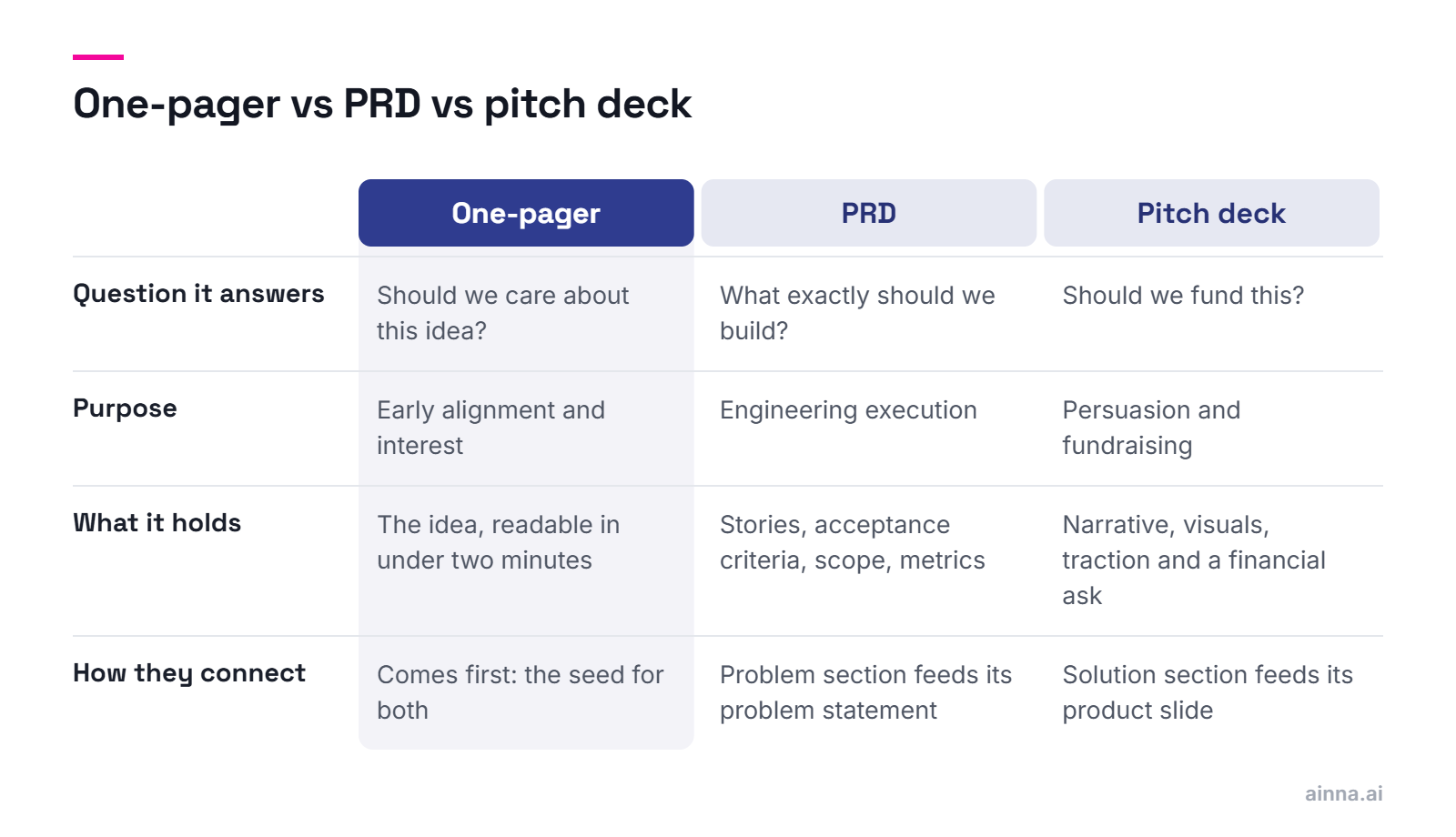
Each document serves a different purpose at a different moment. The one-pager answers 'Should we care about this idea?' The PRD answers 'What exactly should we build?' The pitch deck answers 'Should we fund this?' Confusing these three is one of the most common documentation mistakes junior PMs make - and the result is a document that tries to do everything and achieves nothing.

  • A one-pager is for early alignment and interest generation - it compresses a product idea into a format that any audience can absorb in under two minutes
  • A PRD is for engineering execution - it breaks the product down into user stories, acceptance criteria, scope boundaries, and success metrics. It assumes the 'should we build this?' question has been answered.
  • A pitch deck is for persuasion and fundraising - it tells a narrative story with visuals, traction evidence, and a specific financial ask
  • The one-pager comes first: it tests whether the idea is worth the investment of writing a PRD or building a deck
  • In practice, the one-pager becomes the seed that grows into both: the problem section feeds the PRD's problem statement, the solution section feeds the pitch deck's product slide
  • For hackathon teams, the one-pager often IS the deliverable - a structured single page that judges can assess without a 20-minute presentation
Key Takeaway

Think of the one-pager as the test before the investment. If the one-pager doesn't create interest, no amount of PRD detail or pitch deck polish will fix the underlying idea. Get the one-pager right first.

When should I write a one-pager - and when is it not enough?

Write a one-pager the moment you have an idea worth sharing - even if the idea is rough. It is the cheapest way to test whether your thinking holds up. A one-pager is not enough when you are ready to commit engineering resources (write a PRD), raise funding (build a pitch deck), or validate assumptions with experiments (design a business experiment).

  • Write a one-pager when: you want to pitch an idea internally, propose a new feature to leadership, submit a hackathon concept, introduce your startup to a potential investor or partner, or align a cross-functional team around a new initiative
  • A one-pager is sufficient when the goal is interest and alignment - getting people to agree that this idea is worth exploring further
  • A one-pager is not sufficient when the next step requires engineering specifics (use a PRD), investor persuasion with data (use a pitch deck), or structured validation (use a business experiment from The Innovation Toolkit)
  • The best time to write a one-pager is immediately after a discovery session or brainstorming workshop - while insights are fresh and the team's energy is high
  • In the AI era, the cost of writing a one-pager has dropped to near zero - so the bar for 'worth documenting' should be lower than ever. Document more ideas, not fewer.
  • Junior PMs should make one-pager writing a habit: every feature idea, every user insight, every competitive observation can be captured as a one-pager draft in 15 minutes
Key Takeaway

When in doubt, write the one-pager. It costs 30 minutes and forces you to think through the idea clearly. If the idea survives the one-pager process, it is worth investing in the next level of documentation. If it doesn't, you saved yourself weeks of misdirected effort.

What are the essential sections of a product one-pager?

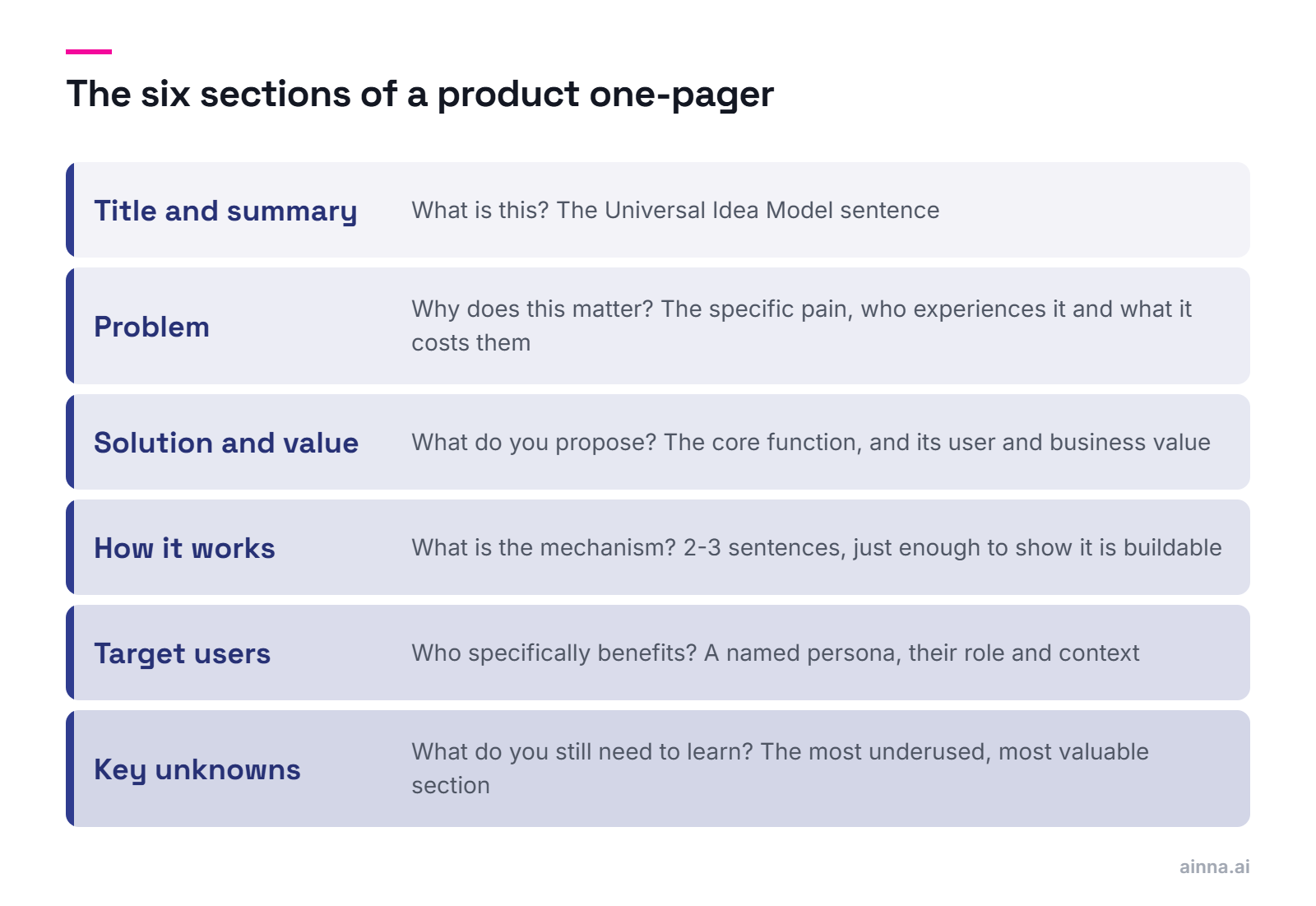
A great one-pager has six sections, and each earns its place by answering a specific question that any reader - investor, stakeholder, or engineer - will ask within the first 60 seconds. These map directly to the four sections of The Innovation Mode Business Idea Template, with two additions for audience clarity.

  • 1. Title and one-sentence summary: What is this? Use the Universal Idea Model sentence: 'An [object] for [users] that [does something] in order to [achieve a goal]. Users benefit by [getting something back] when [they are in a specific situation].' This single sentence does more work than any other element on the page.
  • 2. Problem: Why does this matter? Describe the specific pain, who experiences it, and what it costs them. Quantify where possible. This section draws from your problem framing work.
  • 3. Solution and value: What do you propose and what value does it create? Describe the product's core function and how it changes the user's situation. Cover both user value and business value.
  • 4. How it works: What is the mechanism? 2-3 sentences on the logic, the technology approach, or the key user flow. Just enough for the reader to believe it is buildable - not a technical spec.
  • 5. Target users: Who specifically benefits? Name the persona, their role, and their context. 'Mid-market SaaS product managers who spend 15+ hours per month on documentation' is useful. 'Professionals' is not.
  • 6. Key unknowns: What do you still need to learn? This is the most underused and most valuable section. Listing what you do not know signals intellectual honesty and maps directly to your next discovery or validation step.
Key Takeaway

Six sections, one page. If any section takes more than 2-3 sentences, you are over-explaining. The one-pager is not the place to be thorough - it is the place to be clear.

How do I write the one-sentence summary using the Universal Idea Model?

The Universal Idea Model is a structured sentence template that forces six critical decisions into a single statement. It is the most important sentence on your one-pager - and possibly the most important sentence in your entire product documentation stack. If this sentence is clear, everything else follows. If it is vague, nothing else will save the document.

  • The template: 'An [object] for [class of users] that [does something] in order to [achieve a goal]. Users benefit by [getting something back] when [they are in a specific situation].'
  • Example - AI meeting assistant: 'An intelligent component for business users that captures meeting context and recommends the most suitable participants in order to organize better meetings. Users benefit by instantly finding the right experts when they are setting up a business event.'
  • Example - Ainna: 'An AI platform for product managers and innovators that generates complete product documentation packages in order to accelerate product discovery. Users benefit by eliminating documentation overhead when they need to move quickly from idea to aligned team.'
  • Each element maps to a reader question: [object] = what is it? [users] = who is it for? [does something] = what does it do? [goal] = why does it matter? [value] = what do users get? [situation] = when do they need it?
  • If you cannot complete this sentence cleanly, you have found your discovery gap - the part of your idea you have not yet thought through clearly enough
  • This sentence becomes: your one-pager title, your pitch deck cover slide, your elevator pitch, and your PRD opening statement. Write it once, use it everywhere.
Key Takeaway

Spend 15 minutes getting this sentence right and you will save hours on every document that follows. The Universal Idea Model is the fastest clarity test in product management. Learn more and see real examples at The Innovation Mode.

How do I write a problem section that makes people care?

The problem section is where you earn the reader's attention. If they do not feel the pain by the end of this section, they will not care about your solution no matter how clever it is. The key is specificity: real numbers, real scenarios, real consequences. Vague problems produce vague interest.

  • Start with a specific, relatable scenario - not an abstract category. 'Product managers spend 15 hours per month writing PRDs that are outdated within two sprints' beats 'Documentation is a challenge for teams.'
  • Quantify the cost: time wasted, money lost, opportunities missed, users frustrated. One concrete number is worth ten adjectives.
  • Show that this problem is current and growing - mention what tailwinds (AI adoption, remote work, regulatory changes) are making it worse or more urgent
  • Reference your problem framing work if you have done it - the one-pager's problem section is a compressed version of the Problem Statement Template's four dimensions (environment, dynamics, current state, ideal state)
  • A common mistake: describing the absence of your solution as the problem. 'There is no AI documentation tool' is not a problem - it is a feature gap. The problem is what users suffer because of that gap.
  • If you have conducted user discovery, include one direct insight: 'In 12 user interviews, every PM reported spending more time formatting documents than thinking about product strategy.'
Key Takeaway

The problem section has exactly one job: make the reader think 'Yes, that is a real problem worth solving.' If it achieves that, they will read the rest of the page with genuine interest. If it doesn't, nothing else matters.

What should I deliberately leave out of a one-pager?

A one-pager's power comes from what you remove, not what you add. Junior PMs almost always make one-pagers too long by including material that belongs in a PRD, pitch deck, or appendix. The discipline of cutting is the discipline of thinking - every sentence that survives must earn its place.

  • Leave out: detailed feature lists. Why: listing 10 features tells the reader you have not decided what matters most. Include 2-3 core capabilities that differentiate your product. Save the full feature set for the PRD.
  • Leave out: technical architecture. Why: the one-pager audience cares about what the product does, not how it is built. Technical details belong in the engineering spec or PRD appendix.
  • Leave out: detailed financial projections. Why: a one-pager establishes interest, not investment terms. If you need financials, point to your pitch deck or financial model.
  • Leave out: lengthy competitive analysis. Why: one sentence establishing differentiation is enough for a one-pager. The full competitive landscape belongs in the pitch deck.
  • Leave out: implementation timelines and roadmaps. Why: these signal you are already in execution mode, but a one-pager's job is to establish whether the idea is worth executing at all.
  • Leave out: jargon and buzzwords. Why: if a smart non-expert cannot understand your one-pager, you have written it for yourself, not for your audience. The Innovation Dictionary can help you choose precise language over trendy language.
Key Takeaway

Every element you remove from a one-pager makes the remaining elements more powerful. The hardest skill in product communication is not adding - it is subtracting. The best one-pagers feel effortless because the author did the hard work of deciding what not to say.

What are the most common one-pager mistakes junior PMs make?

After 25+ years reviewing product documentation across Microsoft, Accenture, and four startups, the same one-pager mistakes recur with remarkable consistency. Most are not about writing quality - they are about thinking clarity. Fix the thinking, and the one-pager practically writes itself.

  • Mistake 1: Starting with the solution. You describe a feature-rich product before establishing why anyone should care. Fix: lead with the problem. If the reader does not feel the pain, they will not value the cure.
  • Mistake 2: Writing two pages and calling it a one-pager. If it scrolls, it is not a one-pager. Fix: cut ruthlessly. Every sentence must pass the test: 'Does removing this make the document worse?'
  • Mistake 3: Generic personas. 'Our target user is a busy professional' describes everyone and helps no one. Fix: name a specific role, context, and frustration. See how the Business Idea Template structures user descriptions.
  • Mistake 4: No unknowns section. Presenting an idea as though everything is figured out signals inexperience, not confidence. Fix: list 2-3 open questions that need to be answered through discovery or experimentation.
  • Mistake 5: Missing the Universal Idea Model sentence. Without a clear one-sentence summary, the reader must construct your idea's meaning from scattered paragraphs. Fix: complete the Universal Idea Model before writing anything else.
  • Mistake 6: Writing for yourself instead of your audience. A one-pager for an investor needs different emphasis than one for an engineering lead. Fix: before writing, ask 'What does this specific reader need to decide, and what information do they need to decide it?'
Key Takeaway

Every mistake on this list traces to the same root cause: not enough time spent thinking before writing. The one-pager is a thinking exercise first and a communication exercise second. If the thinking is sharp, the writing is easy.

How do I write a one-pager that gets investors to take a meeting?

An investor one-pager has a single job: make the investor curious enough to say 'Tell me more.' It is not a compressed pitch deck. It is a cold-email attachment that earns 90 seconds of attention and converts that into a 30-minute meeting. Every word must serve that conversion.

  • Lead with the problem and the market size - investors screen first for 'Is this opportunity big enough?' before evaluating the solution
  • Include one traction proof point - even a small one. '200 waitlist signups in 2 weeks' or '12 user interviews confirming the pain' shows momentum.
  • State the ask clearly: 'Raising $X Seed Round' tells the investor immediately whether this fits their thesis and check size
  • Include your Universal Idea Model sentence as the opening line - it tells the investor exactly what you do in one read
  • End with a clear call to action: 'Available for a 30-minute conversation this week' is better than a passive 'We'd love to connect sometime'
  • The one-pager attached to a warm intro email is the most effective fundraising outreach format - see the pitch deck guide for what comes next when the meeting happens
Key Takeaway

An investor receives 50+ cold emails per week. Your one-pager has 90 seconds to earn a meeting or be archived. That is the design constraint. Write for it.

How do I write a one-pager to get internal stakeholder buy-in?

Internal stakeholder one-pagers need to answer one question that investor one-pagers do not: 'Why should our company invest in this instead of the ten other things competing for resources?' The key addition is strategic alignment - connecting your idea to business objectives that the stakeholder already cares about.

  • Connect the problem directly to a business metric your stakeholder owns: 'Support ticket volume has increased 40% year-over-year, costing $2.3M annually' resonates with a VP of Customer Success
  • Show how this aligns with existing company strategy or OKRs - an idea that supports stated priorities faces less resistance than one that creates new priorities
  • Include the 'not building this' cost: what happens if the company does nothing? Framing inaction as a risk is more persuasive than framing action as an opportunity
  • Name the resources required honestly: 'Two engineers for six weeks' is information a stakeholder needs. Hiding the cost creates surprise and erodes trust.
  • Reference discovery evidence if you have it: 'Based on 8 customer interviews and support ticket analysis' is more compelling than 'We believe...'
  • For product leaders reviewing one-pagers from their teams: the quality of the one-pager is a signal of the PM's product thinking maturity. Use it as a coaching tool.
Key Takeaway

The internal one-pager is a proposal, not a report. It should create a decision moment: 'Should we explore this further?' Make it easy for the stakeholder to say yes by doing the strategic alignment work for them.

How do I write a one-pager for a hackathon or innovation challenge?

In a hackathon, the one-pager is often both the planning document and the final deliverable. Judges see dozens of submissions - your one-pager must communicate the idea, its value, and its feasibility in under 90 seconds of reading time. The Business Idea Template from The Innovation Mode was designed precisely for this context.

  • Open with the Universal Idea Model sentence - hackathon judges see many submissions and need to grasp your idea in one read
  • Emphasize feasibility and demo-ability: judges value ideas that can be prototyped or demonstrated within the event window
  • Show the innovation dimension: what makes this idea novel or surprising? Hackathon judges score for creativity and originality, not just business viability
  • Include a 'Big Unknowns' section - it shows maturity and gives judges confidence that you understand what you do not yet know
  • If the hackathon has a specific theme, connect your idea to it explicitly in the first two sentences. See the hackathon winning guide for pitch strategy
  • Use the Business Idea Template's four-section structure (Problem, Users & Value, Logic & Execution, Big Unknowns) as your hackathon one-pager scaffold - it maps perfectly to what judges evaluate
Key Takeaway

The best hackathon one-pagers do double duty: they help the team align on what they are building, and they give judges everything they need to score the submission. Use the Business Idea Template format and you achieve both in a single page.

How do I know if my one-pager is actually good?

A good one-pager passes three tests that require no expertise to administer. Use them before sharing any one-pager externally - they will catch the problems that matter most.

  • Test 1 - The stranger test: Show the one-pager to someone who knows nothing about your idea. After reading it once, can they explain what the product does, who it is for, and why it matters - without any help from you? If not, the document is not clear enough.
  • Test 2 - The compression test: Print it. Does it fit on one page with readable font size? If it overflows, you have not made the hard cuts yet. Every overflow line is a decision you have postponed.
  • Test 3 - The 'so what?' test: Read your problem section aloud. Does a reasonable person respond with 'yes, that is a real problem worth solving' - or with 'so what?' If the latter, your problem is not specific or painful enough.
  • Bonus test for junior PMs: show it to your manager or a senior PM and ask 'What question does this leave unanswered?' Their answer tells you what to add - and often what to remove.
  • The Universal Idea Model sentence is itself a quality gate: if you cannot complete it cleanly, the idea is not yet well-defined enough for a one-pager
  • Quality is not about polish - it is about clarity. A rough one-pager with a sharp idea beats a beautifully formatted one-pager with a confused idea every time.
Key Takeaway

Run all three tests before sending. They take five minutes total and prevent the most embarrassing failure mode: sharing a document that creates confusion instead of interest.

How can AI tools help me write better one-pagers faster?

AI has made the blank page problem obsolete for one-pagers. With structured inputs - a problem statement and a Universal Idea Model sentence - tools like Ainna can generate a complete one-pager in 60 seconds. But the quality of the output depends entirely on the quality of your thinking. AI accelerates documentation, not discovery.

  • The ideal AI workflow: complete the Problem Framing Template (30 minutes) -> write the Universal Idea Model sentence (15 minutes) -> feed both into Ainna -> receive a structured one-pager, PRD, and pitch deck in 60 seconds
  • AI excels at: structuring your thoughts into readable sections, suggesting language for the solution and value propositions, and maintaining consistent tone across the document
  • AI still requires your input for: authentic problem understanding, real user insights, genuine traction data, and the strategic judgment about what matters most
  • The danger: accepting AI-generated content without reviewing it against your actual user knowledge. A plausible-sounding one-pager that is factually wrong is worse than no document at all.
  • For junior PMs, AI is an excellent first-draft tool - but the editing process is where the learning happens. Use AI to generate, then challenge every sentence: 'Is this what I actually learned from users?'
  • In hackathon contexts, the AI-assisted workflow is transformative: teams that use structured templates plus AI generation produce polished one-pagers within the first hour of the event, leaving more time for building
Key Takeaway

AI makes one-pager creation fast. Structured discovery inputs make it good. The combination of both is what produces documents that actually create alignment and earn meetings. Start with the thinking, then let AI handle the formatting.

Meet Ainna

Ready to Write Your One-Pager?

Ainna applies The Innovation Mode methodology to generate your one-pager, pitch deck, and PRD simultaneously - from a single structured input. 60 seconds from idea to aligned team.

Ideas in.
Opportunities out.