Can a PRD be more visual - and still carry the full depth? #
Yes. This is what the Visual PRD is - a visual-first product requirements document that provides a 360-degree view of a product concept across all its key aspects. It carries the same depth as a traditional PRD but matches how stakeholders actually read product documentation today: asynchronously, across time zones, in minutes rather than hours. The Visual PRD helps communicate the concept across stakeholders and drive engineering, commercial, and go-to-market discussions. It presents the opportunity, the risks, the path to success, and how to get there.
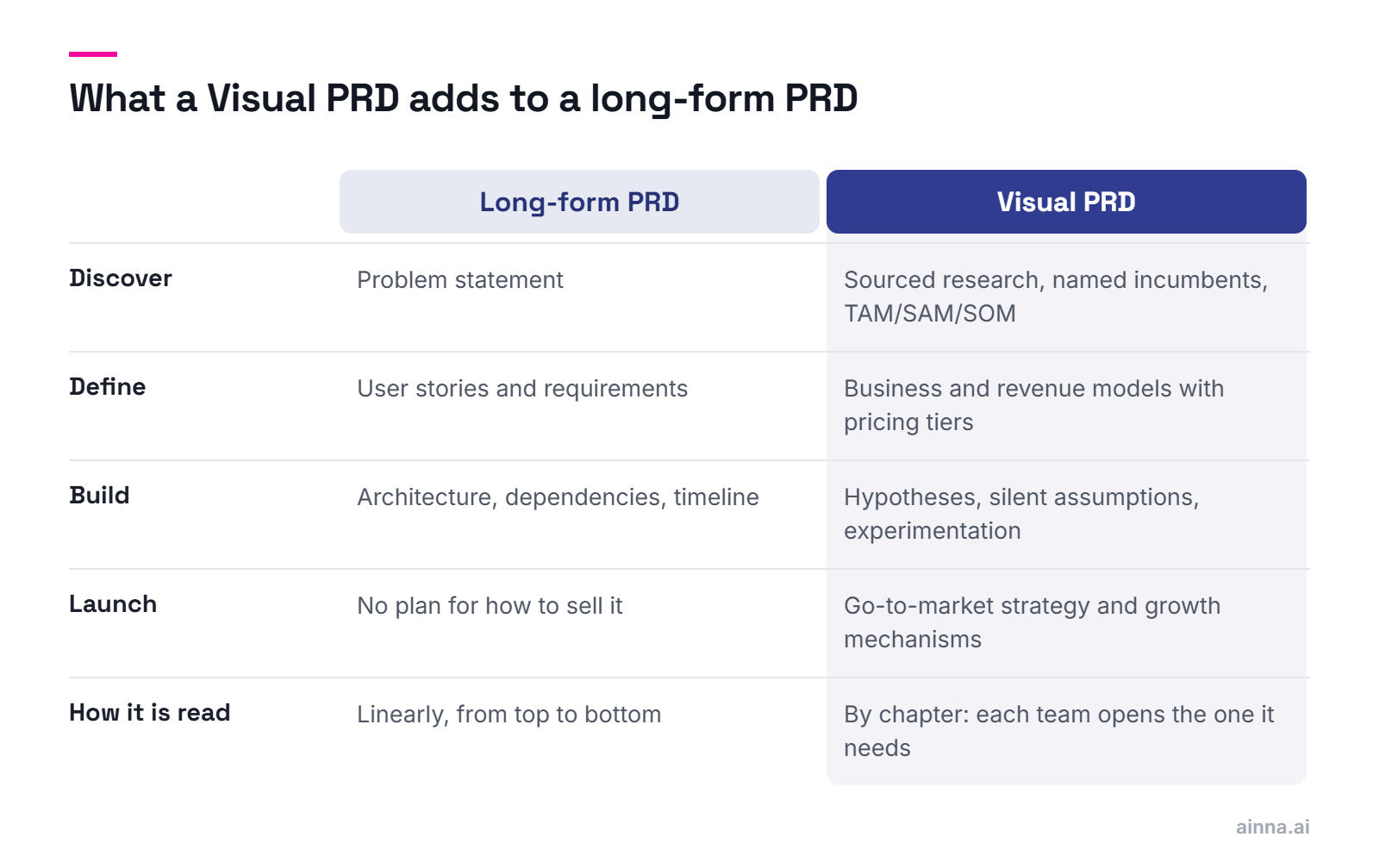
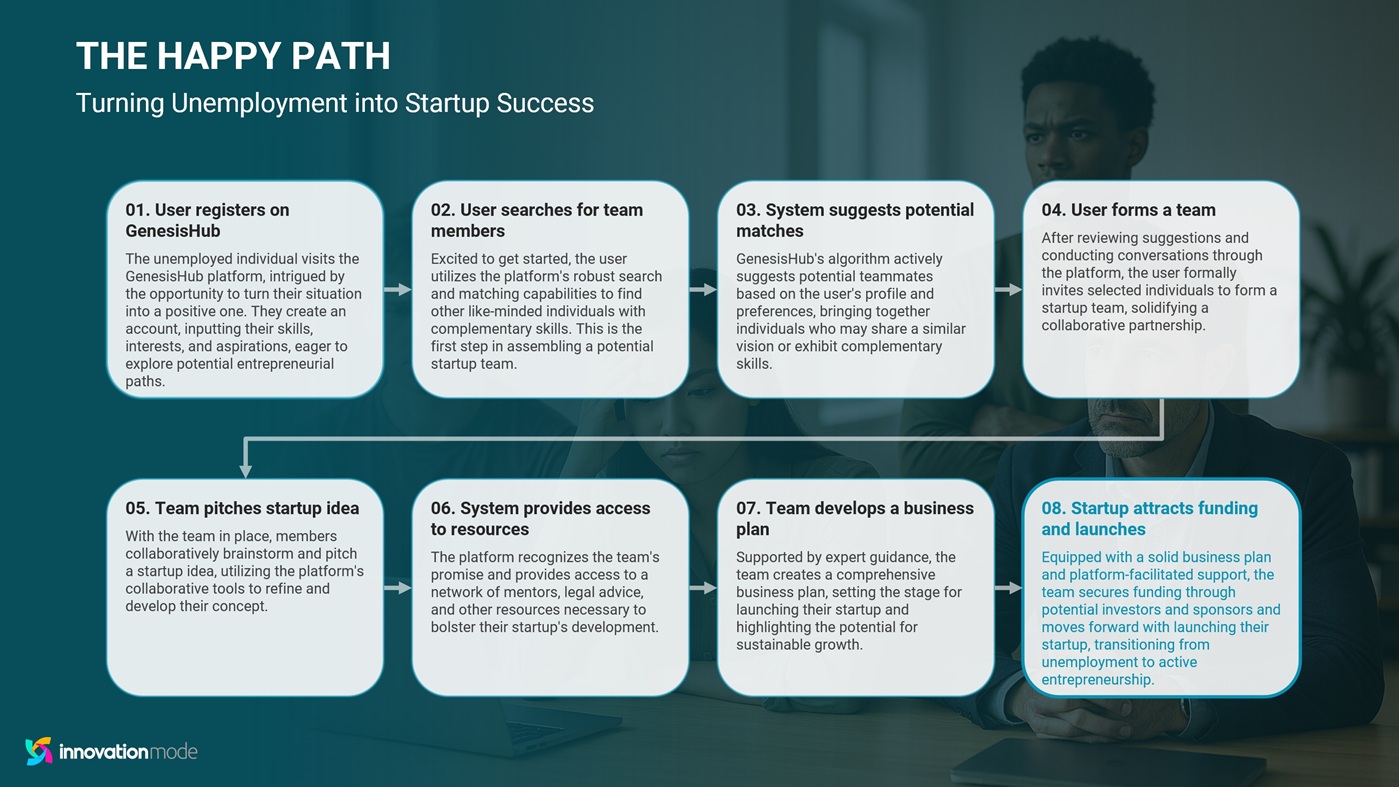
- In the Innovation Mode methodology, we organize the Visual PRD into four chapters: 'Discover', 'Define', 'Build', and 'Launch'. 'Discover' covers the Problem, Users, Market, Market Sizing, Competition, Differentiators, and Opportunity. 'Define' covers the Product Vision, Value Proposition, Happy Path, MVP Features, Business Model, and Revenue Model. 'Build' covers the Value Hypothesis, Growth Hypothesis, Silent Assumptions, Risks, Experimentation Strategy, Technology, MVP Roadmap, and Team. 'Launch' covers the Go-To-Market Strategy and Growth Mechanisms
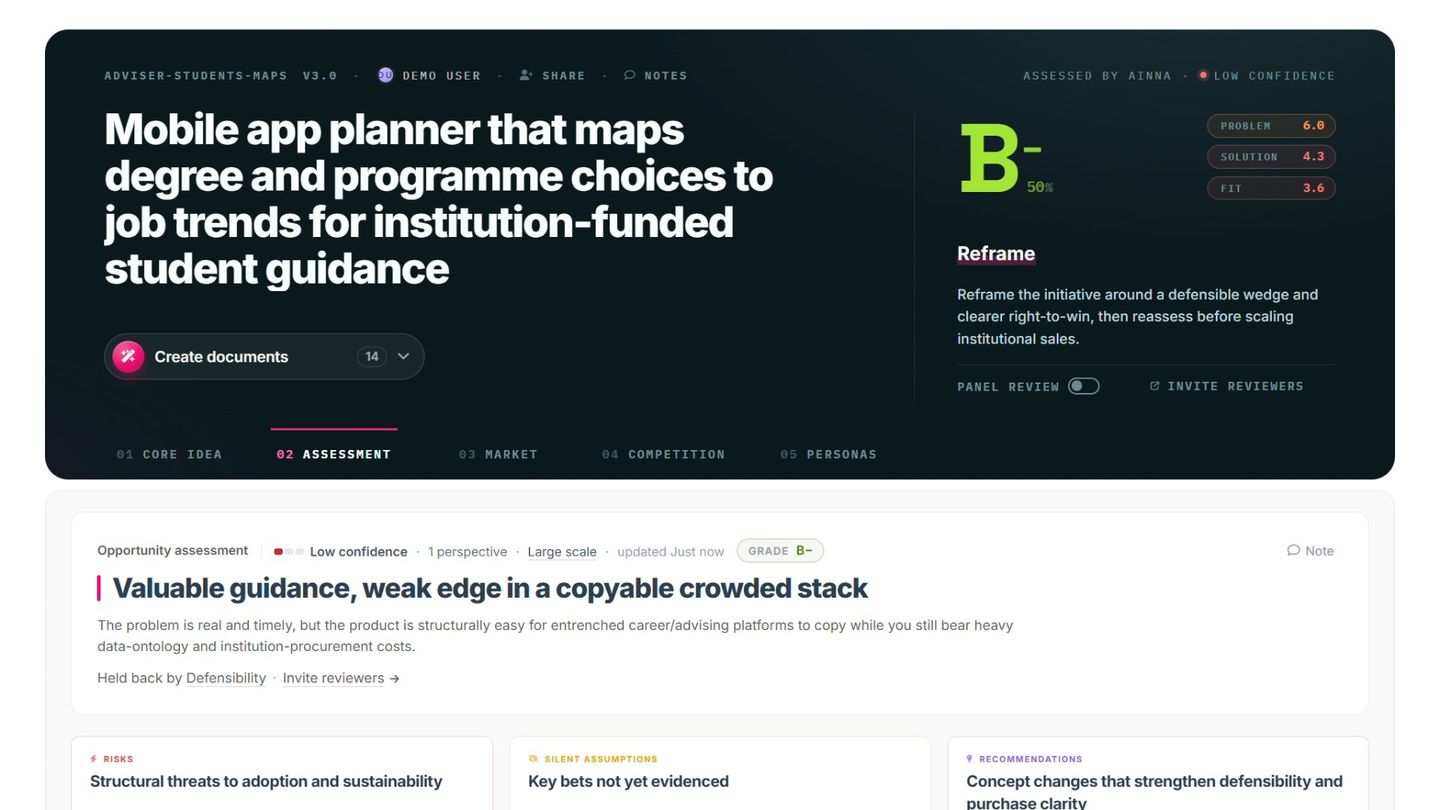
- The depth is in the substance, not the section count. 'Discover' carries sourced research with cited data, competitive intelligence with named incumbents and founding dates, and market sizing backed by explicit methodology. 'Define' specifies pricing tiers with real numbers and a feature inventory scoped enough for an engineering team to estimate. 'Build' includes dedicated sections for risks with mitigation strategies, silent assumptions, and experimentation strategy. These are not optional additions - they are what makes the Visual PRD a product definition rather than a slide deck with ambition
- The format is designed for how stakeholders actually work. Engineers open the Technology section and the MVP roadmap. Commercial teams open the Revenue Model and the Business Model. Executives scan the Opportunity synthesis and the Risks. Legal opens the regulatory content
- AI has made long-form text cheap and abundant, which means length no longer signals thought. The Visual PRD matters now because in a world of text saturation, structure is the last reliable signal that someone actually did the work
- The Visual PRD is a living document, not a presentation. It versions as the product evolves, and updating one chapter does not require rewriting the ones around it
The Visual PRD is a complete product definition - it covers the opportunity, the product, the execution plan, and the go-to-market. Its objective is to give product and engineering leaders, and all stakeholders involved, a single view of the what, why, when, and how.