What is product-market fit?

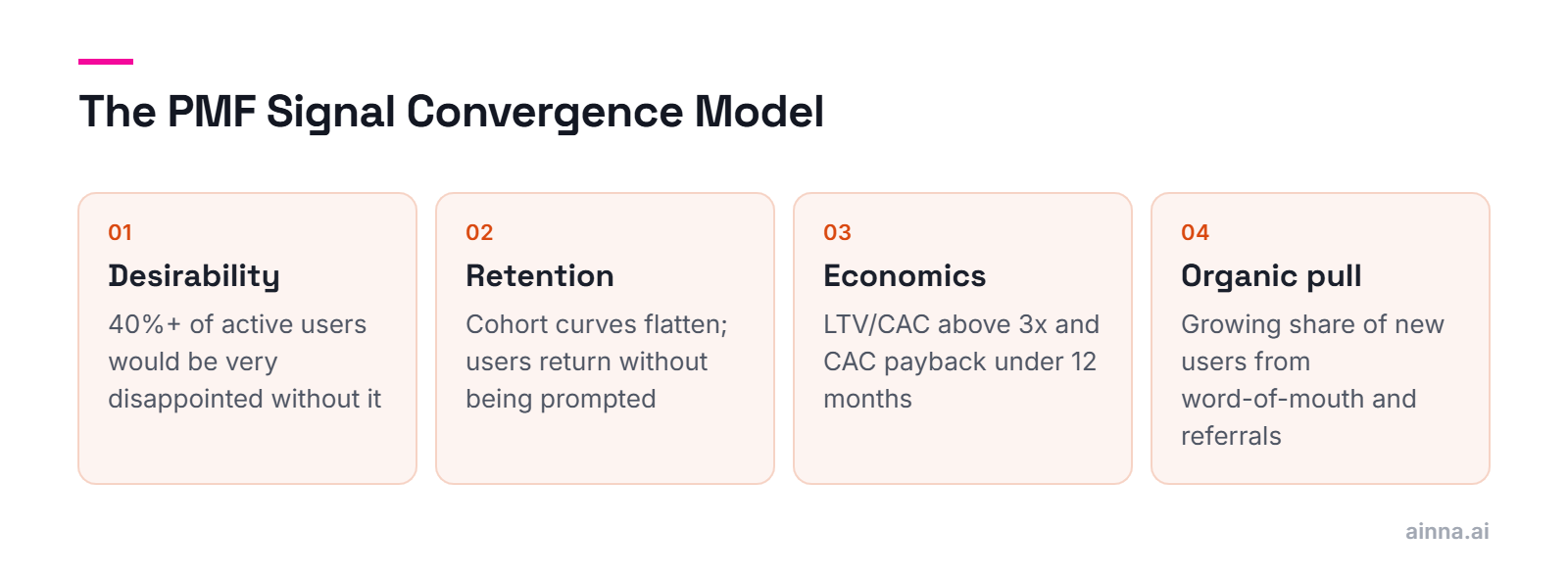
Product-market fit is the point where a product satisfies a strong market demand so effectively that growth shifts from 'push' (expensive marketing) to 'pull' (organic demand). In the Innovation Mode methodology, PMF is defined not as a single metric or moment but as the convergence of four signals - what we call the PMF Signal Convergence Model: desirability (users find the product indispensable), retention (users keep coming back), economics (you can acquire and serve users profitably), and organic pull (new users arrive through word-of-mouth and organic channels).

  • Marc Andreessen defined PMF as 'being in a good market with a product that can satisfy that market' - the foundational concept that has shaped how startups think about viability
  • In the Innovation Mode methodology, PMF sits at the end of a disciplined journey: Opportunity Discovery identifies high-potential concepts, Opportunity Validation tests them with real-world evidence, and Opportunity Realization builds MVPs that are driven toward product-market fit through fast experiment-build-measure cycles
  • PMF is not binary - you don't 'have it' or 'not have it.' It exists on a spectrum from nascent (a few passionate early adopters) to extreme (demand outpaces your ability to serve it)
  • The most common mistake is treating PMF as a destination rather than a dynamic state. Markets shift, competitors respond, user expectations evolve - what fits today may not fit tomorrow
  • Without PMF, scaling is premature: you're spending resources to acquire users for a product that doesn't retain them. According to the Startup Genome Report, 70% of startups scale prematurely
  • With PMF, everything gets easier: sales cycles shorten, retention improves, word-of-mouth accelerates, and unit economics become favorable
Key Takeaway

Product-market fit is the most important milestone for any new product or venture. Everything before PMF is searching; everything after is scaling. The quality of your search - how systematically you discover opportunities, validate assumptions, and iterate on your MVP - determines how quickly and reliably you find fit.

Why is product-market fit a spectrum, not a binary state?

Product-market fit is a spectrum, not a switch. In the Innovation Mode framework, PMF progresses through four stages - Nascent, Developing, Strong, and Extreme - each requiring different actions and investment levels. Treating PMF as binary ('we have it' or 'we don't') leads teams to either declare victory too early or give up too soon.

  • Nascent PMF: You have a handful of users who love the product passionately, but they may be outliers. The product solves their specific problem brilliantly, but it's unclear if that problem is widespread enough to sustain a business. Action: understand why these users love it and whether that pattern can be replicated
  • Developing PMF: You have a clear target persona and some organic growth, but the sales process still feels hard. Retention is inconsistent across cohorts. You're learning what works but haven't locked it in. Action: double down on what your best users love, and run business experiments to address the gaps
  • Strong PMF: Growth is predictable. Your LTV/CAC ratio is healthy (3x or higher). The Sean Ellis 40% Test passes. Retention curves flatten rather than decline to zero. Action: begin scaling - but monitor cohort quality carefully
  • Extreme PMF: Demand outpaces your ability to serve it. Users are pulling the product into new use cases you didn't anticipate. Your biggest challenge is operational capacity, not demand generation. Action: scale aggressively while protecting quality
  • Most startups that fail do so in the 'Developing' stage because they attempt to scale before reaching 'Strong.' In Innovation Mode 2.0, this is addressed through the Venture Studio approach: a specialized team that drives MVPs through fast improvement cycles and makes data-driven decisions about whether to continue, pivot, or sunset
  • The spectrum framing also protects against false confidence: passing one metric (e.g., high NPS) doesn't mean you have PMF if other signals (retention, economics) are weak
Key Takeaway

Understanding where you sit on the PMF spectrum prevents the two most expensive mistakes in startup building: scaling before you're ready (burning resources on a leaky product) and giving up too early (abandoning a product that was one iteration away from fit).

What are the signals that indicate product-market fit?

You won't wake up one morning and suddenly 'have' product-market fit. PMF reveals itself through signals - and the trap is over-indexing on one encouraging metric while ignoring warning signs elsewhere. The PMF Signal Convergence Model, developed as part of the Innovation Mode methodology, defines PMF as the intersection of four signal categories rather than any single metric: Desirability (users would be very disappointed without your product), Retention (users keep coming back), Economics (you can acquire and serve users profitably), and Organic Pull (growth shifts from push to pull).

  • Desirability signals: 40%+ of active users say they would be 'very disappointed' without your product (Sean Ellis Test). Users describe the product as 'essential' or 'irreplaceable' in qualitative feedback. Feature requests focus on expansion ('I wish it also did X') rather than fixes ('it doesn't work')
  • Retention signals: cohort retention curves flatten rather than declining to zero. D30 retention exceeds 40% for high-frequency products. Users return without being prompted by emails or push notifications. Session frequency and depth increase over time
  • Economic signals: LTV/CAC ratio exceeds 3x. CAC payback period is under 12 months. Gross margins are healthy enough to sustain growth investment. Pricing conversations shift from resistance to acceptance
  • Organic pull signals: a growing share of new users come through word-of-mouth, referrals, or organic search rather than paid acquisition. Viral coefficient (K-factor) approaches or exceeds 1.0. Inbound interest from potential customers, partners, or press increases without outbound effort
  • Leading indicators to watch before PMF is fully established: increasing engagement per session, declining support ticket volume per user, improving onboarding completion rates, growing organic traffic to your product category
  • The convergence matters: high desirability with poor retention means you're exciting users but not delivering sustained value. Strong retention with poor economics means you have a product people love but can't afford to serve. All four signals must align
Key Takeaway

The PMF Signal Convergence Model prevents the common trap of over-indexing on a single encouraging metric while ignoring weak signals elsewhere. Track all four categories, and look for the moment when they begin reinforcing each other - that's when PMF is emerging.

What is the difference between Problem-Market Fit, Solution-Market Fit, and Product-Market Fit?

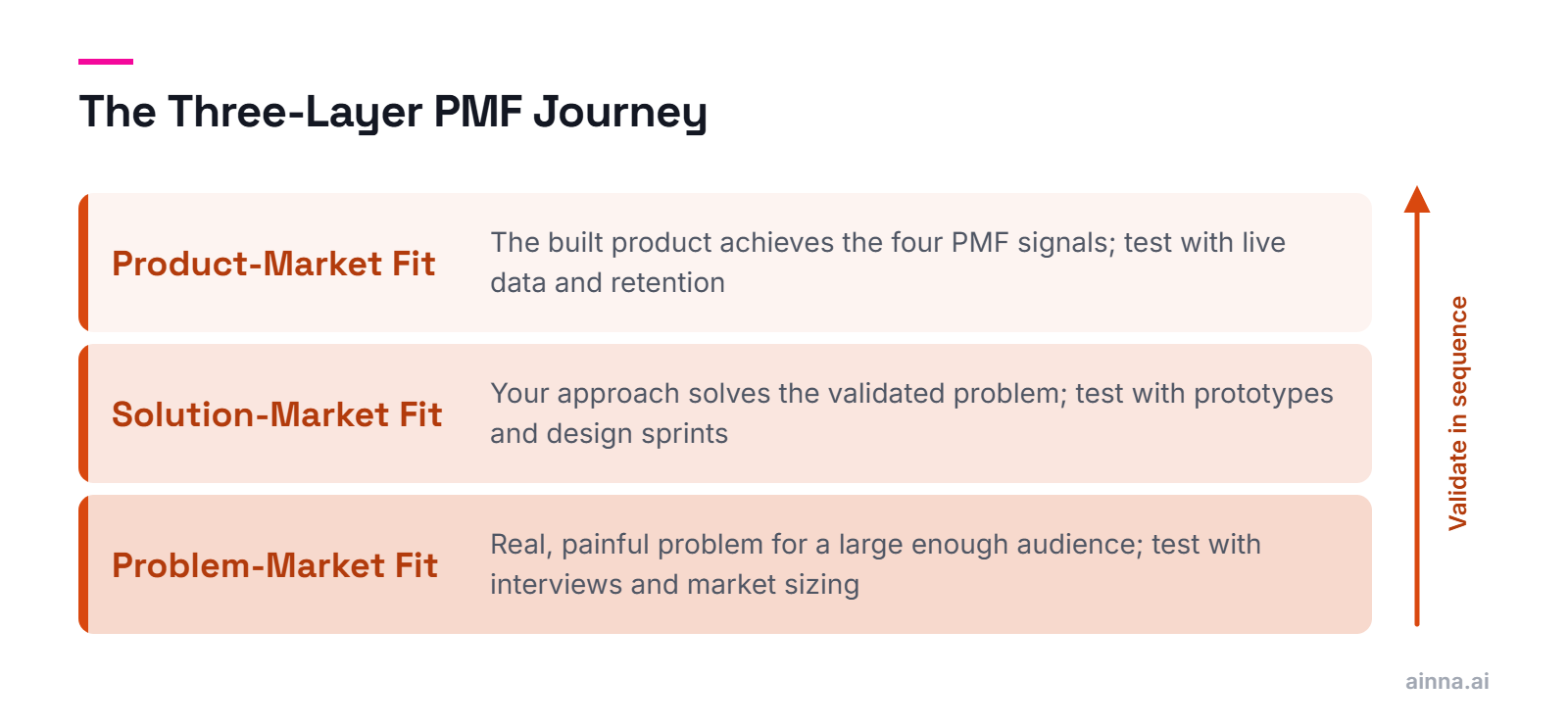
Most startup failures happen because teams jump straight to building a product without validating whether the problem is real or whether their approach is right. The Three-Layer PMF Journey is a framework from the Innovation Mode methodology that breaks the path to product-market fit into three sequential validation stages, each of which must be confirmed before the next becomes meaningful. Layer 1: Problem-Market Fit confirms that a real, painful problem exists for a large enough audience. Layer 2: Solution-Market Fit confirms that your proposed approach effectively addresses that problem. Layer 3: Product-Market Fit confirms that your implemented product delivers the solution in a way users adopt, retain, and value enough to sustain a business.

  • Layer 1 - Problem-Market Fit: Does a real problem exist, and is it painful enough that people actively seek solutions? Use The Problem Framing Template to validate: who is affected, what the current state is, what the ideal state looks like, and how frequently the problem occurs. Without Problem-Market Fit, you're building a solution nobody needs
  • Layer 2 - Solution-Market Fit: Does your proposed approach effectively solve the validated problem? This is where The Product Concept Template and early prototyping help: define the solution, test it with target users through design sprints, and validate that it resonates before investing in full development
  • Layer 3 - Product-Market Fit: Does the built product deliver the validated solution in a way that achieves the four PMF signals (desirability, retention, economics, organic pull)? This is where the MVP enters the market and begins the experiment-build-measure cycles that drive toward fit
  • The most common startup failure pattern is jumping directly to Layer 3 (building a product) without validating Layers 1 and 2 (does the problem exist, does our solution approach work?)
  • Each layer has different validation methods: Layer 1 uses user interviews, market research, and market sizing. Layer 2 uses prototypes, concept testing, and design sprints. Layer 3 uses live product data, retention analysis, and business experimentation
  • In the Innovation Mode framework, Opportunity Discovery addresses Layer 1, Opportunity Validation addresses Layer 2, and Opportunity Realization (the Venture Studio) addresses Layer 3
Key Takeaway

Thinking in three layers prevents the expensive mistake of building the wrong product for the wrong problem. Each layer is cheaper and faster to validate than the next - spending a week validating Problem-Market Fit can save months of building a product nobody wants.

What is the Sean Ellis 40% Test for product-market fit?

The Sean Ellis 40% Disappointment Test is the most widely used qualitative signal for product-market fit. Ask active users: 'How would you feel if you could no longer use this product?' If 40% or more answer 'very disappointed,' you have strong evidence of PMF. In the Innovation Mode PMF Signal Convergence Model, the Ellis Test measures the Desirability dimension - whether users consider your product indispensable rather than merely convenient.

  • The question must be asked of active users who have experienced the product's core value - not day-one signups who haven't engaged. Best practice: survey users 7-14 days after activation, not after first login
  • You need a minimum of 40 respondents for the result to be meaningful. Below that, individual responses swing the percentage too much
  • The answer options are: Very disappointed, Somewhat disappointed, Not disappointed, I no longer use the product. Only 'very disappointed' counts toward the 40% threshold
  • Below 25%: you likely don't have PMF and should iterate or pivot. 25-40%: developing PMF - you're close but need to identify and address the gaps. 40%+: strong PMF signal - ready to begin scaling
  • The real power of the test comes from the follow-up questions: 'What would you use as an alternative?' (reveals competitive positioning), 'What is the primary benefit you get?' (reveals your real value proposition, which may differ from what you think), 'How can we improve?' (reveals the gaps between current and ideal)
  • Limitation: the test captures desirability only. It doesn't measure retention, economics, or organic pull. Use it alongside the other PMF Signal Convergence dimensions for a complete picture
Key Takeaway

The Sean Ellis Test is powerful because it measures what users feel, not just what they do. Behavioral metrics can be gamed or misread; emotional dependency is a genuine signal of value. But treat it as one input into the PMF Signal Convergence Model, not the sole arbiter.

How do retention curves indicate product-market fit?

Retention curves are the most reliable quantitative signal for product-market fit. A product with PMF shows a retention curve that flattens at a meaningful level - a stable percentage of users keep coming back week after week. A product without PMF shows a curve that declines continuously toward zero. In the Innovation Mode PMF Signal Convergence Model, retention is the second dimension and often the most diagnostic: desirability captures what users feel about your product, but retention captures what they do.

  • Plot cohort retention: for each weekly or monthly cohort of new users, track what percentage are still active at D7, D14, D30, D60, D90. The shape of this curve tells you more about PMF than any single metric
  • A flattening curve means you've found a core group of users who get sustained value. The level at which it flattens matters: 40-60%+ at D30 for high-frequency products (daily use apps), 20-30%+ for lower-frequency products (monthly tools)
  • A declining-to-zero curve means users try the product and leave. No amount of acquisition spending fixes this - you need to improve the product before scaling
  • Compare cohorts over time: if later cohorts flatten at higher percentages than earlier ones, your product is improving toward PMF. If later cohorts flatten lower, you may be acquiring less-qualified users or degrading the experience
  • Segment your retention analysis: overall retention can mask important patterns. Retention by acquisition channel, user persona, or activation behavior often reveals that PMF exists for some segments but not others
  • As described in Innovation Mode 2.0, the opportunity realization team monitors product performance down to the feature level, using engagement data and feedback loops to drive rapid improvement cycles that bend the retention curve upward
Key Takeaway

If you can only track one metric for PMF, make it cohort retention. It captures the fundamental question: are users getting enough value to come back? Everything else - revenue, growth, NPS - follows from this.

What metrics should I track on a PMF dashboard?

A PMF dashboard should track metrics across all four dimensions of the PMF Signal Convergence Model (desirability, retention, economics, organic pull) plus leading indicators that predict where you're heading. In the Innovation Mode methodology, we emphasize tracking trends, not snapshots - a single week's data is noise; a multi-week trend is signal.

  • Desirability metrics: Sean Ellis Test score (survey monthly), NPS (target 50+), qualitative sentiment from user interviews, feature request patterns (expansion vs. fix requests)
  • Retention metrics: D7/D14/D30/D60/D90 cohort retention, weekly active users / monthly active users ratio (DAU/MAU for daily-use products), session frequency trend, re-engagement rate (users who return without being prompted)
  • Economic metrics: LTV/CAC ratio (target 3x+), CAC payback period (target under 12 months), gross margin per user, revenue retention (net dollar retention rate for SaaS - target 100%+)
  • Organic pull metrics: percentage of new users from organic/referral channels vs. paid, viral coefficient (K-factor), organic search impressions and clicks trending upward (see our market sizing guide for understanding market opportunity), inbound inquiry volume
  • Leading indicators: onboarding completion rate (predicts retention), time to first value (predicts activation), core action completion rate (predicts engagement), support ticket volume per user (predicts satisfaction)
  • Define your North Star Metric - the single number that best captures the core value you deliver to users. For a project management tool, it might be tasks completed. For a communication platform, it might be messages sent. For Ainna, it's product concepts framed and documented. Every other metric should ladder up to this
Key Takeaway

Don't track 50 metrics on your PMF dashboard - you'll drown in data. Track the four signal categories with 2-3 metrics each, plus your North Star Metric. Review trends weekly, act on signals that persist for 2+ weeks, and ignore single-week fluctuations.

What are false product-market fit signals that mislead teams?

False PMF signals are metrics or experiences that feel like product-market fit but mask fundamental problems. In the Innovation Mode methodology, we distinguish these from genuine PMF by applying the Signal Convergence test: a true PMF signal must be confirmed across all four dimensions (desirability, retention, economics, organic pull). A metric that looks strong in isolation while other dimensions are weak is almost always a false signal - and acting on it leads to premature scaling, the most expensive mistake in startup building.

  • Vanity growth: user signups are increasing, but retention is flat or declining. You're filling a bucket with a hole in it. High acquisition + low retention = no PMF, just marketing spend
  • Founder-driven sales: revenue is growing, but only because the founder personally closes every deal. This tests whether the founder can sell, not whether the product sells itself. If removing the founder from sales would collapse revenue, you don't have PMF
  • Single-customer dependency: one large customer loves the product and drives most of your revenue. This is customer fit, not market fit. PMF requires a pattern of satisfied customers across a segment
  • Feature confusion: users praise specific features but don't use the core product regularly. They like pieces of what you've built but haven't integrated it into their workflow. High feature satisfaction + low overall retention = false signal
  • Paid channel dependency: growth looks strong, but it collapses when you reduce ad spend. PMF should generate organic pull - if 100% of growth comes from paid channels, you're buying users, not attracting them
  • Early adopter bias: your first 50 users are enthusiasts who would love anything in this category. Their enthusiasm doesn't predict mainstream adoption. Test with users who match your target persona, not just anyone willing to try
Key Takeaway

The antidote to false signals is the PMF Signal Convergence Model: check all four dimensions. If desirability is high but retention is low, or retention is high but economics don't work, you haven't found fit - you've found a partial fit that needs more iteration.

What percentage of startups actually achieve product-market fit?

The uncomfortable reality: most startups never achieve strong product-market fit. Research consistently shows that roughly 70-80% of startups fail, and the primary cause is not running out of money or building bad technology - it's building something the market doesn't want. According to the Startup Genome Report, 70% of startups scale prematurely, committing resources to growth before achieving fit. The Innovation Mode methodology exists precisely to improve these odds through systematic validation at each layer.

  • The base rate is sobering: only about 20-30% of funded startups achieve what would qualify as strong PMF (40%+ on the Sean Ellis Test, flattening retention, healthy unit economics). The percentage is even lower for unfunded startups without structured methodology
  • The most common failure pattern is not 'we tried everything and it didn't work' - it's 'we skipped validation and built the wrong thing.' The Three-Layer PMF Journey directly addresses this by requiring Problem-Market Fit and Solution-Market Fit validation before committing to a full MVP build
  • Venture studio-backed startups show meaningfully better outcomes than solo founders. The systematic approach - validated concepts, reusable infrastructure, accumulated playbooks, structured experiment cycles - compresses the search and reduces wasted effort. The Innovation Mode Opportunity Realization capability is designed around exactly this principle
  • Most startups that eventually find PMF pivot at least once. The data suggests that the original concept rarely survives contact with the market intact. What matters is how quickly and cheaply you adapt - which is why experiment velocity matters more than initial concept quality
  • False confidence is as dangerous as no confidence. Many teams believe they have PMF because one metric looks good (vanity growth, single-customer love, founder-driven sales). Applying the full PMF Signal Convergence Model prevents this trap by requiring convergence across all four dimensions
  • The success rate improves dramatically with discipline: teams that talk to users weekly, run experiments continuously, track cohort retention (not just aggregate numbers), and make evidence-based pivot-or-persevere decisions find fit at significantly higher rates than teams relying on intuition and hope
Key Takeaway

These numbers are not meant to discourage - they're meant to motivate rigor. The startups that beat the odds are not luckier or smarter. They're more disciplined: they validate before building, measure before scaling, and iterate based on evidence rather than assumptions. Every framework in this guide exists to move your odds from the base rate toward the top quartile.

What is the step-by-step process for achieving product-market fit?

There is no shortcut, but there is a sequence that dramatically improves your odds. Achieving PMF follows a disciplined path through the three layers (Problem-Market Fit, Solution-Market Fit, Product-Market Fit) with increasing investment at each stage. The Innovation Mode framework organizes this as three interconnected capabilities: Opportunity Discovery, Opportunity Validation, and Opportunity Realization (the Venture Studio).

  • Step 1 - Discover the problem: Before building anything, validate that a real, painful problem exists. Use The Problem Framing Template to articulate who is affected and how. Validate through interviews, research, and market sizing. Output: a validated problem statement
  • Step 2 - Frame the solution: Define your concept using The Universal Idea Model. Test it with target users through design sprints and prototyping. Output: a validated product concept
  • Step 3 - Define and build the MVP: Identify the smallest feature set that delivers real value. Write the PRD, define success metrics, and build. As Innovation Mode 2.0 warns: 'the real risk is releasing a non-viable first instance too late.' Output: a launched MVP with feedback loops
  • Step 4 - Measure and iterate: Establish your PMF dashboard, monitor all four Signal Convergence dimensions, and run rapid experiment-build-measure cycles. In the Innovation Mode Venture Studio approach, the team triggers 'a series of fast improvement and growth cycles that attempt to get the MVP to product-market fit'
  • Step 5 - Decide: Based on data, iterate toward fit, pivot the approach, or sunset the product. As Innovation Mode 2.0 emphasizes, 'early, smart failures are welcome' when they happen fast and cheaply. Every decision is evidence-based, not emotional
  • Step 6 - Scale: When strong PMF is confirmed (40%+ Ellis Test, flattening retention, healthy LTV/CAC, growing organic share), develop a go-to-market strategy and transition from the Venture Studio to a dedicated product team
Key Takeaway

The process is not linear - you will loop back through earlier steps as you learn. The key is that each iteration is faster and cheaper because you're building on accumulated knowledge. Speed of learning is the ultimate competitive advantage in the search for PMF.

How does the MVP connect to product-market fit?

The MVP is not the product - it's the vehicle for finding product-market fit. Its purpose is to enter the market with the minimum viable offering, establish feedback loops, and begin the iterative process of improving toward fit. The MVP tests your core hypothesis: does this product deliver enough value that users engage, retain, and eventually advocate?

  • The 'V' in MVP is an additional hypothesis: you believe this feature set is viable, but the market will confirm or deny that belief. As Innovation Mode 2.0 states, an MVP 'describes the first instance of a product consisting of select features that are expected to provide sufficient value to early customers so they engage with the product while the company obtains essential feedback'
  • The MVP-to-PMF journey is a series of rapid cycles: release, measure, learn, improve. Each cycle should be short (1-2 weeks for digital products) and focused on moving specific PMF signals
  • Feature prioritization during the MVP-to-PMF phase should be ruthlessly focused on retention. Features that improve onboarding, reduce friction, or deepen core value usage matter far more than features that broaden the product's scope
  • The MVP is intentionally incomplete. Contrary to popular misconceptions, an MVP differs from a prototype or proof of concept. MVPs are exposed to real customers and must be closer to production-ready
  • Track the gap between what early users love and what they struggle with. The Superhuman approach - ignoring feedback from users who wouldn't miss the product and doubling down on what passionate users love - is highly effective during MVP-to-PMF
  • Know when to stop iterating and either pivot or sunset. Data should drive this decision, not emotion. If multiple iteration cycles fail to move retention curves, the problem may be at Layer 1 (the problem isn't big enough) or Layer 2 (the solution approach is wrong)
Key Takeaway

The MVP is your fastest path to real-world learning. Building a good, inexpensive first release preserves degrees of freedom - you still have resources to adapt when the market tells you something unexpected.

What role does business experimentation play in finding PMF?

Business experimentation is the mechanism that converts uncertainty into knowledge on the path to product-market fit. As described in Innovation Mode 2.0, 'business experimentation is the practice of testing hypotheses by obtaining insights and signals under real-world conditions. It acknowledges that innovation inherently involves uncertainty and provides a systematic way to address it through targeted learning activities.'

  • In-product experiments run within the live MVP: A/B testing (comparing two versions of a feature), multivariate testing (evaluating multiple elements simultaneously), feature experiments (adding or removing features for user subsets), and pricing experiments (testing different price points)
  • Out-of-product experiments run independently: stand-alone prototypes testing complex features, landing page tests validating demand for potential capabilities, concierge MVPs where you manually deliver the service before automating it
  • Each experiment should have a formal hypothesis, defined success metrics, and evaluation criteria before it runs. Use the Business Experiment Template to structure this
  • Experiment velocity matters: the team that runs 10 experiments per month learns faster than the team that runs 1. Speed of learning is the real competitive advantage in the search for PMF
  • Not all experiments succeed - and that's the point. Failed experiments that generate clear learnings are more valuable than inconclusive experiments that generate no signal. The fail-fast, fail-safe principle applies: learn quickly, limit the blast radius
  • AI can accelerate experimentation by analyzing patterns in product usage, correlating engagement data with feedback, and identifying non-obvious associations between features and retention - insights that would take human analysts much longer to surface
Key Takeaway

The search for PMF is fundamentally an experimentation process. The teams that systematize their experimentation - with clear hypotheses, rapid execution, rigorous measurement, and honest interpretation - find fit faster than those who iterate on intuition alone.

How do I know when to pivot versus persevere in the search for PMF?

The pivot-or-persevere decision is the hardest call in startup building. The answer lies in distinguishing between risks (known challenges you can mitigate) and uncertainties (unknowns that require experimentation to resolve) - a distinction that Innovation Mode 2.0 treats as fundamental to the validation process.

  • Persevere when: retention is improving across cohorts (even slowly), your best users are passionate (even if they're few), experiment results show a clear direction for improvement, and the core problem you're solving is validated and growing
  • Pivot when: multiple experiment cycles fail to improve retention, your best users love a feature that's peripheral to your core concept (the market is telling you your real product is different from what you planned), or your problem hypothesis is invalidated by user behavior data
  • Sunset when: the target market is too small to sustain a business (revisit your TAM/SAM/SOM analysis), the technology can't deliver the required quality (common in AI products where model limitations create hard ceilings), or the economics fundamentally don't work regardless of scale
  • Set time-boxed evaluation points before you start. Decide in advance: 'If we haven't achieved X retention by month Y with Z experiments completed, we will evaluate a pivot.' This prevents the slow death of indefinite iteration without accountability
  • A pivot is not a failure - it's a strategic redirect based on market evidence. Many of the most successful companies pivoted: Slack started as a gaming company, Instagram started as a location check-in app, YouTube started as a dating site
  • The Venture Studio approach in Innovation Mode 2.0 handles this systematically: for ventures that fail to achieve PMF despite multiple iterations, the team 'conducts postmortems, captures valuable insights, and keeps the leadership informed' - then reallocates resources to new opportunities
Key Takeaway

The best founders are neither stubbornly persistent nor recklessly pivoting. They persevere on the problem (which they've validated) while being flexible on the solution (which they iterate based on evidence). The product leadership required to navigate this distinction is perhaps the most valuable skill a founder can develop.

How long does it take to find product-market fit?

Honest answer: typically 18 months to 3 years for startups, though outliers exist in both directions. The timeline depends less on how fast you build and more on how fast you learn. In the Innovation Mode framework, the goal is not to shorten the calendar time to PMF but to compress the learning cycles - running more experiments per month, making faster pivot-or-persevere decisions, and eliminating wasted effort on unvalidated assumptions.

  • The 18-month benchmark is common for B2B SaaS products where sales cycles are long and feedback loops are slow. Consumer products can find fit faster (sometimes 6-12 months) because usage data arrives daily rather than quarterly. Enterprise products often take longer because each customer relationship requires deep customization
  • What actually determines speed: the number of experiment-build-measure cycles you complete, not the number of months that pass. A team running 8 experiments per month will find fit faster than a team running 1 experiment per month - even if the latter team started a year earlier
  • The Three-Layer PMF Journey helps set realistic expectations at each stage: Problem-Market Fit validation takes weeks (interviews, research), Solution-Market Fit takes 1-3 months (prototyping, concept testing), and Product-Market Fit takes 6-18 months (MVP launch, iteration cycles, retention analysis)
  • Warning signs that your timeline is stretching unnecessarily: you've been iterating for 6+ months without improvement in retention curves, you haven't talked to users in the last 30 days, your experiment velocity is below 2 per month, or you're adding features without measuring their impact
  • The Innovation Mode Venture Studio approach compresses timelines by using the Seven-Step MVP Definition Process (weeks, not months for product definition), reusable infrastructure (faster builds), and structured decision protocols (faster pivot-or-persevere calls). The goal is to get to a launched MVP in 6-12 weeks, then iterate toward fit
  • Don't confuse revenue with PMF. Some products generate revenue long before achieving fit (through founder-driven sales), and some achieve fit before monetizing (through strong retention and organic growth). Use the PMF Signal Convergence Model, not revenue, as your compass
Key Takeaway

The right question isn't 'when will we achieve PMF?' but 'are we learning fast enough?' If each month brings clearer signal, improving retention, and better understanding of your users, you're on the right path - regardless of how long it takes. If months pass without meaningful learning, the problem isn't timeline - it's methodology.

How is product-market fit different for AI-powered products?

AI products face three PMF challenges that traditional products don't: the quality of the product is probabilistic (the same input can produce different outputs), the underlying technology shifts rapidly (a model upgrade can change product behavior overnight), and user expectations evolve faster than the technology. In the Innovation Mode methodology, we address this through a layered approach: the PMF Signal Convergence Model still applies, but each dimension requires AI-specific measurement - particularly retention and desirability, which can erode without any change to your own code.

  • The quality bar is a moving target: when ChatGPT raises user expectations for conversational AI, every other AI chatbot's perceived quality drops - even if its actual quality hasn't changed. PMF for AI products can erode without any change to your product
  • Retention in AI products is harder to attribute: users may stop using your product not because your solution is wrong but because the AI output quality isn't consistent enough. Distinguishing 'wrong product' from 'right product, inconsistent model' requires deeper analysis
  • The eval framework is your PMF measurement layer for AI: as detailed in our AI PRD guide, structured evaluations that measure quality across defined dimensions (accuracy, relevance, safety) are the AI equivalent of feature-level retention tracking
  • Model dependency creates PMF fragility: your product's core intelligence is often rented through APIs. A provider update can silently change your product's behavior and erode PMF without any action on your part. Monitor model quality continuously
  • AI products often discover PMF in unexpected places: users may adopt your product for a use case you didn't anticipate. Instrumentation and analytics need to capture how users are using AI features, not just whether they're using them
  • The Sean Ellis Test still applies to AI products, but the follow-up questions are even more important: 'What specific outputs did you find most valuable?' and 'When did the AI fail you?' reveal whether users trust the AI enough to depend on it
Key Takeaway

For AI products, PMF is both easier to lose and harder to measure than for traditional products. The solution is the same disciplined approach - experiment, measure, iterate - but with additional monitoring layers for model quality, output consistency, and evolving user expectations.

What additional metrics matter for AI product-market fit?

AI products need the standard PMF Signal Convergence metrics (retention, Ellis Test, LTV/CAC, organic share) plus AI-specific metrics that capture whether the AI itself is delivering sufficient quality. In the Innovation Mode approach, we frame this as measuring trust: does the user trust the AI's output enough to depend on it for real work? Without these AI-layer metrics, you cannot tell whether a retention problem is a product problem or a model problem.

  • Output acceptance rate: what percentage of AI-generated outputs do users accept, edit, or reject? A declining acceptance rate signals quality erosion. Track this over time and across cohorts
  • Re-prompt frequency: how often do users rephrase their request because the first AI response was unsatisfactory? High re-prompt rates indicate the AI isn't understanding user intent - a critical barrier to PMF
  • Trust calibration: do users verify AI outputs before acting on them? For AI products approaching PMF, users should trust the output enough to act on it directly (for low-stakes tasks) while maintaining healthy skepticism (for high-stakes decisions)
  • Time-to-value with AI: how quickly does the AI deliver useful output? For products like Ainna, the value proposition includes speed - complete documentation in 60 seconds. If the AI adds latency without proportional quality improvement, users will revert to manual methods
  • Feature-level AI quality scores: run evals on production outputs to track quality trends per feature. A product may have strong PMF on its summarization feature but weak PMF on its recommendation feature - aggregate metrics mask these differences
  • Human-escalation rate: how often do users need to bypass the AI and seek human help? A decreasing escalation rate over time signals improving AI-user fit
Key Takeaway

AI product PMF is essentially a trust equation: do users trust the AI's output enough to depend on it for real work? The metrics above measure different facets of that trust. When output acceptance is high, re-prompting is low, and users are acting on AI outputs with confidence - you're approaching fit.

How does the Innovation Mode methodology approach PMF differently for AI products?

The Innovation Mode methodology applies the same PMF Signal Convergence Model to AI products but adds three additional validation layers that address the unique challenges of probabilistic, model-dependent systems: AI Quality Validation (can the model deliver sufficient quality for the core use case?), Dependency Stress Testing (what happens when the underlying model changes, degrades, or becomes unavailable?), and Trust Calibration (do users trust the AI output enough to depend on it for real work?).

  • AI Quality Validation sits between Solution-Market Fit and Product-Market Fit in the Three-Layer PMF Journey. Before building a full MVP, validate that the AI can deliver adequate output quality for your specific use case. As described in our AI PRD guide, this requires structured evaluations (evals) that measure quality across defined dimensions
  • Dependency Stress Testing addresses the reality that most AI products rely on third-party model APIs. Your product's core intelligence is rented, not owned. The Innovation Mode approach requires documenting model dependency risks in the PRD and testing fallback behavior before launch
  • Trust Calibration measures whether users are building appropriate confidence in AI outputs. Too little trust means they verify everything manually (negating the product's value). Too much trust means they accept errors uncritically (creating liability). Both extremes indicate the product hasn't found the right fit with user expectations
  • The Innovation Mode Venture Studio applies the same experiment-build-measure cycles to AI products but with shorter iteration loops and continuous model quality monitoring. As described in Innovation Mode 2.0, the team monitors product performance 'down to the feature level' using engagement data and AI-powered pattern identification
  • AI products often discover PMF in unexpected places. The Innovation Mode framework's Opportunity Discovery capability helps teams recognize when users adopt the product for use cases that weren't anticipated - and pivot toward those higher-value applications rather than forcing the original hypothesis
  • The AI Sandbox concept from Innovation Mode 2.0 applies to PMF validation: test AI product behavior in controlled environments with carefully managed data feeds and monitoring before exposing real users to probabilistic outputs
Key Takeaway

For AI products, the path to PMF requires validating both the product hypothesis (do users want this?) and the technology hypothesis (can AI deliver this with sufficient quality?). The Innovation Mode methodology treats these as parallel validation tracks that must converge before PMF is declared.

When is it safe to scale after achieving product-market fit?

Scale when you have Strong PMF across all four dimensions of the Signal Convergence Model - not when a single metric looks good. In the Innovation Mode methodology, the readiness test is straightforward: if you doubled your user acquisition tomorrow, would your retention, unit economics, and support capacity hold? If the answer is uncertain, you are not ready to scale. Premature scaling is the number one startup killer because it commits resources to growth before the product can sustain that growth.

  • Pre-scale checklist: Sean Ellis Test passes at 40%+, D30 retention is stable or improving across recent cohorts, LTV/CAC exceeds 3x, at least 30% of new users come from organic channels, support ticket volume per user is declining, and onboarding completion rate exceeds 70%
  • Scale the acquisition channel, not the product complexity. When you've found fit, your job is to bring more of the right users to the product that works - not to add features. Feature expansion should follow user demand, not precede it
  • Develop a go-to-market strategy that leverages your PMF insights: use the language your best users use, target channels where similar users cluster, and lead with the specific benefit your passionate users cite
  • In the Innovation Mode framework, this is when the Venture Studio transitions the product to a dedicated product team. The transition protocol ensures continuity of the feedback loops and experimentation culture that drove the product to PMF
  • Monitor cohort quality as you scale. New cohorts acquired through broader channels may retain differently than your early adopter cohorts. If new cohorts show weaker retention, you may be scaling beyond your PMF segment
  • Build a product roadmap that balances growth features (virality, referral, onboarding) with depth features (advanced capabilities for power users) - both are needed to sustain PMF at scale
Key Takeaway

The transition from PMF to scaling is not a switch you flip - it's a gradient you navigate. Scale gradually, monitor relentlessly, and be prepared to slow down if new cohort quality drops. PMF earned with 100 users must be re-earned with 1,000 and again with 10,000.

How do I maintain product-market fit as the market evolves?

Product-market fit is not permanent. Markets shift, competitors respond, user expectations evolve, and technology creates new possibilities. In the Innovation Mode framework, maintaining PMF is treated as a continuous capability - not a one-time achievement. The same Opportunity Discovery, Validation, and Realization capabilities that found PMF initially must remain active to detect erosion and drive re-alignment as the market changes.

  • Continuously monitor the four PMF signals. Set up automated alerts for significant changes: retention dropping below threshold, NPS declining, organic share decreasing, or LTV/CAC deteriorating. Catch erosion early before it becomes a crisis
  • Maintain active feedback loops. As described in Innovation Mode 2.0, product insights come from multiple sources: telemetry (how users interact with features), direct feedback (satisfaction surveys, feature requests), complaints (support tickets, reviews), online reputation (social media, review sites), and research (interviews, usability studies)
  • Run ongoing competitive analysis. A competitor launching a feature that addresses your users' top request can erode your PMF overnight. Stay aware of the competitive landscape and respond proactively
  • Invest in incremental innovation. Continuous small improvements keep the product relevant and demonstrate to users that it's evolving with their needs. As Innovation Mode 2.0 emphasizes, 'through a seamless process, users experience frequent upgrades that should translate to more value and increased engagement'
  • Watch for platform shifts that can invalidate your fit. The rise of AI, for example, has disrupted PMF for many traditional software products by raising expectations for intelligence, personalization, and automation
  • Re-run the Sean Ellis Test quarterly. If the 'very disappointed' percentage declines, investigate immediately. The best time to address PMF erosion is when the first signals appear, not when retention charts start declining
Key Takeaway

The most enduring products don't just find PMF - they build organizational capabilities for continuously rediscovering it. This is the essence of the Innovation Mode framework: a systematic approach to innovation that ensures the organization keeps producing products the market wants, even as the market changes.

What are the most common mistakes teams make in the search for PMF?

After 25+ years of product innovation across four startups and advisory engagements at Microsoft and Accenture, the most common PMF mistakes map to the Three-Layer PMF Journey: teams skip Layer 1 (searching in the wrong order by not validating the problem), attempt to scale before Layer 3 is complete (premature scaling before fit is established), or measure the wrong things at each layer (vanity metrics instead of Signal Convergence dimensions).

  • Skipping problem validation: jumping to building a product without validating that the problem is real, frequent, and painful enough. Spend a week on problem framing before spending months on product development
  • Building too much in the MVP: including features that aren't essential to the core value proposition. Every additional feature adds development time, testing burden, and user complexity. The best MVPs are uncomfortably small
  • Scaling prematurely: investing in growth before retention curves flatten. According to the Startup Genome Report, premature scaling is the most common cause of startup failure. If users aren't retaining, more users won't help
  • Ignoring qualitative signals: relying exclusively on quantitative metrics while ignoring what users are saying in interviews, support tickets, and reviews. Numbers tell you what is happening; qualitative data tells you why
  • Optimizing for acquisition instead of retention: spending most resources on getting new users rather than improving the experience for existing users. Before PMF, every dollar spent on retention improvement is worth more than a dollar spent on acquisition
  • Refusing to pivot when evidence demands it: falling in love with the solution instead of the problem. The market doesn't care about your vision - it cares about whether your product solves a real problem better than the alternatives
Key Takeaway

Most PMF mistakes come from impatience - the desire to scale before the product is ready, to build before the problem is validated, or to celebrate before the evidence is conclusive. The disciplined search for PMF requires patience, honesty about what the data is telling you, and the courage to act on evidence even when it contradicts your assumptions.

What tools and resources help in the search for product-market fit?

The search for PMF requires tools across three domains: product discovery and framing (validating the problem and solution before building), measurement and analytics (tracking PMF signals once the product is live), and strategic documentation (communicating your concept, progress, and ask to stakeholders and investors).

  • Product discovery and framing: Ainna helps you frame your product opportunity using The Innovation Mode methodology - generating problem statements, product concepts, competitive analysis, and complete documentation packages including pitch decks and PRDs. Free to explore, no credit card required
  • Innovation frameworks: The Innovation Toolkit provides templates for every stage of the PMF journey - problem framing, idea assessment, product concept definition, business experiment design, and MVP definition
  • Analytics and measurement: use product analytics platforms to track cohort retention, feature engagement, and user behavior patterns. The key capability is cohort-level analysis, not just aggregate metrics
  • User research: the Sean Ellis survey, NPS surveys, and qualitative user interviews are irreplaceable for understanding the 'why' behind your metrics. Automate survey triggers at key moments (post-onboarding, post-first-value, periodic check-ins)
  • Strategic communication: as you search for PMF, you need to communicate progress to investors, advisors, and your team. A strong one-pager that articulates your problem, solution, traction, and ask is essential
  • Use code AINNA.AI to explore Ainna's full product discovery experience and generate your documentation package
Key Takeaway

The best tools accelerate your learning, not just your building. Tools that help you validate assumptions faster, measure signals more accurately, and communicate your concept more clearly compound your advantage in the search for fit.

Meet Ainna

Ready to Stress-Test Your Product Concept?

Ainna applies The Innovation Mode methodology to help you discover and validate product opportunities - generating pitch decks, PRDs, and strategic documentation so you can focus on finding product-market fit.

Ideas in.
Opportunities out.