What is a chief innovation officer (CINO)? #

A chief innovation officer (CINO) is the most senior formal role dedicated to innovation: a member of the C-suite who reports directly to the CEO and has the authority and resources to drive innovation initiatives and transformation across the company. The abbreviation CINO avoids confusion with the chief information officer (CIO). The role is typically found in large enterprises facing industry disruption, or in companies where innovation is acknowledged as critical and backed by significant investment. Its job is to enable the whole organization to innovate, not to produce innovation itself.

  • Position: the CINO sits at the executive table and reports to the CEO. That is what separates the role from a VP or head of innovation, who reports to another executive such as the CTO or chief strategy officer
  • Prevalence: by 2017, 29% of Fortune 500 companies had a senior innovation executive, according to an Egon Zehnder study reported in Harvard Business Review
  • Signal: appointing a CINO signals top-level commitment to innovation as a strategic priority, and gives organization-wide transformation the resources, visibility and strategic alignment it needs
  • Mandate: Innovation Mode 2.0 defines the innovation executive's mandate as empowering the organization to innovate at scale and pace, whatever the title and wherever the role sits in the hierarchy
  • What the CINO runs: the innovation function, an always-on system of processes, services, technology tools, knowledge and talent that maximizes the company's ability to discover and pursue opportunities
  • Not the only option: many companies lead innovation through other executives, councils or embedded teams instead, and each choice carries its own risk; see who should lead innovation
Key Takeaway

A CINO is defined less by the title than by the mandate: C-suite authority used to make everyone else better at innovating. A CINO who becomes the company's only innovator has missed the point of the role.
Inside Ainna Know which opportunities deserve the budget. The Judge, Ainna's AI evaluator, scores each opportunity across ten dimensions and shows its reasoning. Explore Ainna Enterprise

Why do companies need dedicated innovation leadership? #

Because innovation at scale is a capability, and a capability has to be designed, run and improved by someone accountable. The innovation function, the system of processes, tools, knowledge and talent that lets a company discover and pursue opportunities, does not assemble itself. Executive sponsorship matters, but sponsorship is not orchestration. Without a leader who steers the effort, innovation stays ad hoc or fragments across divisions. In a survey reported by BCG in 2019, 80% of innovation executives ranked innovation a top-three priority, but only 30% said their organizations were good at it.

  • The function needs an architect: capturing and evaluating ideas, sensing the market, rapid prototyping, in-market experiments and innovation workshops need a well-designed framework with the right capabilities, processes and resources behind them
  • Sponsorship is not leadership: senior executives sponsor the program, help shape the innovation agenda, advise and take part in steering. Someone still has to turn that support into capabilities, events and decisions
  • Without orchestration, effort fragments: innovation spread across divisions without a common method produces inconsistent practices, knowledge gaps and results that stay local, so the company cannot innovate as a single system
  • Maturity depends on it: companies at the first three levels, Innovation-inactive to Innovation-engaged, have no leadership roles to run innovation; at the Innovation-powered level, a dedicated executive orchestrates the innovation function
  • Culture needs an owner: an unhealthy culture can be the single point of failure even for well-planned, expensive innovation programs, and shaping that culture is an explicit responsibility of the innovation executive
  • The question is design, not whether: every company that wants to innovate systematically needs innovation leadership; what differs is how it is organized, which depends on industry, size, objectives, strategy and innovation maturity
Key Takeaway

Dedicated leadership is what turns scattered innovation activity into a capability that compounds. The decision that matters is how to organize it, not whether to.

What does a chief innovation officer do? #

A chief innovation officer enables and orchestrates the company's innovation function. The mission, as I put it in Innovation Mode 2.0, is 'to empower the company to thrive through the discovery and pursuit of new business opportunities.' That means three things: improving the organization's ability to spot and frame opportunities, strengthening its capability to identify and validate the high-potential ones, and aligning leadership to invest in validated opportunities and bring new products and services to market. The CINO and their team exist to help the organization innovate, not to do the innovating for it.

  • Envision the target state: the CINO pictures the optimized version of the organization, one able to drive meaningful innovations to market and create value for users, customers and the business, and sets the direction to get there
  • Connect innovation to strategy: they tie innovation efforts to the company's purpose and strategic planning, and bring the C-suite, division leaders, and product and technology leaders into the innovation program
  • Build the conditions: they onboard the right talent, shape the culture, design effective processes and provide the technology that accelerates innovation, so ideas circulate, experiments happen and failures are treated as learning
  • Not the chief ideator: a common misconception is that innovation leaders mainly generate and frame ideas, or invent at the technical level. Their contribution is the system that lets everyone else do so
  • Not a symbolic role: nor is the role merely motivational, or about creativity alone. It depends on methodical execution and on the ability to drive innovations to market
  • Different lenses, one mandate: organizations variously see the role as a change catalyst, as a 'venture capitalist' managing an innovation portfolio, or as the lead for cultural transformation. Innovation Mode 2.0 takes a holistic view instead, built on one mandate: empowering the organization to innovate at scale and pace
Key Takeaway

If your CINO is judged by the number of ideas they personally produce, the role has been misunderstood. Judge it by how much better the whole company gets at finding, validating and launching opportunities.

What are the responsibilities of a chief innovation officer? #

Innovation Mode 2.0 defines ten responsibilities for the innovation executive: enabling innovation, setting its focus, establishing an opportunity discovery capability, establishing an opportunity implementation capability, fostering a culture of innovation, measuring innovation performance, connecting internally, connecting externally, providing innovation talent, and providing innovation resources. The core stays the same whatever the title, but the emphasis shifts with the company's innovation maturity, its industry and the role's position in the hierarchy. A CINO may also take on organizational design for innovation, shaping and funding R&D programs and teams, and specific investments.

  • Enabling innovation: architect the innovation function and bring in platforms, processes and tools such as innovation management and collaboration platforms, market intelligence systems, experimentation frameworks and prototyping tools; see the innovation tech stack. Then run the programs, workshops and knowledge sharing around them
  • Setting the focus: translate broad strategic directives from the C-suite into an innovation agenda of specific focus areas and problems worth solving, so innovation stays connected to business reality
  • Opportunity discovery and implementation: establish an end-to-end process that speeds up ideation, idea assessment and opportunity flagging, manage an opportunity portfolio that balances styles of innovation, and build the teams, systems and processes that take opportunities to market and drive adoption
  • Fostering the culture: introduce programs and events that build a growth and learning mindset, openness, psychological safety and readiness to take calculated risks; lead by example, address resistance to change and remove known cultural blockers
  • Measuring performance: introduce an innovation performance measurement system, and use it to communicate the 'state of innovation', educate the C-suite on appropriate success metrics and set meaningful expectations
  • Connecting internally and externally: bring divisions together with a shared innovation language, frameworks and tools, and build relationships with startups, academic institutions, industry organizations and innovation hubs for open innovation and co-creation
  • Providing talent and resources: define innovation roles and career paths, upskill and mentor, help functional leaders develop innovation champions, secure funding during budget cycles, set clear allocation criteria and create just-in-time financing for promising initiatives
Key Takeaway

None of the ten asks the CINO to produce ideas personally. They describe a system to build and run, and that is where a CINO's time should go.

Who should lead innovation in a company? #

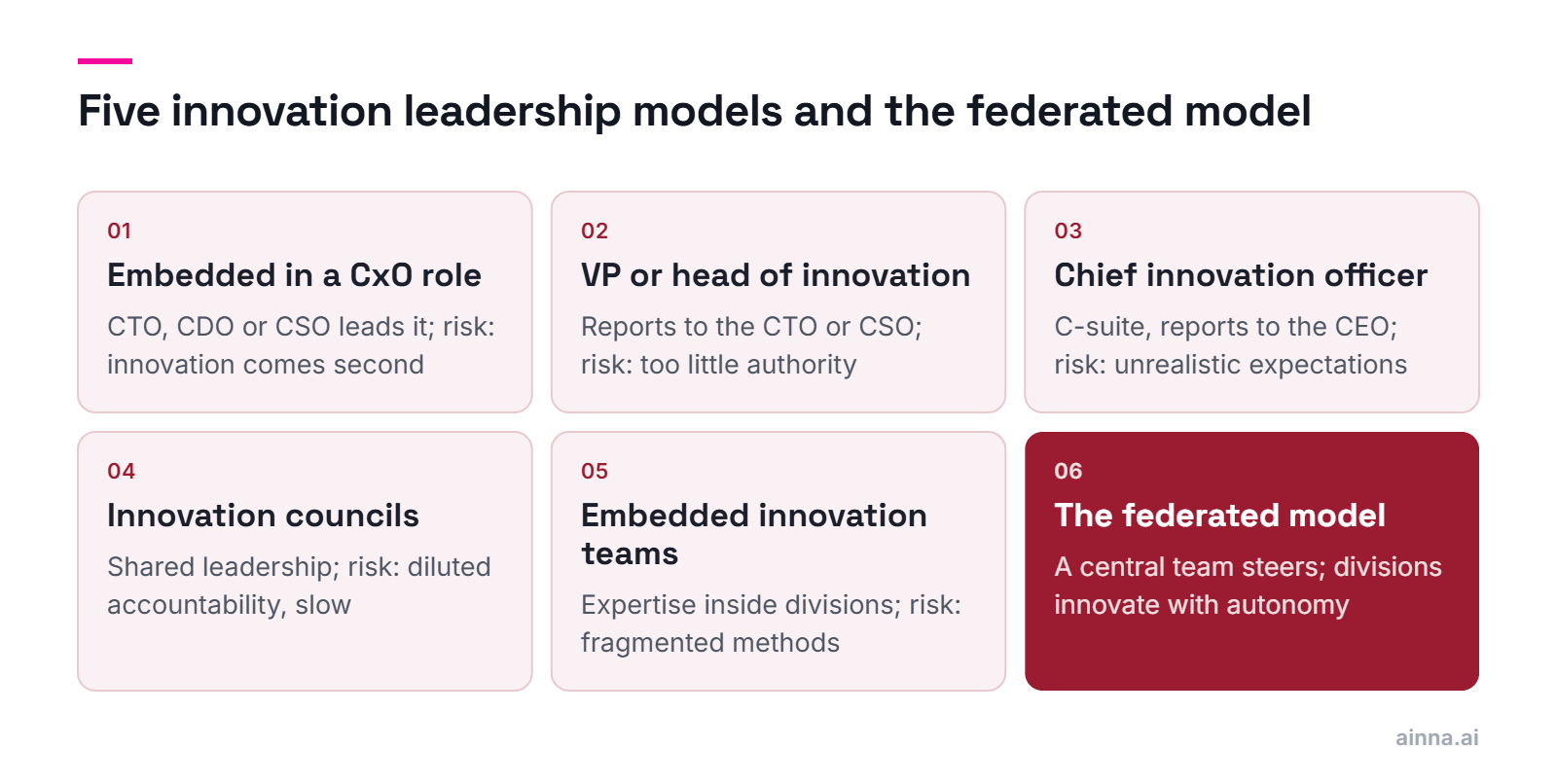
There is no universal answer. The right design depends on the company's industry, size, innovation objectives, strategy and level of innovation maturity. Companies use five models: innovation embedded in another executive's role, a VP or head of innovation below the C-suite, a chief innovation officer, innovation councils, and innovation teams embedded in business units. Each can work under certain conditions, and each carries a hidden risk. An effective design centralizes innovation strategy and orchestration while distributing capability through a network of innovation cores: the federated model.

  • Embedded in a CxO role: the CTO, chief digital officer or chief strategy officer leads innovation alongside their main job. Risk: innovation becomes a secondary priority, often with a technology bias
  • VP or head of innovation: a dedicated leader who reports to the CTO or chief strategy officer. Risk: too little authority and too few resources to drive real change
  • Chief innovation officer: a C-suite role that reports to the CEO. Risk: unrealistic expectations, political friction, organizational inertia and inadequate metrics
  • Innovation councils: shared leadership through cross-functional committees. Risk: diluted accountability and slow, consensus-based decisions
  • Embedded innovation teams: innovation expertise placed inside business divisions. Risk: fragmentation, inconsistent methods and results that stay within each division
  • The federated model: a dedicated innovation team steers the effort and enables every division to innovate with autonomy, yet in alignment
Key Takeaway

No model is safe by default. Choose the one that fits your company's current maturity and strategy, then design deliberately against the risk that comes with it.

A grid of six ways to lead innovation, each with its main risk: embedded in a CxO role, VP or head of innovation, chief innovation officer, innovation councils, embedded teams, and the federated model.
There is no universal answer: each model carries a predictable risk, and the right design depends on industry, size, strategy and maturity.

Should the CTO, chief digital officer or chief strategy officer lead innovation? #

It can work, and in technology companies the CTO often does lead innovation. But embedding innovation in another executive's role carries predictable risks. Innovation tends to become secondary to that executive's core responsibilities. When the CTO leads, innovation is often approached with a narrow focus and a technology bias that neglects other types, such as business model innovation; when the chief product officer (CPO) leads, the focus can stay on existing products. CxOs do not necessarily have a holistic grasp of innovation methodologies, and balancing company-wide orchestration with day-to-day operations is hard.

  • Where it is common: especially in technology companies, the CTO leads innovation; other companies see it as the responsibility of the chief digital officer or even the chief strategy officer
  • Secondary priority: innovation competes with the executive's core job, and balancing strategic orchestration of innovation with day-to-day operations may prove tough
  • Technology bias: a CTO-led program tends toward a narrow, technology-first view of innovation that neglects business model innovation and other types that do not start from technology
  • Product bias: a chief product officer leading innovation risks focusing on existing products and missing opportunities beyond the product landscape
  • Methodology gap: an excellent CTO or chief strategy officer (CSO) does not necessarily have the holistic understanding of the corporate innovation process and methodologies needed to orchestrate a company-wide function
  • If you choose it: treat that executive as the innovation director in full. The team model still applies, with a flat core innovation team reporting directly to them, whether their title is CTO or CSO
Key Takeaway

Embedding innovation in an existing C-suite role is the cheapest option on paper. Its real cost is the types of innovation, and the parts of the company, that fall outside that executive's natural focus.

What is the difference between a chief innovation officer and a head of innovation? #

Position and emphasis. A chief innovation officer sits in the C-suite and reports to the CEO; a VP or head of innovation reports to another executive, often the CTO or chief strategy officer. The core responsibilities are the same, but a C-level leader is expected to emphasize strategic alignment and cultural transformation, while a VP or head of innovation focuses more on process optimization and portfolio management. The lower position carries a known risk: without direct C-suite representation, the leader struggles to secure resources and to drive organizational change.

  • Reporting line: the CINO reports to the CEO and holds the authority and resources to drive change across the company; a VP, SVP or head of innovation reports to another member of the C-suite
  • C-level emphasis: strategic alignment and cultural transformation, plus possible additional responsibilities such as organizational design for innovation, shaping and funding R&D programs and teams, and specific investments
  • VP or head emphasis: process optimization and management of the opportunity portfolio, the operational core of the innovation function
  • The authority risk: leaders below the C-suite typically struggle to secure adequate resources without C-suite approvals, and are often not empowered to drive significant organizational change
  • The perception risk: when innovation is not represented at C-level, the program can look like an isolated effort without strong executive sponsorship, which weakens its message, undermines the culture and makes alignment harder
  • Maturity link: Innovation-active companies have executive-level innovation roles outside the C-suite; at the Innovation-native level, a C-level executive orchestrates the function while innovation talent is embedded in every team
  • Same team model: either way, the innovation team is flat and reports directly to the innovation executive, whatever that person's title
Key Takeaway

A head of innovation can run an excellent function; what they cannot do alone is change how the company allocates resources. If the ambition is transformation, the role needs a seat at the table, or a sponsor who has one.

Do innovation councils and committees work? #

They build buy-in, but as the only form of innovation leadership they risk producing activity without results. Leading innovation through innovation councils or cross-functional committees with decision-making authority is inclusive by design, which makes it easier to win support from leaders across the organization. The price is diffused, and ultimately diluted, ownership and accountability, and slow decisions, because consensus is the mechanism. Members also tend to put their primary roles first, especially under operational pressure. Without clear accountability, innovation efforts risk being seen as innovation theater.

  • The strength: a council invites multiple departments into the process, so leaders across the organization are easier to bring on board
  • Diluted accountability: when ownership is shared by everyone, accountability for outcomes is diffused, and there is no authentic driver for innovation and change
  • Slow decisions: consensus is the decision-making mechanism, which makes the process notably slow
  • Competing priorities: members tend to prioritize their primary roles over innovation, especially during periods of operational pressure; when quarterly targets are at risk, council meetings get cancelled
  • Innovation theater: without clear accountability, activity rises while results stay limited; how innovation theater develops is covered in why corporate innovation fails
  • A better use: keep the cross-functional forum as a steering mechanism for an accountable innovation team. In the Innovation Mode model, orchestrators revise the innovation agenda after steering sessions with the C-suite, while the team owns the program
Key Takeaway

A council is a good way to share information and win support, and a poor way to own outcomes. Give it a steering role and give the accountability to a person.

What are the risks of embedding innovation teams in business units? #

Placing innovation expertise inside business divisions creates innovation cores close to the business, but without orchestration the risks are close to certain: inconsistent innovation methods, gaps in knowledge sharing and limited collaboration across teams. Results tend to stay within the division that produced them, which deepens the sense of isolation and fragmentation. Companies that follow this route face frequent disconnects, overlaps, missed opportunities and partial results, because they cannot innovate as a single system. The fix is not to remove the cores but to connect them.

  • How it works: innovation expertise is injected into business divisions, creating innovation cores that contribute to and coordinate parts of the innovation process within their own teams
  • Inconsistent methods: each division develops its own way of capturing, assessing and pursuing ideas, so opportunities from different divisions are hard to compare
  • Knowledge that stays local: results remain in the team or division that produced them, and gaps open in knowledge sharing and cross-team collaboration
  • Waste at the seams: disconnects, overlaps, missed opportunities and partial results become frequent, and the company's overall innovation performance suffers
  • The upside worth keeping: the decentralized pattern, with the right leadership and orchestration, encourages diverse perspectives, makes innovation more inclusive and typically accelerates implementation
  • The fix: keep the cores and add what they lack, a shared innovation language, methods and tools, and a central team that orchestrates them. That is the federated model
Key Takeaway

Embedded teams put innovation where the business is, which is right. Left unorchestrated, they turn one company into many small innovation programs that never add up.

What is the federated model for organizing innovation? #

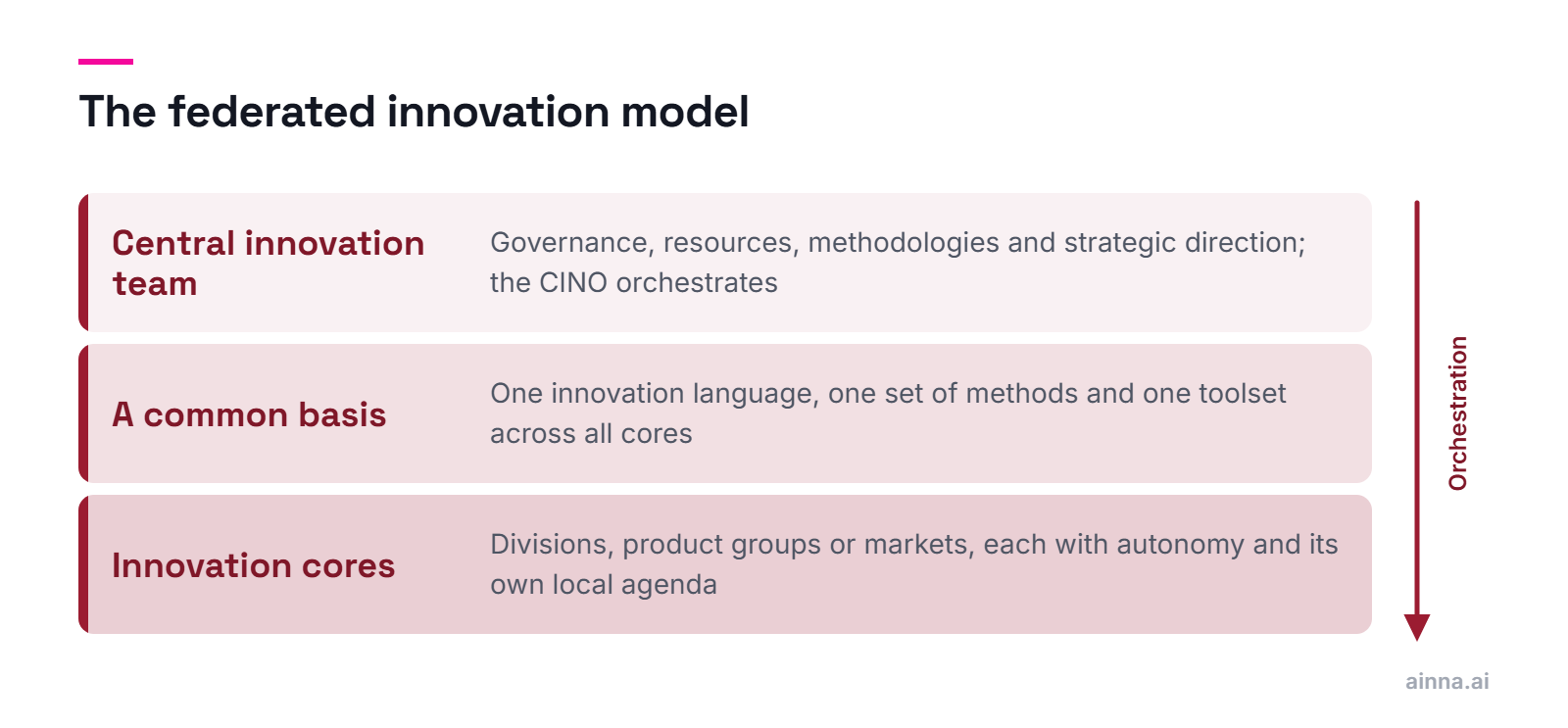
The federated model is a network of innovation cores across the organization that operate independently but are orchestrated by one overall innovation program. Its power is a consistent basis, the same innovation language, methods and tools in every core, so each core keeps its autonomy and local agenda while the network is measured and managed as a single system. A central innovation team provides governance, resources, methodologies and strategic direction. The model combines the specialization and strategic alignment of a centralized model with the local relevance and inclusiveness of a decentralized one.

  • Centralized strategy, distributed capability: strategy and orchestration sit with a dedicated innovation team, while innovation capability is present and accessible across teams and divisions
  • Innovation cores: divisions, product groups or markets each run a core with its own local agenda, which lets the company serve their different business needs
  • A common basis: one innovation language, one set of methods and one toolset across all cores, which is what allows leadership to measure and steer the network as one system
  • The central team's job: governance, resources, methodologies and strategic direction that power the cores; the CINO orchestrates the innovation function rather than owning it
  • What it enables: better planning of innovation resources across the enterprise, faster knowledge transfer between units, and wider adoption of innovation methods and culture
  • What it demands: strong leadership, well-defined decision-making frameworks, and technology for knowledge exchange, strategic alignment and collaboration across organizational boundaries, such as the AI-powered Innovation Portal described in Innovation Mode 2.0
  • Versus the alternatives: a purely centralized model, such as a lab or R&D department, can drift away from operations and leave the rest of the company as consumers of its output; a decentralized one without orchestration fragments
Key Takeaway

The federated model is how a CINO leads innovation without owning it. Drop the common language, methods and tools and it falls back into fragmentation; drop the central team and nothing holds it together.

Three layers of the federated model: a central innovation team giving governance and direction, a common basis of language, methods and tools, and autonomous innovation cores in divisions and markets.
Each core keeps its autonomy and local agenda, while the common basis lets leaders measure and manage the network as a single system.

Did you know? In the Team plan and Enterprise, The Panel brings the experts you trust into the evaluation: invited reviewers add independent assessments alongside The Judge's. Bring your own experts

How is a chief innovation officer different from a CTO, CPO, CDO or CSO? #

Each of those executives owns a domain: technology for the chief technology officer (CTO), the product portfolio for the chief product officer (CPO), digital transformation for the chief digital officer (CDO) and strategy for the chief strategy officer (CSO). The CINO's domain is the company's ability to innovate across all of them: turning the C-suite's strategic direction into an innovation agenda, and bringing product, technology and division leaders into one program. Friction is not unusual, typically over ownership of initiatives and prioritization of investments, so settle both through the innovation agenda and regular steering with the C-suite.

  • Chief strategy officer: strategy sets the direction; the CINO translates the C-suite's strategic directives into an innovation agenda of focus areas and problems worth solving, informed by market trends, competitive dynamics and the company's capabilities
  • Chief technology officer: technology leadership builds and runs systems; the innovation team selects and provisions innovation capabilities but does not implement them, working with internal implementation teams, vendors or consultants to deliver them
  • Chief product officer: product leadership owns existing products; the CINO looks beyond the product landscape, including business model innovation and new ventures, and builds the capability to take validated opportunities to market
  • Chief digital officer: CINOs are typically found where companies invest heavily in both innovation and digital transformation, so boundaries with digital leadership need to be explicit; some companies give innovation leadership to the CDO instead
  • Where friction comes from: conflicts with other C-suite roles over ownership of initiatives and prioritization of investments are not unusual, and some business leaders question what innovation programs contribute
  • How to reduce it: the innovation director educates the C-suite on innovation methods, macro trends, emerging technologies and consumer behavior, and reflects leadership's guidance and priorities in the innovation agenda, so peers shape the agenda rather than compete with it
  • Orchestrate, not own: in a federated setup, innovation happens inside the other executives' organizations, with the CINO providing the method, tools and strategic direction that let it happen consistently
Key Takeaway

The CINO is the one executive whose domain cuts across all the others. That works when peers see the role as a multiplier for their teams, and struggles when it looks like a rival for ownership and investment.

What is an innovation dream team, and what does it do? #

The innovation dream team, or core innovation team, is the high-performing, cross-disciplinary group the innovation executive needs to transform the company. It is not there to produce innovation. Its mission is to enable people, teams and the whole organization to innovate, so it has no pure implementation roles and works across the organization as an autonomous team. It leads the innovation transformation program, provisions innovation capabilities, operates the innovation function and drives the culture of innovation. To do that it needs the right resources, increased autonomy and exceptional talent.

  • Leads the transformation program: defines and architects the program that moves the company up the Innovation Maturity Index, owns its initiatives, workshops and education activities, and brings data, insights and proposals to the C-suite
  • Provisions capabilities: selects and delivers systems such as AI-powered ideation tools, market intelligence tools and tools for planning and hosting hackathons, without building them; wide adoption is part of the team's definition of done and a leading indicator of success
  • Operates the function: maintains the innovation agenda and a unified innovation calendar, manages the portfolio of innovation projects, sets the cadence of big events so innovation and execution stay in balance, and runs communication that informs without creating noise
  • Drives the culture: grows an active community of innovators by giving feedback on ideas, mentoring teams and listening to people across levels and departments
  • Who belongs: people who excel in innovation methodologies, strategy, leadership, communication and program management, and who understand the organization and its industry, market, competition and emerging trends
  • How to position it: say clearly that the team exists to enable innovation rather than to innovate, so no one mistakes it for a group doing innovation in isolation; its purpose is to open innovation up to everyone
Key Takeaway

The test of a dream team is how much innovation happens outside it. If most of the company's innovation comes from the team itself, it has become the bubble it was meant to prevent.

Which roles make up the core innovation team? #

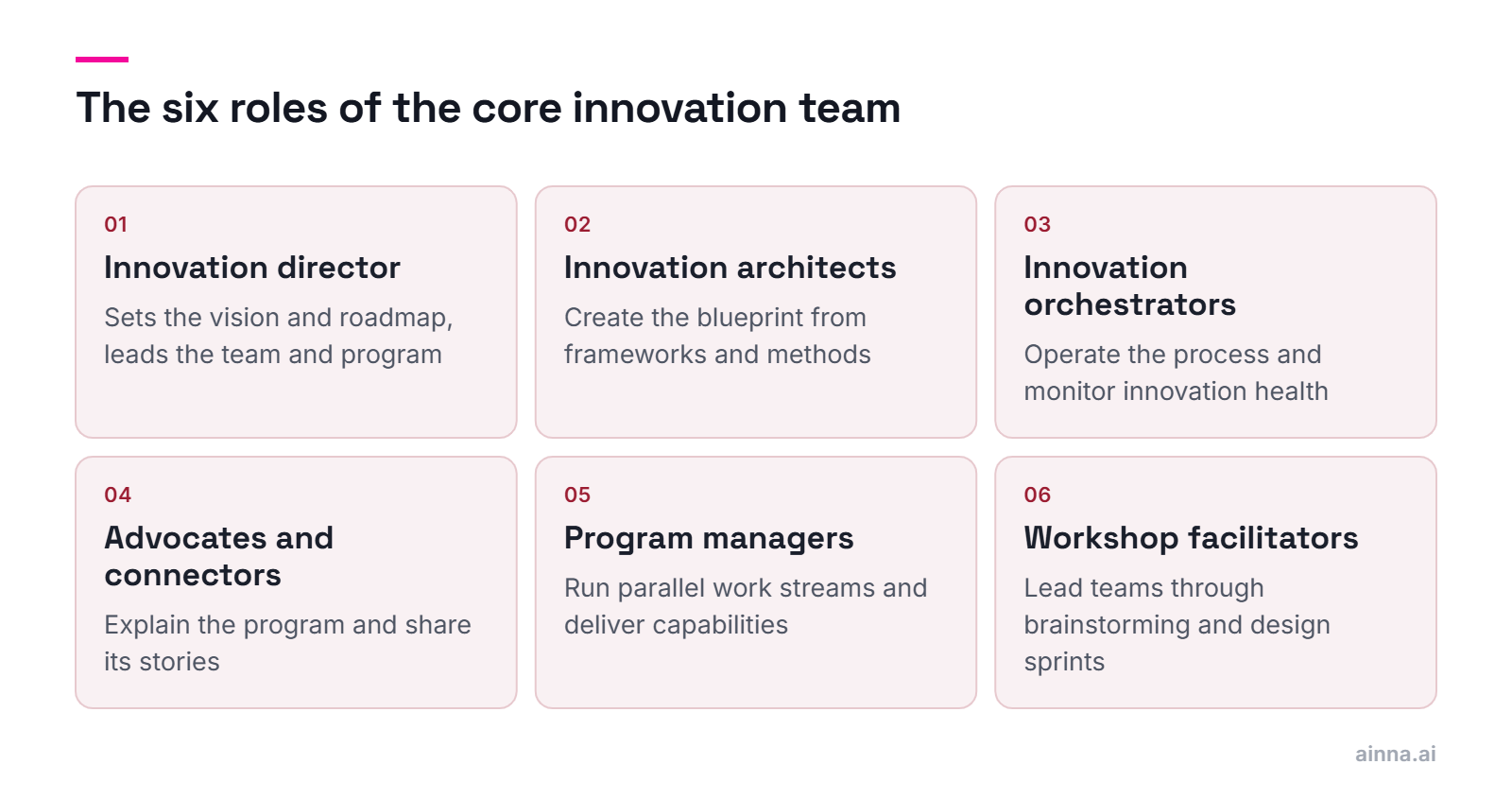
Six roles form the core: the innovation director plus innovation architects, innovation orchestrators, innovation advocates and connectors, program managers and workshop facilitators. Together they are strong enough to launch the innovation transformation program and bring the first waves of change. The structure is flat: every member reports directly to the innovation executive, who reports to the CEO as chief innovation officer or to another C-suite member as VP or head of innovation. Core members are senior leaders fully committed to the program.

  • Innovation director: the innovation executive, whatever the title; sets the vision and roadmap, leads the team and program, partners with business leaders to adopt innovation practices, and educates the C-suite on innovation methods, macro trends and emerging technologies
  • Innovation architects: experts in innovation frameworks, methodologies and organizational design who create the blueprint for the innovation function, assess technological readiness and gaps, and shape roadmaps, priorities and work streams
  • Innovation orchestrators: operate and improve the innovation process, monitor innovation health metrics, review the opportunity portfolio, drive steering discussions with key stakeholders, and organize education such as an innovation academy
  • Advocates and connectors: passionate communicators who explain the program and its achievements, share inspiring stories, and bring innovators, teams and stakeholders together around specific initiatives and opportunities
  • Program managers: innovation leaders rather than coordinators, who run parallel work streams, deliver innovation capabilities with speed and without bureaucracy, and drive adoption by demonstrating the value of each deliverable
  • Workshop facilitators: skilled innovators who lead cross-functional teams through brainstorming sessions and design sprints, synthesize insights into concepts in real time, and manage group dynamics while staying neutral
  • Lead by example: architects and orchestrators also take part in workshops, share ideas and give feedback, so the core team is seen as innovators, mentors and builders
Key Takeaway

Start with this core rather than a large team. How to find and source these people is covered in hiring a chief innovation officer.

A grid of six core innovation team roles: innovation director, innovation architects, innovation orchestrators, advocates and connectors, program managers, and workshop facilitators.
Together these roles can launch the transformation program; an extended team adds technology, validation, commercial and specialist roles later.

How does the innovation team grow beyond its core? #

As the program progresses and the workload grows, an extended team adds the roles that make innovation actionable and faster. They do not have to be acquired at once: some can be provided just in time, as a service, which keeps the team elastic. The extended roles cover technology and product, validation and ventures, commercial strategy, and specialist services. Beyond them, a community of volunteer innovators and a Guest Innovator rotation add capacity, and as maturity rises the team can grow into satellite service teams reporting to the innovation director.

  • Technology and product: technology advisors who explain what emerging technologies can and cannot do, product architects who turn early ideas into concepts and technical architectures, and senior product managers who define MVPs and pursue product-market fit
  • Validation and ventures: opportunity validation leads who own the validation strategy for each concept, MVP leads who define and ship minimum viable products, and venture leads who grow them toward product-market fit; see the venture building team
  • Commercial and strategic: business strategists who validate business models and prioritize opportunities against strategy, commercialization advisors who shape monetization and go-to-market, and intrapreneurs who bring a startup mentality
  • Specialist services: legal advisors with innovation-adapted risk frameworks and IP expertise, a content creation lead who runs the Innovation Portal and newsletter, and a market intelligence lead who turns market signals into insights
  • Just in time or full time: a legal advisor might join only for a patentability assessment, while the MVP lead may be a full-time product expert who takes validated opportunities and ships MVPs
  • Community and rotation: volunteers from the community of innovators and the Guest Innovator program, which rotates employees in for a project or a period, add elasticity and connect the team to the rest of the organization; contributions count toward the innovation rewards program
  • Satellite teams: as the company matures, stand-alone service teams can form around the core, each reporting to the innovation director and covering one area: communication and content; market intelligence; opportunity discovery and concept testing; execution and product development; go-to-market and commercialization; and venture building, incubation and product-market fit
Key Takeaway

Grow the team as the program earns it, and take some expertise as a service rather than as headcount. The elastic setup also keeps the team visibly connected to the rest of the company.

While innovation success often results from collaborative efforts across an organization, corporate innovation failure always reflects leadership's limitations or poor decisions.

Why do chief innovation officers struggle or fail? #

Often because of false expectations about the role rather than the person in it. Expectations of rapid transformation, from the C-suite and the wider company, undermine programs that by design deliver over long timeframes and must accept certain types of failure. CINOs face political friction with other executives over ownership and investment priorities, skepticism from business leaders, and inertia when innovation is concentrated in a single role. They are pressed to prove returns but judged by incomplete metrics. And a CINO given a title without a team, budget or genuine sponsorship tends to become passive, or leave.

  • Unrealistic expectations: innovation is a capability that compounds over time, not a quick fix. Part of the role is to educate the C-suite on appropriate success metrics and set meaningful expectations early
  • Political friction: conflicts with other C-suite roles over who owns certain initiatives and which investments come first are not unusual; see how the CINO differs from and works with the rest of the C-suite
  • Skepticism: some business leaders do not value the potential of innovation programs and question their contribution, which makes visible, well-measured progress essential
  • Organizational inertia: when innovation leadership is concentrated in one role, other leaders may not feel part of the effort and show limited engagement; a federated design gives them a stake in it
  • The wrong metrics: pressure to show returns on innovation investment is reasonable, but inadequate or incomplete metrics fail to capture much of what the innovation function and the opportunity discovery process produce
  • A title without support: without a team, a budget and genuine executive sponsorship, even a capable CINO becomes passive or leaves
  • Misreading the job: expecting the CINO to be the chief ideator, a technical inventor or a symbolic motivator pulls the role away from building the capability; the full catalog of failure patterns is in why corporate innovation fails
Key Takeaway

Most of these problems are set before the CINO starts, in how the role is defined, resourced and measured. Fix the design, and a capable leader has a real chance; skip it, and no hire will be good enough.

Does having a chief innovation officer create innovation silos? #

Not by itself. The fear is that a formal innovation leader signals a centralized approach, with an isolated team in an 'innovation bubble' disconnected from the business. The bubble is a real risk that companies should mitigate, but it comes from the strategy and the design of the innovation program, not from the presence of a leader or a team. A leader educated in innovation methodologies and organizational design can do the opposite: give everyone capabilities, methods and consistent tools, and promote and reward collaboration. Breaking silos should be one of the role's formal objectives.

  • Why the fear exists: executives worry innovation will become the exclusive domain of a specialist team, business units fear being underrepresented, and employees expect to be less empowered to innovate
  • The lab precedent: many organizations have watched stand-alone innovation labs produce impressive prototypes but minimal business impact, which feeds skepticism about any formal innovation function
  • The real cause: silos come from programs that concentrate innovation in one place; a centralized lab can leave the rest of the organization feeling like consumers of the ideas and knowledge it produces
  • What a skilled CINO does instead: acts as enabler and orchestrator of the company-wide innovation process, providing capabilities, methods and tools for every department, and rewarding collaboration and knowledge exchange
  • Position the team deliberately: make clear it is not set up to produce innovation, that it works as a hub connected to every part of the organization, and that it exists to educate people and invite everyone into the process
  • Open the doors: a launch announced by senior executives at a highly visible event such as an all-hands, real examples of the team enabling others, and talent rotation schemes all show that the team is open
  • Make it a formal objective: empowering others to innovate, rather than owning or containing innovation in one department, belongs in the role's written objectives and should be measured
Key Takeaway

The title does not decide whether innovation is opened up or closed in; the program design does. Appoint the leader, and design the program to open innovation to everyone.

How do you know whether a chief innovation officer is succeeding? #

Judge the whole innovation function, not only the financial return on innovation investment. A robust innovation performance measurement system gives a comprehensive view of the function's health: the opportunity pipeline and portfolio, adoption of innovation capabilities, engagement and culture, and business outcomes over time. Agree the metrics with the C-suite in advance, because educating leadership on appropriate success metrics is itself one of the CINO's responsibilities. Movement up the Innovation Maturity Index shows whether the company is actually becoming more innovative.

  • Pipeline: track how ideas become assessed opportunities, validated concepts and launches, not just how many ideas are captured, and review the opportunity portfolio regularly against strategic priorities
  • Adoption: wide adoption of the innovation capabilities the team provisions is part of its definition of done and a leading indicator of success
  • Engagement and culture: steer the program with metrics that reflect progress, engagement and the cultural aspects of innovation, alongside innovation health metrics
  • Business outcomes: innovation delivers over long timeframes, so set goals for outcomes early and judge ventures against them; see measuring corporate ventures
  • Maturity: reassess the company against the Innovation Maturity Index; at the Innovation-powered level, all aspects of innovation performance are measured and outcomes are regularly discussed at the C-suite
  • Reporting: a regular 'state of innovation' built on the measurement framework gives the C-suite a shared view and keeps expectations realistic
  • Warning signs: activity without results, innovation that stays inside the innovation team, peers who do not engage, and metrics that count only ideas all suggest the role is not working
Key Takeaway

A working CINO makes the company measurably better at discovering, validating and launching opportunities. Chapter 9 of Innovation Mode 2.0 sets out how to measure that across its dimensions.

Inside Ainna One method for every opportunity your company pursues. Ainna Enterprise frames, assesses and documents every opportunity the same way, so leaders compare like with like. See Ainna for enterprise

How does innovation maturity shape the way innovation should be led? #

Each level of the Innovation Maturity Index implies a different leadership setup, so the right way to lead innovation depends on where the company stands and where it is heading. At the lower levels there are no roles to run innovation at all. Innovation-active companies add executive-level innovation roles outside the C-suite; at the Innovation-powered level a dedicated executive orchestrates the whole function; and at the Innovation-native level a C-level executive orchestrates while innovation talent is embedded in every team. The seven levels themselves are described in the guide to why corporate innovation fails.

  • Innovation-inactive to Innovation-engaged: no innovation roles or leadership run the process; where activity exists, it is ad hoc and unmeasured
  • Innovation-active: innovation is on the corporate agenda with a strong message from leadership, and executive-level innovation roles appear outside the C-suite
  • Innovation-powered: a dedicated executive orchestrates a well-organized innovation function, performance is measured, and outcomes are tracked and discussed at the C-suite
  • Innovation-led: innovation is embedded in the core business and runs as a single system for discovering, validating and launching opportunities
  • Innovation-native: a C-level executive orchestrates while innovation talent is embedded in every team, and AI is integrated into the innovation process
  • Use it for design, not labels: place the company honestly on the seven-level Innovation Maturity Index, then choose the leadership model for the level you are moving to
Key Takeaway

Design leadership for the level you are moving to, not only the one you are at. Smaller companies can reach high levels with basic tools, but the larger the organization, the more advanced the technology its innovation function needs.

Where should a company start when organizing innovation leadership? #

Start from where the company stands and what the role is for. Use the Innovation Maturity Index to take an honest view of the current level and set the next one. Weigh the five leadership models against your industry, size, objectives and strategy. Define the innovation executive's mandate and responsibilities before settling the title and reporting line. Then back that leader with a core team, resources, autonomy and visible C-suite support, position the team as an enabler for everyone, and agree early how success will be measured.

  • Assess maturity: reflecting honestly on the current state of innovation unveils blind spots and lays the groundwork for a strategic improvement plan; the Innovation Maturity Index gives that reflection a shared scale
  • Pick the model deliberately: compare the five leadership models and their risks, and design toward central orchestration with distributed capability
  • Define the role before the title: write down the mandate, to empower the organization to innovate at scale and pace, and the responsibilities, then decide whether the role belongs in the C-suite or at VP level
  • Hire or appoint against that definition: readiness, competencies, interviews and the choice between appointing from the market and promoting from within are covered in hiring a chief innovation officer
  • Resource the team: the innovation executive needs a dream team with the right resources, increased autonomy, and the full trust and support of the C-suite
  • Launch it visibly: senior executives should announce the innovation team, ideally at a highly visible event such as an all-hands, as the start of an era in which people are empowered to have a greater impact through innovation
  • Agree the measures early: settle with the C-suite what success means and how it will be reported, so expectations match the long timeframes over which innovation delivers
Key Takeaway

Treat innovation leadership as an organizational design decision rather than a single appointment, and the appointment itself becomes far easier to get right.

How is AI changing the role of the chief innovation officer? #

AI makes the role more important, not less. When AI can generate ideas in seconds, ideas stop being scarce, and the differentiator becomes the organization's capability to discover, validate and pursue the right opportunities systematically, which is exactly what the CINO is accountable for building. The work shifts toward provisioning AI-powered capabilities, connecting innovation cores through shared platforms, and leading people through the change. At the Innovation-native level of maturity, AI is integrated across the innovation process while a C-level executive orchestrates it.

  • Ideas are no longer the constraint: the scarce capability is deciding which opportunities deserve validation and investment and taking them to market, and that is the system the CINO builds
  • AI across the process: at the Innovation-native level, AI provides market intelligence, contributes ideas, validates opportunities and helps take products to market, drawing on the Innovation Graph, an AI-powered network of innovation knowledge, ideas and opportunities
  • Provisioning, not building: the innovation team selects AI-powered systems for ideation, opportunity identification and market intelligence, and drives their adoption; platforms such as Ainna apply one method to frame and assess opportunities across teams
  • Federation runs on technology: connecting innovation cores across divisions takes platforms for knowledge exchange and collaboration, such as the AI-powered Innovation Portal and hub described in Innovation Mode 2.0
  • Less routine work: generative AI can handle routine communications, summaries for specific audiences, portal updates and newsletter drafts, freeing the team for strategic storytelling
  • More inclusive events: AI tools let non-developers prototype alongside engineers, which makes hackathons and other innovation events more inclusive
  • Leading people through it: how innovation roles are changing, and how innovation leaders should introduce AI without damaging the culture, is covered in how innovation leaders should adapt to AI
Key Takeaway

AI raises the bar for the CINO rather than removing the need for one. The companies that benefit will be those whose innovation function turns abundant ideas into validated opportunities, and that function still needs someone to orchestrate it.

Inside Ainna

One method for every opportunity in your portfolio

Ainna Enterprise applies the Innovation Mode methodology across your innovation team: every idea framed the same way, scored against the same criteria and documented as an investment case, so decisions compare like with like.

Ideas in โ†’
Opportunities out.