How do you build a culture of innovation in the workplace? #

A culture of innovation is built by measuring where it stands, removing what blocks people, applying six inexpensive fixes, and improving continuously in short loops. As I wrote in Innovation Mode 2.0, “Fixing the culture is difficult,” and it usually takes several long-term initiatives. Before investing in expensive transformation programs, leaders should consider “introducing certain inexpensive ‘fixes’ and ‘hacks’ that can bring cultural improvements organically.” Then run the work as a continual Motivate, Enable, Measure loop.

  • Measure first: an initial measurement sets the basis for continual improvement, so every later initiative can be judged; see how to measure innovation culture
  • Start with quick wins: complex processes, poor communication, missing education on innovation and a limited grasp of innovation methods are the cheapest problems to fix first
  • Remove the blockers: the eight blockers of innovation culture are the everyday costs that stop people from sharing and pursuing ideas
  • Apply the six fixes: define what innovation means for your company, redefine failure, add elasticity to the organizational structure, educate innovators, become responsive and transparent, and connect with innovators
  • Strengthen the six components: every fix builds one or more of trust, safety, openness, curiosity, purposefulness and healthy competition
  • Run it as a loop, not a project: the MEM loop repeats every few weeks or months and adapts to what the measurements show
Key Takeaway

Do not launch a transformation program to fix a culture. Remove what stops the people you already have, then keep measuring.
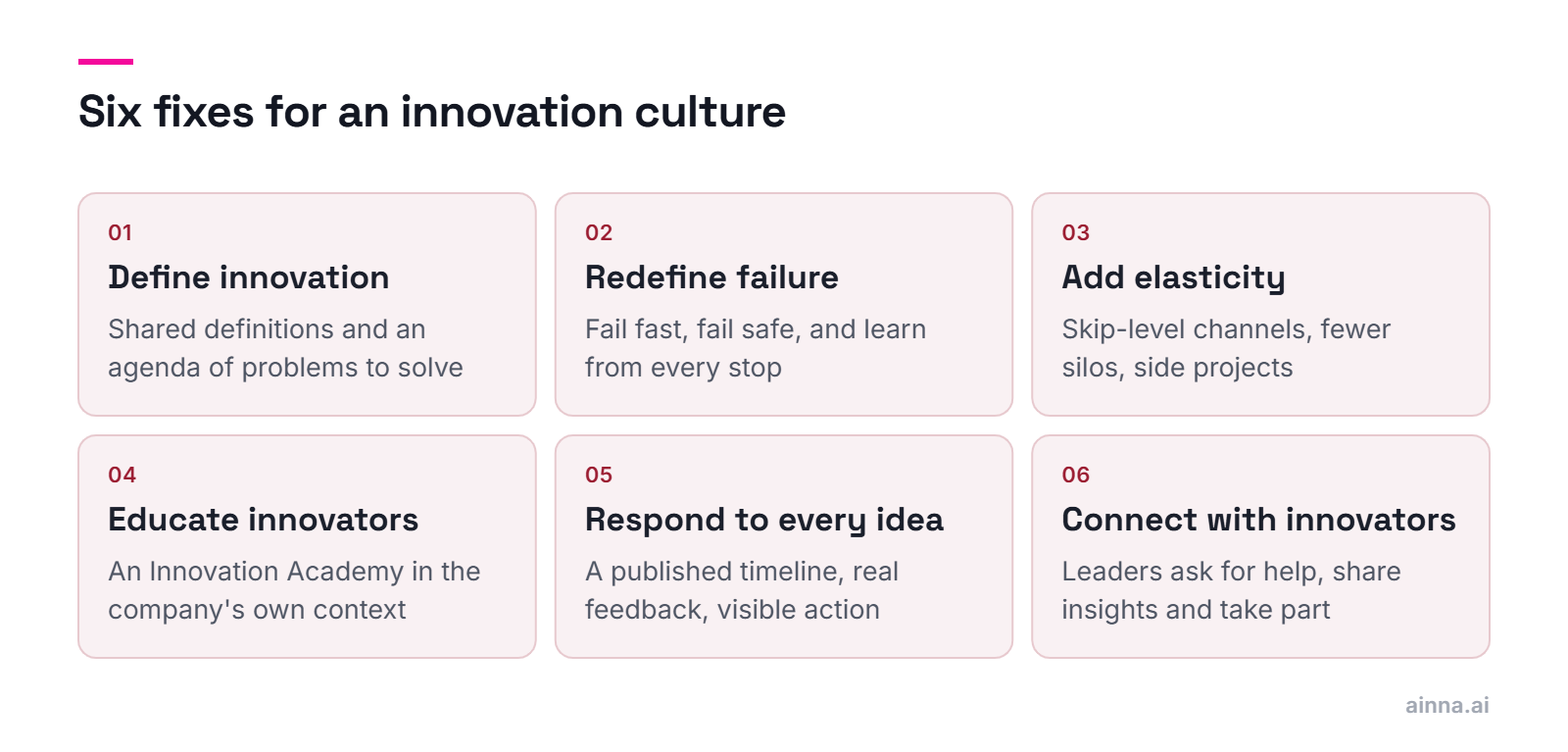
A grid of six fixes for an innovation culture: define innovation, redefine failure, add elasticity, educate innovators, respond to every idea, and connect with innovators.
Inexpensive fixes to apply before any transformation program, measured first and then improved in short loops.
Inside Ainna One method for every opportunity your company pursues. Ainna Enterprise frames, assesses and documents every opportunity the same way, so leaders compare like with like. See Ainna for enterprise

What are the barriers to an innovation culture, and how do you remove them? #

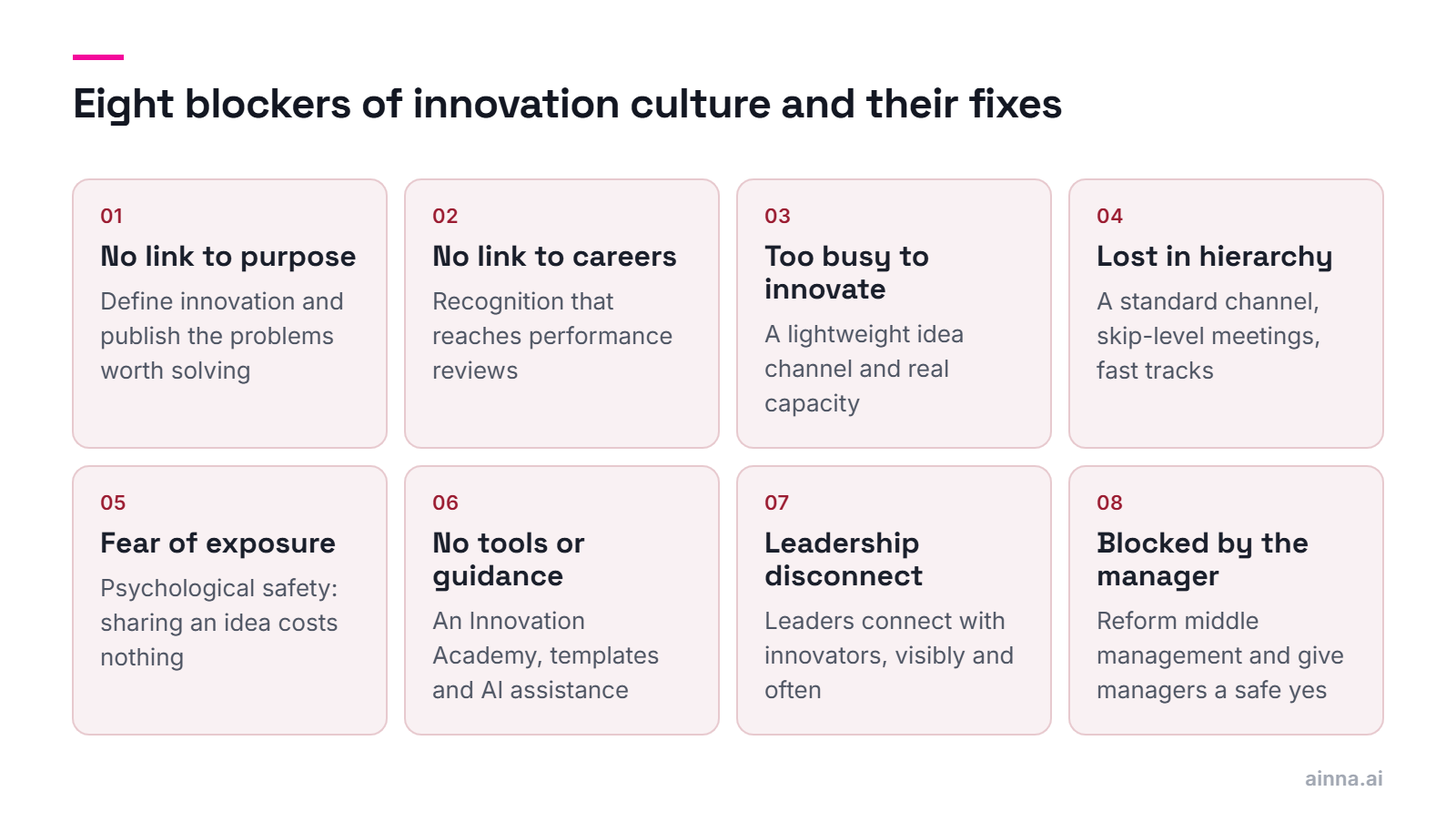
The barriers to an innovation culture are the everyday costs that stop people from sharing and pursuing ideas. Innovation Mode 2.0 names eight blockers: innovation not linked with strategy and purpose, no link with career progression, people too busy to innovate, ideas lost in hierarchy and bureaucracy, fear of exposure and criticism, a lack of tools, templates and guidance, leadership disconnect, and managers who block participation. Each blocker has a fix, and most of the fixes are inexpensive.

Key Takeaway

Give every blocker an owner and a fix. A blocker nobody owns is a blocker that stays.

A grid of eight blockers of innovation culture, each with its fix, from no link to purpose, fixed by defining innovation, to blocked by the manager, fixed by reforming middle management.
Each blocker is an everyday cost people weigh before they share an idea, and most of the fixes are inexpensive.

How do you define what innovation means for your company? #

Defining innovation for your company means writing down, in your own context, what counts as innovation and how it serves the purpose. “Novelty, innovation, and success mean different things to people.” Innovation Mode 2.0 recommends a set of solid definitions adapted to your company's context, kept in the Innovation Playbook, so everyone shares one innovation language. The Innovation Agenda then turns the strategy into specific problems and opportunities worth pursuing, and leaders keep telling the story of how innovation shaped the company.

  • A shared language: the definitions belong in the Innovation Playbook, where they give everyone one innovation language and show how innovation aligns with the organization's vision
  • Connected to the purpose: when employees cannot see how innovation serves the company's purpose, they are less likely to embrace the culture, so leaders have to show the link again and again
  • The Innovation Agenda: a living document that presents the purpose, mission, vision and strategy and translates them into the problem space the innovation engine should focus on; see how to frame a problem statement
  • Compelling narratives: leaders explain how the company uses innovation, how innovation has shaped it, and how it is expected to define its future
  • Expand the field of view: market signals, competitive insights and innovation stories from the public domain, built into daily routines, help teams spot problems and opportunities beyond the company's microcosm
  • Why it pays off: “When people see how innovation is framed as part of the company's strategy, they engage more and adopt the culture of innovation faster.”
Key Takeaway

If ten managers would define innovation ten different ways, start here. A shared definition is the cheapest fix on the list.

How do you build a culture of experimentation where failure is safe? #

A culture of experimentation starts with redefining failure. In most companies failure implies a bad idea or poor execution, and a blame game follows. Innovation-led organizations still optimize for success, but they also have mechanisms to handle failure as part of a culture that promotes experimentation and risk-taking. The core is the fail-fast, fail-safe principle: a negative result is welcome if it comes early, before significant resources or commitments. In an innovation context, “a negative result is not a failure: it is an informed decision.”

  • Fail fast, fail safe: an unsuccessful result is accepted without friction when it happens early and before significant resources, dependencies or commitments; see what fail fast, fail safe means
  • Failure, redefined: in an innovation context, a failure is an initiative that “didn't make it to the next stage,” such as a project parked or killed because it missed its success criteria
  • The portfolio approach: over a long enough period the company experiments with many opportunities, expects a share of them to fail, and gains from the few that succeed; early failures free people and budget for the rest
  • Learn from it, do not just tolerate it: retrospectives on the original hypotheses are the part that pays. A study of 106 US manufacturing firms found that “mere tolerance for failure has no effect on firm product innovativeness,” while analyzing past failures led to more innovative products (Danneels and Vestal, 2020)
  • A signal to everyone: accepting failure in this way shows people that genuine innovation is really happening in the organization
  • Tell the stories: leaders present ambitious projects that were killed early, the invalidated hypotheses and the lessons, and the community shares its own failure lessons learned
  • Experiment by design: product experiments test assumptions before anything is built, so failure happens where it is cheap
Key Takeaway

People take smart risks when they see leaders praise a project that was stopped for good reasons. Say so in public, with the reasons and the lessons.

How do hierarchy and bureaucracy slow innovation, and what can you cut? #

Hierarchy and bureaucracy slow innovation because ideas get lost in layers and approvals, and what you cut is the friction, not the structure: add elasticity at the points of friction instead of waiting for a reorganization. “Too much organizational structure constrains and decelerates innovation.” Structural change is slow, costly and risky, so Innovation Mode 2.0 recommends targeted hacks: a skip-level channel for innovation, cross-department teams, innovation in every role, fast-track exceptions to strict processes, side-innovation projects, and an active community of innovators that networks across divisions and levels.

  • Skip-level for innovation: ad hoc meetings where innovators present mature, well-prepared ideas to senior stakeholders; they “should be encouraged by direct managers and shouldn't require their approval.”
  • Innovation in every role: adding innovation to job descriptions and performance assessments tells middle management to value and measure innovative contributions
  • Break the silos: connect teams through a shared innovation hub so they see each other's ideas, problems and solutions; otherwise two groups can end up solving the same problem independently
  • Remove bureaucracy where it hurts: create exceptions designed for innovation, such as faster provisioning of skills, technology and materials, instead of long forms and approvals for a raw idea; see removing formalities from product teams
  • Side-innovation projects: people with the bandwidth join or start projects without managerial approval or other formalities, and leadership keeps a visible portfolio of them
  • A community of innovators: invite self-motivated innovators, builders and mentors to found it; with a strong message from leadership, resources and branding, this core of enthusiasts can drive an organic cultural shift
Key Takeaway

Most bureaucracy was designed for predictability, not against innovation. Keep the rules and add a fast lane beside them.

Can you train employees to innovate? #

Yes. Employees can be trained to innovate, and it works best as an Innovation Academy: an ongoing education program that teaches innovation in the company's own context. Education “increases general interest, willingness, and readiness to innovate,” and a program built around the company's own context signals how much innovation matters there. Innovation Mode 2.0 suggests starting with three inexpensive packages: the Innovation Playbook, the Journey of an Idea, and the Power of Experimentation. Deliver them through live sessions, recordings and quick-start guides, ideally led by innovators themselves.

  • The Innovation Playbook: “It stands as your organization's definitive manual on ‘how to innovate.’” It holds definitions, problem spaces, methods, tools, templates and key contacts
  • The Journey of an Idea: how ideas are captured, assessed, framed as opportunities, validated and brought to market, with real examples; see the idea assessment model
  • The Power of Experimentation: how prototyping and business experiments reduce uncertainty before large investments, including AI tools that build working prototypes from natural language descriptions
  • Peer educators: sessions led by internal innovators create a community-driven learning environment that reinforces a growth mindset and the innovation culture
  • A learning culture: failure lessons learned and success stories from the community become articles, videos and podcasts in the innovation knowledge base
  • A team to run it: a dedicated innovation education team owns content, events, measurement of success and the program's expansion across the organization
Key Takeaway

Training is also a message. When a company teaches innovation in its own context, people conclude that innovation is part of the job.

How should a company respond to employees' ideas? #

A company should respond to employees' ideas promptly, meaningfully and with visible action. “The promise of innovation raises the bar.” People who share bold ideas expect at least a prompt response, constructive feedback, genuine recognition and a chance to develop the idea further, yet many ideators meet long silences or template replies. Innovation Mode 2.0 recommends three things: respond on a published timeline, act on ideas, and make the process transparent.

  • The first iterations decide it: failing to respond promptly and meaningfully puts the culture and the whole initiative at risk, especially early on, when early adopters set the tone for everyone else
  • Respond on a published timeline: explain what happens after an idea is submitted and how long an assessment takes, then meet it; frequent delays stop people from sharing again
  • Make feedback meaningful: “Quality of response matters as much as speed.” Acknowledge the effort and give insightful, actionable feedback in an appreciative tone
  • Act on ideas: pitching, prototyping, focused research or a presentation to leadership; even when an idea goes no further, serious consideration keeps people innovating
  • Make the rules transparent: publish how ideas are assessed and prioritized, the assessment criteria with real examples, the rules of the rewards program and the intellectual property policies
  • Meet the other expectations: regular chances to pitch, mentorship and guidance for newcomers, room to experiment, visibility and recognition, and leaders who take part
  • At any size: a small company can run idea evaluation as “‘internal services’ powered by simple methods and operated manually by small, effective teams without sophisticated technologies”; at larger volumes, skilled evaluators and AI keep feedback meaningful, which is where Ainna fits
Key Takeaway

Silence is also an answer, and innovators hear it as indifference. A short, honest reply beats a perfect one that arrives in three months.

What should leaders do to build a culture of innovation? #

Leaders build a culture of innovation by connecting with innovators, visibly and often. “Connecting with innovators is probably the most effective way to prove leadership's commitment to innovation and, thus, a great way to grow a healthy innovation culture.” Innovation Mode 2.0 names four moves: ask the community for help with real business challenges, share innovation insights and data stories, recognize top innovators, and take part in innovation activities as mentors, judges and innovators.

  • Ask for help: a call to innovate presents a strategic problem worth solving and asks the community for solutions, through hackathons or pitch sessions with leadership. “Such initiatives are low-cost yet high-impact.”
  • Share innovation insights: data stories on the ideas handled, conversion from idea to experiment or prototype, and community growth, plus survey findings discussed openly even when they show problems
  • Recognize top innovators: highlight ideas and achievements at all-hands and through badges, titles and awards, so recognition becomes a positive reinforcement loop
  • Engage with innovation: “When leaders visibly participate in ideation sessions, hackathons, or opportunity reviews, they send a strong signal that innovation is real.”
  • Show real examples: because the word innovation is overused, people need concrete examples of ideas from innovators that became tangible business opportunities
  • Avoid the disconnect: weak messages, superficial engagement and parked ideas make people doubt the company means it; see how leaders and managers block innovation
  • Give the function an owner: someone has to lead the innovation function end to end; see the chief innovation officer role and how to hire one

These “calls to innovate” send a clear message: the organization seeks innovative solutions from within its own talent pool.

Key Takeaway

Leaders do not build the culture with speeches. They build it every time they show up, ask for ideas and act on what they hear.

Inside Ainna Know which opportunities deserve the budget. The Judge, Ainna's AI evaluator, scores each opportunity across ten dimensions and shows its reasoning. Explore Ainna Enterprise

How do you create psychological safety for innovation? #

Psychological safety for innovation is created by making it safe to share, safe to criticize and safe to fail, and by proving it through what leaders do. Innovation Mode 2.0 describes the target state: “The dominant culture is supportive of sharing, contribution, and constructive feedback, and so is the underlying innovation framework.” In practice that means leaders who invite critique of their own ideas, a lightweight channel for any idea, a prompt answer to every submission, and early failures treated as informed decisions.

  • As a leader: ask the community for help on real problems, take part in ideation sessions and hackathons, and put your own ideas up for critique like everyone else's
  • In idea reviews and meetings: judge ideas against published criteria, invite critique of every idea whatever its source, and follow the Healthy Competition Protocol
  • For anyone with an idea: a lightweight, standard channel to share an idea without committing to research, pitch or prototype it, so contributing costs minutes, not days
  • In the response: “The minimum expectation from an innovator about a proposal or idea submission is attention and acknowledgment.”
  • In virtual and distributed teams: asynchronous ways to contribute, and more lead time for workshops and hackathons, so time zones and workloads do not decide who takes part
  • In how failure is handled: a negative result reached early is an informed decision; see how to build a culture of experimentation
  • In what gets rewarded: recognize sharing, contribution and constructive feedback, not only winning ideas, so safe behavior is also rewarded behavior
Key Takeaway

Psychological safety is built by consequences, not posters. What happens after someone first criticizes a senior leader's idea decides whether anyone does it again.

How much time should employees get to innovate? #

Employees should get time to innovate in two forms: first a way to contribute that costs no extra time, then real capacity for the ideas that earn it. Many teams are “too busy to innovate” or protective of the established pace of the business, a concern Innovation Mode 2.0 accepts as valid. Start with a lightweight way to register ideas without extra work. Then add capacity: dedicated time for innovation, resources for the winners of innovation events, and organizational slack, the unused capacity that can be redirected to a visible portfolio of projects anyone with bandwidth can join.

  • Capture ideas silently: team members register ideas asynchronously in a separate backlog, and the project manager reviews them for the current scope or future iterations, so innovation does not disrupt delivery
  • An outside innovator: for complex, long-running projects, an experienced employee joins as an observer in silent mode and proposes novel features only when there is a justified opportunity
  • Dedicated time: “The simplest method is to allocate specific time for innovation, allowing employees to decide how to utilize it.”
  • Resources for winners: the winning teams of innovation events get the time, equipment and resources to prototype their concepts; see taking hackathon projects to production
  • Organizational slack: a portfolio of prototypes, proofs of concept and demos is open to anyone with bandwidth, and people move in and out of projects according to their interests, availability and skills
  • Credit for small contributions: when someone with free time completes a piece of an innovation project, the contribution is registered and recognized, so helping is worth it
Key Takeaway

Being too busy is usually a design problem, not a people problem. Lower the cost of contributing before you ask for more time.

Why do middle managers resist innovation, and how do you win them over? #

Middle managers resist innovation because, under delivery pressure, it reads as a threat to their timelines; they support it when what they are measured on changes, when they get a safe way to include innovation in delivery, and when they are educated about it. As I wrote in Innovation Mode 2.0, “middle-level management is typically the layer that requires reform in attitude and a significant shift toward an innovation mindset.” Put innovation into roles and reviews, give projects a silent ideas backlog, and measure how managers see innovation compared with senior leaders.

  • Why they block: under deadlines, many managers do not let their people spend time on workshops and related events, because innovation reads as a disruption to delivery
  • Measure what you want: once innovation is part of performance assessments, managers start to value and measure innovative contributions in their teams
  • A safe way to say yes: a silent, asynchronous ideas backlog that the project manager reviews protects the schedule while ideas still get captured
  • Educate them: one of the book's first tactical moves is “implementing an educational program to update middle management's view on innovation”; see the Innovation Academy
  • Find the perception gap: compare how managers and directors see innovation with how senior leaders see it; middle and upper management are expected to advocate for innovation, so gaps between them matter
  • Make them sponsors: managers who encourage skip-level meetings and side projects, and who join innovation events, become the advocates the culture needs
  • The biggest lever: in a study of game development, differences among middle managers explained 22.3% of the variation in project revenue, against just over 7% for the people in innovative roles (Mollick, 2012)
Key Takeaway

Do not ask managers to choose between delivery and innovation. Change the system so they can say yes to both.

What can you do when your manager shoots down every idea? #

When a manager shoots down every idea, change the context of the idea rather than the argument. Register it through the company's formal innovation channel, frame it well, connect it to a problem the company wants solved, and use the routes built for innovation, such as skip-level meetings, side projects and hackathons. The resistance is common: Innovation Mode 2.0 notes that under deadlines, managers may see innovation as a disruption to the smooth execution of their projects, not as an opportunity.

  • Register it formally: where a formal innovation channel exists, it records you as the originator, so your credit is protected even if others take the idea forward
  • Frame it well: great but poorly described ideas rarely get attention; use a business idea template to state the problem, the opportunity and the evidence
  • Connect it to the purpose: show which problem in the company's strategy or innovation agenda it addresses; ideas linked to the purpose are harder to dismiss
  • Respect the delivery pressure: propose the idea for a later iteration or a separate ideas backlog, so it does not compete with the current deadline
  • Use the routes built for innovation: skip-level innovation meetings, side-innovation projects, hackathons and the community of innovators exist so ideas can travel beyond one team
  • Test it cheaply: a small experiment or prototype turns an opinion into evidence; see what a product experiment is
  • If you lead the company: repeated stories like this point to a blocker in the system, not in one person; see how to get middle managers to support innovation
Key Takeaway

An idea with a clear problem, evidence and a link to the strategy is hard to shoot down. Make it that idea before you take it anywhere else.

What rewards and recognition work for innovation in the workplace? #

The rewards and recognition that work for innovation in the workplace reward the behaviors of healthy competition, not only winning ideas, and link them to careers. Innovation Mode 2.0 recommends recognizing innovators “not only for their ability to consistently conceive high-potential ideas but also for their behaviors in reference to collaboration, contribution, and willingness to share.” A recognition program needs an objective way to identify top innovators, clear rules for awards and a way to tell their stories, ideally linked to career progression.

  • Symbols: personalized trophies, formal innovation titles such as distinguished innovator, and digital innovation badges on internal profiles that follow people through their careers
  • What a field experiment found: at a large technology company, rewarding employees whose ideas were approved “substantially increased the quality of ideas” and widened participation (Gibbs, Neckermann and Siemroth, 2017)
  • Money, carefully: financial rewards suit continual contributions, but for one-off wins they should be balanced with other forms of recognition and with messages that stress intrinsic motivation
  • Access: the opportunity to pitch to senior leadership, which connects innovation talent directly with the people who can sponsor it
  • Visibility: announcements at all-hands, in newsletters and on the innovation portal build the innovator's reputation and internal network
  • Resources to make it happen: the most powerful reward for a breakthrough idea or a winning hackathon project is the time, funding and support to explore it further
  • At a small scale: “this can be achieved through a simple process that tracks activity and selects top innovators, supported by a communication program that regularly highlights top performers and their achievements through corporate and innovation channels.” For events, see hackathon awards
Key Takeaway

Recognition teaches people what the company values. Reward only ideas and you get competition; reward contribution too and you get a culture.

How do you sustain an innovation culture, and how long does it take? #

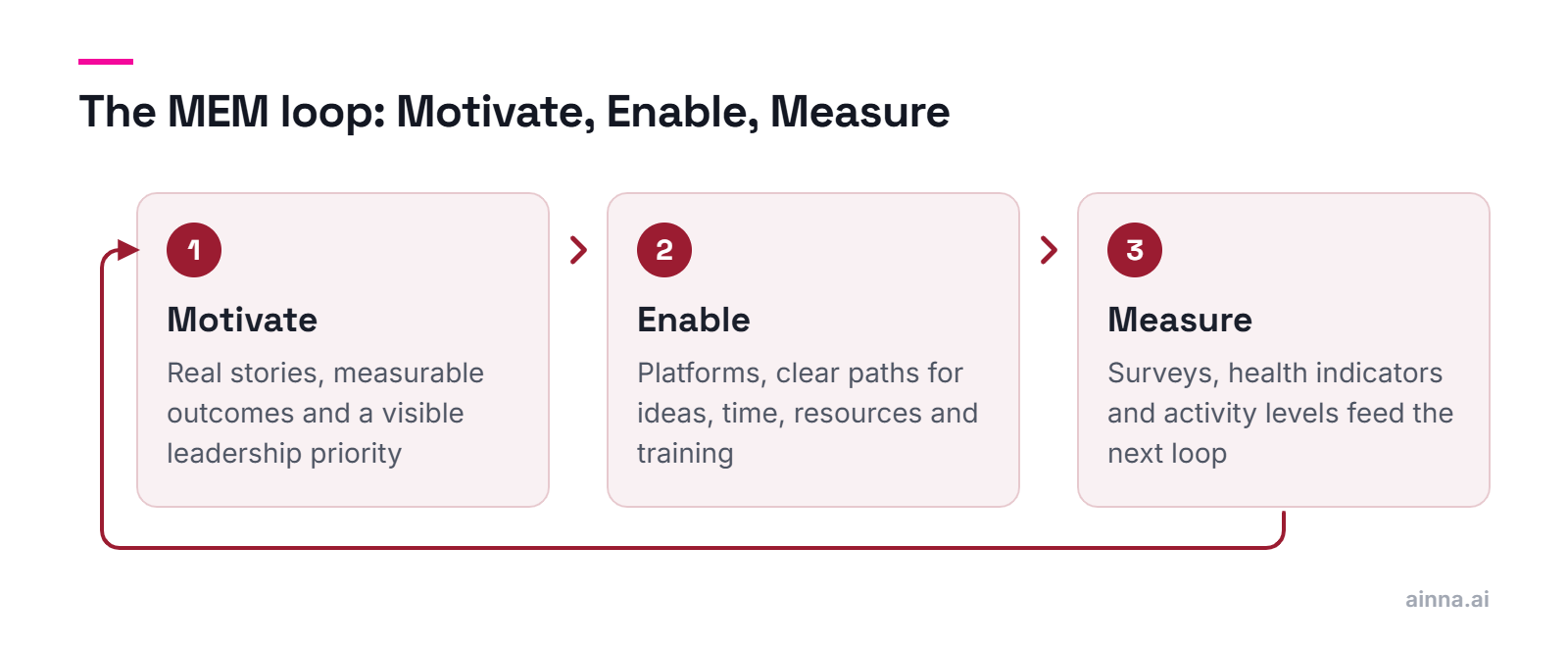
An innovation culture is sustained through a continual improvement loop, not a one-off program, and building one takes a long, nonlinear series of iterations. Innovation Mode 2.0 organizes the work into the MEM loop, its innovation culture improvement framework: Motivate, Enable, Measure. Motivate raises the willingness to innovate, Enable gives people the tools, time and knowledge to act, and Measure feeds the next iteration. “During a single loop, typically lasting weeks or months, the Motivate thread drives multiple parallel activities designed to energize and inspire.” As the organization matures, the threads converge.

  • Motivate: communicate how innovation advances strategic objectives, show measurable outcomes and real stories, including unsuccessful cases, and demonstrate that innovation is a leadership priority
  • Enable: digital innovation platforms, clear pathways for ideas, dedicated time and resources for experimentation, and training through the Innovation Academy, so people feel equipped and empowered to innovate
  • Measure: targeted surveys, event success, innovation health indicators, activity levels and interviews, analyzed into a single view of the culture; see how to measure innovation culture
  • How long it takes: “Fixing the innovation culture is a long journey through multiple and diverse work streams and activities; it is a nonlinear process that requires continuity, persistence, and efficient feedback loops.”
  • Not one-off actions: the fixes are ongoing initiatives that work through iterations and adaptations, not projects with an end date
  • No guarantee: “Still, regardless of the sophistication of the approach, the commitment of the leadership, and the strength of the message, the innovation culture may fail to grow.” That is why the loop adapts instead of following a fixed plan
  • AI in the loop: in the Measure thread, AI can give the innovation team a narrative of the culture's state and suggested improvements for the next iteration
Key Takeaway

Treat culture like a product: ship, measure, learn, repeat. The loop matters more than any single initiative in it.

Three steps in a loop: motivate, with real stories and a visible leadership priority; enable, with platforms, time and training; and measure, with surveys and indicators that feed the next loop.
Each loop lasts weeks or months; as the organization matures, the three threads converge into one part of the innovation function.

How does AI adoption change innovation culture? #

AI adoption changes innovation culture in two directions at once. It removes blockers: people get just-in-time help to frame ideas, research markets and build prototypes, and companies can capture, assess and answer far more ideas. It also puts the culture at risk: “Extensive use of AI in the innovation process may alter our perceptions of what ‘being creative’ and what ‘being an innovator’ mean.” When AI can produce many good ideas in seconds, people question their own contribution, and reward systems struggle to attribute innovation to humans.

  • Fewer tool blockers: AI offers just-in-time assistance for ideation and prototyping, which addresses the lack of tools, templates and guidance that stops many people from innovating
  • Faster, better answers: AI helps evaluators process large volumes of ideas and give meaningful feedback, so responsiveness no longer depends on headcount
  • A risk to identity: the satisfaction of solving hard problems is being replaced by the skill of directing an AI agent, which can hurt self-esteem and motivation; see whether AI is hurting innovation culture
  • A risk to recognition: when AI co-innovates with teams, companies have to decide how to attribute innovation to people and reward them
  • A risk to variety: in an experiment, AI-generated ideas made individual stories more creative but also more similar to each other (Doshi and Hauser, 2024)
  • A balanced model: blend AI efficiency with human judgment, and move people toward higher-level roles: opportunity framing, decision-making and in-market experimentation
  • Honest communication: as I wrote in the book, “I find the popular argument and communication strategy stating that ‘AI is augmenting instead of replacing humans’ only partially true and potentially misleading”; the pragmatic message is to upskill across innovation domains and find new ways to create value
Key Takeaway

“Disrupted by AI, innovation itself becomes what we must innovate.” Update the culture's rules, rewards and roles before the tools outrun them.

Inside Ainna

One method for every opportunity in your portfolio

Ainna Enterprise applies the Innovation Mode methodology across your innovation team: every idea framed the same way, scored against the same criteria and documented as an investment case, so decisions compare like with like.

The AI for product innovation