Getting Started: Hackathon Basics

The fundamentals every hackathon participant needs to understand before diving in.

A great idea is necessary but not sufficient. Winning requires the right team, smart preparation, rapid execution, and—critically—a compelling pitch. Many teams with brilliant ideas lose to teams with good ideas and excellent presentations.

  • Great idea alone won't win—you need execution and communication too
  • Right team composition is often the deciding factor
  • Preparation before the hackathon gives you a massive head start
  • Rapid prototyping skills let you build more impressive demos
  • Pitch quality can make or break even the best technical work
  • Understanding what judges actually want helps you prioritize

Think like an entrepreneur: you have limited time to build something impressive AND convince people it matters. Both halves of that equation are equally important.

Read between the lines. The stated theme is just the surface—dig into the timing, sponsors, judge composition, evaluation criteria, and recent hackathon history to understand the hidden objectives and optimize your strategy.

  • Stated purpose vs real purpose: organizers may want team building, tech promotion, or genuine problem-solving
  • Check the judges: their backgrounds reveal what they'll value (business impact? technical depth? creativity?)
  • Review evaluation criteria: weight your effort toward what's actually being measured
  • Look at past winners: what did winning projects have in common?
  • Consider the sponsors: what problems do THEY care about solving?
  • Timing context: is there a company initiative or industry trend the hackathon aligns with?

The teams that win understand the game they're playing. Spend 30 minutes researching the hackathon context—it'll shape every decision you make.

Expect chaos, embrace it, and focus on learning. Your first hackathon probably won't be a win, and that's fine—the experience is invaluable. Join an experienced team if possible, scope small, and prioritize having something working to demo.

  • Join an experienced team if you can—you'll learn faster
  • Scope aggressively small—first-timers always overestimate what's possible
  • Prioritize a working demo over feature completeness
  • Don't skip sleep entirely—diminishing returns hit hard after 20 hours
  • Network actively—hackathons are relationship-building opportunities
  • Take notes on what worked and didn't—invaluable for next time
  • Have fun—the energy and camaraderie are part of the experience

Your first hackathon is tuition. Focus on learning the rhythm, meeting people, and shipping something—anything. Winning comes later.

Pre-Hackathon Preparation

What to do before the clock starts—the preparation phase that separates winners from also-rans.

Preparation is your unfair advantage. Document your ideas in one-pagers, validate them with quick research, form your team early, set up your development environment, and gather reusable components. The hackathon itself should be execution, not planning.

  • Document ideas upfront: one-pager with problem, solution, assumptions, target output
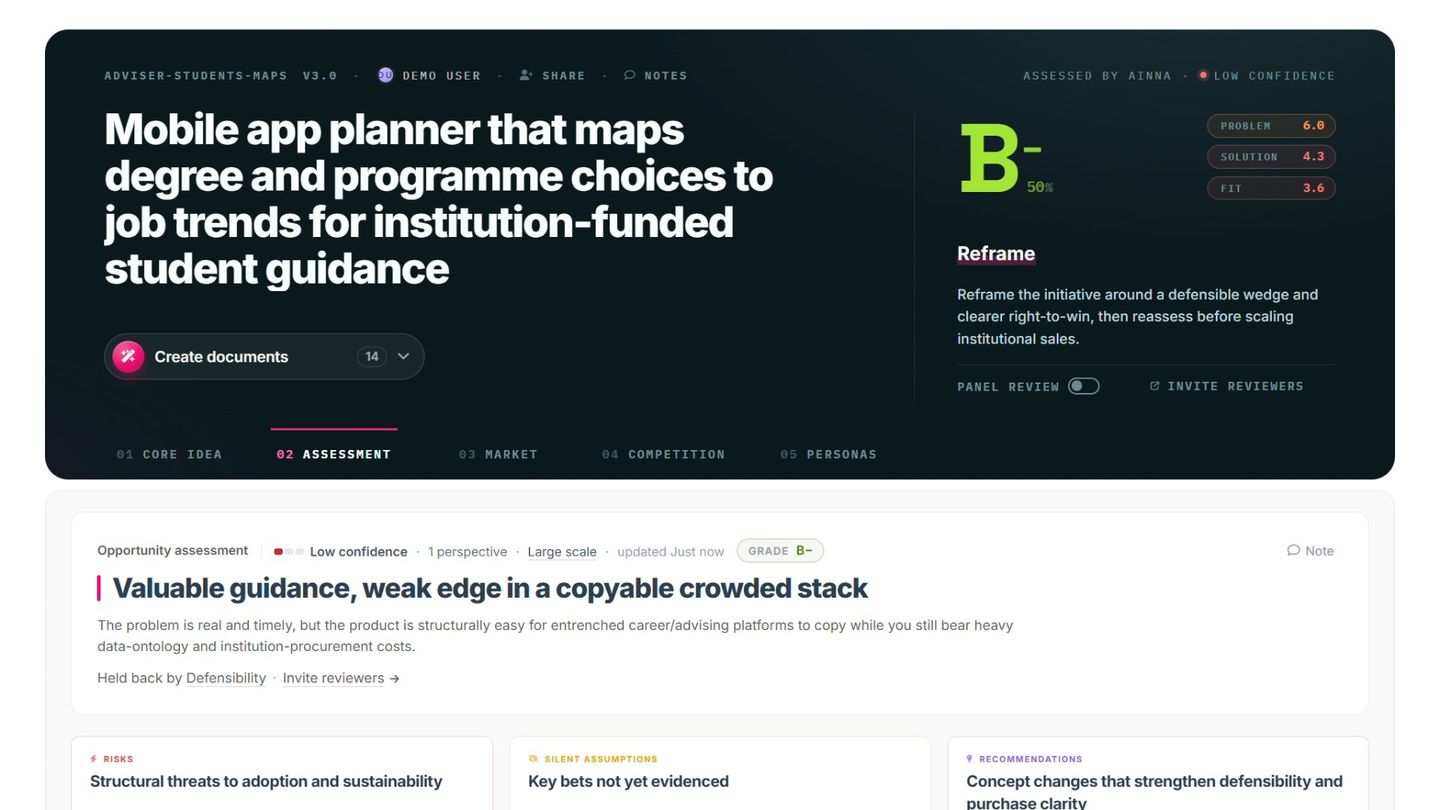
  • Validate before you build: quick research on novelty, feasibility, competition
  • Form your team early: don't scramble for teammates at the start
  • Set up dev environment: have your tools, frameworks, and accounts ready
  • Gather reusable components: UI kits, API templates, boilerplate code
  • Research available APIs and services: know what building blocks exist
  • Prepare your pitch outline: start thinking about the story before you build

Teams that walk in prepared spend their hackathon time building. Teams that wing it spend half their time deciding what to build. Guess who wins?

Do a reality check before you commit. In our interconnected world, the chances of having a truly unique idea are slim—but that's okay. Search for similar solutions, identify your differentiators, and either find your angle or pivot to a better idea.

  • Search extensively: Google, Product Hunt, GitHub, patent databases
  • Finding similar solutions isn't fatal—look for your unique angle
  • Ask: what's different about MY approach, audience, or context?
  • Validate feasibility: can this actually be built in hackathon time?
  • Check judge alignment: does this idea match what they're looking for?
  • Get quick feedback: pitch the concept to a friend in 60 seconds
  • Be willing to kill it: better to pivot early than waste 24 hours

A validated 'good' idea beats an unvalidated 'great' idea. You don't need to invent something nobody's ever thought of—you need to execute something judges will find compelling.

A one-pager forces clarity. Cover the problem you're solving, your innovative solution, key assumptions, technologies involved, and target deliverable. This document aligns your team and becomes the foundation for your pitch.

  • Problem statement: what pain point or opportunity are you addressing?
  • Solution overview: how does your approach solve it differently?
  • Target users: who benefits and why would they care?
  • Key assumptions: what must be true for this to work?
  • Technologies: what will you build with?
  • Target deliverable: functional prototype? concept + wireframes? predictive model?
  • Success criteria: what does 'done' look like for the hackathon?

If you can't explain your idea clearly on one page, you can't pitch it in 3 minutes. The one-pager is both a planning tool and a presentation scaffold.

Building Your Dream Team

How to assemble and lead a hackathon team that can actually deliver under pressure.

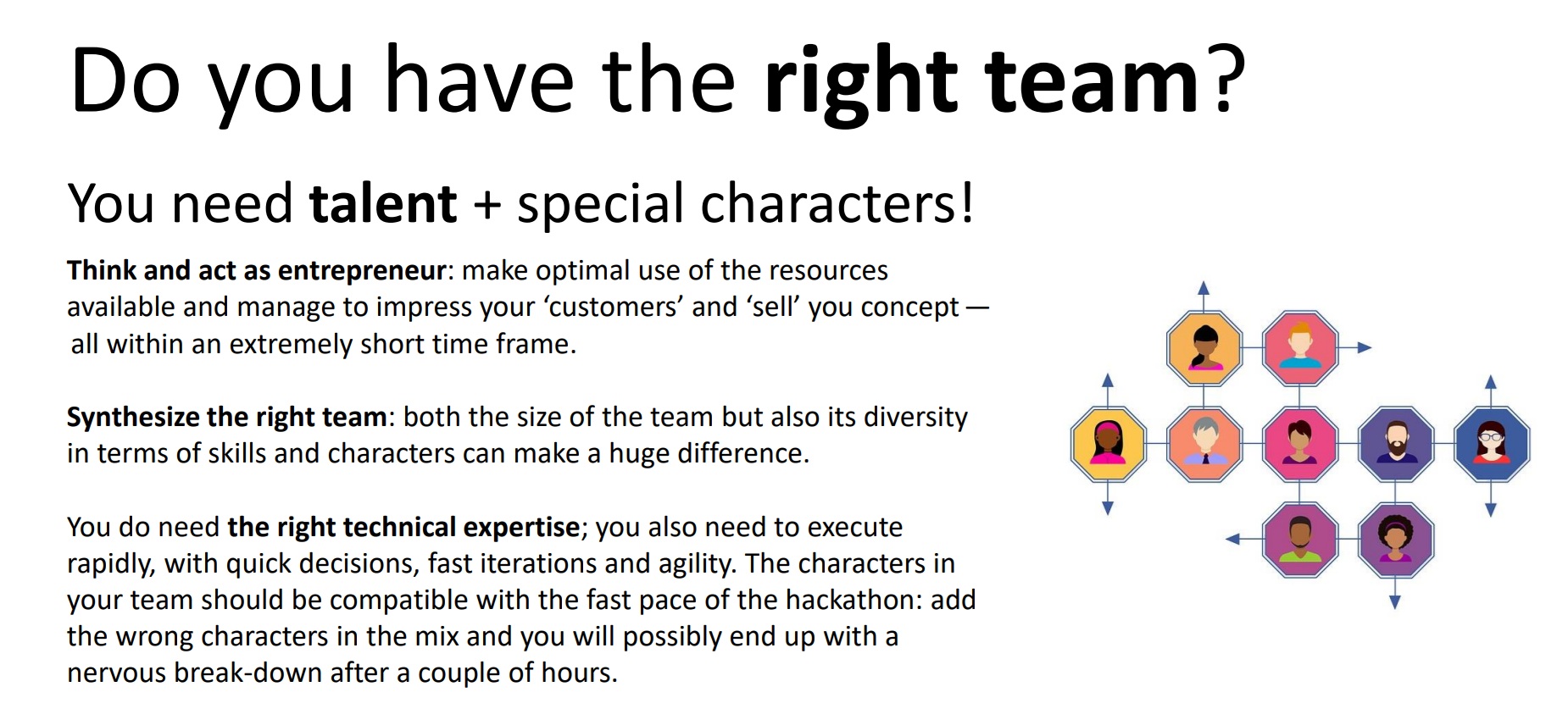
You need talent plus the right characters. Technical skills matter, but hackathon-compatible personalities matter more. Look for people who thrive in chaos, make fast decisions, and can shift gears without drama.

  • Product leader: clear vision, understands technical capabilities, makes decisions fast
  • Technical experts: strong skills AND agile engineering mentality
  • Presentation person: starts working on the pitch from day one
  • Diverse skills: design, frontend, backend, data—cover your bases
  • Compatible characters: hackathons have no room for process-heavy personalities
  • Small is beautiful: 3-5 people is usually optimal
  • Trust and communication: people who can disagree quickly and move on

Hackathons are 'making the impossible happen in no time.' Add the wrong character to the mix and you'll have a nervous breakdown by hour six. Choose teammates carefully.

At minimum: someone to lead product decisions, someone to build the core tech, and someone to own the presentation. In practice, everyone does everything, but having clear ownership prevents dropped balls.

  • Product/Team Lead: owns the vision, makes scope decisions, breaks ties quickly
  • Core Developer(s): builds the novel technical components—your differentiator
  • Integration/Glue Developer: connects pieces, handles APIs, manages deployment
  • Designer/Frontend: makes it look good enough to demo impressively
  • Pitch Lead: builds the presentation, refines the narrative, prepares the demo
  • Overlap is fine: in small teams, people wear multiple hats
  • Avoid role ambiguity: clear ownership prevents 'I thought you were handling that'

The pitch lead role is often neglected but crucial. Assign someone to own the presentation from the start—not as an afterthought at hour 20.

Set expectations early, communicate constantly, and resolve conflicts immediately. Fatigue and pressure amplify tensions—establish norms when everyone's fresh so you have guardrails when things get hard.

  • Kickoff alignment: agree on goals, roles, decision-making process before coding
  • Regular check-ins: brief standups every 3-4 hours to sync and reprioritize
  • Single source of truth: one place where current status and decisions live
  • Conflict protocol: disagree, decide, commit—no relitigating settled questions
  • Energy management: encourage breaks, food, brief walks—burned out teams make mistakes
  • Celebrate small wins: momentum and morale matter in endurance events
  • Protect focus time: not everything needs a group discussion

The best hackathon teams feel like jazz ensembles—individuals who know their parts but improvise together. That chemistry comes from trust and clear communication.

It's possible but much harder. Solo hackers can move fast without coordination overhead, but they're limited in what they can build and often struggle with the pitch. AI tools are making solo participation more viable.

  • Advantages: no coordination overhead, complete creative control, faster decisions
  • Disadvantages: limited bandwidth, no skill diversity, harder to stay energized
  • AI is changing the math: solo + AI tools can now produce team-level output
  • Scope ruthlessly: solo projects must be laser-focused to be impressive
  • Pitch practice is harder: no teammate to rehearse with or get feedback from
  • Play to your strengths: pick problems that match YOUR specific skills
  • Consider hybrid: solo build, recruit a pitch partner

Solo is viable, especially with AI assistance, but you're playing on hard mode. If you're solo, double down on scope discipline and pitch preparation.

Rapid Prototyping & Execution

How to build impressive prototypes under extreme time pressure.

Focus ruthlessly on your core innovation—the novel part that makes you different. Everything else (UI, data, supporting features) should be mocked, hard-coded, or borrowed. Make assumptions, fake the non-essential parts, and move fast.

  • Identify your core innovation: the ONE thing that's genuinely novel
  • Secondary components get shortcuts: mock data, hard-coded values, existing APIs
  • Make explicit assumptions: it's fine to fake parts if you acknowledge it
  • Reuse aggressively: open-source components, templates, existing services
  • Demo-driven development: build what you need for an impressive demo, nothing more
  • Timebox everything: if it's taking too long, cut scope or fake it
  • Have a Plan B: know what you'll cut if you run out of time

Judges don't give bonus points for clean code or real databases. They reward impressive demonstrations of novel ideas. Optimize for demo impact, not engineering excellence.

Work backwards from your demo. Allocate time for pitch preparation (at least 20%), build in buffer for inevitable surprises, and have hard cutoff points where you stop adding features and start polishing.

  • Work backwards: when is the demo? subtract pitch prep time first
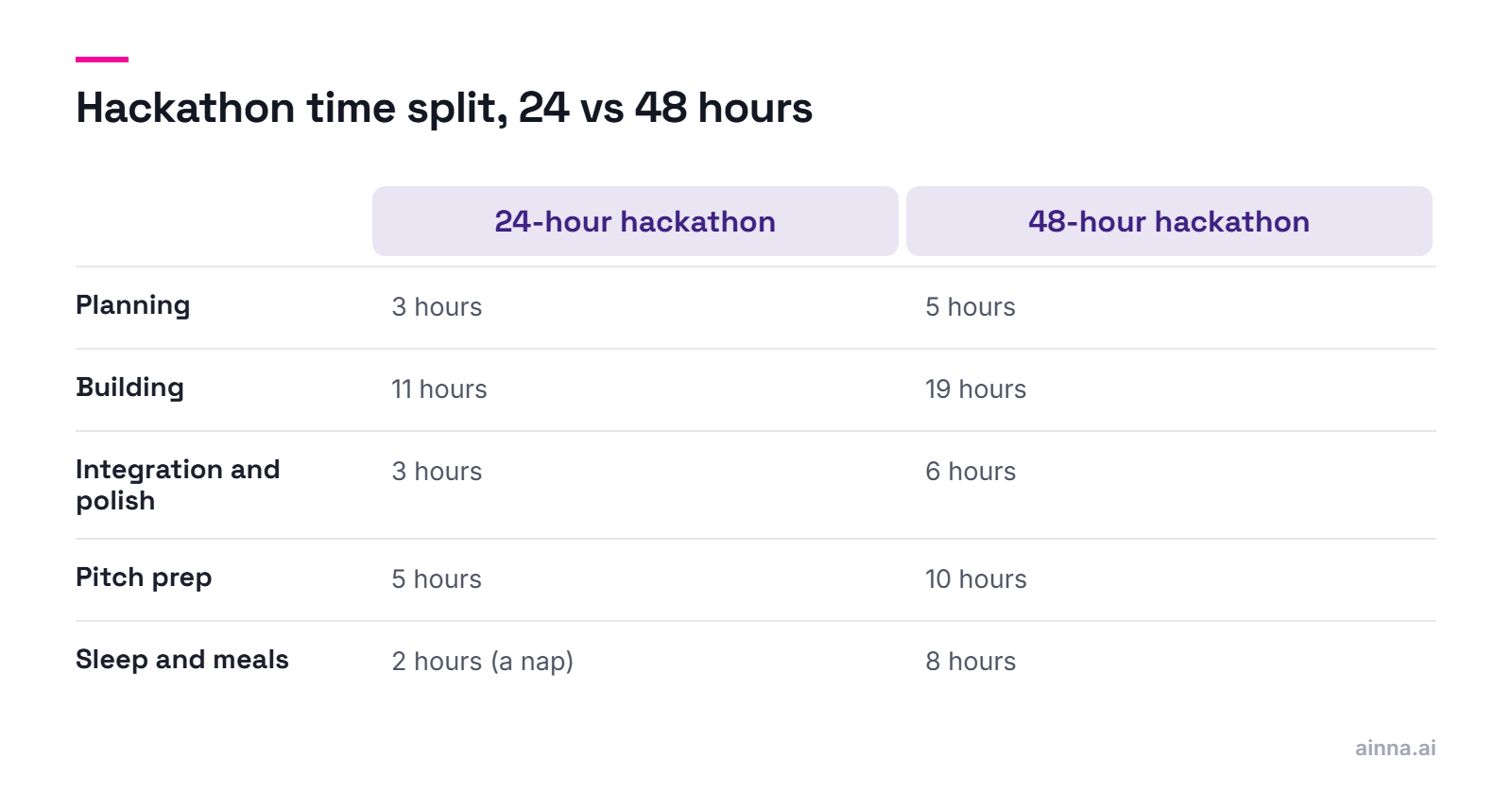
  • 24-hour split: 4h planning, 12h building, 4h integration/polish, 4h pitch prep
  • 48-hour split: 6h planning, 24h building, 8h integration, 10h pitch prep
  • Hard feature freeze: stop adding features with 25% of time remaining
  • Buffer generously: everything takes longer than you think
  • Regular checkpoints: every 4 hours, assess progress and reprioritize
  • Sleep strategy: even a 2-hour nap can restore decision-making ability

The teams that win usually stop coding earlier than you'd expect. They spend the final hours perfecting their demo and pitch while competitors scramble to finish features nobody will see.

Scope for your demo, not a real product. Ask: what's the minimum I need to build to tell a compelling story and show my core innovation? Cut everything else mercilessly.

  • Demo script first: write your ideal demo, then build only what it requires
  • One killer feature: focus on demonstrating ONE impressive capability well
  • The 'golden path' only: build the happy path; don't handle edge cases
  • Fake the context: hard-code user data, skip authentication, mock integrations
  • Visual impact matters: a polished UI on limited features beats full features with bad UI
  • Cut features, not quality: better to have 3 working features than 10 broken ones
  • Plan your cuts: know in advance what you'll drop if time runs short

Your hackathon 'product' is actually a performance. You're building a demo, not software. Scope accordingly.

Use what you know, leverage managed services, and don't be a hero. Hackathons reward output, not learning new frameworks. Pick boring, reliable technologies that let you ship.

  • Use familiar tools: this is not the time to learn a new framework
  • Managed services: Firebase, Supabase, Vercel—skip infrastructure setup
  • Boilerplates and starters: don't write code that templates provide
  • API-first: consume existing APIs rather than building backend logic
  • Static when possible: fake dynamic content with hard-coded data
  • Deployment ready: use platforms with instant deployment (Vercel, Netlify, Railway)
  • Version control basics: commit often, don't lose work to merge conflicts

The winning technical strategy is boring: familiar tools, managed services, and relentless focus on the unique parts of your solution. Save the learning for after the hackathon.

AI-Powered Hackathon Strategies

How to leverage AI tools to 10x your hackathon output—and avoid common AI pitfalls.

AI is compressing weeks of work into hours. Teams can now build functional apps, generate polished presentations, and create marketing assets in hackathon timeframes that were previously impossible. The bar for 'impressive' has risen dramatically.

  • Code generation: describe features, get working code in minutes
  • Full-stack apps: complete applications from natural language descriptions
  • UI/Design: generate polished components and layouts without designers
  • Content creation: pitch decks, documentation, marketing copy at speed
  • Research acceleration: market analysis and competitive research in minutes
  • Bug fixing: AI debugs faster than manual troubleshooting
  • The new baseline: what was impressive last year is now expected

AI has raised the floor AND the ceiling. Basic prototypes are easier to build, which means judges expect more. Winners now deliver what would have been week-long projects.

Sources:The Innovation Mode 2.0AI-augmented innovation sprints

Build your AI toolkit across categories: code generation (Cursor, Copilot), full-stack building (Bolt, Lovable), UI creation (v0), documentation (Ainna), and general assistance (Claude, ChatGPT). Know your tools BEFORE the hackathon.

  • Code in IDE: Cursor, GitHub Copilot, Codeium—AI assistance while you type
  • Full-stack apps: Bolt.new, Lovable, Replit Agent—describe apps, get deployable code
  • UI components: v0 by Vercel—generate React/Tailwind from descriptions
  • Documentation: Ainna—pitch decks and PRDs from structured input in 60 seconds
  • General assistance: Claude, ChatGPT—brainstorming, debugging, research
  • Design assets: Midjourney, DALL-E, Figma AI—visuals and mockups

Practice with your tools before the hackathon. Discovering how Bolt works during the event wastes precious time. Have your accounts set up and workflows rehearsed.

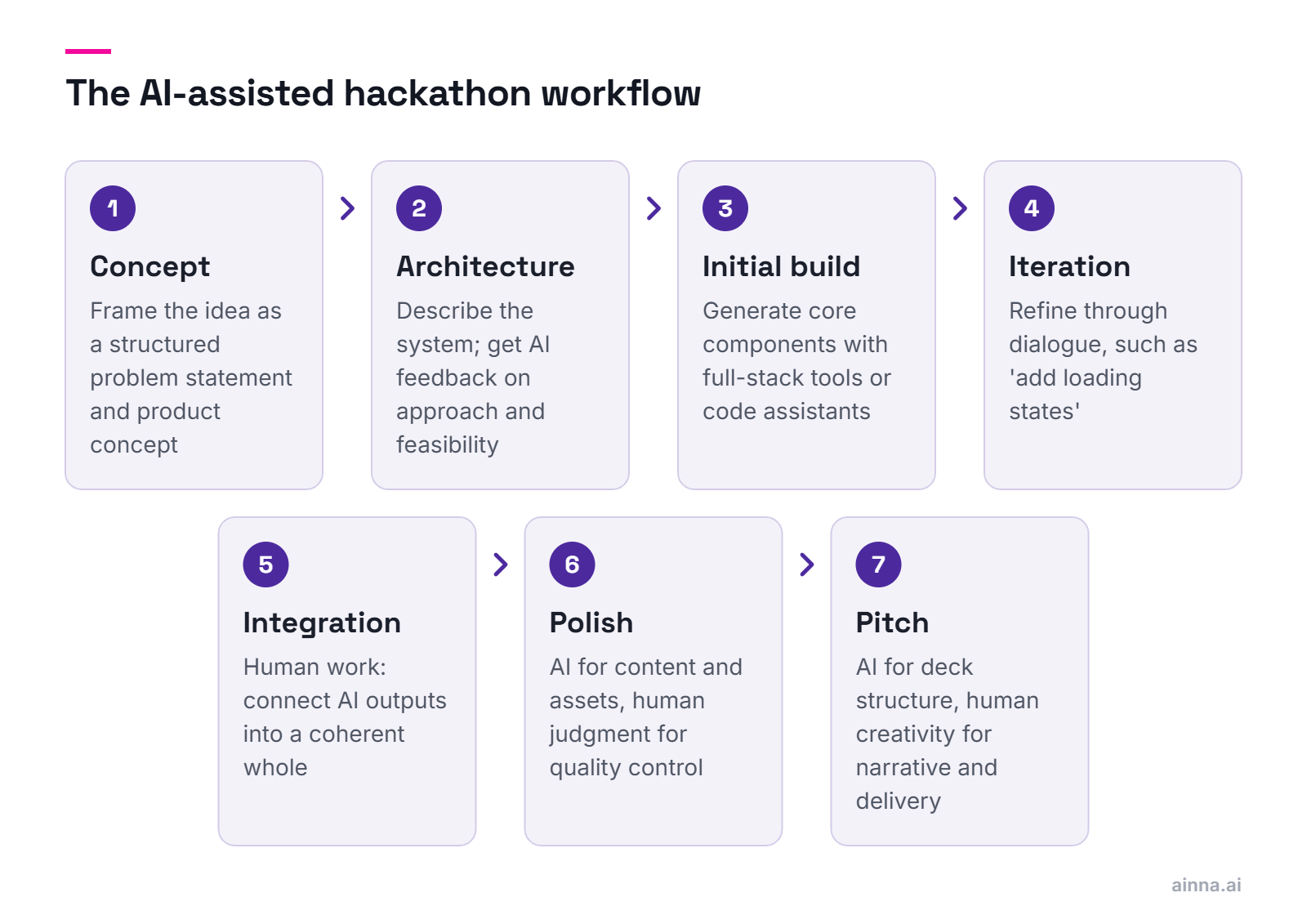
Think of AI as a fast but literal team member. You provide creative direction, AI provides execution speed. The workflow: frame the concept clearly, generate initial versions with AI, iterate through conversation, then refine with human judgment.

  • Phase 1 - Concept: use AI to brainstorm, validate ideas, structure your one-pager
  • Phase 2 - Architecture: describe your system, get AI feedback on approach and feasibility
  • Phase 3 - Initial build: generate core components with full-stack tools or code assistants
  • Phase 4 - Iteration: refine through dialogue—'make the button bigger', 'add loading states'
  • Phase 5 - Integration: human work to connect AI outputs into coherent whole
  • Phase 6 - Polish: AI for content and assets, human judgment for quality control
  • Phase 7 - Pitch: generate deck structure with AI, refine narrative with human creativity

Your role shifts from 'builder' to 'director.' You're orchestrating AI outputs toward your vision, making judgment calls about what's good, and ensuring coherence. That's a skill in itself.

AI excels at rapid exploration. Generate 50 idea variations in minutes, validate against competition, stress-test assumptions, and structure your concept—all before you write a line of code.

  • Brainstorm amplification: 'Give me 20 variations on [concept] for [audience]'
  • Competition scan: 'What existing products solve [problem]? How might we differentiate?'
  • Assumption stress-test: 'What could go wrong with this approach? What am I missing?'
  • Audience insight: 'What would [persona] care about most? What objections would they have?'
  • Problem reframing: 'What's the deeper problem behind [surface issue]?'
  • Feasibility check: 'Can this be built in 24 hours? What's the minimum viable version?'
  • Structured output: use Ainna to convert rough concept into formal pitch deck and PRD

Spend the first hour with AI as your thinking partner. Explore more possibilities than you could alone, then commit to the most promising direction with confidence.

AI shifts prototyping from writing code to directing output. Use full-stack generators for the foundation, code assistants for custom logic, and conversational iteration instead of manual refactoring. Build through dialogue.

  • Foundation first: use Bolt/Lovable to generate complete app scaffolding
  • Component generation: v0 for UI components—describe, generate, refine
  • Custom logic: Copilot/Cursor for the novel parts AI can't template
  • Conversational iteration: 'Add a loading spinner', 'Make the header sticky', 'Fix the mobile layout'
  • Debugging partner: paste errors into Claude/ChatGPT for rapid diagnosis
  • Integration assistance: 'How do I connect [service A] to [service B]?'
  • Test generation: AI can write basic tests faster than you can manually

The bottleneck is no longer 'can I build this?' but 'do I know what I want?' Teams with clear vision can move extraordinarily fast. Teams with fuzzy concepts still struggle, AI or not.

Be specific, structured, and iterative. Vague prompts get generic results. Include context, constraints, and examples. Treat AI like a fast but literal junior developer who needs clear briefs.

  • Be specific: 'a dashboard' vs 'a dashboard showing user activity with charts, filters, and export'
  • Include context: 'for a B2B SaaS product targeting HR managers'
  • Specify tech: 'using React, Tailwind, and shadcn/ui components'
  • Provide examples: 'similar to how Stripe's dashboard handles date ranges'
  • Set constraints: 'mobile-responsive, dark mode support, accessible'
  • Iterate rapidly: 'make the cards larger', 'add hover effects', 'simplify the form'
  • Ask for options: 'give me 3 different approaches to this layout'

Prompting is a skill. The teams that practiced before the hackathon get dramatically better results than teams discovering prompt patterns during the event.

AI Pitfalls & How to Avoid Them

Common mistakes teams make with AI tools—and how to avoid them.

Over-reliance on AI without human judgment, accepting mediocre output because 'AI made it,' spending too much time prompt-wrangling, and ending up with generic solutions that any team could have generated.

  • Generic output trap: AI tends toward average solutions—you need human creativity for differentiation
  • Quality blindness: accepting 'good enough' AI output instead of pushing for excellent
  • Prompt rabbit holes: spending hours refining prompts instead of building
  • Integration chaos: AI generates components that don't fit together coherently
  • Debugging AI code: harder than debugging your own—you don't understand the decisions
  • Over-scoping: AI speed tempts teams to add features they can't polish
  • Lost narrative: focus on AI output generation loses sight of the user problem

AI is a power tool, not a replacement for taste. The winning teams use AI to execute their unique vision faster—not to generate their vision for them.

AI levels the playing field on execution—differentiation now comes from problem selection, creative vision, and the human elements: storytelling, unique insights, and authentic passion.

  • Problem selection: finding interesting problems is still a human skill
  • Unique angle: your perspective, experience, and insight can't be AI-generated
  • Creative vision: AI executes; you decide WHAT's worth executing
  • Quality curation: the judgment to know when AI output is good vs mediocre
  • Storytelling: connecting your solution to human problems emotionally
  • Domain expertise: deep knowledge that informs better prompts and better judgment
  • Authentic passion: judges detect genuine excitement vs going-through-motions

When everyone can build fast, the question shifts from 'can you build it?' to 'is it worth building?' and 'can you make me care?' Those are human questions.

Sources:The Innovation Mode 2.0Human-AI collaboration in innovation

Pick your core tools BEFORE the hackathon and stick with them. You need at most 3-4 AI tools. Master those rather than dabbling in dozens. Tool-hopping wastes precious hackathon time.

  • Core toolkit: one code assistant, one full-stack builder, one general AI—that's enough
  • Practice beforehand: know your tools' strengths and limitations before the clock starts
  • Have fallbacks: if your primary tool fails, know your Plan B
  • Don't tool-hop: switching tools mid-hackathon is almost always a mistake
  • Share tool knowledge: make sure teammates can use the same tools
  • Document workflows: have your preferred prompts and approaches ready
  • Set tool time limits: if it's not working in 10 minutes, try a different approach

Tool mastery beats tool variety. A team that's excellent with Cursor + Bolt will outperform a team dabbling with 10 different AI services.

AI accelerates individuals but can fragment teams. Establish shared conventions, integrate frequently, and maintain a single vision. The risk is multiple AI-generated components that don't fit together.

  • Shared design system: agree on UI components, colors, patterns BEFORE generating
  • Frequent integration: merge AI outputs every 2-3 hours, not at the end
  • Single source of truth: one person owns the 'canonical' version
  • Clear interfaces: define how components connect before building them separately
  • Vision keeper: one person ensures all AI outputs align with the core concept
  • Review AI output together: catch inconsistencies early
  • Communication discipline: overcommunicate when working with AI speed

AI makes individuals faster but can make teams less coherent. Counter this with even more communication and integration checkpoints than you'd have otherwise.

Don't use AI when the core innovation IS the algorithm, when you need deep technical understanding for your pitch, when AI output quality is consistently poor for your specific need, or when it's faster to just write it yourself.

  • Novel algorithms: if your differentiator is a new approach, you need to understand and explain it
  • Your pitch defense: judges will ask questions—you need to understand what you built
  • Complex integrations: sometimes manual control beats AI guesswork
  • Quick one-liners: firing up AI for a simple function is slower than typing it
  • When it's not working: if prompts aren't yielding good results, switch to manual
  • Creative narrative: your pitch story should feel authentic, not AI-generated
  • Technical feasibility proof: if the point is proving YOU can build it, AI defeats the purpose

AI is a tool, not a strategy. Use it when it accelerates you; skip it when it doesn't. The goal is to win, not to maximize AI usage.

Nailing Your Pitch

How to present your hackathon project in a way that wins judges over.

Critically important—often more than the build itself. Judges see your project for 3-5 minutes. A mediocre project with an amazing pitch beats an amazing project with a mediocre pitch. This isn't fair, but it's reality.

  • Judges have limited time: they can't fully evaluate your code, only your demo and story
  • First impressions dominate: you have 30 seconds to hook them
  • Storytelling beats features: why it matters > what it does
  • Demo failures are deadly: a broken demo kills even brilliant ideas
  • Confidence signals quality: how you present affects perception of what you built
  • Questions are opportunities: good pitch anticipates and addresses concerns
  • Many great projects lose: because teams underinvested in presentation

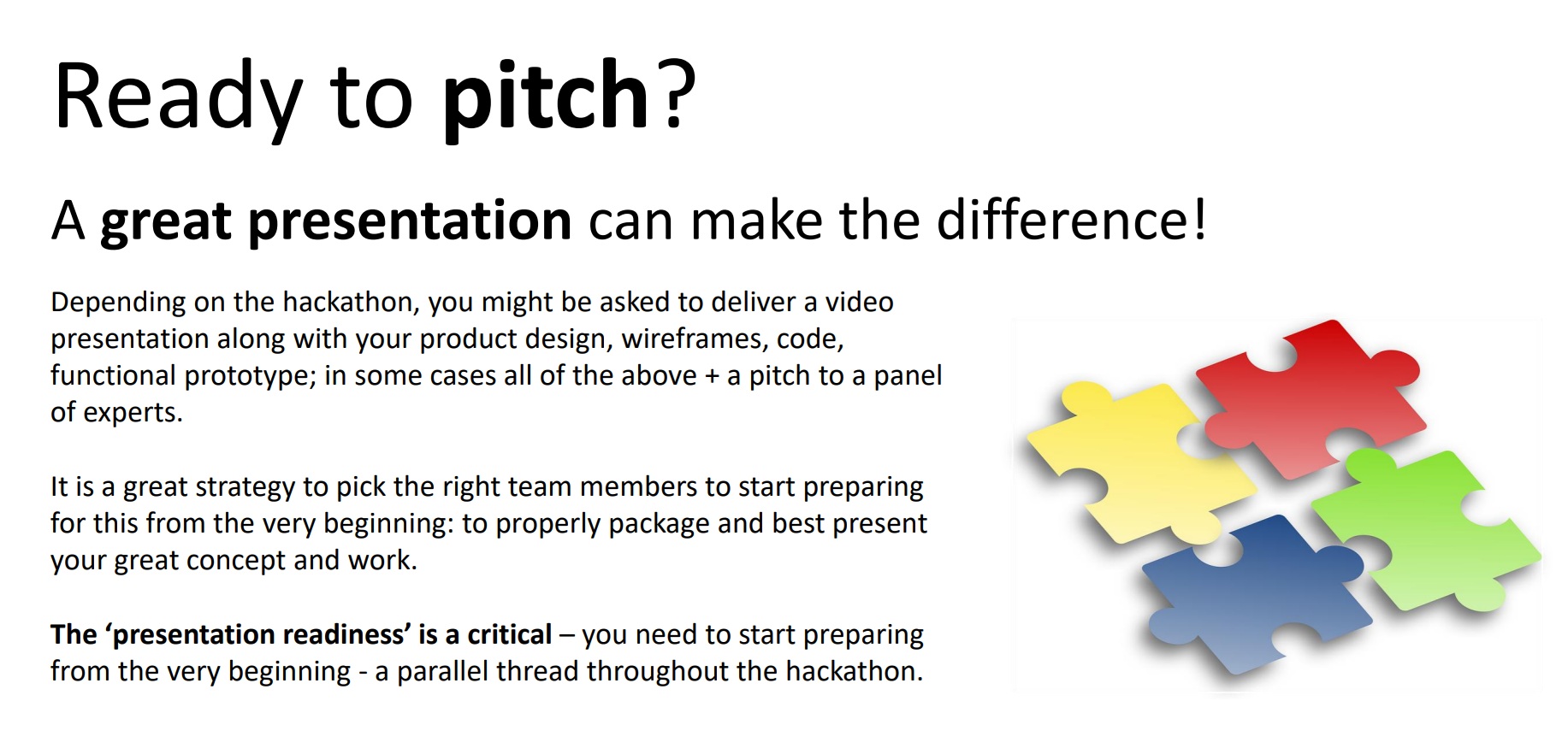
Allocate at least 20% of your hackathon time to pitch preparation. Start working on it from hour one, not hour twenty. This is where hackathons are won and lost.

Problem → Solution → Demo → Impact → Ask. Hook them with the problem, show your solution works, prove it matters, and tell them what you need. Keep it simple, fast, and memorable.

  • Hook (30 sec): start with a compelling problem statement or surprising fact
  • Problem (30 sec): why this matters, who suffers, what's broken today
  • Solution (30 sec): your approach in plain language—what makes it different
  • Demo (60-90 sec): show, don't tell—the golden path through your product
  • Impact (30 sec): what changes if this exists? metrics, outcomes, possibilities
  • Team/Tech (15 sec): brief credibility—why you're the right team
  • Ask (15 sec): what would you do with the prize? what's the next step?

Practice until you can nail this structure in exactly your allotted time. Most teams run over—don't be one of them. Judges appreciate tight, confident delivery.

Script your demo path, practice it repeatedly, have backup recordings, and NEVER demo live features you haven't tested five times. Murphy's Law is undefeated in hackathon demos.

  • Script the golden path: know exactly which buttons to click in which order
  • Pre-load everything: have data, accounts, pages already set up
  • Test the exact sequence: 5+ rehearsals of the exact demo flow
  • Backup video: record a working demo just in case everything breaks
  • Fail gracefully: know what to say if something doesn't work
  • Narrate while clicking: explain what's happening and why it matters
  • Don't apologize: if something's rough, don't draw attention to it

Demo failures are almost always preventable. The teams that practice their demo obsessively look polished. The teams that 'wing it' look amateur. There's no trick here—just preparation.

Research the judges and tailor your pitch. Technical judges want to see innovation. Business judges want impact. Design judges want polish. Know your panel and emphasize what they value.

  • Research judge backgrounds: LinkedIn, their work, their interests
  • Technical judges: appreciate clever solutions, novel approaches, technical depth
  • Business judges: focus on market opportunity, revenue potential, user value
  • Design judges: care about UX, visual polish, user empathy
  • Mixed panels: balance your pitch across dimensions
  • Use their language: mirror terminology they use in their work
  • Anticipate their questions: what would YOU ask if you were them?

Judging isn't objective—it's filtered through individual perspectives. The more you understand those perspectives, the better you can frame your project for each panel.

AI accelerates slide creation, refines messaging, generates supporting data, and helps practice. Use it for structure and content—but your authentic voice and passion must come through in delivery.

  • Slide generation: Ainna for rapid deck creation
  • Narrative refinement: 'Make this problem statement more compelling'
  • Stats and data: 'Find relevant market statistics for [industry]'
  • Objection prep: 'What questions might judges ask? How should I respond?'
  • Script polish: 'Make this explanation clearer and more concise'
  • Practice partner: deliver your pitch to Claude, get feedback on clarity
  • Demo script: 'Help me plan a 90-second demo flow for [product]'

AI can create a solid pitch foundation in 30 minutes instead of 3 hours. Use that time savings to practice delivery—which is the part AI can't do for you.

Mistakes That Sink Hackathon Teams

What NOT to do—common pitfalls that experienced hackers learn to avoid.

Over-scoping, under-preparing the pitch, team dysfunction, and perfectionism over progress. Most losing teams could have won with better prioritization and more pitch practice.

  • Over-scoping: trying to build too much, delivering nothing complete
  • Pitch neglect: treating presentation as an afterthought
  • Feature creep: adding 'one more thing' instead of polishing what exists
  • Team conflict: unresolved disagreements that drain energy and time
  • Perfectionism: polishing code nobody will see instead of demo they will
  • Sleep martyrdom: thinking exhaustion is a badge of honor (it destroys judgment)
  • Demo skipping: not practicing the actual demo sequence

These mistakes are all self-inflicted and preventable. Hackathon veterans have learned these lessons the hard way. Learn from them before you make them yourself.

Write your feature list at the start and treat it as MAXIMUM, not minimum. Every feature you add after that point requires removing something else. 'Wouldn't it be cool if...' is the most dangerous phrase in hackathons.

  • Define done upfront: what does the final demo include? that's your cap
  • Feature freeze: set a time after which no new features are added
  • Trade-off discipline: every addition requires a subtraction
  • Demo-driven scope: if it's not in the demo script, don't build it
  • 'Cool idea' parking lot: write down ideas for 'later' (meaning never)
  • Regular scope checks: every 4 hours, ask 'are we still on track for our demo?'
  • Designated skeptic: one team member whose job is to say 'no, we don't have time'

The teams that win usually build less than they planned. They're just disciplined about building the right things. Cutting scope takes courage but wins hackathons.

Strategic rest beats continuous exhaustion. Take short breaks, eat properly, and consider a brief sleep. Your hour 20 decisions will be terrible if you haven't rested since hour 1.

  • Breaks are productive: a 10-minute walk can solve problems hours of staring can't
  • Eat real food: sugar crashes are real; protein and complex carbs sustain energy
  • Hydrate: dehydration causes foggy thinking
  • Strategic nap: even 90 minutes of sleep restores decision-making ability
  • Rotate intensity: have some team members rest while others push
  • Know your limits: some people crash hard after 18 hours; plan around it
  • Final stretch reserve: save energy for the last 4 hours—demo prep matters

Hackathons reward sustained effectiveness, not performative suffering. The team that makes good decisions at hour 22 beats the team that burned out at hour 16.

Address it immediately—simmering conflict is fatal in time-constrained events. Surface the disagreement, make a decision, commit, and move on. There's no time for extended debate or hurt feelings.

  • Surface it fast: pretending disagreement doesn't exist makes it worse
  • Time-box the discussion: 5 minutes to present both sides, then decide
  • Designated decision-maker: someone has tie-breaker authority
  • Commit fully: once decided, no passive resistance or 'I told you so'
  • Focus on goals: 'which option is more likely to help us win?'
  • Depersonalize: disagree about approaches, not about people
  • Let small stuff go: pick your battles—most conflicts aren't worth the time

Hackathon teams don't have time for consensus-building. Establish decision protocols upfront, make calls quickly, and save energy for building instead of debating.

After the Hackathon

What to do after the event—win or lose—to maximize long-term value.

Absolutely not. Most hackathon value comes regardless of winning: skills developed, relationships formed, ideas validated, and experience gained. The best hackers lose many times before they win.

  • Skills sharpened: rapid prototyping, pitching, teamwork under pressure
  • Relationships built: teammates and fellow competitors become future collaborators
  • Ideas tested: you learned something about your concept—even negative feedback is valuable
  • Experience gained: you now know what to do differently next time
  • Portfolio addition: the project itself is proof of your capabilities
  • Network expanded: judges, organizers, sponsors—all new connections
  • Fun had: the experience itself has value independent of outcomes

Treat every hackathon as practice for the one you'll win. Each event teaches you something. The hackers who win consistently are the ones who learned from losing.

Capture learnings while they're fresh. What worked? What didn't? What would you do differently? Document these insights within 24 hours—they're invaluable for your next event.

  • Team retrospective: brief meeting within 24 hours to discuss learnings
  • Personal notes: write down your individual observations before you forget
  • Technical learnings: which tools, approaches, shortcuts worked best?
  • Process insights: where did time go? what was underestimated?
  • Pitch feedback: what questions did judges ask? what landed well?
  • Team dynamics: what worked in collaboration? what caused friction?
  • Next time list: concrete changes for your next hackathon

The teams that consistently win treat each hackathon as a learning opportunity. They systematically improve their approach. Without debriefing, you keep making the same mistakes.

Maybe—but evaluate honestly first. Most hackathon projects are exciting in the moment but don't survive contact with market reality. If feedback was genuinely enthusiastic and the problem is real, explore further. If not, take the learnings and move on.

  • Feedback quality: was enthusiasm genuine or just polite hackathon energy?
  • Problem validation: is this a real problem people would pay to solve?
  • Your passion: do you actually want to work on this for months/years?
  • Team interest: would teammates commit ongoing time?
  • Market opportunity: quick research—is there a business here?
  • Honest assessment: strip away hackathon excitement and evaluate coldly
  • Pivot possibility: maybe the specific solution is weak but the problem space is interesting

Most hackathon projects should stay as hackathon projects—learning experiences and portfolio pieces. The rare exceptions are worth pursuing seriously. Know the difference.

Participate consistently, share your work publicly, help other teams, and become known for something specific—whether that's technical depth, design, pitching, or problem selection.

  • Consistency: show up regularly—reputation builds over multiple events
  • Public sharing: write up your projects, post on social media, build portfolio
  • Help others: mentor new teams, share knowledge, be generous
  • Specialize: become known for something—'the ML person' or 'the pitch expert'
  • Cross-pollinate: bring teammates from different hackathons together
  • Organizer relationships: be someone organizers want to invite back
  • Win graciously: celebrate others' work, share credit, stay humble

The hackathon community is surprisingly small and interconnected. Being known as helpful, talented, and fun to work with opens doors to better teams, better events, and better opportunities.