Is AI replacing innovation jobs?

Yes, in specific layers. AI is absorbing the ideation, prototyping, and implementation work that traditionally defined innovation roles. What survives is the synthesis, judgment, and execution layer, and that work consolidates into a smaller number of roles I call the Intrapreneur in Innovation Mode 2.0.

  • I have run innovation work for 25 years across enterprise technology, pharmaceuticals, professional services, and venture-stage startups. The pattern is consistent: AI generates ideas in seconds, builds functional prototypes in minutes, analyzes market opportunities in hours. The roles built around those activities are compressing
  • Three roles compress into the Intrapreneur: the hackathon participant valued for technical execution, the brainstorming facilitator valued for idea generation, the innovation PM valued for stage-gate management. Those roles still exist in name; their economic value has migrated
  • What the Intrapreneur owns: judgment to recognize a real opportunity, conviction to commit resources, product sense to shape it, execution discipline to move it through validation into market. The Nine-Dimension Idea Assessment Model and structured validation are the operational toolkit
  • Headcount implication: smaller innovation teams, higher expectations per person, reallocation of effort toward synthesis and execution. Plan for this rather than around it - organizations pretending otherwise will be caught flat
  • For the longform argument see The Innovator's Identity Crisis on theinnovationmode.com
Key Takeaway

Innovation work is not disappearing. A specific shape of it is. Hire and develop for the Intrapreneur.
Does AI augment humans or replace them?

Both, sequentially. AI augments people within their current roles, then those roles get redesigned to require fewer people. The popular 'AI augments humans' framing - what I call the Augmentation Fallacy - assumes freed-up capacity becomes new output. In practice, innovation work has a ceiling that organizations are willing to fund, and productivity gains within a fixed scope reduce headcount needs.

  • The evidence is messy and that is the point. A 2023 GitHub-commissioned study found Copilot users completed coding tasks 55% faster. A 2025 METR randomized controlled trial found experienced developers using early-2025 AI tools took 19% longer on their own codebases - while feeling 20% faster. Both results are real
  • METR's February 2026 follow-up is the more revealing finding. Their second-round data was compromised because developers refused to participate in studies requiring them to work without AI for half their tasks. Inside one year, 'work without AI' shifted from a reasonable research condition to a deal-breaker
  • The implication for planning: every point-in-time productivity study understates AI's trajectory. The honest planning assumption is substantive role restructuring, not incremental adjustment. Headcount, scope, and expectations all move together
  • What humans do that AI does not: synthesis across contradictory inputs, conviction under uncertainty, the courage to commit, and increasingly the work of directing AI systems themselves. Plan to expand effort here while AI absorbs the rest
Key Takeaway

The augmentation framing is comfortable because it requires no organizational change. Replace it with a planning model that assumes smaller teams, higher expectations per person, and effort reallocated toward judgment work.

How are innovation roles changing because of AI?

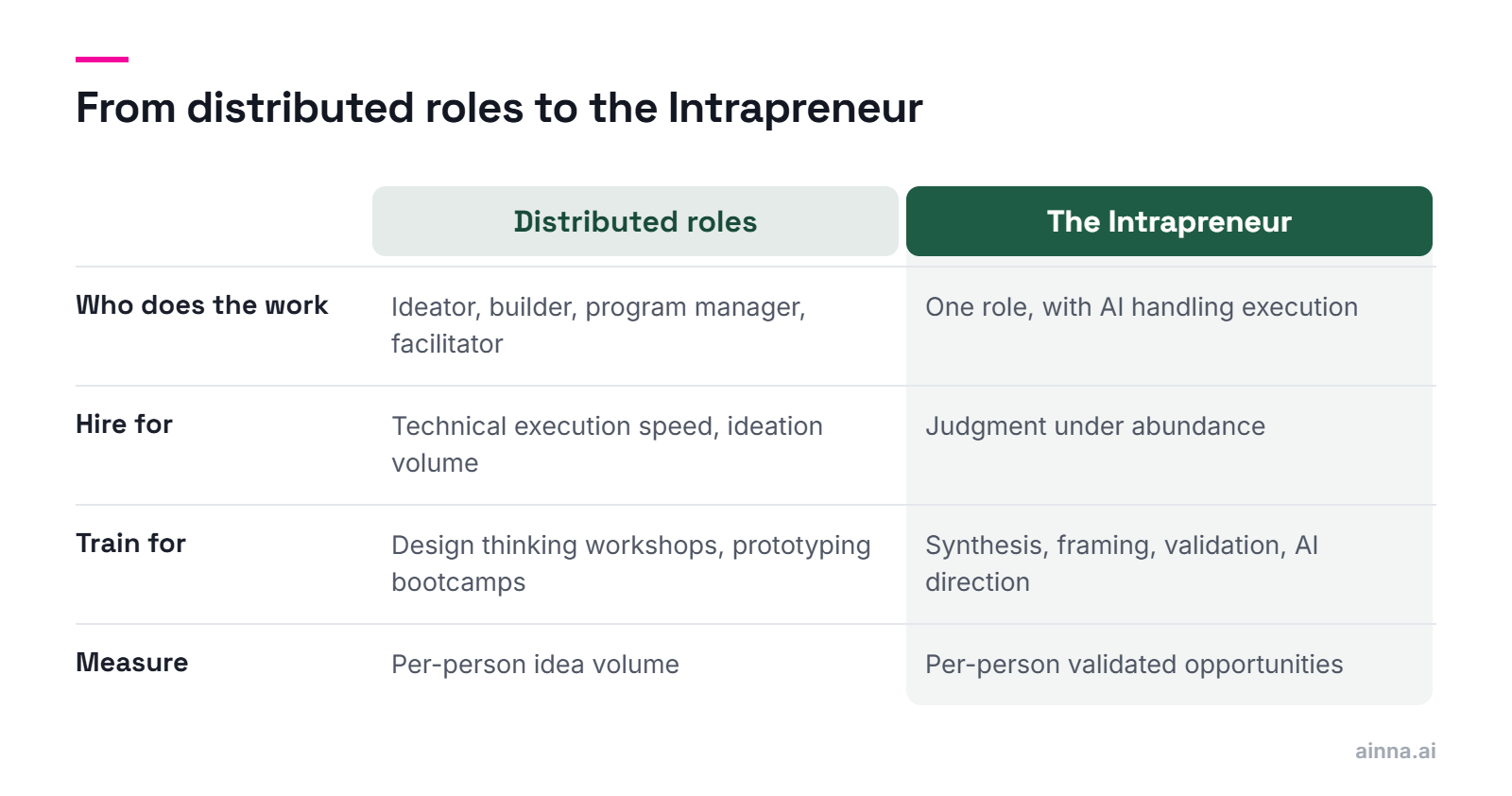
Distributed innovation roles are consolidating into the Intrapreneur. The ideator, the prototype builder, the program manager, the brainstorming facilitator - functions that used to require separate people now live in a single role with AI handling the execution layer. I introduced the Intrapreneur in Innovation Mode 2.0 as the role that inherits the creative ambition of the innovator, the commercial instinct of the product manager, and the risk posture of the founder.

  • The Intrapreneur is part of the broader '-preneur' family (entrepreneur, intrapreneur, solopreneur) that shares one disposition: a bias toward taking and making rather than deliberating. AI's collapse of execution barriers is what makes this consolidation viable - and necessary
  • What you hire for changes. The signal is no longer technical execution speed or ideation volume. The signal is judgment under abundance: can recognize a real opportunity in a sea of AI-generated candidates, can commit resources, can ship to market, can read which experiments are worth running
  • What you train for changes. Synthesis, framing, attribution decisions, market validation, AI direction. These are the skills that compound when AI handles execution. The classic training paths (design thinking workshops, prototyping bootcamps) are necessary but no longer sufficient
  • What you measure changes. Per-person idea volume drops in importance because AI generates idea volume cheaply. Per-person validated-opportunity output rises because that is the work AI cannot do unsupervised. Update performance metrics or you will reward the wrong behavior
Key Takeaway

The job titles do not need to change immediately. The job descriptions, hiring filters, performance metrics, and training paths do. Organizations that update these in 2026 will have a meaningfully different innovation function by 2027.

Did you know? Hackathon teams use Ainna to go from napkin sketch to credible pitch deck in under an hour — structured thinking at competition speed. Try the Hackathon Pack

Should we still run hackathons if AI can build prototypes?

Yes, but the hackathon's center of gravity moves from building to validating. The question shifts from 'can we build it?' to 'should we build it?' I see hackathons evolving into in-market concept validation contests, and the framework I use to design them is the Connected Hackathon Model: pre-event problem framing, in-event prototype validation, post-event commitment to a structured next stage.

  • What dies: the prototype-from-scratch hackathon where the win condition was technical execution under time pressure. AI handles execution. The technical advantage that defined hackathon winners is now available to anyone in the room
  • What survives: the team formation, the time pressure, the cross-disciplinary collision, the public pitch, the visibility for talent that would not otherwise surface. These remain genuinely valuable
  • What replaces the building contest: the validation contest. Teams compete to produce the most credible evidence that a concept will work in market - real user signals, technical feasibility tests, business model validation, competitive defensibility. Judges score the evidence, not the prototype polish
  • What changes structurally: judging criteria, scoring rubrics, the post-event pipeline. The Connected Hackathon Model fixes the historical weakness of corporate hackathons - winning concepts that nobody builds afterward - by routing every output into the broader innovation pipeline
  • For deeper analysis on whether hackathons are still relevant in the AI era, see my piece on theinnovationmode.com
Key Takeaway

The hackathon is not obsolete. The classic format is. Redesign the event around validation, not building, and the format becomes more relevant in the AI era than it was before.

How is AI changing brainstorming and ideation?

Brainstorming is becoming a synthesis event. AI generates concept baselines before or during the session, and participants spend their time evaluating, combining, and prioritizing rather than generating from scratch. I call this the Ideation-to-Synthesis Shift, and it is happening across every innovation event type simultaneously.

  • What the shift looks like in practice: a session opens with 50 AI-generated concepts framed against the problem statement. Participants spend the session pruning, combining, and pressure-testing rather than producing the first draft
  • What this requires from participants: domain expertise, strategic judgment, willingness to disagree, comfort cutting weak ideas. The Dream Team profile changes - you need senior thinkers and domain experts, not creative generalists
  • What this threatens: idea diversity. 2025 Wharton research published in Nature Human Behaviour found AI-assisted ideation produces higher-quality individual ideas but only 6% unique outputs, compared with 100% in human-only groups. AI raises the floor and lowers the ceiling simultaneously
  • What protects diversity: AI-Free Zones - deliberately unassisted segments where participants ideate without AI tools. The mechanism is detailed below
  • What this means for facilitators: facilitation is harder, not easier. The new skill is knowing when to bring AI into the room (synthesis, prototyping) and when to keep it out (initial divergence). Most facilitators have not yet been trained for this
Key Takeaway

Frame the shift to participants as an elevation, not a demotion. Synthesis, combination, and strategic prioritization are higher-order creative skills than first-draft generation. Communicating this correctly is what keeps participation rates from collapsing.

Who gets credit for AI-generated ideas?

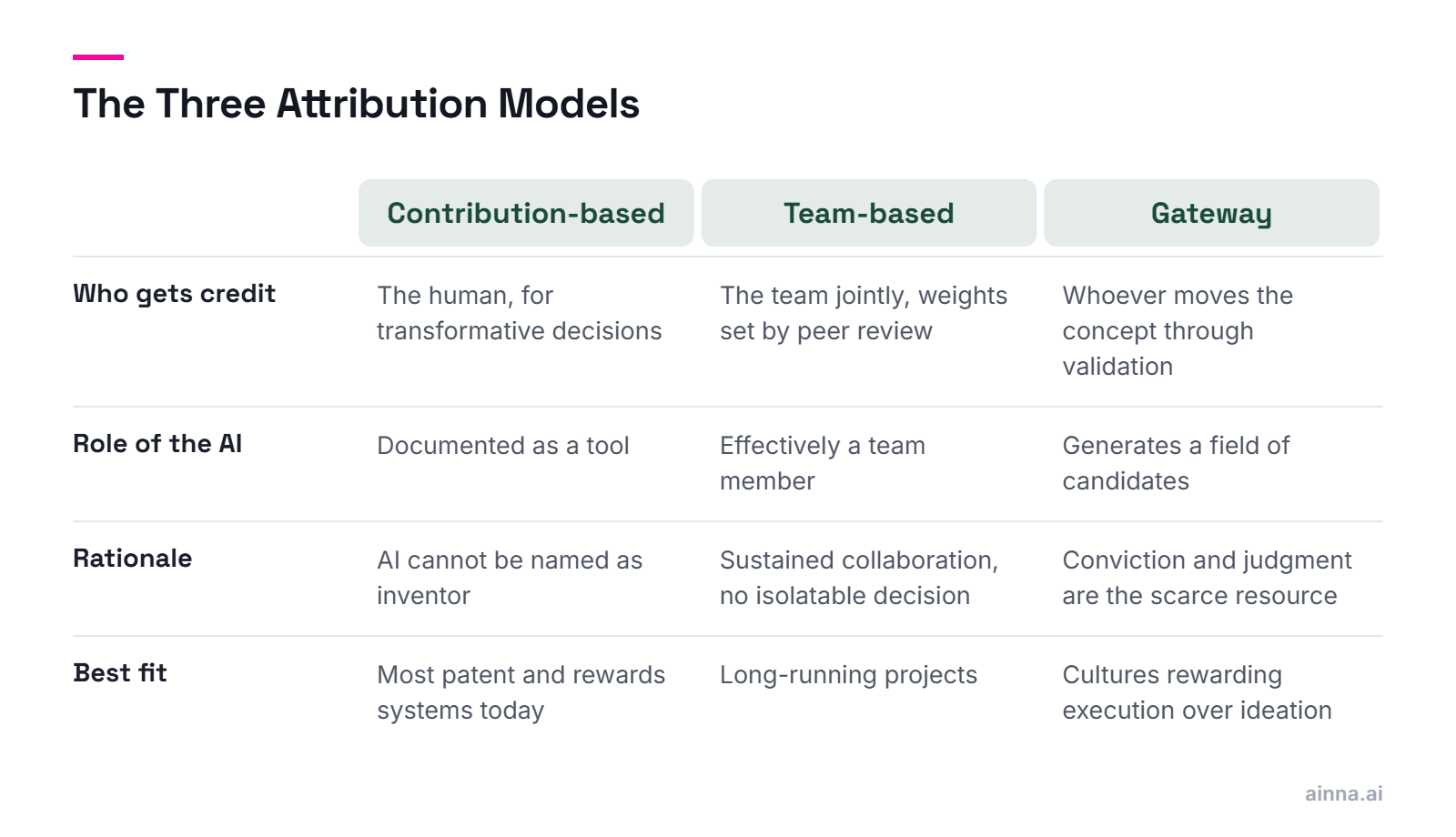
It depends on the model your organization picks - and most organizations have not picked one. From my advisory work with corporate innovation programs, I see Three Attribution Models emerging: Contribution-based attribution (the human is credited for transformative decisions), Team-based attribution (joint credit with peer-reviewed weights), and Gateway attribution (whoever moves the concept through validation owns the innovation). Pick deliberately or you will get the worst of all three by default.

  • Contribution-based attribution. The human is credited for the specific decisions that transformed AI output into something valuable: the selection, the reframing, the combination, the commitment. Patents and awards name the human; the AI is documented as a tool. Aligns with the USPTO position that AI cannot be named as inventor. Best fit for most patent and rewards systems today
  • Team-based attribution. When concepts emerge from sustained human-AI collaboration with no isolatable decision, the team is credited jointly and contribution weights are set by peer review. Best fit for long-running projects where the AI is effectively a team member rather than a one-time contributor
  • Gateway attribution. The AI generates a field of candidates; the person who moves a concept through the validation gateway (in-market test, customer commitment, capital allocation) owns the innovation. Rationale: under abundant idea supply, the scarce resource is conviction and judgment, not the idea itself. Best fit for cultures rewarding execution over ideation
  • Combination is normal. Most companies will combine models depending on event type and stage. The mistake is not having a model at all, which produces silent ambiguity and quietly kills participation - people stop trusting that their contributions will be recognized
  • What to do this quarter. Pick a model explicitly, document it, update performance metrics to include the synthesis and validation work AI does not do well, communicate the model openly to the team. Treat unresolved edge cases as a design problem, not a communications problem
Key Takeaway

Patent law, reward systems, and innovation metrics were built for an era when creative input came from humans. They will not adapt cleanly or quickly. The organizations that get this right will be the ones that pick a model now and refine it as evidence accumulates - rather than waiting for clarity that will not arrive.

Did you know? Ainna challenges weak assumptions during the conversation — surfacing blind spots you haven't considered, not just confirming what you already believe. Test your thinking

Justified, well-intended critique is what true innovators should be looking for.

How do I protect creativity when my team uses AI?

Design AI-Free Zones into your innovation events. An AI-Free Zone is a deliberately unassisted segment where participants ideate, sketch, and create without AI tools. The empirical case is strong: 2025 Wharton research found AI-assisted ideation produces 6% unique ideas compared with 100% in human-only groups. AI raises the floor and lowers the ceiling - AI-Free Zones are how you stop the ceiling from collapsing.

  • Where to place the zone: the divergent thinking phase. In a design sprint, that is Days 1-2. In a brainstorm, the opening hours. In a hackathon, the problem-framing and ideation phases before prototyping starts. AI returns at convergence, prototyping, and post-event documentation
  • What the zone does for participants: it preserves the creative satisfaction that motivates participation. People volunteer for innovation events because they want to make something. If AI does the making, they stop volunteering
  • What the zone does for the output: it protects idea diversity. The Wharton finding (6% unique vs 100%) shows AI-assisted groups converge on similar ideas. AI-Free Zones recover the diversity while keeping AI quality elsewhere
  • How to operationalize: phone-down rules, no-laptop sketching segments, paper-and-pen ideation rounds, structured human-only voting before AI synthesis. The mechanics matter less than the deliberate exclusion. AI-Free Zones are built into the Connected Design Sprint and Connected Hackathon Model by default
  • How to scale beyond events: extend the principle to roles. Some innovation work should remain human regardless of AI capability - synthesis decisions, attribution decisions, cultural facilitation. Treat AI-Free Zones as a category of work, not just a phase of an event
Key Takeaway

AI-Free Zones are how you operationalize human-in-the-loop as a design principle rather than an error-correction safeguard. The mechanic is simple. The discipline to actually enforce it is rare. Organizations that build the discipline will run innovation programs nobody else can match.

Is AI hurting innovation team culture?

It can, and you will not see it in productivity metrics. The signals show up in volunteer rates, post-event energy, and whether people describe themselves as contributors or spectators. From my advisory work, the leading indicator that integration has gone too far is when participation in optional innovation events drops sprint-over-sprint, even though output metrics still look healthy.

  • Volunteer rate. Track sign-ups for optional innovation events month-over-month. If they drop while output metrics improve, AI is producing the output but the people are disengaging. This is the strongest signal and the easiest to measure
  • Self-description. Quarterly survey question: do people describe themselves as valued contributors or spectators? The shift from 'I built this' to 'I evaluated AI's output' is real, and how participants frame it predicts retention. If 'spectator' language rises, the role narrative is failing
  • Post-event energy. Have facilitators score the closing energy of every event on a fixed 1-5 scale. The pattern over time tells you more than any single event. Declining energy is the first cultural metric to move and the first to predict broader culture decline
  • Idea diversity in the pool. Per the Wharton research, AI-assisted ideation produces less diverse output. Track unique-concept count per session alongside total-idea count. Diversity is what cultural health depends on - if diversity collapses, the cultural foundation is collapsing too
  • The integration gate. If volunteer rates, self-description, or post-event energy decline, slow down or roll back AI integration in the affected phases. Treat cultural metrics as a constraint on AI integration, not as an output to optimize alongside it
Key Takeaway

Productivity metrics measure what AI accelerates. Cultural metrics measure what AI threatens. A program that gets faster but less energizing is trading short-term output for long-term cultural decline. The decline is much harder to reverse than the productivity gain was to capture.

How should innovation leaders adapt to AI?

Five actions, in order. Start with the least culturally disruptive AI integrations (setup, documentation, post-event processing). Introduce AI as a prototyper before introducing it as an ideator. Be honest with the team about what is changing. Measure cultural health alongside productivity. Protect the specific moments that generate the most energy and motivation. The pattern is progressive integration, not sudden transformation.

  • Start with the least disruptive integrations. Event setup, documentation, post-event processing. Automate work nobody valued creatively. Solve the bottleneck where good ideas stall because nobody has time to write them up
  • Introduce AI as a prototyper before introducing it as an ideator. AI-assisted prototyping enhances the human experience (faster instantiation of their ideas). AI-assisted ideation can threaten it (their ideas compete with AI's). Sequence matters - this is the core principle of the Connected Design Sprint and the Connected Hackathon Model
  • Be honest about what's changing. Do not tell your innovation community that 'AI is just a tool' if it is restructuring their role. Acknowledge the shift, help people develop synthesis and strategic skills, create genuine recognition for those skills. Ambiguity quietly kills participation
  • Measure cultural health alongside productivity. Volunteer rates, post-event energy, self-description (contributor or spectator). A decline in cultural metrics should gate further AI integration. This is the constraint that keeps you from optimizing yourself into a culturally hollow innovation function
  • Protect what matters. Identify the specific moments in your events that generate the most energy, pride, and motivation - and do not automate them. If the prototyping challenge is what makes your hackathon special, keep it human. Find AI applications that enhance elements people value while accelerating elements they do not
Key Takeaway

The honest planning scenario: smaller teams, higher expectations per person, effort reallocated toward synthesis and execution. The five actions above are how you prepare for it without sacrificing the cultural foundations that make innovation work in the first place.

Did you know? Ainna applies the same structured methodology whether you're framing one idea or evaluating twenty — consistency across your innovation portfolio. See the Board Pack

Innovating versus empowering others to innovate are fundamentally different missions: the former requires domain expertise, while the latter needs primarily innovation methodology and leadership skills.

Most AI says yes.
Ainna says prove it.

The same methodology behind these guides — structured into the AI Innovation Agent that frames opportunities, challenges assumptions, and produces stakeholder-ready documents in minutes.

Put Your Idea to the Test Free to explore · No credit card
Ideas in →
Opportunities out.