Why do most AI projects fail to deliver business value?

Most AI projects fail for the same reason all innovation fails: they start with technology and work backwards toward a problem, instead of starting with a problem and working forward toward the right solution. Having spent three decades building data-driven and AI-powered products - and having watched dozens of AI programs across industries - I keep seeing the same pattern: a leader reads about a new AI capability, mandates 'we need to use this,' and teams scramble to find problems the technology can solve. This is precisely backwards.

  • The technology-first trap: 'We need an AI strategy' is the wrong starting point. 'We have these problems and AI might solve some of them' is the right one. As I describe in my product discovery methodology, jumping to solutions before understanding problems is the most expensive mistake in innovation
  • The demo-to-production gap: AI demos are impressive. AI in production is hard. The gap between a proof of concept that works on clean data and a production system that works on messy, real-world data kills more AI projects than any technical challenge
  • The data delusion: teams assume the data they need exists, is accessible, is clean, and is representative. In my experience building data-driven products across industries, at least one of these assumptions is wrong in 80% of cases
  • Misaligned success metrics: AI projects measured on technical metrics (model accuracy, F1 scores) instead of business outcomes (revenue impact, cost reduction, user satisfaction) produce technically excellent systems that nobody uses
  • The pilot graveyard: organizations that launch 50 AI pilots without a framework for deciding which to scale. Pilots become permanent experiments that consume resources without producing decisions. This often happens because the portfolio was built to keep every stakeholder happy rather than to serve a coherent strategy
  • The consensus trap: while AI prioritization is a strategic, mission-critical exercise, it very often degrades into a consensus-building process where the goal is keeping everybody pleased. Politics and strong opinions become stronger influences than most leaders would be comfortable admitting. Without a structured scoring model - something like my Nine-Dimension Idea Assessment Model extended with AI-specific dimensions - investment decisions default to whoever has the most convincing demo, the loudest voice, or the most political capital
Key Takeaway

The fix is not more AI expertise. It is better innovation methodology applied to AI decisions. The same structured approach that prevents non-AI innovation failure - problem framing, structured assessment, disciplined validation - prevents AI investment failure. AI just adds a few dimensions you must not ignore.
What is the difference between technology-first and problem-first AI strategy?

Technology-first: 'We have GPT-4 - what can we do with it?' Problem-first: 'Our customers wait 72 hours for support responses - can AI reduce that to minutes?' The first produces demos. The second produces business value. The difference is not subtle - it determines whether your AI investment returns millions or produces expensive experiments that get quietly shelved.

  • Technology-first starts with capability: 'AI can generate text / classify images / predict outcomes - let us find applications.' This produces solutions looking for problems - what I call 'innovation theater' in the AI for product management guide
  • Problem-first starts with pain: 'Our sales team spends 30% of their time on data entry instead of selling.' Then asks: 'Can AI address this?' The problem existed before AI - AI is just a candidate solution
  • In my Innovation Mode methodology, this maps to the Innovation Space concept: the Problem Space is populated independently of the Solution Space. AI capabilities live in the Solution Space. Problems live in the Problem Space. The two are connected - not conflated
  • Problem-first AI strategy uses my Problem Framing Template to articulate each challenge before evaluating whether AI is the right approach. Sometimes the answer is a process change, not a model
  • Technology-first organizations end up with a portfolio of AI demos. Problem-first organizations end up with a portfolio of solved problems - some using AI, some not, all delivering value
  • The practical test: if you removed the AI from your project description and the problem statement still makes sense, you are problem-first. If removing the AI leaves you with nothing to say, you are technology-first
Key Takeaway

Every successful AI investment I have been involved with started with a problem that was painful enough to justify solving. The AI was the how, not the why. Leaders who internalize this distinction will save their organizations millions in misdirected AI spending.

What makes AI investments fundamentally different from traditional software investments?

Traditional software is deterministic: given the same input, it produces the same output, every time. AI systems are probabilistic: they make predictions with varying confidence, their performance depends on data quality, and they can degrade over time as the world changes. This fundamentally alters how you should assess, prioritize, and manage AI investments. Leaders who apply traditional software investment frameworks to AI projects will consistently underestimate risk and overestimate predictability.

  • Probabilistic outputs: AI systems are correct 'most of the time' - and the gap between 95% accuracy and 99% accuracy can mean the difference between a useful product and a dangerous one. Your assessment model must account for the business impact of the error rate, not just the accuracy rate
  • Data dependency: traditional software needs code. AI needs code AND data. The data must be available, accessible, clean, representative, and ethically sourced. Each of these is an independent risk dimension that does not exist in conventional software projects
  • Model drift: AI performance degrades over time as the real world changes. A model trained on 2024 customer behavior may be wrong about 2026 customers. Your investment case must include ongoing maintenance costs, not just development costs
  • Talent scarcity: AI projects require specialized skills (data science, ML engineering, MLOps) that are scarcer and more expensive than traditional software engineering. Your feasibility assessment must account for talent availability, not just technical possibility
  • Ethical and regulatory surface area: AI systems can perpetuate bias, make opaque decisions, and create liability. The AI engineering guide covers technical considerations; but the investment decision must also weigh reputational and regulatory risk
  • Non-linear value curves: traditional software delivers incremental value with each feature. AI systems often deliver near-zero value until they cross a performance threshold - then deliver exponential value. Your portfolio must tolerate this step-function pattern
Key Takeaway

These differences do not make AI investments riskier - they make them differently risky. Leaders who understand the specific risk profile of AI projects and adjust their assessment models accordingly will make dramatically better investment decisions than those who treat AI like another software project.

How do leaders avoid the AI hype trap when making investment decisions?

The AI hype trap works like this: a vendor shows a stunning demo, a board member reads an article about AI transforming an industry, and suddenly there is pressure to 'do something with AI' before anyone has identified a problem worth solving. The antidote is not skepticism about AI - AI is genuinely transformative. The antidote is structured assessment that separates real opportunity from impressive technology looking for a purpose.

  • Demand a problem statement before any AI pitch: require every AI proposal to start with the Problem Framing Template - environment, dynamics, current state, ideal state. If the proposer cannot articulate the problem without mentioning AI, the proposal is technology-first
  • Distinguish 'AI can do this' from 'AI should do this for us': capability is not strategy. The question is not whether AI can solve a problem but whether it is the best approach given your data, team, timeline, and strategic priorities
  • Require data evidence early: before approving any AI investment beyond exploration, ask 'where is the data?' and 'is it good enough?' These questions kill 40% of AI hype proposals immediately - and that is a feature, not a bug
  • Benchmark against non-AI alternatives: for every AI proposal, ask 'what would a rule-based system, a process change, or a human workflow achieve?' If AI's advantage over simpler approaches is marginal, the investment is likely hype-driven
  • Use my AI-Adapted Opportunity Assessment Model (described later in this guide) to score every AI proposal on the same dimensions. When proposals compete on structured scores rather than demo impressiveness, hype loses to substance
  • Watch for the 'AI washing' pattern: existing software products rebranded as 'AI-powered' to justify higher prices or investment. Ask what the model actually does, what data it uses, and what happens when the model is wrong
Key Takeaway

The leaders who get the most value from AI are not the most enthusiastic - they are the most rigorous. They embrace AI's potential while subjecting every AI proposal to the same structured assessment they would apply to any significant investment. Rigor and enthusiasm are not opposites - they are partners.

Did you know? Ainna maps your competitive landscape automatically — positioning gaps, differentiation opportunities, and strategic whitespace, generated from your product concept. Map your landscape

How do you identify which business problems are good candidates for AI?

Good AI candidates share three characteristics: the problem involves pattern recognition at scale, the problem has sufficient data to learn from, and the cost of the problem justifies the investment in an AI solution. Not every important problem needs AI - and not every AI-solvable problem is worth solving. The intersection is where you should invest.

  • Pattern recognition at scale: AI excels where humans must process more data than they can handle - classifying thousands of support tickets, analyzing millions of transactions for fraud, personalizing experiences for millions of users. If a human can do the task in 30 seconds per instance, but there are 10,000 instances per day, that is an AI candidate
  • Prediction with consequences: AI is valuable when predicting outcomes improves decisions - which customers will churn, which leads will convert, which machines will fail. The prediction must connect to an action, or it is trivia
  • Generation with structure: generative AI is valuable when producing structured content at scale solves a real workflow problem - not when it produces generic content nobody asked for. As I discovered building Ainna, the value is in generating PRDs and pitch decks from methodology-driven structured inputs - not in generating generic documents from vague prompts
  • Data availability: the problem must have associated data that is accessible, representative, and of sufficient quality. If the data does not exist or requires a multi-year collection effort, the AI timeline extends dramatically
  • Use my Problem Framing Template adapted for AI: add a 'data landscape' section (what data exists, where it lives, how clean it is) and an 'AI applicability' section (which AI techniques could apply, what accuracy is required, what happens when the model is wrong)
  • Conduct an opportunity discovery sweep: survey customer-facing teams, operations leaders, and product managers for their most painful, repetitive, data-intensive problems. These are your AI Problem Space candidates
Key Takeaway

The best AI Problem Space is built from real operational pain, not from technology trend reports. Talk to the people who feel the problems daily. Their frustrations, multiplied by data availability, point to where AI investment will actually pay off.

How should leaders frame problems for AI investment evaluation?

Use my Problem Framing Template with three AI-specific extensions: a Data Landscape section (what data exists and how ready it is), an AI Applicability section (which AI techniques could apply), and a Failure Impact section (what happens when the AI is wrong). These extensions capture the dimensions that make AI investments fundamentally different from traditional software investments.

  • Standard Problem Framing: environment (stakeholders, ecosystem, market forces), dynamics (history, trajectory, failed attempts), current state (symptoms, root causes, quantified impact), ideal state (measurable success criteria)
  • AI Extension 1 - Data Landscape: what data is available? Where does it live? How clean and representative is it? What are the privacy and ethical constraints? How expensive is it to acquire, clean, and maintain? This section alone eliminates half of unrealistic AI proposals
  • AI Extension 2 - AI Applicability: which AI techniques could address this problem (classification, prediction, generation, optimization)? What accuracy threshold is required for business value? Are there existing models or must you build from scratch? What is the current state of the art for this problem type?
  • AI Extension 3 - Failure Impact: AI systems are probabilistic - they will be wrong some percentage of the time. What happens when the model makes an incorrect prediction? Is the failure graceful (a recommendation is ignored) or catastrophic (a medical diagnosis is wrong)? This determines the level of human oversight required
  • Frame problems independently of solutions: the same problem might be solvable with a rule-based system, a process change, or a human workflow - not just AI. Keeping the Problem Space solution-agnostic prevents premature commitment to AI when simpler approaches would suffice
  • Quantify the current cost of the problem: leadership decisions require numbers. 'Customer support takes too long' is not actionable. 'Each support ticket costs $12 to resolve manually, with 50,000 tickets monthly, and AI could reduce resolution cost to $2' is a business case
Key Takeaway

A well-framed AI problem with these three extensions gives leaders everything they need to make informed investment decisions: the business case (standard framing), the technical feasibility (data landscape + AI applicability), and the risk profile (failure impact). Without all three, you are guessing.

How do you run an AI opportunity discovery workshop for your organization?

Gather leaders from across the organization - not just technology leaders - and facilitate a structured session that populates your AI Problem Space. The goal is not to brainstorm AI solutions. The goal is to surface the most painful, data-rich, high-impact problems across the organization and then evaluate which ones are AI candidates. My Workshop Designer concept can generate the complete event setup from an initial brief.

  • Invite cross-functional leaders: operations, sales, marketing, customer success, finance, product, engineering. Each sees different problems. The technology team should NOT dominate - they tend to frame problems in terms of technology rather than business impact
  • Phase 1 - Problem surfacing (2 hours): each leader identifies their top 3 most painful, repetitive, data-intensive problems using the extended Problem Framing Template. Focus on problems, not solutions. No AI discussion yet
  • Phase 2 - AI candidacy screening (1 hour): for each surfaced problem, evaluate: is there sufficient data? Does it involve pattern recognition at scale? What happens when the system is wrong? Score each on a simple 1-5 AI candidacy scale
  • Phase 3 - Prioritization (1 hour): apply the AI-Adapted Opportunity Assessment Model (described in the next section) to rank the top AI candidates by potential value and feasibility
  • Output: a prioritized AI Problem Space - a structured list of business problems ranked by their AI investment potential. This becomes the input for your AI portfolio construction
  • Connect the workshop to your broader product discovery process: the AI Problem Space is a subset of your Innovation Space. Problems that are not AI candidates may still be valuable innovation opportunities pursued through other means. Use the broader brainstorming methodology to ensure nothing is lost
Key Takeaway

The workshop produces a shared, cross-functional understanding of where AI can create the most business value. This is dramatically more powerful than a technology team's wish list - because it is grounded in operational reality and owned by the leaders who will champion the projects.

How do you properly frame an AI solution for investment evaluation?

The same way you frame any innovation solution - using my Idea Framing Template and the Universal Idea Model - with AI-specific additions for model type, data requirements, accuracy expectations, and human-in-the-loop design. A well-framed AI solution describes what the system does, who it serves, and how it creates value - without drowning in technical implementation details that obscure the business case.

  • Start with the Universal Idea Model: 'An [AI-powered system] for [users] that [predicts/classifies/generates/optimizes] in order to [business outcome]. Users benefit by [specific value] when [specific context].' If you cannot complete this sentence clearly, the solution is not yet well-enough understood for investment
  • Add AI-specific framing: what type of model (classification, regression, generation, reinforcement learning)? What data does it need? What accuracy is expected? What happens on incorrect outputs? What human oversight is required?
  • Describe the human-AI interaction model: is the AI autonomous (makes decisions independently), assistive (recommends and human decides), or augmentative (enhances human capability)? This fundamentally shapes the risk profile and the user experience
  • Include the 'cold start' plan: how does the system perform before it has enough data? What is the minimum viable dataset? How long until the model reaches useful performance?
  • Frame the big unknowns: which assumptions could invalidate the entire approach? Data quality, model performance, user adoption, regulatory compliance - each is a specific risk that needs a specific validation plan
  • Use plain, non-technical language: my Innovation Mode methodology requires that ideas are framed in technology-agnostic terms accessible to all stakeholders. An AI solution described only in technical jargon will not get executive buy-in, regardless of its potential
Key Takeaway

A properly framed AI solution lets a non-technical executive understand the business case, a technical leader evaluate feasibility, and a product team plan development - all from the same document. That is the bar for investment-readiness.

What are the main types of AI solutions leaders should understand?

Leaders do not need to understand neural network architectures - they need to understand four categories of AI value creation: predictive AI (what will happen?), analytical AI (what does this mean?), generative AI (create something new), and autonomous AI (act independently). Each category has different data requirements, risk profiles, investment timelines, and business impact patterns. The AI engineering guide covers the technical foundations; this guide covers the investment implications.

  • Predictive AI: forecasting outcomes - churn prediction, demand forecasting, predictive maintenance. Typically the most proven category with clearest ROI. Requires historical data. Risk: model drift as conditions change
  • Analytical AI: extracting meaning from data - sentiment analysis, document classification, anomaly detection, customer segmentation. Augments human decision-making with scale. Requires labeled data for training
  • Generative AI: creating new content - text generation, code generation, image creation, product documentation (as Ainna does). The fastest-growing category in 2026. Requires quality inputs and human review. Risk: hallucination and quality variance
  • Autonomous AI: acting independently - automated trading, self-driving logistics, autonomous customer service. The highest potential and highest risk. Requires extensive validation, monitoring, and fallback mechanisms
  • Portfolio implications: a balanced AI portfolio typically starts with predictive and analytical AI (proven value, lower risk), adds generative AI (fast wins, moderate risk), and selectively invests in autonomous AI (transformational potential, higher risk)
  • The type determines the assessment model weighting: predictive AI investments weight data readiness heavily; generative AI investments weight output quality and human-review costs; autonomous AI investments weight failure impact and regulatory risk
Key Takeaway

Understanding these four categories lets leaders ask the right questions about any AI proposal: What type of AI value are we creating? Do we have the data and infrastructure for it? What is the risk profile? How does it fit our portfolio balance?

When should leaders decide NOT to use AI?

When a simpler solution solves the problem well enough, when the data does not exist or cannot be ethically obtained, when the cost of AI errors is unacceptable and cannot be mitigated, or when the problem is better solved by a process change than a technology investment. The courage to say 'AI is not the right answer here' is one of the most valuable leadership skills in 2026 - because the pressure to use AI everywhere is enormous.

  • Rule-based systems are better when: the logic is well-understood and stable, the rules can be explicitly defined, and transparency is critical (regulatory compliance, medical decisions). Not everything that can be solved with AI should be
  • Process changes are better when: the problem is caused by broken workflows, not insufficient intelligence. Automating a bad process with AI produces an automated bad process - faster
  • Data limitations: if the required data does not exist, would take years to collect, or raises privacy/ethical concerns, the AI investment timeline extends beyond its useful life. Better to invest in data infrastructure first
  • Error intolerance: some domains cannot tolerate probabilistic outputs. When a wrong prediction has catastrophic consequences and human oversight is not feasible, traditional deterministic systems remain safer. As I describe in the AI engineering guide, understanding where AI fails is as important as understanding where it succeeds
  • Cost-benefit: AI solutions have ongoing costs (compute, data maintenance, model retraining, monitoring) that simpler solutions do not. If a spreadsheet-based approach delivers 80% of the value at 10% of the cost, that is often the right business decision
  • The 'AI washing' test: if the primary purpose of using AI is to make a proposal sound more innovative or to justify a higher budget, the investment is hype-driven. Strip out the AI and evaluate the business case on its own merits
Key Takeaway

The best AI leaders are not the ones who put AI in everything. They are the ones who know exactly where AI creates genuine value - and are comfortable saying 'not here' everywhere else. That discrimination is what separates strategy from hype.

Did you know? Every document Ainna generates is fully editable PPTX or DOCX with your branding applied — present them as your own work, because they are. See sample outputs

How do you adapt the Nine-Dimension Assessment Model for AI projects?

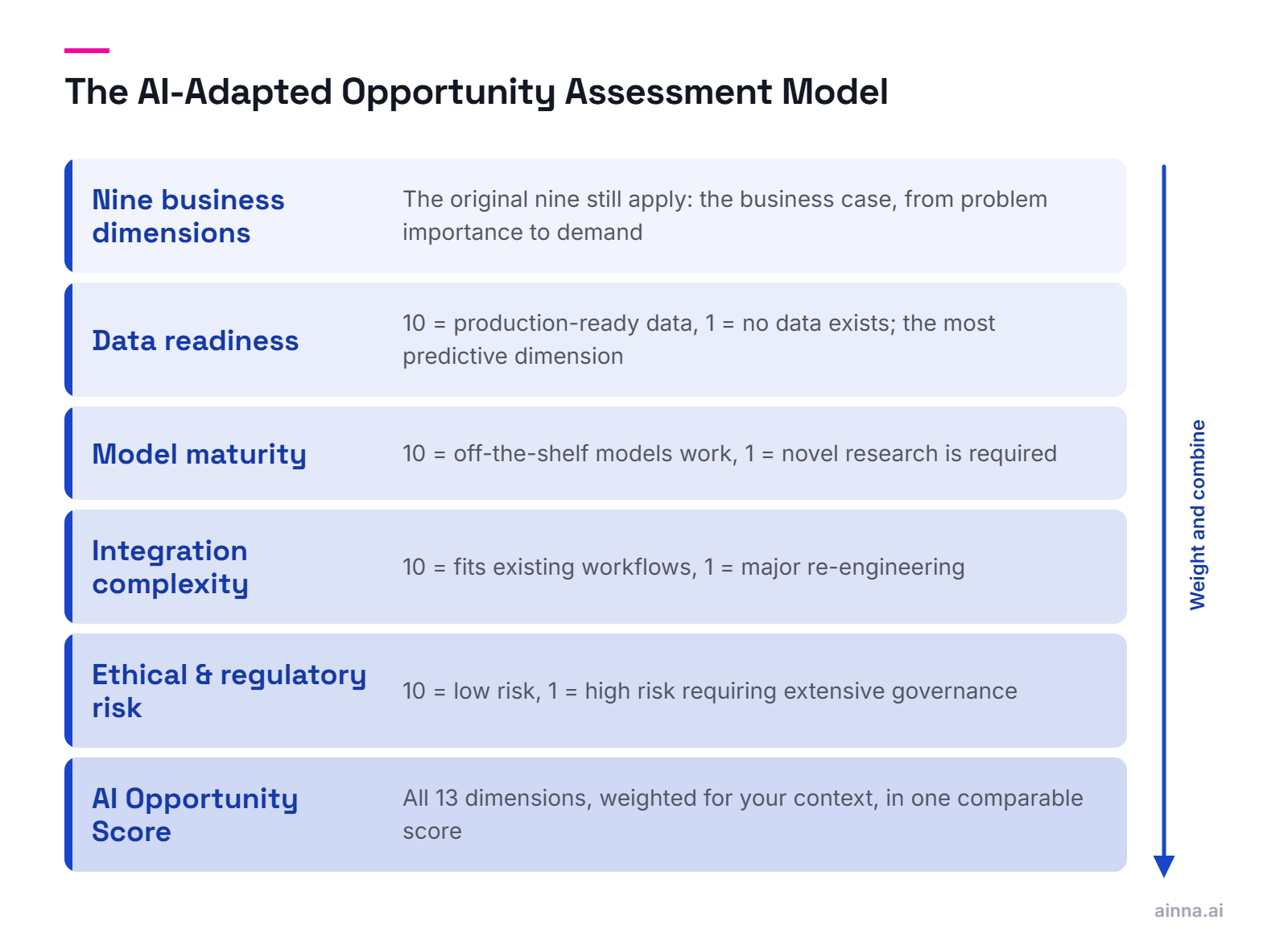
My Nine-Dimension Idea Assessment Model was designed to evaluate any innovation opportunity. For AI investments, I extend it with four AI-specific dimensions that capture the unique risk profile of probabilistic systems: Data Readiness, Model Maturity, Integration Complexity, and Ethical and Regulatory Risk. The extended model produces a single AI Opportunity Score that enables apples-to-apples comparison across your AI portfolio.

  • The original nine dimensions still apply: importance of the problem, strategic alignment, effectiveness of the solution, feasibility, ease of implementation, ease of operation, business impact, novelty, and certainty of demand. These capture the business case
  • AI Dimension 10 - Data Readiness: does the required data exist, is it accessible, is it clean, is it representative, is it ethically sourced? Score 1-10 where 10 means production-ready data and 1 means no data exists. This is the single most predictive dimension for AI project success
  • AI Dimension 11 - Model Maturity: is this a solved problem with proven models (image classification) or an unsolved research challenge (general reasoning)? Score 1-10 where 10 means off-the-shelf models work and 1 means novel research is required
  • AI Dimension 12 - Integration Complexity: how difficult is it to integrate the AI system into existing workflows, systems, and user experiences? Many AI projects succeed technically but fail on integration - the model works but nobody uses it
  • AI Dimension 13 - Ethical and Regulatory Risk: does the system make decisions about people (hiring, lending, healthcare)? Does it operate in regulated industries? Could biased outputs create legal liability or reputational damage? Score inversely: 10 means low risk, 1 means high risk requiring extensive governance
  • Weight the dimensions for your context: a healthcare organization might weight ethical risk heavily; a marketing technology company might weight data readiness and integration complexity. The weighting reflects your strategic priorities - there is no universal formula
Key Takeaway

I designed this extension after watching three enterprise AI programs score high on my original nine business dimensions but collapse when they hit data readiness walls, integration complexity, or ethical review cycles that nobody had anticipated. The four AI-specific dimensions catch what the business dimensions miss. More importantly, structured scoring replaces the consensus-driven prioritization that plagues most organizations - where AI investments are allocated to keep stakeholders happy rather than to serve a coherent strategy. When every proposal competes on the same 13 dimensions, politics loses to evidence. That is what wise prioritization looks like in practice.

How do you score and rank AI investment opportunities?

Score each AI opportunity on all 13 dimensions (1-10), apply your strategic weights, and compute a weighted AI Opportunity Score. Rank by score to create your prioritized investment pipeline. But the scores are conversation starters, not final answers - the discussion about WHY two evaluators scored data readiness differently often reveals more than the score itself.

  • Assemble 3-5 evaluators with complementary perspectives: a business leader (impact, alignment), a data/AI expert (data readiness, model maturity), a product leader (user value, integration), and an ethics/legal perspective (regulatory risk)
  • Score independently first, then discuss discrepancies. When evaluators disagree by more than 3 points on any dimension, the conversation about why is where real insight emerges
  • Apply your strategic weights: different weights for different portfolio segments. 'Quick win' opportunities might weight data readiness and integration simplicity heavily. 'Moonshot' opportunities might weight business impact and novelty more heavily
  • Use 'lenses' for different strategic contexts, as I describe in my Innovation Mode methodology: the same opportunities re-weighted for 'cost reduction,' 'revenue growth,' 'competitive defense,' or 'market expansion' produce different rankings - revealing which opportunities serve multiple strategic objectives
  • Calculate a composite AI Opportunity Score as the weighted sum across all 13 dimensions. Rank opportunities by score to build your prioritized pipeline
  • Flag any opportunity where a single AI-specific dimension scores below 3 - low data readiness, immature model landscape, high ethical risk, or integration complexity that exceeds organizational capability. These are not automatically rejected, but they require explicit risk mitigation plans before investment
Key Takeaway

Structured scoring transforms AI investment decisions from 'who has the best demo' to 'which opportunity has the strongest combination of business value, technical feasibility, and manageable risk.' I have used this approach to evaluate hundreds of opportunities across my career - and the conversations the scores generate are consistently more valuable than the scores themselves.

What are assessment 'lenses' and how do they help AI portfolio decisions?

Assessment lenses are different weighting configurations applied to the same scored opportunities. The same set of AI opportunities re-weighted for 'defensive strategy' (emphasizing competitive necessity and certainty of demand) versus 'growth strategy' (emphasizing market impact and novelty) will produce different priority rankings. This reveals which opportunities are robust across strategies and which are context-dependent.

  • Cost reduction lens: weight operational simplicity, integration complexity, and business impact (cost savings) heavily. Favors AI automation of existing workflows. Best for immediate ROI
  • Revenue growth lens: weight market demand certainty, novelty, and business impact (revenue) heavily. Favors AI-powered new products and features. Best for competitive positioning
  • Competitive defense lens: weight strategic alignment, certainty of demand, and model maturity heavily. Favors matching competitor AI capabilities. Best when market is moving fast and you risk falling behind
  • Innovation exploration lens: weight novelty, problem importance, and business impact heavily while deprioritizing feasibility and data readiness. Favors breakthrough bets. Best for dedicated innovation budget
  • The most valuable insight: opportunities that rank in the top 10 across ALL lenses are your strongest bets. Opportunities that rank high under one lens but low under others are strategic bets that belong in a specific portfolio segment
  • Present lens analysis to the leadership team: 'If we optimize for cost reduction, we fund these five projects. If we optimize for growth, we fund these five. Three projects appear in both lists - those are our highest-confidence investments.'
Key Takeaway

Lenses prevent the common mistake of building an AI portfolio that serves one strategic objective while ignoring others. They also make trade-offs explicit: 'We cannot fund both the defensive projects and the growth projects with this budget - which strategy do we prioritize?' That is a leadership conversation, not a technology conversation.

How do you assess data risk for AI investments?

Data is the single largest risk factor in AI investments - and the most consistently underestimated. Having built data-driven products for 30 years, I can tell you: the data is never as clean, complete, or accessible as the project proposal assumes. Your assessment must evaluate five data dimensions independently: existence, accessibility, quality, representativeness, and ethical sourcing.

  • Existence: does the data you need actually exist? Surprisingly often, the answer is no. Customer behavior data may exist, but the specific behavioral signals you need for your model may not be captured. Check before you invest
  • Accessibility: the data may exist but be trapped in legacy systems, siloed across departments, or subject to access restrictions. Data that technically exists but requires six months of engineering to extract is not 'available' for practical purposes
  • Quality: real-world data is messy - missing values, inconsistent formats, duplicate records, stale information. Budget for data cleaning as a significant project cost, not an afterthought. In my experience, data preparation typically consumes 60-80% of AI project effort
  • Representativeness: the data must reflect the population your model will serve. Training on US customer data and deploying globally creates bias. Training on historical data and predicting the future assumes the future resembles the past. Both are common and dangerous assumptions
  • Ethical sourcing: was the data collected with appropriate consent? Does it contain protected attributes? Could the model perpetuate or amplify existing biases? These questions are not optional - they are legal and reputational requirements
  • Score each dimension independently (1-10) as part of the Data Readiness assessment. Any dimension scoring below 4 requires a remediation plan before the project should proceed beyond proof of concept
Key Takeaway

Data risk is the most honest predictor of AI project success. Invest as much rigor in assessing your data as you do in evaluating the AI model itself. Projects with great models and bad data always fail. Projects with adequate models and great data often succeed.

How should leaders think about model uncertainty and performance risk?

Every AI model is wrong some percentage of the time. The question is not whether it will make mistakes but whether those mistakes are acceptable, detectable, and recoverable. Leaders who understand this - and build it into their investment assessment - make dramatically better AI decisions than leaders who treat AI accuracy as a binary pass/fail.

  • Define acceptable error rates in business terms, not technical terms. 'The model is 94% accurate' means nothing to a business leader. 'The model will incorrectly flag 6% of legitimate transactions as fraud, costing us approximately $120K monthly in customer friction' is a business decision
  • Distinguish false positives from false negatives and understand which costs you more. In fraud detection, false positives annoy customers; false negatives lose money. In medical screening, false negatives can be fatal. The business impact of each error type determines your model optimization strategy
  • Plan for model drift: AI performance degrades over time as the real world changes. Build monitoring and retraining costs into your investment case from day one. A model that performs brilliantly at launch and degrades over 18 months is a maintenance cost, not a one-time investment
  • Assess the 'cold start' period: how does the system perform before it has enough data to be useful? If the initial performance is poor, users may abandon it before it reaches useful accuracy. Plan for this adoption gap
  • Build human-in-the-loop as a feature, not a limitation: the most successful AI systems augment human decisions rather than replacing them entirely. This provides a safety net for model errors and generates training data that improves the model over time
  • In my risks vs uncertainties vs silent assumptions framework, model performance is an uncertainty (test it experimentally) not a risk (mitigate through planning). The only way to know real-world performance is to deploy and measure
Key Takeaway

Model uncertainty is not a reason to avoid AI investment - it is a reason to invest with the right validation structure. Build proof of concepts that test real-world performance, define performance thresholds that trigger decisions, and scale only what actually works.

How do you assess ethical and regulatory risk in AI investments?

Ethical and regulatory risk assessment must be a first-class dimension in your AI scoring model - not an afterthought reviewed by legal after the project is built. The organizations that get this wrong face lawsuits, regulatory penalties, and reputational damage that far exceeds the investment in the AI system itself.

  • Decision impact on people: does the AI make or influence decisions about hiring, lending, insurance, healthcare, education, or law enforcement? If yes, you are in high-risk territory that requires extensive governance, testing for bias, and regulatory compliance review before deployment
  • Transparency requirements: can you explain how the model reaches its decisions? Increasingly, regulations require explainability. Black-box models that cannot be audited create regulatory risk even if they perform well
  • Bias assessment: does your training data reflect historical biases? AI models trained on biased data perpetuate and amplify those biases. You must test for demographic disparities in model performance before deployment
  • Data privacy: does your AI system process personal data? GDPR, CCPA, and emerging AI-specific regulations create compliance obligations that must be designed in, not bolted on. Include privacy-by-design costs in your investment case
  • Competitive and IP considerations: are you training on data that raises intellectual property concerns? Are your AI outputs subject to copyright questions? These legal uncertainties create investment risk that should be assessed explicitly
  • Score ethical and regulatory risk inversely in your assessment model: high-risk applications (decisions about people, regulated industries) score low on this dimension, increasing the overall investment threshold. This ensures high-risk AI projects are not funded casually
Key Takeaway

Ethical AI is not a constraint on innovation - it is a requirement for sustainable innovation. Organizations that build ethical assessment into their AI investment process from day one move faster than those that deal with ethical problems after deployment. Prevention is always cheaper than remediation.

Did you know? Ainna's portfolio view lets you track, compare, and prioritise multiple opportunities against consistent criteria — the same rigour applied to every bet. Evaluate your portfolio

Innovating versus empowering others to innovate are fundamentally different missions: the former requires domain expertise, while the latter needs primarily innovation methodology and leadership skills.

How do you construct a balanced AI investment portfolio?

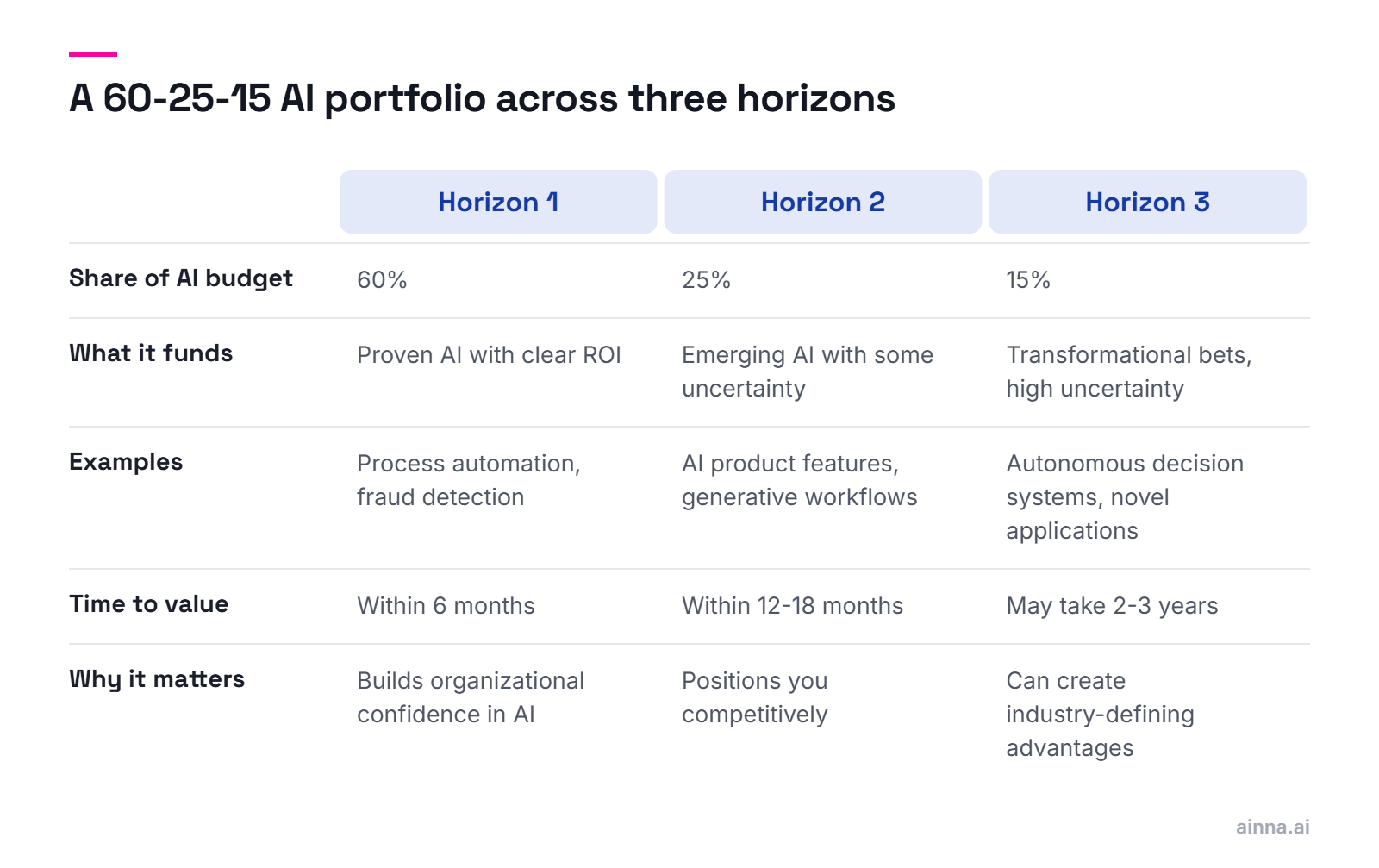
A balanced AI portfolio follows the same logic as any innovation portfolio: allocate across three horizons with different risk-return profiles. I recommend a 60-25-15 split for most organizations entering their AI investment journey: 60% on proven-value AI applications (automation, analytics, optimization), 25% on emerging AI capabilities (generative AI products, predictive features), and 15% on exploratory AI bets (autonomous systems, novel applications).

  • Horizon 1 (60% of AI budget): proven AI applications with clear ROI. Process automation, customer service AI, demand forecasting, fraud detection. These deliver measurable value within 6 months and build organizational confidence in AI
  • Horizon 2 (25% of AI budget): emerging AI applications with strong potential but some uncertainty. AI-powered product features, generative AI workflows, competitive intelligence systems. These deliver value within 12-18 months and position you competitively
  • Horizon 3 (15% of AI budget): transformational AI bets with high uncertainty and high potential. Novel applications, autonomous decision systems, AI-native product lines. These may take 2-3 years but can create industry-defining advantages
  • Map scored opportunities to horizons: high-scoring opportunities with strong data readiness and model maturity go to Horizon 1. High-scoring opportunities with lower data readiness or novel model requirements go to Horizons 2-3
  • Rebalance quarterly: as Horizon 1 projects deliver value and free up budget, reinvest in Horizon 2-3. As Horizon 2 projects prove out, graduate them to Horizon 1 budgets for scaling. Kill Horizon 3 projects that fail to show progress after defined timeframes
  • Resist the consensus portfolio: the most common failure mode is allocating a little bit of budget to every stakeholder's favorite AI idea so nobody feels excluded. The result is 20 underfunded projects instead of 5 properly funded ones. A strategic portfolio disappoints some stakeholders - that is a feature, not a bug. Use the AI-Adapted Assessment Model scores to make these conversations evidence-based rather than political
  • Apply the venture building mindset to Horizon 3: treat each exploratory AI bet as an internal venture with its own team, budget, milestones, and kill criteria. Do not merge them into existing product teams where they will be deprioritized
Key Takeaway

At every company where I have built or advised on AI programs, the organizations that extracted the most value were not the ones that spent the most - they were the ones with the most disciplined portfolio. Quick wins build confidence and fund exploration. Exploration finds the transformational opportunities that justify the entire AI investment program. The Innovation Toolkit templates provide the structured formats for documenting each opportunity as it moves through the portfolio.

How should AI investments be staged and gated?

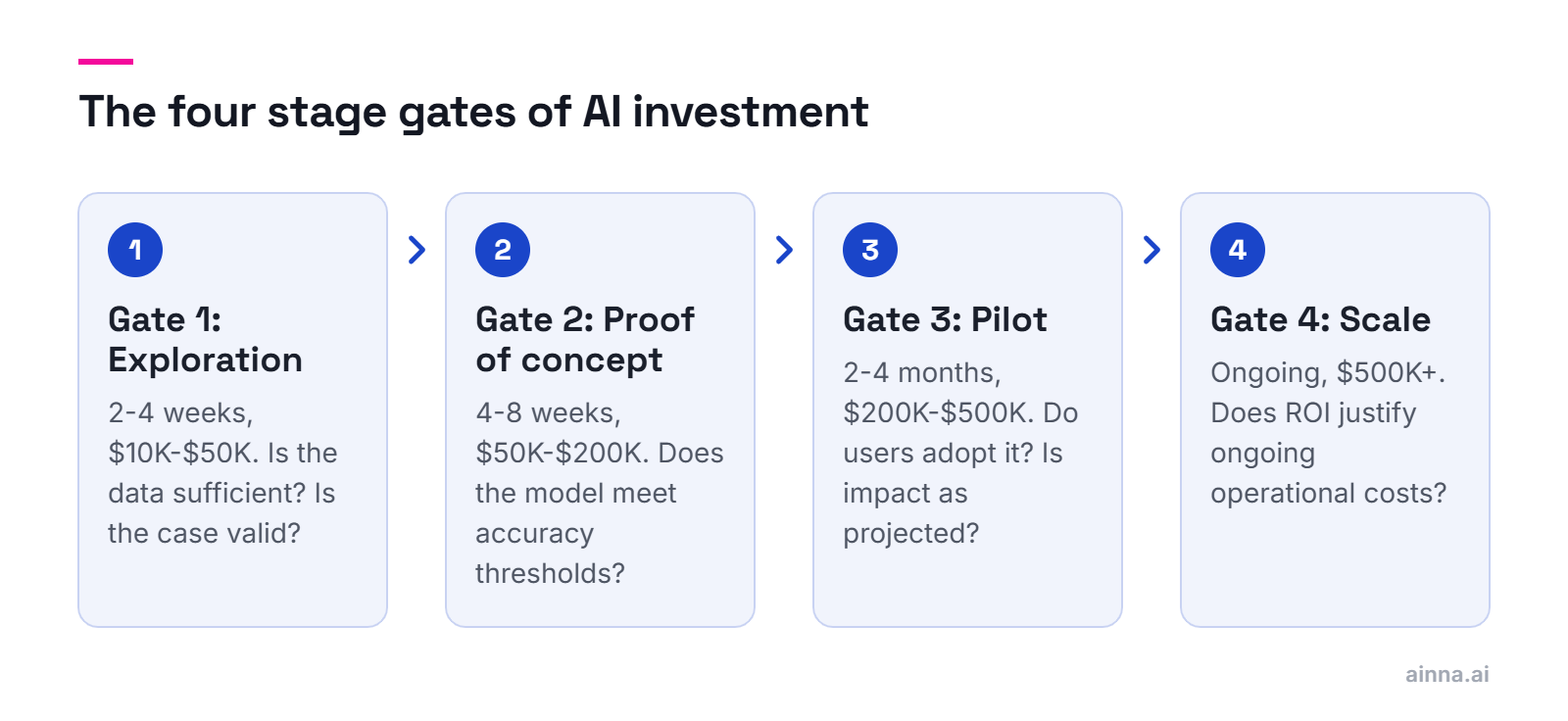
Never fund an AI project from concept to production in a single decision. Stage your investment through four gates: Exploration (is this worth investigating?), Proof of Concept (does the AI actually work on real data?), Pilot (does it work in production conditions?), and Scale (does it deliver business value at full deployment?). Each gate has specific criteria that must be met before additional funding is released.

  • Gate 1 - Exploration ($10K-$50K, 2-4 weeks): assess data availability, evaluate off-the-shelf models, build a small-scale technical experiment. Decision criteria: is the data sufficient? Is model performance plausible? Is the business case valid at expected accuracy levels?
  • Gate 2 - Proof of Concept ($50K-$200K, 4-8 weeks): build a working model on real data, measure actual performance against business requirements. Decision criteria: does the model meet minimum accuracy thresholds? Are the error types acceptable? Is integration technically feasible? Use the prototyping methodology to build validation artifacts
  • Gate 3 - Pilot ($200K-$500K, 2-4 months): deploy to a limited user group in production conditions, measure real business impact, identify operational challenges. Decision criteria: do users adopt it? Does business impact match projections? Are operational costs sustainable?
  • Gate 4 - Scale ($500K+, ongoing): full production deployment with monitoring, retraining pipeline, and support infrastructure. Decision criteria: does ROI justify ongoing operational costs? Is the system reliable and maintainable?
  • Each gate is a kill-or-continue decision: if criteria are not met, the project is either pivoted, returned to a previous stage for rework, or terminated. The sunk cost fallacy kills more AI projects than technical failure - build explicit kill criteria before you start
  • Track gate progression across your portfolio: if multiple projects stall at Gate 2 (PoC), you may have a systemic data readiness problem. If projects succeed at Gate 3 (Pilot) but stall at Gate 4 (Scale), you may have an organizational integration problem
Key Takeaway

Staged investment is not bureaucracy - it is discipline. Having filed 20+ patents on AI systems, I can tell you: the gap between 'this works in a lab' and 'this works in production' is where most AI investment is destroyed. Each gate closes that gap incrementally, providing real evidence before committing additional resources.

How do you balance AI quick wins with transformational bets?

Quick wins fund the future. Transformational bets build the future. You need both - and the relationship between them is not just philosophical, it is financial. The measurable ROI from Horizon 1 quick wins provides the evidence and the budget to justify Horizon 3 exploration. Without quick wins, your AI program loses credibility. Without transformational bets, your competitors eventually leapfrog you.

  • Start with quick wins: identify 2-3 AI applications that can deliver measurable value within 90 days. Process automation, AI-powered documentation, customer inquiry routing. These build organizational confidence that AI actually works - not in demos but in production. This is exactly how I built Ainna: start with a clear problem (documentation overhead for PMs), validate with real users, and scale what works
  • Use quick wins to build AI muscle: the data infrastructure, ML engineering capabilities, and deployment practices developed for quick wins become the foundation for complex projects. Do not skip this capability building
  • Ring-fence transformational budget: do not let quick-win priorities consume the entire AI budget. Allocate a protected 15% for exploration that cannot be raided for operational needs. This is venture capital thinking applied to internal AI investment
  • Connect transformational bets to product discovery: use AI hackathons and design sprints to surface and test transformational ideas quickly and cheaply before committing significant budget
  • Measure differently: quick wins are measured on ROI (cost savings, efficiency gains, revenue impact). Transformational bets are measured on learning velocity (hypotheses tested, assumptions validated, capability gaps closed). Applying ROI metrics to early-stage exploration kills it before it has a chance to prove out
  • Tell both stories to leadership: 'Our AI program delivered $2M in cost savings this quarter from operational AI (quick wins) while our AI exploration team validated two transformational concepts that could create $50M in new revenue over three years (moonshots).' That narrative sustains investment in both horizons
Key Takeaway

The leaders who build the best AI portfolios are comfortable holding two truths simultaneously: we need proven ROI from AI this quarter AND we need to take risks on AI that may not pay off for three years. Managing that tension - not resolving it - is the core leadership skill of AI-era strategy.

How do you validate AI opportunities before committing significant investment?

The same way you validate any innovation opportunity - but with AI-specific validation targets. In my Innovation Mode methodology, validation means gathering real-world evidence for the assumptions that would kill the project if wrong. For AI projects, the assumptions that matter most are: the data is good enough, the model performs adequately, users will trust and adopt the AI output, and the operational costs are sustainable.

  • Validate data first: before building any model, run a data assessment that answers: does the data exist? Is it accessible? Is it representative? Is it clean enough? This $10K investment can prevent a $500K failure. Use the data readiness scoring from the AI-Adapted Assessment Model
  • Validate model feasibility second: build a minimal model on real data and test actual performance against business requirements - not against academic benchmarks. A model that achieves 92% accuracy on a clean dataset but 74% on real-world data is not meeting your bar if you need 85%
  • Validate user adoption third: prototype the AI-powered experience and test with real users. Will they trust AI recommendations? Will they change their workflow? The best model in the world fails if users ignore its output or work around it
  • Validate operational sustainability last: what does it cost to run this system daily? Monthly? What does retraining cost? What happens during model downtime? These costs often exceed initial development costs and must be part of the investment case
  • Use the Business Experiment Framing Template to structure each validation: define learning objectives, hypotheses, metrics, and decision criteria before running the test
  • Apply the validation trap awareness: define your decision criteria and timeline before you start. Four rounds of validation without a decision is procrastination, not rigor
Key Takeaway

AI validation is not optional - it is the most important investment in your AI program. The $50K spent validating saves the $500K lost on projects that fail in production. Validate ruthlessly, decide quickly, and scale only what actually works.

How do validated AI opportunities connect to the product development pipeline?

A validated AI opportunity enters what I call Opportunity Realization - the same pathway as any validated innovation, with AI-specific documentation requirements. The opportunity needs a product concept, a PRD with AI-specific sections (model specifications, data pipeline requirements, monitoring plan), and a go-to-market strategy that addresses trust and adoption.

  • Document validation results: what was tested, what performance was achieved, what assumptions were confirmed or invalidated. This becomes the evidence base for scaling decisions
  • Create an AI-specific PRD that includes: model behavior specifications, data pipeline architecture, accuracy requirements, error handling design, monitoring and alerting plan, retraining schedule, and human-oversight model. The AI PRD guide covers these additional sections
  • Define the MVP carefully: what is the minimum AI system that tests the core value hypothesis with real users? Often this means deploying with human oversight initially and gradually increasing automation as confidence builds
  • Build the business case: use validation data to project ROI, estimate operational costs, and define milestone-based funding. Ainna can generate the complete documentation package - PRD, pitch deck, competitive analysis - from structured inputs in 60 seconds
  • Plan for production operations: AI systems require ongoing care - monitoring, retraining, performance measurement, bias auditing. Build these costs into the investment case, not as surprises after launch
  • Connect to the broader product roadmap: AI features need the same prioritization discipline as any product feature. Use the AI-Adapted Assessment Model scores to position AI opportunities relative to non-AI priorities
Key Takeaway

The transition from validated AI concept to production product is where many organizations lose momentum. The documentation produced during validation - problem statement, assessment scores, validation results, product concept - is what enables a smooth handoff from innovation team to product development team.

Did you know? Ainna applies the same structured methodology whether you're framing one idea or evaluating twenty — consistency across your innovation portfolio. See the Board Pack

Where should a leader start with AI project prioritization?

Start by building your AI Problem Space. Not by evaluating vendors, not by hiring a data science team, not by launching pilots. Gather your leadership team, identify your 10 most painful, data-rich business problems, and score them for AI candidacy. That list - built in a single workshop - is worth more than six months of unfocused AI experimentation.

  • Month 1 - Build the Problem Space: run an AI opportunity discovery workshop with cross-functional leaders. Use my Problem Framing Template extended with AI dimensions to surface 15-20 problems, screen for AI candidacy, and prioritize the top 10
  • Month 1 - Score opportunities: apply the AI-Adapted Opportunity Assessment Model to the top 10 candidates. Score on all 13 dimensions with a cross-functional evaluation team. Rank by weighted score. Use the Innovation Toolkit templates to structure every opportunity consistently
  • Month 2 - Select and validate: pick 2-3 top-scoring opportunities for Gate 1 exploration ($10K-$50K each). Run data assessments and technical feasibility checks. Kill or continue based on evidence, not optimism
  • Month 2 - Document and pitch: for each opportunity advancing past Gate 1, use Ainna to generate the full documentation package - PRD, pitch deck, competitive analysis - in 60 seconds. This makes every scored opportunity investment-ready for leadership review
  • Month 3 - Begin proof of concepts: for opportunities that passed Gate 1, fund Gate 2 PoCs. Simultaneously, launch a second round of problem surfacing to keep the AI Problem Space growing
  • Ongoing: establish quarterly AI portfolio reviews where scored opportunities are re-assessed, gate decisions are made, and new opportunities enter the pipeline. Connect to my Innovation Calendar concept for a year-round rhythm of AI discovery events
Key Takeaway

90 days is enough to go from 'we should do something with AI' to 'we have a scored pipeline of opportunities, we are validating the top three, and we have a portfolio framework for ongoing AI investment.' That is more progress than most organizations make in a year of unfocused experimentation - and it replaces the consensus-driven, politically-shaped prioritization that most AI programs settle for with something far more powerful: evidence-based decisions that your entire leadership team can stand behind, even when they disagree. Prioritizing wisely is a superpower. This is how you build it.

How do leaders build AI fluency without becoming technical experts?

Leaders do not need to understand backpropagation. They need to understand four things: what AI can and cannot do, how to assess AI project proposals, how to read AI performance metrics in business terms, and how to manage the specific risks of probabilistic systems. This guide - combined with the AI for product management guide and the AI engineering guide - provides that foundation.

  • Learn the four categories of AI value (predictive, analytical, generative, autonomous) and be able to classify any AI proposal into one of them. This immediately structures your assessment conversation
  • Master the AI-Adapted Opportunity Assessment Model from this guide. When you can score an AI opportunity on 13 dimensions, you can evaluate any AI proposal regardless of its technical complexity
  • Develop data intuition: learn to ask 'where is the data?' and 'is it good enough?' for every AI proposal. These two questions alone expose 40% of unrealistic AI proposals
  • Understand AI error types: know the difference between false positives and false negatives, and ask 'what happens when the model is wrong?' for every AI system. The answer determines the governance model
  • Stay current through your AI-powered product teams: the best AI education for leaders comes from reviewing actual AI project results, not from courses. Quarterly AI portfolio reviews are learning opportunities
  • Use the Innovation Toolkit templates to structure AI conversations: when everyone uses the same frameworks, the quality of AI discussions improves across the organization
Key Takeaway

AI fluency for leaders is not about technical knowledge - it is about judgment. As I describe in the traits of a great product leader, the ability to navigate ambiguity and make decisions with incomplete information has always been the defining leadership skill. AI just raises the stakes - and rewards the leaders who combine that judgment with structured methodology.

How should organizations govern their AI investment portfolio?

AI portfolio governance combines innovation portfolio management with AI-specific oversight. Establish a quarterly AI Portfolio Review that evaluates all active AI investments against their stage-gate criteria, scores new opportunities entering the pipeline, and makes explicit fund/continue/kill decisions. This is the operating rhythm that transforms AI from a collection of disconnected projects into a managed strategic capability.

  • Quarterly AI Portfolio Review: review all active AI projects against their gate criteria, assess new scored opportunities for funding, rebalance across horizons, and update the AI Problem Space with newly surfaced problems
  • Cross-functional governance board: include technology leadership (feasibility), business leadership (value), product leadership (user impact), ethics/legal (risk), and finance (budget). No single function should control AI investment decisions
  • Standardized reporting: every AI project reports on the same metrics - model performance against business thresholds, user adoption rates, operational costs, and progress against stage-gate criteria. My Innovation Mode Innovation Graph concept provides the infrastructure for this
  • Ethics review integration: high-risk AI projects (decisions about people, regulated domains) require ethics review before advancing past Gate 2. Build this into the process, not as an exception
  • Kill discipline: the hardest but most valuable governance practice. Projects that fail to meet gate criteria must be stopped or pivoted, regardless of sunk costs. The portfolio's health depends on rigorous pruning as much as smart selection
  • Connect to corporate strategy: the AI portfolio should visibly serve strategic objectives. In each quarterly review, validate that the portfolio balance aligns with current strategic priorities - reweight assessment lenses if strategy has shifted
Key Takeaway

Good AI governance does not slow innovation - it accelerates it by ensuring resources flow to the highest-value opportunities and away from projects that consume budget without producing results. As I wrote in Innovation Mode 2.0, the discipline to govern well is what separates organizations that extract real value from AI from organizations that just spend money on it.

In such innovative environments, business titles, hierarchical levels, and job descriptions are less important; it is the vision, ideas, and willingness to contribute that matter most.

Most AI says yes.
Ainna says prove it.

The same methodology behind these guides — structured into the AI Innovation Agent that frames opportunities, challenges assumptions, and produces stakeholder-ready documents in minutes.

Put Your Idea to the Test Free to explore · No credit card
Ideas in →
Opportunities out.