
Foundational Concepts

Core principles and philosophy behind the MVP approach.

The MVP approach aligns with startup reality: limited resources, high uncertainty, and the need to learn fast. It lets you ship earlier, satisfy early customers by solving their core problem first, and avoid spending on features that aren't yet validated.

  • Ship earlier and start learning from real users instead of assumptions
  • Focus resources on solving the core problem exceptionally well
  • Avoid building features nobody actually needs or wants
  • Reduce financial risk by validating before scaling
  • Create feedback loops that guide product evolution

The experimental nature of early-stage startups demands laser focus—MVP thinking provides the discipline to identify and build only what delivers value earliest.

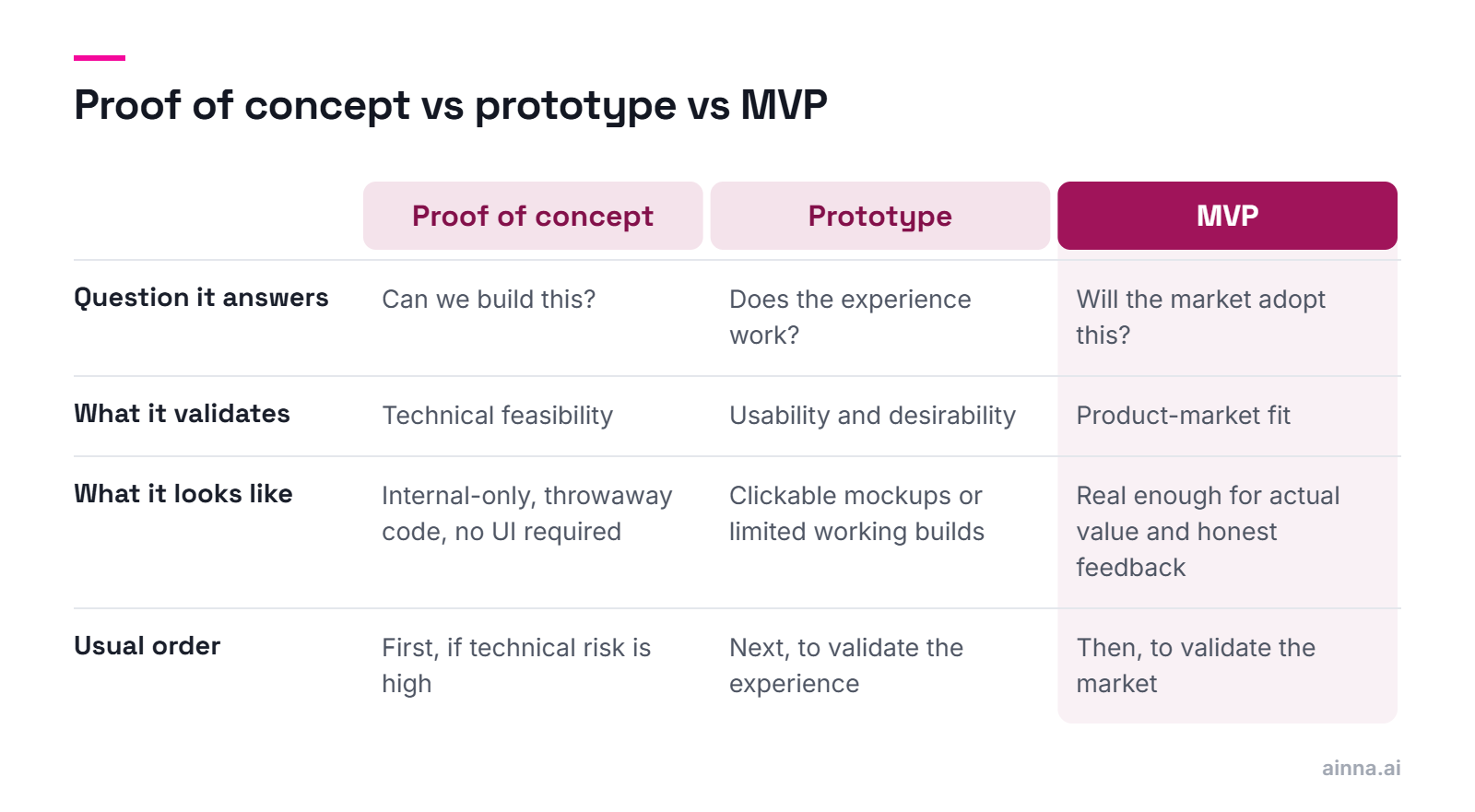
An MVP is the smallest version of your product that solves the core problem well enough to deliver real value and generate meaningful market feedback. It's "minimum" in scope but must be "viable"—it actually works and solves the problem.

  • NOT a broken or buggy version of your product
  • NOT a prototype you're embarrassed to show customers
  • NOT an excuse to skip quality standards on core functionality
  • IS a focused solution that does one thing well
  • IS good enough for users to experience real value and provide honest feedback

Think of MVP as the intersection of minimum scope and viable quality—cutting features, not corners on the features you keep.

Traditional development follows "build it all, then launch"—teams spend months developing comprehensive features based on assumptions, only to discover post-launch that many go unused. MVP flips this: build the smallest valuable increment, release, learn, iterate.

  • Traditional: extensive upfront planning based on assumptions
  • MVP: rapid hypothesis testing with real users
  • Traditional: big-bang launches after long development cycles
  • MVP: continuous small releases with feedback loops
  • Traditional: risk concentrated at launch; MVP: risk distributed across iterations

The key difference is when you learn. MVP development learns early and often, reducing the risk of building something nobody wants.

Feature Prioritization

How to choose and prioritize features for your MVP.

Use structured frameworks to remove emotion from prioritization decisions. The three most effective methods are MoSCoW (categorization), RICE (scoring), and Kano (user satisfaction modeling)—each suits different contexts.

  • MoSCoW Method: Categorize as Must-have, Should-have, Could-have, Won't-have—MVP includes only Must-haves
  • RICE Scoring: Evaluate Reach × Impact × Confidence ÷ Effort—prioritize highest scores
  • Kano Model: Identify Basic (expected), Performance (more is better), Delight (wow) features—MVP needs all Basic + select Performance
  • Start with user problems, not feature wishlists
  • Validate assumptions with user research before committing

No framework is perfect—the goal is structured thinking that forces hard tradeoffs. Document your prioritization rationale for stakeholder alignment.

Cut ruthlessly. If a feature can't be directly tied to solving the core problem for your primary user, it doesn't belong in the MVP. The discipline to cut is what separates MVPs that ship from those that don't.

  • "Nice to have" features—if you can't tie it to the core problem, cut it
  • Advanced customization—start with sensible defaults that work for 80%
  • Multiple user types—focus on your primary persona first
  • Third-party integrations—unless integration IS your core value
  • Admin panels and dashboards—use simple tools or manual processes early on
  • Edge case handling—handle exceptions manually until scale demands automation

Ask for each feature: "Would users still get core value without this?" If yes, cut it. You can always add it in v1.1.

Stakeholder resistance to scope cuts is natural—everyone has features they believe are essential. Success requires reframing the conversation from "cutting" to "sequencing" and grounding discussions in data rather than opinions.

  • Reframe: You're sequencing features, not eliminating them permanently
  • Use data: Studies show most features in most products are rarely used (Pendo reports ~80% of features see minimal engagement)
  • Align on goals: If the shared goal is learning fast, MVP scope becomes logical
  • Propose experiments: Offer to test demand signals before investing months of development
  • Quantify delay cost: Every additional feature delays launch and learning by X weeks

Create a "parking lot" document for deferred features with clear criteria for when they'll be reconsidered. This shows stakeholders their input is valued while maintaining scope discipline.

Sources:Feature Adoption ReportPendo, 2019

Execution & Best Practices

Practical guidance for building and launching MVPs.

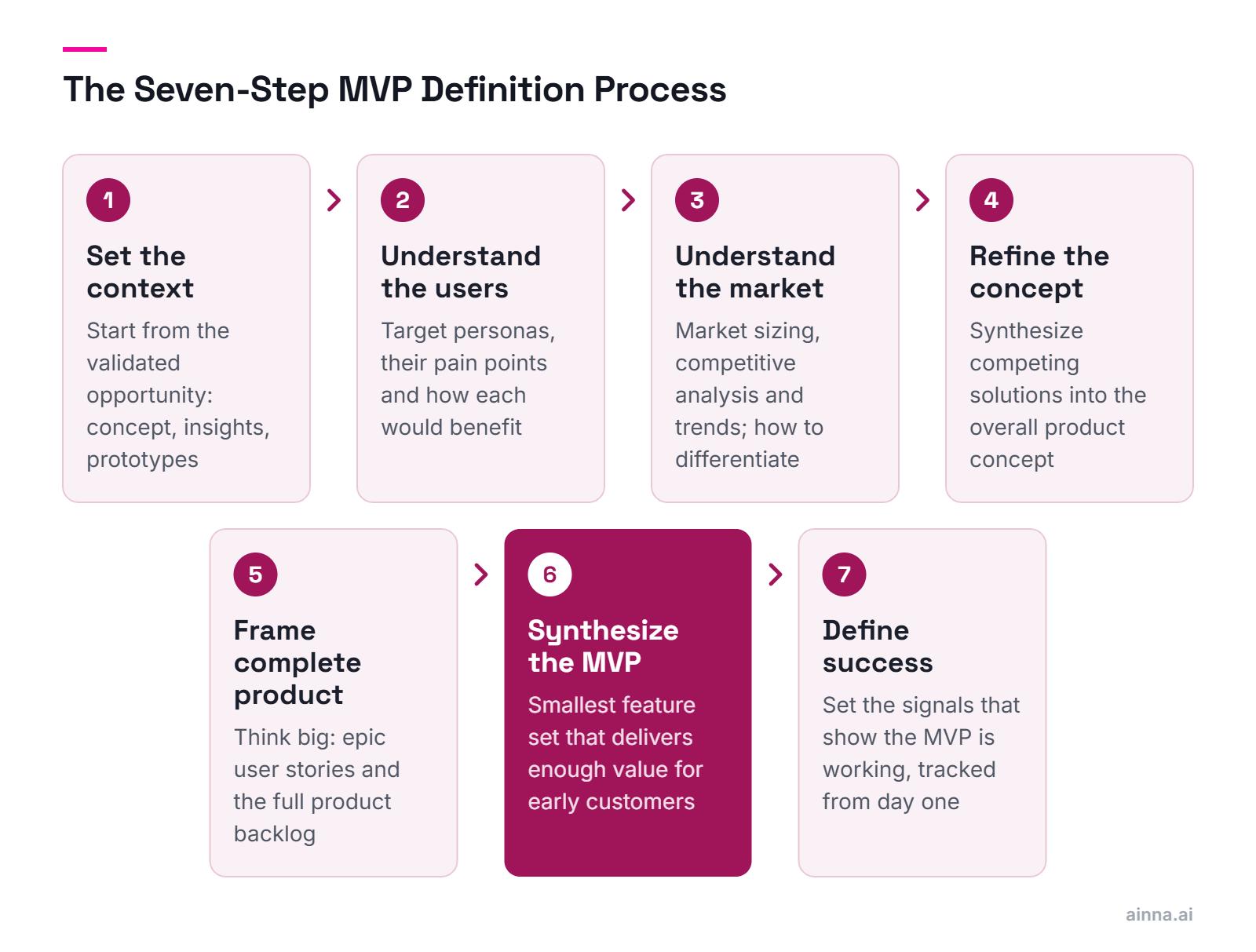
Great MVP definition starts with problems, not features. The PM's job is to translate user pain into the smallest solution that delivers value while creating clear success criteria everyone can rally around.

  • Start with the problem statement, not a feature list—validate the problem exists first
  • Define success metrics upfront: what signals will tell you the MVP worked?
  • Talk to users constantly—before, during, and after building
  • Create hypothesis documents: "We believe [X] will achieve [Y]. We'll know when [metric moves]."
  • Timebox aggressively—scope should fit the timeline, not the other way around
  • Document decisions and rationale for future reference and stakeholder alignment

The best PMs resist the urge to add "just one more thing." Every addition is a bet—make sure you're betting on validated needs.

Most MVP failures come from the same handful of mistakes: scope creep, perfectionism, trying to serve everyone, neglecting quality where it matters, and failing to define what success looks like.

  • Scope creep—each addition delays learning; small additions compound into months of delay
  • Perfecting before launching—if you're not somewhat embarrassed by v1, you launched too late
  • Building for everyone—a product for everyone serves no one well
  • Ignoring "viable"—the core experience must work well; users forgive missing features, not broken ones
  • No success metrics defined—you can't learn without knowing what to measure
  • Building in isolation—getting feedback only after launch wastes the opportunity to course-correct

The meta-mistake: treating MVP as a phase to rush through rather than a discipline to maintain. The best teams apply MVP thinking at every stage.

The answer isn't "balance"—it's strategic allocation. Invest heavily in quality where users directly experience your product; accept shortcuts everywhere else. The core user journey must be solid; supporting infrastructure can be duct tape.

  • HIGH quality required: core UX flow, data integrity, security fundamentals, the "moment of truth" interaction
  • SPEED acceptable: edge case handling (handle manually), admin tools (use spreadsheets), visual polish (functional beats beautiful), scalability (premature optimization is the root of all evil)
  • Ask: "Does this touch the user's core experience?" If yes, quality. If no, speed.
  • Technical debt is acceptable if it's intentional and documented

The rule: Quality where users touch, speed where they don't. A beautiful admin panel nobody sees is wasted effort; a buggy checkout flow kills the business.

MVP success isn't just about metrics going up—it's about learning what you set out to learn. A "failed" MVP that teaches you users don't want the product is more valuable than a "successful" one that teaches you nothing.

  • Engagement signals: Are users completing the core action? Coming back? How frequently?
  • Learning signals: What feedback are you getting? What features are requested? Where do users struggle?
  • Business signals: Are users willing to pay? What's acquisition cost? Are they recommending it?
  • Qualitative over quantitative early on—five deep user interviews beat 500 anonymous data points
  • Define "success" before launch so you're not moving goalposts after

The key question: Did you learn what you set out to learn? If you validated (or invalidated) your core hypothesis, the MVP succeeded regardless of other metrics.

Cost & Business

Financial aspects of MVP development.

MVP costs range from $15K to $500K+ depending on complexity, but most startups should target the $15K-$50K range for initial validation. The goal is spending the minimum needed to learn—a $500K MVP that could have been $50K represents $450K of unnecessary risk.

  • Simple MVP (landing page + core feature): $15K - $50K
  • Medium complexity (web app with user accounts, basic integrations): $50K - $150K
  • Complex MVP (mobile apps, real-time features, compliance requirements): $150K - $500K+
  • Cost reduction tactics: no-code tools, single platform first, existing APIs, pre-built templates
  • In-house vs. agency: agencies cost more but move faster; in-house is cheaper but slower to start

Before budgeting, ask: "What's the cheapest way to test our core hypothesis?" Sometimes that's a $0 landing page with a waitlist, not a $100K app.

It depends on what you're trying to learn. Charging validates willingness to pay and attracts serious users; free maximizes volume and reduces friction. The best approach often combines both through freemium or tiered models.

  • FOR charging: paying customers give more honest feedback, validates willingness to pay early, forces you to deliver real value
  • FOR free: removes friction, maximizes user volume, faster learning, better for network-effect products
  • Middle ground: freemium model captures both volume (free tier) and willingness-to-pay data (paid tier)
  • Consider: what's more important to validate—demand or monetization?

If your business model depends on users paying, validate that assumption early. A million free users means nothing if none will pay.

An MVP transforms fundraising conversations from "trust our vision" to "look at what we've built and learned." Even modest traction dramatically de-risks the investment and gives investors something concrete to evaluate.

  • Proof of execution—you've built something real, not just pitched an idea
  • User validation—even 100 engaged users prove market interest exists
  • Learning evidence—iteration history shows you can adapt based on feedback
  • Real metrics—enables substantive conversations about growth potential
  • Reduced risk—investors fund scaling something that works, not discovering if it works

Investors see hundreds of decks. An MVP with real users and real learnings stands out.

Long-Term Relevance

When and how MVP thinking evolves.

More relevant than ever. AI and no-code tools accelerate building, which means you can run more experiments faster—but the discipline not to over-build remains critical. Faster tools don't eliminate the need for focus; they amplify the cost of losing it.

  • What CHANGES: faster prototyping, lower development costs, easier iteration, more accessible to non-technical founders
  • What STAYS: need to focus on core value, importance of user feedback, discipline not to over-build, goal of validated learning
  • New risk: AI makes it easy to build lots of mediocre features—MVP discipline prevents feature sprawl
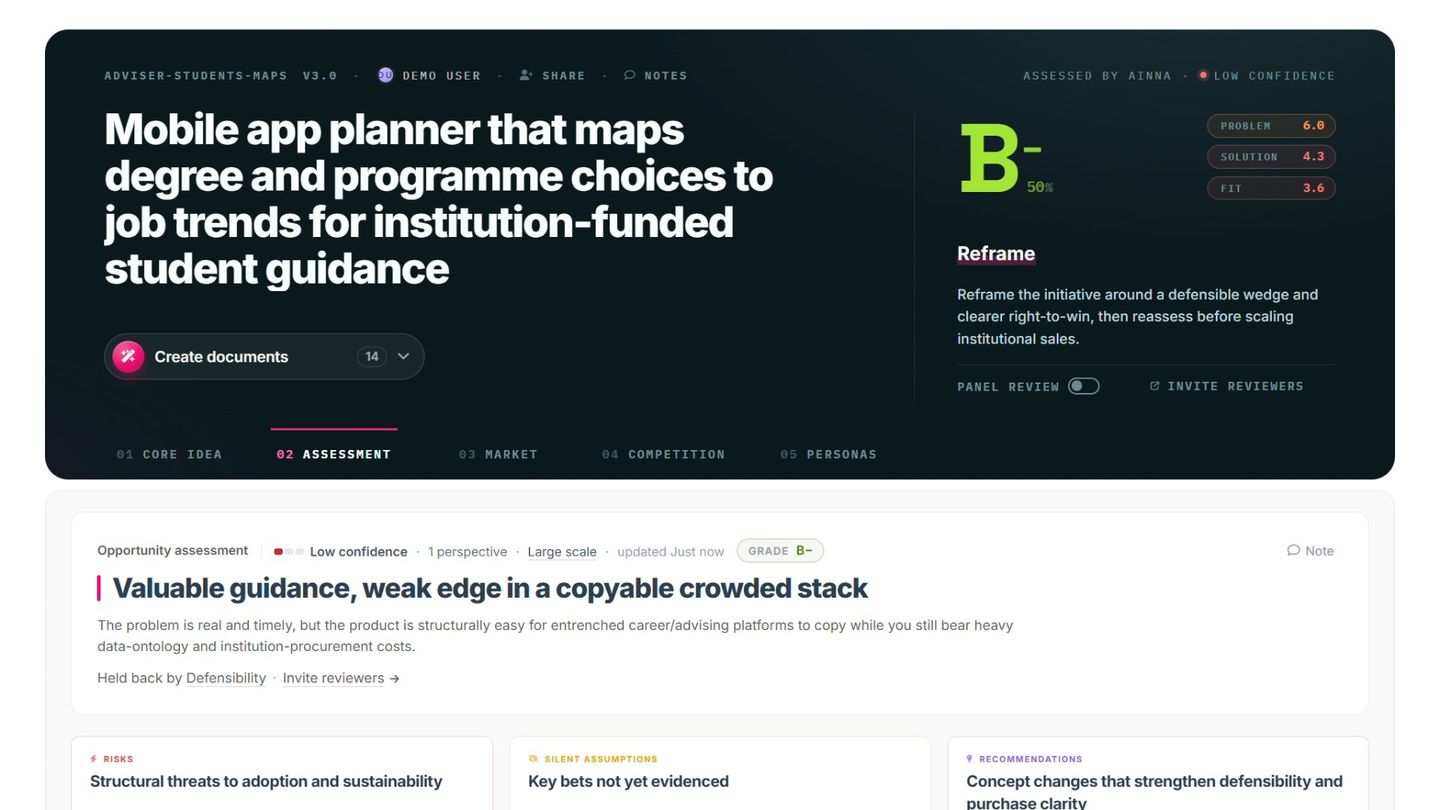
  • Tools like Ainna accelerate documentation, not decision-making—you still need to choose wisely

AI and no-code are force multipliers for MVP thinking—use them to test more hypotheses faster, not to build more features without validation.

You never fully abandon MVP thinking—it evolves. Early stage focuses on product-market fit; later stages apply the same principle to growth experiments, new features, and new markets. The scope changes, but the discipline remains.

  • Phase 1 (Pre-PMF): True MVP—finding product-market fit, core features only
  • Phase 2 (PMF achieved): Expand based on validated user needs, not assumptions
  • Phase 3 (Growth): MVP thinking applies to growth experiments and channel testing
  • Phase 4 (Scale): MVP thinking applies to each new product line, market, or major initiative
  • The principle: always build minimum needed to achieve current learning goal

The best companies never stop asking "what's the smallest thing we can build to learn what we need to learn?"—they just apply it to bigger questions.

Yes—and many of the best do. In established companies, MVP thinking fights the natural tendency toward over-engineering and consensus-driven feature bloat. The challenge is cultural: MVP requires accepting that learning sometimes means "failure."

  • New products: start minimal even when resources allow building more
  • New features: limited rollouts via feature flags before full investment
  • Market expansion: focused offerings for new segments before full product localization
  • Innovation labs: startup-like teams with MVP mandates, protected from corporate overhead
  • Acquisitions: MVP approach to integration—prove value before full-scale merging

Success requires executive sponsorship. Without top-down support for "learning through small experiments," corporate antibodies will kill MVP initiatives.