Hackathon Fundamentals

Core definitions and concepts for understanding what hackathons are and how they create value.

A corporate hackathon is an intensive, software-centric ideation, prototyping, and presentation challenge on known or unknown problems or opportunities. It's a time-boxed event asking participants to create novel solutions—combining technical skills, ideation, and presentation abilities.

  • Intensive: time-boxed process (typically 24-48 hours) asking for the 'impossible'—novel solutions under pressure
  • Software-centric: primarily about technology and code, though modern hackathons increasingly include no-code/AI solutions
  • Multi-skilled: requires great technical abilities, ideation skills, and presentation capabilities
  • Self-organizing: teams align ideas, prioritize, research, code, and present—all autonomously
  • Flexible focus: may target specific problems/technologies or be open to any innovative ideas

Wikipedia defines hackathons as design sprint-like events for software development, but in practice the term describes any intensive idea-generation initiative—with or without functional software deliverables.

Hackathons generate actionable ideas, strategic product concepts, and process improvements—while driving cultural transformation toward an experimentation and innovation mindset. When run properly, they establish a continuous stream of valuable ideas.

  • Idea generation: actionable features, strategic product concepts, process improvements
  • Cultural impact: promotes creativity, collaboration, innovative thinking across teams
  • Talent discovery: employees demonstrate skills outside their job descriptions; companies identify hidden talent
  • Team dynamics: powerful cross-functional teams form organically around shared missions
  • Mindset shift: establishes experimentation culture and idea-sharing as organizational norms
  • Feedback capture: hackathons surface valuable employee insights about technology and business direction

A series of well-designed hackathons can transform organizational culture—awakening an experimentation and innovation mindset that persists beyond individual events.

Hackathons vary by scope (internal, company-wide, public), focus (technology-specific, problem-specific, open), and deliverable type (functional prototype, pitch video, predictive model). Each combination serves different strategic objectives.

  • By scope: internal (specific teams), company-wide (entire organization), public (external participants welcome)
  • By focus: technology-specific (AI, AR/VR, robotics), problem-specific (customer pain points), open (any innovation)
  • By deliverable: functional prototype + source code, pitch video, predictive model, design concept
  • By duration: sprint hackathons (24 hours), extended (48-72 hours), distributed (weeks with checkpoint demos)
  • By format: in-person, virtual, hybrid

Choose your hackathon type based on strategic objectives. Technology-focused hackathons build technical capabilities; problem-focused hackathons solve business challenges; open hackathons maximize creative exploration.

Designing Your Hackathon

How to define hackathon parameters, rules, and success criteria for maximum impact.

Seven critical attributes define your hackathon: timing and lead time, participation rules, minimum deliverable requirements, context/focus, scope, assessment criteria, and awards structure.

  • Date, duration, lead time, venues: allow several weeks lead time for teams to form and prepare
  • Participation rules: who is eligible (employees, teams, external participants)
  • Minimum deliverable: functional prototype? source code? pitch video? predictive model?—this critically affects participation
  • Context: technology focus, business problems to solve, or open innovation
  • Scope: internal team, company-wide, or public event
  • Assessment criteria: voting process, expert panel, evaluation dimensions and weights
  • Awards: number of winners, prize types (monetary, symbolic, resources for next-stage development)

Clear definition is the foundation of hackathon success. Ambiguity in any of these attributes leads to confusion, misaligned expectations, and reduced participation.

Define success across multiple dimensions: participation rate, volume of ideas, percentage of actionable ideas, business opportunities generated, IP-eligible projects, conversion rates over time, publicity opportunities, and team impact metrics.

  • Participation rate: percentage of eligible employees who participated—benchmark against similar past events
  • Volume of ideas: total ideas generated, analyzed with metadata (team size, technology area, etc.)
  • Actionable ideas percentage: ideas worth further investment from a business perspective
  • Business opportunities: ideas that prove valuable after post-processing and validation
  • IP-generating projects: ideas eligible and valuable for patent protection
  • Conversion rates: track the cohort over time—some ideas deliver value months later
  • Publicity opportunities: media attention and external recognition generated
  • Team impact: participant and stakeholder feedback on morale, collaboration, and culture

Success criteria depend on context—business, industry, corporation size, timing. Set targets by analyzing similar events within your organization and adjusting for your specific objectives.

Use a multi-dimensional assessment framework with expert panels. Key dimensions include feasibility, level of innovation, expected business impact, intellectual property potential, and differentiation opportunity.

  • Feasibility: technical achievability with available resources and timeline
  • Level of innovation: novelty and originality of the solution approach
  • Expected business impact: potential revenue, cost savings, or strategic value
  • IP opportunity: eligibility and value for patent protection
  • Differentiation potential: competitive advantage the solution could provide
  • Execution quality: how well the team delivered within hackathon constraints
  • Presentation quality: clarity and persuasiveness of the pitch

Avoid popularity-based voting alone—it's typically biased and can be misleading. Use expert panels with predefined dimensions and clear scoring rubrics. Consider involving actual customers for feedback on select projects.

The most inspiring award is resources and sponsorship to drive the winning idea to the next stage—not just monetary prizes. This creates success stories of 'hackathon projects moving to production' and attaches real purpose to the event.

  • Monetary: bonuses, gift cards—simple but limited motivational impact
  • Symbolic: plaques, titles, recognition—important for culture but not sufficient alone
  • Technology: devices, equipment—popular but doesn't advance the idea
  • Development resources: dedicated time with developers, equipment, software, services to build the idea further
  • Executive access: formal presentation opportunity to senior leaders and decision-makers
  • Incubation: path to internal incubator or innovation program

The ability for winning teams to access specialized resources and present refined outcomes to decision-makers is the most powerful award. It demonstrates that hackathon ideas can become real products—inspiring future participation.

Running the Hackathon

How to structure and execute the three phases of a successful hackathon event.

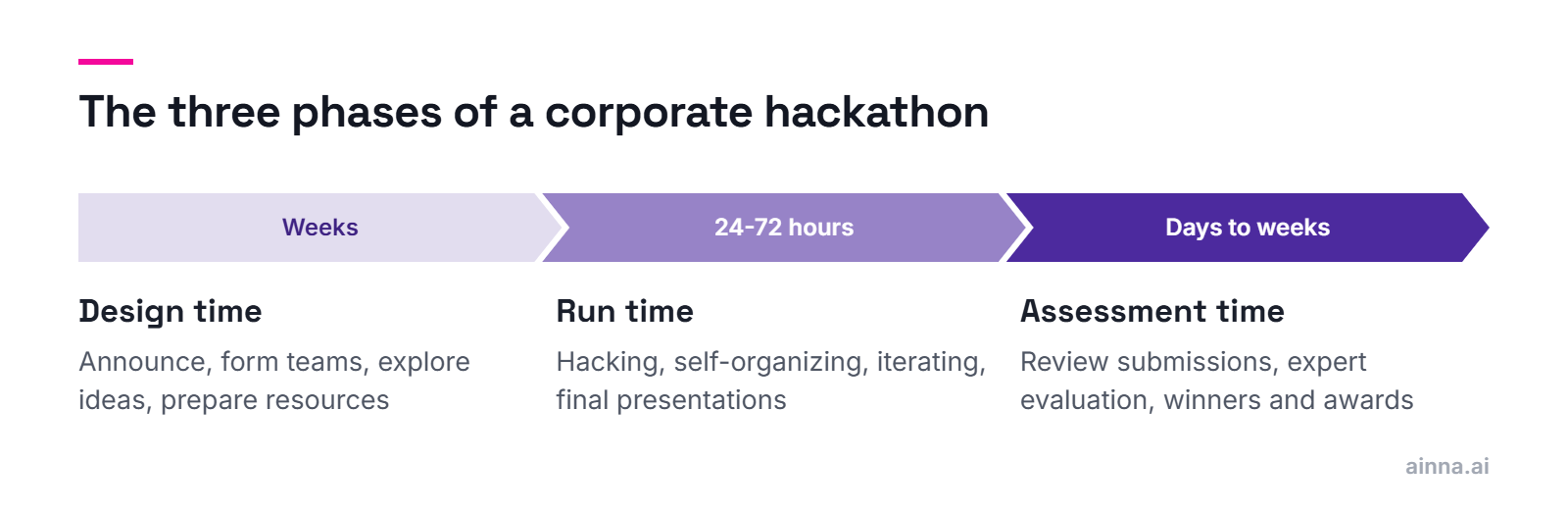
A hackathon has three distinct phases: design time (preparation and team formation), run time (the actual hacking), and assessment time (evaluation and winner selection). Each phase requires different activities and support.

  • Design time: announcement → team formation → idea exploration → resource preparation
  • Run time: intensive hacking → self-organization → iteration → final presentations
  • Assessment time: submission review → expert evaluation → winner selection → awards
  • Each phase has different duration: design time (weeks), run time (24-72 hours), assessment (days to weeks)
  • Support requirements differ: design time needs communication tools; run time needs space/equipment; assessment needs evaluation frameworks

Treat each phase as a distinct project with its own objectives, deliverables, and success criteria. Rushing any phase compromises the entire event.

Design time is the lead-up period from announcement to hack-time. Employees explore ideas, form teams, and prepare resources. This phase requires strong communication, self-service tools, and dedicated support.

  • Announce with clarity: clear messages, strong leadership sponsorship, compelling vision
  • Communicate consistently: frequent updates on timeline, participant count, available resources
  • Provide self-service tools: systems for registration, project creation, team formation, technology exploration
  • Assign support team: dedicated people to answer questions and facilitate preparation
  • Allow sufficient lead time: typically 2-4 weeks for idea exploration and team formation
  • Enable informal collaboration: forums, chat channels, or physical spaces for pre-event discussion

The quality of design time directly impacts run time outcomes. Teams that enter the hackathon with aligned ideas and clear roles produce significantly better results.

Run time is where the magic happens—teams work intensively to align ideas, define their product, execute, review, and iterate. The key is creating conditions where employees forget formal roles and self-organize around their mission.

  • Dedicated time: ensure participants have protected time to focus exclusively on their projects
  • Physical space: suitable venues with equipment, power, connectivity, and collaboration areas
  • Self-organization: teams autonomously align ideas, prioritize, research, code, and prepare presentations
  • Iteration cycles: teams typically go through multiple build-review-refine loops
  • Presentation preparation: time must be allocated for pitch/demo preparation—this is critical
  • Support availability: mentors, technical resources, and logistics support on standby

The best hackathon run times feel like a creative pressure cooker—intense but energizing. Remove obstacles, provide resources, then get out of the way and let teams create.

Assessment time involves reviewing valid submissions against predefined criteria. Use expert panels with clear evaluation dimensions rather than popularity voting alone. Consider involving customers for feedback on select projects.

  • Submission validation: verify deliverables meet minimum requirements before assessment
  • Expert panel: assemble evaluators with relevant technical and business expertise
  • Predefined dimensions: feasibility, innovation level, business impact, IP potential, differentiation
  • Scoring rubrics: clear criteria for each dimension to ensure consistent evaluation
  • Avoid popularity bias: company-wide voting alone is typically biased and misleading
  • Customer involvement: consider having actual customers evaluate and provide feedback on finalists

Fair, transparent assessment is crucial for hackathon credibility. When participants trust the evaluation process, they're more likely to participate in future events and invest real effort.

AI-Enhanced Hackathons

How artificial intelligence is transforming hackathon capabilities, tools, and what teams can achieve in limited timeframes.

AI is dramatically expanding hackathon possibilities by collapsing the time from idea to functional prototype. Teams can now build in 24 hours what previously took weeks—shifting hackathons from 'proof of concept' to 'proof of product' events.

  • Accelerated prototyping: AI code generation tools enable functional prototypes in hours, not days
  • Expanded participation: non-developers can now contribute meaningfully to technical deliverables
  • Higher fidelity outputs: teams produce more polished, complete solutions within the same timeframe
  • Complex integrations: AI assists with APIs, data pipelines, and system connections that previously required specialists
  • Better presentations: AI tools help generate pitch decks, documentation, and demos rapidly
  • Idea amplification: AI brainstorming tools help teams explore more solution variations quickly

The Innovation Mode 2.0 describes this as the 'AI-augmented innovation sprint'—where human creativity directs AI execution capabilities to achieve outcomes previously impossible in hackathon timeframes.

Sources:The Innovation Mode 2.0AI-augmented innovation practices, George Krasadakis, 2025

Modern hackathon teams benefit from a toolkit spanning ideation (ChatGPT, Claude), code generation (Copilot, Cursor), UI building (v0, Bolt), documentation (Ainna), and presentation creation. The key is matching tools to team skills and project needs.

  • Ideation & research: ChatGPT, Claude, Perplexity—for brainstorming, market research, and problem framing
  • Code generation: GitHub Copilot, Cursor, Codeium—accelerate development within IDEs
  • Full-stack building: Bolt.new, Lovable, Replit Agent—describe apps, get deployable prototypes
  • UI components: v0 by Vercel, Galileo AI—generate React/Tailwind components from descriptions
  • Documentation and pitch decks: Ainna—generate pitch decks and PRDs from structured idea input
  • Design: Figma AI, Midjourney, DALL-E—generate visuals and design assets

Provide teams with a curated list of approved/recommended AI tools before the hackathon. This levels the playing field and reduces time spent discovering tools during the event itself.

Successful AI-enhanced hackathons require clear tool policies, updated assessment criteria that value AI orchestration skills, and reframed objectives that account for expanded capabilities.

  • Tool policy clarity: explicitly state which AI tools are allowed, encouraged, or prohibited
  • Pre-event training: offer workshops on effective AI tool usage before the hackathon
  • Updated assessment: add evaluation dimensions for AI orchestration skill and creative direction
  • Raised expectations: adjust 'minimum deliverable' standards to reflect AI-enabled capabilities
  • Attribution requirements: require teams to document which AI tools were used and how
  • Focus on differentiation: emphasize unique insights and novel applications over raw output volume
  • Human-AI collaboration: assess how well teams directed AI rather than just used it

The Innovation Mode 2.0 emphasizes that AI-enhanced hackathons should assess 'innovation orchestration'—the ability to direct AI tools toward novel, valuable outcomes—not just technical execution.

Sources:The Innovation Mode 2.0AI-enhanced innovation events, Chapter 7

AI excels at rapid idea exploration, market research, and structured problem framing. Teams can use AI to generate dozens of variations, validate assumptions quickly, and structure their concept before writing any code.

  • Brainstorming acceleration: generate 50+ idea variations in minutes, then filter for most promising
  • Market validation: quickly research competitors, market size, and existing solutions
  • Problem framing: use AI to articulate the problem statement, user personas, and jobs-to-be-done
  • Solution architecture: explore technical approaches and get feedback on feasibility
  • Edge case discovery: AI can identify scenarios and requirements teams might miss
  • Pitch structure: generate initial pitch narrative and key talking points

Platforms like Ainna apply structured methodology (The Innovation Mode framework) to transform rough concepts into comprehensive documentation—pitch decks, PRDs, and one-pagers—giving hackathon teams a professional starting point in minutes.

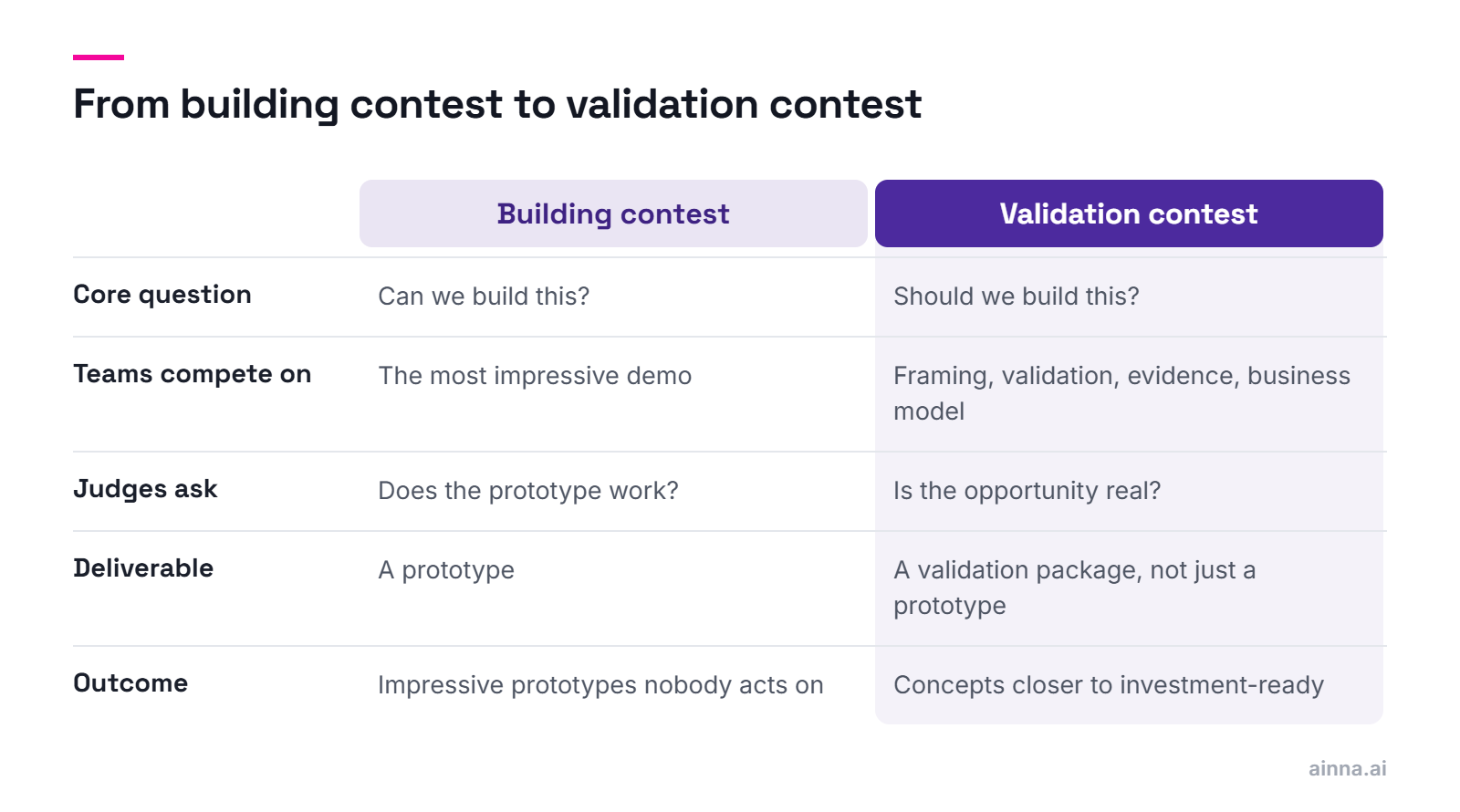
AI code generation tools enable teams to build functional prototypes through conversation rather than manual coding. This shifts the bottleneck from 'can we build it?' to 'what should we build?'—a fundamental change in hackathon dynamics.

  • Conversational development: describe features in natural language, get working code
  • Full-stack in hours: tools like Bolt.new generate complete applications from descriptions
  • UI generation: v0 creates polished React components from text prompts
  • Rapid iteration: modify prototypes through dialogue rather than manual refactoring
  • Integration assistance: AI helps connect APIs, databases, and services quickly
  • Bug fixing: AI debugs issues faster than manual troubleshooting

The limiting factor in AI-enhanced hackathons shifts from development speed to clarity of vision. Teams that know exactly what they want to build can move extraordinarily fast; teams with fuzzy concepts still struggle regardless of AI assistance.

AI Concerns & Challenges

Addressing concerns about AI's impact on hackathon fairness, skill development, and the nature of innovation events.

Yes—AI tool access and proficiency creates new inequities. Teams skilled in AI prompting may dramatically outperform equally talented teams unfamiliar with these tools. Hackathon organizers must address this through policy and preparation.

  • Tool access disparity: some participants may have paid AI tool subscriptions others lack
  • Prompting skill gap: effective AI use requires learned skills that aren't evenly distributed
  • Experience advantage: teams who've used AI tools extensively have significant head start
  • Resource inequality: API costs for heavy AI usage during hackathons can be substantial
  • Attribution ambiguity: unclear what constitutes 'team work' vs 'AI work'
  • Evaluation confusion: judges may not know how to assess AI-assisted vs manual work

Mitigation strategies: provide equal AI tool access to all teams, offer pre-hackathon AI training, establish clear attribution requirements, and update assessment criteria to explicitly value human creativity and AI orchestration skill.

Sources:The Innovation Mode 2.0Fairness in AI-augmented innovation, Chapter 9

Reframe assessment around 'innovation orchestration'—the ability to direct AI tools toward novel, valuable outcomes. Evaluate problem identification, creative direction, quality judgment, and the uniqueness of the final solution—not just code quality or output volume.

  • Problem identification: did the team identify a genuinely valuable problem to solve?
  • Creative direction: how novel and thoughtful was their solution approach?
  • Quality judgment: could they distinguish good AI output from bad and refine accordingly?
  • Integration skill: how well did they combine AI outputs into a coherent solution?
  • Differentiation: is the result unique, or could any team have generated it with same prompts?
  • Presentation clarity: can they explain and defend their choices beyond 'the AI suggested it'?

The most valuable hackathon skill in an AI era is knowing what to build and why—not how to build it. Assess vision, judgment, and creative direction rather than raw technical execution.

It depends on hackathon objectives. If the goal is skill-building through hands-on coding, excessive AI use can undermine learning. If the goal is innovation output and team collaboration, AI accelerates rather than diminishes value.

  • Technical skill development: heavy AI reliance may reduce opportunities to learn fundamentals
  • Problem-solving practice: AI can short-circuit the struggle that builds debugging skills
  • Collaboration dynamics: AI may reduce need for diverse skill sets on teams
  • Counter-argument: AI frees time for higher-order learning (architecture, design, strategy)
  • Counter-argument: learning to orchestrate AI is itself a valuable skill
  • Counter-argument: teams can tackle more ambitious projects, expanding learning scope

Consider hackathon variants: 'AI-free' hackathons for pure skill development, 'AI-enhanced' for maximum innovation output, 'AI-learning' focused specifically on building AI orchestration capabilities.

The 'spirit' of hackathons is intensive creative collaboration toward novel solutions. AI changes the tools but not the spirit—teams still ideate, prioritize, execute under pressure, and present their vision. The essence remains human.

  • Hackathon spirit: creativity, collaboration, time-pressure, novel solutions—AI doesn't change this
  • Tool evolution is normal: hackathons evolved from punch cards to IDEs to cloud services to AI
  • Human elements persist: team dynamics, creative vision, presentation skills, problem selection
  • New challenges emerge: AI orchestration, prompt engineering, quality curation become differentiators
  • Authenticity concern: valid if teams just generate generic AI output without creative direction
  • Mitigation: emphasize novel problem identification and unique solution approaches in assessment

As The Innovation Mode 2.0 argues, AI shifts hackathons from 'can we build it?' to 'what's worth building?'—arguably a more interesting and strategically valuable question.

Sources:The Innovation Mode 2.0The evolution of innovation events

Significant concerns exist around confidential data exposure to AI services, unclear IP ownership of AI-generated code, and potential license contamination from AI training data. Corporate hackathons need clear policies.

  • Data exposure: prompts sent to external AI services may contain confidential business information
  • IP ownership: legal ambiguity about who owns AI-generated code and content
  • License contamination: AI may generate code similar to copyrighted training data
  • Competitive intelligence: AI services may inadvertently leak patterns across companies
  • Audit trail: difficult to prove what's human-created vs AI-generated for patent applications
  • Regulatory compliance: some industries have restrictions on AI use with sensitive data

Establish clear AI usage policies before the hackathon: approved tools list, data sensitivity guidelines, attribution requirements, and IP assignment clauses. Consider enterprise AI tools with stronger data protection.

Blanket bans are impractical and counterproductive—AI is becoming as fundamental as search engines. Instead, create thoughtful policies that level the playing field while harnessing AI's potential. Different hackathon types may warrant different policies.

  • Bans are unenforceable: AI is embedded in IDEs, search, documentation—impossible to fully restrict
  • Bans reduce relevance: real-world development increasingly involves AI; hackathons should reflect this
  • Alternative: 'AI-transparent' hackathons requiring full disclosure of AI tool usage
  • Alternative: tiered categories with different AI allowances and separate judging
  • Alternative: provide standard AI toolset to all teams, ensuring equal access
  • Context matters: early-career skill-building hackathons may warrant restrictions; innovation hackathons shouldn't

The Innovation Mode 2.0 recommends embracing AI as a hackathon force multiplier while adjusting assessment criteria, providing equal access, and maintaining transparency about usage.

Sources:The Innovation Mode 2.0AI policy frameworks for innovation events

Post-Hackathon Value Capture

How to maximize long-term value from hackathon outputs and convert winning ideas into real products.

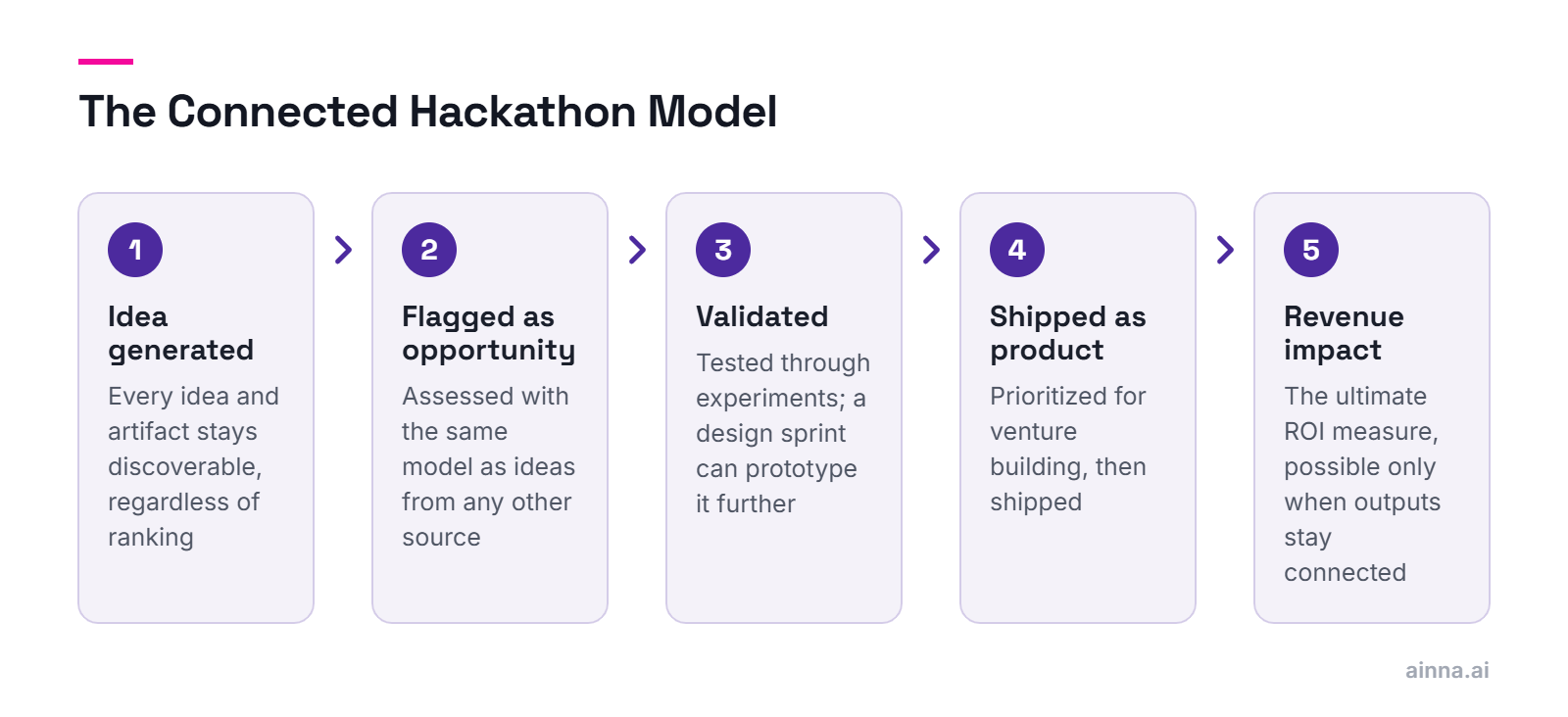
Create a formal pathway from hackathon win to production: post-event validation, resource allocation, executive sponsorship, integration with existing product roadmaps, and defined decision gates for continued investment.

  • Validation phase: winning ideas undergo deeper feasibility and market validation
  • Resource allocation: dedicated development time, budget, and specialist support
  • Executive sponsorship: assign senior leader accountable for project progression
  • Roadmap integration: determine fit with existing product strategy and priorities
  • Decision gates: clear milestones and criteria for continued investment vs parking
  • Team continuity: ideally keep hackathon team involved, at least part-time
  • Documentation: transition from hackathon prototype to proper product documentation

The most inspiring hackathon award is a clear path to production. When employees see hackathon projects become real products, future participation and effort increase dramatically.

Track both direct outputs (ideas generated, products launched, patents filed) and indirect value (cultural impact, talent identification, team collaboration). Measure cohorts over time—some hackathon ideas deliver value months or years later.

  • Direct outputs: number of ideas, actionable percentage, products launched, revenue generated
  • IP value: patents filed and granted from hackathon concepts
  • Talent outcomes: promotions, role changes, retention of hackathon participants
  • Cultural metrics: employee engagement scores, innovation culture survey results
  • Collaboration effects: cross-team relationships formed, knowledge sharing increased
  • Cohort tracking: monitor hackathon idea batches over 6-12-24 months for delayed value
  • Comparative analysis: cost per viable idea vs other innovation channels

Hackathon ROI is often underestimated because indirect and delayed value isn't tracked. Build measurement systems that capture the full value spectrum over extended timeframes.

Hackathons should be one component of a systematic innovation architecture—integrated with ideation platforms, incubation programs, and product development pipelines. A series of well-designed hackathons establishes a continuous stream of validated ideas.

  • Regular cadence: quarterly or bi-annual hackathons create predictable innovation rhythm
  • Theme rotation: alternate between technology-focused, problem-focused, and open hackathons
  • Pipeline integration: hackathon outputs feed into formal innovation funnel
  • Skill building: use hackathons to develop capabilities needed for strategic initiatives
  • Cultural reinforcement: hackathons demonstrate and strengthen innovation values
  • External engagement: occasional public hackathons build ecosystem relationships
  • Gamification layer: ongoing recognition and rewards for hackathon contributions

As The Innovation Mode 2.0 describes, hackathons are most powerful as part of a 'continuous innovation system'—regular events that feed a structured pipeline for validating and developing the best ideas.

Sources:The Innovation Mode 2.0Continuous innovation systems, Chapter 4