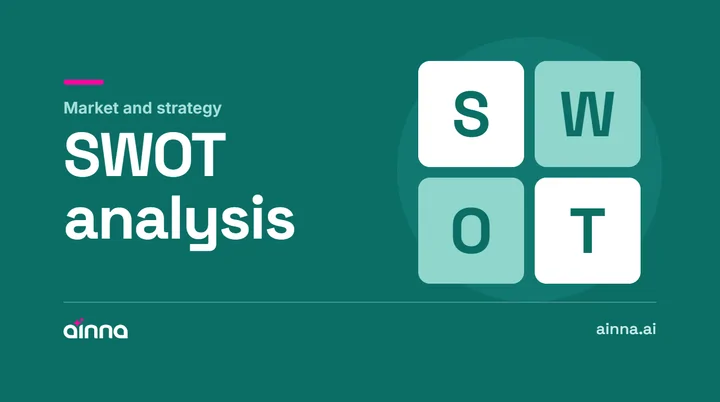
What is a SWOT analysis?

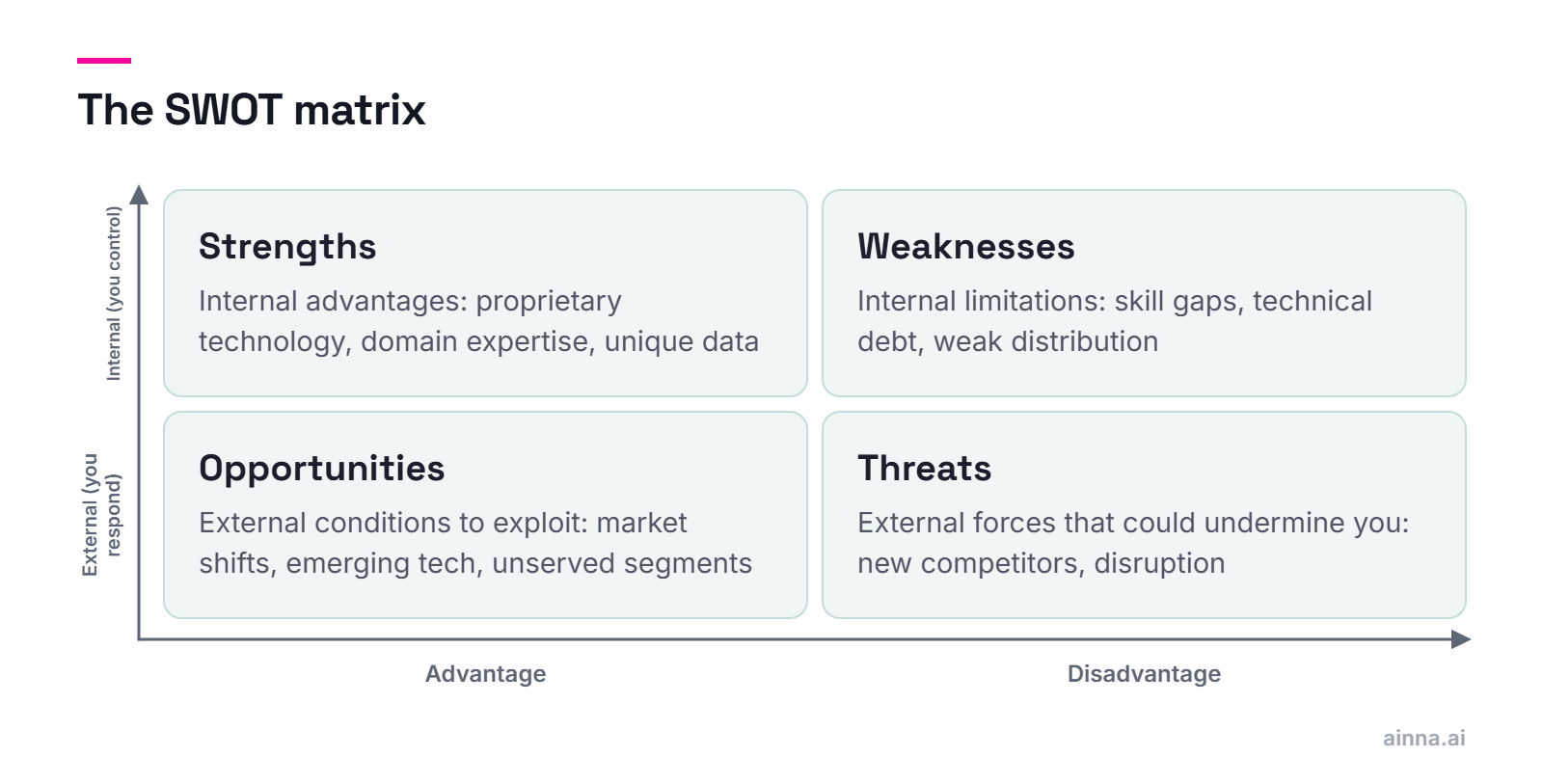
A SWOT analysis is a structured strategic framework that evaluates an organization, product, or opportunity across four dimensions: Strengths (internal advantages), Weaknesses (internal limitations), Opportunities (external favorable conditions), and Threats (external risks). It remains one of the most widely used strategic tools in business - but after leading hundreds of strategic assessments across industries, sectors, and company sizes over 25 years, I can tell you that its value depends entirely on how rigorously you execute it. Most teams leave value on the table by stopping too early.

  • Strengths are internal capabilities that give you an advantage: proprietary technology, domain expertise, strong brand, loyal user base, unique data assets, or exceptional product leadership
  • Weaknesses are internal limitations that put you at a disadvantage: skill gaps, technical debt, limited funding, weak distribution, missing capabilities, or organizational friction that slows execution
  • Opportunities are external conditions you can exploit: market shifts, regulatory changes, emerging technologies, competitor stumbles, or unserved customer segments waiting for the right solution
  • Threats are external forces that could undermine you: new competitors, technology disruption, changing regulations, market saturation, shifting customer preferences, or macro-economic headwinds
  • The internal/external distinction is the foundation of the entire framework: strengths and weaknesses are things you can control or influence; opportunities and threats are things happening around you that you must respond to. Mixing them is the first mistake most teams make
  • A SWOT analysis is a snapshot - it captures a moment in time. In the markets I have worked across, conditions shift quarterly at minimum. A SWOT that is not revisited regularly becomes a historical document, not a strategic tool
Key Takeaway

SWOT is a thinking tool, not a deliverable. The moment you treat it as a box to check rather than a conversation to have, it loses its value. The best SWOTs I have facilitated were messy, argumentative, and led directly to uncomfortable strategic decisions. The worst were neat, consensus-driven, and led nowhere.

When should you use a SWOT analysis - and when is it the wrong tool?

Use SWOT when you need a structured starting point for strategic thinking - launching a new product, entering a new market, evaluating a pivot, preparing a pitch deck, or assessing competitive position. Do not use it as your only strategic tool, and never use it when you need quantitative rigor - for that, you need market sizing, financial modeling, or structured opportunity assessment.

  • Use SWOT for: new product launches, market entry decisions, annual strategy reviews, competitive repositioning, partnership evaluations, pre-investment analysis, and team alignment when multiple stakeholders have different views of the strategic landscape
  • Use SWOT in hackathons: during the early hours of a hackathon, a quick 15-minute SWOT on your concept surfaces blind spots before you commit precious build time to the wrong direction
  • Do not rely on SWOT alone for: major investment decisions, detailed market entry strategy, or any decision that requires quantified evidence. SWOT identifies dimensions but does not measure them - it generates questions, not answers
  • SWOT works best as the first step in a deeper analysis process. In my Innovation Mode methodology, SWOT often feeds into the Nine-Dimension Idea Assessment Model, which takes the qualitative observations from SWOT and converts them into quantified, weighted scores
  • For startup idea validation, SWOT provides a useful initial scan, but the structured Opportunity Discovery framework I developed offers a more rigorous, scored alternative that quantifies what SWOT merely lists
  • A useful rule: if the decision can be reversed cheaply, SWOT is sufficient. If the decision involves significant irreversible investment, SWOT should be the starting point for deeper quantitative analysis

With the rise of AI, expertise is becoming a commodity, while innovation tools, methods, and patterns are already more accessible than ever.

Key Takeaway

The real strategy work starts after the four quadrants are filled. A SWOT that ends when the matrix is complete has done 20% of the job. The TOWS conversion, prioritization, and action planning are the other 80%.

How does SWOT compare to Porter's Five Forces, PESTLE, and other strategic frameworks?

Each framework answers a different strategic question. SWOT gives you a broad internal-external scan. Porter's Five Forces analyzes industry-level competitive dynamics. PESTLE examines macro-environmental factors. The best strategists do not pick one - they layer them, using each to fill the gaps the others leave. In my practice, I rarely use any framework in isolation.

  • SWOT is broad and versatile but shallow - it covers everything at surface level. Best for: initial strategic scanning, team alignment, and identifying which deeper analyses are needed
  • Porter's Five Forces goes deep on competitive structure: rivalry, buyer power, supplier power, substitutes, and new entrants. Best for: understanding why an industry is attractive or unattractive - and where power sits in the value chain
  • PESTLE covers macro factors: Political, Economic, Social, Technological, Legal, Environmental. Best for: systematically populating SWOT's Opportunities and Threats quadrants with factors you might otherwise miss
  • Value Chain Analysis maps where you create and destroy value internally. Best for: grounding SWOT's Strengths and Weaknesses in operational reality rather than perception
  • In my Innovation Mode methodology, I developed the Nine-Dimension Idea Assessment Model specifically for structured opportunity scoring. It goes beyond SWOT by quantifying each dimension with weighted criteria and producing a single Opportunity Score that enables direct comparison across ideas - something SWOT fundamentally cannot do
  • The practical approach I recommend: use PESTLE to populate the external quadrants, Value Chain Analysis for the internal quadrants, and Porter's Five Forces to pressure-test the competitive dimensions. Then convert the populated SWOT into strategy using the TOWS matrix. This layered approach takes half a day and produces genuinely actionable output
Key Takeaway

Frameworks are lenses, not loyalties. The product leaders I respect most do not debate which framework is best - they use whichever combination illuminates the decision they need to make right now.

What are the real limitations of SWOT analysis?

SWOT's biggest limitation is that it generates lists, not decisions. It does not tell you what to do, how to prioritize, or which factors matter most. Without a structured method to convert findings into action - like the TOWS matrix - a SWOT analysis is a brainstorming exercise that creates the illusion of strategic thinking while producing none.

  • No prioritization: SWOT treats all items as equal - a minor weakness sits alongside an existential one. A startup's lack of a favicon sits in the same quadrant as its lack of revenue. Weighted SWOT addresses this but adds complexity most teams skip
  • No causality: SWOT does not explain why strengths exist, how threats will materialize, or what connects them. It lists symptoms, not mechanisms. Understanding root causes requires deeper investigation
  • Subjectivity without guardrails: what one team member calls a strength, another calls a weakness. Without evidence-based input - customer data, market research, performance metrics - SWOT reflects organizational politics, not market reality
  • Static in a dynamic world: SWOT captures a moment in time but markets do not pause for your analysis. I have seen teams execute strategies based on SWOTs that were already outdated by the time the presentation reached leadership
  • Category ambiguity: the same factor can legitimately appear in multiple quadrants. AI disruption is both an opportunity and a threat. Remote work is both a strength and a weakness. This ambiguity frustrates teams who want clean categories
  • No quantified output: unlike my Nine-Dimension Idea Assessment Model, SWOT produces no score. You cannot look at two SWOTs side by side and determine which opportunity is stronger. For portfolio decisions, this is a critical gap
Key Takeaway

Knowing SWOT's limitations does not diminish it - it makes you a better user of it. Use SWOT for what it does well (surfacing dimensions and generating strategic conversation) and supplement it with tools that do what it cannot (quantifying, prioritizing, deciding).

Who should participate in a SWOT analysis session?

The value of a SWOT analysis is directly proportional to the diversity of perspectives in the room. A SWOT run by one person reflects one person's blind spots. A SWOT run by a cross-functional team - product, engineering, design, sales, customer success, and at least one external voice - surfaces the uncomfortable truths that drive real strategy.

  • Product managers bring market context and user insight - they know what customers are asking for and what competitors are shipping. But they also carry product bias: they overestimate strengths of the thing they have been building
  • Engineers bring feasibility reality - they know which 'strengths' are actually held together with shortcuts and which 'weaknesses' are fixable in a sprint. Their perspective on technical threats is often more accurate than anyone else's
  • Sales and customer success bring frontline intelligence - they hear objections, competitive mentions, and feature requests daily. These are the most honest signals about how the market actually perceives your product, unfiltered by internal narratives
  • A senior leader should participate but not dominate - their presence signals importance, but if they speak first, everyone else aligns to their view. I have a rule: the most senior person in the room speaks last in each quadrant
  • Include at least one outsider perspective: an advisor, a recent hire, or someone from a different business unit. Fresh eyes catch what familiarity hides. Some of the most valuable SWOT insights I have seen came from someone who joined the company three weeks earlier
  • Keep the group to 5-8 people. Larger groups produce consensus; smaller groups produce insight. This is the same principle I apply to design sprint team composition - enough diversity to challenge assumptions, not so many voices that conversation becomes performance
Key Takeaway

The most dangerous SWOT is one where everyone agrees. If the session does not produce at least two genuinely uncomfortable findings, you either have the wrong people in the room or the wrong culture in the room.

How do you run a SWOT workshop that produces honest, actionable results?

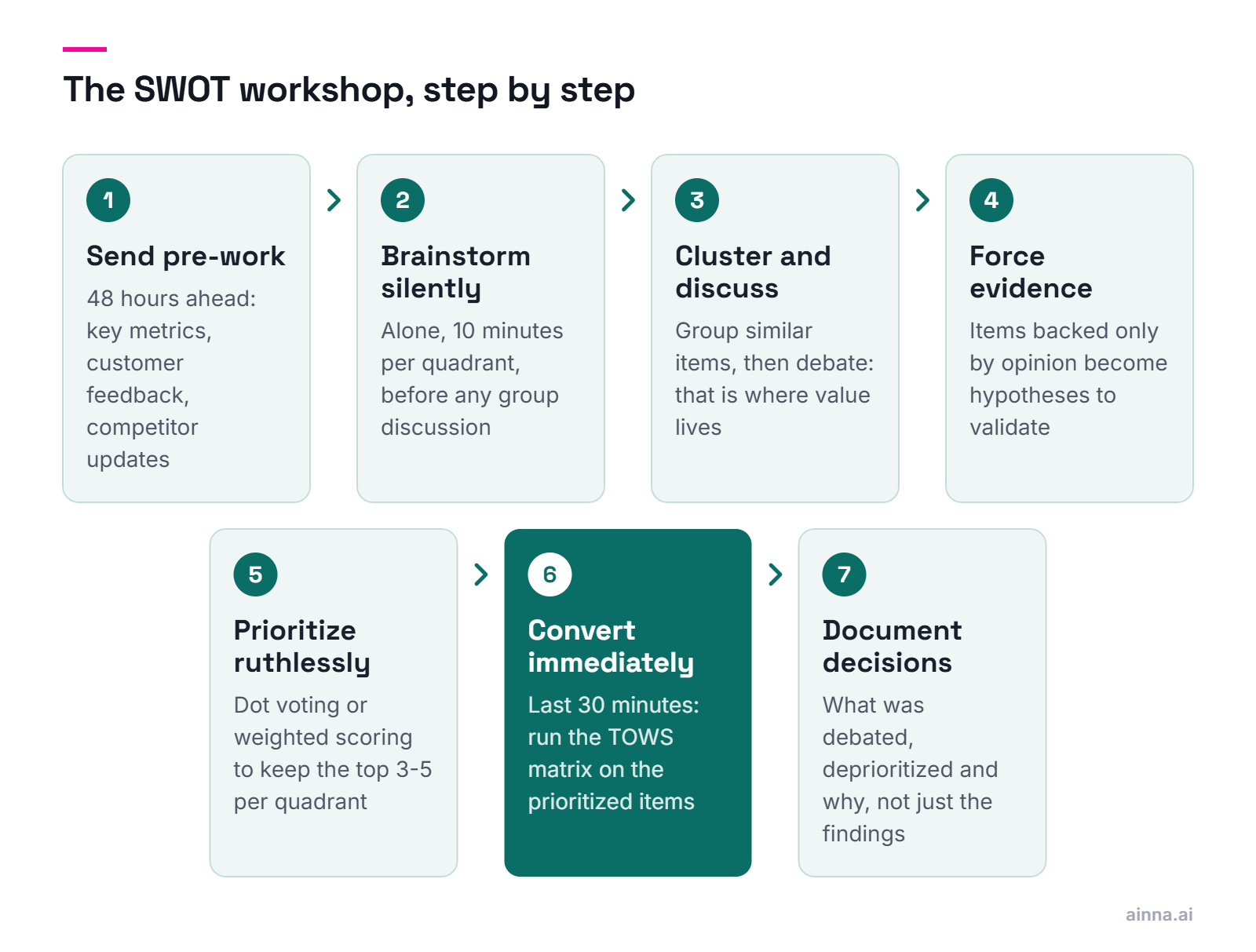
The workshop format determines whether SWOT produces genuine strategic insight or polite consensus. I have facilitated dozens of these sessions across industries and company sizes, and the single biggest determinant of quality is not the framework - it is whether the facilitator creates conditions for honest disagreement. Here is the process that consistently works.

  • Pre-work matters: send participants a brief data pack 48 hours before - key metrics, recent customer feedback themes, competitor updates, and market developments. This grounds the conversation in evidence rather than gut feeling from the start
  • Start with individual silent brainstorming (10 minutes per quadrant). Each person writes their items on separate sticky notes or digital cards before any group discussion. This prevents anchoring to the first voice and ensures introverts contribute equally
  • Cluster and discuss: group similar items, then debate the clusters. The debate is where value lives. When two people disagree about whether something is a strength or a weakness, that disagreement is the most important conversation in the room
  • Force evidence: for each item that survives the discussion, ask 'what is the evidence for this?' Items backed by customer data, market research, or performance metrics stay. Items backed only by opinion get flagged as hypotheses that need validation
  • Prioritize ruthlessly: use dot voting or weighted scoring to identify the top 3-5 items per quadrant. A SWOT with 15 items per quadrant is a brainstorm dump, not a strategic analysis. Prioritization is where the strategic thinking actually happens
  • Convert immediately: spend the last 30 minutes of the session running the TOWS matrix on the prioritized items. If you leave the room with only a populated SWOT and no action plan, momentum dies and the analysis joins the graveyard of unused strategy documents
  • Document decisions, not just findings: capture not only what was listed but what was debated, what was deprioritized, and why. These decisions are as valuable as the final matrix because they reveal the team's strategic reasoning

Without robust market intelligence capabilities, organizations often discover market realities only after significant resources have been invested, leading to costly pivots or abandoned projects that could have been avoided through timely market insights.

Key Takeaway

Budget 3 hours for a thorough SWOT-to-TOWS session. Less than 2 hours produces surface-level output. More than 4 hours produces fatigue-driven consensus. The sweet spot is enough time to argue, not enough time to get comfortable.

Did you know? Ainna generates complete, branded pitch decks — 50+ slides with market analysis, competitive positioning, and contextual AI-generated visuals — in 60 seconds. Generate your deck

How do you identify strengths that are actually strategic advantages?

A real strength passes two tests: customers value it, and competitors cannot easily replicate it. Everything else is an internal capability, not a strategic advantage. The most common SWOT mistake I see - across industries, company sizes, and sectors - is listing things you are good at without asking whether those things matter to the market.

  • Apply the 'so what?' test to every strength: 'We have a great engineering team' - so what? Does that engineering capability translate into faster shipping, better reliability, or features competitors cannot match? If you cannot connect the strength to a customer outcome, it is not strategic
  • Strengths must be relative, not absolute. 'We have AI capabilities' is not a strength in 2026 - everyone does. 'We have 5 years of proprietary training data in pharmaceutical supply chains' is a strength because it is specific and hard to replicate. Specificity is the difference between a useful strength and a vanity item
  • Look for strengths in your product concept: what aspects of your solution are genuinely differentiated? What did your product discovery reveal that competitors have not found? The strongest advantages often come from depth of understanding, not breadth of features
  • Customer evidence beats internal opinion every time. If customers consistently cite a capability as their reason for choosing you, that is a validated strength. If only your team thinks it is a strength, it is a hypothesis that needs testing - not a strategic fact
  • Consider strengths across multiple dimensions: technology, team expertise, brand trust, data assets, distribution, partnerships, methodology, speed of execution, customer relationships, and switching costs. The most powerful strengths are ecosystem-level - things like developer community, integration depth, or data network effects that compound over time
  • Beware of strengths that are actually dependencies. 'We have an exclusive partnership with X' is a strength today but a single point of failure tomorrow. Map the fragility of each strength alongside its value
Key Takeaway

The best strengths are the ones your competitors wish they had and cannot build quickly. If a competitor could replicate your 'strength' in six months, it is a temporary advantage, not a strategic one. When I assess opportunities, I always ask: what would remain a strength if our best competitor spent a year trying to copy us?

How do you surface weaknesses honestly - especially when the team does not want to hear them?

The hardest part of SWOT is not identifying weaknesses - it is creating the psychological safety for people to name them honestly. In every organization I have worked with, listing weaknesses feels like admitting failure. But a SWOT that glosses over weaknesses is actively harmful - it creates false confidence that leads to strategic blind spots and, eventually, to products that fail in predictable ways.

  • Start with data, not opinions: customer churn reasons, support ticket themes, lost deal analyses, and NPS verbatims reveal weaknesses more honestly than any brainstorm. I always bring a printed summary of these signals to the session. Data is harder to argue with than opinions
  • Use the 'competitor advantage' reframe: instead of asking 'what are we bad at?' ask 'what do customers say our competitors do better than us?' This shifts the conversation from self-criticism to market reality - and it is much easier for people to discuss
  • Separate fixable weaknesses from structural ones. A missing feature is fixable. A fundamental architecture limitation, a weak brand in a key market, or a talent gap in a critical domain - these require strategic decisions, not sprint planning. The distinction matters because they demand different responses
  • Check for weaknesses hiding as strengths: 'We are scrappy and move fast' often masks 'We have no process and accumulate technical debt.' 'We are customer-focused' sometimes means 'We say yes to everything and have no strategy.' 'We are lean' sometimes means 'We are understaffed and burning out.'
  • Anonymous pre-session input surfaces what people will not say with their manager present. I send a one-question survey before every session: 'What is the one thing about our product, team, or strategy that worries you most?' The themes that emerge are almost always more honest than what surfaces in the room
  • In hackathon settings, weakness assessment is simpler and more honest - the time pressure strips away politics. This is one reason I advocate for hackathons as a tool for surfacing uncomfortable truths about the business, not just generating new ideas

When companies fail to maintain a clear, unified view of customer needs, pain points, and user journeys, innovation efforts may end up solving the wrong problem or missing essential opportunities.

Key Takeaway

If your weaknesses quadrant is shorter than your strengths quadrant, you probably did not dig deep enough. In my experience across hundreds of assessments, the ratio should be closer to equal - every organization has as many limitations as advantages. The ones that admit it outperform the ones that hide from it.

How do you identify opportunities that are real - not just wishful thinking?

An opportunity is real when you can point to evidence that it exists independently of your desire for it to exist. Market data, customer behavior changes, regulatory shifts, technology inflection points, and competitor gaps - these are evidence. 'We think there is a big market for X' without supporting data is a hypothesis, not an opportunity. I have watched more products fail from pursuing imaginary opportunities than from any other single cause.

  • Ground every opportunity in evidence: TAM/SAM/SOM analysis quantifies the size, customer interviews validate the demand, and competitor analysis confirms the gap. An opportunity without at least two forms of supporting evidence belongs in the 'hypotheses to test' column, not the 'opportunities to pursue' quadrant
  • Use the 'why now?' test: every real opportunity has a timing dimension. What changed - technologically, regulatorily, behaviorally, or competitively - that makes this opportunity available now when it was not before? If nothing changed, the opportunity has existed for years and there is probably a reason it remains uncaptured
  • Distinguish between opportunities you can capture and opportunities that exist in theory. A $10 billion market is meaningless if you have no credible path to reaching even 0.1% of it. Size without reach is a mirage. My market sizing guide covers how to distinguish TAM (total) from SOM (what you can actually capture)
  • Look for opportunities at the intersection of your strengths and market gaps - this is where SWOT's real power emerges. A market gap that does not align with any of your strengths is someone else's opportunity, no matter how large it is
  • In my Innovation Mode methodology, I formalize this as the Opportunity Discovery capability - using structured frameworks and AI-powered market intelligence to systematically scan for high-potential concepts rather than relying on brainstorming alone. The most valuable opportunities are rarely the ones that surface in a brainstorm - they emerge from disciplined, evidence-based scanning
  • Be wary of opportunities that everyone in your industry sees. If the opportunity is obvious, the competition will be fierce and margins will compress. The most valuable opportunities require domain insight to recognize - they are non-obvious to outsiders but clear to those with deep understanding of the problem space
Key Takeaway

The best opportunities are the ones where you see something others do not - because of your unique position, expertise, or customer insight. If every competitor lists the same opportunity in their SWOT, it is a market trend, not a competitive opportunity. Your job is to find the angle within the trend that only you can exploit.

How do you assess threats without either panicking or dismissing them?

Assess threats on two axes: probability of occurring and severity of impact if they do. A high-probability, high-impact threat demands immediate strategic response. A low-probability, high-impact threat needs a contingency plan. A high-probability, low-impact threat needs monitoring. Everything else is noise. The mistake most teams make is treating all threats as equal - or, worse, ignoring the biggest ones because they are too uncomfortable to discuss.

  • Map every threat on a 2x2 probability-impact matrix. This forces prioritization and prevents the common failure of listing 15 threats and acting on none. If you cannot plot a threat on both axes, you do not understand it well enough to include it
  • The most dangerous threats are the ones your team dismisses. 'That will never happen to us' and 'They are too small to matter' are the phrases that precede the most painful disruptions. In Innovation Mode 2.0, I describe how established companies across sectors consistently underestimate emerging competitors who leverage new technologies to move faster than incumbents expect
  • Competitive threats from direct competitors are obvious. The threats that blindside you come from adjacent industries, new business models, or technology shifts that make your entire approach obsolete. A streaming service was not a 'competitor' to video rental stores - until it was the only thing that mattered
  • Regulatory threats require special attention because they have hard deadlines and binary outcomes. A new regulation either applies to you or it does not - and the teams that prepared early gain a strategic window while competitors scramble to comply
  • For AI products specifically, the threat landscape includes model commoditization (what happens when your AI capability becomes a generic feature?), data moat erosion, open-source alternatives closing the gap faster than expected, and the constant risk that a general-purpose AI simply absorbs your niche use case
  • Revisit your threat assessment at least quarterly. In my experience across fast-moving sectors, threats I identified as 'two years away' sometimes arrived in six months - especially threats driven by technology adoption curves or well-funded new entrants

New competitors can emerge quickly from unexpected directions: with AI, everyone can access great ideas and obtain good-enough advisory on implementing them - and all at negligible cost.

Key Takeaway

A credible threat assessment is uncomfortable. If your threats quadrant does not include at least one scenario that genuinely worries the leadership team, you have not looked hard enough - or you are not being honest with yourselves.

What are the most common traps in each quadrant - and how do you avoid them?

Each quadrant has a characteristic failure mode. Strengths attract vanity. Weaknesses attract denial. Opportunities attract wishful thinking. Threats attract either panic or dismissal. Knowing the trap for each quadrant helps you catch yourself before you fall in.

  • Strengths trap - the vanity list: teams list things they are proud of rather than things that create competitive advantage. Test: remove your company name. Could any competitor claim the same strength? If yes, it is not a differentiator. 'Passionate team' fails this test. '12 domain-specific patents in computer vision for retail' passes it
  • Weaknesses trap - the safe list: teams list weaknesses that are either already being addressed ('we need to improve onboarding') or too minor to matter. The real weaknesses - the ones that could cause failure - stay unspoken. Test: does this weakness keep the CEO awake? If not, dig deeper
  • Opportunities trap - the dream list: teams list massive market opportunities without connecting them to realistic capture strategies. A $50 billion market is not an opportunity for a seed-stage startup with three engineers. Test: can you describe the first 100 customers by name, industry, and use case?
  • Threats trap - the abstract list: teams list threats so vaguely that no response is possible. 'Economic downturn' and 'competitive pressure' are too abstract. 'Our largest customer is evaluating an in-house solution that would eliminate 18% of our revenue within 12 months' is specific enough to act on
  • Cross-quadrant trap - the echo chamber: the same observation appears in multiple quadrants rephrased differently. 'Strong AI capabilities' as a strength and 'AI talent shortage' as a weakness are connected but distinct. If your quadrants repeat the same themes, you are not getting enough perspectives in the room
  • The meta-trap - stopping at the matrix: the single most destructive pattern across every SWOT I have seen go wrong. Teams invest hours populating the quadrants and then declare victory. The matrix is not the output. The strategy derived from the matrix is the output

Many established companies fail to assess their competitive landscape accurately. Leaders often define their competition narrowly, dismissing emerging start-ups while failing to anticipate threats originating from other industries or emerging technologies.

Key Takeaway

Every quadrant trap traces back to the same root cause: insufficient evidence and insufficient courage. Data cures the evidence problem. Culture cures the courage problem. Both are the product leader's responsibility.

What is the TOWS matrix and how does it convert SWOT into strategy?

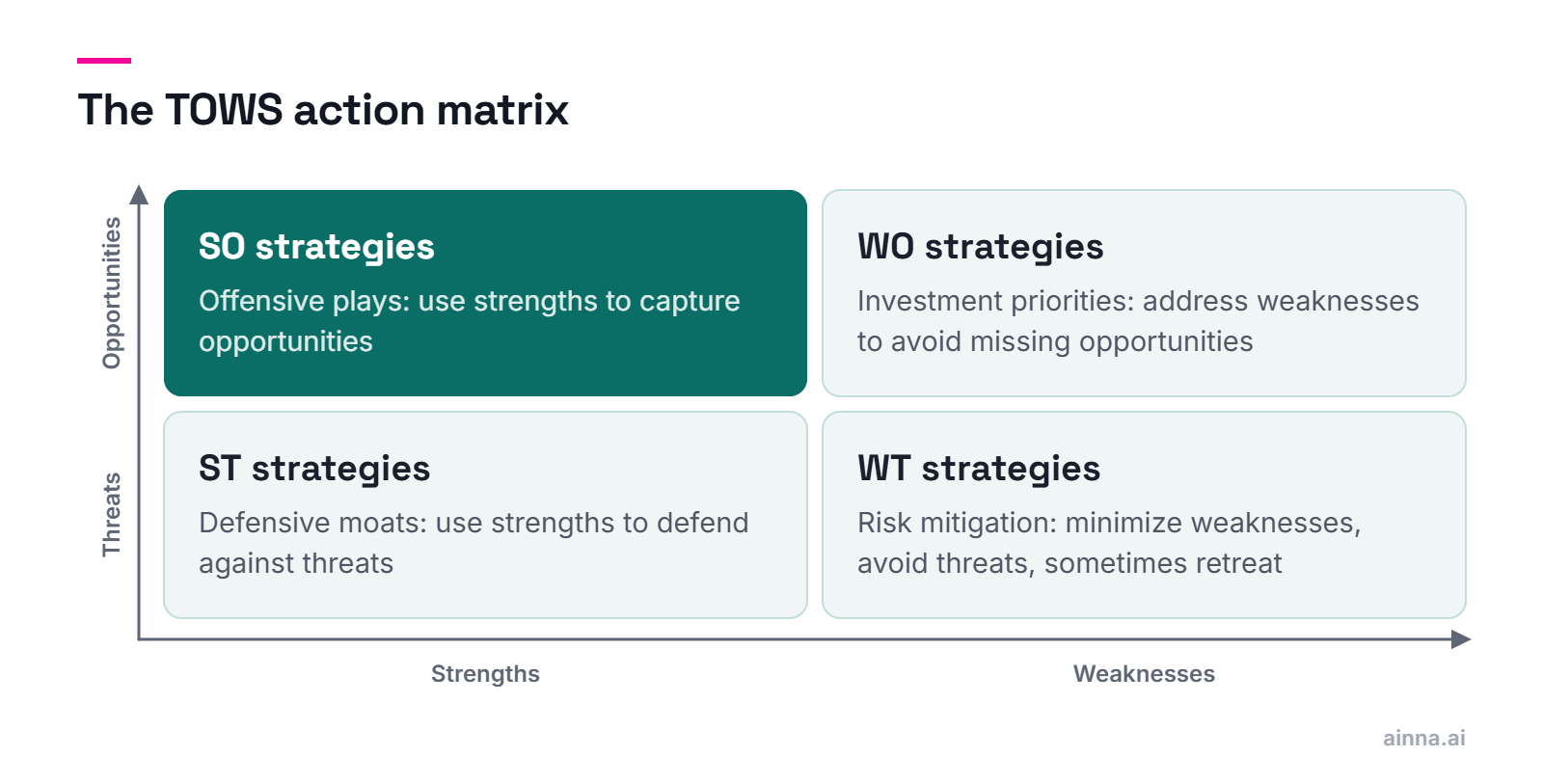
The TOWS matrix is the bridge between SWOT analysis and strategic action. Where SWOT asks 'what is our situation?' TOWS asks 'so what do we do about it?' It works by systematically pairing internal factors (strengths, weaknesses) with external factors (opportunities, threats) to generate four distinct strategy types. This is the single most valuable extension of basic SWOT - and the one most teams have never heard of. I consider any SWOT incomplete without TOWS.

  • SO strategies (Strength-Opportunity): use your strengths to capture opportunities. These are your offensive plays - the most exciting quadrant and typically where the best product ideas live. Example: 'Our proprietary data asset (strength) positions us to build the compliance automation solution the new EU regulation demands (opportunity)'
  • WO strategies (Weakness-Opportunity): address weaknesses to avoid missing opportunities. These are your investment priorities - where spending money or effort now prevents regret later. Example: 'We lack mobile capabilities (weakness) but mobile-first users are the fastest-growing segment (opportunity) - hire a mobile lead this quarter'
  • ST strategies (Strength-Threat): use your strengths to defend against threats. These are your defensive moats - how you protect what you have built. Example: 'Our deep customer relationships and integration depth (strength) create switching costs that protect against commodity competitors (threat)'
  • WT strategies (Weakness-Threat): minimize weaknesses and avoid threats. These are your risk mitigation plays - sometimes including strategic retreat from markets you cannot win. Example: 'Our small team (weakness) cannot compete in a market being flooded by well-funded competitors (threat) - narrow focus to the niche where we have domain advantage'
  • Each strategy should be specific enough to become a roadmap initiative with an owner, a timeline, and a measurable outcome. 'Leverage our technology' is not a strategy. 'Build an API integration with the top 3 CRM platforms by Q3 to exploit our data processing advantage in the enterprise segment' is a strategy
  • Not all TOWS quadrants deserve equal investment. Typically, SO strategies get the most resources because they represent your best path to growth. WT strategies get the least because they are about survival, not advantage. This allocation itself is a strategic decision that reveals your priorities

Innovative companies maintain their edge through what we might call a 'reflex advantage' - the ability to sense opportunities and respond rapidly.

Key Takeaway

The TOWS matrix is what separates strategic SWOT from academic SWOT. If you do nothing else from this guide, add the TOWS step to your next analysis. It transforms a 30-minute brainstorm into a strategic planning session with actionable output that your team can execute against.

How do you weight and prioritize SWOT findings?

Basic SWOT treats all findings equally, which means a minor convenience feature sits alongside a core competitive moat. Weighted SWOT assigns importance scores (how much does this factor matter?) and magnitude scores (how strong is this factor currently?) to each item. The result is a prioritized view that tells you where to focus - not just what exists. This is the difference between a brainstorm output and a strategic input.

  • For each item in every quadrant, assign two scores on a 1-5 scale: importance (how much does this matter to our strategic success?) and magnitude (how strong or severe is this factor currently?). Do this individually first, then discuss disagreements
  • Multiply importance by magnitude to get a weighted score. Sort each quadrant by weighted score. The top 3-5 items in each quadrant are your strategic priorities - everything else is context that informs but does not drive decisions
  • For strengths: high importance + high magnitude = core competitive advantages to protect and amplify. High importance + low magnitude = latent strengths that need investment to realize their potential - often the most interesting strategic opportunities
  • For threats: high importance + high magnitude = existential risks requiring immediate response. High importance + low magnitude = emerging threats to monitor and prepare for. Most teams over-invest in monitoring and under-invest in responding
  • This approach mirrors what I formalized in my Nine-Dimension Idea Assessment Model - each dimension gets a weighted score, producing a single Opportunity Score that enables objective comparison across ideas. The principle is the same: quantification forces prioritization, and prioritization forces decisions
  • Weighted SWOT is especially valuable when presenting to stakeholders who need to make resource allocation decisions. A prioritized SWOT with scores communicates 'here is what matters most and why' - which is dramatically more actionable than a flat list of 20 items per quadrant
Key Takeaway

If your SWOT has more than 5 items per quadrant, you have not prioritized. Strategy is about choosing what matters most - and weighted SWOT forces that discipline. The items you choose to deprioritize tell you as much about your strategy as the items you elevate.

How do you connect SWOT findings to product strategy and OKRs?

SWOT findings should flow directly into your strategic planning process - not sit in a separate document gathering dust. Each high-priority TOWS strategy becomes a strategic initiative. Each strategic initiative maps to an OKR. Each OKR drives roadmap priorities. If you cannot trace a line from a SWOT finding to a roadmap item, the finding was either not important enough to keep or you have not done the conversion work.

  • Step 1: Prioritize your TOWS strategies using weighted scoring. Select the top 3-5 for the current planning period. Trying to pursue more than 5 simultaneously is a sign that you have not made the hard strategic choices
  • Step 2: For each selected strategy, define a measurable objective. 'Exploit our data advantage in enterprise' becomes 'Achieve 15% market share in the enterprise data analytics segment by Q4.' The transformation from vague direction to measurable target is where strategy becomes executable
  • Step 3: Define 2-3 key results per objective that would prove the strategy is working. These become your product OKRs and the metrics your team reviews weekly
  • Step 4: Map key results to specific roadmap initiatives, PRD features, or GTM actions. Every item on the roadmap should be traceable to a TOWS strategy. Items that cannot be traced are either misaligned with strategy or addressing a strategy you have not articulated
  • Review quarterly: as SWOT factors shift, the strategies derived from them should shift too. A rigid annual SWOT feeding a rigid annual plan defeats the purpose of having a strategic analysis process in the first place
  • This cascade - SWOT to TOWS to OKR to roadmap - ensures that day-to-day product decisions connect to strategic reality rather than drifting toward feature-request-driven development. In my experience, the teams that maintain this traceability consistently outperform those that treat strategy and execution as separate activities
Key Takeaway

The gap between strategic analysis and daily execution is where most product teams lose their way. The SWOT-to-TOWS-to-OKR cascade bridges that gap by making every roadmap item traceable to a strategic rationale. When someone asks 'why are we building this?' the answer should trace back to a TOWS strategy derived from evidence.

Can you walk through a real SWOT example for a product team?

Here is a worked SWOT example for a B2B SaaS product entering the AI-powered analytics market - the kind of analysis I have led dozens of times across sectors and company sizes. This is not a template to copy; it is an example of the thinking process and evidence standard behind a useful SWOT.

  • Strengths: proprietary dataset of 3 years of industry-specific customer behavior data (validated by customer feedback citing this as primary differentiator); founding team with 15+ years of combined domain expertise in logistics; existing customer base of 200 mid-market companies with 90%+ retention; established integrations with the top 3 ERP platforms (each integration took 6+ months - a real barrier for competitors to replicate)
  • Weaknesses: no dedicated ML engineering team (relying on general engineers for AI features, causing 3x longer development cycles for AI-specific work); brand unknown outside the logistics vertical (zero inbound from adjacent sectors); pricing 40% above market average without clear value communication (lost 3 of last 10 competitive deals on price); mobile experience significantly behind competitors (mobile NPS 22 vs. desktop NPS 61)
  • Opportunities: new EU supply chain reporting regulation creates mandatory compliance need effective 2027 (every mid-market company in our ICP will need a solution); two major competitors recently acquired and distracted by integration (their release cadence dropped 60% post-acquisition); mid-market companies actively seeking alternatives to expensive enterprise platforms (validated in 15 customer interviews); AI-powered analytics adoption in logistics growing at 35% annually per industry reports
  • Threats: three well-funded AI-native startups entered logistics analytics in the past 12 months (combined $45M in seed/Series A funding); largest customer representing 18% of revenue is evaluating building an in-house solution (timeline: 6-9 months); cloud infrastructure costs for AI features eroding margins (AI compute costs grew 40% YoY while pricing remained flat); potential commoditization of basic analytics features by platform providers bundling analytics into their core offering
  • TOWS output: SO strategy - build a regulatory compliance module leveraging proprietary data (strength) to capture the EU mandate opportunity before competitors (timeline: Q3). WT strategy - diversify customer base immediately to reduce single-customer dependency (weakness) before that customer builds in-house (threat) - target 10 new mid-market accounts this quarter. WO strategy - hire ML engineering lead and two senior ML engineers to address the AI talent gap (weakness) before the AI adoption wave peaks (opportunity). ST strategy - deepen ERP integrations and add API-first architecture to increase switching costs (strength) that protect against AI-native startup competition (threat)
  • Notice how each TOWS strategy is specific, time-bound, and traceable to evidence. This is the standard every SWOT should reach. If your TOWS strategies read like 'leverage our strengths' or 'address our weaknesses,' they are not actionable enough
Key Takeaway

A worked example is worth a thousand templates. The quality of a SWOT is not in the format - it is in the specificity, evidence standard, and honesty of the content. If your SWOT could apply to any company in your industry, it is too generic to be useful.

Did you know? Ainna maps your competitive landscape automatically — positioning gaps, differentiation opportunities, and strategic whitespace, generated from your product concept. Map your landscape

How do you use SWOT analysis for product launch decisions?

A pre-launch SWOT forces the product team to confront whether they are genuinely ready - or just eager. The most expensive product launches I have witnessed failed not because of weak products, but because the team overestimated strengths, ignored weaknesses, or misread competitive timing. A rigorous SWOT before committing to a launch date can save months of wasted effort and, in some cases, the entire venture.

  • Run SWOT at two levels: the product itself (features, UX, performance, differentiation) and the go-to-market (positioning, channels, pricing, team readiness, sales enablement). A strong product with a weak GTM strategy still fails. I have seen this pattern more times than I can count
  • Strengths assessment for launch: do we have validated product-market fit? Is the MVP genuinely viable - not just functional? Do we have the customer evidence to support our positioning claims?
  • Weaknesses assessment for launch: what is missing that customers will notice on day one? What is the gap between our demo and the production experience? Where will early adopters get frustrated - and will they tell us or just leave?
  • Opportunities assessment for launch: is the timing right? Are there market tailwinds - industry events, competitor stumbles, regulatory deadlines, seasonal patterns - that make now the optimal moment?
  • Threats assessment for launch: who else is launching? What is the risk of a competitor announcement overshadowing yours? Are there macro conditions - funding contraction, regulation changes, platform shifts - that could undermine adoption regardless of product quality?
  • The launch SWOT should produce a clear go/no-go recommendation with conditions: 'Launch now with these specific mitigations' or 'Delay until these two weaknesses are addressed.' Ambiguous recommendations are worse than no recommendation
Key Takeaway

The best time to do a launch SWOT is before you have emotionally committed to a date. Once a team has announced a launch date internally, objectivity disappears and the SWOT becomes a rationalization exercise rather than a strategic analysis.

How do you use SWOT to find and defend your competitive position?

Competitive positioning is where SWOT becomes genuinely powerful - because it forces you to look at your position through both an internal lens (what you are good at) and an external lens (what the market rewards). The intersection of your strengths and your competitors' weaknesses is where your positioning should live. Everything else is either a head-to-head fight you may not win or a market gap you are not equipped to fill.

  • Run a SWOT for each major competitor, not just yourself. Then overlay them. Where your strength maps to their weakness is your attack vector. Where their strength maps to your weakness is your vulnerability. This competitive SWOT overlay is one of the most valuable exercises a product team can do
  • Use the competitive analysis framework to gather the intelligence that feeds your SWOT - feature comparison matrices, positioning maps, customer perception data, win/loss analysis, and pricing intelligence
  • Positioning should exploit SO strategies from the TOWS matrix - areas where your strengths align with market opportunities that competitors are poorly positioned to capture. This is the sweet spot for sustainable differentiation
  • Defensible positioning requires strengths that are hard to replicate: proprietary data, network effects, switching costs, regulatory advantages, deep methodology, or domain expertise that took years to build. If your positioning rests on features alone, competitors will copy it within a release cycle
  • For pitch deck competitive slides, SWOT provides the foundation but needs translation. Investors do not want to see your internal SWOT - they want to see what it implies about your competitive moat, differentiation sustainability, and ability to win against well-funded alternatives
  • Revisit competitive SWOT after any major market event: a competitor funding round, a new market entrant, a regulation change, a technology shift, or a significant customer loss. Static positioning in a dynamic market is a recipe for being outflanked
Key Takeaway

The strongest competitive positions are built where your strengths intersect with market needs that competitors cannot or will not serve. SWOT is the tool that surfaces those intersections - but only if you include the competitive overlay rather than analyzing yourself in isolation.

How do you use SWOT to evaluate whether to enter a new market?

Market entry is one of the highest-stakes decisions a product team makes - and it is where SWOT earns its keep. The question is not just 'is this market attractive?' but 'do we have what it takes to win in this specific market, given who is already there and what is changing?' A market entry SWOT forces you to answer both questions honestly before you commit resources.

  • Strengths for market entry: which of your current capabilities transfer to the new market? Domain expertise, technology, brand, distribution, customer relationships - assess each for transferability. A strength in your home market may be irrelevant in the new one
  • Weaknesses for market entry: what are you missing that incumbents in the target market already have? Local knowledge, regulatory compliance, established partnerships, category-specific features, or a sales motion tuned to different buyer personas
  • Opportunities in the target market: what is the specific gap or shift that creates an opening? Is it underserved segments, outdated incumbents, regulatory change, technology disruption, or shifting buyer expectations? Ground this in market sizing data, not intuition
  • Threats in the target market: incumbent response, regulatory barriers, cultural differences, distribution challenges, or the risk that the market is already being targeted by better-positioned entrants
  • Apply the beachhead strategy: instead of entering the full market, identify the smallest segment where your strengths are most relevant and the competitive intensity is lowest. Win that segment first, then expand. This is the approach I describe in my Innovation Mode methodology - start narrow, prove the model, then scale
  • The TOWS conversion for market entry should answer four questions: which strengths give us the right to enter (SO)? What must we build before entry (WO)? How do we defend our beachhead (ST)? And what risks should make us reconsider entry entirely (WT)?

The true competitive advantage of a company is its ability to spot opportunities fast and pursue them effectively - its readiness to discover, experiment, and pivot at scale and a fast pace.

Key Takeaway

A market entry SWOT should produce one of three outcomes: enter now (with specific beachhead and TOWS strategies), enter later (after addressing specific weaknesses), or do not enter (the gap between current capabilities and market requirements is too large). Any other outcome is not a decision.

How do you use SWOT to evaluate partnerships and acquisitions?

The most valuable partnerships and acquisitions are those that directly address a SWOT gap - they convert a weakness into a strength or neutralize a threat through combination. The worst are those driven by opportunity excitement without assessing whether the partnership actually closes a strategic gap. SWOT provides the lens to distinguish between the two.

  • Map your SWOT alongside the potential partner's SWOT. The best partnerships are complementary: your weakness is their strength and vice versa. If both of you are strong in the same areas and weak in the same areas, the partnership adds scale but not capability
  • WO partnerships: you lack a capability (weakness) needed to capture an opportunity. The partner has it. Example: you have the product but lack enterprise sales capability. They have the enterprise distribution but lack a compelling product in your category. This is the classic 'build vs. partner' analysis
  • ST partnerships: a threat exists that neither party can address alone, but together you can defend against it. Example: a platform provider is moving into your space (threat). By partnering with a complementary solution provider, you create a bundle that the platform cannot easily replicate
  • Acquisition assessment: when the gap between your current capabilities and what the market demands is too large to bridge organically, acquisition becomes the TOWS strategy. Map the acquisition target's strengths against your weaknesses - the more direct the match, the stronger the strategic rationale
  • Due diligence through a SWOT lens: beyond financial metrics, assess whether the target's strengths are sustainable post-acquisition, whether their weaknesses are fixable or structural, and whether the threats they face will become your threats
  • Partnership risk assessment: every partnership also introduces new threats - dependency, cultural mismatch, competing priorities, information leakage, or the partner pivoting away from the collaboration. These belong in your updated SWOT post-partnership
Key Takeaway

The best partnerships close SWOT gaps. The worst create new ones. Before any partnership discussion, ask: which specific weakness does this address, or which specific threat does this neutralize? If you cannot answer with precision, the partnership is driven by enthusiasm, not strategy.

How is SWOT different for AI products and AI-native startups?

AI products face a unique strategic landscape where the strengths and threats dimensions behave differently than in traditional software. Capabilities that were strengths six months ago become commodities. Moats that seemed defensible get eroded by open-source alternatives. The pace of change means SWOT for AI products needs to be run more frequently and with a shorter time horizon than traditional product SWOT. I built my first classification algorithm in 1996 and my first production predictive system in 1999 - and I have never seen the strategic landscape shift as fast as it does now.

  • AI strengths are perishable: a model advantage today may become a commodity tomorrow as foundation model providers absorb niche capabilities. Focus on strengths that compound - proprietary data, domain-specific fine-tuning, customer workflow integration, and AI engineering execution speed - not model performance alone
  • AI weaknesses often hide behind impressive demos: the gap between 'works in demo' and 'works reliably in production at scale' is where AI products fail. Your SWOT should explicitly assess production readiness, edge case handling, and cost sustainability - not just capability
  • AI opportunities shift with every model release: a SWOT done in January may identify opportunities that are already captured by competitors or made obsolete by a new model in April. Run AI-specific SWOT at a monthly cadence, integrated into your regular product review cycle
  • AI threats include commoditization from model providers themselves, open-source alternatives closing the quality gap faster than expected, data privacy regulations constraining your training approach, the constant risk that a general-purpose AI simply absorbs your niche use case, and the rising cost of compute eroding margins
  • For AI PRDs, the SWOT should directly inform your model strategy: which capabilities are core (build and maintain in-house), which are commodity (use APIs), and which are experimental (partner or wait). This build-buy-partner decision is the most consequential strategic choice in AI product development
  • In Innovation Mode 2.0, I describe how the AI transformation is creating both extraordinary opportunities and existential threats across every industry. The companies that thrive are those with systematic opportunity discovery, not those that chase the latest model release

The rules of engagement are changing, and the competition will soon be set at a new level, with an increasing number of start-ups disrupting the market and threatening established players and business models.

Key Takeaway

For AI products, the traditional SWOT cadence of annual or quarterly is too slow. AI-specific factors - model capabilities, competitive AI releases, open-source developments, regulatory changes - shift monthly or faster. Build lightweight SWOT reviews into your sprint cadence, not just your strategic planning cycle.

How do you present SWOT analysis in a pitch deck or to investors?

Never put a raw SWOT matrix in a pitch deck. Investors have seen thousands of them and they all look the same. Instead, translate your SWOT into the slides investors actually care about: use strengths to build your competitive moat narrative, weaknesses to demonstrate self-awareness in your risk section, opportunities to strengthen your market timing argument, and threats to show strategic maturity.

  • The competitive slide should reflect your strengths-versus-competitor-weaknesses analysis - but framed as differentiation and defensibility, not as a 2x2 matrix. Show what you do that others cannot, not what you listed in a brainstorm
  • The 'why now?' argument in your pitch should come directly from your opportunities analysis - what has changed that makes this the right moment? Investors fund timing as much as they fund teams and products
  • Acknowledge 1-2 risks derived from your threats analysis. Investors respect founders who show they have thought about what could go wrong - and have specific mitigation plans, not vague 'we will adapt' statements
  • Use your weaknesses analysis internally to prepare for tough Q&A questions. Investors will probe your weak spots; founders who have already confronted them handle Q&A with confidence and specificity rather than defensiveness
  • For due diligence, having a thorough SWOT with TOWS strategies available in a data room signals strategic depth that goes beyond the deck. It shows investors that your thinking has layers
  • If investors ask about your strategic analysis process, mentioning SWOT plus TOWS plus the Innovation Mode's opportunity assessment framework signals that you combine established tools with modern methodology - not just intuition dressed up as strategy
Key Takeaway

A SWOT is a strategic thinking tool, not a presentation format. Do the analysis rigorously, then translate the findings into the language investors understand: moats, timing, risks, mitigation, and the evidence behind each claim.

How do you use SWOT for portfolio prioritization across multiple products?

When you are managing a portfolio of products or opportunities - as a product leader, innovation director, or venture builder - individual SWOTs are necessary but insufficient. You need a portfolio-level view that compares opportunities against each other and allocates resources to the ones with the strongest strategic position. This is where SWOT's limitations become most apparent - and where structured scoring frameworks become essential.

  • Run a SWOT for each product or opportunity in the portfolio. Then extract the top-priority items from each and compare: which products have the strongest SO combinations (strengths aligned with opportunities)? These are your growth bets. Which have the most severe WT combinations? These need rescue or retirement
  • Use a portfolio heat map: plot each product on a grid with 'strategic position strength' (derived from SWOT) on one axis and 'market attractiveness' (derived from opportunities and threats) on the other. Products in the top-right get investment. Products in the bottom-left get hard questions
  • For venture building portfolios, SWOT helps determine which concepts to advance and which to park. But comparison across SWOTs is inherently subjective - which is why I developed the Nine-Dimension Idea Assessment Model to produce comparable scores across opportunities
  • Balance the portfolio across risk profiles: some SO-heavy bets (offensive, high-potential) combined with some ST-heavy plays (defensive, protecting existing value). An all-offense portfolio has no fallback; an all-defense portfolio has no growth
  • Portfolio SWOT reveals resource conflicts: two products may both need the same scarce resource (a specific engineering capability, a key partnership, executive attention) to execute their TOWS strategies. These conflicts must be resolved at the portfolio level, not the product level
  • Ainna accelerates this portfolio analysis by generating competitive positioning, market analysis, and strategic documentation for each product concept - enabling portfolio-level comparison in hours rather than weeks of manual analysis
Key Takeaway

Portfolio SWOT is where strategic analysis meets resource allocation - the most consequential decisions a product leader makes. The frameworks that work at the individual product level (SWOT, TOWS) need to be augmented with comparative scoring at the portfolio level. This is the gap that structured opportunity assessment models like the Nine-Dimension model are specifically designed to fill.

Failures that originate from untested assumptions denote poor execution and must be prevented.

How can AI tools accelerate and improve SWOT analysis?

AI transforms SWOT from a periodic brainstorming exercise into a continuously informed strategic intelligence system. AI can scan competitive signals, synthesize market data, identify emerging threats, and surface opportunities that human teams would miss - not because humans are not smart enough, but because the volume of information exceeds what any team can manually process. The bottleneck shifts from gathering intelligence to interpreting it and deciding what to do.

  • Competitive intelligence: AI agents can continuously monitor competitor product updates, pricing changes, hiring patterns, patent filings, and customer sentiment - feeding the threats and opportunities quadrants with real-time data rather than stale quarterly reviews that are outdated before the meeting ends
  • Market opportunity scanning: AI can synthesize industry reports, regulatory filings, technology trend data, and customer behavior signals to identify opportunities faster than manual research. In my Innovation Mode methodology, this is formalized as the Market Radar - an AI-powered intelligence system that continuously scans the environment and alerts the team to changes that matter
  • Customer insight synthesis: AI can analyze thousands of customer feedback signals - reviews, support tickets, NPS verbatims, social mentions, churn interviews - to surface strengths and weaknesses that surveys and quarterly reviews would miss entirely. The patterns that emerge from analyzing 10,000 support tickets are different from what you learn in 10 customer interviews
  • Bias reduction: AI-generated initial SWOT drafts serve as a starting point that is less influenced by organizational politics, personal attachment to products, or hierarchical dynamics than human-only brainstorms. The team then validates, challenges, and refines with their judgment and context
  • Tools like Ainna apply structured methodology to product concepts and generate competitive landscape analysis, market positioning, and strategic documentation - accelerating the intelligence-gathering phase so teams invest their time on interpretation and decision-making rather than data collection
  • The critical point: AI does not replace strategic judgment. It replaces the data gathering and pattern recognition that used to consume 80% of the analysis time, freeing human expertise for the 20% that actually creates strategic value - the interpretation, the debate, and the decision
Key Takeaway

The best AI-powered SWOT process uses AI for what it does well (scanning, synthesizing, pattern recognition at scale) and humans for what they do well (contextual judgment, strategic intuition, and the courage to act on uncomfortable findings). The team that combines both will outperform teams that rely on either alone.

What is dynamic SWOT and how do you implement it for fast-moving markets?

Dynamic SWOT replaces the traditional one-time analysis with a continuously updated strategic view that evolves as conditions change. Instead of a document created once per year, dynamic SWOT is a living system that integrates real-time competitive intelligence, market signals, and internal performance data. In markets where AI releases happen weekly and competitor moves happen daily, this is not a luxury - it is a requirement for staying strategically current.

  • Traditional SWOT is a snapshot. Dynamic SWOT is a feed. Set up monitoring systems - AI-powered where possible - that automatically flag changes relevant to each quadrant and surface them for human review
  • For strengths and weaknesses: connect to internal performance metrics - product usage data, customer satisfaction scores, team capacity indicators, technical debt measurements, and competitive win/loss ratios. When these shift meaningfully, your internal assessment should shift too
  • For opportunities and threats: connect to external signals - competitor product launches, funding announcements, regulatory developments, technology releases, market research publications, and customer behavior changes. Each signal triggers a review of whether your current strategies remain valid
  • Implement a monthly SWOT review cadence that takes 30 minutes, not 3 hours. The AI-powered monitoring does the data collection and pattern detection; the team reviews, validates, and makes decisions. This is the cadence I recommend for any product in an active, competitive market
  • Use a simple signal system to track changes: new factors added this period, existing factors that changed in magnitude or importance, and factors that require immediate strategic response. This turns the quarterly SWOT document into a weekly strategic pulse check
  • In Innovation Mode 2.0, I describe how the innovation intelligence function should operate as a continuous market radar - this is essentially dynamic SWOT at organizational scale, powered by AI agents that scan, interpret, and alert. The technology to do this is now accessible to any product team, not just enterprises with dedicated intelligence functions

The market radar continuously scans the public domain for open intelligence content - patents, product announcements, research publications, and competitor movements - distilling unique insights, opportunities, and emerging patterns that might otherwise remain hidden.

Key Takeaway

Dynamic SWOT is not more work - it is different work. Instead of one exhausting annual session, you build a lightweight system that keeps your strategic awareness current with minimal effort per cycle. The initial setup takes a day. The ongoing maintenance takes 30 minutes per month. The strategic clarity it provides is continuous.

When do you need something more rigorous than SWOT - and what are the alternatives?

SWOT is a starting point, not an endpoint. When you need to compare multiple opportunities objectively, allocate investment across a portfolio, or make a high-stakes go/no-go decision with quantified confidence, you need a structured scoring framework. I developed the Nine-Dimension Idea Assessment Model in my Innovation Mode methodology specifically for this purpose - it extends SWOT's qualitative observations into a quantified, weighted assessment that produces a single comparable Opportunity Score.

  • SWOT's critical limitation for decisions: you cannot compare two SWOTs side by side and determine which opportunity is stronger. They are qualitative assessments that resist direct comparison. When a leadership team asks 'should we invest in opportunity A or opportunity B?' SWOT cannot answer the question
  • The Nine-Dimension Idea Assessment Model evaluates opportunities across nine weighted criteria: importance of the problem, strategic alignment, effectiveness of the solution, feasibility, scalability, differentiation, timing, team capability, and economic viability. Each dimension maps to aspects of SWOT but adds measurement and weighting
  • Each dimension produces a quantified score. Weighted scores combine into a single Opportunity Score that enables direct comparison across ideas. An opportunity scoring 78/100 can be meaningfully compared to one scoring 62/100 - something SWOT fundamentally cannot produce
  • Use SWOT when you need a broad strategic scan, team alignment, or initial exploration. Use structured scoring when you need to decide between competing opportunities, allocate resources across a portfolio, justify an investment to stakeholders, or rank a pipeline of ideas
  • For startup idea validation, the Nine-Dimension model provides the rigor that investors expect - not just 'we did a SWOT and feel good about it' but 'we scored this opportunity at 78/100 against nine evidence-backed dimensions, with the strongest signal in problem importance and the biggest risk in competitive differentiation'
  • Ainna automates this structured assessment process - when you describe your product concept, the platform applies the Innovation Mode methodology to evaluate your opportunity across multiple dimensions, challenge your assumptions, and generate the documentation that communicates the results to stakeholders
Key Takeaway

SWOT is a great conversation starter. Structured opportunity assessment is a decision-maker. Know which one you need for the situation you are in, and use them accordingly. For the most important decisions - where to invest, what to build, which market to enter - you need the depth that SWOT alone cannot provide.

Did you know? Ainna generates executive one-pagers that distil your entire strategic analysis into a single page — different audiences need different stories from the same underlying work. Create your one-pager

What are the most common SWOT analysis mistakes?

After 25 years of leading and reviewing strategic analyses across industries, company sizes, and sectors - from early-stage startups to large-scale enterprise innovation programs - I can tell you the mistakes are remarkably consistent. Most are not analytical failures. They are organizational and cultural failures that the SWOT process makes visible.

  • Mistake 1: Listing features, not advantages. 'We have a mobile app' is not a strength. 'Our mobile app has 4x the engagement rate of our nearest competitor' is a strength. Every item must be comparative and evidence-backed, not descriptive and aspirational
  • Mistake 2: Confusing internal and external. Your high employee turnover is a weakness (internal). Your industry's talent shortage is a threat (external). Mixing them produces muddled strategies because the responses are fundamentally different - internal issues need operational fixes, external issues need strategic positioning
  • Mistake 3: Generic analysis. If your SWOT could apply to any company in your industry, it has not earned its place. 'Strong team' is not a strength. '3 team members with prior exits in this exact vertical and a combined 40 years of domain expertise' is a strength. Specificity is the difference between insight and noise
  • Mistake 4: Stopping at the matrix. A completed SWOT with no TOWS action plan, no prioritization, and no connection to roadmap decisions is activity without outcome. The matrix is step one of four. Most teams treat it as the only step
  • Mistake 5: Consensus-driven analysis. SWOT run by committee tends toward bland, inoffensive observations that everyone can agree on. The most valuable items are precisely the ones at least one person in the room disagrees with - because disagreement reveals the tensions your strategy must navigate
  • Mistake 6: One-time exercise. Running SWOT once and never revisiting it means your strategy is based on conditions that no longer exist. Markets change; competitors move; your own capabilities evolve. A SWOT that is not revisited is a historical document masquerading as a strategic one
  • Mistake 7: Ignoring data. If your NPS is declining, that is a weakness - regardless of what the leadership team prefers to believe. If a competitor just raised $50M, that is a threat - regardless of how your team rationalizes their product quality. Evidence-backed SWOT beats opinion-backed SWOT every time, and the willingness to confront evidence is a test of organizational maturity
Key Takeaway

Every mistake on this list comes back to the same root cause: treating SWOT as a format to fill rather than a thinking process to engage with. The format is trivial - anyone can draw a 2x2 grid. The thinking is everything - and thinking requires evidence, honesty, and the courage to act on what you find.

How do you know if your SWOT analysis is actually good?

A good SWOT passes five tests. If it fails any of them, you have identified your next improvement - not a reason to abandon the exercise. I use these as a quality checklist with every team I advise, and they reliably expose the work still to be done.

  • Test 1 - The specificity test: could this SWOT apply to any company in your industry? If yes, it is too generic. Every item should be specific to your situation, backed by evidence, and distinguishable from what a competitor would list
  • Test 2 - The discomfort test: does the SWOT contain at least two findings that make someone on the team uncomfortable? If everyone is comfortable, you have not been honest enough. Comfort in strategic analysis is a warning sign, not a success indicator
  • Test 3 - The action test: can you derive at least one specific, time-bound strategic action from each quadrant using the TOWS matrix? If a quadrant produces no actionable output, the items in it are either too vague, too trivial, or too disconnected from your actual strategic decisions
  • Test 4 - The evidence test: is every item supported by data, customer feedback, market evidence, or at minimum a documented observation? Items based purely on opinion should be flagged as hypotheses and validated before they drive resource allocation
  • Test 5 - The outsider test: if you showed this SWOT to a knowledgeable advisor, board member, or potential investor, would they recognize your business in it? Would they learn something they did not already know? Or would it read like a textbook exercise that could describe any company?
Key Takeaway

The best SWOT I ever participated in ended with a senior leader saying 'I did not expect that' about two of the findings. That is the sign that the process worked - it surfaced something the team's daily proximity to the business had hidden from view. If your SWOT produces no surprises, you have not looked hard enough.

How do you present SWOT findings to stakeholders who are skeptical of frameworks?

Many senior leaders have developed a justified skepticism toward strategy frameworks - they have seen too many that produced impressive slides and zero decisions. The way to overcome this is not to defend the framework but to lead with the insights and decisions it produced. Nobody cares about the method. They care about the outcome.

  • Lead with the decision, not the framework. Instead of 'We did a SWOT analysis and here are our four quadrants,' say 'We identified three strategic priorities for Q3 and here is the evidence behind each one.' The SWOT is the work behind the curtain, not the show
  • Present TOWS strategies as strategic options with trade-offs, not as a matrix. 'We can invest in regulatory compliance to capture the EU mandate, but that means delaying the mobile redesign by one quarter. Here is why we recommend the compliance path.' That is a strategic conversation. A 2x2 grid is not
  • Use the language of the audience: financial stakeholders respond to 'risk-adjusted opportunity value.' Sales leadership responds to 'competitive positioning for Q3 pipeline.' Engineers respond to 'technical capability gaps relative to market requirements.' Translate the SWOT into each audience's native dialect
  • Show the evidence, not the opinions. When you say 'our mobile experience is a weakness,' immediately follow with 'our mobile NPS is 22 versus our desktop NPS of 61, and 3 of our last 10 lost deals cited mobile experience as the deciding factor.' Data survives stakeholder skepticism; opinions do not
  • Connect every finding to a financial outcome or a customer outcome. Stakeholders who are skeptical of frameworks are usually not skeptical of money. 'This weakness costs us approximately $200K per quarter in lost deals' makes the weakness impossible to dismiss
  • If the stakeholder is still resistant, reframe entirely: 'Let me share the three biggest risks to our Q4 targets and the three best opportunities we are not currently pursuing. Here is the evidence for each.' That is a SWOT presentation without ever saying the word SWOT
Key Takeaway

The goal is not to convince stakeholders that SWOT is a good framework. The goal is to make better strategic decisions. If the framework produced the insight but the stakeholder does not care about the framework, present the insight and save the methodology discussion for another day.

What templates and tools should you use for SWOT analysis?

The template matters far less than the process and the thinking. A simple four-quadrant grid on a whiteboard works as well as any expensive strategy tool - provided the team engages with intellectual honesty and converts findings into action. That said, some tools genuinely accelerate the process and help you get to decisions faster.

  • For the SWOT itself: a simple 2x2 matrix is all you need. Physical whiteboards work well for in-person sessions; Miro or FigJam work for remote teams. Do not spend money on SWOT-specific software - the format adds zero value. The conversation adds all the value
  • For the TOWS conversion: create a separate 2x2 matrix pairing internal-external factors. This is the step where most teams need structure because the combinatorial thinking (pairing each strength with each opportunity, each weakness with each threat) is less intuitive than listing items in quadrants
  • For competitive SWOT: run your own SWOT and a parallel SWOT for 2-3 key competitors. The competitive analysis guide covers how to gather the intelligence needed for competitor SWOTs without relying on guesswork
  • For AI-accelerated analysis: tools like Ainna generate initial competitive landscape analysis, strategic positioning, and market sizing from your product concept - providing a data-backed starting point that the team refines through the SWOT conversation. This cuts the intelligence-gathering phase from days to minutes
  • For connecting SWOT to execution: use your existing roadmapping and OKR tools. The SWOT should feed those tools with strategic rationale, not replace them. Every roadmap item should be traceable to a TOWS strategy
  • The Innovation Toolkit includes structured templates for problem framing, product concept development, and idea assessment - these complement SWOT by providing the structured thinking that SWOT identifies as needed. Readers of this guide can access the Innovation Toolkit with coupon code AINNA.AI for exclusive pricing
Key Takeaway

Start simple. A whiteboard and an honest conversation will produce better strategy than the most sophisticated template filled out perfunctorily. The investment is in the thinking, not the tooling. Get the thinking right, and the tooling follows naturally.

Novelty introduces uncertainty, which, if not understood and handled, becomes an additional source of risk.

Most AI says yes.
Ainna says prove it.

The same methodology behind these guides — structured into the AI Innovation Agent that frames opportunities, challenges assumptions, and produces stakeholder-ready documents in minutes.

Put Your Idea to the Test Free to explore · No credit card
Ideas in →
Opportunities out.