Foundational Concepts

Understanding what product leadership truly means and why it matters.

Product managers execute on roadmaps; product leaders envision what those roadmaps should be. True product leaders don't just <em>manage</em> a product—they spot opportunities others miss, shape scope from ambiguity, and inspire teams to build something remarkable.

  • Product management focuses on execution: shipping features, managing backlogs, coordinating teams
  • Product leadership focuses on vision: identifying opportunities, defining strategy, inspiring belief
  • Leaders see the 'critical differences' between a superior product and an average one
  • Leaders know how to handle ambiguity and shape scope when others are lost
  • The best product leaders act as 'CEO of the product'—bringing vision, strategy, and accountability

The distinction matters because organizations need both—but leadership is what separates products that ship from products that win.

Building great products is difficult and complex. It requires both bold vision and strong connection with reality. Product leaders are simultaneously visionaries and pragmatists—strategic thinkers who see product opportunities when others are lost in ambiguity.

  • Great products don't emerge from well-managed backlogs—they emerge from bold product vision
  • Leaders make 'epic things happen' by releasing the right product instances, in the right order, at the right time
  • They balance what users need, what creates business potential, and what can be built with available resources
  • Strong leadership creates the culture and conditions for innovation to flourish
  • Without product leadership, teams default to incremental improvements rather than transformational products

Talented product leaders make the difference between products that merely exist and products that change markets.

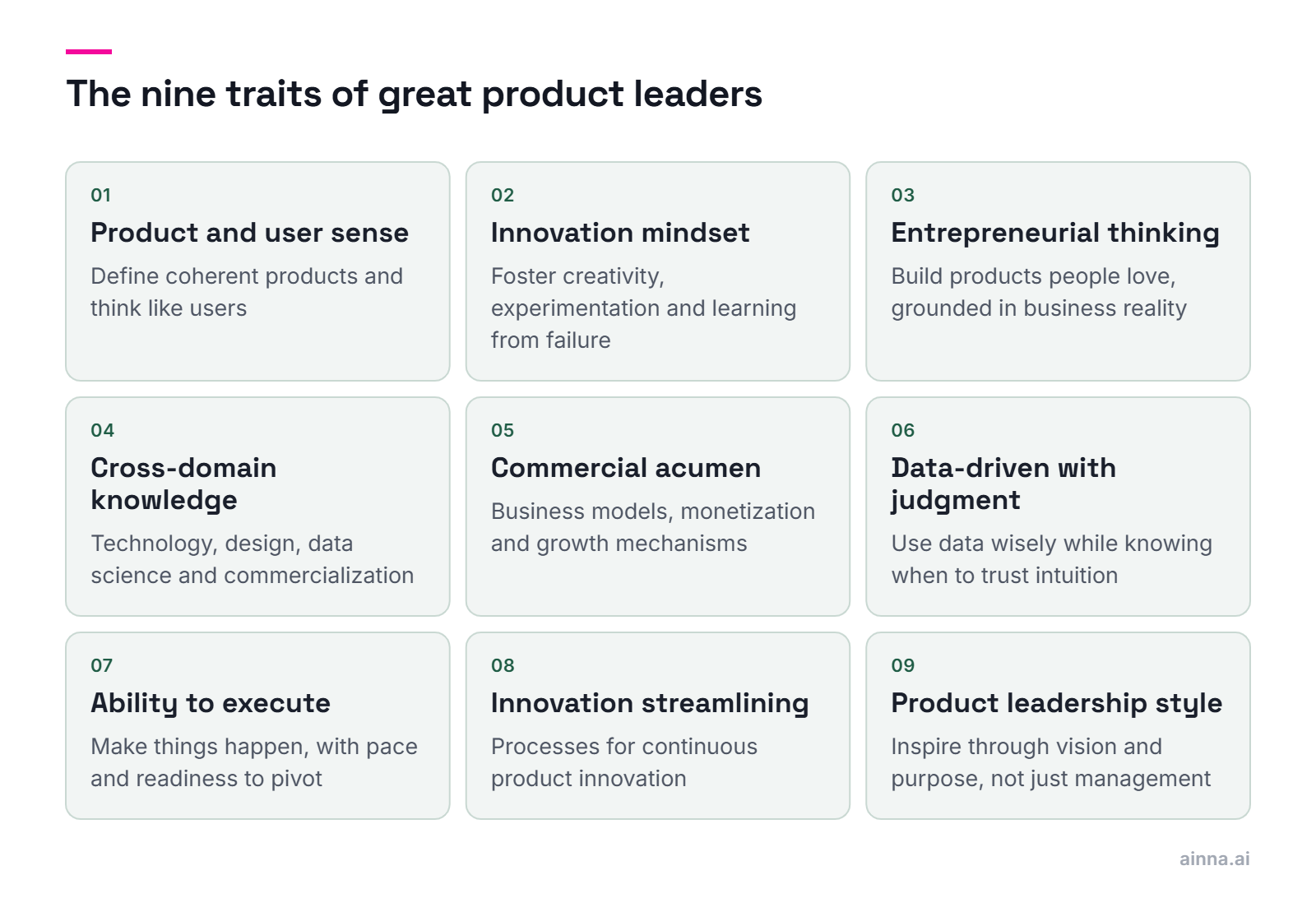
After 20+ years in technology innovation and product development, nine traits consistently distinguish exceptional product leaders: product & user sense, innovation mindset, entrepreneurial thinking, cross-domain knowledge, commercial acumen, data-driven judgment, execution ability, innovation streamlining, and a distinctive leadership style.

  • Product & User Sense — ability to define coherent products and think like users
  • Innovation Mindset — fostering creativity, experimentation, and learning from failure
  • Entrepreneurial Thinking — passion for building products people love while staying grounded in business reality
  • Cross-domain Knowledge — understanding technology, design, data science, and commercialization
  • Commercial Acumen — identifying business models, monetization, and growth mechanisms
  • Data-Driven with Sound Judgment — using data wisely while knowing when to trust intuition
  • Ability to Execute — making things happen with pace, effectiveness, and readiness to pivot
  • Innovation Streamlining — establishing processes for continuous product innovation
  • Product Leadership Style — inspiring through vision and purpose, not just management

These traits work together—the strongest product leaders develop all nine, though everyone has natural strengths in different areas.

Core Competencies

The fundamental abilities that form the foundation of product leadership.

Product sense is the ability to define concrete, coherent products with high business potential—seeing the 'big picture' and 'how to get there' when others struggle. It's a rare skill that combines strategic vision, risk identification, and the ability to think like a user.

  • Ability to obtain a holistic, strategic view of what the right product <em>might</em> be for a given problem space
  • Identifying riskier assumptions and knowing <em>how</em> to test them, learn, and adapt
  • Defining what success looks like with clarity and setting measurement frameworks
  • Understanding the landscape: key market players, differentiators, monetization models, technology, partner ecosystem
  • Thinking 'as a user'—using empathy to relate to problems, needs, and expectations
  • Feeling pain points deeply and understanding the problem within its ecosystem

Product sense develops through experience—building products, talking to users, studying markets, and learning from both successes and failures. There's no shortcut, but deliberate practice accelerates growth.

An innovation mindset means establishing processes that empower a special culture—fostering idea sharing, collaboration, creativeness, and experimentation. It includes mastering innovation practices and having healthy mechanisms to deal with failure as a source of learning.

  • Mastering innovation tools: design thinking, design sprints, <a href='/resources/faq/mvp-faq'>MVP development</a>, idea assessment, <a href='/resources/faq/software-prototyping-guide'>rapid prototyping</a>, validation methods
  • Accepting failure as part of the innovation process—a source of learning, not punishment
  • Encouraging teams to take risks and 'fail-safe, fail-fast' as part of continuous improvement
  • Creating psychological safety where people share ideas without fear
  • Running <a href='/resources/faq/corporate-hackathon-guide'>hackathons</a> and experimentation programs that generate validated opportunities
  • Celebrating learning from failed experiments as much as successful launches

The innovation mindset isn't about having great ideas yourself—it's about creating conditions where great ideas emerge, get tested, and evolve into great products.

Entrepreneurial thinking means being enthusiastic about building products people love while staying grounded in business reality. It's big thinking balanced with awareness of commercial, technological, and resource constraints—the mindset of a 'CEO of the product.'

  • Always looking for opportunities to create value and solve big problems in novel ways
  • Driven by impact and innovation, but connected to reality via clear objectives and measurement
  • Balancing what users need, what creates business potential, and what can be built with available resources
  • Understanding technology capabilities and constraints at a strategic level
  • Taking ownership of outcomes, not just outputs—you're accountable for product success
  • Treating corporate resources wisely while pursuing ambitious goals

Entrepreneurial PMs don't wait for perfect conditions or complete information—they move forward with calculated risks, learn fast, and adapt.

User empathy isn't a soft skill—it's the foundation of product sense. It means developing a 'user mentality' that lets you feel pain points deeply, understand problems within their ecosystem, and relate authentically to customer needs and stakeholder expectations.

  • Talk to users constantly—before, during, and after building
  • Don't just ask what they want; observe what they do and struggle with
  • Use your own product like a real user would—feel the friction firsthand
  • Sit with customer support and hear unfiltered complaints
  • Create journey maps that capture emotional states, not just functional steps
  • Distinguish between what users say they want and what they actually need

Empathy isn't about agreeing with users—it's about understanding them deeply enough to build solutions they didn't know they needed.

Strategic Skills

The strategic capabilities that enable informed decision-making at scale.

Modern digital products are complex systems where technology, usability, business models, marketing, and operations must work together in harmony. Product leaders must understand enough about each domain to make wise tradeoffs and communicate effectively with specialists.

  • Product leaders interact with designers, engineers, data scientists, marketing, and commercial teams daily
  • Understanding each domain's language, perspective, and capabilities is crucial for alignment
  • Strong technical background helps define exceptional products—understanding both capabilities and constraints
  • Must grasp UX principles, engagement measurement frameworks, and enabling technologies
  • Need working knowledge of ML models and data science—how they power differentiated experiences
  • While you can delegate technical decisions, deep understanding multiplies your effectiveness

You don't need to be an expert in everything, but you need enough fluency to ask the right questions, recognize good answers, and make informed tradeoffs.

Commercial acumen means understanding how products create and capture value. Great product leaders identify the right business models, monetization strategies, pricing structures, and growth mechanisms—and continually explore opportunities for both product innovation and business model innovation.

  • Understand different business models: SaaS, marketplaces, freemium, transactional, advertising
  • Learn pricing strategy: value-based pricing, competitive pricing, price discrimination
  • Study unit economics: CAC, LTV, payback period, contribution margin
  • Scan for competitors AND potential partners and synergies
  • Recognize that business model innovation can be as powerful as product innovation
  • Connect feature decisions to business outcomes—not just user satisfaction

Commercial acumen ensures you build products that are not just loved but also viable. The best product is worthless if it can't sustain itself.

Great product leaders use data to inform decisions, not make them. They identify the right sources and feedback loops, interpret data in context, and know when to decide against the 'data story.' The goal is better decisions—not more data.

  • Identify the right data sources: user research, A/B tests, telemetry, market research, experiments
  • Design feedback loops that trigger or support important decisions in the product lifecycle
  • Know when user research is strong enough to kill a feature—and when it isn't
  • Synthesize qualitative and quantitative data from multiple sources
  • Recognize when data is incomplete, unreliable, or potentially misleading
  • Be ready to question patterns derived from data—alternate interpretations may exist

Data-driven doesn't mean data-dictated. The best leaders know when to be purely data-driven and when to lean on business judgment, critical thinking, and strategic insight.

In ambiguous situations—which are common in product work—leaders must demonstrate sound judgment and sometimes decide against or without data signals. This requires drawing on pattern recognition, strategic vision, first-principles thinking, and intellectual honesty about uncertainty.

  • Use first-principles reasoning: break problems down to fundamental truths and build up
  • Draw on analogies from similar situations—yours or others'
  • Consider multiple interpretations of the limited data you have
  • Make decisions reversible where possible—two-way doors vs. one-way doors
  • Be explicit about uncertainty: 'We believe X because Y, and we'll know if we're wrong when Z'
  • Document reasoning so you can learn whether your judgment was sound

Perfect information never exists. The skill is making good-enough decisions quickly enough while building in feedback loops to course-correct.

Execution Excellence

Translating vision into shipped products that deliver value.

Defining great products is only one part of the story. As a product leader, you need to set the roadmap, make the team believe in the purpose and potential, drive execution, and 'make it happen'—requiring effective work decomposition, prioritization, measurement, and steering.

  • Start with clear success criteria everyone understands and can rally around
  • Decompose work into meaningful increments that deliver value independently
  • Apply <a href='/resources/faq/mvp-faq'>MVP thinking</a>: what's the smallest thing that tests our biggest assumption?
  • Prioritize ruthlessly—see our <a href='/resources/faq/mvp-faq#how-to-prioritize'>prioritization frameworks guide</a>
  • Make the team believe in the <em>purpose</em>—not just the plan
  • Measure continuously and adjust based on real signals, not just opinions

Great execution requires pace, effectiveness, and agility—moving fast while remaining responsive to what you learn along the way.

Readiness to pivot means accepting that even core aspects of your initial strategy might need reconsideration. By setting well-thought goals and success criteria upfront, you can recognize early signals indicating a different approach—and have the courage to act on them.

  • Define success criteria <em>before</em> launch so you're not moving goalposts after
  • Measure performance of experiments and newly released features continuously
  • Look for patterns: consistent negative signals across multiple channels warrant attention
  • Distinguish between 'not working yet' and 'won't work'—iteration vs. pivot
  • Be transparent with your team: share insights about failures and justify strategic changes
  • Pivot on strategy, not on vision—the 'why' should be more stable than the 'how'

The courage to pivot comes from confidence in your learning systems. If you trust your data and judgment, changing course feels like progress, not failure.

Product leaders must establish processes that allow fast execution, continuous discovery of high-potential ideas, and smooth adaptation based on insights. This means having methods to incorporate new ideas, assess them transparently, and prioritize them effectively.

  • Establish clear channels for idea submission from anywhere in the organization
  • Create transparent assessment frameworks so contributors understand decisions
  • Know when <a href='/resources/faq/software-prototyping-guide'>prototyping</a> or proof of concept is required before full commitment
  • Design processes that let you incorporate new ideas into existing backlogs without chaos
  • Run regular <a href='/resources/faq/corporate-hackathon-guide'>hackathons</a> to generate validated concepts
  • Build in time for exploration—not just execution of known requirements

Innovation isn't a one-time event—it's a capability. The best product leaders build systems that generate innovation reliably, not randomly.

Effective execution requires effective communication. Great product leaders are transparent—they share insights about failures, justify changes in strategy, and bring clarity on how the product needs to evolve and why. The goal is alignment through understanding, not compliance through authority.

  • Share the 'why' behind decisions, not just the 'what'
  • Be transparent about failures and what you learned from them
  • Articulate changes in strategy clearly—what changed and why
  • Use artifacts—PRDs, one-pagers, roadmaps—to create shared understanding
  • Adapt communication style for different audiences: engineering, executives, customers
  • Create forums for questions and pushback—decisions improve through challenge

Communication isn't overhead—it's how alignment happens. Time invested in clear communication pays back in reduced confusion and faster execution.

Leadership & Culture

Building teams and cultures that consistently deliver great products.

Leading <em>people</em> is very different from leading a <em>product</em>. As a product leader, you need to inspire and energize your team—but this should happen 'naturally' as the outcome of extraordinary efforts to shape and build a great product, not through management techniques alone.

  • Lead through communicating the vision, purpose, and strategy—not through directives
  • Create an open culture of innovation, information sharing, and collaboration
  • Let the bold product vision and passion for impact inspire people to do their best
  • Help people realize they can leave their mark on the product and grow as leaders
  • Focus on inspiring and influencing over managing and controlling
  • When people believe in the purpose, they engage and become part of the product's success

The special culture combined with bold product vision and passion for impact is what inspires people to get obsessed with product success. That's product leadership.

Great products are built by talented teams that are inspired by passionate, skillful product visionaries. The key is creating conditions where people realize they can contribute meaningfully, get recognized, and grow—leading great products to success also leads to great product engineering teams.

  • Hire for 'product sense' and learning ability, not just domain expertise
  • Create psychological safety for sharing ideas and respectful disagreement
  • Give people ownership of outcomes, not just tasks
  • Celebrate learning—from successful experiments AND failed ones
  • Build cross-functional fluency: help engineers understand customers, help designers understand constraints
  • Develop future product leaders by giving them increasing scope and responsibility

The best product teams have internalized the product's purpose so deeply that they make good decisions even without explicit guidance.

Product leaders must have mechanisms to deal with failure—accepting it as part of the innovation process and as a source of learning in the context of continuous improvement. The goal isn't to avoid failure; it's to fail fast, fail cheap, and extract maximum learning.

  • Normalize failure: 'We expect some experiments to fail—that's how we learn'
  • Create 'fail-safe, fail-fast' processes as part of fast-paced product innovation
  • Distinguish between smart failures (good bets that didn't work) and preventable failures
  • Run blameless post-mortems focused on learning, not accountability
  • Share failure learnings widely—they're organizational assets
  • Model vulnerability: share your own failures and what you learned

Teams that fear failure stop taking risks. Teams that embrace failure as learning take smart risks—and smart risks are how great products emerge.

Product leaders must deliver value to end-users, customers, AND stakeholders—while using corporate resources wisely. Alignment comes from shared understanding of goals, transparent decision-making, and consistent communication about progress and learnings.

  • Start with shared goals: what does success look like for the business, not just the product?
  • Use data and customer evidence to ground discussions in reality, not opinions
  • Create clear prioritization frameworks so tradeoffs are transparent
  • Share learnings regularly—what you're testing, what you're learning, what's changing
  • Involve stakeholders early in discovery, not just at review gates
  • Build trust through delivery: consistent execution creates credibility for bold bets

Stakeholder management isn't about getting approval—it's about building genuine alignment around what matters and why.

Career Development

Developing yourself as a product leader over time.

To become a great product leader, you need a natural propensity to build epic stuff, a passion for impact, and a wide combination of skills—from software engineering and product development to monetization and growth. It's a journey of continuous learning and deliberate practice.

  • Build products—there's no substitute for hands-on experience shipping
  • Talk to users obsessively: before, during, and after building
  • Study both successes and failures: yours and others'
  • Develop technical fluency—you don't need to code, but you need to understand
  • Learn business fundamentals: pricing, unit economics, go-to-market
  • Seek increasing scope: more ambiguity, more stakeholders, more impact

Product leadership isn't a destination—it's a practice. The best product leaders are perpetual learners who stay curious about users, technology, and business.

After 20 years in technology innovation, the most common mistakes I've seen are: insufficient problem framing, struggling to distinguish products from projects, misunderstanding agile methodology, and failing to see the big picture while getting lost in execution details.

  • Jumping to solutions before deeply understanding problems
  • Confusing a <em>product</em> with a <em>project</em>—products evolve, projects end
  • Misapplying agile: treating it as a process rather than a mindset
  • Abandoning great concepts due to inability to see the path forward
  • Over-indexing on features rather than outcomes
  • Waiting for perfect data instead of making progress with imperfect information

Most mistakes stem from the same root cause: not spending enough time in the problem space before jumping to the solution space.

Prioritize skills based on your current gaps and career stage. Early-career PMs should focus on execution fundamentals and technical fluency. Mid-career PMs should develop strategic thinking and stakeholder management. Senior PMs should master vision-setting and organizational leadership.

  • Early career: Technical fluency, user research, feature specification, agile execution
  • Mid career: Strategic thinking, prioritization frameworks, stakeholder alignment, team leadership
  • Senior career: Vision-setting, organizational influence, portfolio management, culture building
  • Always: Communication, empathy, analytical thinking, learning agility
  • Identify your weakest trait among the 9 and focus development there
  • Seek experiences that stretch you into areas of discomfort

The best development happens through challenging experiences, not just reading. Seek stretch assignments, take on ambiguous problems, and learn from doing.

Modern product leaders leverage tools that accelerate documentation, facilitate collaboration, and enable data-driven decisions. The right tools let you spend less time on administrative work and more time on the strategic thinking that differentiates great product leaders.

  • Documentation: Tools like <a href='/'>Ainna</a> generate pitch decks and PRDs in seconds instead of days
  • Frameworks: The <a href='https://www.theinnovationmode.com/innovation-toolkit'>Innovation Toolkit</a> provides templates for problem framing, idea assessment, and more
  • User Research: Interview tools, survey platforms, analytics for understanding users
  • Collaboration: Roadmapping tools, design systems, async communication platforms
  • Analytics: Product analytics, A/B testing platforms, customer feedback systems
  • Learning: SVPG resources, product management communities, continuous education

Tools should amplify your effectiveness, not replace your judgment. The best tool is one that frees you to focus on the work only you can do—the strategic thinking and leadership that makes products great.