What is product discovery?

Product discovery is the discipline of finding problems worth solving and solutions worth building - before you commit to building them. As I wrote in Chapter 6 of Innovation Mode 2.0: 'Opportunity discovery is too vital to leave to chance and just hope for the next wave of inspiration. The ability to discover high-potential opportunities needs more than ad hoc processes and isolated innovation workshops; it requires a systematic method executed with speed and decisiveness.'

  • Discovery is not a phase - it is a continuous organizational capability. The best product teams are always in discovery mode, not switching between 'discovery time' and 'delivery time'
  • Discovery answers two fundamental questions: 'Is this problem worth solving?' and 'Will this solution actually work?' - before you invest months of development effort answering them the expensive way
  • In my Innovation Mode methodology, discovery operates through three essential capabilities: Opportunity Discovery (finding and assessing ideas), Opportunity Validation (testing with real-world evidence), and Opportunity Realization (building and scaling)
  • A rich pipeline of quality ideas, paired with a robust discovery capability, increases the likelihood of impactful innovations: the more opportunities evaluated, the higher the chances of spotting the truly game-changing ones
  • Discovery feeds every downstream activity: PRDs, pitch decks, MVPs, roadmaps - all are only as good as the discovery work that preceded them
  • Without systematic discovery, organizations rely on the HiPPO (Highest Paid Person's Opinion) or on occasional flashes of inspiration. Both are unreliable at scale
Key Takeaway

Product discovery is what separates organizations that consistently build products people want from organizations that occasionally get lucky. It is the foundation that everything else in product management rests upon.
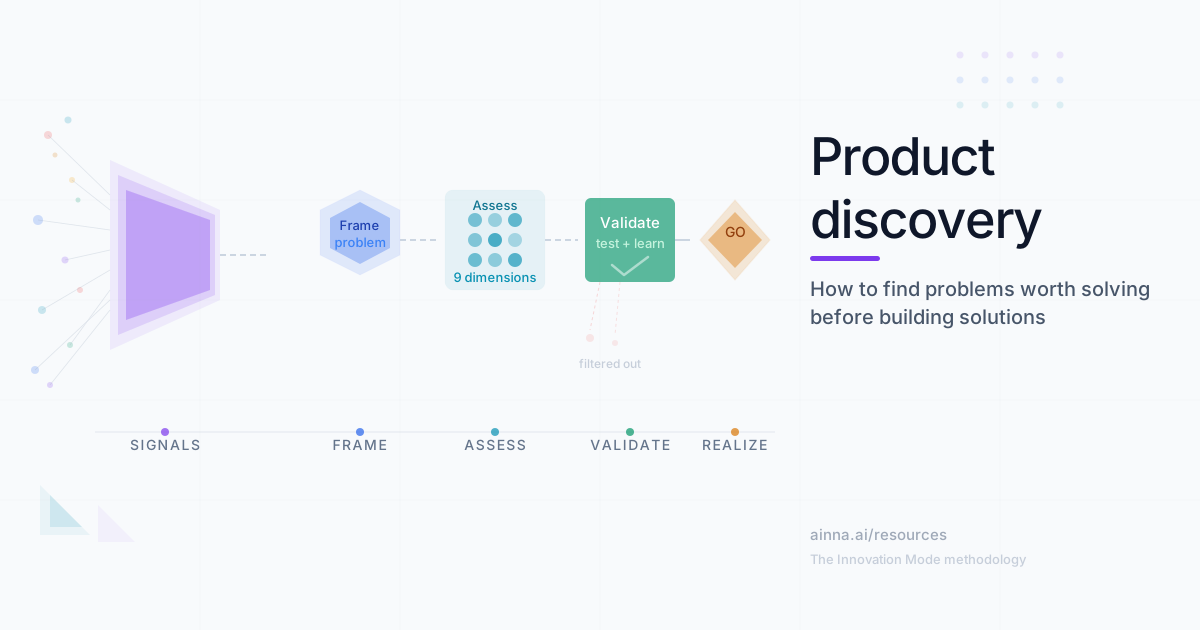
Product discovery pipeline diagram showing raw problem signals flowing through a discovery funnel into four stages: Frame the problem, Assess across nine dimensions, Validate with real-world evidence, and Realize as a validated opportunity - the Innovation Mode discovery framework
Figure 1: The product discovery pipeline - from raw signals through problem framing, multi-dimensional assessment, and validation to opportunity realization. Based on the Innovation Mode methodology.

What is the difference between product discovery and product delivery?

Discovery determines what to build. Delivery determines how to build it. The most expensive mistake in product management is doing delivery well on something that should never have been built - and it happens when teams skip or rush discovery.

  • Discovery asks: Is this a real problem? Is this the right solution? Will people want it? Can we build it? Should we build it?
  • Delivery asks: How do we architect it? How do we ship it? How do we scale it? How do we maintain it?
  • The traditional waterfall mistake: doing all discovery first, then all delivery. The modern practice: continuous discovery running in parallel with delivery, constantly feeding validated opportunities into the development pipeline
  • In my Innovation Mode methodology, discovery and delivery are connected through the Innovation Graph - a persistent repository where ideas, assessments, experiments, and product artifacts are linked and searchable
  • Teams that only do delivery build features. Teams that do discovery AND delivery build products people love. The difference shows up in product-market fit metrics
  • The AI era has compressed delivery timelines dramatically - which makes discovery more important, not less. When you can build anything in weeks, the question of what to build becomes the only question that matters
Key Takeaway

The ratio of discovery to delivery effort should never drop below 30/70 - and for new products, it should be closer to 50/50. If your team spends less than a third of its time on discovery, you are optimizing delivery of the wrong things.

What is the Innovation Space and why does it matter for discovery?

The Innovation Space is a concept I introduced in Innovation Mode 2.0 where problems and solutions live as independent, interlinked assets. Problems exist in the Problem Space - linked to the company's strategy and purpose. Solutions exist in the Solution Space - linked to one or more problems. This decoupling is deliberate: it prevents the most common discovery mistake, which is jumping to solutions before understanding problems.

  • The Problem Space translates the company's strategy into well-defined problems that must be tackled. It answers: 'What are we innovating on? What problems are we solving and why?'
  • The Solution Space is where ideas live - each linked to one or more problems. Multiple solutions can address the same problem, enabling comparison and combination
  • Decoupling is critical because, as I have seen throughout my career, 'regardless of their level or their experience in innovation, people often come with preconceived solutions, preferences, and personal agendas that may prevent them from paying sufficient attention to the problem being solved'
  • Well-framed problems are equally important for innovation as ideas - if not more. A problem, as an innovation asset, has its own properties and lifecycle
  • The Innovation Space forms the foundation of the innovation agenda - the strategic tool that links problems and ambitious ideas with the company's purpose
  • When problems are decoupled from solutions, they become accessible to broader audiences, increase engagement, and create a new source of opportunities: innovation is also about spotting significant problems
Key Takeaway

Contributing to the innovation process by framing problems worth solving is an essential innovation behavior. It should not require proposing a solution - sometimes the most valuable contribution is articulating a problem nobody else has noticed.

What does continuous product discovery look like in practice?

Continuous discovery means your organization is always in 'opportunity discovery mode' - the leadership is always listening for opportunities and open to considering them. It is not a sprint, not a quarterly exercise, not an annual offsite. It is an always-on capability where ideas flow in from across the organization, get assessed systematically, and feed a pipeline of validated opportunities ready for development.

  • Always-on idea intake: any individual in the organization can submit ideas without needing a formal innovation title. As I describe in my methodology, 'innovation should be open and accessible to all'
  • Systematic assessment: ideas are evaluated using my Nine-Dimension Idea Assessment Model by skilled evaluators who provide meaningful feedback - not template responses
  • Multiple discovery channels: ideas emerge from hackathons, design sprints, brainstorming sessions, customer conversations, market intelligence, and everyday business operations
  • The Innovation Graph: all ideas, assessments, experiments, and outcomes are stored in a persistent, searchable repository. Ideas submitted three years ago become discoverable when market conditions change
  • My Innovation Calendar concept coordinates a year-round rhythm of innovation events - each feeding into the discovery pipeline rather than existing as isolated activities
  • AI amplifies continuous discovery by processing idea volumes that would overwhelm human teams - see the AI for product management guide for how this works in practice
Key Takeaway

The difference between occasional and continuous discovery is the difference between hoping to find opportunities and systematically creating them. Organizations with continuous discovery do not wait for inspiration - they manufacture the conditions for it.

Did you know? The Judge is Ainna's independent AI assessor — it scores your opportunity across viability, feasibility, desirability, and strategic fit without knowing your emotional investment. Get an honest assessment

Why must discovery start with problems, not solutions?

Because jumping to solutions is the most expensive mistake in innovation - and it is not a matter of expertise or seniority. Throughout my career across markets and industries - including companies like Microsoft, Accenture, and a series of startups - I have seen brilliant, experienced professionals come with preconceived solutions that prevent them from paying sufficient attention to the problem being solved. The result is always the same: wasted resources building things that address symptoms rather than root causes.

  • Solution-first thinking is primarily a mindset issue: people naturally anchor on the first solution that occurs to them and then seek evidence to support it, rather than exploring the problem space fully
  • The cost is enormous: when you build a solution for the wrong problem, every hour of development, every dollar of marketing, and every customer conversation is wasted - and you only discover this after launch
  • My Problem Framing Template is designed to force problem-first thinking: you cannot complete it without deeply understanding the environment, dynamics, current state, and ideal state
  • A well-framed problem creates alignment before ideation begins. When everyone understands the problem deeply, brainstorming becomes focused and productive rather than scattered
  • Problem-first thinking is also more inclusive: problems are more compact and simpler than ideas. They describe situations that everyone can relate to and empathize with
  • In my Innovation Mode methodology, problems are first-class innovation assets. They live independently in the Problem Space, are evaluated and prioritized, and are exposed to the innovation community through the innovation agenda
Key Takeaway

The discipline of framing problems before ideating solutions is the single highest-leverage practice in product discovery. I have seen it transform brainstorming sessions from noise generators into opportunity engines.

How do you frame a problem effectively for product discovery?

An effectively framed problem covers four dimensions on a single page: the Environment (the ecosystem and stakeholders), the History and Dynamics (how the problem emerged and evolved), the Current State (symptoms, root causes, and quantified impact), and the Ideal State (what success looks like). I designed my Problem Framing Template around these dimensions because each adds a distinct layer of understanding that prevents the superficial problem statements that lead to superficial solutions.

  • The Environment: map the ecosystem - key players, market forces, stakeholder motivations, regulatory landscape, and technological trends. Understanding who is affected and how they are interlinked reveals the political dimension most problem statements miss
  • History and Dynamics: when did the problem emerge? How has it grown? What attempts have been made to address it? Understanding failed attempts is often more valuable than understanding the problem itself - it tells you what does not work
  • Current State: this must go beyond symptoms to root causes and specific triggers. Include quantified impact - frequencies, costs, inefficiencies. 'Product managers waste time on documentation' is a symptom. '40+ hours per month spent on documents that become outdated in weeks' is a root cause with quantified impact
  • Ideal State: contrast the current state with what success looks like. Express it in measurable terms - what metrics change? What behaviors shift? How do stakeholder relationships evolve?
  • Keep it to one page. This forces prioritization of what truly matters and makes the problem shareable - anyone can read a one-page problem statement before a brainstorming session and arrive prepared
  • Use plain, non-technical language. A problem framed in jargon excludes the cross-functional perspectives that produce the best solutions
Key Takeaway

The problem framing template is not just a thinking tool - it is also the ideal structured input for AI. As I describe in the AI for product management guide, methodology-first AI usage starts with a completed problem statement. The 30 minutes you spend framing the problem saves hours of AI-output revision and produces dramatically better results.

How do you know if a problem is worth solving?

A problem worth solving passes five tests: it has significant impact on identifiable people, it is getting worse or more prevalent, existing solutions are inadequate, it aligns with your capabilities and strategy, and there is a plausible path to a viable business. Not every problem deserves your resources - and the courage to say 'this is important but not for us' is one of the most valuable product leadership skills.

  • Impact magnitude: how much does this problem cost users in time, money, or frustration? Quantify it - 'people are frustrated' is not actionable; '$47B wasted annually' is
  • Trend direction: is the problem growing, stable, or declining? Growing problems create urgency and expanding markets. Use the History and Dynamics section of your problem framing to assess trajectory
  • Solution gap: why haven't existing solutions solved this? Use competitive analysis to map what exists and identify where the gap lies - in capability, in accessibility, in cost, or in approach
  • Strategic fit: does solving this align with your capabilities, your team's expertise, and your organization's purpose? A massive problem that does not fit your capabilities is someone else's opportunity
  • Monetization potential: can a solution become a viable business? Use TAM/SAM/SOM analysis to quantify the opportunity. A painful problem with no path to revenue is a charity project, not a product
  • In my Nine-Dimension Idea Assessment Model, 'importance of the problem' and 'certainty of demand' are two of the nine dimensions specifically designed to answer this question with structured rigor rather than gut feeling
Key Takeaway

The best innovations solve important, frequent, growing problems with inadequate current solutions. Use these criteria ruthlessly - the problems you choose not to solve are as strategically important as the ones you do.

How do you frame a business idea so it can be evaluated effectively?

Throughout numerous innovation workshops, I have witnessed teams struggling to describe their ideas effectively and concisely. Innovators get trapped in details and provide excessive information on unimportant aspects, making comprehension and evaluation difficult. My Idea Framing Template solves this: it captures context, target users, value for users, value for the business, form factors, the solution logic, success criteria, and big unknowns - all on a single page.

  • Context: the broader conditions and the referenced problem. What pain points, market gaps, or business challenges does this idea address?
  • Target users: the classes of users or named personas who will interact with and benefit from the solution
  • Value for users and business: how users' lives improve AND how the company benefits. Both must be clear - an idea that serves users but cannot sustain a business is incomplete
  • Form factor: how the idea manifests - mobile app, web platform, service, device, API. This shapes how stakeholders comprehend the concept
  • Solution logic: how the idea actually works - the steps, conditions, actors, and interactions. Use simple, non-technical, technology-agnostic language
  • Big unknowns and assumptions: the risks, uncertainties, and silent assumptions that need to be addressed. These become the agenda for your validation experiments
  • The Universal Idea Model compresses the essence of any idea into a single sentence: 'An [object] for [users] that [does something] in order to [achieve goal]. Users benefit by [value] when [situation].' If you cannot complete this sentence, you do not yet understand your own idea
Key Takeaway

A properly framed idea uses simple, non-technical language and is technology agnostic. This makes innovation more inclusive by ensuring ideas are accessible to broader audiences. It also serves as the ideal structured input for Ainna and other AI tools - producing dramatically better output than vague briefs.

How does the Nine-Dimension Idea Assessment Model work?

My Nine-Dimension Idea Assessment Model evaluates the multiple qualities of an idea and its associated business problem to produce a single Opportunity Score. I designed it with nine dimensions because each captures a different facet of an idea's potential - from the importance of the problem it solves to the certainty that customers will want the solution. The startup idea validation guide covers the complete model in depth.

  • Importance of the problem: how significant is the problem being solved - independently of your company's context? This universal view keeps the organization open to unexpected opportunities
  • Strategic alignment: how aligned is the problem with your organization's strategy and innovation agenda? Combined with universal importance, this reveals opportunities beyond your current radar
  • Effectiveness: how well does the proposed solution actually address the referenced problem? This is typically the most time-consuming assessment dimension
  • Feasibility and ease of implementation: can it be built, and how complex is the development? I deliberately separate these from effectiveness - a brilliant but infeasible idea still has value as inspiration
  • Ease of operation, business impact, novelty: how easy to run, how large the potential outcomes, and is there intellectual property potential?
  • Certainty of demand: how confident are you that customers will actually want this? This is where product-market fit thinking enters the assessment
  • The model uses a weighting mechanism: different organizational contexts weight dimensions differently. A startup might prioritize impact and novelty; an enterprise might emphasize strategic alignment and feasibility
Key Takeaway

The same model is used across the entire innovation ecosystem - from hackathon judging to AI-powered idea assessment to strategic portfolio reviews. This consistency means an idea scored at a hackathon is directly comparable to an idea from a product team - creating assessment continuity across the innovation pipeline.

What is the opportunity creation funnel?

The opportunity creation funnel tracks how ideas progress from raw submissions to commercialized innovations. It is the measurement backbone of your discovery process - and the reason most innovation programs fail is that they measure only the top of the funnel (how many ideas were submitted) while ignoring the conversion rates that actually matter.

  • Submissions: raw ideas entering the system from hackathons, brainstorming sessions, everyday operations, and AI-generated concepts
  • Valid submissions: ideas that meet minimum quality standards - properly framed, addressing a real problem, with sufficient detail for assessment
  • Opportunities: ideas flagged through formal assessment as having genuine potential - scored using the Nine-Dimension Model
  • Actionable opportunities: opportunities reviewed by business experts (product teams, engineering leaders, patent attorneys) who confirm they are worth pursuing
  • Validated opportunities: opportunities that have been tested through prototyping, experimentation, or other forms of real-world evidence gathering
  • Commercialized opportunities: in-market implementations offered in general availability. The conversion ratio to commercialized innovations reflects the connection between discovery and the real market
  • Track each conversion rate independently. Low valid-submission rates indicate poor framing or unclear communication. Low opportunity-to-actionable rates indicate disconnect between innovation and product strategy. Low validated-to-commercialized rates indicate execution bottlenecks in opportunity realization
Key Takeaway

The funnel reveals where your discovery process is leaking value. Fix the conversion rates from the bottom up - a commercialization bottleneck wastes everything upstream, while a submission-quality problem is cheap to fix with better templates and training.

Did you know? Ainna maps your competitive landscape automatically — positioning gaps, differentiation opportunities, and strategic whitespace, generated from your product concept. Map your landscape

When does a discovered opportunity need validation?

An opportunity needs validation when there is increased uncertainty about whether it will work in the real world - and when the cost of being wrong is significant. In my Innovation Mode methodology, the validation decision depends on the type of unknowns: risks can be mitigated through planning, uncertainties must be tested through experiments, and silent assumptions must first be surfaced before they can be tested at all.

  • Not every idea needs formal validation. Simple feature improvements with clear user demand can go directly to the product backlog
  • Validation is essential when: the concept involves novel technology, user adoption is uncertain, the business model is unproven, or the implementation cost is significant enough that failure would be painful
  • The riskiest assumptions to validate: 'Users will actually want this,' 'Users will pay for this,' 'This technology actually works at scale,' 'This can be operated sustainably'
  • Silent assumptions are the most dangerous - things nobody has thought to question. These are often what kills products after launch. Surface them explicitly before they surface themselves expensively
  • The validation trap: spending so long validating that the market window closes. My Innovation Mode approach balances rigor with speed - validate the assumptions that would kill the idea if wrong, accept reasonable uncertainty on everything else
  • When a flagged opportunity comes with certain risks or unknowns, the company must quickly determine the best path forward - which depends on the complexity and the associated level of uncertainty
Key Takeaway

The purpose of validation is not to eliminate all risk - that is impossible and trying will paralyze you. The purpose is to address the risks that would make your product dead on arrival. Everything else you learn by shipping.

What are the best methods for validating product opportunities?

The right validation method depends on what you need to learn. Prototypes test whether users will engage with a concept. Business experiments test specific hypotheses with controlled conditions. Customer interviews test whether the problem resonates. Market analysis tests whether the demand exists at scale. The validation capability I describe in Chapter 7 of Innovation Mode 2.0 provides a structured approach to selecting the right method for each type of uncertainty.

  • Prototyping: build a minimal implementation and put it in front of real users. In the AI era, functional prototypes can be built in hours rather than weeks - see my Hybrid Prototyping Model
  • Business experiments: structured tests using the Business Experiment Framing Template - define learning objectives, hypotheses, metrics, and success criteria before running the test
  • Design sprints: compressed discovery-to-prototype cycles that produce testable artifacts in 3-5 days. AI-powered sprints compress this further to 2-3 days
  • Customer interviews: structured conversations that test whether your problem framing resonates with real users and whether your proposed solution direction matches their needs
  • Competitive validation: analyzing competitor traction as evidence that market demand exists - if competitors are growing, the problem is real; the question is whether your approach is better
  • My prototype factory concept: a specialized organizational entity that streamlines prototyping and validation as a service, dramatically improving discovery bandwidth
Key Takeaway

The best validation approach tests the riskiest assumption with the cheapest method. Do not build a prototype when a phone call would answer the question. Do not rely on phone calls when you need to observe real user behavior.

How do validated opportunities become products?

Validated opportunities enter what I call Opportunity Realization - the third essential innovation capability. This is where concepts with real-world evidence behind them are transformed into MVPs, then into products, and eventually into scaled businesses. The transition requires disciplined documentation: a validated opportunity needs a product concept, a PRD, and a go-to-market strategy before it is ready for full development investment.

  • Document the validation results: what was tested, what was learned, what assumptions were confirmed or invalidated. This becomes the evidence base for investment decisions
  • Frame the product concept: use my Product Concept Template to capture market context, user personas, form factors, strategy, monetization, and open questions
  • Define the MVP using my Seven-Step MVP Definition Process: what is the minimum version that tests the core value hypothesis with real users in real conditions?
  • Build the business case: market sizing, competitive positioning, unit economics, and the pitch that secures resources or funding
  • For larger organizations, the venture building approach treats validated opportunities as internal ventures with dedicated teams, budgets, and milestones
  • Ainna accelerates this entire transition: feed it a validated product concept and get a complete documentation package - PRD, pitch deck, competitive analysis, one-pager - in 60 seconds
Key Takeaway

The transition from validation to development is where many organizations lose momentum. The team that validated the concept may not be the team that builds it. The discovery documentation - problem statement, validation results, product concept - is what transfers the insight from one team to the next.

Where do the best product opportunities come from?

Everywhere - and that is precisely the problem. Opportunities emerge from customer conversations, market intelligence, competitor moves, technology shifts, employee ideas, hackathon outputs, and random observations. Without a system to capture, assess, and route them, most are lost. The organizations that consistently find great opportunities are the ones with the most input channels feeding into a single, structured discovery pipeline.

  • Customer-facing teams: sales, support, and customer success teams hear problems every day that product teams never see. Create a frictionless channel for them to submit observations using the Idea Framing Template
  • Market intelligence: systematic scanning of competitor activity, technology trends, regulatory changes, and market dynamics. In my methodology, the market intelligence team feeds the innovation engine with directional advice and emerging patterns
  • Innovation events: hackathons, design sprints, and brainstorming sessions produce concentrated bursts of ideas. The key is connecting these to the discovery pipeline so ideas do not die when the event ends
  • Everyday operations: routine meetings, product development sessions, and business interactions generate ideas that are usually lost. My methodology makes idea capture as simple as describing the concept to an AI assistant
  • AI-generated opportunities: AI can scan market data, customer feedback, and competitive signals to autonomously surface opportunities. As I describe in Chapter 6 of Innovation Mode 2.0, this represents a shift toward autonomous, AI-driven opportunity discovery
  • The critical infrastructure: all channels feed into the Innovation Graph - a single repository where ideas are captured, assessed, and made discoverable regardless of their source
Key Takeaway

The most valuable opportunities often come from unexpected sources - a support ticket pattern, a customer workaround, a hackathon team's side idea. Your discovery system must be designed to welcome these surprises, not filter them out.

How do hackathons and design sprints fit into product discovery?

Innovation events are concentrated discovery engines - but only when they are connected to the broader discovery pipeline. An isolated hackathon that produces 50 ideas and then archives them is innovation theater. A connected hackathon that feeds all 50 ideas into the Innovation Graph, assesses them using the Nine-Dimension Model, and tracks them through the opportunity creation funnel is genuine discovery at scale.

  • My Connected Hackathon Model ensures that every idea produced during the event gets captured, assessed, and made discoverable beyond the event. Winners are championed, but non-winning ideas remain alive in the Innovation Graph for future contexts
  • AI-powered hackathons transform the equation further: when AI handles implementation, participants focus on problem quality and validation strategy rather than coding speed
  • Design sprints produce ideas under intense, focused conditions - but time constraints mean not all ideas are properly evaluated. Connecting sprint outputs to the discovery pipeline ensures missed opportunities get a second look
  • The Innovation Calendar coordinates events throughout the year so that each one builds on the outputs of previous ones rather than starting from scratch
  • The best hackathon prize is not a trophy - it is a path to the venture building pipeline. When participants know their idea could become a real product, the quality of submissions increases dramatically
  • For complete guidance on running effective innovation events, see the corporate hackathon guide, the hackathon participation guide, and the AI design sprints guide
Key Takeaway

Innovation events are the highest-energy moments in your discovery process. The organizations that get the most value from them are the ones that treat them as inputs to a system, not as stand-alone celebrations.

Did you know? Ainna generates TAM/SAM/SOM market sizing with transparent assumptions you can challenge and refine — not black-box numbers you have to trust. Size your market

In such innovative environments, business titles, hierarchical levels, and job descriptions are less important; it is the vision, ideas, and willingness to contribute that matter most.

What are the most common product discovery mistakes?

After 25 years of running and observing discovery processes, the same patterns appear with remarkable consistency. Most are not about lacking ideas - they are about how organizations handle ideas once they have them.

  • Jumping to solutions: the most expensive mistake. Teams rush past problem framing and start building before they understand what they are solving. Fix: complete my Problem Framing Template before any ideation begins
  • Innovation theater: running hackathons and brainstorming sessions for the optics without connecting outputs to development pipelines. When hackathons aim for the press rather than for discovery, people eventually get the signals and disengage
  • The HiPPO problem: letting the Highest Paid Person's Opinion override structured assessment. My Nine-Dimension Model exists specifically to ground these conversations in evidence rather than seniority
  • Killing ideas on feasibility alone: dismissing ideas because current technology cannot support them. As I wrote in Innovation Mode 2.0: 'Considering the rapid pace of technological change, it is not a good practice to dismiss an idea based on a quick feasibility assessment'
  • Template-based idea responses: giving ideators generic, meaningless feedback. When people share ideas and receive silence or boilerplate, they stop sharing. The evaluation process must provide meaningful, actionable feedback - even when the idea does not advance
  • Treating discovery as a phase rather than a capability: doing discovery in Q1, then switching to delivery for the rest of the year. Discovery must be always-on, with ideas flowing in and assessments happening continuously
Key Takeaway

Every mistake on this list traces back to the same root cause: treating discovery as an event rather than a system. Build the system - the templates, the assessment model, the feedback loops, the Innovation Graph - and the mistakes become structurally impossible.

What is the 'validation trap' and how do you avoid it?

The validation trap is spending so long validating an opportunity that the market window closes or a competitor ships first. It is the opposite of jumping to solutions - and it is equally destructive. I have seen teams run seven rounds of user research on a concept that a competitor launched and proved viable during round four.

  • The validation trap is driven by risk aversion disguised as rigor. Teams request 'one more round of testing' not because they need more data but because they fear making a decision with imperfect information
  • The antidote: define your decision criteria before you start validating. What evidence would make you say 'go'? What evidence would make you say 'stop'? If you cannot answer these questions, you are not ready to validate - you are procrastinating
  • My Innovation Mode methodology distinguishes between risks (mitigate through planning), uncertainties (test through experiments), and silent assumptions (surface and test). Only uncertainties require validation. Risks need risk management. Silent assumptions need awareness
  • Time-box your validation: set a deadline and a budget. When time is up, decide with the evidence you have. Imperfect decisions made quickly almost always outperform perfect decisions made slowly
  • The speed advantage of AI makes the validation trap less excusable than ever: when prototypes can be built in hours, there is no reason for validation cycles to last months
  • Watch for the pattern: if your team has validated the same concept three times and still has not decided, the problem is not insufficient evidence - it is insufficient courage
Key Takeaway

Validation is a tool for making better decisions faster - not a tool for avoiding decisions entirely. The best discovery teams validate ruthlessly and decide decisively.

What team do you need for systematic product discovery?

As discovery matures, it requires dedicated capabilities across six pillars that I outline in Innovation Mode 2.0: Market Intelligence (scanning for signals), Opportunity Discovery and Concept Testing (assessing and validating), Communication and Content (sharing and inspiring), Execution and Product Development (building), Go-to-Market and Commercialization (launching), and Venture Building and PMF (scaling).

  • Start small: a single innovation lead with market intelligence support can run discovery for an early-stage team. Do not wait until you can afford a full innovation team to start systematic discovery
  • Market intelligence leads systematically scan the market, competitive landscape, and broader ecosystem to detect opportunities and threats before they become apparent. They transform noisy market signals into actionable insights
  • Evaluators are employees with specialized domain knowledge who assess ideas using the Nine-Dimension Model. They need expertise in applying evaluation principles objectively - and the communication skills to provide meaningful feedback
  • The product development team must be connected to discovery outputs so validated opportunities flow smoothly into development sprints
  • As I describe in my methodology, all team members should demonstrate genuine innovation behaviors beyond their job descriptions: acting as advisors, ideators, and evaluators. The Guest Innovator program allows employees from across the organization to join discovery efforts on rotation
  • Strong product leadership is what turns discovery from an occasional activity into an organizational muscle. Leaders who model discovery behaviors - framing problems, assessing ideas rigorously, making evidence-based decisions - create cultures where discovery happens naturally
Key Takeaway

The team structure matters less than the behaviors. An organization where everyone frames problems, captures ideas, and values evidence will outperform an organization with a dedicated innovation team that operates in isolation.

Why does product discovery need a shared 'innovation language'?

A shared innovation language is a standardized way of describing problems, ideas, and concepts across your organization. Without it, 'idea' means something different to engineering, marketing, and leadership. Problems are described in incompatible formats. Assessment is subjective and inconsistent. My Innovation Toolkit provides the templates that establish this common language - so that anyone can quickly understand, evaluate, and discuss innovation opportunities regardless of their role.

  • The Problem Framing Template ensures everyone describes challenges the same way: environment, dynamics, current state, ideal state. No more vague 'we should improve X' proposals
  • The Idea Framing Template and Universal Idea Model ensure every idea is captured with the same structure - making comparison, assessment, and discovery possible at scale
  • The Nine-Dimension Model ensures assessment is consistent: the same idea scores similarly regardless of who evaluates it or when. This builds trust in the discovery process
  • Standardized templates accelerate collaboration: less time explaining formats, more time developing ideas. A new team member can read one problem statement and immediately understand the standard
  • The shared language compounds over time: as templates become embedded in organizational culture, discovery quality improves because everyone is better at framing problems and articulating ideas
  • For the full set of templates and how they connect into a progressive workflow, see the product discovery documentation guide and the Innovation Toolkit guide
Key Takeaway

Creating an innovation language is one of the highest-leverage investments an organization can make. It costs almost nothing - just adopt consistent templates - and it transforms how the entire company discovers and pursues opportunities. For related terminology, see the Innovation Dictionary.

How do you measure whether your product discovery process is working?

Measure discovery through the opportunity creation funnel conversion rates - not just the volume of ideas submitted. The funnel tracks ideas from submission through assessment, validation, and commercialization. Each conversion rate reveals a specific health signal about your discovery process.

  • Submission rate: are people actively contributing ideas? Low rates indicate cultural barriers, not a lack of creativity. Fix communication and lower the friction of idea submission
  • Assessment quality: are evaluated ideas receiving meaningful feedback? Track the percentage of ideas that receive actionable guidance versus template responses
  • Opportunity identification rate: what percentage of assessed ideas are flagged as opportunities? Too low suggests poor idea quality or overly conservative evaluators. Too high suggests insufficient rigor
  • Validation conversion: what percentage of opportunities produce clear go/no-go signals within a reasonable timeframe? Stalled validations indicate the validation trap
  • Commercialization rate: what percentage of validated opportunities reach market? This is the ultimate discovery metric - and it often takes months or years to materialize, so track leading indicators alongside it
  • Cultural metrics: innovation pulse surveys, participation rates in discovery events, cross-functional collaboration patterns. These leading indicators predict future discovery performance
  • As I describe in Chapter 9 of Innovation Mode 2.0, the opportunity creation funnel should be standardized and tracked over time so you can build baselines and monitor how discovery performance correlates with innovation culture
Key Takeaway

The most important discovery metric is not how many ideas you generate - it is how efficiently those ideas become validated, commercialized innovations. Optimize the funnel, not just the top of it.

Did you know? Ainna's AI doesn't just generate answers — it leads the strategic process, knowing which questions to ask, which assumptions to challenge, and which blind spots to surface. Experience the difference

Where should a team start with product discovery?

Start with one problem. Not a workshop, not a framework rollout, not a new tool. Take the most important unsolved problem your team faces right now and frame it using my Problem Framing Template. Share it with your team. Watch how the conversation changes when everyone is looking at the same structured problem description. That is the moment when discovery starts to feel different.

  • Week 1: frame one real problem using the Problem Framing Template. Share it with your team and key stakeholders. Note how it creates alignment you did not have before
  • Week 2: run a focused brainstorming session against that framed problem. Capture ideas using the Idea Framing Template and the Universal Idea Model. You will get better ideas because the problem is clear
  • Week 3: assess the ideas using the Nine-Dimension Model. Score them, discuss the scores, and select the top 2-3 for deeper exploration
  • Week 4: validate the top idea with a lightweight test - customer interviews, a quick prototype, or a competitive analysis using Ainna
  • Then repeat. Each cycle gets faster as your team builds muscle memory with the templates and the assessment model. After three cycles, you have a discovery practice
  • Download the complete Innovation Toolkit to get all the templates. Use the AI for product management guide to accelerate each step with AI
Key Takeaway

Product discovery is a practice, not a project. Start small, be consistent, and let the results speak for themselves. The teams that discover the best opportunities are not the ones with the biggest budgets - they are the ones with the best habits.

How does product discovery differ for startups versus enterprises?

The principles are identical. The execution is different. Startups do discovery with three people and a whiteboard. Enterprises need systems that process hundreds of ideas from thousands of employees across dozens of business units. But both need the same foundation: structured problem framing, rigorous idea assessment, and disciplined validation before development.

  • Startups: discovery is existential - you are searching for product-market fit and every cycle matters. Speed trumps process. The founder IS the discovery engine. Use the Problem Framing Template and Universal Idea Model to force clarity, then validate as fast as possible with real users
  • Enterprises: discovery must be systematic because scale creates noise. Hundreds of ideas compete for attention. My Innovation Mode methodology provides the infrastructure: the Innovation Graph for idea management, the Nine-Dimension Model for consistent assessment, and the Innovation Calendar for coordinated events
  • Startups struggle with: over-validation (the validation trap), premature scaling, and confusing founder conviction with validated demand
  • Enterprises struggle with: the HiPPO problem, innovation theater, disconnected hackathons, siloed idea management, and the 'not invented here' syndrome
  • Both benefit from AI: startups use Ainna to generate documentation packages that make discovery outputs investor-ready. Enterprises use AI to process idea volumes and maintain continuous discovery at scale
  • The venture building approach bridges both worlds: enterprises that treat validated opportunities as internal ventures, with startup-like autonomy and accountability
Key Takeaway

Whether you are three people in a garage or 30,000 people across 50 countries, the discovery question is the same: 'Is this problem worth solving, and is this solution worth building?' The frameworks that answer it are the same too. Only the scale differs.

Domain experts who lack formal training in innovation methodologies often frame innovation narrowly within their sphere of knowledge.

Most AI says yes.
Ainna says prove it.

The same methodology behind these guides — structured into an AI platform that frames opportunities, challenges assumptions, and produces stakeholder-ready documents in minutes.

Put Your Idea to the Test Free to explore · No credit card
Ideas in.
Opportunities out.