How does AI make hackathons truly inclusive?

This is the single most transformative impact of AI on hackathons - and it's already happening. AI prototyping and no-code development remove the technical barrier that previously made hackathons exclusive to developers. As Innovation Mode 2.0 describes: 'non-technical members and teams can create fully functional applications with zero coding.' A product manager, a marketing leader, or a domain expert can now build and present a functional prototype that convincingly demonstrates their concept.

  • The practical reality, as described in Innovation Mode 2.0: 'you can describe a digital experience, say a website, to Anthropic's Claude and obtain a first implementation in seconds; then by providing feedback and clarifications, you can experience Claude extending or correcting its own code to meet your exact requirements. In just a few iterations and maybe in less than an hour, you can have a realistic, presentable, interactive experience that matches exactly your requirements. All of these done without a single line of code from the user'
  • For teams with basic development experience, the effect compounds: 'the code produced by AI can be embedded as a component into a bigger, hosted application, thus enabling the team to gradually build a fully functional, quality prototype with proper backend and all the essential functions in place'
  • The result: 'AI is opening up development to all while compressing development cycles dramatically. This allows hackathon teams to produce realistic, presentable prototypes in a couple of hours rather than days'
  • What this means for team composition: hackathon teams no longer need to be developer-heavy. Teams of business strategists, domain experts, and customer researchers can now produce prototypes that match or exceed what developer-only teams built before AI. The competitive advantage shifts from coding speed to concept quality
  • What this means for participation: employees who previously self-selected out of hackathons because they 'couldn't code' can now participate meaningfully. This broadens the diversity of perspectives, which typically improves the quality and novelty of concepts
  • For a deeper guide on hackathon fundamentals, see the Corporate Hackathon Guide. For 50+ AI-era hackathon themes designed for diverse teams, see this guide on The Innovation Mode
Key Takeaway

AI-powered inclusivity isn't just about fairness - it's about innovation quality. When hackathons were restricted to developers, the concepts were constrained by developer perspectives. When product managers, marketers, salespeople, and domain experts can build prototypes, the concept space expands dramatically. The best hackathon ideas often come from people closest to the customer - people who previously couldn't participate.

How are hackathons evolving from building contests to validation contests?

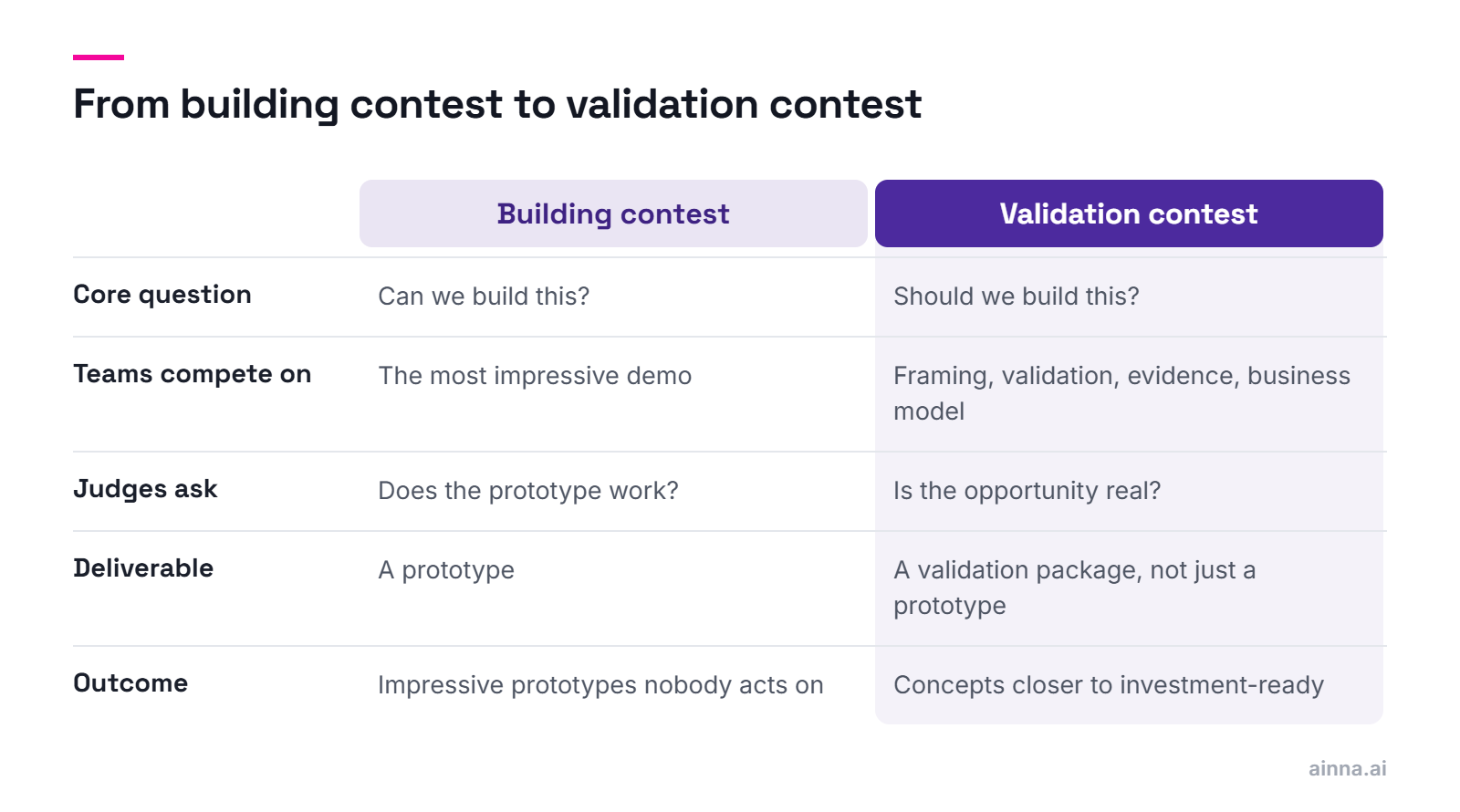
This is the most significant strategic prediction in Innovation Mode 2.0 regarding hackathons. When AI handles the building, the competitive advantage shifts from prototype quality to opportunity quality. As I write in the book: 'I see hackathons gradually evolving into in-market concept validation contests, with companies awarding high-potential concepts backed by smart market-testing strategies and real-world evidence of business potential.'

  • The traditional hackathon awards the best prototype - the team that built the most impressive demo under time pressure. When AI can generate functional prototypes in hours, 'the most impressive demo' is no longer a meaningful differentiator. The question shifts from 'Can we build this?' to 'Should we build this?'
  • The new competitive edge: 'hackathon teams will have to focus their energy and creativity primarily on justifying the opportunity around their concept by developing business models, smart pricing, defining partnerships, and intelligent go-to-market strategies'
  • What teams compete on in validation contests: the quality of their problem framing, the rigor of their validation approach, the strength of their market evidence, the creativity of their 'hypothesis validation hacks,' and the viability of their business model - not just the functionality of their prototype
  • This changes the judging criteria: instead of 'does the prototype work?' judges evaluate 'is the opportunity real?' using frameworks like the Nine-Dimension Idea Assessment Model. Judges need business strategy expertise alongside technical knowledge
  • This changes the deliverables: teams submit not just a prototype but a validation package - problem statement, market sizing, competitive analysis, pitch deck, and evidence from real market signals. Tools like Ainna can generate most of this documentation in 60 seconds, freeing teams to focus on the strategic thinking
  • This changes the outcomes: hackathon winners emerge with concepts that are closer to investment-ready. The path from hackathon to venture building to MVP to product-market fit becomes shorter because the validation work started during the hackathon itself
Key Takeaway

The hackathon of the AI era doesn't celebrate who built the best demo. It celebrates who found the best opportunity. This is a fundamental shift - from technical achievement to strategic insight. Companies that redesign their hackathons around this reality will produce concepts that are closer to market-ready. Those that don't will produce impressive AI-generated prototypes that nobody acts on.

What is the 'connected hackathon' model?

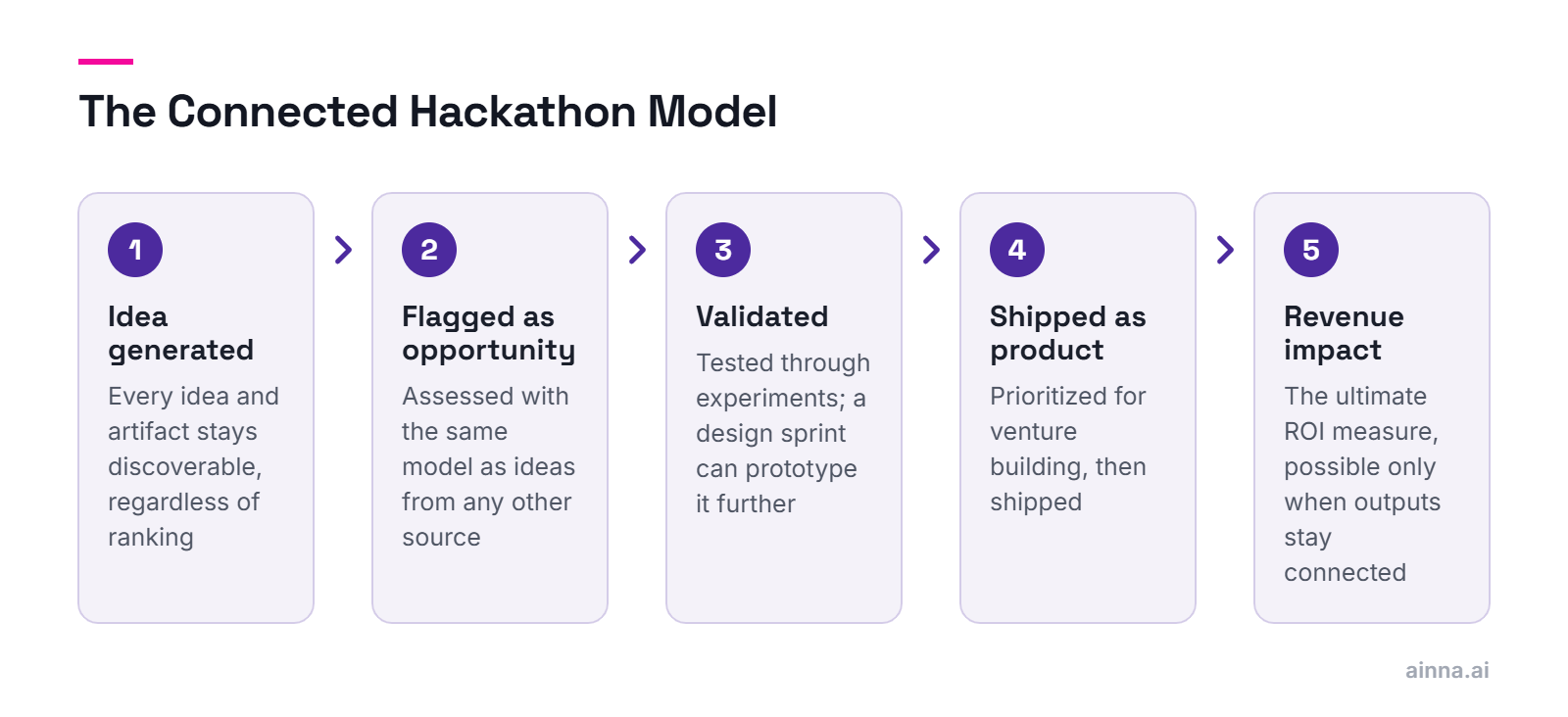
A connected hackathon is one that's integrated into the broader innovation infrastructure rather than operating as an isolated event. In the Innovation Mode methodology, this means hackathon outputs flow directly into the Innovation Graph and Opportunity Discovery pipeline - making every idea, project, and artifact discoverable and usable beyond the event, regardless of ranking. As Innovation Mode 2.0 describes: 'hackathons become integrated into the broader innovation program - they evolve as connected innovation experiences that feed opportunities to the corporate innovation knowledge base.'

  • Output preservation: all hackathon ideas, projects, pitch decks, prototypes, and code repositories are hosted in the Innovation Portal. They remain discoverable by anyone in the organization - not just the people who attended the event. Non-winning projects retain their value as innovation assets
  • Pipeline connection: hackathon projects are assessed using the same Idea Assessment Model as ideas from any other source. 'Projects can be compared and ranked across hackathons and against the entire corpus of ideas living in the Innovation Graph.' A project from Hackathon #3 can be compared directly with a concept from a design sprint or a brainstorming session
  • AI-powered evaluation: the committee can 'utilize the network of idea evaluators to either support the panel of judges or outsource the entire project evaluation process.' This makes evaluation faster, more consistent, and less dependent on the availability of a small panel of senior judges
  • Cross-event intelligence: connected hackathons share context with all other innovation events. A market intelligence briefing can set the hackathon theme. A design sprint can prototype the winning hackathon concept further. The opportunity review can prioritize hackathon outputs for venture building
  • Performance measurement: the connected model enables tracking the full lifecycle: idea generated in hackathon -> flagged as opportunity -> validated through experiments -> shipped as product -> revenue impact. This is the ultimate ROI measure, and it's only possible when hackathon outputs are connected to the downstream pipeline
  • Conversational discovery: 'people can learn about an upcoming hackathon simply by asking the portal's innovation agent. Through a conversational experience, they can explore existing projects and participating teams, express interest in joining, describe their idea to the agent, create a new team, and instantly discover participants who would be interested'
Key Takeaway

The connected hackathon model transforms hackathons from annual events that produce excitement and sticky notes into continuous contributors to the organization's innovation portfolio. Every hackathon builds on the knowledge accumulated by previous ones, and every output remains alive in the system for future discovery and action.

What happens to technical talent when AI removes coding as the hackathon's competitive advantage?

This is the cultural question at the heart of AI-powered hackathons - and Innovation Mode 2.0 is direct about it. Hackathons have traditionally celebrated a specific kind of human achievement: talented engineers showcasing their ability to build something impressive under extreme time pressure. When AI handles the building, 'those talented individuals and teams will have to redefine their roles in innovation and find other ways to stay motivated and energized beyond the excitement of coding or problem-solving under the intensity of the hackathon.'

  • The identity challenge: developers who have built their professional identity around technical excellence face a genuine crisis when AI can produce equivalent code in minutes. 'The satisfaction derived from overcoming technical obstacles and building smart solutions fast is increasingly being replaced by the general skill of effectively directing an AI agent - something that any professional can do'
  • The motivation problem: what energizes hackathon participants when the building is handled by AI? Companies need to find new sources of motivation: strategic problem-solving challenges, real market validation tasks, opportunities to interact directly with customers, or challenges that combine technical depth with business acumen
  • The reframing opportunity: technical talent doesn't become less valuable - it becomes valuable for different reasons. Developers who understand both the technology and the market opportunity can evaluate AI-generated prototypes with depth that non-technical participants can't match. The role shifts from 'builder' to 'technical strategist and quality evaluator'
  • The design implication: hackathon challenges should include elements that require genuine technical judgment - architecture decisions, scalability analysis, security assessment, performance optimization - alongside the business validation components. Pure 'build this' challenges lose their meaning; 'build this AND prove it can scale to 10,000 users' retains the technical dimension
  • As described in the parent guide on AI-powered innovation events: this cultural risk demands honest communication. Don't tell technical teams that 'AI is just a tool' if it's fundamentally restructuring their competitive advantage. Acknowledge the shift and help them develop the strategic skills the new model requires
  • The broader context: this isn't unique to hackathons - it's the same identity challenge facing innovators across all AI-powered innovation events. Companies that address it proactively will retain their technical talent. Those that ignore it will lose them - to companies that value their judgment, not just their coding speed
Key Takeaway

The hardest truth about AI-powered hackathons: the people who loved them most - the engineers who lived for the intensity of building under pressure - are the ones most affected by the transformation. Designing hackathons that give technical talent new sources of pride and satisfaction isn't just a cultural nicety. It's a retention strategy.

Did you know? Ainna generates executive one-pagers that distil your entire strategic analysis into a single page — different audiences need different stories from the same underlying work. Create your one-pager

How does AI streamline hackathon setup and communication?

Organizing a large-scale hackathon is a complex project with dozens of work streams. In the Innovation Mode methodology, the AI-powered Workshop Designer compresses this into a streamlined process: from an initial event brief, it generates branded content, a complete communication plan, a dedicated event page, participant resources, and the entire sequence of updates from announcement through completion to retrospective.

  • Content generation: the Workshop Designer 'uses the initial event brief and the broader context of the company to create branded content that best presents the hackathon and its objectives.' This includes the event page, promotional materials, FAQs, participant guides, and judging criteria - all generated in minutes from a brief
  • Communication automation: formal content is diffused through the Innovation Portal with 'timely notifications and updates toward, during, and after the event - all based on the content prepared by AI and using the associated high-quality email templates.' The full communication plan described in Innovation Mode 2.0 (announcement, countdown, kick-off, runtime updates, completion, winner announcement, feedback invite, retrospective) is automated
  • Team discovery: 'people can explore existing projects and participating teams and express interest in joining, describe their idea to the agent, create a new team, and instantly discover participants who would be interested in joining.' This solves the team formation problem that traditionally requires multiple networking sessions
  • The Problem Framing Template and Universal Idea Model provide structured formats for participants to articulate their ideas before the event - ensuring teams arrive with clearer concepts and better preparation
  • For hackathon organizers without a full Innovation Portal: Ainna can generate problem statements, competitive analysis, and product concept templates as hackathon preparation materials. 50+ hackathon theme ideas provide inspiration for AI-era hackathon challenges
  • Education and onboarding: AI generates introductory materials for first-time participants, explaining the hackathon format, expectations, available tools, and how to form teams - making the event more accessible to newcomers
Key Takeaway

AI-powered setup doesn't just save the organizing team weeks of work - it raises the quality and consistency of hackathon communication and preparation. When participants arrive better informed and better prepared, the hackathon itself produces better results.

What should hackathon deliverables look like in the AI era?

When AI can generate functional prototypes in hours, the prototype is no longer the differentiating deliverable. In the Innovation Mode methodology, AI-era hackathon deliverables should include not just a working prototype but a complete opportunity package: a structured problem statement, a framed product concept, market sizing, competitive analysis, a validation strategy, and evidence of market demand.

  • The traditional deliverable was a functional prototype plus a pitch video. When every team can produce a functional prototype using AI in a couple of hours, the prototype alone doesn't differentiate. Teams need to demonstrate why the concept is worth building, not just that it can be built
  • The expanded deliverable package: (1) Problem statement using The Problem Framing Template, (2) Product concept using The Universal Idea Model, (3) Functional prototype, (4) Market analysis and competitive positioning, (5) Validation strategy with specific hypotheses to test, (6) Evidence of market demand (customer conversations, existing market signals, competitor reviews)
  • Tools like Ainna can generate items 1-2 and 4 automatically - freeing teams to invest their hackathon time in items 5-6, which require human judgment, market insight, and creative validation thinking
  • The pitch evolves: instead of demonstrating the prototype's features, teams present their validation logic. Why is this problem worth solving? How big is the market? What assumptions does the concept rest on? How would they test those assumptions in the first 30 days? This is the substance of the idea validation discipline
  • Judging criteria adapt: use elements of the Nine-Dimension Idea Assessment Model - importance of the problem, effectiveness of the solution, certainty of demand, business impact - rather than prototype quality alone
  • Post-hackathon value: an expanded deliverable package makes post-hackathon action much easier. Leadership can evaluate opportunities based on structured analysis, not just demo excitement. The path to venture building starts with evidence, not just enthusiasm
Key Takeaway

The AI-era hackathon deliverable answers 'Should we build this?' not just 'Can we build this?' Teams that arrive with a validated opportunity backed by market evidence will outperform teams that arrive with a polished prototype and no market analysis - regardless of how impressive the prototype looks.

How should hackathon judging change when AI handles the building?

When every team can produce a functional prototype using AI, judging prototype quality becomes meaningless as a differentiator. Hackathon judging must shift from evaluating what was built to evaluating what was discovered: is the problem real? Is the market large enough? Is the solution defensible? Does the team have a credible path to validation? In the Innovation Mode methodology, this shift maps directly to the Nine-Dimension Idea Assessment Model - the same structured framework used in the Opportunity Discovery pipeline.

  • The old judging model evaluated: prototype quality, technical complexity, demo polish, presentation skill. These made sense when building a working prototype in 48 hours was genuinely hard. When AI compresses that to 2 hours, these criteria no longer separate strong concepts from weak ones
  • The new judging model should evaluate the nine dimensions from the Innovation Mode Idea Assessment Model: importance of the problem (is this a real, significant pain?), strategic alignment (does it fit the company's market position?), effectiveness (does the proposed solution actually address the problem?), feasibility, ease of implementation and operation, business impact, novelty (is there IP potential?), and certainty of demand (is there evidence people will adopt this?)
  • This creates a natural connection to Ainna: teams can use Ainna to frame their concept as a structured opportunity - generating the problem statement, competitive analysis, market sizing, and pitch deck that map directly to the dimensions judges will evaluate. The judging criteria and the documentation tools align
  • Judges need new skills too: traditional hackathon judges were senior technologists who could evaluate code quality and architectural decisions. AI-era judges need business strategy expertise, market knowledge, and the ability to assess validation logic. Include product leaders, commercial leaders, and domain experts alongside technical judges
  • The evaluation process can leverage the same evaluator network used in the Opportunity Discovery pipeline. As Innovation Mode 2.0 describes, 'the committee utilizes the network of idea evaluators to either support the panel of judges or outsource the entire project evaluation process.' Projects are scored using the Idea Assessment Model, enabling fair comparison across hackathons and against the entire Innovation Graph
  • Practical implementation: publish the judging dimensions in advance so teams know what to optimize for. When teams know they're being judged on problem importance, market evidence, and validation strategy - not just demo quality - their hackathon effort redirects toward the activities that produce real business value
Key Takeaway

The judging shift mirrors the broader transformation: from evaluating technical achievement to evaluating strategic insight. Companies that update their judging criteria will get hackathon outputs that are closer to investment-ready. Those that keep judging on prototype quality will keep producing impressive demos that nobody acts on.

How do you measure the success of an AI-powered hackathon?

AI-powered hackathons require an expanded measurement framework that captures both the immediate event performance and the long-term pipeline impact. In the Innovation Mode methodology, hackathon metrics follow an opportunity creation funnel: from engagement, to valid submissions, to flagged opportunities, to actionable opportunities, to validated opportunities, to commercialized innovations. Some of these metrics can only be measured months after the event.

  • Engagement: participation rate (registered vs. eligible), active participants (teams that submitted valid projects), and diversity metrics (role distribution, seniority range, cross-functional composition). AI-powered hackathons should show broader participation than traditional ones - if they don't, the inclusivity promise isn't being delivered
  • Output quality: number of valid submissions, percentage flagged as opportunities through formal assessment, and the Opportunity Scores produced by the Idea Assessment Model. Compare across hackathons to establish quality baselines
  • Pipeline conversion: 'the percentage of actionable innovation opportunities over the total number of valid project submissions.' Track which hackathon concepts progress to design sprints, venture building, MVP development, and ultimately to market. This is the ultimate ROI measure
  • Cultural impact: participant satisfaction, perceived value from the assessment survey, changes in innovation pulse surveys, and critically - whether participants want to do it again. As described in Innovation Mode 2.0, feedback is 'automatically processed by AI, which summarizes qualitative feedback, generates insights, and suggests improvements'
  • Team dynamics: 'the distribution of teams by size, the degree of similarity of the roles within the team, and the range of skills' provides insights for improving future events. AI-era hackathons should show more diverse team compositions than traditional ones
  • A concrete example of the funnel in action: imagine a hackathon with 120 participants forming 24 teams. 20 submit valid projects. AI-powered assessment flags 8 as opportunities (33% conversion). Business review identifies 4 as actionable (50%). Two get funded for design sprints. One reaches MVP six months later. That single MVP - traceable back to its hackathon origin - is the ROI story that justifies the entire hackathon program to leadership. Without the connected model, this lineage is invisible
  • Long-term metrics require patience: 'some of these metrics can only be obtained months after the hackathon's completion since they refer to realizations of ideas that need time. Nevertheless, whenever this happens, it is essential to link back to the source hackathon and reflect it on its performance scorecard'
Key Takeaway

The hackathon that generates the most excitement on demo day is not necessarily the most successful. The most successful hackathon is the one whose concepts reach the market and generate business value - and that can only be measured by tracking the full pipeline from concept to commercialization. The connected hackathon model makes this tracking possible.

What tools do hackathon teams need in the AI era?

AI-era hackathon teams need tools across three categories: concept framing (structuring the opportunity), AI prototyping (building the demo), and validation (gathering market evidence). In the Innovation Mode framework, these tools are integrated through the Innovation Portal, but teams can assemble equivalent capability from available tools today.

  • Concept framing: Ainna generates problem statements, product concepts, competitive analysis, pitch decks, PRDs, and one-pagers from rough concept descriptions in 60 seconds. This eliminates the documentation burden that traditionally consumed hours of hackathon time
  • AI prototyping: Claude (Anthropic), ChatGPT (OpenAI), and specialized AI coding assistants convert natural language descriptions into functional code. For design, AI tools generate UI mockups and interactive experiences. See the software prototyping guide for detailed practices
  • Validation tools: landing page builders for demand testing, survey tools for concept validation, and access to market data for sizing the opportunity. The Business Experiment Framing Template structures validation activities during the hackathon
  • Collaboration: digital whiteboards for remote/hybrid teams, real-time code collaboration, and video tools for async updates across time zones. The Innovation Portal provides a unified space for team formation, resource discovery, and project submission
  • Idea structuring: the Universal Idea Model provides a consistent format for capturing and presenting concepts. Using a standard structure across all teams makes evaluation more fair and cross-hackathon comparison possible
  • Use code AINNA.AI to explore Ainna and generate your hackathon team's complete documentation package - problem statement, product concept, competitive analysis, pitch deck, and PRD - in 60 seconds
Key Takeaway

The right tools for an AI-era hackathon free teams from documentation and prototyping overhead so they can invest their time in what actually differentiates winners: understanding the customer, sizing the opportunity, and designing a credible path to market.

Organizations should no longer view innovation as a nice-to-have — it has become a critical business priority.

While conventional companies optimize for ambitious short-term financial targets, innovative companies aim for long-term success through systematic innovation.

Most AI says yes.
Ainna says prove it.

The same methodology behind these guides — structured into an AI platform that frames opportunities, challenges assumptions, and produces stakeholder-ready documents in minutes.

Put Your Idea to the Test Free to explore · No credit card
Ideas in.
Opportunities out.