

For product managers, founders & innovation teams

Know what's worth building.

Ainna is the AI system for product idea validation and opportunity assessment. Bring a rough idea. Get it framed, scored by Ainna and the people you trust, and backed by personas, market sizing and competitive analysis.

Free to start · No credit card · LinkedIn for sign-in only

Frame your idea. Bring a rough idea, even a hunch. Ainna asks what a sharp advisor would ask, pushes back on the weak answers, and shapes it into a concept worth assessing: the problem, who it's for, how it works, why now.
Assess it with Ainna. The Judge, Ainna's assessment model, scores the concept across ten dimensions, shows its reasoning, and tells you exactly what would make it stronger. Personas, market size, and the competitive landscape come with the verdict.
Assess it with your experts. Invite the domain experts, advisors, or customers you trust to run the same assessment, independently. Where they agree with Ainna, your confidence goes up. Where they don't, you've found the question that matters.
Capabilities

Scattered ideas build decisions.With confidence.

Ainna frames the concept with you, then assesses it from every side: a model that scores the problem and the solution across ten dimensions, then its fit to your Innovation Agenda, with the reasoning behind every score, the people you trust reviewing it independently, and the personas, market size and competitive landscape that back it. Every assessed opportunity lands in a portfolio, ranked against the rest, so the strongest becomes a decision instead of a favourite.

01 Frame

Your idea, formed in conversation.

Ainna doesn't take dictation. It asks what a sharp advisor would ask, challenges the weak answers, and forms the concept with you: the problem, who it's for, how it works, why now. Once the concept holds, it keeps advising without ever rewriting your idea behind your back.

Guided framing Problem, user, solution, and why now, structured and challenged as you answer
Advisor mode After framing, Ainna asks, recommends, or hands the pen back. Your changes apply at once; its suggestions wait for your approval.
Brainstorm Open the space around the problem and develop the promising alternatives into concepts. Unlimited on every plan.
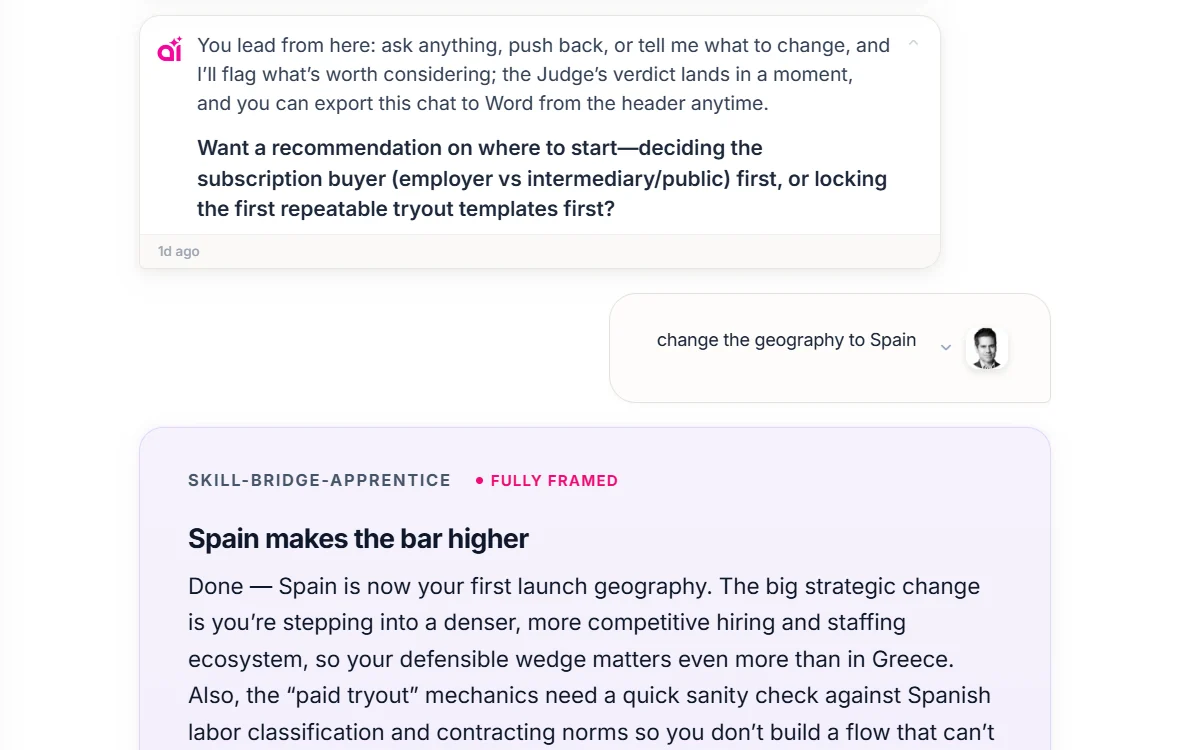
Ainna framing view: an advisor exchange where a request to change the launch geography is answered with a reframed concept, marked fully framed, and a follow-up question about the next decision
02 Assess

A thorough assessment, and how to improve it.

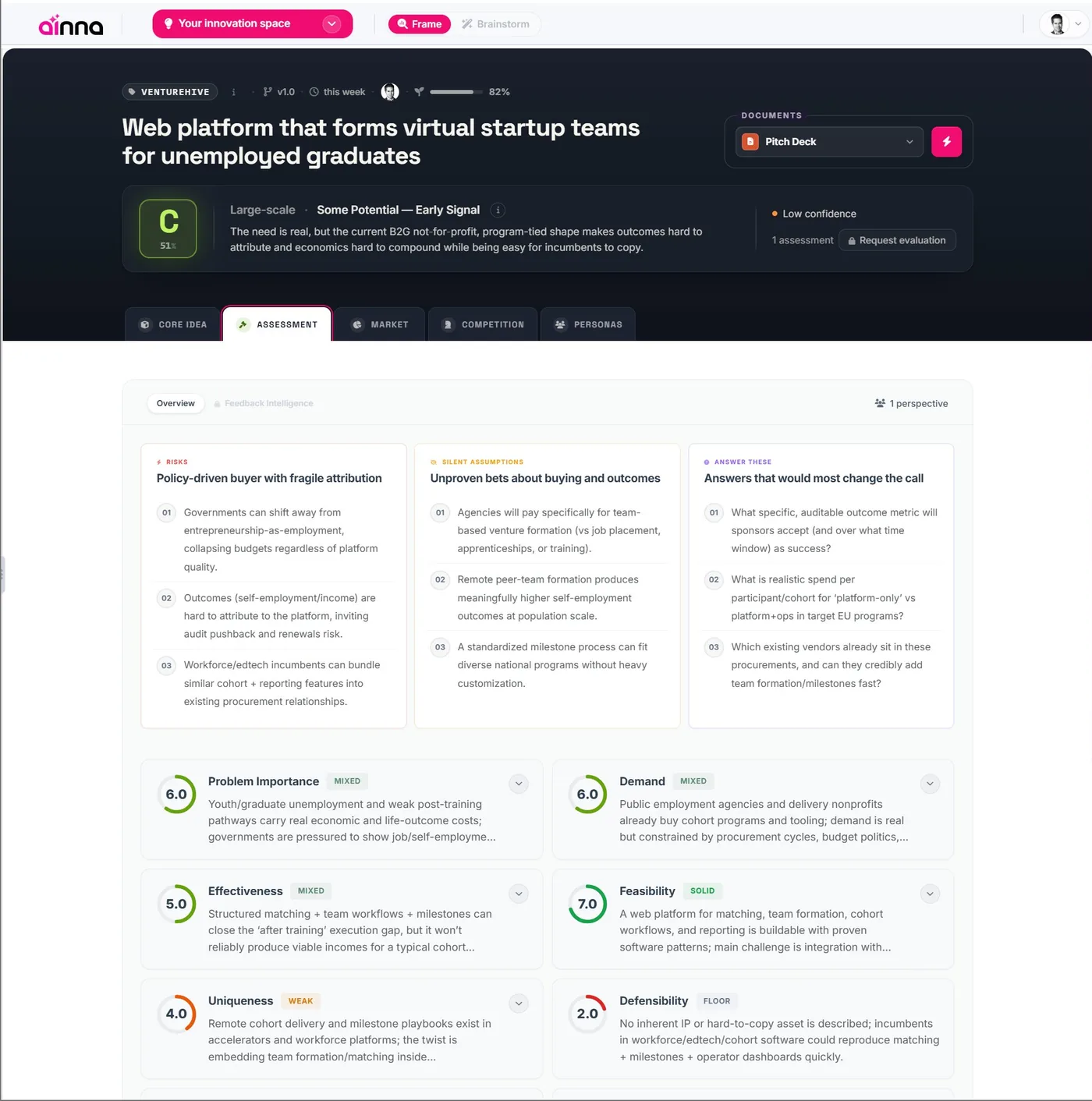
The Judge scores the concept across ten dimensions, from problem gravity to solution strength, then rates its fit to your Innovation Agenda, shows the reasoning behind every score, and names the moves that would raise it. Reframe, re-run, and watch the verdict move.

Ten-Dimension Idea Assessment Problem and solution lenses scored with the evidence shown, plus fit to your Innovation Agenda
A verdict with the next move Build, reframe, or stop, with the risks, silent assumptions, and recommendations that led there
Re-run without cost Refining or re-running an Opportunity never uses another one
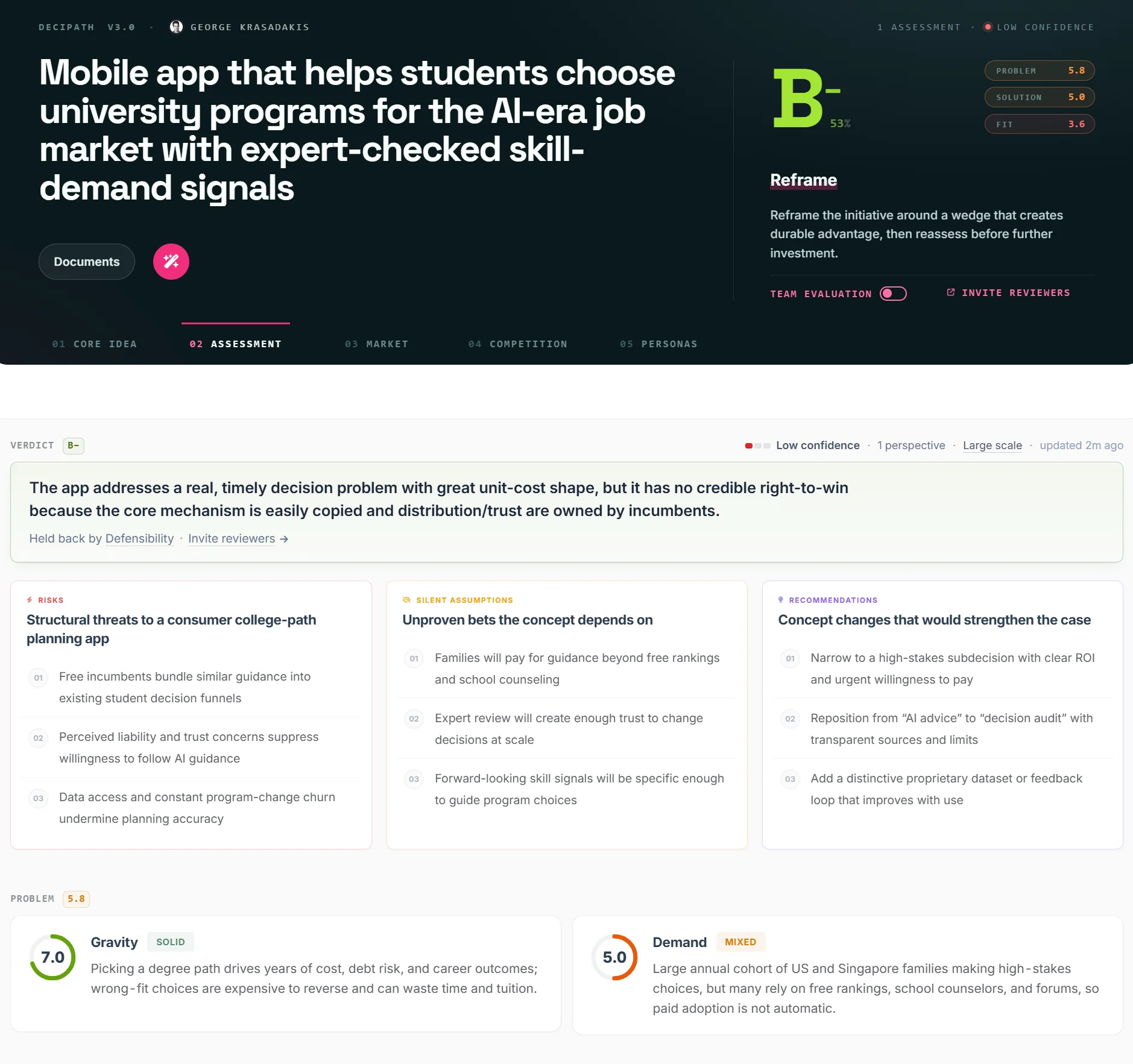
Ainna assessment view: an overall grade with problem, solution and fit scores, a walk-away verdict naming the dimension holding it back, and columns of risks, silent assumptions, and recommendations
03 The Panel

Invite the people you trust.

Ainna's assessment is one perspective. Invite advisors, domain experts, or target customers to assess the same concept in their own view, on their own time. Their input joins Ainna's in one consolidated verdict, and confidence rises as perspectives are added.

Independent reviews Each reviewer assesses the Opportunity in their own view, not by editing yours
One consolidated verdict Ainna's view and your reviewers' side by side, with agreement and disagreement visible
Included in the Team plan Seats, a shared workspace, and the Panel. Enterprise for whole organizations.
Ainna assessment header with team evaluation and invite reviewers controls
04 Personas

Who it's for, and what they'd do.

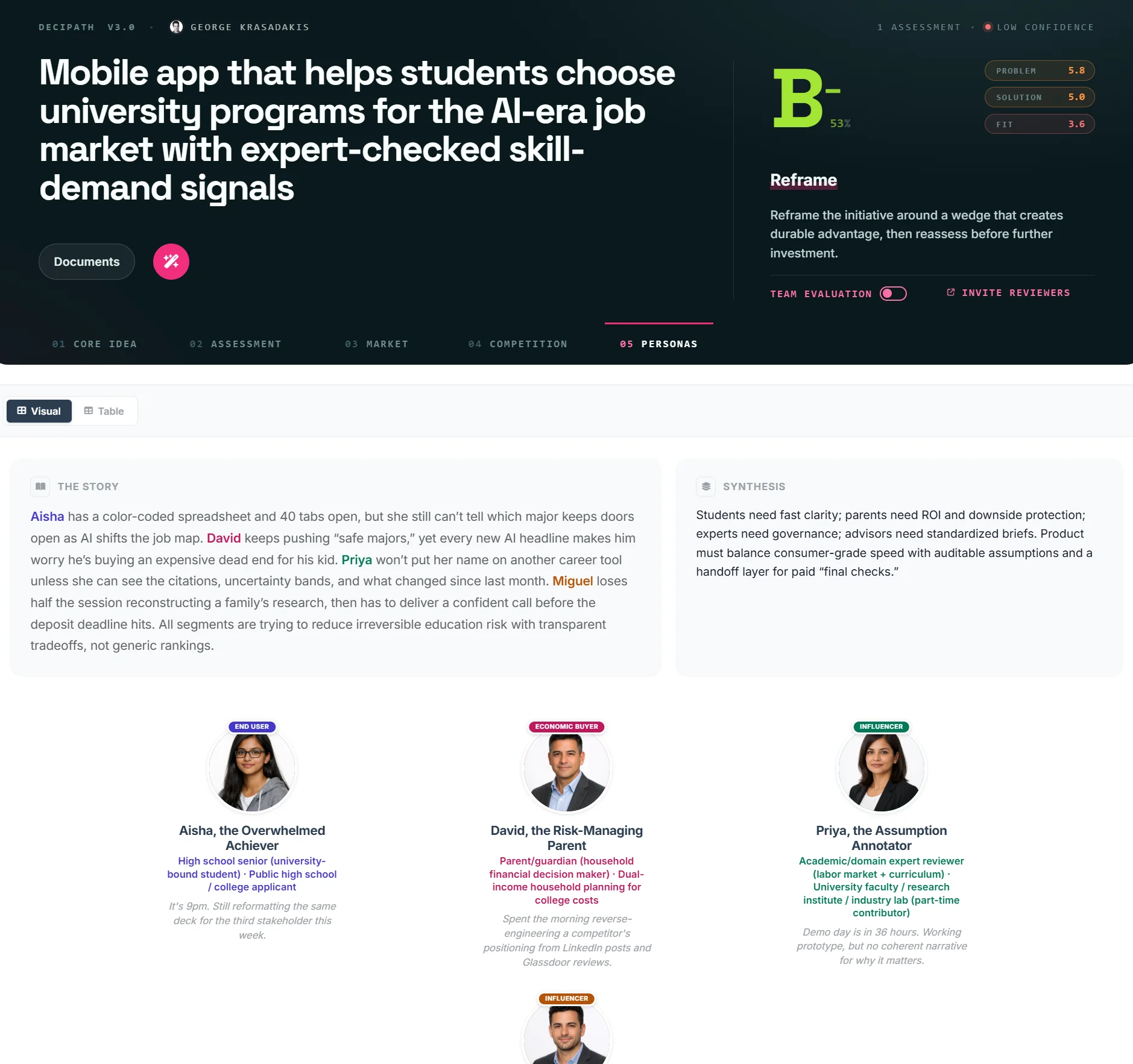
Ainna profiles the people who use it, pay for it, and influence the decision, tells their story as one scene so the tensions are obvious, and then runs the concept through each persona's eyes.

End user, buyer, influencer Named and profiled, with the roles they play in the decision
Pains and motivations What each persona is trying to reduce, and what would make them adopt or walk away
Persona assessment Fit gaps and adoption risks per persona, not in aggregate
Ainna personas view: the story, the synthesis, and the end-user, buyer, and influencer personas
05 Market

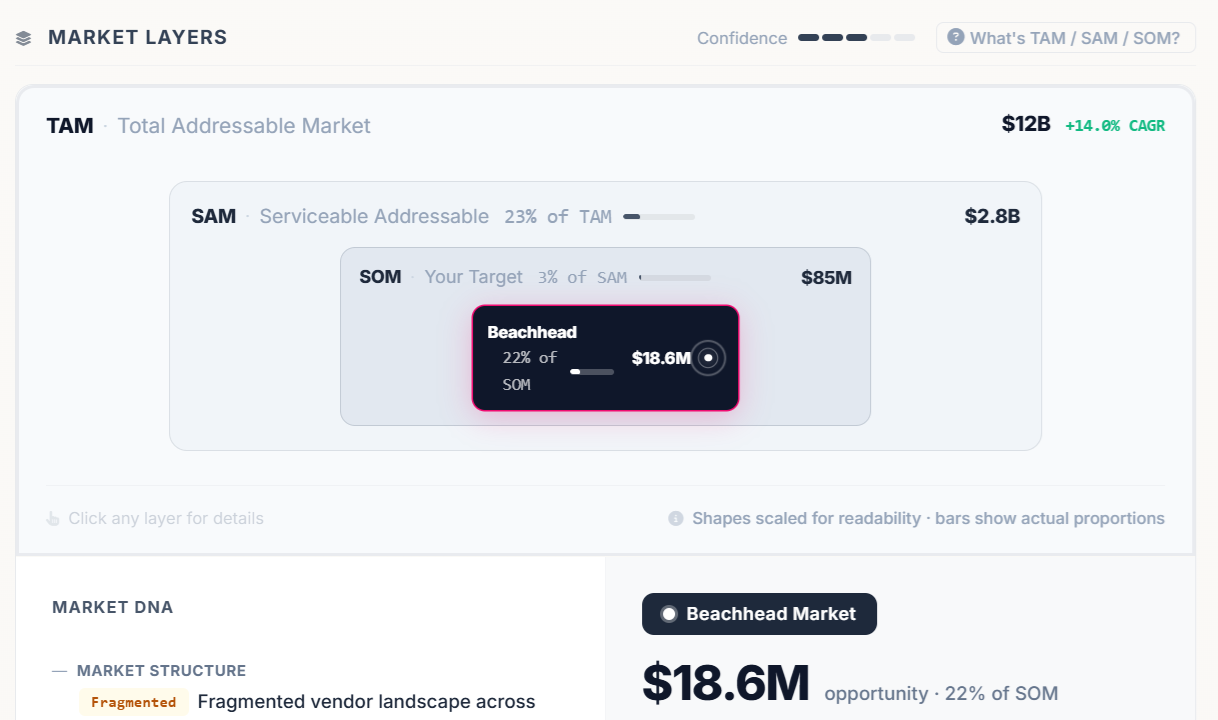
Market insights and a size you can defend.

Ainna sizes the market with the assumptions on the table, reads the trends that open the window or close it, and feeds all of it into the Judge's demand and timing scores. Challenge any number and re-run it.

Market size estimates Numbers with the assumptions shown, not optimistic guesswork
Trends and timing The shifts that make now the moment, and the ones that could close it
Evidence behind the score The same analysis the Judge cites for demand and timing
Ainna market view: size estimates with their assumptions, trends, and timing signals
06 Competition

The competitive landscape, mapped.

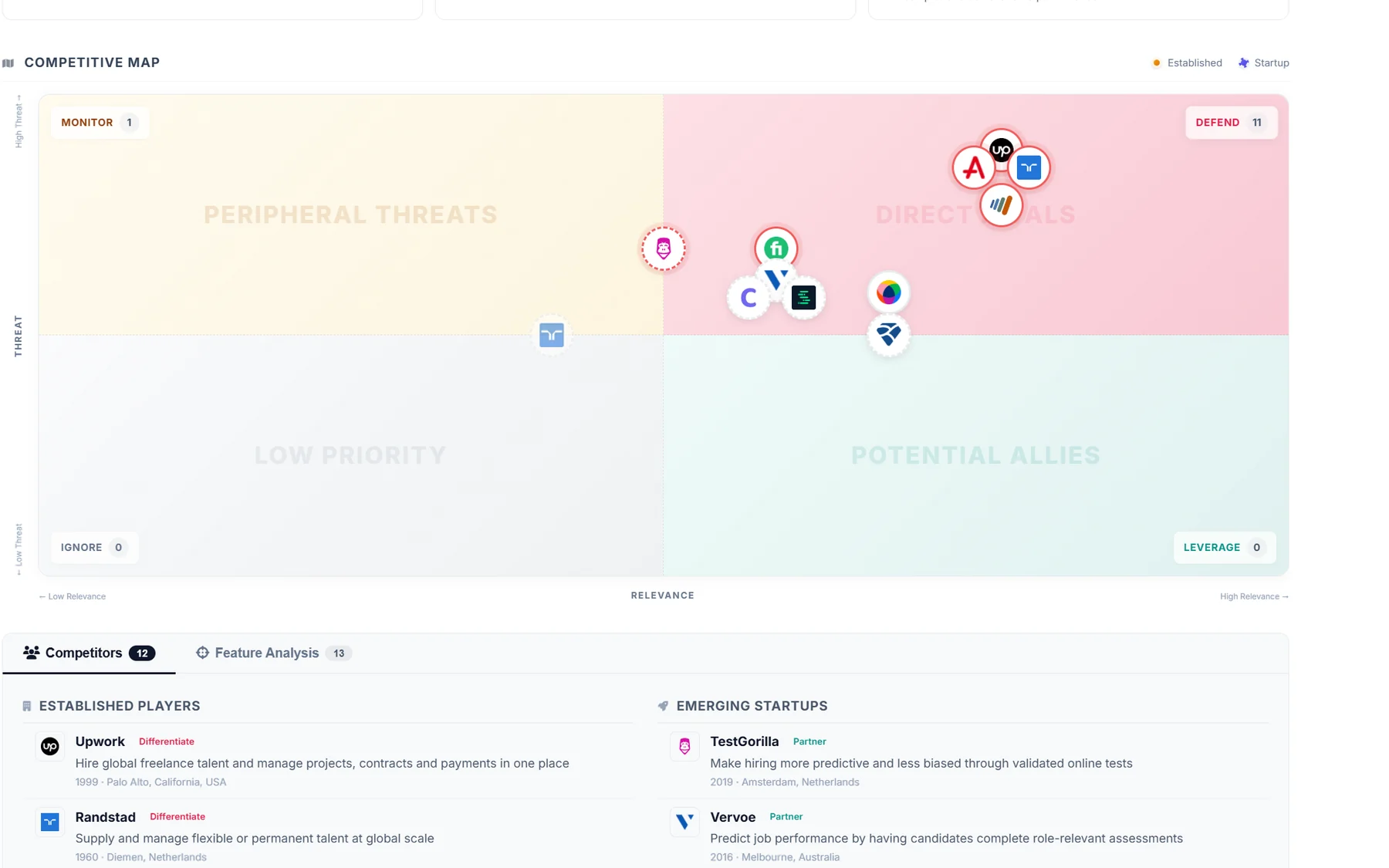
Established players and emerging startups, placed on a threat-by-relevance map and given a stance: defend, monitor, ignore, leverage. Feature analysis shows what the market already does well and where nobody plays yet.

Competitive map Direct rivals, peripheral threats, and potential allies, visible at a glance
Established and emerging Incumbents and startups, each with a recommended stance
Feature analysis What competitors cover, what they miss, and where the whitespace is
Ainna competition view: a threat-by-relevance map sorting established players and startups into defend, monitor, leverage, and ignore quadrants, with the competitor list and feature analysis below
07 Portfolio

Brainstorm, collaborate, decide what to pursue.

Ideas don't live alone. Run the loop on every problem worth solving, keep the candidates, rank the assessed opportunities against each other and against your Innovation Agenda, and turn the strongest into decisions your team commits to. When the case holds, the documents follow.

Portfolio of ideas Every concept scored and comparable, in one place
Collaboration A shared workspace on Team, reviewers on the Panel, one version of the truth
Innovation Agenda The themes, outcomes and targets that say what innovation is for, and what every idea is measured against
Documents when you need them Pitch deck, PRD, and one-pager generated from the work, in your branding, fully editable, on Pro and Team
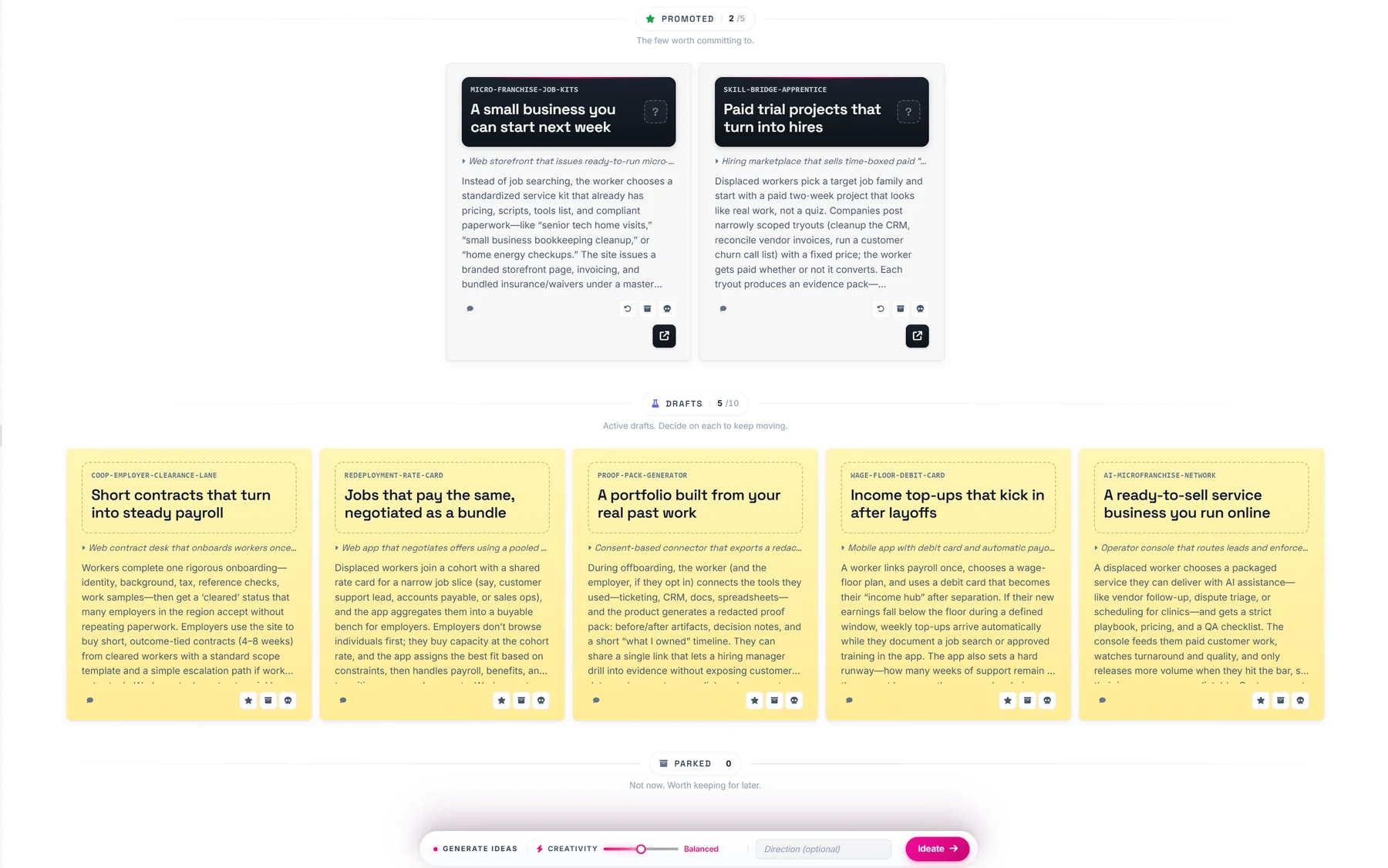
Ainna brainstorm view: the idea board for one problem, with promoted, draft, and parked lanes, each card showing its concept and mechanism, and a creativity control for generating more
The system

Innovation takes inspiration.
Being innovative takes a system.

Talent and inspiration are enough to produce good ideas. But that innovation is occasional: it depends on the right people and the right moment, and it doesn't compound. Being innovative means innovating systematically, as one organisation, with measurable outcomes aligned to your purpose. That takes a shared methodology and the tools to run it, so the capability compounds with every cycle.

01 · Agenda

Set the strategic focus

Before anyone pitches an idea, set the agenda: the themes you'll invest in, the outcomes you're after, the targets that count. Ainna challenges it, sharpens it, and measures every idea that follows against it.

An Innovation Agenda the whole team can see
02 · Explore

Define problems, fill the solution space

Frame the problems worth solving and brainstorm without limits. Ainna develops the promising alternatives into concepts and keeps the rest as options, so high-potential ideas live somewhere the team can find and review them.

Solution spaces full of developed concepts
03 · Assess

Deep-dive and score every concept

Every concept gets the same treatment: framed, scored by the Judge across ten dimensions and against your agenda, reviewed by the people you trust, with personas, market size, and the competitive landscape behind every score.

Scored, comparable opportunities
04 · Decide

Build the portfolio, make the call

The strongest opportunities land in portfolios, ranked against each other and against the agenda. They surface to the people who decide, so resources go to the concepts that earned them, with the case already made.

Decisions, with the case behind them

Running through all four, Ainna keeps you connected to what is moving outside: contextual market and competitive insight at every step, so decisions are made against the market as it is, not as it was when the idea first came up.

Free to start · No credit card

Pricing

Free to begin. Upgrade when ready.

Transparent pricing. Subscribe monthly to stay flexible, or prepay annually and save up to 25%.

Free

For founders exploring a bet, students, and anyone meeting the verdict for the first time
Free
1 Opportunity ongoing
Features Interactive Idea Framing The Judge Personas Market Outlook Competitive Landscape
Documents Idea One-Pager Problem Framing Document

Team

For innovation leads, senior PMs managing multiple bets, and portfolio owners
$699
50 Opportunities per month
10 seats · $69.90 per person/month Save 25% with annual billing
Features Brainstorming Mode Interactive Idea Framing The Judge Personas Market Outlook Competitive Landscape The Panel Branded Documents Themed Decks Pivot History
Documents Pitch Deck Idea One-Pager Problem Framing Document Problem Framing Deck Product Requirements Document (PRD) Product Requirements Deck Patent Draft Accelerator Jira Product Backlog

Start framing your product concept.

Getting started takes a minute: sign in with LinkedIn or email, no credit card. Ainna will help you frame your idea, then you'll get a thorough assessment and recommendations on how to improve it. When you decide: upgrade to Pro for more features and higher usage limits, or Team to collaborate with your peers.

Frequently Asked

Everything you need to know

Yes, and you should bring a real problem, not a toy one. The Free plan gives you the full strategic conversation, a real Opportunity Score from the Judge with its reasoning, and document previews, with no credit card and no time limit. This isn't a demo running on sample data; you frame your own idea and see exactly how it holds up.

Start with a rough concept and let Ainna drive the framing, or hand it something you've already been chewing on and watch it get sharper. When you want the editable files, Pro unlocks full document generation; when you want your own experts in the assessment, Team adds the Panel. Everything you created on Free is still there.

Three plans: Free, Pro, and Team. Every plan includes the full strategic conversation, the Judge's assessment with its reasoning, personas, and the market and competitive analysis. Free gives you a limited number of Opportunities with document previews, no credit card and no time limit. Pro adds full document generation and download for an individual. Team adds seats, a shared workspace, and the Panel for bringing your own experts into the assessment. Paid plans start at $99 per month, annual billing saves up to 25%, and there are no hidden fees and no lock-in; larger organizations can move to a custom enterprise agreement.

An Opportunity is one idea taken all the way through the process: framed, enriched, assessed, and documented into a complete 360-degree view. Your plan sets how many Opportunities you can take to that depth; on paid plans the allocation resets monthly. Refining or re-running an Opportunity you've already started never uses another one, and brainstorming is unlimited on every plan.

The ideas, strategies, analysis, and substance in everything Ainna generates belong to you, to use for your own business purposes: investor pitches, internal alignment, engineering handoff, team templates. Downloaded files are yours to keep whatever happens to your plan. The one boundary is the methodology itself: the frameworks and document structures embedded in the outputs remain The Innovation Mode's, so they can't be repackaged or resold as templates, and agencies producing client deliverables need a commercial license.

On privacy, the answer is direct: your content is never used to train AI models, never shared with other users, and never sold. Your account is hosted in EU data centers under GDPR. Generated documents aren't stored on our servers; each one is rendered when you download it, and you can regenerate it any time the Opportunity exists. Your ideas and analyses stay in your account, on any plan, until you delete them; a free account with no login for 12 months is deleted after 30 days' notice. Export anytime, delete any idea in one click, and close your account whenever you choose. That privacy is deliberate: people think more freely when half-formed ideas aren't being stored or studied.

An Innovation Agenda is a clearly stated focus for innovation, linked to your strategy: the themes you will invest in, the outcomes you are after, and the targets that count. It is the reference every idea gets measured against, which is what makes two opportunities comparable rather than two opinions.

You do not need one to start. Bring a single problem and Ainna will frame and assess it straight away. The agenda becomes useful the moment you have more than one idea in play, because holder fit scores each opportunity against the focus you have set and the assets you actually hold. Ainna challenges and sharpens the agenda the same way it challenges an idea, and it is versioned, so you can see which version an assessment was scored against.

A general-purpose chatbot is one small piece of the puzzle. It gives you ideas and prose - maybe a tenth of the work - then leaves you to be the strategist, the analyst, the formatter, and the reviewer. Ask it to size a market and you get plausible numbers with no method; ask for a competitive map and you get a list, not an assessment.

Ainna runs the whole method. It sizes the market against a defensible model, scores the opportunity on a structured framework, maps the competition, profiles real personas, brings human experts in to challenge the result, and hands you a branded pitch deck, PRD, and one-pager that are yours to keep - from one body of work, in minutes. Generic AI reacts to your prompts. Ainna runs corporate innovation end to end, built on a published methodology that knows which questions to ask and which assumptions to break.

An idea is worth building when it solves an important problem, for a real and reachable user, in a way you can actually deliver, with enough demand and strategic fit to matter - and the only way to know is to assess it honestly before you commit. Most ideas fail not because they were bad, but because they were never properly framed, or were judged in the wrong context by the wrong people.

Ainna gives you that honest read fast. It frames the problem, sizes the market, maps competitors, and produces an Opportunity Score across ten scored dimensions plus fit to your Innovation Agenda - then the experts you trust weigh in. You get a clear signal: take it forward with evidence behind you, or pivot before you've spent real resources on the wrong bet.

Every opportunity gets a single Opportunity Score, built from a system of ten dimensions across two lenses, one for the problem and one for the solution. Each is scored with a justification, so the number always comes with the reasoning behind it.

Alongside those, holder fit rates the opportunity against your Innovation Agenda: whether it matches the focus you have set and the assets you actually hold. The model evolved from the nine-dimension assessment model published in Innovation Mode; what runs in Ainna goes considerably further.

The score is produced by an AI evaluator and then enriched by the human experts you invite, who assess the same opportunity independently. The result is an Opportunity Narrative - not just a grade, but a defensible account of where the idea is strong, where it's weak, and what to do next. The model is configurable: a product team and an IP team can weight the dimensions differently, because what matters depends on the decision you're making.

The trustworthy unit isn't the AI alone - it's Ainna plus the domain experts you bring. We hold to the human-in-the-loop principle by design: an AI evaluator scores each opportunity and writes its narrative, then the experts you invite - co-founders, advisors, specialists, even target customers - assess the same opportunity independently. Where their judgment and the AI's diverge, the system surfaces the disagreement rather than smoothing it over.

We've built a deliberate process around that combination, because real wisdom comes from AI's speed and consistency working with human context and judgment - not from either on its own. The AI is the analyst; you and your experts are the decision-makers. That principle is the spine of the Innovation Mode methodology. The Panel is included in the Team plan and in Enterprise.

You start a conversation, and the system does the structured work. Bring a hunch, a problem, or a half-formed concept; Ainna frames the problem, sizes the market, maps the competition, profiles the personas, and assesses the result - producing an Opportunity Score and a narrative that explains the strengths, the risks, and the recommended next step. What took an innovation team weeks now takes minutes.

The score isn't the finish line. The experts you invite assess the same opportunity independently, you iterate as your thinking sharpens, and what survives becomes a defensible case - with the pitch deck, PRD, and one-pager to back it. What doesn't survive fails here, where failure is cheap.

You don't need a template - Ainna generates the PRD for you, formatted and visual, from the work you've already done. Once an opportunity is framed and assessed, it produces a complete Product Requirements Document as an editable DOCX: the problem and goals, target personas and user journeys, requirements, and an implementation outline, laid out with your branding and contextual visuals rather than a blank outline you have to fill in.

The same body of work also yields the pitch deck and the one-pager, so the story stays consistent across every format. Everything exports fully editable and yours to keep - bring your own judgment to the numbers and claims, and it's ready for stakeholders. A static template gives you a shell; Ainna gives you the substance, already written.

Ainna is for anyone who has to turn an idea into a decision someone will act on - and, more broadly, for any company that wants to stay competitive by innovating faster than it used to. That includes product managers building the case for what to build next, founders validating a concept before they commit time and money, and innovation leaders who need a steady flow of well-framed opportunities instead of a once-a-quarter scramble.

What unites them is the same need: rigorous thinking at speed, without a six-figure consulting budget or weeks of waiting. If you're framing a problem, weighing an opportunity, or preparing something stakeholders will scrutinize, Ainna is built for you. It scales from a single person with one idea to an entire organization running innovation as a function.

Innovation Mode is a structured methodology for running corporate innovation as a disciplined, repeatable function - from spotting opportunities, to validating them with evidence, to building the ones that earn it. It's set out in Innovation Mode 2.0, and it's the framework Ainna is built on rather than a thin layer over a language model.

In practice it gives the work a backbone: a structured way to frame problems, a multi-dimension model for scoring opportunities, a human-in-the-loop principle so AI augments judgment instead of replacing it, and a portfolio view that lets the strongest ideas compete on consistent criteria. Anyone can wrap an AI in a prompt. A proven, published innovation system is what makes the output rigorous - and hard to replicate.

An AI-native innovation system runs corporate innovation as a continuous, always-on function rather than a one-off event - using AI agents to discover, assess, and develop opportunities across an entire organization. It spans the three capabilities every innovation program needs: opportunity discovery (turning ideas and market signals into framed, scored opportunities), validation (testing them against real-world evidence), and realization (building the ones that earn it).

Ainna is an AI-native innovation system built on the Innovation Mode methodology. Anyone can bring an idea; an AI evaluator scores it against a structured model; the human experts you trust stay in the loop; and the strongest opportunities surface into a live portfolio, each with the deck, PRD, and business case attached. It isn't a chatbot and isn't a slide generator. It's the system that turns raw thinking into decisions you can defend.

Agentic AI for innovation means AI that doesn't just answer prompts but acts - perceiving signals, making assessments, and taking steps through the innovation process on its own. Applied to corporate innovation, agentic AI can continuously scan for opportunities, frame and score ideas as they arrive, orchestrate independent assessments, and route the strongest concepts to the right team - running always-on instead of waiting for the next workshop.

Inside Ainna this shows up today: an AI evaluator scores each opportunity against a structured model and writes its narrative, AI personas can pressure-test an idea from an investor's or a customer's point of view, and the system surfaces where assessments disagree so humans can resolve it. The agents handle the scale and the speed; people decide what's worth fighting for. This is the shift set out in Innovation Mode 2.0, the methodology Ainna is built on.

FROM INNOVATION MODE

Insights on innovation and product development.

Strategy starts before the first line of code

Ainna helps startup founders and product teams turn rough ideas into validated opportunities. Our guides explore the thinking behind the platform: Product Development Teams, AI Engineering Basics, Product Discovery, Software Prototyping, AI Brainstorming. Built on The Innovation Mode, a methodology shaped by 25 years of innovation work across industries and markets.

Not ready to dive in? Stay sharp.

One insight per week. No fluff. Unsubscribe anytime.

Product Development Teams

Product Development Teams

Comprehensive guide to setting up and leading high-performing product development teams. Covers the 'one team' mentality, vision communication, avoiding team fragmentation, entrepreneurial culture, effective communication practices, avoiding micromanagement, optimizing meetings, information sharing, and eliminating bureaucracy. Based on 25+ years of experience leading software engineering teams in project and product setups.

Read the guide

AI Engineering Basics

AI Engineering Basics

Comprehensive FAQ guide covering AI engineering fundamentals for product teams. Topics include: AI vs ML vs deep learning distinctions, types of AI models (LLMs, vision, speech), key technologies and frameworks, development tools and platforms, MLOps processes, deployment considerations, costs, ethics, and practical guidance for building AI-powered products.

Read the guide
Product Discovery

Product Discovery

Comprehensive FAQ guide on product discovery for product managers, grounded in the Innovation Mode discovery stack: Problem Framing Template, Universal Idea Model, Product Concept Template, and Business Experiment Framing Template. Covers what product discovery is, why it matters, the full discovery framework (problem framing, opportunity assessment, user research, ideation, validation, documentation), continuous discovery practices, the four risks every discovery effort must address (value, usability, feasibility, viability), common discovery anti-patterns, how AI is accelerating discovery, and how discovery connects to PRDs and pitch decks downstream.

Read the guide

Reconnecting

Your strategic session is being restored.

Still reconnecting

This is taking longer than usual. Your work is safe.

Connection lost

We couldn't restore the connection. Your work has been preserved.

Session expired

Your session has ended. Reload to continue where you left off.