Ainna for product teams
Frame your next product.
Discover if it’s worth building.
Brainstorm with your team, assess every idea with Ainna and the domain experts you trust, then decide what to build next.
Ainna is the AI for brainstorming and evaluating product concepts. Every grade is backed by market, competitor and user research, with sources and assumptions shown.
See it for real
One idea, from rough to ready to pitch.
A real session in Ainna: an idea framed, graded C+ and then B−, proved with the market, the competition and the customers, and pitched. 75 seconds.
- 0:00How strong is your idea?
- 0:09Start rough: framed with you
- 0:19Graded, then sharpened: C+ to B−
- 0:38Prove it: market, competition, customers
- 0:55Pitch it
AI brainstorming and idea evaluation, with your team
From a problem to
a portfolio of opportunities.
Ainna makes product innovation faster, more effective and more collaborative. Brainstorm with your team, assess the most promising ideas and add the strongest opportunities to your portfolio.
Your team and the experts you trust, working on the same ideas.
-
01
A problem worth solving
Start from your own problem or one from the Radar. Ainna questions it the way a sharp advisor would: who lives with it, what it costs, why now. It pushes back until the problem holds on its own.
-
02
A space full of ideas
Your team brainstorms against it with Ainna. Brainstorming Mode adds the ideas nobody raised in the room, round after round, and learns from what you reject as much as from what you keep.
-
03
The few, framed in depth
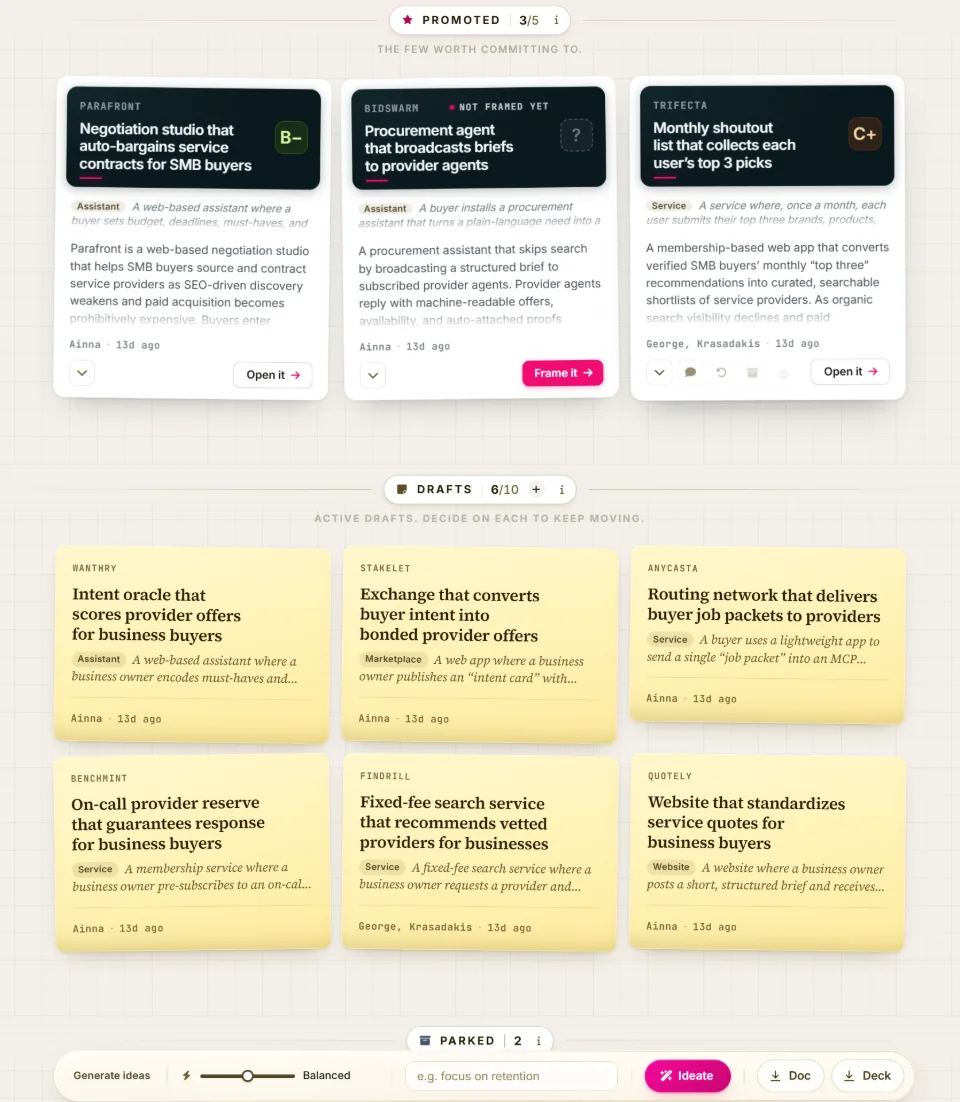
Shortlist the promising ones and park the rest. Each one you shortlist is framed in depth: its personas profiled, its market sized, its competitors mapped.
-
04
Graded, challenged, sharpened
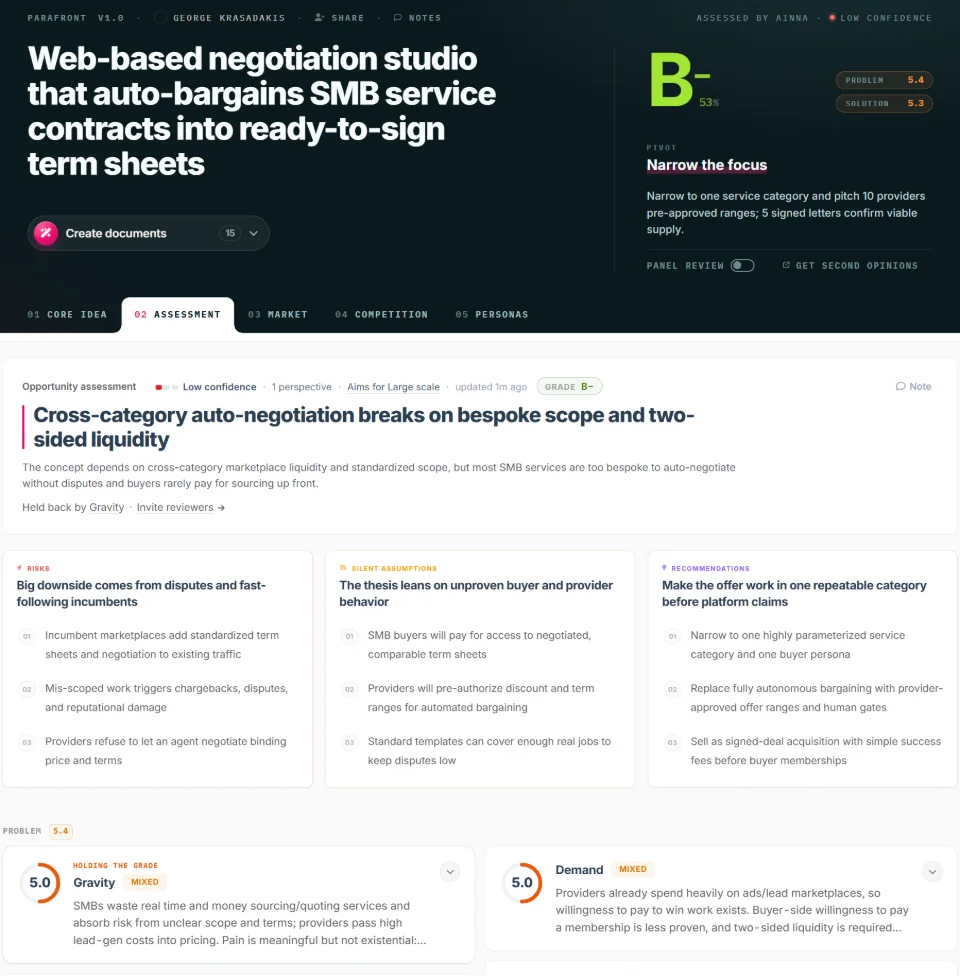
The Judge grades every concept on ten dimensions and names the one holding it back. The people you trust give their own view, blind to the Judge’s. Reframe, grade again, as many rounds as it takes.
-
05
A portfolio of opportunities
The opportunities that hold up under a rigorous, multidimensional assessment by AI and domain experts, ranked side by side. The ground for what you build next.
7 days free · No card
The Judge · opportunity assessment by AI and human experts
Is it worth the investment? Know before you commit.
The Judge grades every concept on ten dimensions, shows the reasoning in the open and names the one dimension holding the grade back. Then the experts you trust add their own view. Ainna is not on your side. It's on the evidence's side.
Yes, the Judge can give you a D
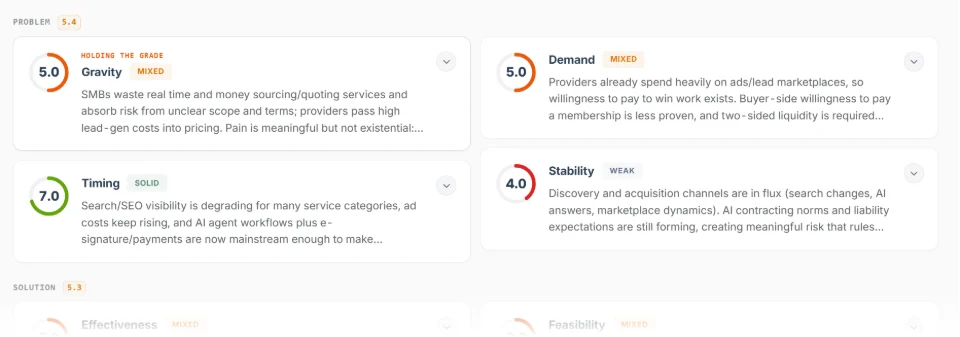
But this is good news. Ask an AI about your idea and the odds are it will congratulate you. Stanford measured it: production models affirm what a user wants to do 49% more often than a person would. The Judge grades the concept, shows its work, names the one dimension doing the damage, and tells you what would change it. A D is the most useful thing that can happen to an idea about to cost you six months.
Not your cheerleader.*
Our core principle
Not just human-in-the-loop. Human-at-the-core.
The human-in-the-loop principle puts a person at the end of the process, to monitor and approve what the machine decided. Our human-at-the-core thesis puts innovators at the centre of it: AI carries the volume and the speed; people bring the insight and the inspiration, and keep the judgment, the scrutiny and the decision. In Ainna, you shape the idea, the options and the agenda: Ainna asks what a sharp advisor would ask. You create the solution space: Ainna widens it. Your experts grade the concepts: blind to the Judge's score, with the same standing, disagreement shown and never averaged. And you decide. Ainna is your partner in the work, never the authority over it.
A panel you choose yourself, for the expertise they bring.
Cheng et al., Sycophantic AI decreases prosocial intentions and promotes dependence. Science, 2026. Stanford and Carnegie Mellon; 11 models.
AI PRD and pitch deck generator · from your own work
Ready to pitch? Yes, you are.
Not templates: finished documents, written for each opportunity from the work behind it, the framing, the market, the competitors and the Judge's reasoning. Twelve of them, from the problem to the build. A problem framing deck gets the problem agreed before anyone argues for a solution. The pitch deck makes the case to the people who fund it, and the social carousels take the idea to your network. The PRD and the FRS tell the team what to build and why, every requirement traced. All in PowerPoint or Word, yours to edit, and they can carry your logo.
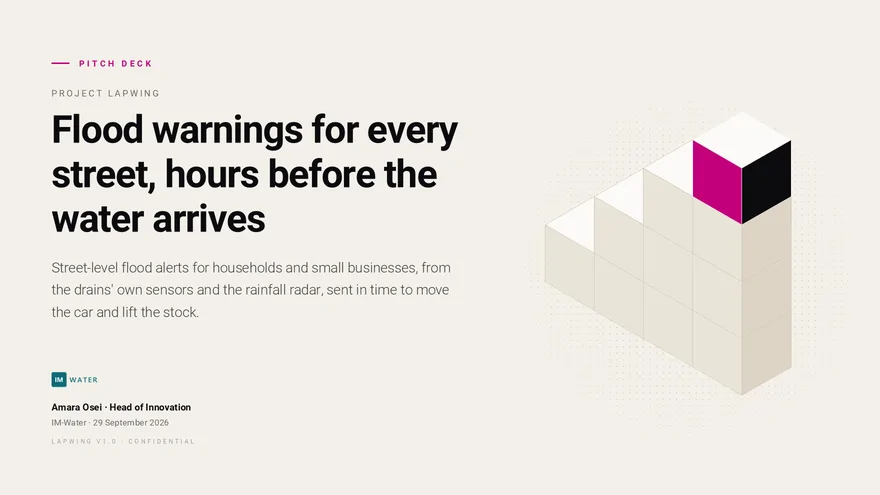 Pitch deckThe case, the market and the ask
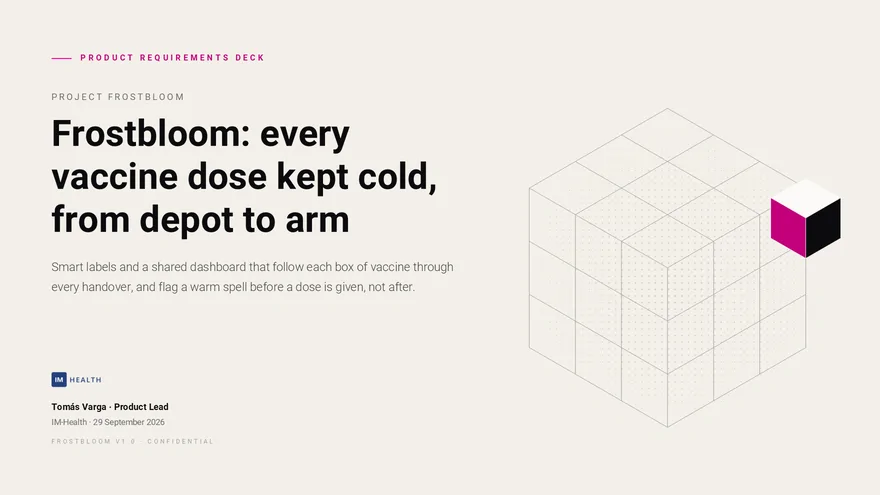 PRD deckWhat to build, for whom, and why
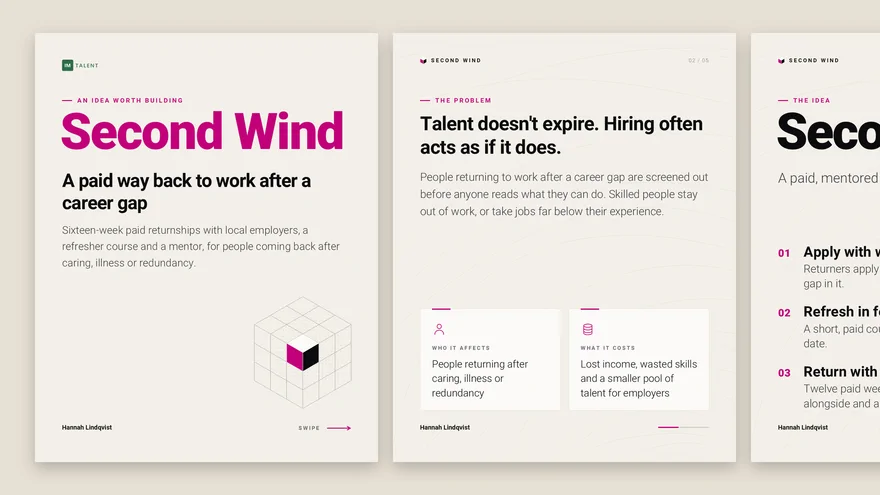 Social carouselsReady to post, for the idea and the problem
Samples made by Ainna for fictional concepts. IM-Water, IM-Health and IM-Talent are demo organisations (IM for Innovation Mode, the company behind Ainna), and the people named are invented.
Each one opens its own page, with sample pages. See all twelve together.
Pricing
Start free. Scale when you're ready.
7 days free, no card. Then choose a plan. Up to 20% less with annual billing.
Who it's for
Your next big thing.
Use it hard for a season, then go build. Bring your startup idea, or the problem that won't leave you alone. Ainna frames it, opens it wide and grades every concept before you spend a month on the wrong one. You leave with an MVP and a pitch deck that hold up, and a decision log from first idea to MVP, so months later you can still say why the product is shaped this way. Or with the pivot found while it was still cheap.
Ainna for Founders →Your team's next big thing.
Turn on the Market Radar and the team gets a standing feed of product opportunities, in your market, shaped by what is actually happening out there. Brainstorm against them with Ainna and with each other, frame what holds into opportunities, and rank them on the same ten dimensions. Repeat, and the work stops evaporating: it compounds into your Innovation Space.
Your company's next big thing.
Product innovation at company scale: an evolving network of every idea, opportunity and judgment in the organisation, each linked to the others it touches, so nothing good is lost when the workshop ends. Ainna builds it as you work: your cloud, your brand, everyone invited, and a Radar tuned to your agenda. Problems surface from the Radar and from your people, and every one is graded to the same standard by the Judge and by your Panel. Decisions get faster, budget follows evidence, and the organisation starts innovating as one.
- Every Opportunity graded by the Judge, with its market, competition and personas
- Documents: Product Requirements Document (PRD), Business Plan, Investor Pitch Deck and 11 more, under your own brand
- The Circle: anyone you trust reviews your idea through a private link, no account needed
- The Panel: experts you choose assess each idea independently, before they see the Judge's grade
- Documents: Jira Product Backlog, Product Requirements Document (PRD), Investor Pitch Deck and 13 more, under your own brand
- Pivot History: every version of each idea kept, so the whole team sees what changed
- Your cloud, your perimeter
- Your brand, on every screen
- Everyone included, not by the seat
- Market and Corporate Radar, tuned to your agenda
Questions
Everything you'd ask first.
What is Ainna, and who is it for?
Ainna is AI for brainstorming and evaluating product ideas: it helps product teams and founders decide what to build, and why, before anything is built. Bring an idea, a feature request or a problem, your own or one from Problem Radar, and Ainna works it with you: it frames it, brainstorms the alternatives, profiles the users, sizes the market, maps the competition, grades every concept on ten dimensions with the reasoning shown, and brings in the experts you trust. It keeps every pivot and writes the PRD, the functional specification, the architecture, the pitch deck and the one-pager.
Product managers use it to decide what to build next and make the case for it; product teams and heads of innovation for a steady flow of well-framed opportunities instead of a once-a-quarter scramble; founders to grade a concept before they commit six months to it. Organisations use its sibling product, Ainna Enterprise, the Opportunity Discovery System. Ainna is built by Innovation Mode Limited in Dublin, on The Innovation Mode methodology (Springer Nature).
How is Ainna different from Jira Product Discovery or Productboard?
They organise discovery; Ainna does the discovery work. Jira Product Discovery and Productboard help teams collect ideas and feedback, prioritise them and plan roadmaps, and research tools tell you what users said. Ainna works on each idea itself: it frames it, brainstorms the alternatives, sizes the market, maps the competition, grades every concept on ten dimensions with the reasoning shown, and brings your experts in to challenge the result. What survives becomes a PRD and, on Team (coming soon), a backlog of prioritised user stories ready to import into Jira. Many teams will use both: Ainna to decide what is worth building, their roadmap tool to plan and track it. The product discovery guide goes further.
How is Ainna different from ChatGPT or Claude?
A general-purpose assistant gives you ideas and prose, a small part of the work, then leaves you to be the strategist, the analyst and the reviewer. Ask it to size a market and you get plausible numbers with no method; ask for a competitive map and you get a list, not an assessment. And it is built to be agreeable: in a study published in Science in 2026, researchers at Stanford and Carnegie Mellon found that 11 leading AI models, including ChatGPT, Claude, Gemini and DeepSeek, affirmed users' actions 49% more often than people did (Cheng et al., Science, 2026).
Ainna runs the whole method. It frames the opportunity, sizes the market against a defensible model, grades the concept on a published framework with the reasoning shown, names the one dimension holding the grade down, brings the people you trust in to challenge the result, and hands you the PRD, the pitch deck and the one-pager, from one body of work. It is not on your side; it is on the evidence's side.
How are product managers using AI tools, and is Ainna an AI agent?
To research and write faster, and increasingly to think better. Product managers use AI to summarise feedback, scan competitors and draft PRDs. The bigger gain is in judgment: framing the problem sharply, comparing alternatives on the same criteria and pressure-testing a concept before the team commits.
That is what Ainna is built for: a team of AI agents with one job, deciding what to build. The Strategist frames the problem and the concept with you, the Judge grades every concept on ten dimensions with the reasoning shown, and research agents size the market, map the competition and profile the users. You stay in charge: every grade can be challenged with new evidence, and your experts give the human verdict, so an AI grade is never the last word. When a concept holds up, Ainna writes the PRD, the functional specification and the architecture.
How can a product team brainstorm product ideas with AI?
Start from a framed opportunity, not a blank page. Brainstorming Mode opens the solution space around it: it develops the alternatives you hadn't considered, keeps the rest as options, and works with you to turn the promising ones into concepts. Then the Judge grades each concept on the same ten dimensions, so the brainstorm ends in a ranked shortlist with the reasoning shown, not a wall of sticky notes. Your first idea is rarely the best one; this is how you find the one that is.
How do I evaluate or validate a product idea?
Bring a hunch, a feature request or a half-formed concept, and Ainna does the structured work: it frames the opportunity, brainstorms the alternatives, sizes the market, maps the competition, profiles the personas and puts the concept before the Judge, which returns a grade across ten dimensions with the reasoning shown, the one thing holding it back named, and the recommended next move.
An idea is worth pursuing when it solves an important problem for a real, reachable user, in a way you can deliver, with enough demand and strategic fit to matter, and the only way to know is to assess it honestly before you commit. The grade isn't the finish line: the experts you invite assess the same opportunity independently, you iterate as your thinking sharpens, and what survives becomes a defensible case. What doesn't fails here, where failure is cheap.
What is a product opportunity assessment, and how does the Judge grade?
A structured judgment of whether an opportunity deserves the team's time, made before anything is built. The classic form, Marty Cagan's, answers ten questions: the problem, the target market, its size, how success is measured, the alternatives, why you, why now, how you will reach the market, what is critical to success, and the recommendation. The Judge grades every concept on ten dimensions across two lenses, extended from the nine of the published Innovation Mode model: importance of the problem, strategic alignment, effectiveness of the solution, feasibility, ease of implementation, ease of operation, business impact, novelty and certainty of demand. Each score carries its justification, and the dimension holding the grade back is named.
And yes, it will tell you your idea is bad, if it is, with the reasoning, the one thing that would change the grade, and the risks and silent assumptions the concept rests on. Alongside, holder fit rates the opportunity against your Innovation Agenda: whether it matches the focus you have set and the assets you actually hold. The letter follows from the scores. The verdict (pursue, pivot, park or reconsider, or redirect when it doesn't fit your agenda) is a judgment, and you can appeal it with new evidence. Appeals are free, always.
How do you prioritise features and product ideas?
On the same criteria every time, with the reasoning written down. Prioritisation frameworks like RICE (reach, impact, confidence and effort) and MoSCoW (must, should, could, won't), or an impact and effort matrix, give a quick order, but the scores are guesses and the reasons stay in someone's head. In Ainna every concept is graded on the same ten dimensions, with the justification behind each score and the one dimension holding it back named, so your portfolio of ideas ranks itself and anyone can see why one comes first. On Team (coming soon), the work continues into a backlog of prioritised user stories, ready to import into Jira.
How do the experts I trust take part?
On the Panel. Co-founders, advisors, specialists, even target customers assess the same opportunity independently: they don't see the Judge's grade until they have given their own. Feedback intelligence sets their views beside the Judge's: where they agree, and where they don't, never averaged away.
It is the principle the product is built on: not human-in-the-loop, where a person checks what the machine decided, but human-at-the-core, where people do the work and the AI makes them better at it. The AI is the analyst and the honest second opinion; you and your experts decide. The Panel comes with Team (coming soon) and Enterprise; on Pro, the Circle brings in the people you trust through a private link.
Can Ainna write my PRD, and which other documents does it produce?
Yes. Ainna is an AI PRD generator with one difference: it writes from evidence, not from a template or a one-line prompt. It writes the PRD, a PRD deck and an executive brief from the opportunity you framed, the market you sized, the personas and the Judge's reasoning, then the functional specification and the architecture, so every document agrees with the rest of your work and is ready to hand to your engineers or an AI coding tool. On Team (coming soon), the backlog follows: your prioritised user stories, ready to import into Jira. The AI PRD guide shows how.
In all, it can produce twelve documents, in four parts: for the problem, a problem framing document and deck, a social carousel and the brainstorm's outcomes; for the idea, a one-pager, a carousel and the pitch deck; for the product, the PRD, a PRD deck and an executive brief; and for the build, a functional requirements specification and the system's architecture. Which ones you can create depends on your plan, and each one has its own page, with sample pages. They all come from one body of work, so the story stays consistent across every format, and everything exports as fully editable PowerPoint and Word files that are yours to keep and can carry your logo. Bring your own judgment to the numbers and claims, and it's ready for stakeholders.
Can I bring my own idea, or start from the Radar?
Either. Bring your own idea, feature request or problem, in a sentence or two, and Ainna starts from your words. What you bring is private to you and is never published. No idea yet? That's a good place to start: the strongest opportunities often begin as a problem with no solution attached.
Or start from Problem Radar. Ainna's Radar scans for problems worth solving, spotting some itself and finding others in public reporting, and frames each one to one standard; a few are framed by Ainna's innovation team from conditions most people will recognise. In every case, the team chooses and edits every problem before it is published. Every entry says which, and news-backed entries link the reporting they were drawn from. The Index is Ainna's own work: nothing on it comes from what users bring.
How do you write a problem statement as a product manager?
Say who has the problem, what it costs them and why now, and leave the solution out. A good problem statement is specific about the user and the situation, honest about how often it happens and what it costs, and silent about features. Ainna asks exactly these questions when you bring a problem, pushes back on the vague answers, and keeps the framed problem as the reference every concept is graded against. See a problem statement example.
What is a decision log in product management?
A running record of the significant product decisions, each with its reasoning and the evidence behind it. It stops teams relitigating settled questions and shows anyone, months later, why the product is shaped the way it is. Ainna keeps one as you work: every verdict, pivot and change of scope, with the reason, attached to the opportunity it belongs to.
What is an Innovation Agenda, and do I need one to start?
An Innovation Agenda is a clearly stated focus for innovation, linked to your strategy: the themes you will invest in, the outcomes you are after, and the targets that count. It is the reference every idea is measured against, which is what makes two opportunities comparable rather than two opinions.
You don't need one to start: bring a single problem and Ainna frames and grades it straight away. The agenda becomes useful once more than one idea is in play, because holder fit scores each opportunity against the focus you have set and the assets you hold. Ainna challenges and sharpens the agenda the way it challenges an idea, and it is versioned, so you can see which version an assessment was graded against.
How does pricing work, and can I try it for free?
Start with a free trial on a real problem of your own, with no credit card: the full strategic conversation and a real grade from the Judge with its reasoning. It isn't a demo on sample data. Pro adds the Circle for the people you trust and full document generation, for an individual; Team (coming soon) adds seats and a shared workspace, the Panel for your own experts, an Innovation Agenda every idea is graded against, the Market Radar tuned to your market and a ranked portfolio. Paid plans start at $99 per month, annual billing saves up to 20%, and there are no hidden fees and no lock-in; larger organisations move to Enterprise. Everything you created in your trial is still there when you subscribe.
An Opportunity is one problem taken all the way through: framed, opened, graded and documented. A Brainstorm is one round of opening the solution space against a framed problem. Your plan sets how many of each you can use, the paid allocations reset monthly, and refining or re-grading an Opportunity you've started never uses another. And with Ainna Fellows, bringing people into the work pays both ways: more Opportunities on your side, a head start on theirs; your invite link appears after sign-in.
Who owns what Ainna generates, and is my data used to train AI?
You do. The ideas, strategies, analysis and substance in everything Ainna generates belong to you, to use for your own business: investor pitches, internal alignment, engineering handoff. Downloaded files are yours to keep, whatever happens to your plan. The one boundary is the methodology itself: the frameworks and document structures embedded in the outputs remain The Innovation Mode's, so they can't be repackaged or resold as templates, and agencies producing client deliverables need a commercial licence.
Your content is never used to train AI models, never shared with other users, never sold, and never published. It is seen only by you, by your teammates when you make an idea discoverable or ask for their assessment, and by the people you invite to your Panel. Your account is hosted in EU data centres under GDPR. Generated documents aren't stored on our servers: each is rendered when you download it and can be regenerated any time the Opportunity exists. Your work stays in your account until you delete it; an account with no paid plan and no sign-in for 12 months is deleted after 30 days' notice. Export anytime, delete any idea in one click, close your account whenever you choose. Delete means delete.