

What is a problem framing document?
A problem framing document defines a challenge before anyone proposes a solution: who it affects, what it costs, the evidence, why now, and what solved would look like.
Also called: Problem framing, Problem definition document.
Why it matters
Most innovation fails at the problem, not the solution. Teams mix symptoms with causes and start building before they know who is affected and why it matters now, and they end up with good answers to the wrong question.
A framed problem gives a team one target to agree on. It is the first document in an idea's life, and every later one rests on it: the brainstorm, the one-pager, the pitch, the PRD.
“A real problem has a user, a moment and a cost. Without all three, it's a theme.” From the method of Innovation Mode 2.0
The four dimensions of a well-framed problem
Innovation Mode frames a problem from four sides before anyone proposes a solution. Each one has its place in Ainna's document.
- The environment. The who and the where: the people affected, the stakeholders, and the setting the problem lives in. In Ainna's document: the people and the setting.
- The dynamics. The when and the trend: how the problem emerged, how it is changing, and what has been tried. In Ainna's document: why now, and how people cope today.
- The current state. The what and the why: symptoms, impacts and root causes, with cause kept apart from effect. In Ainna's document: the current state.
- The ideal state. The vision: what solved looks like, measurably, without prescribing the solution. In Ainna's document: the ideal state, and how we would know it is solved.
Ainna adds two things to the method: the evidence, each item reported or assumed, with its source and date; and a grade for the problem.
The method as a template: Problem Statement Template, on theinnovationmode.com.
What's inside
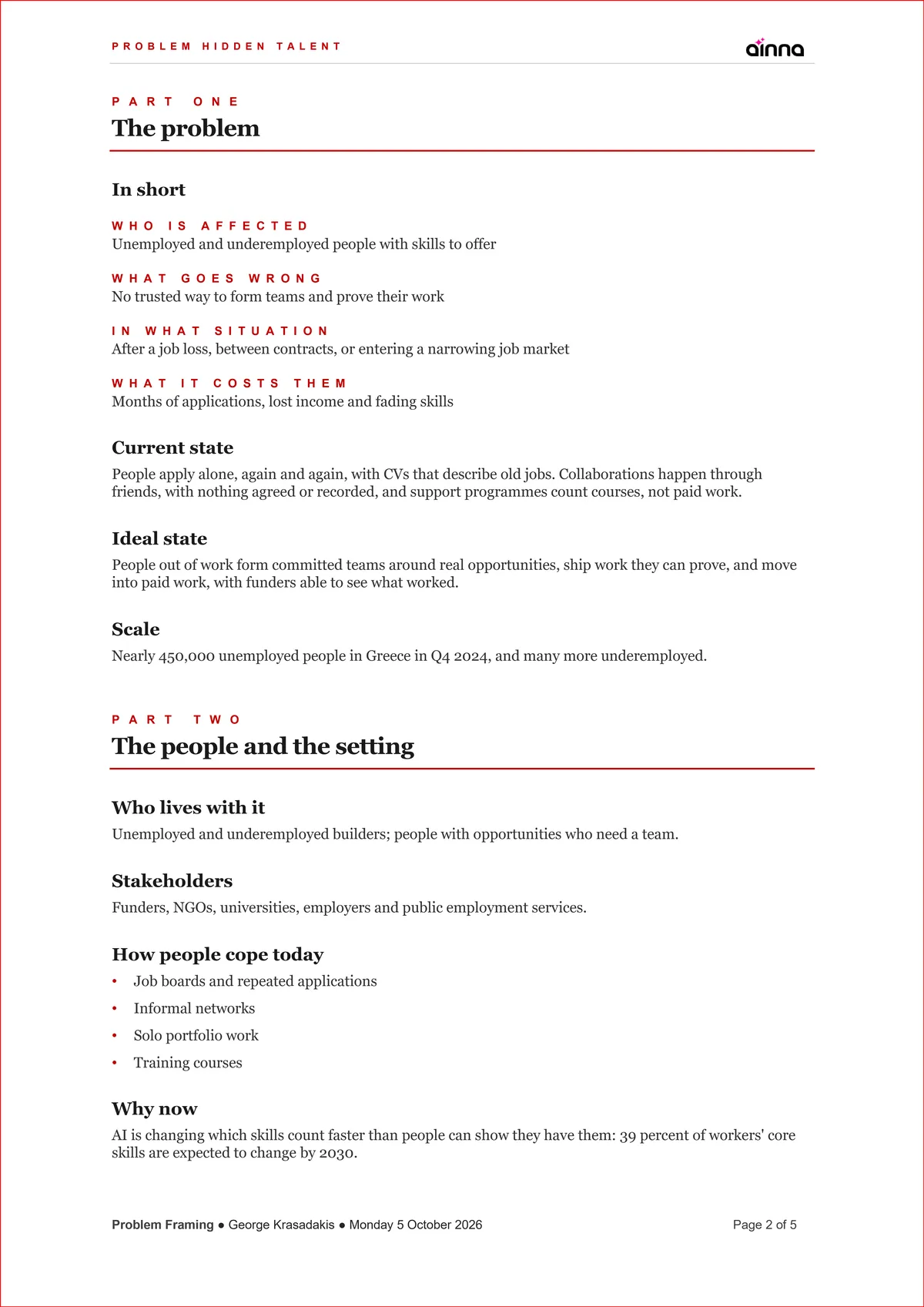
- In short
- Current and ideal state
- How people cope today
- Why now
- What solved looks like
- Open questions
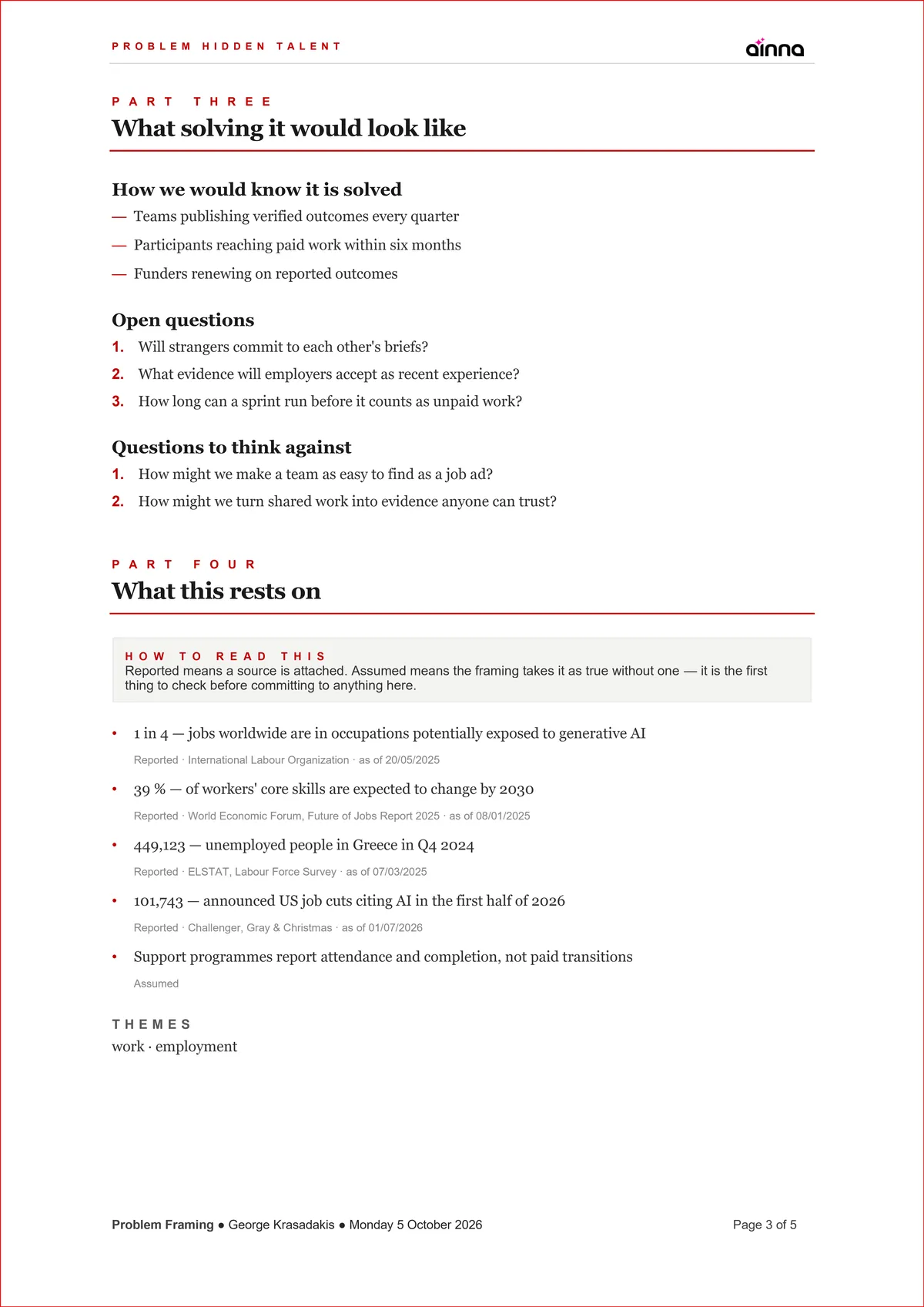
- The evidence, reported or assumed
- The grade
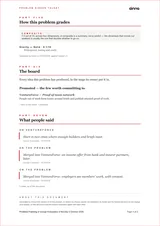
- The board, and what people said
Where it fits
It is distilled from the framing session, the evidence logged with its sources, the brainstorm board and what people said.
It leads to Problem Framing Deck, Problem Social Carousel, Brainstorm Outcomes Deck and Idea One-Pager.
Questions
How is a problem statement different from a project brief or a business case?
A problem statement defines the challenge and stops before any solution. A project brief plans an initiative already chosen: its objectives, scope, timeline and resources. A business case argues for investing in a solution, with its costs, returns and risks. The problem comes first; the brief and the business case follow once a direction is chosen.
What makes a problem well framed?
It names who is affected, at what moment and at what cost. It separates symptoms from root causes, says why the problem matters now, and describes the solved state without prescribing the solution.
Is a problem framing document the same as a problem statement?
The statement is its heart: a paragraph that says who is affected, what it costs and why now. The framing document adds the evidence behind it, how you would know it is solved, the questions still open, and the ideas already on the board.
How long should a problem framing document be?
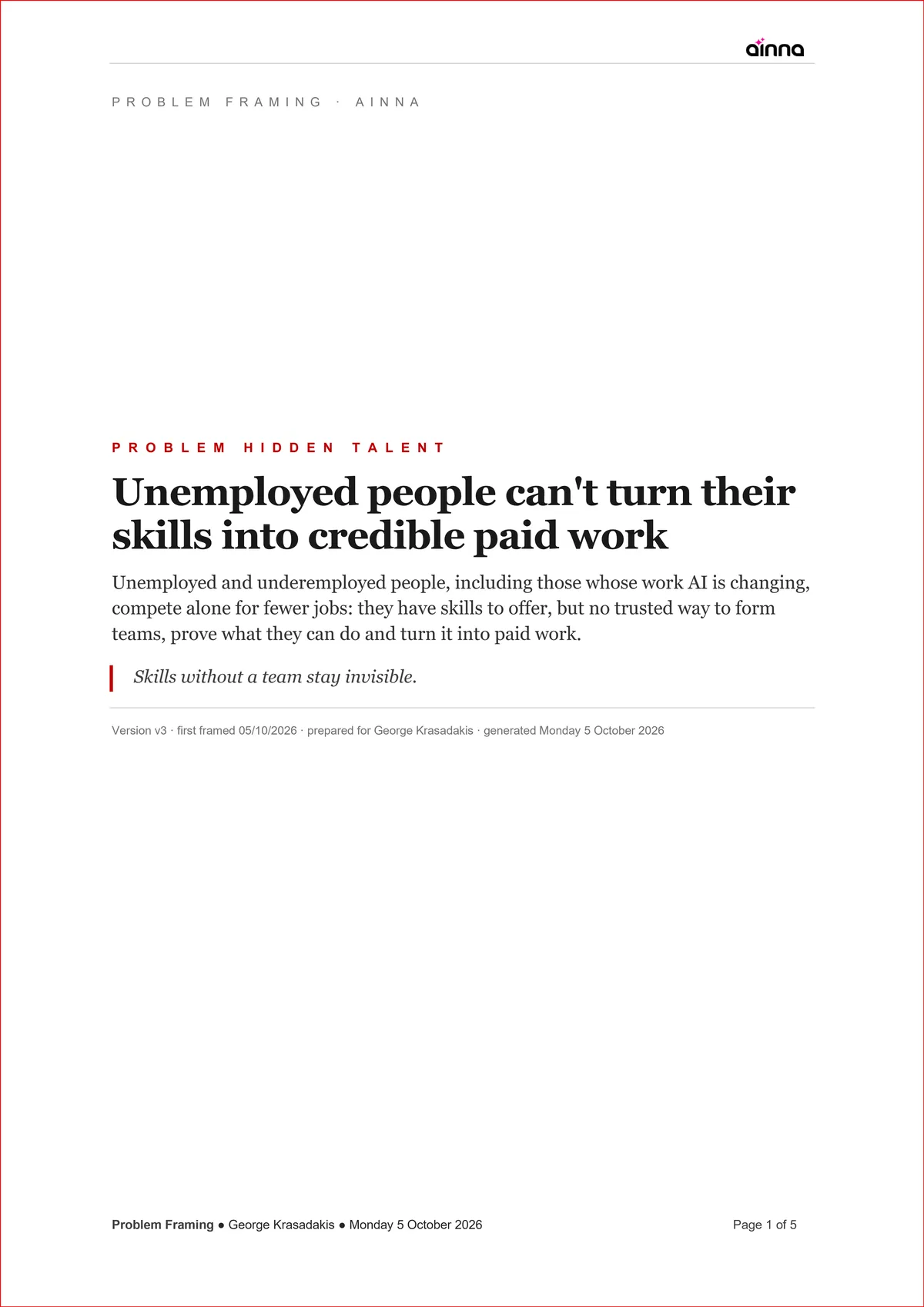
The statement fits in a few lines; the framing that supports it, a few pages. Ainna's runs to five, including the evidence and the brainstorm board.
Do the work in Ainna.
Ainna is where you frame a problem, explore ideas and test them against the evidence. When the work is done, this is how it is packaged: a problem framing document, written from your own analysis, about your own idea.
Which documents you can create depends on your plan.
Read next
- Guide: What Documents Do You Need for Product Discovery?
- Where VentureForce began: number 0032 on Problem Radar
- All twelve: the document examples, together