
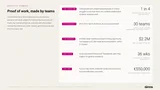
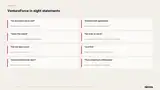

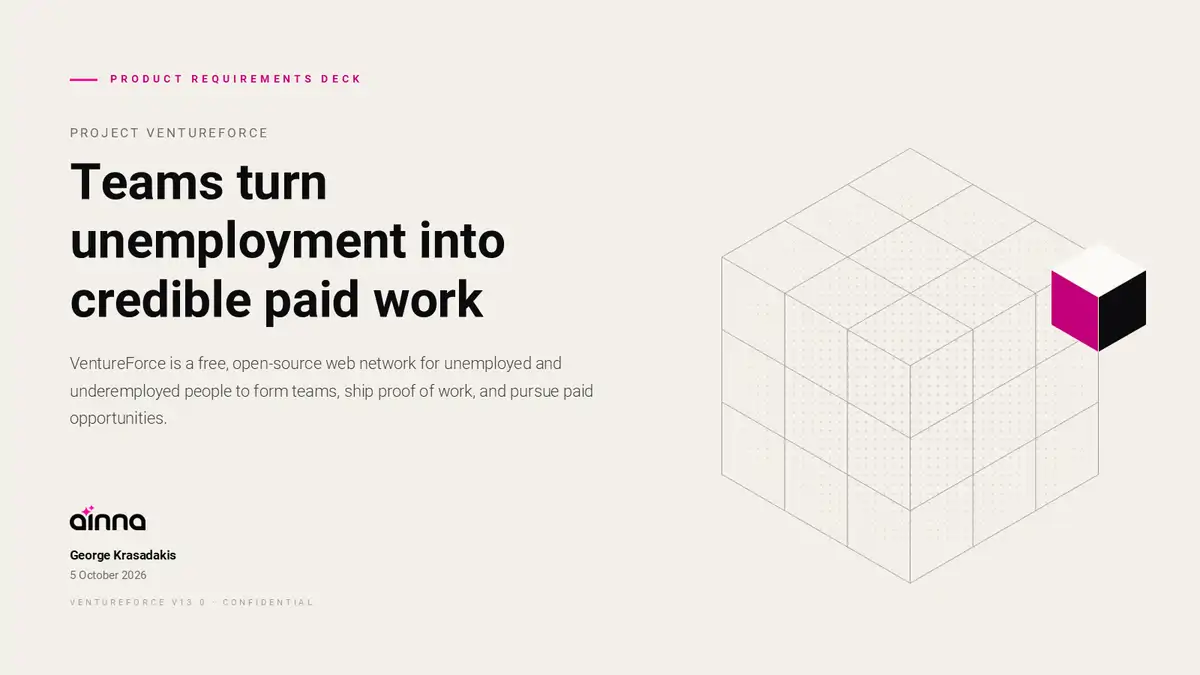
What is a product requirements deck?
A product requirements deck presents the PRD for alignment meetings, in four parts (discover, define, build and launch), with the requirements in an appendix.
Also called: Visual PRD, PRD deck, PRD presentation.
Why it matters
Decisions are made in meetings, not in documents. The deck carries the PRD's reasoning in a form a room can follow, part by part, and every slide traces back to the same analyses.
Four parts, from the opportunity to the market
The deck follows the product lifecycle of Innovation Mode 2.0.
- Discover. The problem, the users, the market and the competition, and the opportunity worth pursuing.
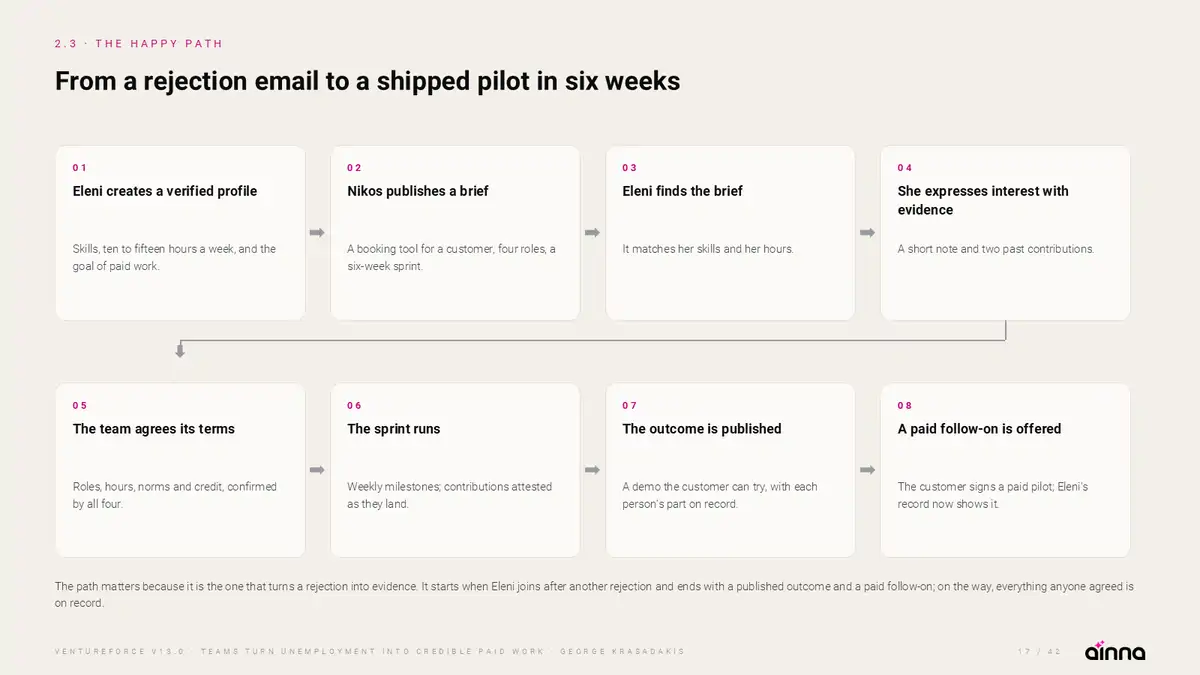
- Define. The product itself: the vision, the value proposition, the happy path, the MVP scope, and the business and revenue models.
- Build. De-risk it before any code: hypotheses, assumptions, risks, experiments, technology and the team.
- Launch. Go to market with intent: the strategy, the success metrics, growth, and the roadmap after the MVP.
The requirements and the sources follow in an appendix.
Prefer a template? See the PRD Toolkit on theinnovationmode.com.
What's inside, part by part
- Executive summary
- The whole case, on one slide.From the six analyses.
- Discover: the need, the users, the market, the competition
- Why the opportunity is real.From the personas, the market sizing and the competitive map.
- Define: vision, value, the happy path, the MVP, the business model
- What the product is, and what the first release holds.From the product definition and the business plan.
- Build: hypotheses, risks, experiments, technology, the team
- How it is de-risked before any code.From the delivery plan.
- Launch: go-to-market, growth, the ask
- How it reaches the market.From the business plan.
- Appendix: requirements and sources
- Every requirement, and where every figure came from.From the product definition and the sources.
Where it fits
It is distilled from the same six analyses as the PRD, set as slides.
It comes after the Product Requirements Document (PRD), and leads to the PRD Executive Brief.
How the PRD deck compares with related documents
| Document | Answers | Read by | Length |
|---|---|---|---|
| Pitch Deck | Why invest in it, or sponsor it | Investors and sponsors | 16 slides |
| Product Requirements Document (PRD) | What to build, and why | Product, engineering, design and leadership | About 20 pages |
| Product Requirements Deck | The PRD, for the alignment meeting | The room that has to agree | 42 slides in four parts |
| PRD Executive Brief | The case, for the meeting that decides | Executives and sponsors | 14 slides |
| Functional Requirements Specification (FRS) | Exactly how the system must behave, testably | Engineers and testers | 13 pages |
Questions
Can AI turn a PRD into a deck?
Ainna does not summarise a document into slides: the deck is written from the same analyses as the PRD, so the two always agree.
What is a visual PRD?
A PRD set as slides, for alignment and gate reviews: the same content as the written PRD, in the order a meeting needs.
Deck or document?
The document is the reference; the deck is for the meeting where the decision is made.
Yours comes from the work, not from a prompt
- It is set from the same six analyses as the PRD, so the deck and the document always agree.
- The concept behind it has been graded by the Judge, with the reasoning shown, and can be put to the people you trust.
- Every figure carries its source or its method, and estimates are labelled as estimates.
- Where a piece of the work is missing, the document leaves it out instead of filling it with plausible text.
- It is yours to edit as a PowerPoint deck, and it can carry your logo.
Create yours in Ainna.
Ainna is where you frame a problem, explore ideas and test them against the evidence. When the work is done, Ainna packages it as a product requirements deck like this one: from your own analysis, about your own idea.
Which documents you can create depends on your plan.
Read next
- Guide: What is a Visual PRD?
- The problem behind this sample: no. 0032 on the Problem Radar
- See all twelve document examples