
Skip to content

Ideas are cheap. Problems are valuable.

Start with the problem. Opportunities follow.

AI made building cheap. It also made judgment more critical than ever. Ainna is where a problem gets framed properly, opened up, graded against a published framework, and put to the people whose judgment you trust, until you know whether it's worth your next six months.

Free to start · No credit card

World Radara live stream of problems worth solvingAll 20 on the Index ↓
Media

Unverifiable AI answersReaders can't check the AI answer they were given

Use of AI assistants for news is rising while stated trust in them stays very low: people take answers from a source they openly doubt, because it is faster than the alternative. The gap is not ignorance; it is the absence of anything that lets a reader check an answer at the moment they receive it, without abandoning it and starting a separate search.

For whomAnyone getting news through an assistant · publishers whose work is summarised without attribution · educators teaching source literacy
Discover more

Building got free.
Judgment didn't.

For decades the hard part of launching something new was building it. That's over. AI creates the app, makes the deck, ships the prototype. Building digital products got cheaper. What didn't get cheaper is knowing which problem deserves the next six months of your life. And the tools out there made that harder: general-purpose AIs agree with whatever you type, AI product builders build anything you ask and never ask why, while consultants charge six figures to tell you in September what was true in March. So teams have never had more ideas, and never shipped fewer things that mattered.

Building the wrong thing
has never been easier.

Meet the Judge · Ainna's evaluator

So we invented the Judge.

Built to grade, not to please. Ten dimensions, one letter, the reasoning in the open, and the one dimension holding the grade named. Ainna is not on your side. It's on the problem's side.

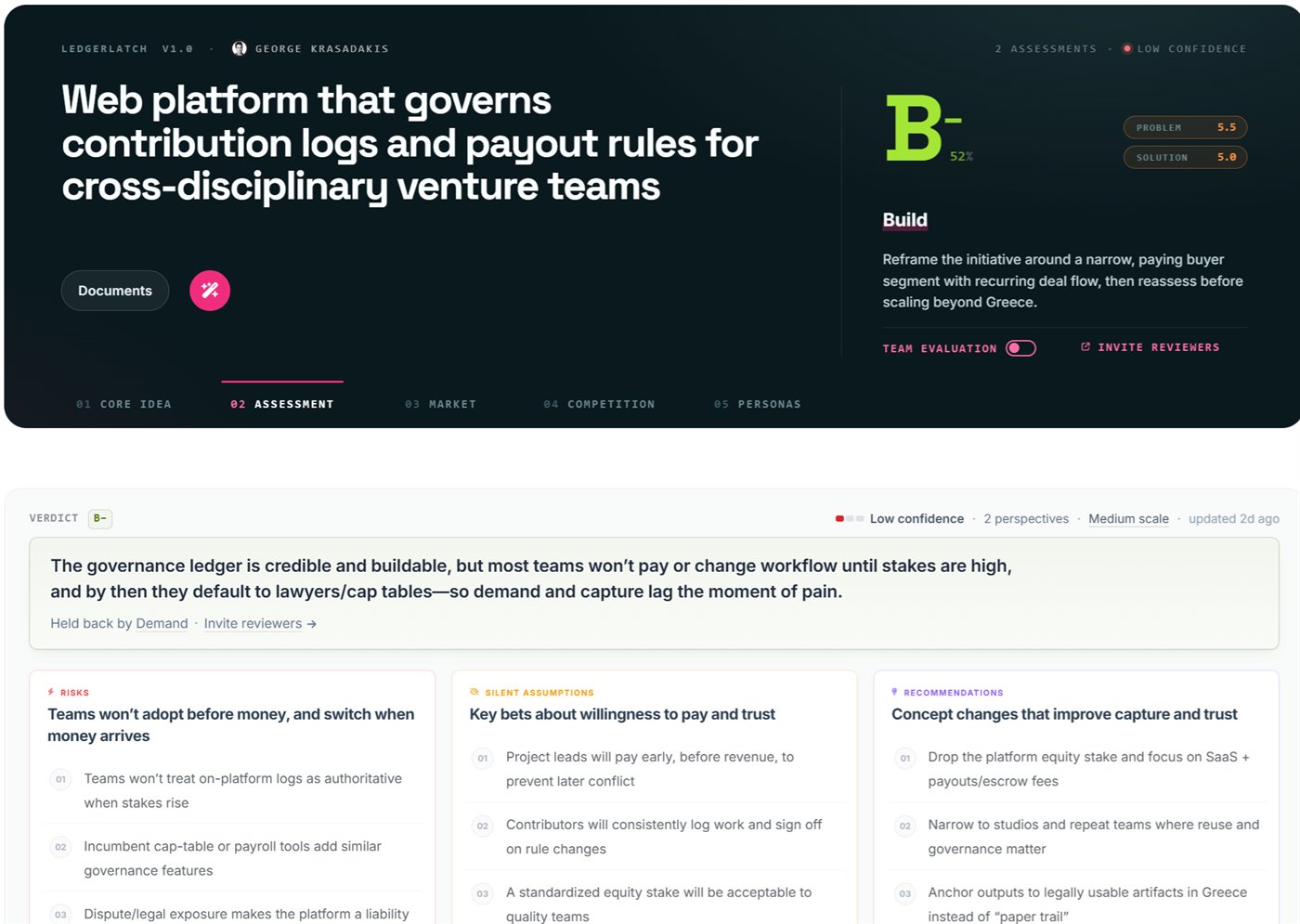
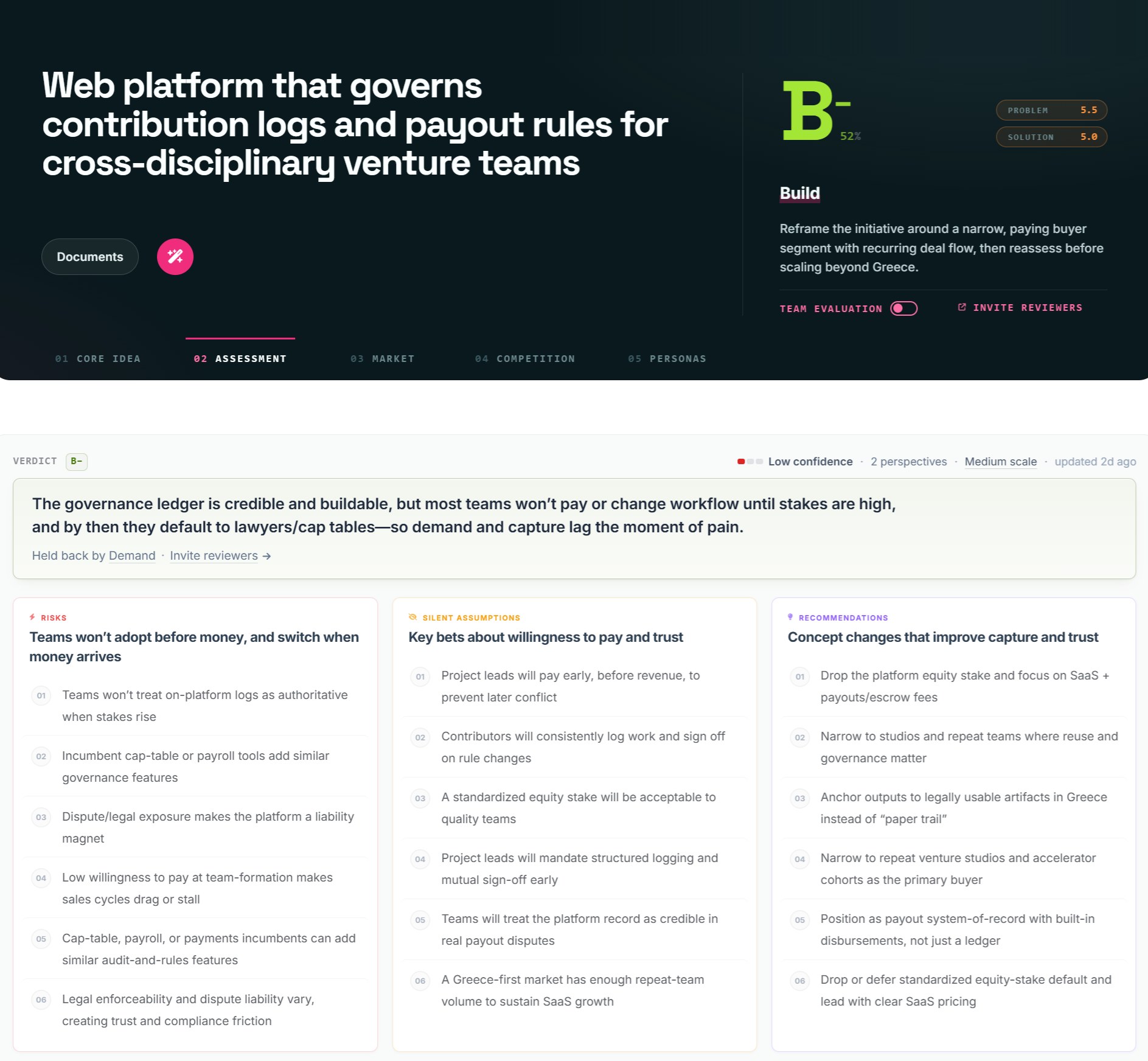
An Opportunity in Ainna · the header, the verdict, the risks, the assumptions, the recommendations
An Opportunity in Ainna: the concept's title, a B minus grade at 52 per cent with the problem and solution scores, the Judge's recommendation, and beneath them the verdict with its reasoning and three columns of risks, silent assumptions and recommendations

How it works

From a problem to a ranked portfolio of solutions.

Every problem goes through the same four moves, so every opportunity that comes out is framed the same way, graded the same way, and comparable with the rest.

01 · Frame the problem

Name the problem, the need, the gap.

Bring a sentence. Ainna asks what a sharp advisor would ask: who it hurts, what it costs, why now. Then it pushes back on the weak answers until the problem holds on its own, before anyone proposes a solution.

02 · Brainstorm

Fill the solution space.

Ainna develops the alternatives you hadn't considered, keeps the rest as options, and works with you to turn the promising ones into concepts worth grading. Your first idea is rarely the best one. This is how you find it.

03 · Assess with the Judge

Get a grade, and the reason for it.

The Judge grades each concept across ten dimensions using a scoring model built on a published framework, shows the reasoning behind every score, and names the one thing holding it back. Reframe it to fix what it named, and grade it again. As many rounds as it takes, always free.

04 · Assess with domain experts

Invite the people you trust.

Bring in advisors, domain experts, or the customers you're building for. Each assesses independently: they won't see the Judge's grade until they've given their own. Where they disagree, Ainna shows you the disagreement instead of averaging it away.

Inside the brainstorm

Your first idea gets company.

Ask for as many ideas as you want against your framed problem. Every round brings fresh seeds for you and your team to judge, and Ainna learns from what you reject as much as from what you promote. Pick one and frame it as an opportunity, with the market and the competition mapped.

Every graded concept lands in your portfolio, ranked against the rest on the same ten dimensions: one venture's alternatives, or a whole team's quarter. What comes out: a framed opportunity, a grade with its reasoning, the personas, a market size you can defend, the competitive map, and the documents to carry it. Or a clear no, three weeks in, not three quarters.

Free to start · No credit card

The board · promoted, drafts, parked
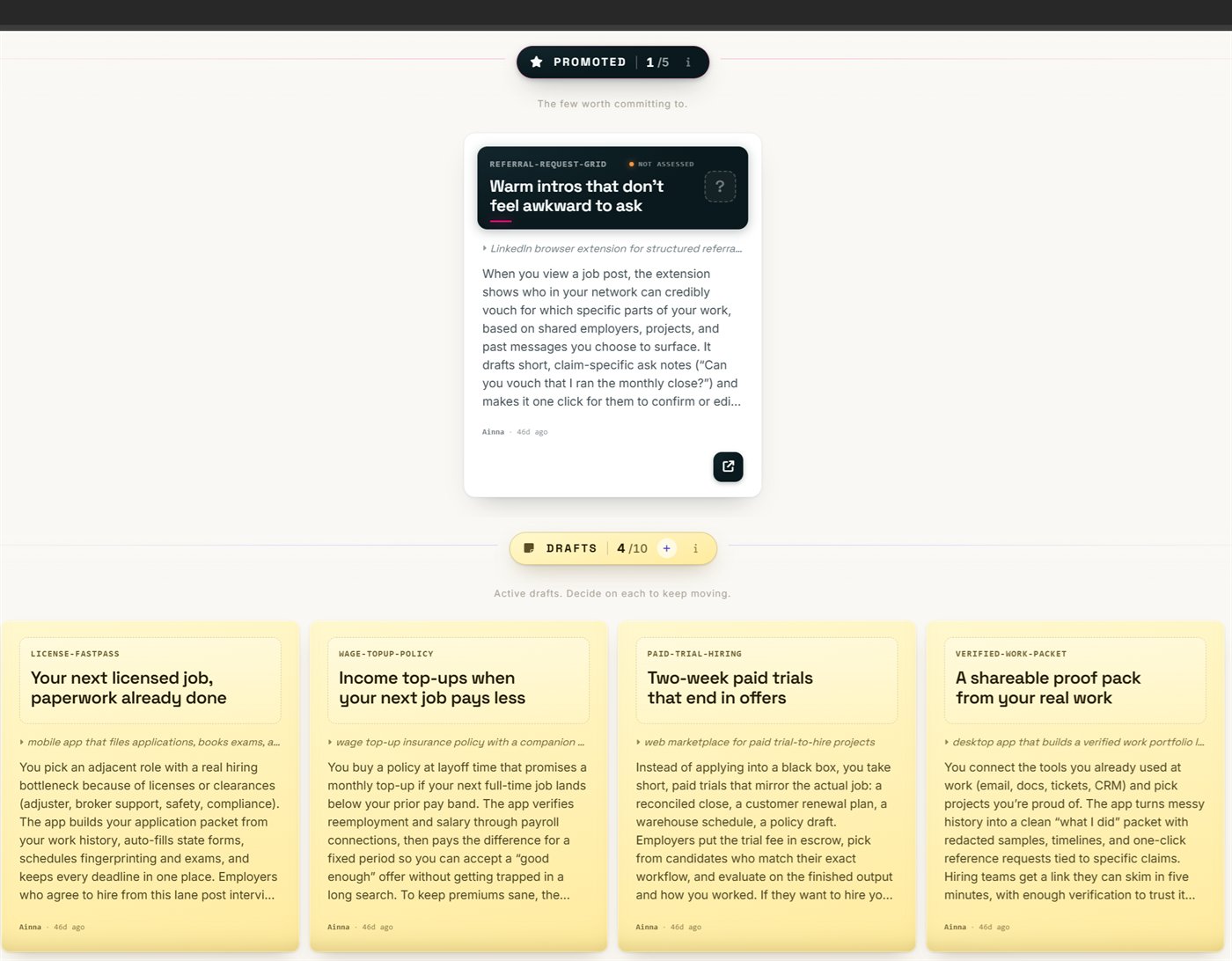
The board of generated concepts: one promoted, four drafts waiting for a decision, none parked

The Judge

Yes, the Judge can give you a D

But this is good news. Ask ten AIs about your idea and nine will congratulate you. Stanford measured it: production models affirm what a user wants to do 49% more often than a person would. The Judge grades the concept, shows its work, names the one dimension doing the damage, and tells you what would change it. A D is the most useful thing that can happen to an idea about to cost you six months.

Not your cheerleader.

Sycophancy in production language models. Stanford, 2025. 11 models, 11,000+ scenarios.

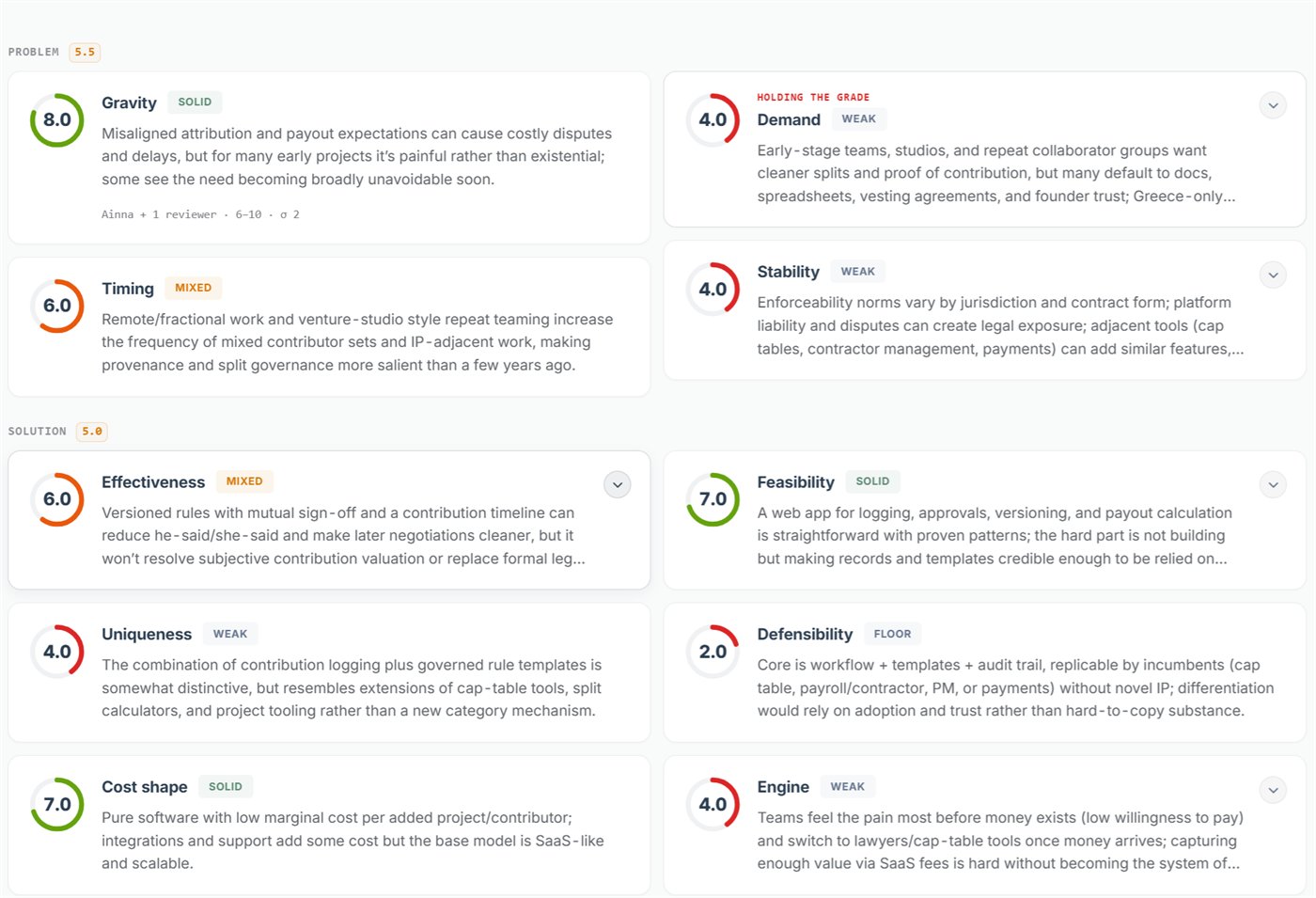
Ten dimensions · the one holding the grade, “certainty of demand”
The Judge's scorecard: each dimension scored with its reasoning, Demand marked weak and flagged as holding the grade

Who it's for

Founder, product team, or head of innovation?

Ainna adapts to each, with the right tools for the job: the market it watches, the agenda it grades against, and whose judgment sits on the Panel.

Founders

One problem, taken all the way to an MVP.

Use it hard for a season, then go build. Bring the problem that won't leave you alone. Ainna frames it, opens it wide and grades every concept before you spend a month on the wrong one. You leave with a case that holds and a decision log from problem to MVP, so months later you can still say why the product is shaped this way. Or with the pivot found while it was still cheap.

Ainna for Founders →
Teams

A shared Innovation Space that evolves.

Turn on the Market Radar and the team gets a standing feed of problems worth solving, in your market, shaped by what is actually happening out there. Brainstorm against them with Ainna and with each other, frame what holds into opportunities, and rank them on the same ten dimensions. Repeat, and the work stops evaporating: it compounds into your Innovation Space.

Ainna for Teams →
Organisations

The Innovation Graph, your most valuable asset.

An evolving network of every problem, idea and judgment in the organisation, each linked to the others it touches, so nothing good is lost when the workshop ends. Ainna builds it as you work: your cloud, your brand, everyone invited, and a Radar tuned to your agenda. Problems surface from the Radar and from your people, and every one is graded to the same standard by the Judge and by your Panel. Decisions get faster, budget follows evidence, and the organisation starts innovating as one.

Ainna for Organisations →

Our core principle

Not just human-in-the-loop.Human-at-the-core.

The human-in-the-loop principle puts a person at the end of the process, to monitor and approve what the machine decided. Our human-at-the-core thesis puts innovators at the centre of it: AI carries the volume and the speed; people bring the problem and the inspiration, and keep the judgment, the scrutiny and the decision. In Ainna, you shape the problem, the ideas and the agenda: Ainna asks what a sharp advisor would ask. You create the solution space: Ainna widens it. Your experts grade the concepts: blind to the Judge's score, with the same standing, disagreement shown and never averaged. And you decide. Ainna is your partner in the work, never the authority over it.

A jury you choose yourself, for the expertise they bring.

Verdict · two perspectives · reviewers invited
An opportunity's verdict card with two perspectives, the sentence that holds it back, and the risks, assumptions and recommendations beneath

When you pitch it

Your opportunity, presented properly.

Nothing gets built until the people around it agree, and agreement is won with documents good enough to be read without you there. When the case holds, Ainna writes the whole set in about a minute, from the pitch deck to the problem framing. All of it comes out of the work you have already done, carries your branding, and stays yours to edit.

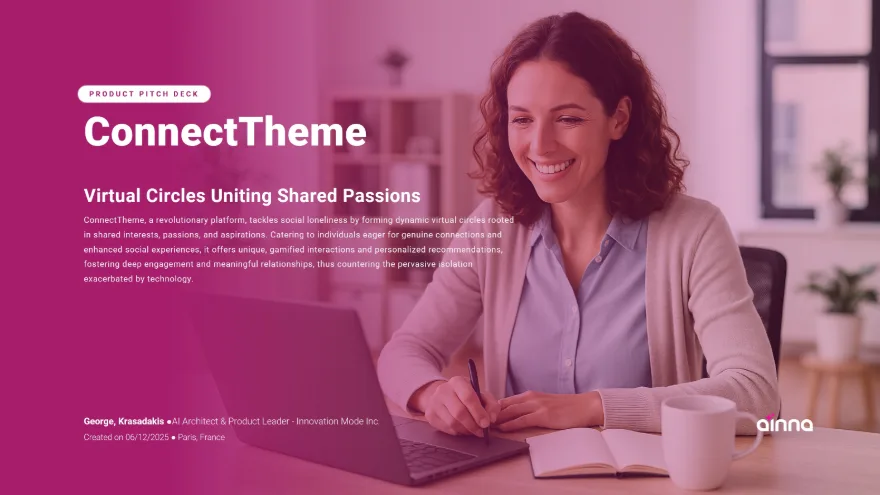
Cover slide of a generated pitch deckPitch deckBuilt from the case · your branding
Roadmap slide from a generated PRD deck: discover, define, build, launchPRDDiscover · define · build · launch
Problem analysis slide from a generated deckProblem analysisWhat's wrong, and for whom

Shown above: real slides Ainna created for problems we publish openly.

Made from your work, not around it.

Every document is built from work already done on your opportunity: the problem you framed, the market sizing, the competitive map, the Judge's reasoning. Nothing to fill in, nothing to invent, and what comes out is something you will be glad to put your name on.

The Method

Grounded in a published methodology.

Assessing an opportunity is not a general-purpose task. It takes a position on what makes a problem worth solving and which evidence counts. Ainna is built on The Innovation Mode, a methodology published by Springer Nature in 2020 and rebuilt for the AI era in 2026, reflecting twenty-five years of designing products and innovation programmes. Every question Ainna asks, every grade it gives and every challenge it raises comes from that published framework, and you can go and read it.

PublishedTwo editions. Springer Nature, 2020; rewritten for the AI era, 2026.
TaughtOn the syllabus at top universities.
PractisedTwenty-five years of designing products and innovation programmes.
LiveMarket signals and reporting, listened to continually; 20 problems framed by the same method so far.

Pricing

Start free. Scale when you're ready.

No card, no time limit. Up to 25% less with annual billing.

Start here
Starter For founders testing an early bet, students, and anyone trying Ainna on a real problem
Free · No credit card · No time limit 2 fully framed Opportunities a month: verdict, reasoning, and the path to yes
  • The Judge's full verdict: the reasoning trail and the path to yes
  • Documents: Idea One-Pager and Problem Framing Document
Frame your first Opportunity
Pro For PMs owning products, founders gone full-time, and solo operators running the cycle alone
$99 / month 15 fully framed Opportunities a month, unlimited re-assessment: the score moves when the evidence does
  • Re-assessment never metered: every verdict keeps its history, so you see what moved the score
  • Documents: Pitch Deck, Idea One-Pager and Problem Framing Document and 3 more
Start the cycle
Team For innovation leads, senior PMs managing multiple bets, and portfolio owners
$699 / month · 10 seats 100 fully framed Opportunities a month, pooled across 10 seats, one shared memory of every verdict and pivot
  • The Market Radar, tuned to your market, feeding problems worth solving
  • Documents: Pitch Deck, Idea One-Pager and Problem Framing Document and 5 more
  • One flat price across 10 seats, no seat arithmetic
Bring the team
Enterprise For innovation centres, corporate venture teams and innovation leaders
Contact us Custom pricing, request a quote Innovation takes inspiration. Being innovative takes a system.
  • Your cloud, your perimeter
  • Your brand, on every screen
  • Everyone included, not by the seat
  • Market and Corporate Radar, tuned to your agenda
Ainna for Organisations →

Questions

Everything you'd ask first.

What is an AI-native innovation system?

An AI-native innovation system runs innovation as a continuous function rather than an occasional event: AI agents listen for problems, frame them, grade the opportunities and develop the ones that earn it, across a whole organisation if you want. It covers the three things every innovation programme needs: opportunity discovery (turning problems and market signals into framed, graded opportunities), assessment (testing them against evidence and independent judgment) and realisation (building the ones that hold).

Ainna is one, built on The Innovation Mode methodology. Anyone can bring a problem or a rough idea; the Judge grades the concept against a published framework and shows its reasoning; the people whose judgment you trust sit on the Panel; and the strongest opportunities surface into a portfolio, each with the deck, PRD and one-pager attached. It isn't a chatbot and it isn't a slide generator. It's the system that turns raw thinking into decisions you can defend.

Who is Ainna for?

Anyone who has to turn an idea into a decision someone will act on, and any company that wants to innovate faster than it used to. Founders grading a concept before they commit six months to it. Product managers building the case for what to build next. Heads of innovation who need a steady flow of well-framed opportunities instead of a once-a-quarter scramble.

What unites them is the same need: rigorous thinking at speed, without a six-figure consulting budget or weeks of waiting. Ainna scales from one person with one problem to an organisation running innovation as a function.

What if I don't have an idea yet?

Good. Start with a problem instead: one from the Index, or one of your own. The strongest opportunities often begin as a problem with no solution attached.

Where do the problems come from?

From the World Radar. Ainna listens to public reporting, continually, and frames the problems worth solving to one standard; some are framed by Ainna's innovation team from conditions most people will recognise. Every entry says which, and news-backed entries link the reporting they were drawn from. Never from users: what you bring to Ainna is private to you and is never published, not on the Index, not anywhere.

How do I turn a rough idea into a validated business opportunity?

You start a conversation and the system does the structured work. Bring a hunch, a problem or a half-formed concept: Ainna frames the problem, opens the solution space, sizes the market, maps the competition, profiles the personas and puts the concept before the Judge: a grade across ten dimensions with the reasoning shown, the one thing holding it back named, and the recommended next move. What took an innovation team weeks takes minutes.

The grade isn't the finish line. The experts you invite assess the same opportunity independently, you iterate as your thinking sharpens, and what survives becomes a defensible case, with the pitch deck, PRD and one-pager to carry it. What doesn't survive fails here, where failure is cheap.

How does the Judge grade an opportunity?

Every concept gets a grade built from ten dimensions across two lenses, one for the problem and one for the solution, each scored with its justification, so the letter always comes with the reasoning behind it, and the single dimension holding the grade back is named. Alongside, holder fit rates the opportunity against your Innovation Agenda: whether it matches the focus you have set and the assets you actually hold.

The model evolved from the assessment model published in The Innovation Mode, which grades on nine dimensions; what runs in Ainna goes considerably further at ten across two lenses, and it is configurable: a product team and an IP team can weight the dimensions differently, because what matters depends on the decision you're making. The letter follows from the scores. The verdict (proceed, reframe, or stop) is a judgment, and you can appeal it with new evidence. Appeals are free, always.

Will Ainna tell me my idea is bad?

Yes, if it is. You get the reasoning, and the one thing that would change the grade. An encouraging answer would be worth nothing to you.

How do I know if a product idea is worth building?

An idea is worth building when it solves an important problem, for a real and reachable user, in a way you can actually deliver, with enough demand and strategic fit to matter, and the only way to know is to assess it honestly before you commit. Many ideas fail not because they were bad, but because they were never properly framed, or were judged in the wrong context by the wrong people.

Ainna gives you that honest read fast: the problem framed, the market sized, the competition mapped, the concept graded across ten dimensions plus fit to your Innovation Agenda, then the people you trust weigh in. You get a clear signal: take it forward with evidence behind you, or pivot before you've spent real resources on the wrong bet.

How does Ainna work with the experts I already trust?

The trustworthy unit isn't the AI alone; it's Ainna plus the people you bring. Not human-in-the-loop, where a person checks what the machine decided: human-at-the-core, where the person does the work and the AI makes them better at it. You frame the problem, you open the solution space, your experts grade the concept, you decide.

The Panel is how they take part: co-founders, advisors, specialists, even target customers assess the same opportunity independently: they don't see the Judge's grade until they have given their own. Where their judgment and the Judge's diverge, Ainna shows the disagreement rather than averaging it away. The AI is the analyst and the honest second opinion; you and your experts are the decision-makers. The Panel comes with Pro, Team and Enterprise.

What is agentic AI for innovation, and what can it do today?

Agentic AI for innovation means AI that doesn't just answer prompts but acts: perceiving signals, making assessments and taking steps through the innovation process on its own. Applied to a company, it can listen continually for problems, frame and grade opportunities as they arrive, orchestrate independent assessments and route the strongest concepts to the right team, always on instead of waiting for the next workshop.

Inside Ainna this is what runs today: the World Radar listens to public reporting and frames what it hears; the Judge grades each concept against a published framework and writes its narrative; AI personas pressure-test an idea from an investor's or a customer's point of view; and the system shows where assessments disagree so people can resolve it. The agents handle the scale and the speed. People decide what's worth fighting for.

How is Ainna different from ChatGPT or Claude?

A general-purpose assistant is one small piece of the puzzle. It gives you ideas and prose, a small part of the work, then leaves you to be the strategist, the analyst, the formatter and the reviewer. Ask it to size a market and you get plausible numbers with no method; ask for a competitive map and you get a list, not an assessment. And it tends to agree with you.

Ainna is an innovation partner, not an assistant, and it runs the whole method. It frames the problem, opens the solution space, sizes the market against a defensible model, grades the concept on a published framework with the reasoning shown, maps the competition, profiles realistic personas, brings the people you trust in to challenge the result, and hands you a branded pitch deck, PRD and one-pager that are yours to keep, from one body of work, in minutes. Generic AI reacts to your prompts. Ainna is not on your side; it's on the problem's side.

What is the Innovation Mode methodology?

The Innovation Mode is a methodology for running innovation as a disciplined, repeatable function: from spotting problems worth solving, to assessing the opportunities with evidence, to building the ones that earn it. It was published by Springer Nature in 2020 and rewritten for the AI era in 2026, and it is the framework Ainna is built on rather than a thin layer over a language model.

In practice it gives the work a backbone: a structured way to frame problems, a multi-dimension model for grading opportunities, the human-at-the-core principle so AI sharpens judgment instead of replacing it, and a portfolio view where the strongest ideas compete on consistent criteria. Anyone can wrap an AI in a prompt. A published innovation system is what makes the output rigorous, and hard to replicate.

What is the Innovation Graph?

The Innovation Graph is the central innovation store in The Innovation Mode methodology: an evolving network of problems, ideas, assessments, insights and market intelligence, where every item is linked to the others it touches. Ideas from every source live in it with their attribution and provenance, de-duplicated and framed the same way, so they stay discoverable long after the session that produced them.

The links are what make it a graph rather than a database. AI maintains them from the semantic relationships between items: one idea extends another, two overlap far enough to be duplicates, two compete by solving the same problem differently, or two complement each other by addressing different parts of it. That structure is what lets an idea from a January brainstorm surface again in a March hackathon, and what lets AI propose combinations nobody thought to look for. It is how innovation stops being episodic and starts accumulating.

What is an Innovation Agenda, and do I need one to start?

An Innovation Agenda is a clearly stated focus for innovation, linked to your strategy: the themes you will invest in, the outcomes you are after, and the targets that count. It is the reference every idea gets measured against, which is what makes two opportunities comparable rather than two opinions.

You do not need one to start. Bring a single problem and Ainna will frame and grade it straight away. The agenda becomes useful the moment you have more than one idea in play, because holder fit scores each opportunity against the focus you have set and the assets you actually hold. Ainna challenges and sharpens the agenda the same way it challenges an idea, and it is versioned, so you can see which version an assessment was graded against.

Can the Radar listen for my market, or my company?

Yes. It's one instrument at three scopes. The World Radar is what you see on this page, free. The Market Radar, in the Team plan, is tuned to the sectors, themes and geographies you set, and lands what it finds in your portfolio, graded. The Corporate Radar, in Enterprise, is tuned to your innovation agenda and fed by your own people as well as the news. Both are private to you; nothing from them is ever published.

How do I create a visual PRD, and is there a template?

You don't need a template. Ainna writes the PRD for you, formatted and visual, from the work you've already done. Once an opportunity is framed and graded, it produces a complete Product Requirements Document as an editable DOCX: the problem and goals, target personas and user journeys, requirements, and an implementation outline, laid out with your branding and contextual visuals rather than a blank outline you have to fill in.

The same body of work also yields the pitch deck and the one-pager, so the story stays consistent across every format. Everything exports fully editable and yours to keep, so bring your own judgment to the numbers and claims, and it's ready for stakeholders. A static template gives you a shell; Ainna gives you the substance, already written.

How does pricing work, and what counts as an Opportunity?

Three plans: Starter, Pro and Team. Every plan includes the full strategic conversation, the Judge's grade with its reasoning, personas, and the market and competitive analysis. Starter gives you a limited number of Opportunities and Brainstorms, with no credit card and no time limit. Pro adds the Panel for bringing your own experts into the assessment, and full document generation and download for an individual. Team adds seats and a shared workspace, an Innovation Agenda every idea is graded against, the Market Radar tuned to your market and a ranked portfolio. Paid plans start at $99 per month, annual billing saves up to 25%, and there are no hidden fees and no lock-in; larger organisations move to Enterprise.

An Opportunity is one problem taken all the way through: framed, opened, graded and documented into a complete 360-degree view. A Brainstorm is one round of opening the solution space against a framed problem. Your plan sets how many of each you can use; on paid plans the allocation resets monthly. Refining or re-grading an Opportunity you've already started never uses another one.

Can I try Ainna with a real problem before committing?

Yes, and you should bring a real problem, not a toy one. The Starter plan gives you the full strategic conversation and a real grade from the Judge with its reasoning, with no credit card and no time limit. This isn't a demo running on sample data; you frame your own problem and see exactly how it holds up.

Start with a rough concept and let Ainna drive the framing, or hand it something you've already been chewing on and watch it get sharper. When you want the editable files or your own experts in the assessment, Pro unlocks full document generation and the Panel. Everything you created on Starter is still there.

Why do you call it a season?

Because the work has a shape: you use Ainna hard while a problem is open, then you go build. That's the point. We'd rather you ship than renew.

Is there a referral programme?

Yes. Ainna Fellows. Bring people who take problems seriously into the work, and it pays both ways: more Opportunities on your side, a head start on theirs. Your invite link appears after sign-in, with the terms.

Who owns what Ainna generates, and is my data used to train AI?

The ideas, strategies, analysis and substance in everything Ainna generates belong to you, to use for your own business purposes: investor pitches, internal alignment, engineering handoff, team templates. Downloaded files are yours to keep whatever happens to your plan. The one boundary is the methodology itself: the frameworks and document structures embedded in the outputs remain The Innovation Mode's, so they can't be repackaged or resold as templates, and agencies producing client deliverables need a commercial licence.

On privacy, the answer is direct: your content is never used to train AI models, never shared with other users, never sold, and never published, not on the Index, not anywhere. Your work is seen only by you, by your teammates when you make an idea discoverable or ask for their assessment, and by the people you invite to your Panel. Your account is hosted in EU data centres under GDPR. Generated documents aren't stored on our servers; each one is rendered when you download it, and you can regenerate it any time the Opportunity exists. Your ideas and analyses stay in your account, on any plan, until you delete them; a free account with no login for 12 months is deleted after 30 days' notice. Export anytime, delete any idea in one click, and close your account whenever you choose. Delete means delete.

The World Radar · the Index

Problems the world wants solved.

Ainna listens to public reporting, continually. Its World Radar picks out the problems worth solving, frames each to one standard, shows where each one came from, and keeps the record on the Index (20 entries across 1 edition), free to start solving. Nothing here comes from a user: what you bring to Ainna stays yours, and is never published. The same Radar works in your context too, tuned to your market, or to your company's own agenda.

Enterprise AI

Undefended small firmsSmall firms face enterprise attacks without a security team

The tooling that would protect a small firm assumes somebody to run it: a console to watch, alerts to triage, a policy to maintain. A twelve-person company has none of those, and a serious incident can threaten the business itself. What is missing is not awareness (owners know) but anything that works without an operator.

For whom
Owner-managed firms and their one technical person · the larger customers whose supply chain runs through them · insurers pricing cyber cover

Public sector

Digital identity exclusionPeople without ID lose the services that moved online

Benefits, banking, health records and school places are moving to interfaces that begin by asking you to prove who you are online. Hundreds of millions of people cannot prove who they are at all, and billions more have no digital means of doing it, so each service added to the digital channel quietly removes itself from the people who most need it, while the statistics record improved efficiency.

For whom
People without foundational or digital ID · agencies moving services online · the frontline staff handling every exception by hand

Health

Blind antibiotic prescribingDoctors prescribe antibiotics without knowing what works locally

Resistance is as much a data problem as a drug problem. Surveillance depends on cultures, and much of the world's prescribing happens where there is no microbiology laboratory within reach, so the clinician makes a reasonable guess, and what happens next is rarely recorded anywhere that would improve the next one. The map of what still works is drawn from the minority of cases that reach a lab.

For whom
Prescribers in primary and rural care · national AMR programmes · hospital pharmacy and stewardship teams

Education

Unverifiable student workTeachers can't tell who learned and who prompted

Most institutions are writing or planning a policy about AI; few have changed what they actually measure. The essay, the problem set and the report were proxies for thinking that worked only while producing them was expensive. That assumption is gone. Detection tools are unreliable enough to risk accusing the wrong students, and much of what is graded no longer shows reliably what a student understands.

For whom
Teachers and lecturers redesigning assessment alone · students wrongly suspected · institutions whose credentials depend on the answer

Finance

Withdrawn home insuranceHomeowners lose insurance their mortgage still requires

Insurers are withdrawing from places where people still live and still owe money. The mortgage requires cover; the cover depends on a risk model that has stopped holding. Homeowners find out at renewal, with weeks to replace a policy that may not exist at any price, and often no accepted way to show an insurer the work they have done to make the building safer, because that evidence is rarely collected in a form an underwriter will accept.

For whom
Homeowners in high-risk areas · mortgage lenders and brokers · local authorities watching values move

Food

Unmeasured supply lossGrowers and buyers can't see the food lost between them

Loss happens at the handovers: field to packer, packer to distributor, distributor to shelf. Every party measures only its own side of each one. So each set of numbers looks defensible while the total is enormous, and the interventions that would work are precisely the ones nobody can see, because they sit between two businesses rather than inside one.

For whom
Growers and packers · distributors and independent retailers · redistribution charities working the same corridors

All 20 problems on the Index →

The same Radar runs in your context. What you see here is the World Radar, free. Tune it to your market and it listens to the sectors, themes and geographies you set, landing every find in your portfolio, graded: that's the Team plan. Tune it to your company and it listens to your innovation agenda and to your own people: that's Enterprise. Both are private to you: nothing they find is ever published.

Four problems. Pick one.Bring a problem

Join or sign in · two minutes

Join and start innovating.

Small employers and local jobseekers can't find each otherIt opens in your workspace, yours to refine. Ainna frames it, and your first three ideas are one click away.

Continue with LinkedIn

Sign-in only. Ainna reads your name and email, nothing else.

Never posts · never reads your connections

No credit card · Your work is never used to train models

Reconnecting

Your strategic session is being restored.

Still reconnecting

This is taking longer than usual. Your work is safe.

Connection lost

We couldn't restore the connection. Your work has been preserved.

Session expired

Your session has ended. Reload to continue where you left off.